How will advanced nuclear companies make money before reactors scale?
Whether you're building or investing in the advanced nuclear market, our report covers everything you need to know: the players, the money, and what's coming next.
Summary
Advanced nuclear companies will make money before reactors scale mainly by selling fuel, engineering, first-of-a-kind hardware, defense microreactors and government-funded deployment work, while customer prepayments help finance projects before electricity revenue begins.
The strongest early business is not necessarily the reactor itself. Fuel can be sold before startup, components can serve several reactor designs, and engineering can be billed years before a plant produces a megawatt.
That already makes parts of the sector more commercial than the usual “pre-revenue nuclear startup” label suggests. X-energy is generating tens of millions of dollars from services, NuScale is billing engineering work, and Standard Nuclear has begun shipping TRISO fuel.
Government money is doing more than keeping R&D alive. Programs such as Hermes, Project Pele and the Army’s Janus procurement are increasingly paying for hardware, construction, commissioning and repeatable deployment milestones.
Defense may become the first market where standardized microreactors are bought in something resembling a series rather than as one-off demonstrations. That is a major change for an industry that has spent years proving individual prototypes.
Big Tech is creating another pre-scale financing model. When a data-center operator cares enough about future power availability, it can fund site work, fuel reservations and project development long before normal electricity sales begin.
Fuel stands out because the economics can improve with reactor success instead of disappearing after first deployment. Initial cores create revenue before startup, then operating fleets create recurring refueling demand.
Engineering is proven but capped. It can validate customers and offset development burn, but a reactor company spending hundreds of millions of dollars a year cannot build a large industrial business around studies and licensing support alone.
The more attractive supply-chain positions may be architecture-neutral. A reactor developer needs its own design to win; a scarce fuel, graphite or nuclear-grade component supplier can potentially sell into several winners.
Early revenue should therefore be judged by what happens next. If it leads toward repeat hardware, fuel, services or power sales, it is a bridge to a scalable business. If development money keeps arriving without that transition, the company has found funding rather than a durable nuclear business.

Written by the New Market Pitch teamWe track new markets so founders and investors can move faster. About us

A good product starts with a real problem. In our report covering the advanced nuclear market, we show you the ones customers still live with.
Are advanced nuclear companies already making real money before their reactors operate?
Some advanced nuclear companies are already generating tens of millions of dollars before commercial reactor fleets exist, although most of that money currently comes from engineering, government programs and fuel rather than electricity.
X-energy is the clearest example today. In its latest half-year results, the company reported $90.0 million of services revenue and another $8.0 million of grant income. That compares with $34.0 million of services revenue and $8.3 million of grant income over the same period a year earlier. Calling X-energy a pre-revenue nuclear startup no longer describes the business very well.
NuScale is in a similar position on a smaller scale. It generated $31.5 million of revenue in 2025 despite having no NuScale Power Module producing electricity. Almost all of that came from engineering, licensing and project-development work connected with prospective reactor deployments.
Fuel is creating another route. Standard Nuclear generated $5.3 million of revenue in the first half of 2026, up from $0.9 million a year earlier, as it made its first commercial TRISO fuel deliveries and carried out customer-development and government work. The company subsequently completed what it described as the first full reactor core of commercially produced TRISO supplied by an independent U.S. manufacturer.
Other developers remain much closer to the traditional pre-revenue startup profile. Oklo has yet to generate commercial electricity revenue, while Terrestrial Energy has historically booked only small amounts of engineering income.
| Company / business | Recent pre-scale monetization | Approximate scale | What customers are paying for |
|---|---|---|---|
| X-energy | Services revenue, latest half year | $90.0m | Reactor and fuel engineering |
| X-energy | Grant income, latest half year | $8.0m | Government-backed development |
| NuScale | 2025 revenue | $31.5m | Engineering and licensing services |
| Standard Nuclear | Latest half-year revenue | $5.3m | TRISO fuel and development work |
| Oklo | Equinix upfront payment | $25m | Rights linked to future power, currently a liability |
| Kairos Power | DOE Hermes support | Up to $303m | Reactor-development milestones |
| BWXT | Project Pele | About $300m | Defense microreactor development |
| Radiant | U.S. Army Janus agreement | Up to $750m | Development and deployment of 15 microreactors |
What actually counts as making money before advanced reactors scale?
For advanced nuclear companies, we should count customer revenue and paid government contracts as genuine pre-scale business activity, while keeping grants, customer prepayments and equity financing in separate buckets.
The distinction sounds technical, but it radically changes how we read this market.
When X-energy performs reactor engineering under a contract and recognizes services revenue, the company has sold something. When Standard Nuclear delivers TRISO fuel, it has sold a physical product. When BWXT builds hardware for the U.S. government, it is performing under a customer contract.
A grant is different. It can lower development costs enormously, but the government may simply be reimbursing work that the company would otherwise have had to finance itself.
Customer prepayments sit somewhere else again. Oklo received $25 million from Equinix in connection with future power rights. Its filings currently record that amount as a liability because Oklo still owes the customer an economic benefit through future electricity pricing. Cash arrived, but Oklo has not earned electricity revenue from it.
And an equity raise is simply financing. A nuclear startup that raises $500 million from investors has gained a much longer runway, but it has not created $500 million of sales.

If you build or invest in the advanced nuclear market, you need to know which business models pay off now and which ones are fading. That's why our report covering it has a whole section on it.
Why is advanced nuclear suddenly finding more ways to get paid before deployment?
Advanced nuclear companies have more ways to get paid today because governments, data-center operators and defense customers are increasingly willing to fund capacity years before they receive normal commercial nuclear power.
AI data centers have made access to large blocks of reliable electricity much more valuable. Companies such as Amazon and Meta are consequently getting involved much earlier in nuclear projects instead of waiting for a completed plant and signing an ordinary power contract.
The U.S. government has also become far more aggressive about paying for advanced-reactor development, domestic enrichment, fuel manufacturing and first deployments. DOE alone has committed multibillion-dollar programs around reactor demonstrations and uranium enrichment.
Defense procurement has moved particularly quickly. Radiant's latest agreement with the U.S. Army is worth up to $750 million for the development and deployment of 15 Kaleidos microreactors. That is much closer to an initial production order than to a research grant.
The technology itself has also moved forward. Antares Nuclear, Valar Atomics, Deployable Energy and Aalo Atomics have all recently completed zero-power criticality demonstrations through accelerated DOE pathways. These reactors are still a long way from proving commercial fleet economics, but the industry is producing physical hardware and operating milestones faster than it was a few years ago.
Is the U.S. government already paying advanced nuclear companies to build and test reactors?
Yes. The U.S. government is currently one of the biggest paying customers for advanced nuclear, and increasingly it is funding actual reactor hardware and deployment milestones rather than only early research.
X-energy gives us a useful measurement. Its latest half-year results included $98.0 million of revenue and grant income, with the increase driven mainly by work under the Department of Energy's Advanced Reactor Demonstration Program. Commercial work with companies such as Dow exists, but federal programs still dominate today's economics.
Kairos Power has another version of the model. DOE committed up to $303 million toward the design, construction and commissioning of Hermes, with support linked to project progress. Hermes itself is a demonstration reactor rather than a commercial electricity plant, so government funding is paying for technical learning that Kairos intends to reuse later.
BWXT's Project Pele goes further toward procurement. Its roughly $300 million program covers the development and delivery of a transportable microreactor for the Department of Defense.
Recent DOE reactor programs have also compressed the technical-development cycle. Antares, Valar Atomics, Deployable Energy and Aalo have now completed zero-power criticality demonstrations. Those tests do not prove commercial economics, but they create regulatory and operating evidence that subsequent projects can use.
Radiant's Army agreement pushes the model closer to repeat purchasing: up to $750 million for as many as 15 Kaleidos units.
X-energy still shows the limitation. The company reported $98.0 million of revenue and grant income in the first half of the year but $274.2 million of operating expenses. Government support can accelerate deployment without making the developer self-sustaining.

Learning from others' mistakes is the cheapest lesson there is. In our market report about advanced nuclear reactors, we look at what broke startups before you, so you don't repeat it.
Can advanced nuclear companies make a real business out of engineering work?
Paid engineering already works as a pre-scale nuclear business, but it probably cannot support a large reactor company on its own.
NuScale offers the cleanest example. Before selling commercial reactor modules, the company can charge customers for engineering, licensing support and plant-development work. Its $31.5 million of 2025 revenue shows that these activities can become meaningful well before a reactor starts operating.
X-energy does the same at a larger scale. Its contracts cover reactor design, fuel development, systems engineering and project-specific work. Dow has directly funded engineering associated with the planned Xe-100 project at its Seadrift site in Texas.
Terrestrial Energy has also described pre-construction engineering as a distinct commercial phase. Customers can pay for site-specific engineering, construction planning, procurement preparation and licensing work before deciding whether to build the full plant.
The ceiling is obvious: a company trying to build a multibillion-dollar industrial business cannot live forever on $10 million or $30 million engineering assignments.
If you want more recent data on this point, please see our latest advanced nuclear market report.
Will Big Tech pay advanced nuclear companies years before receiving electricity?
Yes. Data-center companies are now willing to help finance advanced nuclear projects years before power delivery when securing future electricity is strategically important enough.
Oklo's deal with Meta is a particularly useful example. The agreement covers plans for a 1.2 GW power campus in Ohio and gives Meta a mechanism to prepay for future power. Oklo says those funds can be used to secure nuclear fuel and advance the first phase of development.
That arrangement solves a very specific nuclear problem. Fuel reservations, licensing work, site development and long-lead equipment all require money before electricity revenue appears.
Oklo's earlier $25 million Equinix payment shows why we should still separate cash from revenue. The company currently carries that payment as a liability connected with future power economics. Oklo received useful financing, while Equinix received contractual rights linked to future electricity.
Amazon's relationship with X-energy follows a broader version of the same logic. Amazon has backed X-energy while supporting a deployment program targeting at least 5 GW of new nuclear capacity over time. The customer is helping create the generation capacity it eventually wants to consume.
For hyperscalers, paying early can make sense when a delayed data center would destroy more economic value than the upfront nuclear commitment costs.

When you build or invest in the advanced nuclear market, you need clarity, not confusion. In our document detailing everything you need to know about advanced nuclear, we always try to put numbers on and quantify whatever is usually vague and confusing.
Is nuclear fuel a better early business than building reactors?
Right now, advanced nuclear fuel looks like one of the strongest businesses available before reactor fleets scale because customers need fuel before startup and the supply chain is still scarce.
Standard Nuclear is giving us one of the clearest real-time tests. Its first-half revenue rose to $5.3 million from $0.9 million a year earlier as commercial TRISO deliveries began. Its total contract backlog stood at $241.5 million at the end of the half, including $61.9 million of funded backlog, up from only $8.2 million three months earlier. After the quarter, the company signed another agreement covering one metric ton of HALEU TRISO fuel with options for up to seven more.
That is a very different commercial pattern from selling reactor studies. Customers are committing to physical fuel that they expect to need for actual reactors.
X-energy is making the same strategic bet internally through TRISO-X. Its TX-1 plant in Tennessee is being built as a commercial-scale fuel fabrication facility, and construction continues today alongside upstream HALEU agreements with suppliers such as Centrus and General Matter.
The federal government is spending at an even larger scale upstream. DOE awarded $900 million HALEU enrichment task orders to American Centrifuge Operating, a Centrus subsidiary, and General Matter, while Orano Federal Services received another $900 million for LEU enrichment capacity.
Fuel has another attractive feature: successful reactors require repeated purchases. Initial cores create revenue before startup, and refueling can continue for decades afterward.
Early economics are still rough. Standard Nuclear's $5.3 million of first-half revenue came with $6.6 million of cost of revenue, so commercial deliveries have not yet produced positive gross margins.
| Fuel indicator | Recent figure | What it tells us |
|---|---|---|
| Standard Nuclear H1 revenue | $5.3m | Commercial TRISO sales have started |
| Standard Nuclear H1 prior year | $0.9m | Revenue has increased rapidly from a small base |
| Standard Nuclear funded backlog, March | $8.2m | Early committed demand was still small |
| Standard Nuclear funded backlog, June | $61.9m | Firm contracted demand jumped within one quarter |
| Standard Nuclear total contract backlog, June | $241.5m | Options and unfunded commitments extend much further |
| Standard Nuclear later reported total backlog | $576.9m | Contracted opportunity kept expanding |
| Centrus HALEU DOE task order | $900m | Government is paying to create enrichment capacity |
| General Matter HALEU DOE task order | $900m | A second large domestic HALEU supplier is being funded |
If you want more recent data on this point, please see our latest advanced nuclear market report.
Could military bases become the first real market for advanced microreactors?
Military bases could become the first repeat market for advanced microreactors because defense customers care about resilience, fuel logistics and energy security much more than ordinary power buyers do.
Radiant's Army agreement has made this much easier to argue. The company has a binding agreement worth up to $750 million to develop and deploy 15 Kaleidos microreactors through the Janus program, with deployments targeted before the end of the decade.
That implies as many as 15 units of substantially the same reactor design. For an industry accustomed to one-off demonstrations, repeated units matter enormously.
BWXT's Project Pele provides another path. Its roughly $300 million program covers the development and delivery of a transportable microreactor for the Department of Defense.
The customer economics are also different from those of a utility. A military installation may put a high value on power that keeps operating through grid failures or reduces dependence on vulnerable fuel deliveries. The reactor therefore competes against the cost of losing energy access, rather than simply against the cheapest wholesale electricity price.

In our report covering the advanced nuclear market, we look at what the winners do differently, so you can learn from the best instead of guessing.
Can advanced nuclear companies make money from reactor designs without owning every plant?
Yes, but the most credible model today combines engineering, proprietary technology, hardware and services rather than relying on pure reactor royalties.
NuScale sits close to this model. Customers and project developers handle much of plant ownership while NuScale aims to provide technology, engineering, modules, startup support and long-term services.
Terrestrial Energy similarly expects to monetize engineering, technology supply and later project support without necessarily putting every plant on its own balance sheet.
This structure gets revenue moving earlier and keeps more construction capital off the reactor developer's balance sheet.
Oklo is taking the opposite route. Its main strategy is to build, own and operate Aurora powerhouses and sell electricity and heat over long contracts. If Aurora works, the company can retain far more lifetime economics from each plant.
The trade-off is financing. A build-own-operate developer has to fund site work, licensing, fuel, equipment and construction before meaningful power revenue begins.
Pure licensing remains harder before deployment because customers need more than reactor IP. They need a licensable safety case, qualified components, fuel, manufacturers, trained operators and long-term support.
For now, the strongest asset-light version looks closer to selling a full technology package than collecting royalties on reactor drawings.
Could radioisotopes and other nuclear products fund reactor companies first?
Adjacent nuclear products such as radioisotopes can create earlier revenue, but we still have little evidence that they can finance an entire advanced-reactor company before power sales begin.
Oklo moved into this market by acquiring Atomic Alchemy. The strategy broadens Oklo beyond electricity into medical, industrial and other isotopes that can be produced and sold without waiting for a fleet of Aurora powerhouses.
The logic is attractive because isotopes can carry high value relative to the size of the production facility. A reactor developer may also reuse some nuclear engineering, licensing, fuel-handling and materials expertise across both businesses.
Atomic Alchemy is now part of the DOE Reactor Pilot Program, which gives Oklo another path for developing the production technology.
Commercial proof remains limited, though. Atomic Alchemy was still not generating revenue in Oklo's reported 2025 period.
Can scarce nuclear components make more money than the reactor design itself?
In the early buildout, suppliers of scarce fuel, materials and components may have a more predictable business than some reactor developers because every winning reactor design still needs a physical supply chain.
Advanced reactors require enriched uranium, fabricated fuel, specialized graphite, qualified metals, control systems, pumps, valves and nuclear-grade manufacturing capacity. Many of those supply chains remain thin today.
The HALEU market makes the imbalance obvious. The U.S. government has committed $2.7 billion across major enrichment task orders because domestic capacity is nowhere near the level required for the expected reactor pipeline.
X-energy is also securing long-term enrichment relationships with Centrus and General Matter while investing in its own TRISO fabrication capacity. Its agreements with nuclear-grade graphite suppliers show that fuel is only one potential bottleneck.
This creates an attractive position for architecture-neutral suppliers. A reactor startup depends heavily on its own design winning, while a fuel or component company can sell into several competing reactor programs.
If you want more recent data on this point, please see our latest advanced nuclear market report.

Your time is limited. In our research about advanced nuclear reactors, we put numbers on each part of the market, so you can see where it makes sense to focus.
Does early nuclear revenue actually cover the cash burn?
Usually not. Today's strongest pre-scale nuclear revenue can extend runway and validate demand, but it still falls well short of the cost of designing, licensing and industrializing most reactor platforms.
X-energy is the clearest current example. The company generated $98.0 million of revenue and grant income in the first half of 2026, up 132% year over year. During the same period, operating expenses reached $274.2 million and operating cash use reached $164.6 million.
Standard Nuclear provides a smaller manufacturing example. Its first-half revenue climbed to $5.3 million, but cost of revenue was $6.6 million. The company has clearly crossed an important commercialization threshold by shipping fuel, yet current production still loses money at the gross-profit level.
NuScale has likewise generated tens of millions in engineering revenue while continuing to rely heavily on external capital.
A company generating $50 million a year while spending $300 million has found customers. It has not solved its economics.
Could an advanced nuclear company become profitable before reactor fleets scale?
A fuel supplier or diversified nuclear contractor could become profitable before advanced reactors reach fleet scale, but pure-play reactor startups face a much harder path.
BWXT already shows what the easier version looks like. Project Pele sits inside a much larger nuclear and defense contractor with existing customers, manufacturing infrastructure and profitable operations. BWXT does not need thousands of microreactors to keep the company alive.
Fuel companies could eventually get there too. They can sell initial cores before reactors start producing electricity and then earn repeat business from refueling. Standard Nuclear remains loss-making today, but its rapidly expanding contracted demand gives us a real market to watch.
Engineering-heavy reactor vendors also have a possible route if customer-paid development, licensing and equipment work becomes large enough.
Build-own-operate startups such as Oklo face a longer wait because most of their attractive revenue begins after each plant starts operating.
If you want more recent data on this point, please see our latest advanced nuclear market report.
Will these early revenue streams still matter once advanced reactors scale?
Fuel, services and component manufacturing should become more valuable as reactor fleets grow, while demonstration grants and unusual customer prepayments should gradually become less important.
Fuel is the easiest example. An initial TRISO order generates revenue before startup; an operating fleet creates decades of refueling demand.
Engineering can also turn into a lifecycle business. Plants need regulatory work, modifications, inspections, operator support, replacement equipment and software after construction.
Manufacturing has the same potential. A supplier that learns how to make qualified reactor components through the first few projects can keep selling them as deployment increases.
One-off demonstration support behaves differently. DOE does not need to subsidize the hundredth reactor in the same way it may support the first.
The useful test is simple: does the revenue stream get larger if the reactor fleet succeeds?

In our market report about advanced nuclear reactors, we always try to gather several sources and make estimates that make sense, so you can work with solid numbers.
What could make advanced nuclear pre-scale revenue look better than it really is?
The biggest danger is treating every contract announcement, gigawatt agreement or government award as proof of a commercial reactor business.
Oklo's agreements show why the distinctions matter. The company has announced a 12 GW master power agreement with Switch and other large prospective customer relationships, but several arrangements remain subject to future project development, financing and deployment steps.
Gigawatts in a framework agreement are therefore very different from gigawatts already operating under a power purchase agreement.
Backlog requires similar care. Standard Nuclear's latest reported contract backlog is impressive, but funded backlog, purchase options and unfunded commitments do not carry the same economic weight. Its $61.9 million of funded backlog at midyear told us more about near-term committed demand than the much larger headline figure on its own.
Government awards can also contain options and milestones. Radiant's agreement is worth up to $750 million, which does not mean the company receives $750 million immediately.
Customer prepayments can similarly strengthen cash balances while creating future obligations.
Which advanced nuclear business models look strongest before reactors reach scale?
Advanced fuel, customer-paid engineering, defense microreactors and government-funded deployment work currently look like the strongest ways to generate meaningful money before large reactor fleets exist.
Fuel stands out because it already has commercial deliveries, rapidly growing contracted demand and a path toward repeat purchases after reactors begin operating.
Engineering is less scalable, but it is proven. NuScale and X-energy can charge for expertise years before large equipment orders arrive.
Defense microreactors have become much more interesting lately. Radiant's agreement for as many as 15 units gives us something the advanced-reactor industry rarely has: a prospective repeat order for substantially standardized hardware.
Government reactor programs remain essential because they absorb technical and first-of-a-kind costs that commercial customers are reluctant to carry alone. The best programs also pay for capabilities that remain useful afterward, such as manufacturing lines, licensing progress and operating data.
Customer-funded site engineering belongs high on the list for the same reason. X-energy's work with Dow advances an actual planned Xe-100 deployment rather than producing a standalone study.
Big Tech prepayments sit slightly outside this ranking because they behave more like project financing than conventional revenue.
Pure reactor-IP licensing looks weaker before deployment, while isotopes may create another business for selected companies even though today's commercial evidence remains thinner.
| Business model | Money before reactor scale? | Can keep growing after scale? | Evidence today | Our assessment |
|---|---|---|---|---|
| Advanced nuclear fuel | Yes | Yes | Strong | Best all-around bridge |
| Paid engineering | Yes | Yes | Strong | Proven but limited in size |
| Defense microreactor sales | Yes | Yes | Rapidly improving | One of the most promising models |
| Government reactor contracts | Yes | Partly | Very strong | Critical for first deployments |
| Customer-funded project development | Yes | Project by project | Growing | Increasingly important |
| Power prepayments | Cash before revenue | Indirectly | Growing | Powerful financing tool |
| Components and specialty materials | Yes | Yes | Growing | Attractive if architecture-neutral |
| Radioisotopes | Potentially | Yes | Early | Interesting but still unproven for reactor startups |
| Reactor IP licensing | Potentially | Yes | Limited before deployment | More convincing after first plants work |
If you want more recent data on this point, please see our latest advanced nuclear market report.

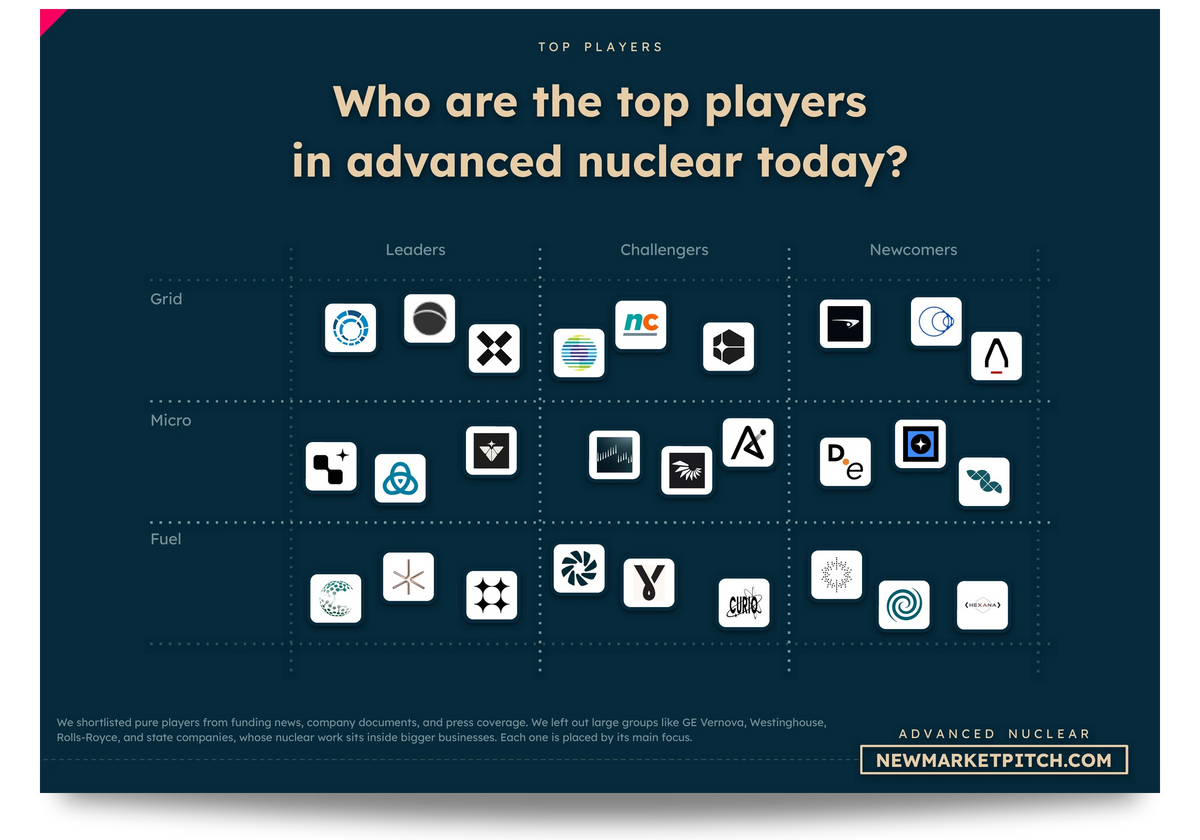
In our document detailing everything you need to know about advanced nuclear, we turn what is vague and complex into simple, useful visuals. Market maps like this one show you at a glance where every startup stands.
So how will advanced nuclear companies make money before reactors scale?
Advanced nuclear companies will mostly make money by selling the work, fuel and hardware needed to turn reactor designs into deployable plants long before large fleets are selling electricity.
X-energy is getting paid for reactor development while building a fuel business. NuScale earns engineering revenue before module sales. Standard Nuclear is shipping TRISO fuel. Kairos gets government support as it builds and learns from Hermes. BWXT and Radiant can sell microreactors into defense programs. Oklo is using customer commitments and prepayments to bring future power demand forward into today's project financing.
Fuel currently looks strongest because the same business can generate revenue before startup and keep generating it once fleets operate. Defense microreactors have also moved sharply up the list now that orders can involve multiple standardized units rather than one experimental reactor. Engineering remains the simplest proven bridge, although the revenue ceiling is much lower.
Government money will continue to carry a large share of first-of-a-kind costs for now. Commercial customers are starting to shoulder more of the burden, especially where access to reliable electricity has become strategically important.
The companies that eventually win should become progressively less dependent on investors as their reactors mature: first development revenue, then fuel and hardware sales, and eventually recurring power, refueling and service revenue.
If development money keeps arriving without progress toward repeat hardware or power sales, the company has found funding rather than a scalable nuclear business.
Our methodology
The central question here is easy to answer badly because advanced nuclear companies sit in an awkward commercial phase: many do not yet have reactors selling electricity, but they are already receiving money from customers and governments. Instead of treating every dollar as equivalent, we broke the question into the main pre-scale business models and looked at what each one is actually proving.
For each model, we prioritized recent, checkable evidence of economic activity: recognized revenue, paid engineering work, physical fuel deliveries, funded contracts, customer prepayments, manufacturing activity, reactor-development milestones and repeat procurement. We gave more weight to things that have already been delivered or contractually funded than to announced gigawatts, options or long-term pipeline.
We also separated revenue from grants, prepayments and financing. A service contract or fuel shipment is commercial revenue; a grant can offset development cost; a customer prepayment can fund a project while remaining a liability; and an equity raise extends runway without creating sales. That distinction is important in a sector where very large headline numbers can sit years away from normal commercial revenue.
The second test was whether the money gets more valuable if reactor deployment succeeds. Fuel, lifecycle engineering, standardized hardware and scarce components can grow with the installed base. One-off demonstration support cannot. That is why some smaller revenue streams can look strategically stronger than larger first-of-a-kind awards.
The companies used throughout the analysis are not meant to be a complete census of advanced nuclear. We selected them because they provide unusually clear evidence for different commercial paths: X-energy and NuScale for engineering, Standard Nuclear for TRISO fuel, Kairos and BWXT for government-backed hardware, Radiant for repeat defense procurement, and Oklo for customer-backed project financing and adjacent isotope activity.
Key sources include X-energy's Q2 2026 results, NuScale's FY2025 results, NuScale's 2025 Form 10-K, Standard Nuclear's Q2 and first-half 2026 results, Standard Nuclear's Q2 2026 Form 10-Q, Oklo's Q2 2026 SEC filing, DOE on Kairos Power's Hermes reactor, the U.S. Department of Defense on Project Pele, Radiant on the Janus Army agreement, DOE on the $2.7 billion uranium-enrichment awards, X-energy on the Amazon deployment program, DOE's Reactor Pilot Program, and Oklo on the Atomic Alchemy acquisition.

Our report covering the advanced nuclear market gets updated several times a month, so you always get the latest view of where things stand.
Written by the New Market Pitch teamWe track new markets so founders and investors can move faster. About us