Small modular reactors: which startup is ahead?
Whether you're building or investing in the advanced nuclear market, our report covers everything you need to know: the players, the money, and what's coming next.
Summary
TerraPower is currently ahead among independent Western small modular reactor startups. Its 345 MW Natrium project received a US nuclear construction permit in March 2026, putting it closer to delivering a commercial-scale advanced reactor than Kairos Power, X-energy, NuScale, or Oklo.
That lead depends on what we measure. TerraPower is ahead in commercial construction, Kairos Power in staged reactor demonstrations, NuScale in approved light-water reactor design, and X-energy in building the fuel infrastructure and customer pipeline needed for a large fleet.
The biggest divide is between regulatory permission and commercial reality. NuScale obtained approval for its 77 MW module design in May 2025, yet its first major US project collapsed over rising costs and insufficient customer commitments. An approved reactor design doesn't guarantee a viable power plant.
Kairos Power could still operate an advanced reactor before TerraPower. Its Hermes program is deliberately smaller, giving the company a chance to test its technology and construction methods before committing to larger commercial projects. Its later Google-backed electricity plans extend beyond the scope of its original test-reactor permits.
X-energy may have the strongest long-term fleet opportunity. Amazon's development program targets at least 5 GW by 2039, Dow is pursuing a four-reactor industrial project, and a further 960 MW development is being explored in Indiana. These are substantial ambitions, but most of that capacity is not yet committed to construction.
Fuel supply could become just as important as reactor design. TerraPower, X-energy, Kairos, and Oklo need advanced nuclear fuel that the United States cannot yet manufacture at sufficient commercial scale. X-energy has responded by building its own TRISO-X fuel factory, giving it a potential advantage over developers relying more heavily on external suppliers.
Industrial heat is an underappreciated part of the market. X-energy's reactors could supply chemical factories with high-temperature steam as well as electricity, creating a customer opportunity that is quite different from selling power to data centers.
Established nuclear companies are further ahead than the startup rankings suggest. GE Vernova Hitachi's BWRX-300 is already progressing through construction in Canada, while China has operated its modular HTR-PM plant commercially since December 2023. Western startups are competing against real construction and operating experience.
NuScale's canceled Idaho project remains the clearest warning. Its estimated $9.3 billion construction cost and $89/MWh target electricity price showed how a project can fail commercially even after years of engineering and regulatory progress. The same economic test awaits today's leaders.
Our ranking is TerraPower first for near-term commercial development, Kairos Power for its demonstration strategy, and X-energy for its fuel manufacturing and multi-market expansion potential. The eventual winner will be the company that can build successive reactors reliably and at lower cost. No independent Western SMR startup has proved it can do that yet.

Written by the New Market Pitch teamWe track new markets so founders and investors can move faster. About us
Why is the small modular reactor race heating up now?
The small modular reactor race has become much more serious because TerraPower, Kairos Power, and X-energy are finally moving from reactor designs to construction, licensing, and real customer projects.
The biggest change happened between 2024 and 2026. TerraPower started site work for its Natrium plant in Wyoming in June 2024 and received a nuclear construction permit in March 2026. Kairos Power began building its first nuclear reactor in 2025 and broke ground on a second demonstration plant in April 2026. X-energy advanced its proposed four-reactor project with Dow in Texas while building a dedicated nuclear fuel factory.
Large electricity buyers have also started making commitments. Google agreed to support up to 500 MW of Kairos Power capacity by 2035, while Amazon partnered with X-energy on a development program targeting at least 5 GW by 2039. Both arrangements go well beyond expressing interest in nuclear power, although the planned capacity is still far from guaranteed.
What would make a startup the leader in small modular reactors?
The leading small modular reactor startup should be the company closest to delivering electricity from a commercial plant that customers can afford to build again. By that measure, TerraPower currently has the strongest position, although the ranking changes when we focus on licensing or experimental reactors.
Consider three companies. NuScale received US Nuclear Regulatory Commission approval for its 77 MW module design in May 2025. That approval covers a standardized reactor design, rather than permission to construct a particular power plant.
TerraPower received a construction permit for its 345 MW Natrium reactor in Wyoming in March 2026. Kairos Power has also secured construction permits, but its Hermes projects are designed to demonstrate a new reactor technology through successive stages.
These achievements tell us different things. NuScale has completed more standardized light-water reactor design review. TerraPower has permission to build a commercial-scale nuclear power plant. Kairos is accumulating physical construction experience through smaller projects.

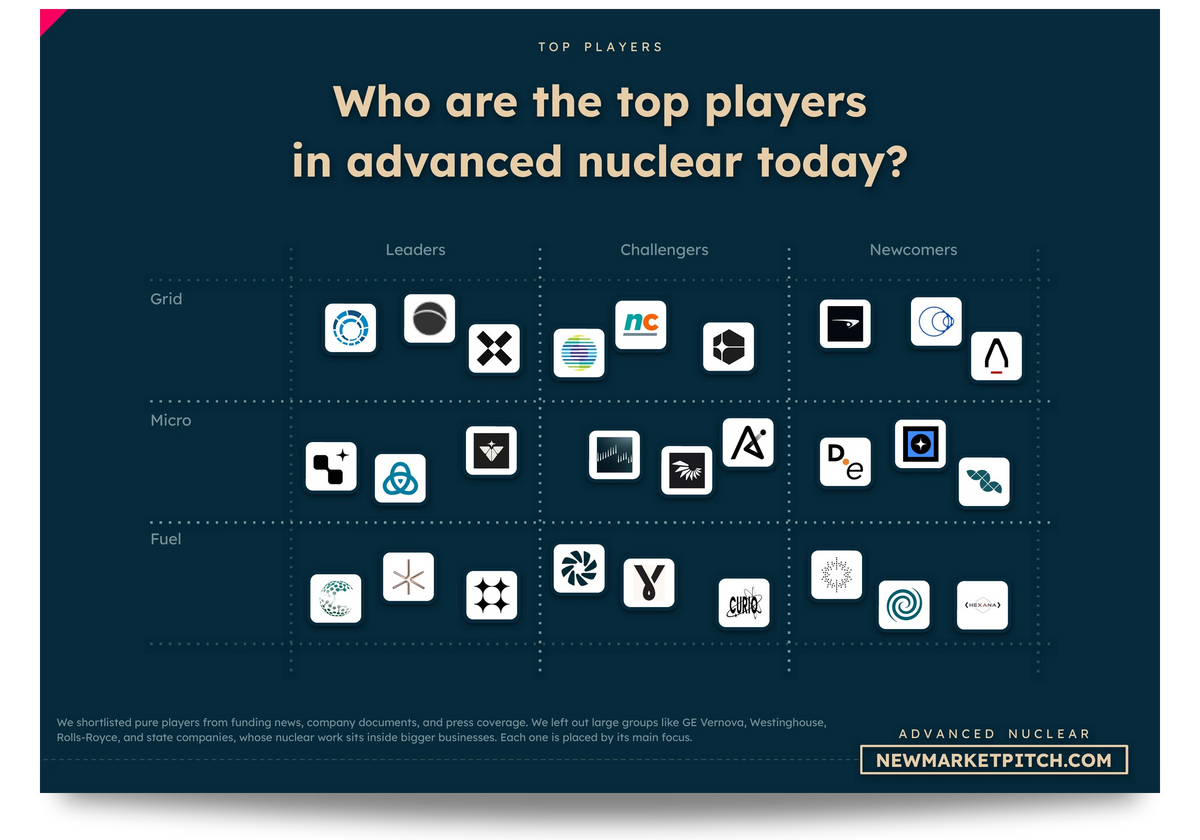
In our report covering the advanced nuclear market, we turn what is vague and complex into simple, useful visuals. Market maps like this one show you at a glance where every startup stands.
Which small modular reactor startups are furthest ahead today?
TerraPower and Kairos Power are currently ahead in advanced reactor construction, NuScale leads in approved light-water reactor design, and X-energy has made impressive progress in nuclear fuel manufacturing.
TerraPower's Natrium project has a commercial construction permit and an active Wyoming construction site. Kairos Power has two successive demonstration projects underway in Tennessee. X-energy has advanced its Dow reactor project through environmental review and is building its first TRISO fuel facility. NuScale has an approved design and a proposed Romanian project, but still lacks an operating or under-construction commercial reactor.
Other competitors deserve attention. Oklo is developing compact fast reactors, although its first Aurora reactor has yet to receive construction authorization. Rolls-Royce SMR has won important government and utility backing in Europe. GE Vernova Hitachi, which benefits from an established nuclear industry parent, is already supporting licensed construction of its BWRX-300 reactor in Canada.
| Company | Reactor | Most important achieved milestone | Current position |
|---|---|---|---|
| TerraPower | Natrium, 345 MWe | Commercial reactor construction permit, March 2026 | Leading commercial construction |
| Kairos Power | KP-FHR | Two demonstration projects permitted; construction underway | Leading staged demonstration |
| NuScale | US460, 77 MWe/module | NRC standard design approval, May 2025 | Leading approved light-water design |
| X-energy | Xe-100, 80 MWe | Dow permit application under review; fuel factory under construction | Strong fuel and customer position |
| Rolls-Royce SMR | 470 MWe PWR | UK selection and Czech deployment agreements | Strong government backing |
| Oklo | Aurora fast reactor | Idaho site development and regulatory preparation | Earlier licensing stage |
| GE Vernova Hitachi | BWRX-300, 300 MWe | Licensed reactor construction underway in Canada | Leading established-industry competitor |
Is TerraPower really the closest startup to a commercial SMR?
TerraPower is currently the strongest contender to deliver a commercial-scale advanced reactor in the United States. Its Natrium project has reached a stage that most competing nuclear startups are still trying to achieve.
The decisive milestone came on March 9, 2026, when the Nuclear Regulatory Commission issued a construction permit for Kemmerer Unit 1 in Wyoming. According to the US Department of Energy, this was the first NRC construction permit for a commercial non-light-water power reactor.
Natrium combines a 345 MW sodium-cooled reactor with molten-salt thermal storage. The storage system is designed to increase electrical output to as much as 500 MW during periods of peak demand. That would give the plant more flexibility than a conventional nuclear reactor operating at a relatively constant output.
TerraPower has also spent years assembling the project. It was selected for the Department of Energy's Advanced Reactor Demonstration Program in 2020, started non-nuclear construction in June 2024, and announced another $650 million financing round in June 2025.
The company expects to apply for an operating license in 2028. Its biggest remaining challenges include completing construction, securing sufficient advanced nuclear fuel, and getting the reactor through testing.
For now, TerraPower has the clearest path from construction permission to a large commercial reactor. That's a real lead, even if the project doesn't arrive on schedule.
If you want more recent data on this point, please see our latest advanced nuclear market report.

Our research about advanced nuclear reactors gets updated several times a month, so you always get the latest view of where things stand.
Could Kairos Power get a working reactor before TerraPower?
Kairos Power could operate an advanced reactor before TerraPower, thanks to its strategy of building smaller reactors and learning from each project before attempting larger deployments.
The company received a construction permit for Hermes 1 in December 2023 and started nuclear construction in 2025. The NRC then approved construction permits for the Hermes 2 project in November 2024. Kairos broke ground on Hermes 2 in April 2026.
There is a useful pattern here. Kairos obtained permission for its second demonstration project before starting nuclear construction on the first. The company has been developing successive reactor designs in parallel rather than waiting for one complete operating cycle before advancing the next.
Hermes 1 is a low-power demonstration reactor intended to test the technology. Hermes 2 is considerably more ambitious. Its original construction permits cover two 35 MW thermal test reactors, while the later agreement with Google and the Tennessee Valley Authority sets out a plan to deliver up to 50 MW of electricity from the Hermes 2 project. That electricity plan requires further regulatory work beyond the original test-reactor authorizations.
TerraPower is building a much larger 345 MW plant, while Kairos is pursuing a series of smaller steps. The schedules could overlap toward the end of the decade, and Kairos may be able to demonstrate its reactor technology sooner.
Is NuScale still leading the SMR industry after its NRC approval?
NuScale leads Western SMR startups in standardized light-water reactor approval, but its commercial position has weakened after losing its flagship US project.
The company secured NRC certification for an earlier 50 MW module in 2023. In May 2025, the regulator approved its larger US460 design, which uses six 77 MW modules to produce a combined 462 MW.
That represents a 54% increase in electrical capacity per module compared with the original design. NuScale made the change partly to improve project economics, allowing customers to generate more electricity from each reactor module.
However, the company suffered a major setback in November 2023 when Utah Associated Municipal Power Systems canceled its Carbon Free Power Project in Idaho. The project had originally been promoted as an important first deployment of NuScale technology.
Attention has since shifted toward Romania. In February 2026, Romanian authorities approved an investment decision with conditions for the proposed Doicești plant. NuScale's SEC filings make clear that financing, engineering contracts, and additional project work are still required before construction can move forward.

In our market report about advanced nuclear reactors, we look at what the winners do differently, so you can learn from the best instead of guessing.
Is X-energy becoming TerraPower's biggest rival?
X-energy is becoming a serious rival to TerraPower because it has developed three things at once: a reactor, an industrial customer project, and a nuclear fuel factory.
Its Xe-100 is an 80 MW high-temperature gas-cooled reactor that can generate electricity and supply industrial heat. That second capability is especially useful for chemical manufacturing, where factories need large amounts of dependable steam.
Dow plans to use four Xe-100 reactors at its Seadrift complex in Texas, with up to 320 MW of electrical capacity. The construction permit application was submitted in March 2025 and accepted for review in May 2025.
A major regulatory step followed in May 2026, when the NRC completed its environmental assessment and found no significant environmental impact. The company is targeting construction authorization in 2027, although the regulator still needs to complete its safety review.
X-energy is also building the TRISO-X fuel manufacturing facility in Oak Ridge. The company reported completing vertical construction of the facility in September 2026, following the award of a 40-year NRC special nuclear material license.
The industrial heat opportunity makes X-energy particularly interesting. Data centers can buy electricity from the grid or contract with other generators, but chemical manufacturers need high-temperature steam that can be difficult to replace with renewable electricity alone.
Dow's proposed Seadrift facility could provide up to 320 MW of electrical capacity or approximately 800 MW of industrial-grade thermal output, depending on the operating configuration. A nuclear reactor supplying both electricity and steam could solve two expensive energy problems for the same customer.
TerraPower's Natrium offers a different advantage through thermal storage, which could allow electricity output to increase when power prices are high. Kairos Power's technology may also support applications beyond electricity, although its first customer-backed project focuses on grid supply.
TerraPower is further ahead with its first commercial reactor. X-energy has invested heavily in the fuel supply and manufacturing infrastructure needed to support multiple future reactors, with an industrial application that gives it access to customers beyond the electricity market.
If you want more recent data on this point, please see our latest advanced nuclear market report.
Which SMR startup has the biggest customer deals?
X-energy has the largest disclosed long-term deployment target among the leading startups, while Kairos Power has secured one of the clearest agreements for electricity from a specific advanced reactor project.
Amazon's October 2024 partnership with X-energy targeted at least 5 GW of nuclear capacity by 2039. That's equivalent to more than 60 Xe-100 reactors rated at 80 MW each. The companies are working with Energy Northwest on initial projects.
The partnership expanded further in October 2026, when X-energy, Amazon, and American Electric Power announced feasibility work on a proposed 12-reactor development in Indiana, representing another 960 MW of potential capacity. That Indiana project forms part of the broader Amazon development program rather than a fully separate commitment.
Google's partnership with Kairos Power targets up to 500 MW by 2035. The companies took an important additional step in August 2025 when Kairos, Google, and the Tennessee Valley Authority announced a power purchase agreement for up to 50 MW from Hermes 2.
The difference is striking: X-energy's original Amazon target is ten times the total capacity covered by Google's Kairos development agreement. But the figures measure proposed capacity, and the biggest programs still require licensing, financing, and construction decisions.
We give particular weight to named projects, identifiable buyers, and signed power arrangements. On that basis, X-energy has the bigger development pipeline, while Kairos has one of the strongest early examples of a project moving toward actual electricity sales.
| Company | Customer or partner | Disclosed capacity | Type of commitment |
|---|---|---|---|
| X-energy | Amazon | At least 5,000 MW targeted | Long-term development program |
| X-energy | Dow | 320 MW | Proposed industrial nuclear plant |
| X-energy | AEP and Amazon | 960 MW | Indiana feasibility project within the wider Amazon program |
| Kairos Power | Up to 500 MW | Multi-plant development agreement | |
| Kairos Power | TVA and Google | Up to 50 MW | Specific power purchase agreement |
| NuScale | RoPower, Romania | 462 MW | Investment decision with conditions |
| NuScale | ENTRA1 and TVA | Potential multi-GW program | Development arrangement, subject to further agreements |

In our document detailing everything you need to know about advanced nuclear, you will always find fresh funding data, taken straight from our own verified funding database.
Could nuclear fuel shortages stop TerraPower or X-energy?
Nuclear fuel shortages remain one of the biggest threats to TerraPower, X-energy, Kairos Power, and Oklo, because their advanced reactors depend on fuel that the United States cannot yet produce at large commercial scale.
Several of these designs use high-assay low-enriched uranium, or HALEU. This generally contains more uranium-235 than the fuel used in conventional commercial reactors, where enrichment levels are typically around 3% to 5%.
For years, Russia was the only established commercial supplier of HALEU at scale. The US Department of Energy has since funded domestic enrichment and fuel manufacturing programs to reduce that dependency.
X-energy has gone further than most competitors in building its own manufacturing infrastructure. Its TRISO-X plant in Tennessee is designed to produce approximately 700,000 fuel pebbles annually, which the company says could support up to 11 Xe-100 reactors. At 80 MW per reactor, that represents 880 MW of reactor capacity.
The factory still depends on access to enriched uranium and successful fuel qualification. X-energy has therefore pursued agreements with enrichment providers including Centrus Energy and General Matter.
TerraPower also receives federal support for advanced fuel availability, while Kairos has been developing its fuel manufacturing capability alongside its demonstration reactors.
X-energy currently has a particularly strong position in fuel fabrication. Whether that becomes a lasting advantage depends on how quickly American enrichment capacity grows and whether competing reactor developers can secure enough fuel for their first plants.
Is Kairos Power's strategy of building smaller reactors actually better?
Kairos Power's smaller-reactor strategy gives it a practical advantage in testing its technology, although we still don't know whether this approach will produce the cheapest commercial nuclear plants.
Rather than immediately constructing a several-hundred-megawatt power station, Kairos has developed non-nuclear testing systems, Hermes 1, and Hermes 2. Each project is intended to answer specific engineering questions before the company commits to larger-scale production.
The company can test molten-salt cooling, component performance, fuel behavior, and construction methods through a sequence of increasingly demanding projects. Problems discovered during one stage can be addressed before a much larger investment is made.
TerraPower has taken a different route. Its first Natrium project targets 345 MW of electrical output, almost seven times the electricity capacity planned for Kairos's later Hermes 2 deployment. A successful TerraPower plant would therefore deliver much more power from a single project.
Kairos can learn from smaller and potentially less expensive projects, but eventually needs to prove that scaling up produces competitive electricity costs. TerraPower is attempting to solve more of those commercial-scale challenges in its first plant. We'd favor Kairos for reducing early technical risk, but TerraPower for testing commercial economics sooner.
If you want more recent data on this point, please see our latest advanced nuclear market report.

Learning from others' mistakes is the cheapest lesson there is. In our report covering the advanced nuclear market, we look at what broke startups before you, so you don't repeat it.
Why did NuScale's first SMR project collapse?
NuScale's first major US project collapsed because its projected electricity costs rose too high and too few customers remained willing to subscribe to the power.
The Carbon Free Power Project was developed with Utah Associated Municipal Power Systems in Idaho. It initially targeted a 12-module plant before shifting toward six larger 77 MW modules.
By 2023, the projected construction cost had increased to approximately $9.3 billion. The target power price reached $89 per megawatt-hour, even after accounting for expected federal financial support.
Those numbers were difficult for participating utilities to accept. UAMPS terminated the project in November 2023 after concluding that it lacked sufficient subscriptions to justify continued development.
The lesson extends beyond NuScale. First-of-a-kind nuclear plants face expensive financing, long construction periods, uncertain component costs, and the possibility of major delays. Customers care about the electricity price that eventually emerges from those conditions.
TerraPower has substantial government backing, X-energy has a large industrial partner in Dow, and Kairos has Google and TVA supporting its early electricity project. These arrangements help explain why the companies have continued progressing despite NuScale's setback.
They still need to prove their economics. The Idaho cancellation is the clearest example of how a technically advanced SMR project can fail before construction because its customers no longer like the numbers.
Which SMR startup could build the most reactors?
X-energy currently has the clearest opportunity to build a large fleet of reactors, although no Western startup has yet proved it can manufacture and deploy SMRs repeatedly at competitive costs.
Its 80 MW Xe-100 can be installed in groups, allowing project developers to adjust the number of reactors to match customer demand. Dow's proposed plant uses four units, while the Indiana project being studied with Amazon and AEP involves 12.
That gives X-energy a recognizable expansion model. The same reactor design could serve chemical plants, utilities, and data centers, potentially creating repeated orders for standardized components and fuel.
Kairos Power is also thinking in terms of fleets. Its agreement with Google covers multiple deployments, and its successive Hermes projects are designed to improve construction methods before the company scales production.
TerraPower's Natrium is much larger at 345 MW. Fewer units would be needed to supply the same amount of electricity, but each site represents a substantial construction project with specialized equipment.
NuScale's approved six-module design offers another approach, using technology closer to familiar light-water reactors. However, its earlier commercial difficulties make it harder to judge how quickly customers will adopt the design.

Your time is limited. In our research about advanced nuclear reactors, we put numbers on each part of the market, so you can see where it makes sense to focus.
Is Oklo falling behind the other SMR startups?
Oklo is currently behind TerraPower, Kairos Power, and X-energy in getting a reactor built, despite attracting attention for its compact nuclear power technology.
The company is developing Aurora fast reactors for customers that need relatively small amounts of continuous electricity. Its potential markets include industrial facilities, remote locations, and data centers.
Oklo's biggest setback came in January 2022, when the NRC denied its first combined license application without prejudice because the submission lacked sufficient technical information. The company subsequently revised its licensing strategy and continued working with the regulator.
Oklo began site-development activities in Idaho in 2025 and has targeted an initial deployment in 2028. However, preparing a site is different from receiving permission to construct and operate a commercial nuclear reactor.
There is still a meaningful opportunity for Oklo. A customer needing a few dozen megawatts may have little interest in financing a 345 MW Natrium plant or a multi-reactor industrial complex. Smaller reactors could serve locations where larger nuclear plants make little sense.
But we wouldn't put Oklo among today's overall leaders. Its smaller size gives it an interesting commercial niche, and the market could be substantial. Its regulatory and construction progress has simply not caught up with the attention the company receives.
If you want more recent data on this point, please see our latest advanced nuclear market report.
Are GE Hitachi and Rolls-Royce already beating the SMR startups?
GE Vernova Hitachi is ahead of most independent SMR startups in getting a conventional small modular reactor built, while Rolls-Royce SMR has become one of Europe's best-positioned nuclear developers.
GE Vernova Hitachi's BWRX-300 is a 300 MW boiling-water reactor based on technology closely related to established nuclear power systems. Ontario Power Generation received a construction license for the first unit at Darlington in April 2025.
The project advanced again in March 2026 when Canadian regulators cleared a regulatory hold point for reactor-building foundation work. Its first unit is targeting commercial operation around the end of 2030.
Darlington benefits from something startups often lack: an experienced utility, an established reactor supplier, and a national nuclear industry already capable of managing complex projects. That makes it an unusually strong competitor in the race to deliver a Western commercial SMR.
Rolls-Royce SMR uses a 470 MW pressurized-water reactor design. It was selected for Britain's government-backed SMR program in 2025 and has also advanced agreements connected to future deployment in Czechia.
The company's industrial background and government support are major strengths, but its first nuclear construction project remains behind Darlington.
These companies change the broader ranking. TerraPower leads our independent startup comparison for commercial advanced reactor construction, while GE Vernova Hitachi has a stronger claim in the established nuclear industry's SMR race.

In our market report about advanced nuclear reactors, we always try to gather several sources and make estimates that make sense, so you can work with solid numbers.
Has China already built the kind of SMR Western startups are promising?
China has already operated a commercial modular high-temperature reactor, giving it a lead in real operating experience that Western SMR startups have yet to match.
The HTR-PM plant at Shidao Bay entered commercial operation in December 2023. It combines two high-temperature gas-cooled reactor modules with one steam turbine.
Construction began in December 2012, and the facility first connected to the grid in 2021. It took roughly 11 years from the start of construction to reach commercial operation. That's a useful reality check on the much shorter timelines being discussed by Western developers.
According to operating data compiled by the World Nuclear Association, Shidao Bay generated approximately 576 GWh of electricity in 2025, compared with roughly 206 GWh in 2024. That is an increase of around 180%, although the figures should be interpreted in the context of commissioning and early commercial operation rather than as a mature long-term performance trend.
Russia also has operational experience with smaller reactors. Its floating Akademik Lomonosov nuclear power plant began commercial operation in May 2020 using two KLT-40S reactors.
China's experience is particularly relevant for X-energy because both technologies involve high-temperature gas-cooled reactors, even though their detailed designs differ.
Which SMR startup has enough money to finish its first reactor?
TerraPower currently has one of the strongest funding positions among independent SMR startups, thanks to substantial private investment and federal support, but none of the major contenders can assume that its first plant will be completed without additional financial pressure.
TerraPower announced a $650 million funding round in June 2025, with participation from investors including NVIDIA's venture capital arm, Bill Gates, and HD Hyundai. The company had already secured significant financing and support through the Department of Energy's Advanced Reactor Demonstration Program.
That backing has helped TerraPower move from reactor development to physical construction. However, a multibillion-dollar nuclear project can still face cost increases as specialized equipment is manufactured and work progresses.
X-energy has benefited from private capital, government support, and major commercial partnerships. In its second-quarter 2026 financial results, it reported approximately $54.6 million in combined revenue and grant income, compared with $21.5 million a year earlier.
That represents growth of roughly 154%. The distinction is that part of the amount came from grants, and the company is still developing reactors rather than selling electricity from operating plants.
NuScale has raised capital through public markets, while Kairos Power's private financial disclosures provide less detail about its available resources. Both companies still face large future construction and development costs.

If you build or invest in the advanced nuclear market, you need to know which business models pay off now and which ones are fading. That's why our report covering it has a whole section on it.
What could change the SMR startup rankings over the next few years?
The SMR rankings could change quickly if Kairos Power starts operating its demonstration reactors, X-energy receives construction approval for Dow's plant, or TerraPower encounters major delays at Natrium.
For TerraPower, the immediate tests are continued nuclear construction in Wyoming, access to advanced fuel, and the operating license application planned for 2028. A successful first reactor would reinforce its leadership considerably.
Kairos has a different opportunity. Hermes 1 and Hermes 2 could provide operating evidence that other startups still lack. Successful testing would help establish whether its reactor design can perform as intended before the company commits to a wider commercial fleet.
X-energy needs to secure construction authorization for the Dow project and move its fuel factory into production. Those two achievements would show that the company can support both reactor construction and the fuel supply needed for future plants.
NuScale must convert Romania's conditional investment decision into financing and construction. Oklo needs to move through the licensing process for Aurora, while Rolls-Royce SMR must turn government and utility agreements into an actual nuclear construction project.
There is also a meaningful external benchmark: GE Vernova Hitachi's Darlington project in Canada. If it commissions its first BWRX-300 around the end of the decade, independent startups will face an established-industry competitor with operational evidence.
| Company | Next major milestone | What it would prove |
|---|---|---|
| TerraPower | Continued construction and operating license application | Commercial-scale delivery progress |
| Kairos Power | Hermes 1 operation and Hermes 2 progress | Real-world reactor performance |
| X-energy | Dow construction permit and fuel production | Ability to connect reactors and fuel supply |
| NuScale | Financed Romanian construction | Commercial viability after the Idaho cancellation |
| Oklo | Construction authorization for Aurora | Progress beyond site preparation |
| Rolls-Royce SMR | First authorized nuclear construction | Delivery beyond government selection |
| GE Vernova Hitachi | Darlington commissioning | First commercial Western BWRX-300 operation |
So, which small modular reactor startup is ahead right now?
TerraPower is currently the leading independent Western SMR startup in commercial-scale reactor development. Kairos Power is its strongest challenger in reactor demonstration, while X-energy looks particularly well positioned to build a larger industrial nuclear business.
TerraPower deserves first place because it has already secured construction authorization for a 345 MW advanced reactor in Wyoming. Its project has an identified site, substantial funding, government support, and a clear path toward operating license review.
Kairos Power is a close competitor, but its advantage is different. By building successive Hermes reactors, the company may gain valuable operating experience before TerraPower's larger plant is ready. If those demonstrations work and Natrium suffers serious delays, the ranking could change.
X-energy has built an impressive combination of industrial customer relationships, proposed multi-reactor projects, and dedicated fuel manufacturing. Its partnership with Dow gives it a clear application beyond ordinary electricity sales, while Amazon's involvement creates the possibility of a much larger fleet.
NuScale remains the leader in standardized light-water reactor design approval, but its canceled US project and unfinished commercial deployment plans hold it back. Oklo has potential in smaller nuclear applications but is behind in reactor licensing. Outside the independent startup category, GE Vernova Hitachi is already supporting commercial SMR construction in Canada, while China has demonstrated actual operation of modular nuclear reactors.
We therefore rank TerraPower first for its progress toward a commercial-scale plant, Kairos Power first for its staged reactor demonstration program, and X-energy first for its combination of fuel manufacturing and multi-market deployment opportunities.
The overall winner will be the company that can build a second reactor more cheaply and predictably than its first. TerraPower has earned the lead today, but nobody has yet proved that part of the business.
If you want more recent data on this point, please see our latest advanced nuclear market report.

In our report covering the advanced nuclear market, we don't want to repeat what boring consulting reports say. Instead, we show you the real and latest market signals that matter.
Our methodology
This analysis examines which small modular reactor startup is furthest ahead as of October 2026. We compare TerraPower, Kairos Power, X-energy, NuScale, Oklo, and other significant developers using regulatory progress, actual construction, operating experience, commercial partnerships, funding, nuclear fuel availability, and manufacturing readiness.
We place the greatest weight on achieved milestones that bring a company closer to producing commercial electricity. A construction permit carries more weight than a permit application, and a physical reactor project carries more weight than an announced development target. We also distinguish design approval from authorization to construct or operate a particular plant.
Our comparison separates independent startups from established nuclear reactor suppliers. TerraPower, Kairos Power, X-energy, NuScale, and Oklo form the core startup comparison. GE Vernova Hitachi and Rolls-Royce SMR provide industrial benchmarks, while China's HTR-PM and Russia's Akademik Lomonosov provide evidence of operational experience outside the Western startup market.
We evaluated customer agreements according to how far they have progressed. Broad capacity targets, feasibility studies, named development projects, and power purchase agreements are treated differently. The analysis also distinguishes the original NRC authorization for Kairos Power's two low-power Hermes 2 test reactors from the subsequent 50 MW electricity project announced with Google and TVA.
We assessed commercial readiness through more than project schedules. Fuel manufacturing, access to HALEU, financial backing, industrial heat applications, and construction costs can all determine whether an authorized project becomes an operating plant. NuScale's canceled Idaho project is particularly important because it demonstrates how rising costs and weak customer participation can stop a reactor project before construction.
Our ranking is an evidence-weighted editorial judgment rather than a mechanical score. TerraPower leads because of its commercial reactor construction authorization, Kairos Power because of its step-by-step demonstration program, and X-energy because of its combination of reactor development, fuel manufacturing, and customer partnerships. These are distinct advantages, and the ranking can change as new milestones are achieved.
Key regulatory sources include the US Nuclear Regulatory Commission's March 2026 TerraPower construction permit announcement, the US Department of Energy's explanation of Natrium's regulatory significance, the NRC's records for Kairos Power's Hermes 1 and Hermes 2 projects, the NuScale US460 design approval, the X-energy and Dow licensing record, and the Oklo Aurora licensing record.
For construction, commercial agreements, and fuel supply, we used the Canadian Nuclear Safety Commission's Darlington project records, the UK government's Rolls-Royce SMR selection announcement, Google's Kairos Power and TVA electricity agreement, AEP's October 2026 Indiana project announcement, X-energy's TRISO-X construction update, the Department of Energy's HALEU Availability Program, and X-energy's second-quarter 2026 financial results.
Historical operating evidence comes from the World Nuclear Association's reactor records for China's Shidao Bay HTR-PM and Russia's Akademik Lomonosov. We also used NuScale and UAMPS's original Idaho project termination announcement to assess the commercial risks facing first-of-a-kind reactors.

In our research about advanced nuclear reactors, we like to show you the big picture. We know your time is precious, so we make every page quick to read and packed with as much learning as possible per minute.
Written by the New Market Pitch teamWe track new markets so founders and investors can move faster. About us