What’s the latest funding news in the AI accounting market? (October 2026)
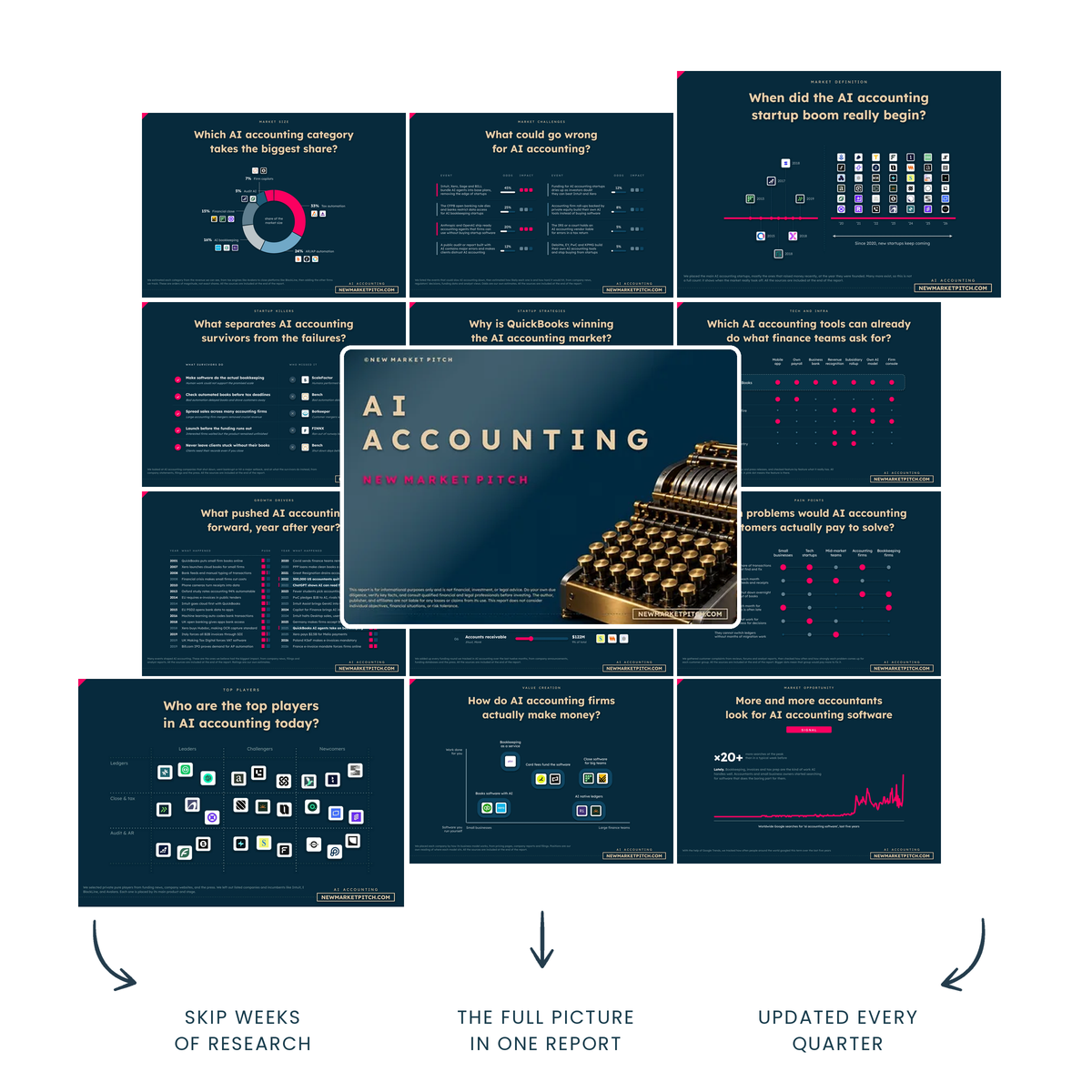
Whether you're building or investing in the AI accounting market, our report covers everything you need to know: the players, the money, and what's coming next.
As of October 2026, the 12 AI accounting funding rounds covered here represent approximately $216 million in disclosed financing, with announcements spanning April to October 2026.
From autonomous bookkeeping to AI-powered financial close, investors are backing companies that perform accounting tasks rather than simply display financial data.
The market now includes early-stage European startups, specialized accounting agents and larger US platforms, although a few companies have broader financial software businesses.
And if you want to better understand this new industry, you can download our pitch covering the AI accounting market.
Insights
- The 12 AI accounting funding rounds total approximately $216 million, but the distribution is uneven. Rillet's $100 million Series C alone accounts for about 46% of the capital identified in this selection.
- Eight of the 12 companies raised seed or pre-seed rounds, yet those financings represent only about 16% of the disclosed capital. Larger accounting platforms attract much bigger checks once commercial adoption becomes visible.
- Europe accounts for five companies, spanning Italy, Poland, Germany and the Netherlands. Several startups are designing AI bookkeeping around local tax rules and accounting obligations rather than launching a single universal product.
- AI accounting does not always mean removing accountants. Computis, Integral and Neno combine automation with professional services, reflecting the continued need for human oversight in tax filings and regulated financial work.
- Vertical accounting is becoming a distinct investment opportunity. Adaptive focuses on construction job costing, while Ambrook serves agriculture and other physical industries, although Ambrook's AI-native positioning remains less clearly established.
- The AI accounting market includes very different products. Rillet develops a general ledger that records transactions continuously, whereas Quillon focuses on technical accounting memos and auditable financial reporting decisions.
- AI bookkeeping agents are also reaching existing accounting practices. OCTA Flow targets firms managing multiple SME clients, while autoMEE automates finance-document workflows, although both require further company-level market concentration checks.
- Only Rillet has a disclosed valuation in this group, at $1 billion. That leaves limited evidence for comparing valuations across AI accounting startups, even when their announced financing rounds are substantial.

Written by the New Market Pitch teamWe track new markets so founders and investors can move faster. About us

In our report covering the AI accounting market, you will always find fresh funding data, taken straight from our own verified funding database.
Summary table of the latest funding deals in the AI accounting market as of October 2026
We define the AI accounting market as AI products that automate or assist accounting and financial recordkeeping.
We include AI-native bookkeeping, reconciliation, financial close and accounting-workflow platforms.
We exclude general budgeting tools, payment processing and conventional accounting software without substantive AI automation.
The table covers the 12 financing announcements provided for this research, ordered from newest to oldest, with rounded US dollar equivalents for rounds originally disclosed in euros or Polish złoty.
| Name | When | Amount in $ | Round Type | Category |
|---|---|---|---|---|
| Computis | October 1, 2026 | $2.3M | Pre-seed | AI Bookkeeping & Reconciliation |
| autoMEE | October 1, 2026 | $2.7M | Seed | AI Accounting Workflow Automation |
| mika | September 23, 2026 | $7M | Seed | AI Bookkeeping & Tax Accounting |
| Adaptive | September 17, 2026 | $30M | Series B | Construction Accounting Automation |
| OCTA | September 17, 2026 | $3.5M | Seed | AI Accounting Agents & Financial Close |
| Integral | September 16, 2026 | $20.6M | Series A | AI accounting & Tax Services |
| Neno | August 25, 2026 | $7.6M | Seed | AI Bookkeeping & Financial Administration |
| Rillet | August 17, 2026 | $100M | Series C | AI General Ledger & Accounting ERP |
| Ambrook | August 3, 2026 | $30M | Series B | Vertical Bookkeeping & Financial Operations |
| Synthetic | May 14, 2026 | $10M | Seed | Autonomous AI Bookkeeping |
| Jupid | April 30, 2026 | $0.84M | Pre-seed | Embedded AI accounting for Small Businesses |
| Quillon | April 24, 2026 | $1.5M | Pre-seed | Technical Accounting & Financial Reporting AI |
These are identified funding announcements, not a verified census of every AI accounting investment worldwide. Ambrook is a borderline market match, while OCTA and autoMEE have broader business activities that make their accounting revenue concentration uncertain.
All the latest funding deals in the AI accounting market as of October 2026
Computis raised approximately $2.3 million in pre-seed funding in October 2026 to expand AI-powered accounting for Italian SMEs.
When was it?
Computis announced its funding on October 1, 2026.
Who are they?
Computis combines AI bookkeeping software with human accountants to process invoices, collect documents, reconcile bank transactions and maintain financial records for small businesses.
Geographical focus?
Based in Milan, Computis currently focuses on Italian SMEs and their local accounting and tax requirements.
Why do we include them in the AI accounting market?
Computis directly fits the AI bookkeeping category because its platform automates accounting entries, document processing and reconciliation while professionals review the results.
What is the company stage?
Computis is at the pre-seed and early commercialization stage, with its accounting platform already serving businesses and further product development underway.
How much did they raise?
Computis secured €2 million, equivalent to approximately $2.3 million, led by Techshop Capital.
What round is it?
Computis completed a pre-seed financing round involving Techshop Capital and several European venture investors.
Why did they raise?
Computis raised the capital to improve accounting automation, hire additional professionals, acquire SME customers and expand its accountant-partner network.
autoMEE raised approximately $2.7 million in seed funding in October 2026 to develop AI accounting automation.
When was it?
autoMEE's PLN 10 million financing was reported on October 1, 2026.
Who are they?
autoMEE develops flowMEE, an AI platform that processes invoices, creates accounting entries, reconciles transactions and automates financial-document workflows.
Geographical focus?
Headquartered in Gdańsk, autoMEE initially targets Polish businesses, internal finance departments and accounting firms.
Why do we include them in the AI accounting market?
autoMEE's flowMEE product directly automates bookkeeping and accounting workflows, although the company's broader historical activities make its overall market concentration less certain.
What is the company stage?
autoMEE is a seed-stage company with a commercial finance automation platform and an expanding team.
How much did they raise?
autoMEE raised PLN 10 million, equivalent to approximately $2.7 million, from Level2 Ventures and business angels.
What round is it?
autoMEE completed a seed funding round led by Level2 Ventures.
Why did they raise?
autoMEE raised funding to develop flowMEE, improve accounting-document automation and introduce more current financial reporting through its RZiS live product.

In our research about AI accounting tools, we turn what is vague and complex into simple, useful visuals. Market maps like this one show you at a glance where every startup stands.
mika raised approximately $7 million in seed funding in September 2026 to expand AI-native bookkeeping and tax accounting.
When was it?
mika announced its financing on September 23, 2026.
Who are they?
mika provides AI-powered bookkeeping, VAT declarations, annual accounts and tax preparation for German small businesses.
Geographical focus?
Based in Berlin, mika focuses on Germany, particularly small incorporated businesses operating as GmbHs and UGs.
Why do we include them in the AI accounting market?
mika belongs to AI-native accounting services because automated bookkeeping and statutory financial reporting form the center of its offering.
What is the company stage?
mika is in early commercial growth, with more than 750 businesses using its services when the round was announced.
How much did they raise?
mika secured €6 million, equivalent to approximately $7 million, in new financing.
What round is it?
mika completed a seed round led by Smedvig Ventures, with participation from existing investors and business angels.
Why did they raise?
mika raised capital to attract more German SME customers and develop its AI-native infrastructure across bookkeeping, taxation and financial administration.
Adaptive raised $30 million in Series B funding in September 2026 to develop AI accounting agents for construction companies.
When was it?
Adaptive announced its Series B on September 17, 2026.
Who are they?
Adaptive builds AI project accountants that automate invoice coding, job costing, work-in-progress reporting, billing and reconciliations for construction businesses.
Geographical focus?
Headquartered in New York, Adaptive primarily serves the US construction industry and accounting firms working with contractors.
Why do we include them in the AI accounting market?
Adaptive is a direct vertical accounting match because its AI agents perform construction-specific accounting tasks using project and financial data.
What is the company stage?
Adaptive is in its growth stage, with more than 750 construction companies reported as customers at the funding announcement.
How much did they raise?
Adaptive raised $30 million, bringing its total reported financing to approximately $57 million.
What round is it?
Adaptive completed a Series B led by Tidemark, with participation from Andreessen Horowitz, Emergence Capital and other investors.
Why did they raise?
Adaptive raised the capital to expand its Project Accounting Agents across job costing, accounts payable, billing, payments and construction compliance.

Your time is limited. In our market report about AI accounting tools, we put numbers on each part of the market, so you can see where it makes sense to focus.
OCTA raised $3.5 million in seed funding in September 2026 to expand AI agents for accounting firms.
When was it?
OCTA announced its seed financing on September 17, 2026.
Who are they?
OCTA develops OCTA Flow, a platform where AI agents perform bookkeeping, bank reconciliation and month-end close tasks for accounting practices.
Geographical focus?
OCTA operates across the UAE and Saudi Arabia and is expanding toward the United States.
Why do we include them in the AI accounting market?
OCTA Flow directly addresses AI accounting automation, although OCTA's earlier receivables and payables activities make its company-wide accounting concentration uncertain.
What is the company stage?
OCTA is in seed-stage commercialization, with more than 520 accounting firms reportedly signing up for access to OCTA Flow.
How much did they raise?
OCTA secured $3.5 million, bringing its reported total funding to approximately $5.6 million.
What round is it?
OCTA completed a seed round led by Middle East Venture Partners, alongside Wa'ed Ventures, Plug and Play and other investors.
Why did they raise?
OCTA raised funding to develop more sophisticated accounting agents, automate additional monthly workflows and expand internationally, particularly in the US.
Integral raised approximately $20.6 million in Series A funding in September 2026 to scale AI-native accounting services.
When was it?
Integral announced its financing on September 16, 2026.
Who are they?
Integral combines AI agents with licensed accounting and tax professionals to deliver bookkeeping, payroll, accounting and tax services for German SMEs.
Geographical focus?
Based in Berlin, Integral currently focuses on Germany, where local accounting and tax obligations shape its service model.
Why do we include them in the AI accounting market?
Integral belongs to the AI accounting services category because its agents prepare accounting work that qualified professionals review and approve.
What is the company stage?
Integral is in its commercial growth stage, with a functioning AI-enabled accounting service and hundreds of business customers.
How much did they raise?
Integral secured €18 million, equivalent to approximately $20.6 million, bringing its cumulative funding above €30 million.
What round is it?
Integral completed a Series A co-led by Mosaic Ventures and Reid Hoffman, with participation from existing investors.
Why did they raise?
Integral raised the capital to develop its proprietary AI agents, automate more accounting and tax workflows, and expand its professional and commercial teams.

In our document detailing everything you need to know about AI accounting, we always try to gather several sources and make estimates that make sense, so you can work with solid numbers.
Neno raised approximately $7.6 million in seed funding in August 2026 to expand AI-native accounting services across Europe.
When was it?
Neno announced its funding on August 25, 2026.
Who are they?
Neno combines AI-powered bookkeeping, transaction reconciliation, payroll and tax administration into an integrated financial service for small businesses.
Geographical focus?
Headquartered in Amsterdam, Neno initially serves Dutch SMEs and plans to expand into additional European countries.
Why do we include them in the AI accounting market?
Neno directly fits AI bookkeeping and accounting services because automated recordkeeping and financial administration are central to its customer offering.
What is the company stage?
Neno is in early commercial growth, with nearly 200 customers reported following its launch in the Netherlands.
How much did they raise?
Neno raised €6.6 million, equivalent to approximately $7.6 million, from AlleyCorp and other investors.
What round is it?
Neno completed a seed funding round led by AlleyCorp, with participation from Motive Partners and firstminute capital.
Why did they raise?
Neno raised capital to establish Neno Labs, improve background accounting automation, hire accounting professionals and prepare for European expansion.
Rillet raised $100 million in Series C funding in August 2026, reaching a $1 billion valuation.
When was it?
Rillet's company announcement was dated August 17, 2026, with major technology publications reporting the financing over the following two days.
Who are they?
Rillet develops an AI-native accounting ERP with a real-time general ledger that records transactions, automates accounting work and supports faster financial closes.
Geographical focus?
Based in San Francisco, Rillet targets modern corporate finance teams, including businesses with complex accounting operations.
Why do we include them in the AI accounting market?
Rillet is a direct AI accounting platform because its general ledger and accounting agents automate the core financial recording and closing processes.
What is the company stage?
Rillet is in rapid commercial growth, with more than 600 customers and a reported acceleration in recurring revenue.
How much did they raise?
Rillet raised $100 million at a reported $1 billion valuation, bringing cumulative financing above $200 million.
What round is it?
Rillet completed a Series C led by ICONIQ, with participation from Sequoia, Andreessen Horowitz and other investors.
Why did they raise?
Rillet raised capital to develop advanced accounting AI agents that can perform finance tasks within its real-time ledger while preserving approvals and audit trails.

Our report covering the AI accounting market gets updated several times a month, so you always get the latest view of where things stand.
Ambrook raised $30 million in Series B funding in August 2026 to expand accounting tools for physical industries.
When was it?
Ambrook announced its financing on August 3, 2026.
Who are they?
Ambrook provides bookkeeping, expense tracking, profitability analysis and financial operations software for farms, ranches and other independent businesses.
Geographical focus?
Ambrook operates in the United States, serving agriculture, trucking, construction and other asset-intensive industries.
Why do we include them in the AI accounting market?
Ambrook is included as a borderline vertical accounting candidate because it automates financial recordkeeping, although the extent of its AI-native accounting activity is not fully verified.
What is the company stage?
Ambrook is in its growth stage, with approximately 8,000 businesses reportedly using its platform at the funding announcement.
How much did they raise?
Ambrook secured $30 million, bringing its reported total financing to approximately $59 million.
What round is it?
Ambrook completed a Series B led by Lachy Groom, with participation from Thrive Capital, Thomson Reuters Ventures and other investors.
Why did they raise?
Ambrook raised funding to expand its financial software beyond agriculture and improve accounting automation, payments and cash management for independent operators.
Synthetic raised $10 million in seed funding in May 2026 to develop an autonomous AI bookkeeper for startups.
When was it?
Synthetic's funding was announced on May 14, 2026.
Who are they?
Synthetic is developing an AI bookkeeper that connects to banking, billing, payroll and other business systems to prepare accrual-based financial records automatically.
Geographical focus?
Headquartered in San Francisco, Synthetic initially targets startups and technology businesses, especially those operating in the United States.
Why do we include them in the AI accounting market?
Synthetic is a strong pure-player match because autonomous bookkeeping and the preparation of accounting records form its core product vision.
What is the company stage?
Synthetic was at the pre-product development stage when the financing was announced, with its autonomous accounting system still being designed.
How much did they raise?
Synthetic raised $10 million in financing led by Khosla Ventures.
What round is it?
Synthetic completed a seed round with backing from Khosla Ventures, Basis Set Ventures and several technology founders.
Why did they raise?
Synthetic raised funding to develop and commercialize an autonomous bookkeeping product intended to reduce repetitive accounting work for startups.

In our research about AI accounting tools, we look at what the winners do differently, so you can learn from the best instead of guessing.
Jupid raised $840,000 in pre-seed funding in April 2026 to expand AI accounting for small businesses.
When was it?
Jupid announced its financing on April 30, 2026.
Who are they?
Jupid develops an AI accountant that automates bookkeeping, financial administration and tax-related tasks for small businesses, including through digital banking integrations.
Geographical focus?
Based in Santa Monica, Jupid focuses on US microbusinesses and financial institutions serving small business customers.
Why do we include them in the AI accounting market?
Jupid directly fits embedded AI accounting because its platform automates bookkeeping and related financial recordkeeping within small business workflows.
What is the company stage?
Jupid is at the pre-seed and early commercialization stage, with banking integrations and initial commercial deployments underway.
How much did they raise?
Jupid secured $840,000, equivalent to $0.84 million, to develop and distribute its AI accounting technology.
What round is it?
Jupid completed a pre-seed round led by Pre-Seed to Succeed, with participation from Michigan State University Research Foundation.
Why did they raise?
Jupid raised capital to improve its AI bookkeeper, connect more financial systems and distribute accounting automation through banks and FinTech platforms.
Quillon raised $1.5 million in pre-seed funding in April 2026 to develop AI for technical accounting and financial reporting.
When was it?
Quillon's financing was reported on April 24, 2026, with additional coverage published in early May.
Who are they?
Quillon develops AI software that researches accounting standards, drafts technical accounting memos and supports the preparation of auditable financial statements.
Geographical focus?
Quillon operates between Sofia and San Francisco and focuses on accountants working with US financial reporting standards.
Why do we include them in the AI accounting market?
Quillon belongs to the technical accounting and financial reporting category because its AI assists with accounting judgments, documentation and audit-ready reporting rather than routine bookkeeping.
What is the company stage?
Quillon is in early commercialization, with more than 500 accountants reportedly using its platform across businesses and professional firms.
How much did they raise?
Quillon secured $1.5 million from 42CAP and angel investors affiliated with major technology companies.
What round is it?
Quillon completed a pre-seed financing round led by Munich-based 42CAP.
Why did they raise?
Quillon raised capital to expand its engineering team, improve AI-assisted technical accounting research and reach more US companies and auditors.
Written by the New Market Pitch teamWe track new markets so founders and investors can move faster. About us