How big is the AI accounting market with fewer accountants?
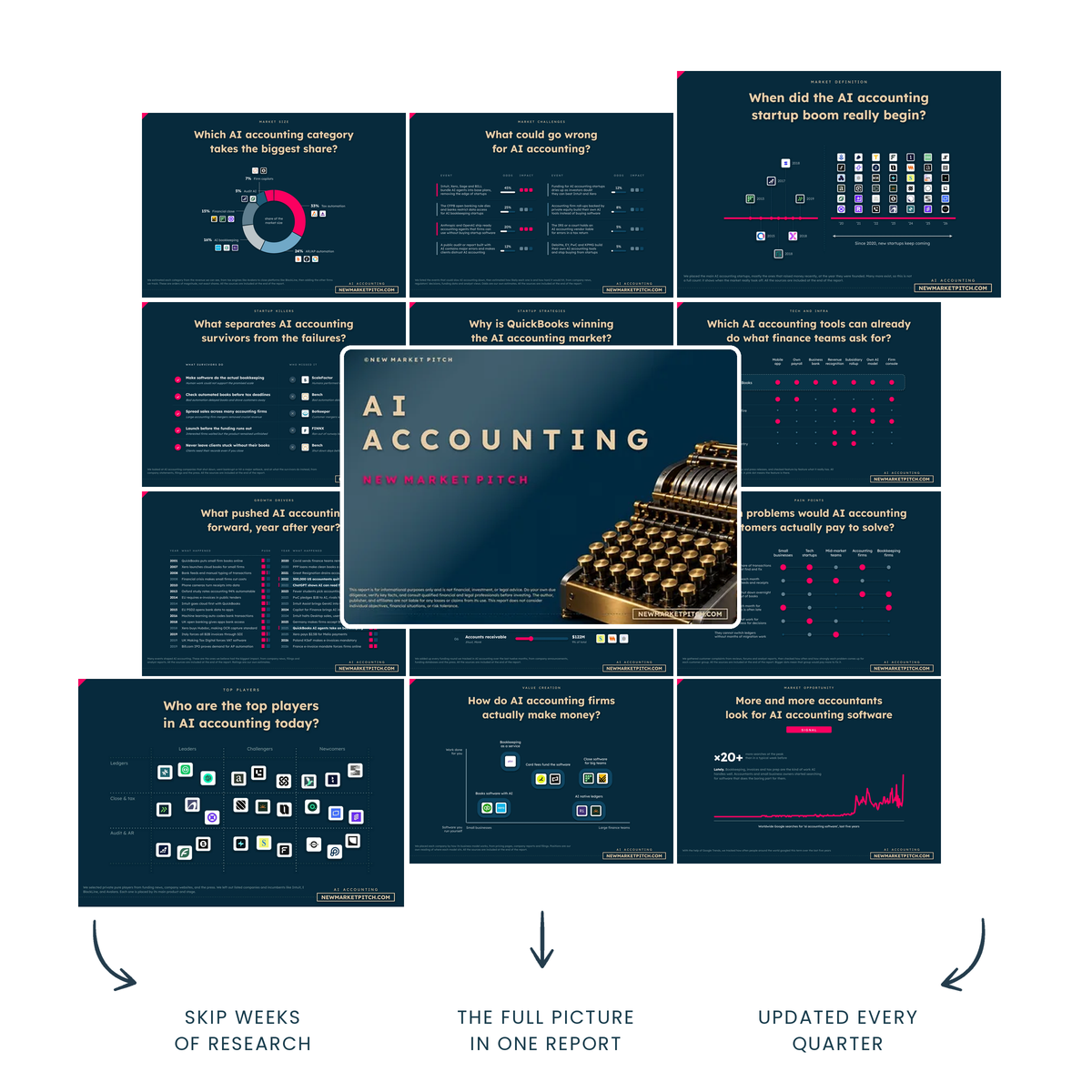
Whether you're building or investing in the AI accounting market, our report covers everything you need to know: the players, the money, and what's coming next.
Summary
The AI accounting market could reach $10 billion to $20 billion in annual global software revenue by 2030, even as companies employ fewer bookkeeping workers. The opportunity comes from automating financial work and replacing existing accounting systems, although revenue generated specifically by AI remains difficult to measure today.
The underlying market is already substantial. Intuit generated $5.05 billion in QuickBooks Online Accounting revenue in fiscal 2026, while Sage reported £2.08 billion in Sage Business Cloud revenue in fiscal 2025. The United States also has a $208.8 billion accounting, tax, bookkeeping, and payroll-services industry, giving automation vendors a much larger pool of labor-intensive spending to pursue.
The accountant shortage is more complicated than the headlines suggest. U.S. accounting degrees fell 6.6% in 2023–2024, but undergraduate enrollment has started recovering. Meanwhile, the Bureau of Labor Statistics expects bookkeeping clerk employment to decline 6% by 2035 while demand for qualified accountants and auditors continues growing.
The immediate employment effect may be fewer new hires rather than mass layoffs. Accounting departments can process more transactions without expanding their teams proportionately, especially as software takes over classification, reconciliations, and routine reporting. That productivity improvement can be significant even when the total number of accountants barely changes.
The economics are already interesting at modest automation levels. Avoiding the equivalent of 100,000 bookkeeping positions would represent approximately $5.07 billion in annual base-wage savings in the United States. If software vendors captured 20% of those hypothetical savings, they would generate roughly $1 billion annually, before considering other sources of value.
Accounting firms are adopting AI considerably faster than they are automating entire workflows. Thomson Reuters found that 81% of tax and audit professionals used AI at least several times a week in 2026, but much of that activity still involves research, drafting, and assistance rather than autonomous financial processing.
AI-native startups are gaining customers, though their revenue is still largely undisclosed. Rillet reached more than 600 customers and raised $100 million at a $1 billion valuation in August 2026. Numeric raised $51 million in November 2025 to expand financial-close automation. Neither provides enough public revenue information to establish the overall size of the AI-native segment.
The competitive divide is emerging between startups replacing the accounting system itself and companies automating work around existing software. Rillet is pursuing core financial infrastructure, while Numeric concentrates on financial-close workflows. The former can command larger contracts; the latter can avoid the disruption of replacing an established ERP.
Fewer accountants do not necessarily mean less software revenue. Vendors relying on employee-seat licenses could suffer as accounting teams shrink, while companies charging by transaction volume, workflow, or business activity can grow even when their customers employ fewer people.
The biggest constraint is trust. Financial statements, revenue recognition, tax obligations, and audit evidence cannot tolerate the same error rates as low-stakes AI applications. Products that reduce work after human review, rather than simply moving the checking burden onto accountants, have the stronger commercial case.
The $10 billion to $20 billion opportunity is most credible when AI-enabled functionality inside existing platforms is counted alongside AI-native software. A market made entirely of incremental AI-agent subscriptions would need much stronger evidence of spending and retention. The eventual winners will be the companies that capture a meaningful share of the savings from automated work or displace the financial software businesses already collecting billions.

Written by the New Market Pitch teamWe track new markets so founders and investors can move faster. About us
Is AI accounting taking off because companies cannot find enough accountants?
AI accounting is gaining ground because companies want to get more financial work done with smaller teams, and the shortage of qualified accountants makes that proposition especially attractive.
The American Institute of CPAs (AICPA) reported 55,152 accounting bachelor's and master's degrees awarded in the 2023–2024 academic year, down 6.6% from the previous year. Meanwhile, the U.S. Bureau of Labor Statistics expects bookkeeping, accounting, and auditing clerk employment to fall 6% between 2025 and 2035, equivalent to approximately 85,600 jobs.
At the same time, businesses still need financial reporting, tax compliance, reconciliations, and audits. Those obligations are not disappearing. Software companies are trying to complete more of the underlying work automatically.
Rillet provides a useful example. The AI-native accounting company raised $100 million at a $1 billion valuation in August 2026, after reaching more than 600 customers. Numeric, which automates financial close processes, raised $51 million in November 2025. Both are selling software that reduces the amount of manual work accounting teams must perform.
The opportunity becomes particularly attractive when transaction volumes increase faster than headcount. An accounting department may handle twice as many invoices or financial records without needing twice as many employees.
How big is the AI accounting market today?
AI accounting is already part of a multibillion-dollar software business, but the revenue generated specifically by AI accounting products is still too poorly disclosed to measure accurately.
We can establish the scale of the underlying market from public financial statements. Intuit reported $5.05 billion in QuickBooks Online Accounting revenue for fiscal 2026, up 23% from $4.12 billion in fiscal 2025. Its wider Online Ecosystem, including related services, generated $9.92 billion. Sage reported £2.08 billion in Sage Business Cloud revenue for fiscal 2025.
Those figures demonstrate how much businesses already spend on accounting and financial software. They cannot be counted entirely as AI revenue because the products include traditional accounting functions, payments, payroll, and other services.
The professional services market is considerably larger. According to the U.S. Census Bureau's 2022 Economic Census, American establishments providing accounting, tax preparation, bookkeeping, and payroll services generated approximately $208.8 billion in revenue.
That spending gives AI vendors two opportunities. They can replace existing accounting software, or they can automate work that companies currently pay accountants and bookkeeping firms to perform.
The second opportunity potentially opens a much larger pool of spending. However, professional-service revenue includes salaries, expertise, regulatory responsibility, and client relationships that cannot simply be converted into software subscriptions.
For now, the evidence supports a large existing accounting software market and a much smaller, rapidly developing AI-native segment. There is no sufficiently reliable public dataset to assign the latter a precise global revenue figure.

Your time is limited. In our report covering the AI accounting market, we put numbers on each part of the market, so you can see where it makes sense to focus.
Are there actually fewer accountants, or is the shortage exaggerated?
The shortage of accountants is real, particularly among experienced professionals, but the latest education figures suggest the supply of new accountants may be starting to recover.
The AICPA's 2025 Trends Report showed accounting degrees declining for several consecutive years. The 6.6% fall in 2023–2024 followed drops of 9.6% and 7.4% in the preceding academic years.
The more encouraging development is that undergraduate accounting enrollment increased 11.3% in fall 2024 and another 7.3% in fall 2025, according to National Student Clearinghouse figures cited by the AICPA.
There is also a major difference between bookkeeping clerks and qualified accountants. The Bureau of Labor Statistics projects declining employment for bookkeeping, accounting, and auditing clerks, while its earlier projections anticipate 5% employment growth for accountants and auditors from 2024 to 2034.
AI adoption and professional hiring can therefore increase simultaneously. Companies may need fewer people entering routine transactions while still competing to recruit experienced accountants who understand complex financial reporting.
The latest BLS projections also anticipate approximately 144,100 annual openings for bookkeeping, accounting, and auditing clerks despite the expected employment decline. Retirements and workers changing occupations continue to create replacement demand.
| U.S. accounting labor indicator | Latest reported figure | What it suggests |
|---|---|---|
| Accounting degrees awarded, 2023–2024 | 55,152 | Lower graduate supply |
| Annual degree change | -6.6% | Continued education decline |
| Fall 2024 undergraduate enrollment | +11.3% | Student interest recovering |
| Fall 2025 undergraduate enrollment | +7.3% | Recovery continuing |
| Bookkeeping clerk employment, 2025 | 1,532,400 | Large routine-work workforce |
| Projected bookkeeping employment, 2035 | 1,446,800 | 85,600 fewer positions |
| Annual bookkeeping clerk openings | 144,100 | Significant replacement demand |
| Accountant and auditor employment outlook, 2024–2034 | +5% | Professional roles still growing |
Can AI accounting software actually replace junior accountants?
AI accounting software can already perform many tasks assigned to junior accountants, especially transaction classification, reconciliations, document processing, and preparation of routine reports. Replacing an entire junior accounting position is considerably harder.
Numeric helps accounting teams reconcile accounts, identify discrepancies, and manage the monthly close. Rillet uses AI agents inside its general ledger to process financial information and prepare accounting workflows, with human approvals and audit trails. QuickBooks automates parts of bookkeeping, invoicing, and transaction categorization for smaller businesses.
These products address work that traditionally required considerable manual effort. They can also reduce errors caused by copying information between spreadsheets, bank statements, and accounting systems.
But junior accountants do more than enter data. They investigate unusual transactions, prepare supporting evidence, communicate with clients, and learn to interpret financial statements. More complicated accounting treatments may also require experienced supervision.
A recurring software subscription payment is relatively easy to classify. A contract combining several services, variable payments, and deferred revenue presents a different problem.
The strongest commercial evidence concerns specific workflows being automated. We still lack broad, independently verified data showing how frequently companies remove entire junior positions after implementing AI accounting products.

In our research about AI accounting tools, we always try to gather several sources and make estimates that make sense, so you can work with solid numbers.
Will AI accounting reduce headcount or just slow down hiring?
AI accounting will probably reduce the number of new hires companies need before it produces large-scale cuts to qualified accounting teams.
The Bureau of Labor Statistics' projected decline of 85,600 bookkeeping positions over ten years provides a useful benchmark. It represents a 6% reduction across an occupation employing more than 1.5 million people, rather than the disappearance of bookkeeping work.
Thomson Reuters' 2026 Future of Professionals research found that 49% of surveyed tax and audit firm professionals expected entry-level roles to decline over the next two to three years. That expectation points toward a change in staffing, although it does not establish how many positions will actually disappear.
Consider a company that processes 10,000 transactions per month and expects that volume to double. Previously, it might have needed five additional accounting employees. With automated reconciliations and transaction processing, it may need only two.
The company would still be hiring accountants, but three positions would have been avoided.
This type of change is difficult to identify in traditional employment statistics. A business can increase revenue, process more transactions, and grow its accounting team more slowly without announcing any layoffs.
The metric worth watching is therefore the volume of accounting work handled per employee. If that figure rises consistently across companies using AI, we will have much stronger evidence that automation is changing the profession's economics.
If you want more recent data on this point, please see our latest AI accounting market report.
How much money could companies save with fewer bookkeeping employees?
AI bookkeeping could unlock billions of dollars in annual labor savings in the United States alone, even if it replaces only a relatively small share of routine accounting work.
The Bureau of Labor Statistics reported a median annual wage of $50,670 for bookkeeping, accounting, and auditing clerks in May 2025.
At that wage level, avoiding the equivalent of 100,000 full-time bookkeeping positions would save approximately $5.07 billion annually in base wages. The equivalent of 300,000 positions would represent $15.2 billion.
These are illustrations of potential savings, not predictions that those jobs will disappear. They also exclude benefits, payroll taxes, implementation expenses, and the cost of reviewing automated work.
The relevant comparison for AI vendors is how much of those savings customers will spend on software.
If a company saves $100,000 annually and pays an AI accounting vendor $20,000, the vendor captures 20% of the benefit. Across thousands of customers, that can become a substantial recurring revenue stream.
| Equivalent full-time bookkeeping positions avoided | Annual base-wage savings | Software revenue at 20% capture |
|---|---|---|
| 25,000 | $1.27B | $253M |
| 50,000 | $2.53B | $507M |
| 100,000 | $5.07B | $1.01B |
| 200,000 | $10.13B | $2.03B |
| 300,000 | $15.20B | $3.04B |
| 500,000 | $25.34B | $5.07B |
| 750,000 | $38.00B | $7.60B |
The 20% software capture rate is an illustrative assumption, and the employment reductions are hypothetical. We use the BLS median wage to show the relationship between labor savings and potential software revenue.
Even at the equivalent of 100,000 avoided positions, the resulting software opportunity would exceed $1 billion annually under this assumption.

In our market report about AI accounting tools, we don't want to repeat what boring consulting reports say. Instead, we show you the real and latest market signals that matter.
Are accounting firms actually using AI, or mostly talking about it?
AI is already widely used inside accounting firms, although much of that usage still involves assistants rather than fully automated accounting workflows.
Thomson Reuters' 2026 Future of Professionals research found that 81% of tax and audit firm professionals use AI tools at least several times a week.
The investment figures are equally revealing. Its 2026 State of Tax Professionals survey found that 57% of respondents considered AI their highest technology investment priority, compared with 47% in 2025 and 35% in 2024.
That's a 22-percentage-point increase in two years.
The adoption data become more interesting when compared with actual automation levels. In the same State of Tax Professionals research, 44% of respondents said their firms automate up to one-quarter of their tax workflows, while 27% reported automating up to half.
Usage and automation are moving at different speeds. Professionals may use ChatGPT or specialized AI tools to research tax questions and draft documents without allowing software to prepare, approve, and submit accounting records autonomously.
The survey also found that 63% of large firms were in proactive or optimized stages of technology development, compared with 35% of small firms.
Larger accounting businesses appear to be moving faster, probably helped by greater technology budgets and more standardized workflows. There is widespread adoption, but plenty of implementation work remains.
Are AI accounting startups making real money yet?
AI accounting startups have real customers and growing businesses, but most still disclose more about fundraising and customer adoption than actual revenue.
Rillet is among the clearest examples. The company raised a $25 million Series A and a $70 million Series B in 2025, followed by a $100 million Series C in August 2026. The latest round, led by ICONIQ, valued the company at $1 billion and brought total funding above $200 million.
Rillet reported more than 600 customers and said its annual recurring revenue had doubled over the preceding three months.
That is rapid growth, but the missing starting figure is crucial. Doubling ARR from $5 million produces a very different business from doubling it from $30 million. Rillet did not disclose enough information to calculate a reliable revenue multiple.
Numeric offers another example. Its $51 million Series B in November 2025 followed adoption by finance teams at companies including Brex, Plaid, and Wealthfront. Those customers indicate that the product addresses real enterprise accounting problems, although its public fundraising announcement did not establish a comparable revenue figure.
Established vendors provide a much clearer revenue benchmark. In fiscal 2026, Intuit's QuickBooks Online Accounting business increased revenue by approximately $931 million in a single year.
That annual increase alone is larger than the disclosed lifetime fundraising of most AI-native accounting startups.
Startups are gaining traction, but the accounting software industry's financial center of gravity remains with established platforms.

In our document detailing everything you need to know about AI accounting, we like to show you the big picture. We know your time is precious, so we make every page quick to read and packed with as much learning as possible per minute.
Can Rillet, Numeric, and other AI startups beat QuickBooks, Sage, and Oracle?
AI-native accounting startups have a credible opening against established vendors, especially where companies spend too much time managing accounting software instead of getting work done.
Rillet is taking the more ambitious route by building an AI-native ERP system with a general ledger at its core. It aims to replace parts of the existing financial system rather than simply add an assistant.
Numeric has a more targeted strategy. Its software helps finance teams close their books, reconcile accounts, and prepare reporting while working with existing accounting systems.
These approaches have different commercial advantages. Replacing the core system creates the opportunity for a larger contract, while selling a specialized tool can avoid the cost and disruption of a complete migration.
Incumbents have considerable protection. QuickBooks, Sage, Oracle, and SAP already hold companies' financial histories, support numerous integrations, and have established relationships with accountants and implementation partners.
Their financial performance also remains strong. Sage's cloud-native revenue grew 23% to £885 million in fiscal 2025, while Intuit's QuickBooks Online Accounting revenue increased 23% in fiscal 2026.
We have yet to see evidence that AI-native vendors are taking enough market share to materially weaken these businesses.
The more immediate opportunity is for startups to win customers whose existing software leaves them with expensive manual work. A product that meaningfully reduces the monthly close or replaces an outdated ERP system has a stronger selling proposition than one offering better AI-generated explanations.
If you want more recent data on this point, please see our latest AI accounting market report.
Is AI bookkeeping a bigger opportunity than AI tax and audit software?
AI bookkeeping has the clearest path to automating repetitive labor, while tax and audit software can command higher prices when it helps professionals handle complicated and high-value work.
Bookkeeping involves large volumes of repeated transactions. Invoices need extracting, payments matching, bank accounts reconciling, and financial reports preparing. Once the accounting rules and exceptions are defined, software can perform much of this work consistently.
Tax and audit require more judgment, but they also involve expensive professional time.
Thomson Reuters' 2025 generative AI research identified tax research, tax return preparation, and tax advisory as important applications, with reported applicability of 77%, 63%, and 62%, respectively.
The 2026 State of Tax Professionals research found that firms were also expanding advisory services such as tax strategy, business consulting, decision support, and financial planning.
That expansion creates a second commercial opportunity. A firm that spends fewer hours preparing routine filings can serve more clients or provide more valuable services to existing ones.
Audit automation is likely to progress differently because software must produce traceable evidence and support professional review. AI can inspect large datasets and flag unusual transactions, but final audit judgments still carry legal and regulatory responsibility.
Bookkeeping should therefore be easier to automate extensively. Tax and audit may create equally attractive software businesses through higher-value professional workflows, even with less complete automation.

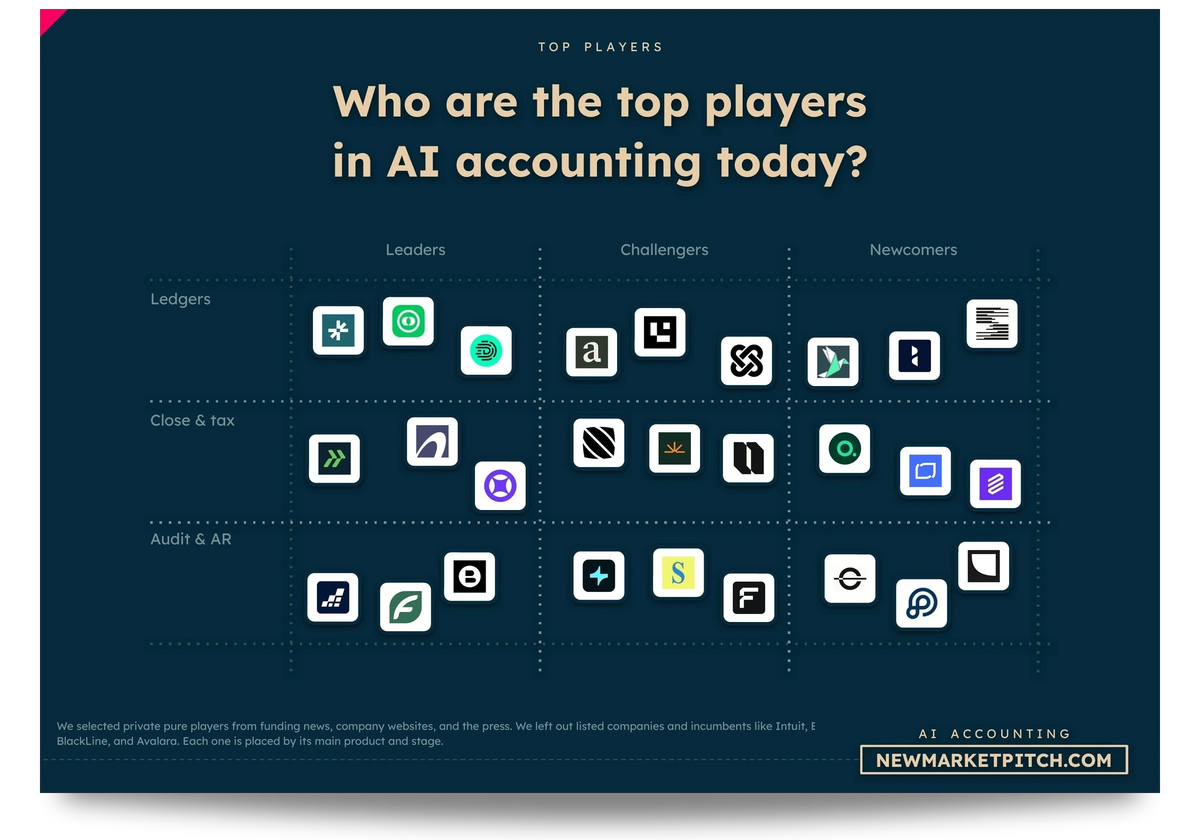
In our report covering the AI accounting market, we turn what is vague and complex into simple, useful visuals. Market maps like this one show you at a glance where every startup stands.
Could AI let accounting firms serve twice as many clients with the same team?
AI could allow some bookkeeping firms to serve twice as many clients per employee, but there is no convincing industry-wide evidence that such productivity gains are already typical.
We can test the economics with a simple calculation.
Suppose an accountant spends 60% of working time processing transactions, preparing reconciliations, and producing routine reports. If AI eliminates half of that work without adding equivalent review time, total time per client falls by 30%.
The accountant could then handle approximately 43% more equivalent work.
Doubling client capacity would require reducing total work per client by 50%, which is considerably harder. Client communications, unusual transactions, compliance reviews, and administrative tasks would need to become more efficient too.
The business case is still attractive at smaller improvements.
Thomson Reuters' 2026 State of Tax Professionals research found that tax and accounting firm profit margins averaged about 30% in 2025, with some firms exceeding 40%.
A firm that increases its client capacity by 20% or 30% without proportionately increasing staff costs could improve profitability substantially, assuming it can attract the additional clients.
If you want more recent data on this point, please see our latest AI accounting market report.
Will AI accounting make accounting services cheaper?
AI should make routine accounting cheaper to produce, but customers may not immediately see equivalent reductions in their accounting bills.
The outcome depends heavily on how firms charge for their services.
A bookkeeping firm charging a fixed $500 monthly fee can improve its profit margin when software reduces the time spent on each client. A firm charging $100 per hour has a different problem: completing the same assignment in half the time could reduce revenue unless the firm changes its pricing or wins more work.
The latest professional-services research suggests firms are already adapting. Thomson Reuters reported that tax and accounting businesses were expanding advisory services and that most surveyed firms saw revenue and profit growth in 2025.
AI gives firms another way to protect those economics. They can automate routine work while charging for specialist advice, financial planning, and complex compliance services.
Customers are also becoming more demanding. Thomson Reuters' 2026 Future of Professionals report found that 78% of surveyed corporate clients considered AI-enabled quality improvements very important or essential, while only 6% believed most or all of their providers were delivering them.
That gap could eventually intensify competition.

Our research about AI accounting tools gets updated several times a month, so you always get the latest view of where things stand.
How much can AI accounting companies realistically charge?
AI accounting companies can build large businesses at very different price points, but cheap bookkeeping subscriptions require vastly more customers than enterprise financial systems.
At $200 per month, a company needs approximately 417,000 paying customers to reach $1 billion in annual recurring revenue.
At $2,000 per month, it needs about 41,700 customers. At $50,000 per year, it needs 20,000.
The arithmetic explains why AI accounting startups are targeting different markets.
Small-business bookkeeping products compete on simplicity and price. The customer may only want invoices classified, accounts reconciled, and financial reports prepared.
Medium-sized finance teams can justify spending considerably more when automation eliminates repeated close processes or reduces the need for additional employees.
Enterprise buyers are different again. A company purchasing an ERP system is paying for financial infrastructure, integrations, controls, security, and implementation support alongside automation.
Rillet's system-replacement strategy therefore has potentially greater revenue per customer than a narrow reconciliation tool, although winning each account may be much more difficult.
The software's value must also survive implementation costs and human review. A customer saving $100,000 annually in accounting labor may willingly spend $20,000 on reliable automation, but a product that introduces substantial reconciliation errors would quickly undermine that business case.
Contract sizes will vary enormously across the industry. A single average selling price would hide more than it explains.
Could fewer accountants actually hurt AI accounting software revenue?
Fewer accountants could hurt software vendors that charge per employee, even as demand for automated accounting grows.
Traditional software pricing frequently depends on user seats. If a company reduces its accounting department from ten employees to six, it may need fewer licenses.
The alternatives are already familiar across financial software: subscriptions per company, per legal entity, per transaction, or per workflow completed.
The economics change considerably under those models.
A company processing 100,000 transactions annually may eventually handle 200,000 with the same accounting headcount. A vendor charging according to processed volume can increase revenue as the customer's business grows. A vendor charging only for employee seats may see no corresponding benefit.
As seen above, the BLS expects fewer routine bookkeeping employees over the coming decade. However, companies will still need to process payments, invoices, and financial records.
The most resilient AI accounting businesses will therefore connect their prices to the amount of work performed or the value delivered. This lets revenue grow alongside customer activity even when the number of accounting employees falls.
If you want more recent data on this point, please see our latest AI accounting market report.

In our market report about AI accounting tools, you will always find fresh funding data, taken straight from our own verified funding database.
Can companies trust AI accounting without checking everything manually?
Fully autonomous accounting remains a difficult sell for complex businesses because financial errors can create expensive reporting, tax, and compliance problems.
Automating a straightforward recurring transaction is relatively easy. Handling revenue recognition, acquisitions, related-party transactions, and unusual contractual terms requires far more context.
The distinction becomes important when errors are costly.
A wrongly classified office expense may be corrected during the month-end close. An incorrect revenue recognition decision could affect financial statements, investor disclosures, loan covenants, and audit conclusions.
AI vendors are designing their products around this reality. Rillet's platform combines automated workflows with human approvals and a full audit trail. Numeric focuses on helping accounting teams identify discrepancies and manage financial close controls.
There is also a security problem.
Thomson Reuters' 2026 Future of Professionals report found that 34% of professionals surveyed across legal, tax, audit, accounting, and related fields were using AI tools their organizations had not sanctioned.
That creates risks when confidential financial documents or client information are entered into systems without appropriate controls.
The commercial winners will need to prove that automation reduces total work after review, rather than simply generating transactions that accountants must check one by one.
For complex accounting decisions, human oversight will remain part of the product for the foreseeable future.
Is a $10 billion AI accounting market actually realistic?
A $10 billion annual AI accounting software market is realistic, provided the definition includes AI-enabled accounting platforms and automated workflows. Reaching $10 billion in entirely new AI-specific spending would be a much bigger achievement.
There are several ways to reach that scale.
At $2,000 in annual revenue per customer, vendors would need five million paying organizations. At $10,000 annually, they would need one million. At $50,000, the requirement falls to 200,000.
Those customer counts are substantial, but the existing accounting software industry already demonstrates that businesses are willing to spend billions annually on financial systems.
The more difficult question is how much spending AI genuinely adds.
Suppose a business replaces a $20,000 traditional accounting software contract with a $20,000 AI-native platform. The new vendor gains $20,000, but total industry spending remains unchanged.
If that same business also buys $10,000 of additional automation, the incremental market is $10,000.
Replacing existing accounting software can create large AI-native companies without increasing total software expenditure by the same amount.
We consider $10 billion a plausible scale for a broad AI-enabled accounting category. It is too early to treat that amount as verified standalone AI accounting revenue.

In our document detailing everything you need to know about AI accounting, we look at what the winners do differently, so you can learn from the best instead of guessing.
How big could the AI accounting market become by 2030?
The global AI accounting market could plausibly reach $10 billion to $20 billion in annual software revenue by 2030 under a broad definition, although available company disclosures are insufficient to support a precise forecast.
A market of that size could emerge through a combination of AI-native ERP adoption, accounting automation subscriptions, existing platforms adding paid AI capabilities, and software taking over portions of professional bookkeeping work.
We can calculate several possible revenue scenarios without assuming a specific market-growth rate.
| Illustrative market scenario | Paying organizations | Average annual spend | Annual revenue |
|---|---|---|---|
| Small-business AI bookkeeping | 1 million | $1,000 | $1B |
| Wider small-business adoption | 2 million | $2,000 | $4B |
| Midmarket accounting automation | 200,000 | $10,000 | $2B |
| Enterprise workflow automation | 30,000 | $50,000 | $1.5B |
| Enterprise system replacement | 50,000 | $100,000 | $5B |
| Professional accounting firm tools | 100,000 | $15,000 | $1.5B |
| Large mixed global deployment | 500,000 | $40,000 | $20B |
These are independent illustrative scenarios, not forecasts or figures that should be added together. They show the customer volumes and spending levels required to support different market sizes.
The $10 billion to $20 billion range is most credible when AI-enabled features inside existing accounting platforms are included. A standalone market composed entirely of new AI agents would need stronger proof of customer spending and retention.
The upside also depends on whether enterprise accounting systems can be replaced at scale. That would shift far more revenue than simply adding AI features to existing software.
If you want more recent data on this point, please see our latest AI accounting market report.
How big is the AI accounting market with fewer accountants, ultimately?
The AI accounting market has a credible path to becoming a $10 billion to $20 billion annual global software category by 2030, even with fewer bookkeeping employees. But current evidence supports a much more cautious assessment of how much revenue comes from AI itself.
Three findings make the opportunity convincing.
First, accounting automation addresses an enormous base of repetitive work. More than 1.5 million Americans worked as bookkeeping, accounting, and auditing clerks in 2025, and the BLS expects that workforce to shrink by 85,600 positions over the next decade.
Second, businesses already spend billions on accounting software. Intuit's QuickBooks Online Accounting business generated $5.05 billion in fiscal 2026, demonstrating that the underlying market has substantial recurring revenue.
Third, accounting firms are adopting AI quickly. Thomson Reuters found frequent AI usage among 81% of tax and audit professionals in 2026, while AI became the leading technology investment priority for 57% of respondents to its tax professional survey.
Startup revenue disclosures remain the main weakness in the investment case. Rillet and Numeric have established genuine customer demand, but we cannot yet demonstrate that AI-native accounting vendors collectively generate billions in annual revenue.
The eventual impact on employment will also be uneven. Companies should need fewer people for transaction entry and routine reconciliations, while continuing to hire qualified professionals for reporting, tax, audit, and financial judgment.
Our conclusion is that AI accounting can become a very large software market precisely because companies can get more accounting work done with fewer people. The strongest businesses will capture part of the savings from automated work, while the largest opportunities may come from replacing the financial systems companies already pay substantial amounts to use.

If you build or invest in the AI accounting market, you need to know which business models pay off now and which ones are fading. That's why our report covering it has a whole section on it.
Our methodology
This analysis examines how large the AI accounting software market could become as businesses automate financial work and potentially reduce their need for routine accounting staff. We assessed the existing accounting software industry, professional-services spending, employment trends, actual AI adoption, startup traction, software pricing, and the economics of automating bookkeeping, tax, and financial-close workflows.
We used a structured aggregation of recent evidence rather than relying on a single market forecast. For each dimension, we identified fresh, observable developments, aggregated the most relevant findings, assessed what they showed, and connected the results across dimensions. Conclusions supported by several independent indicators received greater weight than those based on isolated funding announcements, vendor claims, or hypothetical productivity gains.
We distinguish three types of spending throughout the analysis: revenue generated by established accounting software platforms, revenue from identifiable AI-native accounting products and automation services, and the value of accounting labor or professional services that software might eventually replace. These categories overlap economically, but they are not interchangeable. In particular, the full revenue of QuickBooks, Sage, or the professional accounting-services industry should not be classified as AI accounting revenue.
For labor-market analysis, we relied on AICPA accounting education and enrollment data alongside U.S. Bureau of Labor Statistics employment projections and wage figures. We kept bookkeeping, accounting, and auditing clerks separate from qualified accountants and auditors because their responsibilities and projected employment trajectories differ. We also distinguish projected occupational declines from demonstrated AI-related job losses; the former cannot establish how many positions automation will eliminate.
For market and company performance, we prioritized published company financial statements and original fundraising announcements. Intuit and Sage provide measurable benchmarks for established financial software, while Rillet and Numeric provide evidence of customer demand and capital flowing into AI-native accounting. Startup valuations, financing totals, customer counts, and reported growth rates were evaluated separately from disclosed annual revenue.
For adoption and workflow automation, we used Thomson Reuters' 2025 and 2026 professional-industry research, comparing reported AI usage with technology investment priorities, automation maturity, expected staffing changes, and firm economics. These surveys describe the experiences and expectations of respondents; they do not automatically establish industry-wide productivity gains, software profitability, or the number of accounting jobs eliminated.
We tested the commercial opportunity through bottom-up scenarios. Labor-savings calculations apply the BLS median bookkeeping wage to hypothetical full-time-equivalent positions avoided, with a separate illustrative assumption that software vendors capture 20% of base-wage savings. Client-capacity calculations reflect changes in time spent per accounting task, while market-revenue scenarios multiply assumed paying organizations by annual software spending. These exercises test what different outcomes would require, rather than presenting modeled results as observed market revenue.
Our $10 billion to $20 billion outlook for 2030 is therefore a plausibility range for a broadly defined AI-enabled accounting software category, including functionality inside established platforms. It should not be interpreted as an independently verified forecast of incremental spending on standalone AI accounting agents. The distinction between software replacement, additional automation spending, and recoverable labor savings is maintained throughout the assessment.
Key sources include AICPA's 2025 Accounting Education and Hiring Trends, AICPA's CPA qualification and accounting enrollment review, U.S. Bureau of Labor Statistics data on bookkeeping and accounting clerks, BLS data on accountants and auditors, the U.S. Census Bureau's 2022 Economic Census, Intuit's fiscal 2026 financial results, and Sage's fiscal 2025 financial results.
Professional adoption and productivity evidence comes from Thomson Reuters' 2026 Future of Professionals research for tax and accounting, the 2026 State of Tax Professionals report, Thomson Reuters' 2026 tax industry analysis, and its 2025 Generative AI in Professional Services research.
For emerging companies and their commercial positioning, we used Rillet's August 2026 Series C announcement, Rillet's August 2025 Series B announcement, Numeric's November 2025 Series B announcement, and Rillet's August 2026 product and accounting-controls update. Together, these original sources provide the basis for distinguishing measurable financial performance, adoption trends, and startup development from the market scenarios constructed in the article.

When you build or invest in the AI accounting market, you need clarity, not confusion. In our research about AI accounting tools, we always try to put numbers on and quantify whatever is usually vague and confusing.
Written by the New Market Pitch teamWe track new markets so founders and investors can move faster. About us