What are the top AI accounting startups by revenue today?
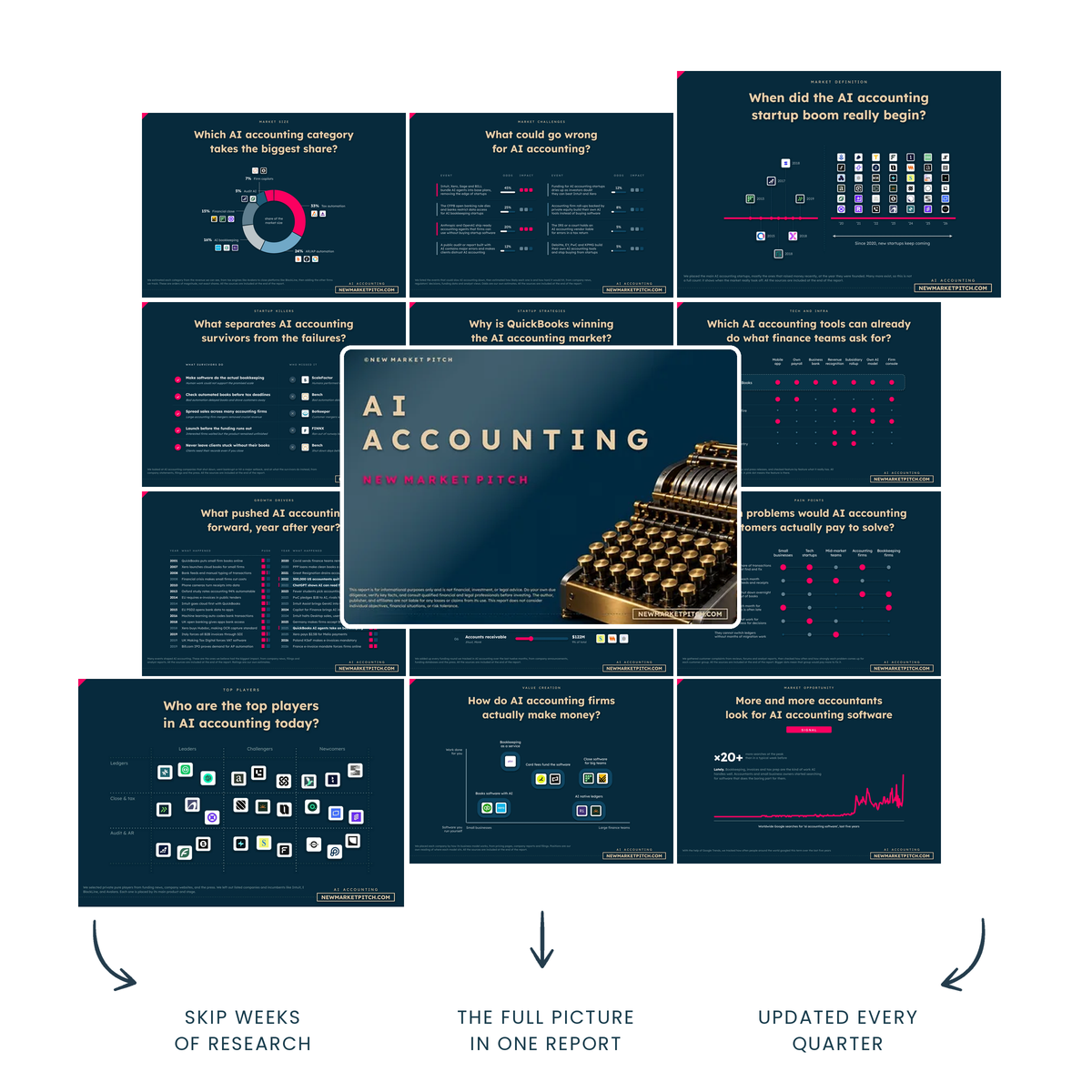
Whether you're building or investing in the AI accounting market, our report covers everything you need to know: the players, the money, and what's coming next.
Summary
OneStream is the top AI accounting startup by revenue today, with $602M in FY2025 revenue, followed by Pennylane at €200M ARR, FloQast and Tipalti at more than $200M ARR each, and HighRadius with INR 9.62B in revenue from its Indian subsidiary.
The companies making the most money are mostly established finance automation platforms, rather than the newer AI-native startups attracting headlines. Financial consolidation, closing the books, accounts payable, and receivables have already produced businesses generating hundreds of millions annually.
The ranking covers 16 startups with monetary revenue evidence, 15 more with measurable customer adoption or operational activity, and three notable companies without an attributable financial figure. The figures mix annual revenue, ARR, estimates, and legal-entity accounts, so the precise ordering has limits.
Pennylane has one of the strongest growth stories. Its ARR climbed from €113M at the end of 2025 to €200M by September 2026, supported by a distribution model reaching approximately 1.5 million French businesses through 7,500 accounting firms.
FloQast and Tipalti each passed $200M ARR before AI agents became a major standalone revenue category. Their advantage is that accounting teams already pay for the underlying software, giving them existing customers to whom they can sell more automation.
HighRadius illustrates how much accounting automation extends beyond bookkeeping. Its Indian subsidiary recorded INR 9.62B in FY2025 revenue, although that is not consolidated worldwide revenue, while its software focuses heavily on collections, cash application, and reconciliation.
Technology-enabled bookkeeping is also a substantial business. Dougs exceeds €50M ARR, Pilot has a historical estimate near $43M ARR, and Finaloop and Inkle have reached smaller but measurable revenue levels. These companies still vary considerably in how much human accounting work they perform.
AI-native challengers are gaining customers faster than their revenue disclosures suggest. Rillet has more than 600 customers, Campfire more than 400 organizations, and Digits more than 7,000 users, but none has published an annual revenue figure comparable with the largest established platforms.
Audit and professional accounting software form another meaningful market. DataSnipper has a historical ARR estimate of approximately $45M, while Fieldguide reports adoption among roughly half of the 100 largest US accounting firms.
Commercial adoption does not automatically mean profitability. OneStream reported a $94.8M GAAP operating loss in FY2025, whereas Dougs and Inkle have described themselves as profitable. The delivery model, staffing requirements, and growth spending all affect the economics.
The biggest unanswered question is how much revenue AI agents will generate on their own. Established vendors rarely separate AI-related sales from platform subscriptions, while AI-native startups mostly report adoption. OneStream leads today's ranking, but Pennylane's expansion and the rise of new general-ledger platforms could reshape it over the next few years.

Written by the New Market Pitch teamWe track new markets so founders and investors can move faster. About us

In our report covering the AI accounting market, we turn what is vague and complex into simple, useful visuals. Market maps like this one show you at a glance where every startup stands.
The ranking of top startups in the AI accounting market by revenue
Below is a table ranking the startups of this market by their current revenue scale. You can find our methodology at the end of this page.
If you want a deeper understanding of the market and its current dynamics, get our report on the AI accounting market.
| Ranking | Company | Latest Metric | Metric Type | Freshness | Disclosed When | Source Quality | Confidence | Segment | Why This Ranking | Local Metric | Country |
|---|---|---|---|---|---|---|---|---|---|---|---|
| 1 | OneStream | $602M | Fiscal-Year Revenue | Fresh · 10mo | Feb 2026 | Filed / Audited | High | Financial Close Automation | Audited revenue leads the younger companies in this ranking; also includes consolidation, planning and wider corporate finance products. First listed in 2024 and taken private by financial investor Hg in 2026. | us | |
| 2 | Pennylane | ~$235M | ARR | Very Fresh · 1mo | Oct 2026 | Credible Reported | Medium | AI Accounting Software | Extremely recent ARR places it above similarly sized older recurring-revenue disclosures, but the amount is reported by an investor analyst rather than audited. | €200M | fr |
| 3 | FloQast | >$200M | ARR | Fresh · 9mo | Jan 20, 2026 | Company Disclosed | Medium | Financial Close Automation | A company-disclosed lower bound for recent ARR supports a leading position; a conservative floor is used instead of guessing its precise present value. | us | |
| 4 | Tipalti | >$200M | ARR | Fresh · 13mo | Sep 24, 2025 | Company Disclosed | Medium | Accounts Payable Automation | Comparable ARR floor to FloQast but four months older and a broader payment-automation perimeter, so it ranks just below. | us | |
| 5 | HighRadius | ~$113M | Fiscal-Year Revenue | Aging · 19mo | 2025 | Filed / Audited | Low | Receivables & Reconciliation | Strong statutory revenue evidence for the Indian legal entity, not the entire global group; the limited corporate perimeter prevents a direct group-wide comparison. | INR 9.62B | us |
| 6 | Dext | ~$72M | Fiscal-Year Revenue | Aging · 22mo | 2025 | Filed / Audited | Medium | Bookkeeping Automation | Recognized annual revenue is stronger evidence than most lower-ranked ARR estimates, although 2024 results are aging; acquired by IRIS Software Group in Dec 2024. | £56.4M | gb |
| 7 | Dougs | >$58M | ARR | Very Fresh · 0mo | Oct 15, 2026 | Company Disclosed | Medium | AI Bookkeeping Services | A very current company-confirmed ARR floor; it trails Dext on the last recognized revenue figure but is more up to date and growing. | >€50M | fr |
| 8 | Indy | ~$49M | Annual Revenue | Fresh · 14mo | Aug 26, 2025 | Credible Reported | Medium | AI Accounting Software | Reported overall turnover is more directly comparable with annual revenue than older estimated ARR, but its precise accounting year is unspecified. | ~€45M | fr |
| 9 | DataSnipper | ~$45M | ARR | Historical · 34mo | Sep 26, 2024 | Third-Party Estimate | Low | Audit & Reconciliation Automation | Estimated 2023 ARR indicates commercial scale, but it is historical and less reliable than the newer disclosed turnover and ARR figures above. | nl | |
| 10 | Pilot | ~$43M | ARR | Historical · 46mo | 2023 | Third-Party Estimate | Low | AI Bookkeeping Services | An older estimated recurring-revenue figure is retained rather than replaced with users, but its age limits confidence about current scale. | us | |
| 11 | Tiime | ~$11.1M | Fiscal-Year Revenue | Fresh · 10mo | 2026 | Filed / Audited | Medium | AI Accounting Software | Recent filed entity revenue merits a stronger position than similarly sized outside estimates; not necessarily consolidated across all Tiime entities. | €9.86M | fr |
| 12 | Finaloop | ~$10.1M | Annual Revenue | Fresh · 10mo | Sep 10, 2026 | Third-Party Estimate | Low | AI Bookkeeping Services | Recent revenue estimate is useful but weaker than Tiime filed accounts, and the same source carries an inconsistent higher estimate. | us | |
| 13 | Aiwyn | $8M | Annual Revenue | Historical · 34mo | Dec 19, 2024 | Company Disclosed | Low | Accounting Practice Automation | Founder-confirmed historical revenue outranks undated user counts, but aging and the broader practice-management perimeter weigh against comparability. | us | |
| 14 | Inkle | >$5M | Annual Revenue | Very Fresh · 0mo | Oct 28, 2026 | Credible Reported | Medium | AI Bookkeeping Services | Current revenue lower bound is more useful than smaller, older estimates; inorganic customer growth from the acquired Finally bookkeeping assets affects comparability. | us | |
| 15 | Hysab Kytab | ~$29.5K | Monthly Revenue | Very Fresh · 4mo | Jul 2026 | Credible Reported | Medium | AI Accounting Software | Recent actual monthly revenue is directly monetary but cannot be treated as ARR or multiplied by twelve without inventing an annual disclosure. | INR 2.5M | in |
| 16 | Tabby | ~$100K | ARR | Very Fresh · 1mo | Sep 21, 2026 | Company Disclosed | Medium | AI Accounting Software | Very current ARR is small but more defensible as a revenue proxy than customer or transaction counts with no published monetization. | us | |
| 17 | Double | >4,000 firms | Paying Customers | Fresh · 10mo | Dec 2025 | Company Disclosed | Low | Financial Close Automation | Large accounting-firm adoption is credible commercial evidence but lacks annual revenue or ARR and cannot be compared arithmetically with financial rows. | us | |
| 18 | Stampli | >2,000 customers | Paying Customers | Very Fresh · 0mo | Company Disclosed | Low | Accounts Payable Automation | Strong customer adoption in AP accounting automation; reported processing volumes are intentionally not converted to company revenue. | us | ||
| 19 | Rillet | >600 customers | Paying Customers | Very Fresh · 2mo | Aug 19, 2026 | Company Disclosed | Low | AI-Native General Ledger | A recent enterprise-customer count signals strong traction but the undisclosed ARR cannot be inferred from customer numbers or the fundraising valuation. | us | |
| 20 | Campfire | >400 customers | Paying Customers | Very Fresh · 0mo | Company Disclosed | Low | AI-Native General Ledger | Reported enterprise-customer adoption is relevant, but there is no verified financial magnitude; customers may vary widely by contract size. | us | ||
| 21 | Zeni | >1,000 customers | Paying Customers | Very Fresh · 0mo | Company Disclosed | Low | AI Bookkeeping Services | An active client count is a reasonable indicator of recurring bookkeeping activity, not revenue. Sorted below more enterprise-focused disclosures despite greater client volume. | us | ||
| 22 | Digits | >7,000 users | Users | Very Fresh · 0mo | Company Disclosed | Low | AI-Native General Ledger | Large reported user base demonstrates product reach but user counts are not equivalent to paying customers or annual revenue. | us | ||
| 23 | Puzzle | >7,000 organizations | Users | Very Fresh · 1mo | Sep 2026 | Credible Reported | Low | AI-Native General Ledger | Substantial claimed user adoption lacks paid-customer differentiation; acquired by Accrual in Sep 2026 and counted only once as the underlying business. | us | |
| 24 | Vic.ai | >1B invoices | Transactions | Very Fresh · 2mo | Aug 6, 2026 | Company Disclosed | Low | Accounts Payable Automation | Large cumulative invoice volume documents deployment, but transaction count has no reliable conversion to revenue and the window spans multiple years. | us | |
| 25 | DualEntry | >$100B | Other Scale Signal | Very Fresh · 0mo | Company Disclosed | Low | AI-Native General Ledger | The amount is the value of entries processed, not billings, GMV or revenue; it supports commercial deployment without a dollar-revenue comparison. | us | ||
| 26 | Synder | $30.8B | Other Scale Signal | Fresh · 10mo | Dec 31, 2025 | Company Disclosed | Low | Reconciliation Automation | Multi-year financial value synchronized is a platform throughput figure, not Synder revenue; ranked with operational signals rather than monetary earnings. | us | |
| 27 | Fieldguide | ~50 top-100 firms | Paying Customers | Fresh · 8mo | Feb 2, 2026 | Company Disclosed | Low | Audit & Reconciliation Automation | High-profile accounting-firm deployments indicate scale in audit workflows, but firm count does not reveal contract value and audit scope is broader than bookkeeping. | us | |
| 28 | Maxima | Hundreds of customers | Paying Customers | Very Fresh · 0mo | Company Disclosed | Low | Financial Close Automation | Numerically vague but current customer traction demonstrates deployment; a specific revenue or annualized revenue figure is unavailable. | us | ||
| 29 | Ravical | >100 firms | Paying Customers | Very Fresh · 0mo | Oct 29, 2026 | Company Disclosed | Low | Accounting Practice Automation | Recent accounting-firm customer count is strong category evidence, but it is not a revenue disclosure and firm size varies substantially. | be | |
| 30 | Basis | 21 named organizations | Other Scale Signal | Very Fresh · 0mo | Oct 27, 2026 | Third-Party Estimate | Low | Accounting Practice Automation | Named deployments show market presence but are neither a verified company-wide customer count nor recurring revenue. | us | |
| 31 | Nominal | >50,000 hours saved | Other Scale Signal | Fresh · 15mo | Jul 9, 2025 | Company Disclosed | Low | Financial Close Automation | Operational benefit is distinct from actual revenue and difficult to compare with paid-customer counts; it is the strongest quantified public scale signal. | us | |
| NR | AppZen | Not disclosed | Other Scale Signal | Undated | Company Disclosed | Low | Accounting Practice Automation | Expense-audit automation is adjacent to core accounting. | us | ||
| NR | Numeric | Not disclosed | Other Scale Signal | Undated | Company Disclosed | Low | Financial Close Automation | No attributable annual revenue or ARR is public. | us | ||
| NR | Tabs | Not disclosed | Other Scale Signal | Undated | Company Disclosed | Low | Revenue Recognition Automation | Accounting contribution is revenue recognition rather than general bookkeeping; no company-wide monetary metric is available. | us |

Our research about AI accounting tools gets updated several times a month, so you always get the latest view of where things stand.
Which AI accounting startups make the most revenue today?
OneStream currently leads the AI accounting startup revenue ranking with $602M in FY2025 revenue, followed by Pennylane with €200M ARR, FloQast with more than $200M ARR, Tipalti with more than $200M ARR, and HighRadius with INR 9.62B in FY2025 revenue from its Indian subsidiary.
These five companies show how much money accounting automation can already generate. The biggest businesses cover far more than basic bookkeeping: financial consolidation, accounts payable, receivables, reporting, and software used by accounting professionals.
OneStream's $602M is recognized fiscal-year revenue, while Pennylane, FloQast, and Tipalti report annual recurring revenue. HighRadius's figure comes from statutory accounts covering one Indian legal entity rather than its entire international business. We retain these differences instead of treating every figure as identical.
Across the market, we identified 16 startups with monetary revenue or ARR evidence, 15 more with quantified customer adoption or operational activity, and three notable companies without an attributable financial figure. The ordering is indicative where figures use different currencies, periods, or open-ended ARR thresholds.
| Rank | Startup | Revenue or ARR | Metric and period |
|---|---|---|---|
| 1 | OneStream | $602M | FY2025 fiscal-year revenue |
| 2 | Pennylane | €200M | September 2026 ARR |
| 3 | FloQast | >$200M | January 2026 ARR |
| 4 | Tipalti | >$200M | September 2025 ARR |
| 5 | HighRadius | INR 9.62B | FY2025 Indian subsidiary revenue |
| 6 | Dext | £56.4M | FY2024 fiscal-year revenue |
| 7 | Dougs | >€50M | October 2026 ARR |
| 8 | Indy | ~€45M | Annual turnover reported August 2025 |
| 9 | DataSnipper | ~$45M | Estimated 2023 ARR |
| 10 | Pilot | ~$43M | Estimated 2022 ARR |
| 11 | Tiime | €9.86M | FY2025 legal-entity revenue |
| 12 | Finaloop | ~$10.1M | Estimated 2025 annual revenue |
| 13 | Aiwyn | $8M | 2023 annual revenue |
| 14 | Inkle | >$5M | October 2026 annual revenue run-rate |
| 15 | Hysab Kytab | INR 2.5M | June 2026 monthly revenue |
| 16 | Tabby | ~$100K | September 2026 ARR |
Why are AI accounting startups getting so much attention now?
AI accounting startups are getting more attention because they are starting to automate entire accounting workflows, and several companies have already turned that technology into substantial revenue.
In January 2026, FloQast announced that it had exceeded $200M ARR while expanding its auditable AI agents. Pennylane reached €200M ARR in September, according to an October investor analysis, after building a platform connecting accountants with small businesses. Rillet, a much younger AI-native accounting company, reported more than 600 customers in August and raised another $100M.
The three businesses show how the market is developing. FloQast is adding AI to established accounting software. Pennylane combines accounting production, business management, and financial services. Rillet is building a new general ledger designed around automation.
The companies earning hundreds of millions today generally started automating finance operations before generative AI became mainstream. The newer generation is trying to go further by reducing the amount of accounting work humans have to perform.
Investors are paying for that possibility, but customers are already spending heavily on the older generation of automation tools.

In our market report about AI accounting tools, we look at what the winners do differently, so you can learn from the best instead of guessing.
How much revenue does OneStream make?
OneStream generated $602M in FY2025 revenue, up 23% from the previous year, making it the highest-revenue AI accounting startup in our ranking.
According to OneStream's FY2025 results, subscription revenue reached approximately $550M, growing 28% year over year. Subscriptions accounted for around 91% of total revenue, compared with 87% in 2024.
OneStream added approximately $113M in total annual revenue between 2024 and 2025, while subscription revenue alone increased by roughly $122M. Its recurring software business was growing faster than the company overall as traditional licensing became less important.
OneStream sells software for financial consolidation, close management, reporting, planning, and forecasting. Its $602M therefore covers a broad enterprise finance platform, rather than revenue earned exclusively from AI-powered bookkeeping.
The company went public in 2024 before being acquired by private-equity investor Hg in April 2026 for approximately $6.4B in equity value. It remains eligible for our startup ranking because its first public listing was recent and it is now privately owned by financial investors.
Is Pennylane already one of the biggest AI accounting startups?
Pennylane is now the second-ranked AI accounting startup, having reached €200M ARR in September 2026 after ending 2025 at €113M.
Those figures come from an October 2026 investor analysis of Pennylane's business. They imply approximately 77% ARR growth in just nine months, following 109% year-over-year growth in 2025.
Pennylane's distribution model helps explain the pace. The analysis estimated that around 7,500 accounting firms were using its platform to process records for approximately 1.5 million French businesses.
Rather than selling accounting software to each business independently, Pennylane can reach businesses through their accountants and then sell additional financial tools.
Its reported revenue mix shows how far this approach has developed. Approximately 40% came from accounting-firm production licenses, 50% from ERP software sold to businesses, and 10% from financial services.
Pennylane has also expanded into business banking, payment terminals, and AI-assisted accounting. Its September milestone came as the company was entering additional European markets, including Germany and Spain.
The €200M ARR figure is investor-reported rather than audited annual revenue. Still, the sequence from €113M to €200M makes Pennylane one of the clearest current examples of rapid monetization in accounting software.

In our document detailing everything you need to know about AI accounting, you will always find fresh funding data, taken straight from our own verified funding database.
Are FloQast and Tipalti making more money than newer AI accounting startups?
FloQast and Tipalti have already reached more than $200M ARR each, giving both a substantial commercial head start over newer AI accounting companies whose revenue remains undisclosed.
FloQast passed the threshold in January 2026. Its announcement described accelerating enterprise adoption, international expansion, and growing demand for auditable AI agents.
The company reported more than 3,500 accounting teams using its platform, including Shopify, Chipotle, and Lululemon. It also announced a new relationship with EY to help the firm's advisory teams deploy FloQast's accounting automation products.
Tipalti crossed $200M ARR by September 2025 and reported 30% customer-base growth. Its platform spans accounts payable, supplier management, procurement, payments, and treasury operations.
The two companies have expanded in different directions. FloQast started with financial close and moved into broader accounting operations. Tipalti expanded from payment automation into additional finance workflows, including AI-powered treasury tools.
Both entered the AI-agent market with existing customer relationships and substantial recurring revenue. That is a serious advantage over startups still trying to convert early adoption into annual sales.
How much revenue does HighRadius make?
HighRadius ranks fifth among AI accounting startups, with INR 9.62B in FY2025 revenue reported by its Indian statutory subsidiary.
The amount comes from corporate accounts for the fiscal year ended March 2025. It confirms substantial commercial activity, although it covers only one legal entity within HighRadius's international business.
HighRadius focuses on automating accounts receivable, collections, deductions, cash application, and reconciliation. These are often large, repetitive operations for companies managing substantial customer payment volumes.
The company has also expanded its AI capabilities across financial operations, particularly tasks involving payment matching, collections, and cash-flow management.
HighRadius operates internationally, so the Indian entity's turnover should not be interpreted as consolidated global revenue.
Even within that narrower scope, INR 9.62B is a substantial annual business. Some of the largest accounting automation opportunities sit outside the general ledger, in the processes companies use to collect and reconcile money.

Learning from others' mistakes is the cheapest lesson there is. In our report covering the AI accounting market, we look at what broke startups before you, so you don't repeat it.
Which European AI accounting startups make the most money?
Pennylane ranks highest among European AI accounting startups with €200M ARR, followed in the overall ranking by Dext, Dougs, Indy, and Tiime, all of which have published meaningful financial figures.
Dext reported £56.4M in FY2024 revenue before becoming part of IRIS Software Group in December 2024. Its bookkeeping automation platform remains a recognizable product within the acquiring group.
Dougs reported more than €50M ARR and over 50,000 business customers in October 2026. Indy was reported to generate approximately €45M in annual turnover as of August 2025, while Tiime Software's French statutory accounts showed €9.86M in FY2025 turnover.
These businesses sell accounting technology in different ways. Pennylane works through accounting firms and business customers, Dext automates document collection and bookkeeping, Dougs provides technology-enabled accounting services, and Indy focuses on entrepreneurs and small businesses.
France is particularly well represented among the revenue-disclosing companies. Pennylane, Dougs, Indy, and Tiime all operate from France, although their financial figures cover different periods and business perimeters.
Accounting firms remain an important distribution channel in France, and several of the country's largest accounting automation startups have built their businesses around that relationship.
Are AI bookkeeping startups making as much money as accounting software companies?
AI bookkeeping startups have built meaningful businesses, but their published financial figures remain below those of the largest enterprise accounting software companies.
Dougs ranks seventh overall with more than €50M ARR. Pilot ranks tenth with approximately $43M estimated ARR from 2022, followed by Finaloop with approximately $10.1M estimated 2025 revenue and Inkle with more than $5M in annual revenue run-rate in October 2026.
The figures also describe different businesses. Dougs provides regulated accounting services supported by software and automation. Pilot offers managed bookkeeping and financial operations. Finaloop specializes in ecommerce accounting, while Inkle combines bookkeeping with tax and compliance services.
The service component changes the economics. Dougs employs accountants and other specialists alongside engineers. A fully software-based provider can potentially serve more customers without increasing accounting staff at the same rate, although actual margins depend on the product and operating costs.
We have credible revenue evidence for these four companies, but not enough comparable margin information to conclude which model earns more profit per customer.
For now, the biggest disclosed revenues come from broader accounting software platforms. Technology-enabled bookkeeping is already a tens-of-millions business, though, and that is hardly a small market.

Your time is limited. In our research about AI accounting tools, we put numbers on each part of the market, so you can see where it makes sense to focus.
Are financial-close automation startups the biggest winners in AI accounting?
Financial-close automation has produced two of the highest-revenue AI accounting startups: OneStream at $602M in FY2025 revenue and FloQast at more than $200M ARR in January 2026.
Their products help finance teams reconcile accounts, close reporting periods, consolidate financial results, and prepare records for review and audit.
OneStream's subscription revenue grew 28% in FY2025. FloQast, meanwhile, has expanded beyond its original close-management product into connected compliance, accounting operations, and auditable AI agents.
Smaller companies are also entering this part of the market. Double, formerly Keeper, reported more than 4,000 accounting firms using its software as of December 2025. Maxima reports hundreds of customers, while Nominal disclosed more than 50,000 manual accounting hours saved by July 2025.
Those latter figures measure adoption and operational activity rather than annual revenue.
Companies have to close their accounts regularly, and mistakes can create compliance and reporting problems. Paying for software that makes this work faster and easier to audit is an easy decision to understand.
Financial-close automation is already one of the most commercially successful segments of accounting technology.
How big are AI accounts payable startups by revenue?
Tipalti ranks fourth overall with more than $200M ARR, making accounts payable and payment automation one of the largest revenue-generating areas among AI accounting startups.
Other companies in the category have disclosed strong adoption without publishing comparable revenue.
Stampli reported more than 2,000 procure-to-pay customers as of October 2026. Vic.ai announced in August 2026 that its platform had processed more than one billion cumulative customer invoices.
These figures describe different aspects of the business. Tipalti's ARR measures recurring revenue, Stampli's customer count indicates adoption, and Vic.ai's invoice volume measures work processed over several years.
The distinction is especially important for payment technology. Processing invoices worth billions doesn't mean the software company earns billions. Revenue generally comes from subscriptions, transaction charges, or other fees.
Tipalti's commercial scale is established through its recurring-revenue disclosure. Stampli and Vic.ai have demonstrated considerable operational use, although their public figures don't establish how much annual revenue they earn.

In our market report about AI accounting tools, we always try to gather several sources and make estimates that make sense, so you can work with solid numbers.
How much revenue are AI-native general ledger startups making?
AI-native general ledger startups are getting customers, but none of the prominent companies in this group has published a comparable annual revenue figure in our ranking.
Rillet reported more than 600 customers in August 2026. Campfire reported more than 400 organizations using its product in October, while Digits reported more than 7,000 accountants and business owners using its platform.
Puzzle was associated with more than 7,000 organizations as of September 2026 and was acquired by Accrual that month. DualEntry disclosed more than $100B in cumulative journal entries processed through October 2026.
These companies are building accounting systems around automation, real-time financial data, and AI assistance, rather than gradually adding those capabilities to long-established software.
Customer adoption is already substantial. Revenue remains harder to judge because the companies have mostly disclosed user counts, customer counts, or financial activity processed.
In DualEntry's case, the $100B figure represents the value of journal entries recorded through its software. It says nothing directly about the company's annual sales.
AI-native accounting systems are gaining traction. Their revenue scale is still much less visible than their customer growth.
Is Rillet becoming a major AI accounting startup?
Rillet is already one of the most closely watched AI-native accounting startups, with more than 600 customers and a $1B valuation reported in August 2026.
The company raised a $100M Series C led by Iconiq, with participation from investors including Sequoia and Andreessen Horowitz. The round brought its total funding above $200M.
Rillet's CEO, Nicolas Kopp, told TechCrunch that the company had accumulated approximately 600 customers within two years of emerging from stealth. The company also disclosed that annualized new revenue had doubled over the preceding three months, although it did not publish its absolute ARR.
The product competes with established enterprise accounting systems by automatically bringing financial data from different business applications into a continuously updated ledger.
Rillet's customer base includes companies looking to replace legacy systems rather than simply add another finance tool. Replacing the ledger can give a vendor a central role in a customer's financial operations.
Still, a $1B valuation and $200M raised don't tell us how much revenue Rillet earns. The startup has demonstrated fast adoption and strong investor backing, but its annual sales remain undisclosed.

If you build or invest in the AI accounting market, you need to know which business models pay off now and which ones are fading. That's why our report covering it has a whole section on it.
Which AI accounting startups have the most customers without disclosing revenue?
Double, Stampli, Rillet, Campfire, and Zeni are among the AI accounting startups reporting substantial customer activity without publishing comparable company-wide revenue figures.
Double reported more than 4,000 accounting firms using its product, while Stampli disclosed more than 2,000 procure-to-pay customers. Rillet and Campfire reported hundreds of customer companies, and Zeni described more than 1,000 monthly bookkeeping closes.
Other startups disclose different measures of adoption. Digits reports users, Vic.ai counts invoices processed, Synder reports the value of financial data synchronized, and Fieldguide reports penetration among major accounting firms.
For example, Synder's December 2025 review reported $30.8B in cumulative amounts synchronized through its software. Fieldguide said its platform was used by approximately half of the 100 largest US accounting firms as of February 2026.
Neither figure is company revenue, but both show that accounting automation is being used for substantial financial work.
The following positions reflect the strongest commercial-scale evidence available after the 16 startups with monetary figures. They should not be read as estimates of undisclosed revenue.
| Position | Startup | Reported commercial indicator | Period |
|---|---|---|---|
| 17 | Double | >4,000 firms | December 2025 |
| 18 | Stampli | >2,000 customers | October 2026 |
| 19 | Rillet | >600 customers | August 2026 |
| 20 | Campfire | >400 customers | October 2026 |
| 21 | Zeni | >1,000 monthly books closed | October 2026 |
| 22 | Digits | >7,000 users | October 2026 |
| 23 | Puzzle | >7,000 organizations | September 2026 |
| 24 | Vic.ai | >1B cumulative invoices | Through August 2026 |
| 25 | DualEntry | >$100B journal entries processed | Through October 2026 |
| 26 | Synder | $30.8B cumulative amounts synchronized | Through December 2025 |
| 27 | Fieldguide | ~50 top-100 accounting firms | February 2026 |
| 28 | Maxima | Hundreds of customers | October 2026 |
| 29 | Ravical | >100 firms | October 2026 |
| 30 | Basis | 21 named organizations | October 2026 |
| 31 | Nominal | >50,000 accounting hours saved | July 2025 |
| Unranked | AppZen | Revenue not disclosed | - |
| Unranked | Numeric | Revenue not disclosed | - |
| Unranked | Tabs | Revenue not disclosed | - |
Are AI audit startups making real money?
AI audit startups have reached meaningful commercial scale, with DataSnipper ranking ninth overall on approximately $45M in estimated 2023 ARR.
The estimate comes from Sacra and remains historical rather than a current financial disclosure.
DataSnipper helps auditors extract and verify information from documents, reducing the manual work involved in collecting evidence and checking financial records.
Fieldguide takes a broader approach to audit and advisory workflows. In February 2026, its CEO reported that the software was being used by approximately half of the 100 largest accounting firms in the United States.
That's a considerable share of the largest accounting practices, although the number of firms doesn't tell us how much they spend on subscriptions.
Aiwyn offers another example of software sold to accounting practices. Founder Justin Adams told TechCrunch in December 2024 that Aiwyn generated $8M in 2023 revenue while serving approximately 130 of the 500 largest accounting firms.
Accounting practices are spending on automation well beyond basic bookkeeping. Audit preparation, evidence collection, billing, and client management have all developed into commercial software opportunities.

In our report covering the AI accounting market, we don't want to repeat what boring consulting reports say. Instead, we show you the real and latest market signals that matter.
Which AI accounting startups are growing the fastest today?
Pennylane has one of the strongest documented revenue-growth trajectories among large AI accounting startups, while Rillet has reported particularly fast customer growth.
Pennylane's ARR rose from €113M at the end of 2025 to €200M by September 2026, according to the October investor analysis. That represents an approximately 77% increase in nine months.
Dougs reported annual growth above 50% for a decade in its October 2026 investment announcement. The business had reached more than €50M ARR and was targeting €100M ARR, although that higher figure remains a future objective.
Rillet's customer base grew from more than 200 to more than 600 over roughly a year, according to investor and company interviews. Its latest funding announcement also said new ARR doubled over three months, without disclosing the underlying amount.
OneStream offers a comparison from a much larger revenue base. Its FY2025 revenue grew 23%, adding approximately $113M in annual sales.
A company growing 100% from a small base can still add much less revenue than one growing 20% from hundreds of millions.
Pennylane stands out because it combines rapid growth with an already substantial ARR base. Few accounting startups have documented that combination so clearly.
Are AI accounting startups actually making money from AI agents?
AI agents are becoming part of paid accounting software, but the largest companies generally don't disclose how much revenue comes specifically from those agents.
FloQast announced its $200M ARR milestone in January 2026 alongside the expansion of FloQast Transform, which helps accounting teams build and manage auditable agents for repetitive financial tasks.
Tipalti introduced more agent-oriented capabilities in September 2025, following its expansion into treasury automation. Its AI assistant works across financial workflows, including information retrieval, reporting, and process management.
Pennylane is following another route by introducing AI assistants, automated accounting production, and tools that let accounting firms build custom applications.
Companies sell AI as part of existing subscriptions, as additional modules, or as automation built directly into the main product. In many cases, the customer isn't paying a separate line item for an AI agent.
The financial disclosures generally cover the whole platform rather than individual AI features. That makes it impossible to calculate a reliable industry-wide figure for accounting-agent revenue.
For now, the strongest commercial evidence is that AI capabilities are helping established accounting platforms expand their products. How much customers will pay specifically for autonomous agents is still an open question.

In our research about AI accounting tools, we like to show you the big picture. We know your time is precious, so we make every page quick to read and packed with as much learning as possible per minute.
Can AI accounting startups replace human bookkeepers?
AI accounting startups are already automating much of the routine work performed by bookkeepers, but the largest commercial service models still involve human accountants.
Dougs is a useful example. Its October 2026 announcement described a business serving more than 50,000 customers with software, AI automation, and professional support from accountants, legal specialists, and tax experts.
The company plans to automate more accounting production, including the preparation of financial statements, while retaining professional review and sign-off.
Tabby is pursuing a more aggressive approach. Founder Ahad Ali told TechCrunch in September 2026 that his goal was to make bookkeeping software largely invisible to small-business owners by automating the underlying work.
Tabby reported approximately 5,500 businesses using its platform and roughly $100K ARR. Those figures show early interest, although its commercial scale remains small.
Inkle offers an example of consolidation in the service market. After acquiring Finally's bookkeeping operations in 2026, it reported an annual revenue run-rate above $5M, partly reflecting the acquired business.
Software is taking over more data entry, categorization, reconciliation, and reporting preparation. Whether that eliminates entire bookkeeping roles depends on how far automation can handle exceptions, tax requirements, review, and client advice. That's a harder job than processing invoices.
Can AI accounting startups compete with QuickBooks, Sage, and Xero?
AI accounting startups can challenge established accounting software companies in specific markets, but the incumbents still earn substantially more revenue.
Intuit reported $5.05B in QuickBooks Online Accounting product revenue for FY2026, according to its annual filing. That was approximately 23% higher than the previous year.
For additional context, Sage reported £2.51B in FY2025 statutory group revenue, while Xero reported NZD 2.75B in FY2026 operating revenue.
These are different reporting perimeters: Intuit's figure is specific to QuickBooks Online Accounting, while Sage and Xero report broader company revenue. All three are established players and remain outside our startup ranking.
Pennylane has shown how a startup can challenge established software by building closer relationships between accountants and businesses. Rillet is targeting companies looking to replace older enterprise accounting systems with AI-native alternatives.
But replacing an accounting system is a big decision. These platforms hold years of financial records, connect to other business applications, and support auditing and regulatory requirements.
Switching can be difficult even when the alternative software is technically better. Newer companies are gaining ground, while established platforms still control much larger commercial operations.

When you build or invest in the AI accounting market, you need clarity, not confusion. In our market report about AI accounting tools, we always try to put numbers on and quantify whatever is usually vague and confusing.
Are AI accounting startups profitable yet?
Some AI accounting startups are already profitable, although the largest revenue figure in our ranking belongs to a company that reported an accounting loss.
OneStream's FY2025 results showed a GAAP operating loss of approximately $94.8M on $602M in revenue. Its operating margin improved considerably from the previous year, but the company had not reached positive GAAP operating income.
Dougs offers a contrasting example. Its October 2026 investment announcement stated that the company had been profitable since its founding in 2015, while reaching more than €50M ARR and serving over 50,000 businesses.
Inkle's October 2026 acquisition reporting also described the company as profitable after raising only $1.5M in pre-seed funding.
Companies investing heavily in enterprise sales, international expansion, and product development may report losses even with substantial recurring revenue.
Technology-enabled accounting services can also have very different labor costs from software subscription businesses.
We have profitability claims for individual companies, but most private startups don't publish the financial statements needed for a reliable comparison of operating margins.
Does raising more money mean an AI accounting startup makes more revenue?
Funding is a poor substitute for revenue when comparing AI accounting startups, and the market offers several examples of why.
Rillet raised a $100M Series C in August 2026 at a $1B valuation, bringing its total investment above $200M. Its public disclosures established more than 600 customers but did not include a comparable annual revenue figure.
OneStream's acquisition by Hg valued the company at approximately $6.4B, against $602M in FY2025 revenue. The transaction price and annual sales represent entirely different financial measures.
Pennylane offers another comparison. Its investor-reported €200M ARR gives us a direct indication of subscription scale, separate from its financing history or valuation.
Finally's bookkeeping business illustrates the risk of treating fundraising as commercial success. After its parent entered a wind-down in 2026, the bookkeeping operations were acquired by Inkle.
Investors can fund a company because they expect future growth, even when current sales remain modest. Revenue measures what customers are paying, while profitability tells us whether the business can earn money after its costs.
For a ranking of who earns the most today, financing amounts can't replace those measures.

A good product starts with a real problem. In our document detailing everything you need to know about AI accounting, we show you the ones customers still live with.
Will AI-native accounting startups overtake the biggest automation companies?
AI-native accounting startups could eventually become major revenue competitors, but the current evidence still puts OneStream, Pennylane, FloQast, Tipalti, and HighRadius ahead in our ranking.
The newcomers have made real progress. Rillet has attracted hundreds of customers, Campfire has reported adoption across hundreds of organizations, and other AI-native products are reaching thousands of users.
These companies are building accounting systems with automated workflows at their core. They could eventually reduce the time businesses spend reconciling transactions, preparing reports, and managing financial records.
The established automation companies have a different advantage: customers already pay them substantial recurring amounts for financial processes they depend on.
OneStream's $602M FY2025 revenue, Pennylane's €200M ARR, and the more than $200M ARR figures disclosed by FloQast and Tipalti demonstrate how far those businesses have progressed commercially.
To change the revenue ranking, AI-native startups will need to turn early adoption into sustained annual sales. That means winning customers, keeping them, expanding contracts, and handling the reliability requirements of financial systems.
OneStream currently tops the AI accounting startup revenue ranking, while Pennylane has one of the strongest recent growth stories. FloQast, Tipalti, and HighRadius complete the top five. The AI-native challengers are getting bigger, but their published revenue figures haven't caught up with the attention surrounding them.
Our methodology
We ranked AI accounting startups using the strongest publicly attributable evidence of their current commercial scale. Our analysis covers accounting software, bookkeeping automation, financial close, accounts payable and receivable, audit technology, and AI-native general ledgers. We identified 16 companies with monetary revenue evidence, 15 with measurable adoption or operational activity, and three notable companies without attributable financial figures.
We included companies founded in 2000 or later that have never been publicly listed or first listed within the past five years. Companies acquired within the past three years remain eligible, while subsidiaries of larger operating groups acquired earlier are excluded. Financial-investor ownership does not exclude a company. OneStream remains eligible following its 2024 listing and 2026 acquisition by Hg, while Dext is identified as part of IRIS Software Group.
We prioritized annual revenue, fiscal-year revenue, trailing revenue, and ARR, followed by credible run-rates and historical estimates. When monetary figures were unavailable, we examined customer counts, users, invoices processed, journal-entry volumes, and other measurable commercial activity. We kept each metric's original currency, reporting period, and business perimeter rather than converting every number into an apparently comparable annual revenue figure.
Several figures require particular care. OneStream reports consolidated fiscal-year revenue; Pennylane, FloQast, and Tipalti report ARR; HighRadius's statutory figure covers its Indian subsidiary; and Tiime's turnover covers a French legal entity. DataSnipper, Pilot, and Finaloop have historical or externally estimated revenue figures. Rankings involving these different measures, especially lower-bound ARR disclosures, should be interpreted as indicative rather than exact.
We reviewed public materials from the previous ten years, prioritizing regulatory filings, annual reports, statutory accounts, official company announcements, investor publications, and direct executive interviews. Valuations, fundraising amounts, payment volumes, and customer activity were not treated as company revenue. For recently acquired businesses, we retained the latest attributable figures while identifying the acquisition.
Key sources include OneStream's FY2025 SEC filing, OneStream's annual financial results, the October 2026 Pennylane investor analysis, FloQast's ARR announcement, Tipalti's growth and financing announcement, HighRadius's Indian statutory information, Dext's UK financial information, and Dougs' October 2026 investment announcement.
Additional sources include Rillet's Series C announcement, TechCrunch's Rillet interview, TechCrunch's Aiwyn founder interview, TechCrunch's Tabby interview, Synder's 2025 review, Intuit's FY2026 Form 10-K, Sage's financial results, and BILL's FY2026 results for established-market context.

It's easy to get lost in the details. In our report covering the AI accounting market, we give you some perspective first, so you see the whole market before you make a move.
Written by the New Market Pitch teamWe track new markets so founders and investors can move faster. About us