
Can AI support startups make money charging per ticket?
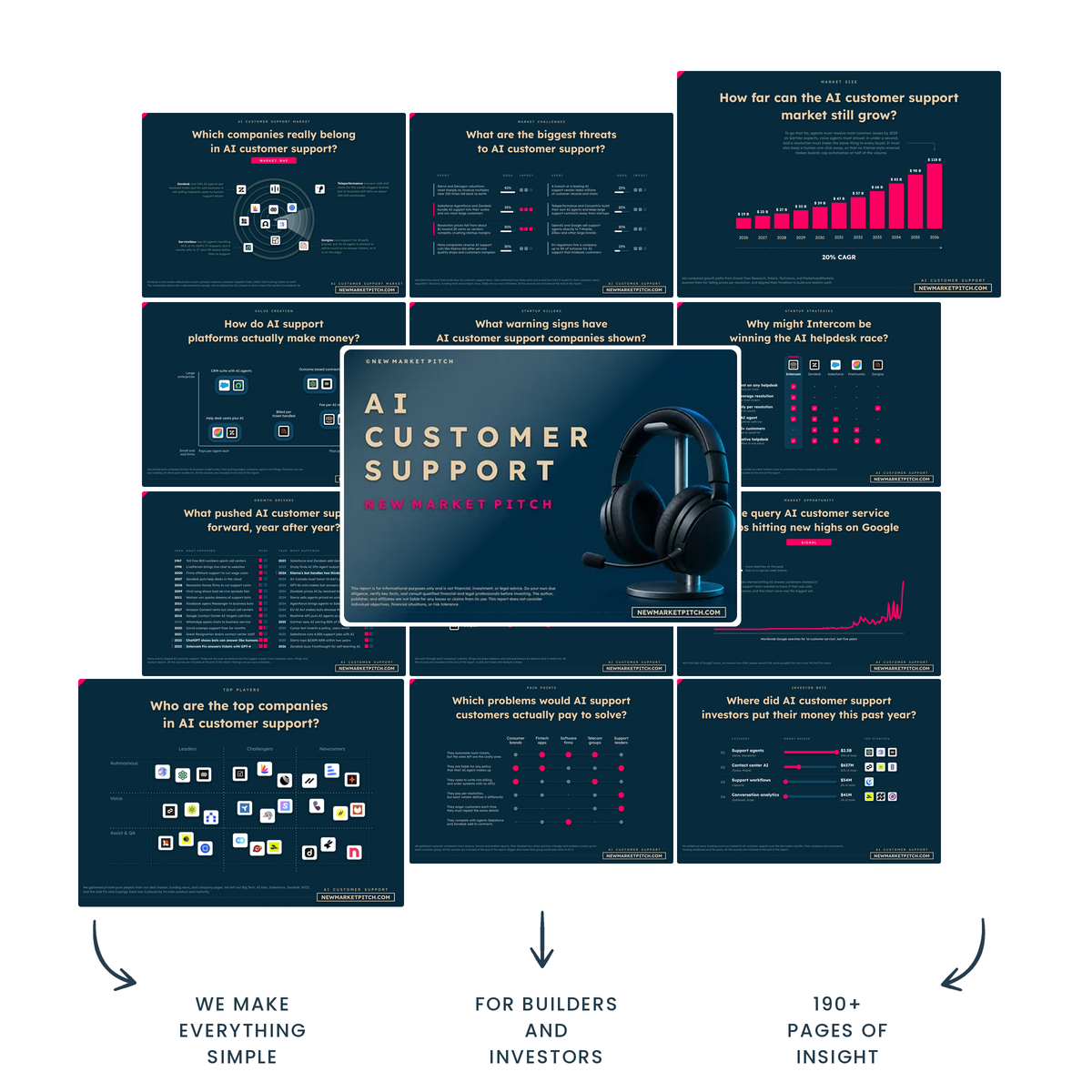
Whether you're building or investing in the AI customer support market, our report covers everything you need to know: the players, the money, and what's coming next.
Summary
Yes, AI support startups can make money charging per ticket. At roughly $1 per successful resolution, the economics can be attractive, especially when AI handles high volumes of repeatable requests. The bigger challenge is building a profitable business that survives falling prices, unsuccessful conversations, and expensive enterprise integrations.
The commercial model is already established. Intercom charges $0.99 per qualifying Fin outcome, Gorgias approximately $0.90 per AI-resolved interaction, and Zendesk advertises $1.50 to $2.00 per automated resolution. Businesses are increasingly buying completed support work rather than just access to software.
Resolution rates are high enough to make the model credible. Vendor-reported deployments at Lightspeed, Orthofeet, Dr. Bronner's, and Barn Owl achieved automation or resolution rates between 45% and 65%. These are selected success stories, but they show that automating roughly half of a suitable support workload is achievable.
Direct inference costs leave considerable room for profit. A hypothetical GPT-4.1 mini interaction using 10,000 input tokens and 2,000 output tokens costs approximately $0.0072 in model inference. Yet the economics depend on the cost of every attempted conversation, including those that never generate a billable resolution.
At $0.99 per resolution, a vendor spending $0.15 per incoming conversation earns a contribution margin of approximately 70% when it resolves 50% of requests. At 20% automation, that margin collapses to about 24%. Below roughly 15.2%, the vendor loses money before fixed expenses.
Scale matters more than the headline price suggests. A startup charging $0.99 needs approximately 84,200 monthly paid resolutions to generate $1 million in annual usage revenue. With $5 million in annual fixed costs and $0.79 contribution per resolution, break-even requires about 6.33 million paid resolutions annually.
Enterprise demand is substantial, but profitability remains less visible. Sierra reported reaching $100 million in annual recurring revenue in November 2025. That demonstrates serious customer spending on AI support agents, although it does not establish Sierra's profitability or how much revenue comes specifically from per-ticket contracts.
Billing definitions create another economic risk. Some providers recognize assumed resolutions when customers stop responding, even without explicit confirmation that the problem was solved. At 100,000 claimed monthly resolutions, a 5% classification difference represents $4,950 in monthly charges at $0.99 per outcome.
The strongest customer segment combines high ticket volume, repeatable transactions, and reusable integrations. Ecommerce is particularly attractive because many merchants share similar order, return, and subscription workflows. Small customers requiring extensive custom engineering can destroy otherwise attractive ticket margins.
Basic FAQ automation will face growing price pressure, and better customer experiences may eventually reduce the number of tickets available to bill. The most defensible AI support startups will be those that reliably complete complex, valuable transactions at low total cost, rather than depending on a permanent $1 price for answering routine questions.

Written by the New Market Pitch teamWe track new markets so founders and investors can move faster. About us
Why are AI support companies charging per resolved ticket?
AI customer support companies are increasingly charging for resolved tickets because businesses want to pay for work completed rather than another chatbot subscription.
Traditional helpdesk software usually charges per agent seat. AI changes that calculation: a company can handle more customer requests without increasing its support team at the same rate. Charging for successful resolutions gives buyers a direct way to compare the price of automation with the cost of human support.
Several major vendors now offer this model. Intercom's Fin advertises $0.99 per qualifying outcome, Gorgias charges approximately $0.90 per AI-resolved interaction on most plans, and Zendesk lists $1.50 per committed automated resolution or $2.00 on a pay-as-you-go basis. Enterprise discounts and contract terms can change those prices.
The interesting development is that customers can buy support work almost like a utility. Instead of paying primarily for access to software, they pay each time the software completes a task. That makes AI support easier to sell, while forcing vendors to prove that their resolutions are genuine and worth the money.
Does an AI support startup get paid for every ticket its chatbot touches?
No. AI support startups generally earn outcome-based fees only when a conversation meets the vendor's definition of a successful resolution.
Intercom charges for qualifying Fin outcomes rather than individual messages. One conversation can contain several questions without generating multiple resolution fees. Gorgias separates AI-resolved interactions from the ticket volumes covered by its underlying helpdesk plans. Zendesk also distinguishes automated resolutions from the conversations and messages used to produce them.
Those differences can change revenue substantially.
Suppose a startup receives 100,000 monthly customer conversations and resolves 50% of them. At $0.99 per resolution, it earns $49,500 in monthly usage revenue. The other 50,000 conversations may still consume computing resources even though they produce no resolution revenue.
There is also a measurement problem. Some providers count a conversation as resolved when a customer explicitly confirms that the answer helped. Others also recognize cases where the customer stops asking for assistance. Those outcomes are not necessarily equivalent, particularly when customers return later with the same problem.
So a startup's reported resolution rate tells us relatively little unless we also understand which conversations qualified, how many were escalated, and whether customers actually received the help they needed.

A good product starts with a real problem. In our report covering the AI customer support market, we show you the ones customers still live with.
Can companies really save money paying $1 per AI support ticket?
Yes. Paying around $1 for an automated support resolution can save businesses considerable money, particularly when human agents would otherwise spend several minutes handling the same request.
Take a support operation with a fully loaded labor cost of $24 per agent-hour. A six-minute conversation represents $2.40 in handling cost. Replacing that work with a $0.99 AI resolution would save approximately $1.41, or 59%, before accounting for other expenses.
A 12-minute ticket costs approximately $4.80 in human handling time, making the potential saving much larger. The customer would save $3.81 on that ticket under the same assumptions.
Real deployments point in the same direction. Gorgias reports that Dr. Bronner's automated 45% of its support interactions and saved approximately $100,000 annually after switching from Salesforce. That reported saving includes broader changes to the support platform, so we cannot attribute the entire amount to AI automation.
There is another catch: handling-time savings do not automatically become payroll savings. A company paying fixed salaries may simply give employees more capacity until it can reduce outsourced work, avoid new hires, or reorganize the team.
At roughly $1 per resolution, vendors can charge a meaningful amount while leaving buyers with room to save money. That goes a long way toward explaining why outcome-based billing has gained traction.
How much revenue can AI support startups make from ticket fees?
An AI support startup charging $0.99 per resolution needs roughly 84,200 paid resolutions per month to generate $1 million in annual usage revenue.
That is an achievable volume across several large enterprise customers, but a demanding target for a vendor serving mostly small businesses.
At a 50% automation rate, the startup needs approximately 168,400 incoming conversations each month to reach that $1 million annual revenue level. Improving automation to 70% lowers the required inbound volume to about 120,300.
The difference between customer sizes is enormous. A small retailer receiving 2,000 tickets monthly generates just $990 in monthly revenue for the vendor at 50% automation. A company handling 200,000 tickets can generate $138,600 at 70% automation.
We modeled how the economics change across customer sizes using the same $0.99 resolution price. The figures exclude subscriptions, enterprise discounts, minimum commitments, and implementation fees.
| Incoming tickets/month | AI resolution rate | Monthly revenue | Annualized revenue |
|---|---|---|---|
| 2,000 | 50% | $990 | $11,880 |
| 5,000 | 50% | $2,475 | $29,700 |
| 10,000 | 50% | $4,950 | $59,400 |
| 25,000 | 50% | $12,375 | $148,500 |
| 50,000 | 60% | $29,700 | $356,400 |
| 100,000 | 60% | $59,400 | $712,800 |
| 200,000 | 70% | $138,600 | $1,663,200 |
| 500,000 | 70% | $346,500 | $4,158,000 |

If you build or invest in the AI customer support market, you need to know which business models pay off now and which ones are fading. That's why our report covering it has a whole section on it.
Can AI support agents actually resolve half of customer tickets?
Yes. Several commercial AI support deployments have reached resolution or automation rates around 50%, although their reported figures use different measurement methods.
Intercom reports that Lightspeed Commerce achieved up to 65% resolution with Fin. Gorgias says Orthofeet automated 56% of tickets within two months, while Dr. Bronner's reached 45%. My AskAI reports that Barn Owl achieved 47% AI resolution across approximately 700 monthly AI-handled tickets.
Across those four cases, the reported rates range from 45% to 65%, with an unweighted average of approximately 53%. That comparison gives us useful real-world examples, although the definitions, customer workloads, and measurement periods are different.
We also need to consider who published the results. These are vendor-selected customer stories, generally chosen because the deployment went well. They cannot establish the average automation rate across the whole industry.
Still, automating approximately half of a suitable support workload is already realistic. Assuming every customer can reach that level would be much harder to defend, especially in industries where requests involve sensitive information, complex decisions, or unusual technical problems.
If you want more recent data on this point, please see our latest AI customer support market report.
What does an AI support ticket actually cost the startup?
An AI support startup can process a routine text conversation for far less than $1 in direct computing expenses, but its fully loaded cost per successful resolution is considerably harder to establish.
OpenAI's published GPT-4.1 mini pricing provides a useful reference. At $0.40 per million input tokens and $1.60 per million output tokens, a hypothetical interaction using 10,000 input tokens and 2,000 output tokens costs approximately $0.0072 in model inference.
Even five equivalent model calls would cost about $0.036. That helps explain how a provider could charge close to $1 while keeping direct inference costs relatively low.
However, real support systems also pay for knowledge retrieval, databases, external APIs, orchestration, monitoring, infrastructure, and sometimes human review. More complicated tickets may require additional model calls or larger models. Published token prices cannot tell us what Intercom, Sierra, or Decagon actually spends per resolution.
The other important issue is failed attempts. A startup that spends $0.15 on every incoming conversation and resolves 50% pays an effective $0.30 in variable costs per paid resolution. At $0.99 in revenue, that leaves a contribution margin of approximately 70%.
At the same cost per attempt, increasing the resolution rate to 70% reduces effective cost per successful outcome to approximately $0.21. The contribution margin rises to roughly 78%.
We calculated the effect of different processing costs on a vendor charging $0.99 per successful outcome, holding resolution at 50%. These figures are scenarios, not reported company margins.
| Cost per AI attempt | Cost per paid resolution | Contribution margin |
|---|---|---|
| $0.03 | $0.06 | 93.9% |
| $0.05 | $0.10 | 89.9% |
| $0.10 | $0.20 | 79.8% |
| $0.15 | $0.30 | 69.7% |
| $0.20 | $0.40 | 59.6% |
| $0.25 | $0.50 | 49.5% |
| $0.35 | $0.70 | 29.3% |
| $0.50 | $1.00 | -1.0% |

Learning from others' mistakes is the cheapest lesson there is. In our market report about AI customer support tools, we look at what broke startups before you, so you don't repeat it.
Can failed AI conversations make per-ticket pricing unprofitable?
Yes. AI support startups can lose money on outcome-based contracts when too many customer conversations consume computing resources without generating billable resolutions.
Suppose a provider spends $0.15 per attempted conversation and charges $0.99 for each successful resolution.
At 60% automation, every 100 incoming conversations generate $59.40 in revenue and $15 in variable costs. That leaves $44.40 before fixed expenses, equivalent to a 74.7% contribution margin.
At 20% automation, the same workload generates just $19.80 in revenue against $15 in costs. The contribution margin falls to 24.2%.
Below approximately 15.2% automation, the provider loses money at the variable-cost level.
This risk becomes especially important when customers ask AI agents to handle complex requests. An order-status question may take seconds, whereas resolving a disputed transaction could require several database checks, repeated reasoning, account verification, and human escalation.
The vendor has a strong incentive to improve automation, but pushing agents to handle unsuitable cases can create customer-service problems. An outcome-based contract works best when the provider can keep failed attempts cheap without compromising quality.
Are AI support companies counting customer silence as a successful resolution?
Yes. Some AI support systems count conversations as resolved when customers leave without asking for additional help, which makes reported resolution rates worth examining carefully.
Intercom's Fin methodology distinguishes confirmed resolutions from assumed resolutions. A confirmed resolution involves positive customer feedback, while an assumed resolution can occur when the customer stops requesting assistance after receiving an answer.
There is a reasonable argument for using that approach. Many customers receive the information they need and leave without explicitly confirming anything. Requiring positive feedback for every successful interaction would underestimate automation.
But silence also has other explanations. A customer may give up, abandon the purchase, or decide to contact the company through another channel.
The financial implications are measurable. For a vendor claiming 100,000 monthly resolutions at $0.99 each, a 5% classification difference represents 5,000 outcomes and $4,950 in monthly charges.
Intercom also revised elements of Fin's reporting methodology in 2026, affecting how involvement and resolution metrics are calculated while leaving its stated billing and automation-rate treatment unchanged. Historical figures therefore need to be compared using consistent definitions.
The best evidence of genuine automation comes from completed transactions, customer feedback, low repeat-contact rates, and audits that confirm the original problem was solved. A disappearance from the chat window is weaker evidence.

When you build or invest in the AI customer support market, you need clarity, not confusion. In our document detailing everything you need to know about AI customer support, we always try to put numbers on and quantify whatever is usually vague and confusing.
Do companies actually prefer paying per resolved ticket?
Not always. Per-resolution pricing is attractive to AI support buyers, but some enterprises prefer paying for conversations because the resulting bills are easier to predict and audit.
Decagon offers both per-conversation and per-resolution pricing. In its published explanation of those models, the company says most customers have gravitated toward per-conversation contracts.
Under Decagon's conversation model, customers pay for the conversation rather than exclusively for a verified successful outcome. Under the resolution model, the charge is higher for successful resolutions, while escalated conversations are excluded from outcome billing.
The preference is understandable. When success is difficult to define, conversations are easier to count. A company can forecast expenses using anticipated support traffic instead of negotiating what qualifies as completed work.
Per-resolution pricing can still be the better offer for customers worried about poor automation. It shifts more financial risk to the vendor because unsuccessful attempts may not generate revenue.
Both billing methods have a place. Customers focused on measurable success may favor paid resolutions. Those seeking predictable costs and simpler accounting may prefer conversation-based contracts. The market may well retain both rather than converge on a single pricing unit.
If you want more recent data on this point, please see our latest AI customer support market report.
Can an AI support startup become profitable without subscriptions?
Yes. An AI support startup can theoretically become profitable on resolution fees alone, but the volume required can be surprisingly large once salaries, sales, integrations, and infrastructure are included.
Suppose a company charges $0.99 per resolution and spends an average of $0.20 in variable costs per paid outcome, including costs allocated from unsuccessful attempts. It earns $0.79 in contribution per resolution.
At one million annual paid resolutions, that produces $790,000 before fixed expenses. At ten million resolutions, the contribution reaches $7.9 million.
Now assume the company has $5 million in annual fixed operating expenses. It needs approximately 6.33 million paid resolutions per year, equivalent to 527,000 per month, to break even under those assumptions.
That could come from roughly 20 enterprise accounts averaging 26,400 monthly resolutions each. It could also require hundreds of smaller customers, with far more sales and servicing work.
The customer mix makes a huge difference. A company selling standardized automation to large businesses has a different cost structure from one building custom workflows for dozens of small accounts.
There is currently too little public information about individual AI support startups' total operating expenses to conclude that the industry has already achieved consistently strong net margins.

In our report covering the AI customer support market, we look at what the winners do differently, so you can learn from the best instead of guessing.
Are AI support startups already making serious money?
Yes. Enterprise AI support startups have demonstrated that they can generate substantial recurring revenue, even though public revenue figures tell us little about their profitability.
Sierra announced in November 2025 that it had reached $100 million in annual recurring revenue around seven quarters after its February 2024 launch.
The company's disclosed customers include Deliveroo, Discord, Ramp, Rivian, SoFi, Sonos, ADT, Cigna, and SiriusXM. That range is important because customer-service automation is being purchased across financial services, transportation, retail-related businesses, communications, and consumer technology.
Reaching a nine-figure recurring revenue run rate so quickly is strong evidence that enterprises are willing to spend serious amounts on AI agents.
However, Sierra has not publicly broken down enough financial information to establish how much of its revenue comes specifically from per-ticket charges, what its average production cost is, or whether its business is profitable.
We can be much more confident about the existence of significant demand than about the profitability of individual startups.
Are simple AI support tickets becoming too cheap to build a business around?
Routine AI support tickets are becoming easier for competitors to automate, which makes basic question-answering a weak source of lasting pricing power.
Order tracking, return policies, subscription changes, and simple troubleshooting are common across thousands of businesses. These tasks generally require a language model, access to company information, and reliable integrations.
That makes the technology increasingly accessible. Startups can build on commercially available foundation models, while established customer-service platforms can add similar capabilities to products customers already use.
We can already see several competing pricing approaches across the market. As discussed earlier, major support providers advertise automated resolutions at different price points, and Salesforce offers AI consumption through conversations and Flex Credits. These are not perfectly comparable billing units, but buyers have several ways to purchase similar automation capabilities.
A startup selling only routine FAQ automation has little protection against competitors offering comparable results for less money.
The more interesting businesses are moving deeper into actual customer-service workflows. Processing refunds, verifying accounts, modifying orders, handling exceptions, and safely accessing internal systems all create opportunities for differentiation.
Those tasks are harder and more expensive to automate, but they also create stronger reasons for customers to keep paying a specialized provider. Basic chatbot answers are unlikely to command premium prices forever.

In our research about AI customer support tools, we always try to gather several sources and make estimates that make sense, so you can work with solid numbers.
Can AI support startups beat Zendesk and Salesforce?
Independent AI support startups can win enterprise customers against Zendesk and Salesforce, but competing with products already embedded in a company's support operations is getting harder.
Established platforms have a built-in distribution advantage. They already manage customer records, support tickets, permissions, workflows, and agent interfaces. Adding an AI agent to that environment can be simpler than introducing another vendor.
Zendesk's acquisition of Forethought in March 2026 illustrates how seriously incumbents are treating AI automation. Salesforce has integrated Agentforce into its enterprise software, while Intercom has continued developing Fin as a specialized AI support product.
At the same time, Fin can operate alongside external helpdesks. That shows independent automation software can compete without forcing customers to replace their entire support platform.
The challenge is proving enough additional value to justify a separate contract, integration, security review, and operating relationship.
For routine tickets, the incumbent's convenience can be difficult to overcome. For complex workflows where a specialist consistently resolves more requests, an independent vendor has a much stronger selling argument.
We expect product performance to matter most where the difference in automation quality creates measurable financial savings. Elsewhere, the company already managing the tickets has an obvious advantage.
If you want more recent data on this point, please see our latest AI customer support market report.
Can expensive customer integrations wipe out AI support profits?
Yes. Custom enterprise integrations can consume months of an AI support startup's ticket revenue, particularly when the customer has relatively little support traffic.
Automating customer service often requires access to order systems, payment platforms, CRMs, identity verification, internal databases, and business-specific policies. Every integration needs testing, permissions, error handling, and maintenance.
Let's use the earlier illustrative contribution of $0.79 per resolved ticket.
A customer generating 5,000 paid resolutions monthly contributes $3,950 per month before customer-specific engineering costs. If connecting that customer requires $40,000 of implementation work, the startup needs more than ten months of contribution to recover the initial expense.
For a customer generating 100,000 paid resolutions monthly, the same unit economics produce $79,000 of monthly contribution. The $40,000 implementation cost becomes much easier to absorb.
This explains why enterprise volume and reusable connectors are so valuable.
A vendor repeatedly building custom integrations for small accounts may end up operating like a consulting firm. A company that connects hundreds of customers through standardized systems can spread the engineering cost across a much larger revenue base.
The amount a startup earns per ticket matters, but the number of times it can reuse the same technology may matter just as much.

In our market report about AI customer support tools, we turn what is vague and complex into simple, useful visuals. Market maps like this one show you at a glance where every startup stands.
Which customers are best for AI support startups: ecommerce, SaaS or banks?
Ecommerce offers some of the easiest workflows to repeat across customers, while SaaS and financial services can offer more valuable tickets at the cost of greater complexity.
Online retailers receive large volumes of familiar questions about shipping, returns, exchanges, subscriptions, and product availability. Many use common commerce platforms, making integrations reusable.
Gorgias deployments at Orthofeet and UKLASH illustrate this model. Once an AI agent can access order information and apply return policies reliably, similar capabilities can serve other merchants.
SaaS support brings different problems. Billing questions and basic account administration are relatively straightforward, but product bugs, unusual configurations, and detailed troubleshooting may require extensive technical context.
Financial services can justify expensive automation when inquiries involve sensitive or time-consuming processes. Sierra's work with Ramp and SoFi demonstrates commercial interest in this market. However, payments, identity verification, and regulated interactions introduce additional security and operational requirements.
Our preference would be for businesses that automate repeatable transactional workflows across multiple customers. Ecommerce is a natural starting point, although sophisticated financial-service workflows may eventually support higher-value contracts.
The worst combination is a small customer, low ticket volume, and heavily customized automation. Even attractive per-ticket margins struggle to compensate for that amount of engineering work.
Could AI support startups lose revenue by making customer service too good?
Yes. A successful AI support startup can eventually reduce its own ticket revenue if better automation prevents customers from needing support in the first place.
The issue becomes clearer as automation rates rise.
Suppose a business receives 100,000 monthly conversations and pays $0.99 for each successful resolution. At 50% automation, the vendor earns $49,500 monthly. At 80%, revenue rises to $79,200. Increasing automation again to 90% brings revenue to $89,100.
The first improvement produces 60% revenue growth. The second produces just 12.5%.
As seen above, higher automation rates can improve contribution margins, but there is a natural limit to how many existing tickets the vendor can resolve.
Better customer-service systems can also prevent tickets entirely. Proactive shipping notifications, automatic billing corrections, self-service account management, and clearer product information can eliminate reasons to contact support.
Customers benefit from that reduction, but a vendor paid exclusively per resolution may earn less despite delivering a better overall experience.
There is a strange incentive here: a support company can become so effective at eliminating customer problems that it shrinks its own billable workload.
This is one reason broader outcome contracts, platform fees, or payments linked to customer savings could become more attractive over time. The most valuable AI support products may eventually prevent more problems than they resolve.
If you want more recent data on this point, please see our latest AI customer support market report.

Our document detailing everything you need to know about AI customer support gets updated several times a month, so you always get the latest view of where things stand.
Can bad AI support cost companies more than it saves?
Yes. Poor AI customer support can erase labor savings when customers need repeated assistance, receive incorrect information, or abandon transactions.
Klarna provides one of the clearest examples of why automation volume should be treated carefully.
In 2024, the company announced that its AI assistant had handled 2.3 million customer-service conversations during its first month, representing approximately two-thirds of its support chats. Klarna also reported faster average resolution times and an estimated workload equivalent to hundreds of full-time agents.
Those were unusually large deployment figures, but the company's position evolved. In 2025, Klarna publicly acknowledged shortcomings in service quality following its aggressive automation push and emphasized rebuilding access to human support.
The episode does not establish that Klarna's AI assistant lost money. It does show how strong automation metrics can coexist with concerns about the customer experience.
The same problem appears at the individual ticket level. An AI agent that correctly answers a delivery question creates a straightforward saving. An agent that incorrectly authorizes a refund, mishandles an account restriction, or gives misleading financial information can create much larger costs.
For customers, the relevant comparison is the total cost of providing acceptable support, including repeat contacts, mistakes, lost sales, and human escalation.
AI providers capable of reducing those costs consistently should have an easier time defending their fees than companies relying on headline automation percentages.
Will AI support companies have to charge less than $1 per ticket?
Prices for routine AI support resolutions will likely face pressure, but there is not enough consistent historical pricing data to claim that industry-wide prices are already falling at a measurable rate.
The competitive pressure is clear. Foundation models are widely available, inference can be inexpensive, and multiple established support vendors already sell automation. Basic tickets offer limited room for permanent differentiation.
However, publicly advertised prices are difficult to compare directly. Some providers charge for resolutions, others for conversations or actions, and enterprise agreements often include discounts, commitments, and additional services.
We can still measure how sensitive profitability is to price cuts.
Suppose an AI support startup has $0.20 of variable cost per successful billable resolution. At a selling price of $0.99, its contribution is $0.79. If competition forces the price down to $0.50 without changing production costs, contribution falls to $0.30.
That is a revenue-price decline of approximately 49.5%, but a much steeper 62% reduction in contribution per ticket.
Cheaper inference can help offset that pressure. Yet sophisticated support workflows also require integrations, security, monitoring, and reliability, whose costs do not necessarily fall at the same rate as model tokens.
For now, we expect the strongest pricing pressure to fall on routine text-based requests. Companies proving they can safely complete complex transactions should have more room to defend higher prices.

In our report covering the AI customer support market, we don't want to repeat what boring consulting reports say. Instead, we show you the real and latest market signals that matter.
Can AI support startups make money charging per ticket?
Yes. AI support startups can make money charging per ticket, and the business model already has credible commercial evidence behind it. What remains unproven is whether most independent vendors can build lasting profits as competition gets tougher.
Our research points to several encouraging facts. Established vendors already charge roughly $1 or more for automated outcomes. Real customer deployments have reported automation rates around 45%–65%. Public model pricing shows that straightforward AI conversations can cost only a few cents in inference, leaving considerable room for gross profit.
Sierra's reported $100 million annual recurring revenue also demonstrates how quickly enterprise demand for AI customer-service automation can grow. That figure does not establish Sierra's profitability or the share of revenue attributable specifically to per-ticket contracts.
The weaknesses are equally concrete. Failed conversations consume resources, some claimed resolutions are difficult to verify, custom integrations can be expensive, and established helpdesk companies already have relationships with the same buyers.
There is also a ceiling to what basic ticket automation can command. As models become cheaper and more capable, answering routine questions becomes easier for competitors. Startups depending entirely on those workflows will struggle to defend premium pricing.
We think the most attractive companies will be those automating high-volume, repeatable transactions with low failure costs and limited customer-specific engineering. They can make money from individual resolutions while building deeper connections to the customer's operations.
So the answer is clearly yes, with an important distinction: per-ticket charging is already a viable way to monetize AI support, but it does not guarantee a durable business. The startups that ultimately make the most money will be the ones that reliably solve expensive customer problems at a low total cost, even when competitors can offer a basic chatbot for almost nothing.
If you want more recent data on this point, please see our latest AI customer support market report.
Our methodology
This analysis examines whether AI support startups can build profitable businesses around per-ticket pricing. Because the answer depends on several interconnected economic variables, we divided the question into distinct dimensions: commercial pricing, actual automation performance, customer savings, technical costs, billable resolution definitions, operating profitability, integration requirements, and competitive pressure.
For each dimension, we collected recent, directly observable evidence, prioritized primary disclosures, aggregated the most relevant findings, and assessed what those findings could establish. We then compared the results across dimensions to identify where commercial adoption, technical performance, and financial economics support the same conclusion, and where the available evidence remains less conclusive.
We distinguished several billing units that are sometimes grouped together in discussions of AI customer support: tickets, conversations, automated resolutions, qualifying outcomes, and usage credits. Our comparisons use the definitions published by individual providers, rather than assuming that differently labeled billing events represent identical services. Enterprise discounts, contractual commitments, and bundled services may also produce different effective prices from publicly advertised rates.
We evaluated deployment performance through documented customer cases, including reported automation rates, resolution rates, and operational savings. These observations provide evidence of what AI support systems have achieved in production, but are not treated as representative industry averages. We also examined how vendors define successful resolutions, including assumed outcomes, escalations, and reporting changes, because measurement differences affect both claimed automation performance and potential billing revenue.
To investigate the financial model, we constructed reproducible scenarios using explicit assumptions about incoming conversation volumes, resolution rates, revenue per outcome, variable processing costs, and annual operating expenses. Revenue is calculated from paid resolutions, while processing costs also account for unsuccessful attempts. Contribution margins, price sensitivities, implementation payback periods, and break-even volumes are model outputs rather than reported financial results for specific startups.
We assessed commercial traction separately from profitability. Disclosed revenue milestones establish that enterprise customers are spending substantial amounts on AI agents, but do not reveal a vendor's full production costs, contract-level economics, or net margins. We also distinguished customer labor savings from realized reductions in operating expenses, since avoided handling time does not necessarily translate into immediate payroll savings.
Finally, we assessed the sustainability of the model through competitive developments, the availability of commercially accessible AI technology, incumbent distribution advantages, and the engineering requirements of more complex transactional workflows. This allowed us to evaluate which economic advantages appear repeatable across customers and which depend on favorable deployment conditions or pricing assumptions.
Key pricing and measurement sources include Intercom's official pricing, Intercom's Fin outcome definitions, Gorgias' AI Agent pricing explanation, Zendesk's pricing, Zendesk's automated resolution tiers, Decagon's comparison of conversation and resolution billing, and Intercom's 2026 performance-metric update.
For actual deployment performance, we examined Intercom's Lightspeed Commerce case, Gorgias' Orthofeet deployment, Gorgias' Dr. Bronner's case, My AskAI's Barn Owl results, and Gorgias' UKLASH deployment. Technical cost assumptions were benchmarked against OpenAI's published GPT-4.1 mini model pricing.
For revenue, competition, and market development, principal sources include Sierra's $100 million ARR announcement, Salesforce's Agentforce pricing, Zendesk's acquisition of Forethought, Klarna's original AI assistant deployment announcement, and Intercom's documentation of transactional AI agents.
Our conclusions are based on the combined weight of these observations and the modeled economics. In particular, we separated proof that AI support can be sold at meaningful prices, proof that it can automate substantial workloads, and proof that a provider can earn attractive margins after all relevant costs. Assessing those dimensions together gives a more defensible answer to whether per-ticket pricing can support a profitable and durable AI support business.

In our research about AI customer support tools, you will always find fresh funding data, taken straight from our own verified funding database.
Written by the New Market Pitch teamWe track new markets so founders and investors can move faster. About us