Will Democrats stop new AI data centers?
Whether you're building or investing in the AI data center market, our report covers everything you need to know: the players, the money, and what's coming next.
Summary
No, Democrats are unlikely to stop new AI data centers across the United States. They can still kill individual projects, hold up many more and make developers pay much more to get new campuses built. The likely result is a slower and more expensive buildout, especially in states where power, water and local opposition are already tight.
The midterms made that risk much bigger. Democrats won control of both chambers of Congress and governorships in Texas, Georgia and Ohio. At the local level, the vote was even harsher for developers: the Associated Press reported that restrictions won in 44 of the 45 completed data center referendums tracked by Redbud Consulting.
Wall Street is taking the change seriously. Goldman Sachs estimates that states where Democrats could tighten data center rules account for roughly 45% of planned US capacity, and Texas alone represents about 25%. Goldman still expects most moratoriums to be short, so that share is better read as capacity facing new political risk than capacity likely to disappear.
Texas is the biggest test because the pressure there started before Democrats won. Republican Governor Greg Abbott ordered a grid audit in August, halted state permits in September and told regulators to make data centers cover the electrical infrastructure they need. Governor-elect Gina Hinojosa campaigned for a statewide moratorium until stronger protections are in place.
Ohio adds a different kind of risk. The Associated Press counted 21 local data center referendums there, and Governor-elect Amy Acton backed a conditional moratorium during the campaign. In Piqua, 66.7% of voters approved a charter amendment banning construction of data centers above 25 MW even though the city already had a large project underway.
Georgia matters because so much construction is already happening there. Reuters reported that CBRE ranks Atlanta as the country's most active data center construction market. Governor-elect Keisha Lance Bottoms campaigned on tougher oversight, although Georgia has not yet laid out anything as specific as the Texas pause.
New York gives a clearer picture of what tougher Democratic policy can look like. Governor Kathy Hochul paused certain state permits for new hyperscale data centers for up to one year while New York writes broader rules on grid costs, energy, water and community impacts. Her administration also wants massive data centers to lose their state sales-tax exemption.
Across those states, electricity bills are becoming the easiest issue for politicians to act on. Texas and New York are already pushing more grid costs onto large data center customers, and the Senate has now advanced a bipartisan energy bill that would also make large operators bear more of the cost of grid upgrades. A government does not need to ban AI infrastructure to make a marginal project much harder to finance. Power bills are easy for politicians to act on and hard on developers; see our report on AI data centers for who would pay for what.
Developers still have options. Early projects can move to states with enough electricity, land, fiber and faster approvals, while projects with permits, utility agreements and construction already underway are much harder to relocate. That split is why local bans can kill some sites without stopping national AI infrastructure spending.
So the answer is fairly clear now. Democrats can slow new AI data centers, force companies to pay more of their own infrastructure costs and push some projects into other states. Stopping the national buildout would require a much broader and longer-lasting set of bans than anything currently in place or proposed.

Written by the New Market Pitch teamWe track new markets so founders and investors can move faster. About us

A good product starts with a real problem. In our report covering the AI data center market, we show you the ones customers still live with.
How can Democrats actually block AI data centers?
Democrats now hold more levers over AI data centers than at any point in the boom, from city halls and governors' offices up to the next Congress.
The new restrictions come from several levels of government. Cities can ban large projects or reject zoning changes. Governors can pause permits. Utility commissions can make developers pay more for grid upgrades. Congress can add national rules on electricity costs, permitting or disclosure.
Goldman Sachs estimates that states where Democrats could tighten data center policy account for roughly 45% of planned US capacity. The same post-election analysis expects moratoriums to be short-lived, which is why we would not treat that share as capacity headed for cancellation.
The projects in the weakest position are still early in development and need zoning, permits or power agreements. Campuses that already own land, have utility contracts and have started construction have more ways to fight, adapt or keep moving.
What changed for AI data centers after the midterms?
AI data centers now face much stronger political resistance because Democrats won major state races just as local voters overwhelmingly backed new restrictions.
Democrats won control of the House and Senate and will take over both chambers in January. They also won governorships in Texas, Georgia and Ohio, three important states for current or planned data center construction.
The local vote was even more one-sided. The Associated Press reported that Redbud Consulting tracked 47 data center referendums in 44 municipalities across 12 states. Restrictions won in 44 of the 45 contests where counting was complete, including 21 measures in Ohio.
The opposition also reaches beyond Democratic candidates. Data Center Watch told AP that 32 of the 34 winning gubernatorial candidates in races already called supported stronger rules or restrictions, and 12 supported a ban or moratorium. Developers are now dealing with a broader local backlash at the same time Democrats have more power to act on it.
How much planned AI data center capacity could face tougher rules?
About 45% of planned US AI data center capacity sits in states where Democratic victories could lead to tighter rules, according to Goldman Sachs.
Texas drives more than half of that exposure. Goldman puts Texas at about 25% of planned US capacity, making one state unusually important to the national pipeline.
Those percentages measure policy exposure. They do not tell us how much capacity will be cancelled. A project can survive a moratorium by waiting, paying more for grid infrastructure, changing its cooling plan or moving to another site. Policy exposure and real cancellations are different things, and we keep our market size estimate and its assumptions visible in our AI data center market report.
Goldman's own view is useful here. The bank still expects the current moratorium issue to fade in importance and sees most pauses as short-lived. Earlier in the fall, Goldman also said US data center growth through 2027 remained broadly intact despite rising political opposition.

If you build or invest in the AI data center market, you need to know which business models pay off now and which ones are fading. That's why our report covering it has a whole section on it.
Is Texas now the biggest risk for new AI data centers?
Yes. Texas now stands out as the biggest political risk for new AI data centers because it combines roughly 25% of planned US capacity with an existing permit freeze and a governor-elect who campaigned for a moratorium.
Governor-elect Gina Hinojosa called for stopping new approvals until Texas passes stronger protections for residents and gives communities more say. Reuters reported after the election that she intends to keep pressing for laws that shield Texans from data center costs.
Texas was already tightening the rules under Republican Governor Greg Abbott. In August, Abbott ordered an audit of every data center moving through ERCOT's interconnection process. At the time, ERCOT was considering more than 474 GW of new connection requests, and Abbott's office said about 90% came from data centers.
The state went further in September. Abbott ordered the Texas Commission on Environmental Quality to halt permits sought by data centers until the audit was complete. He also directed stricter water reporting, told regulators to make developers fund their own electrical infrastructure and said he would seek to eliminate data center incentives in the next legislative session.
Hinojosa is therefore taking over a market that was already under pressure from both parties. Her biggest choice is how long the pause lasts and how much of Abbott's temporary crackdown becomes permanent law.
Could Democrats slow Georgia's AI data center buildout?
Probably, but Georgia still looks more likely to get tougher rules than a broad stop on new AI data centers.
Democrat Keisha Lance Bottoms won the governorship after campaigning on tighter oversight of data center development. Reuters also reported that CBRE ranks Atlanta as the most active data center construction market in the country, so even moderate delays there can affect a large amount of new capacity.
Georgia has not yet produced a policy package as specific as Texas. There is no equivalent statewide permit freeze already in force, and the incoming administration has more room to choose between utility-cost rules, local approval requirements, environmental standards and changes to incentives.
That makes Georgia important but less predictable. The risk today is that one of the country's busiest construction markets becomes slower and more expensive, not that the state suddenly closes to data centers.
Is Ohio turning against new AI data centers?
Increasingly, yes. Ohio is seeing unusually strong local resistance to new AI data centers, and the incoming governor also backed a conditional moratorium.
The Associated Press reported 21 data center referendums in Ohio during the wider national wave. Governor-elect Amy Acton said during the campaign that projects should be blocked unless they cover their utility costs, use union labor, operate transparently, meet environmental standards and provide community benefits.
Piqua gives us a concrete example of how far local voters are willing to go. Miami County election results show 66.7% of Piqua voters backed a charter amendment prohibiting construction of data centers above 25 MW. The City of Piqua says a large data center project was already underway and had signed development, water, wastewater and electric-service agreements before the vote. Local ballot fights like this are the kind of recent signal we track every quarter in our report on the AI data center market.
That creates the kind of legal fight developers now have to plan for. A state can welcome investment while individual cities put hard limits on where a campus can be built.

Learning from others' mistakes is the cheapest lesson there is. In our market report about AI data centers, we look at what broke startups before you, so you don't repeat it.
Will Democrats in Congress try to restrict AI data centers nationwide?
Only partly. Democrats are preparing national AI data center legislation, but a sweeping federal construction ban still looks unlikely while President Trump remains in office.
Reuters reported after the election that Democrats plan bills aimed at protecting consumers from higher electricity costs tied to data centers when they take control of Congress. They can also use hearings, spending bills and federal permitting rules to pressure the industry.
The first post-election test is already underway under the current Congress. The Senate voted 73-25 to advance a bipartisan energy-permitting bill that would speed power projects while requiring large data center operators to bear more of the cost of grid upgrades needed to serve them.
Trump still has veto power, and many of the strongest tools remain outside Washington. Local governments control zoning, state agencies issue key environmental permits, and utility regulators decide how huge new loads connect to the grid and who pays for the upgrades.
What new rules are most likely to hit AI data centers?
The most likely new AI data center rules make developers pay more of the costs they create and give communities more control over where projects go.
Texas already requires more scrutiny of electricity, water, ownership and local impacts before projects move forward. New York has paused certain permits while it writes statewide standards and is considering a grid fund, dedicated generation requirements and stronger community-benefit rules.
Ohio's incoming governor campaigned on full utility-cost coverage, transparency, union labor and environmental conditions. Local ballot measures add another layer because a city can require voter approval, impose size limits or ban a large project outright.
For developers, these rules can change the economics quickly. A campus that must fund grid upgrades, secure its own generation, use different cooling, negotiate community benefits and lose a tax break may still be buildable, but the original return can disappear.
The table below shows the main policy tools already appearing around new AI data centers.
| Policy tool | Where it is appearing | Main business effect |
|---|---|---|
| Permit moratorium | Texas, New York | Delays project starts |
| Grid audit | Texas | Holds up interconnection |
| Developer-funded grid upgrades | Texas, New York, federal bill | Raises upfront cost |
| Water reporting and limits | Texas, New York | Can force redesign |
| Local construction ban | Ohio and other municipalities | Can kill a site |
| Voter or community approval | Local proposals and campaigns | Adds political risk |
| Community-benefit rules | New York, Ohio proposals | Raises project obligations |
| Tax incentive cuts | New York, Texas proposals | Makes marginal projects less attractive |
| Dedicated generation requirements | New York proposal, Texas policy direction | Adds power investment |

When you build or invest in the AI data center market, you need clarity, not confusion. In our document detailing everything you need to know about AI data center, we always try to put numbers on and quantify whatever is usually vague and confusing.
Can local bans still stop AI data centers that are already underway?
Sometimes. Local AI data center bans have the most power before a project locks in its permits and contracts, while projects already underway can end up in a legal fight over what the new rule covers.
Piqua is a useful test. Voters approved a charter amendment banning construction of data centers above 25 MW, but the city says its large project already had development and utility agreements and was underway before the vote. City officials said after the election that they were reviewing how the amendment applies.
The same timing issue appears in moratoriums. New York's pause of up to one year excludes discretionary permit applications already deemed complete. That gives developers a strong reason to get projects through zoning, permitting and interconnection milestones before a new restriction takes effect.
A local vote can therefore stop a proposed site outright, but it becomes harder to unwind a campus after contracts, permits and construction have piled up.
Will stricter rules push AI data centers into other states?
In general, yes. Some AI data centers will move to states with faster approvals, especially projects that have not yet locked in land, power and permits.
HSBC analysts told Reuters that one plausible outcome is more regulation and oversight instead of broad moratoriums, with some projects simply moving out of Texas. Morgan Stanley made a similar point after the election, saying new state rules could split the country between places that remain open to new data centers and places where approvals are much harder. For where the money goes when projects move, our report covering the AI data center market looks at the investors and developers behind the shift.
Power is the main limit on that strategy. A hyperscale campus needs huge amounts of electricity, transmission capacity, fiber, land and either water or another workable cooling system. A friendly governor cannot create those things overnight.
The easiest projects to move are still on paper. A campus with a signed utility agreement, equipment orders and construction underway has much more money tied to its location. Stricter rules can therefore redirect the next wave of projects even while existing campuses stay put.
Which companies are most exposed if AI data center projects slow?
Data center developers and power companies with heavy exposure to Texas and other fast-growth states face the most immediate risk from slower AI data center approvals.
Reuters reported that Morgan Stanley put Cipher Digital, MARA Holdings and Galaxy Digital among the developers with major Texas exposure. J.P. Morgan highlighted Vistra, NRG Energy, Constellation Energy and Talen Energy as power companies that could come under pressure if expected data center loads arrive later.
Cloud companies face a different problem. Baird identified Oracle and CoreWeave as names that could be hurt by construction delays or moratoriums, while Morgan Stanley saw Applied Digital and TeraWulf as relatively better insulated because they have less Texas exposure.
The biggest hyperscalers have more room to adjust. Reuters said Amazon, Microsoft and Alphabet could be more resilient because their data center footprints and balance sheets are broader. Scarcer approved capacity can even make the campuses they already own or lease more valuable.
The table below shows where the main company exposure sits today.
| Group | Examples cited by analysts | Main risk |
|---|---|---|
| Texas-heavy developers | Cipher Digital, MARA Holdings | Delays or relocation |
| Digital infrastructure | Galaxy Digital | Texas project uncertainty |
| Power producers | Vistra, NRG Energy | Slower load growth |
| Power producers | Constellation Energy, Talen Energy | Delayed demand |
| Cloud companies | Oracle, CoreWeave | Slower capacity additions |
| Power equipment | Innio | Slower Texas bookings |
| Lower-Texas-exposure developers | Applied Digital, TeraWulf | Relatively insulated |
| Hyperscalers | Amazon, Microsoft, Alphabet | More diversified exposure |

In our report covering the AI data center market, we look at what the winners do differently, so you can learn from the best instead of guessing.
Are electricity bills becoming the biggest political problem for AI data centers?
Actually, yes. Electricity bills now rank among the hardest political problems for AI data centers because households can see a higher bill long before they see any benefit from extra computing capacity.
Texas has already told regulators that data centers must fully fund the electrical infrastructure needed to serve them so those costs do not move onto residential customers. New York's Public Service Commission is also rewriting large-load interconnection rules around the principle that data centers should bear the grid costs they create.
The issue has now reached Congress. The bipartisan permitting bill moving through the Senate includes provisions requiring large data center operators to pay more of the grid-upgrade costs linked to their demand.
That approach can attract support from politicians who still want AI investment. They can welcome new capacity while telling developers to bring more of their own power or pay for the new wires, substations and generation their campuses require.
Are water and land now major limits on AI data centers too?
Yes. New AI data centers increasingly need to solve power, water and local land approval at the same time.
Texas now asks projects for detailed water-use information, supply sources and cooling technology as part of its audit. The state has also threatened penalties when major water users fail to provide required reports.
New York's environmental review will examine water use and water quality alongside electricity demand and air quality. Local ballot measures add the land problem because voters can block a site even after a developer finds enough power. In our AI data center report, we rate the risks of power, water and land limits by probability.
The number of easy locations shrinks fast once all three conditions have to work together. A project can find electricity and lose on zoning, or secure industrial land and still fail on water or grid costs.
Will Democrats cut tax breaks for new AI data centers?
In some places, yes. Some Democratic governments are already targeting AI data center tax breaks, and Texas is moving in the same direction under a Republican governor.
New York Governor Kathy Hochul says she will pursue legislation to repeal sales-tax exemptions for massive data centers. Her July moratorium announcement paired that change with new rules on grid spending and community investment.
Texas Governor Greg Abbott has also said he will work with lawmakers to eliminate financial incentives for data centers. That gives tax policy a bipartisan path that permanent construction bans may not have.
Losing an incentive will not stop every project, but it can sink sites that only worked because cheap land, public infrastructure support and tax exemptions made the numbers add up.

In our research about AI data centers, we always try to gather several sources and make estimates that make sense, so you can work with solid numbers.
So will Democrats stop new AI data centers?
No. Democrats can kill individual AI data center projects and slow a large part of the pipeline, but they do not currently have a path to shut down the national buildout.
The clearest evidence comes from the states already acting. Texas has frozen permits and may keep tougher rules under its incoming Democratic governor. New York has a pause of up to one year tied to new standards. Ohio voters passed a wave of local restrictions, while Governor-elect Amy Acton backed a conditional moratorium. Georgia is likely to tighten oversight in one of the country's busiest construction markets.
Those actions can remove sites, push projects into other states and raise the cost of power, water and community approval. They can also make already-approved capacity more valuable because new supply becomes harder to build.
Demand for AI computing is still large, and developers can respond by moving early-stage projects, funding more of their own infrastructure or waiting out temporary pauses. Goldman Sachs still expects US data center growth to continue and most moratoriums to be short.
So the national AI data center boom is likely to keep going, only with more political fights and fewer easy approvals. Democrats now have enough power to change where projects get built and what companies must pay for them, but not enough to stop the industry across the country.
Our methodology
We built this answer around actions that can directly change whether a data center gets built: permit pauses, grid and utility rules, local bans and ballot measures, tax incentives, water requirements and explicit commitments from elected governors. We checked post-election results with Associated Press and Reuters reporting, then used first-hand records from Texas, New York, Ohio and Piqua for policies, campaign proposals and local project status. Campaign promises are treated as proposals until enacted, and local ballot measures are kept separate from statewide law.
The research runs through November 11, 2026. Election transitions are still moving, so we gave the most weight to completed votes, existing executive actions, official regulatory proceedings and direct statements from incoming officials. For Goldman's capacity-exposure estimate, we kept Reuters' description of planned capacity in states where Democrats could impose tighter rules and did not treat that number as expected cancellations. We also treated Texas as a bipartisan policy shift because Governor Greg Abbott had already ordered an audit, infrastructure-cost protections and a permit halt before Democrat Gina Hinojosa won the governorship. Piqua is used only as an example of the timing problem around local bans because official city records confirm the project was already underway and the Miami County Board of Elections records the vote itself.
Key primary sources include the Texas governor's data center audit order, the Texas order on data center grid costs and New York's hyperscale data center moratorium.

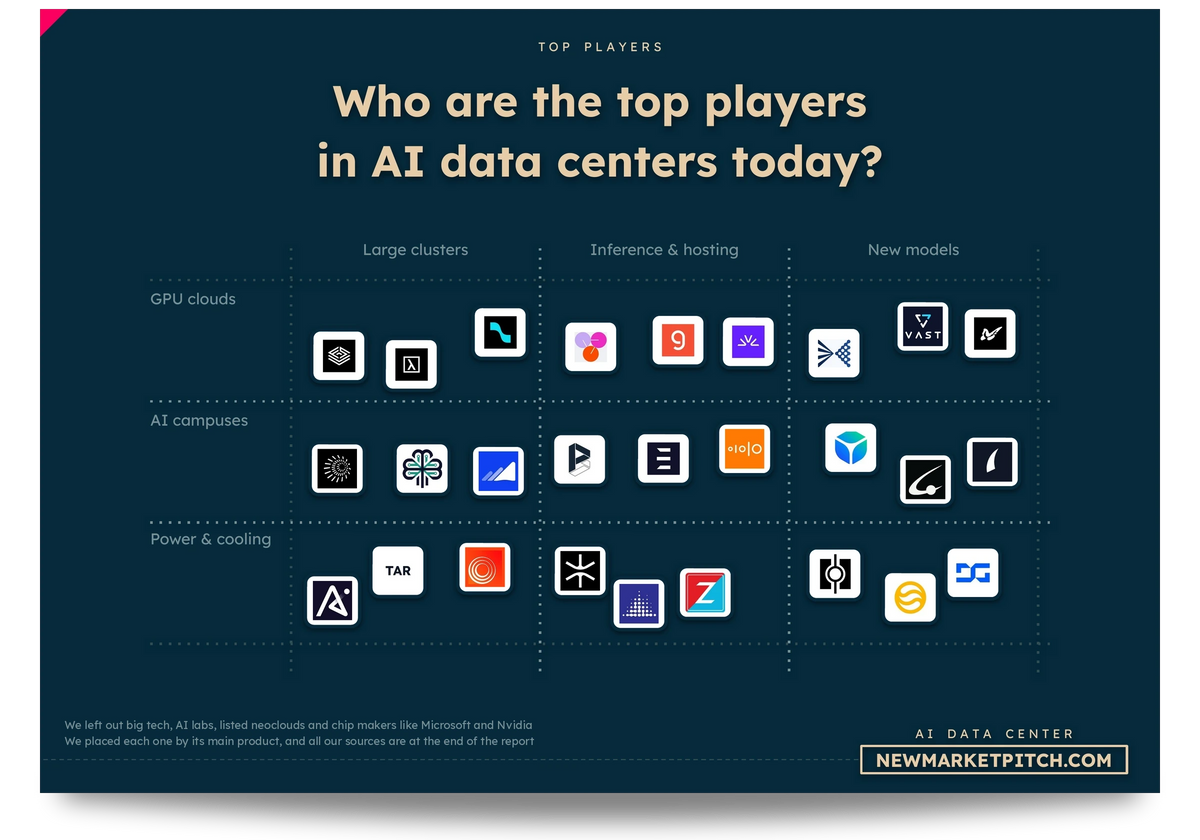
In our market report about AI data centers, we turn what is vague and complex into simple, useful visuals. Market maps like this one show you at a glance where every startup stands.
Written by the New Market Pitch teamWe track new markets so founders and investors can move faster. About us