How big is the AI data center market without counting chips?
Whether you're building or investing in the AI data center market, our report covers everything you need to know: the players, the money, and what's coming next.
Summary
The AI data center market without counting chips is roughly $250 billion to $350 billion a year globally, with about $300 billion as the most useful single estimate today.
Removing semiconductors cuts the headline AI infrastructure market dramatically. GPUs, CPUs, HBM, DRAM, NAND and networking silicon absorb roughly half or more of total AI data center capital expenditure, so trillion-dollar compute forecasts cannot be carried straight into the physical-infrastructure market.
The remaining market is still enormous because an AI data center is much more than a building around expensive GPUs. Construction, electrical distribution, liquid cooling, racks, cabling, networking equipment, storage hardware and dedicated power infrastructure can consume billions of dollars at a single large campus.
Construction alone understates the opportunity. Current shell-and-core costs are around $11.3 million per MW globally, while high-end AI technology fit-outs can reach multiples of that amount once dense power, cooling and networking are installed.
Power is becoming the defining non-chip bottleneck. Rack densities above 100 kW push spending upstream into transformers, substations, switchgear, UPS systems, busways and generation, and in many markets the ability to energize a site now matters more than simply finding available land.
Cooling is smaller in absolute dollars but unusually exposed to AI density. Liquid cooling is moving from a niche category toward a multi-billion-dollar market because the hottest AI racks can no longer be handled economically with conventional air cooling alone.
Networking also survives a chip-free definition. Once the semiconductor content is removed, AI clusters still require large amounts of switches, optical modules, fiber, cabling, network cards, chassis and integration work as thousands of accelerators are connected into one system.
Hyperscalers dominate the buildout, but they are no longer the whole market. Oracle, neoclouds, sovereign AI programs and specialized infrastructure operators are creating a second tier of very large buyers, spreading AI data center construction beyond the traditional US cloud giants.
AI appears to account for roughly four-fifths of projected incremental data center capacity growth through 2030 in McKinsey's current scenario. That helps explain why physical-infrastructure suppliers can grow far faster than mature enterprise IT even though the installed data center base still serves many non-AI workloads.
Our base case is that chip-free AI data center spending can rise toward roughly $400 billion to $500 billion annually by the end of the decade. Against about $5.2 trillion of projected AI-related data center investment through 2030, around $2.1 trillion to $2.4 trillion could ultimately sit outside semiconductor value.

Written by the New Market Pitch teamWe track new markets so founders and investors can move faster. About us

In our report covering the AI data center market, we always try to gather several sources and make estimates that make sense, so you can work with solid numbers.
What counts as the AI data center market if we remove chips?
The AI data center market excluding chips is currently worth roughly $250 billion to $350 billion a year globally, once we count the infrastructure needed to house, power, cool, connect and operate AI compute.
For this estimate, we include data center construction, electrical systems, cooling, racks, cables, non-semiconductor server components, networking hardware after removing its chip content, storage systems after the same adjustment, and infrastructure directly tied to supplying power to the facility.
GPUs, CPUs, AI accelerators, HBM, DRAM, NAND and other semiconductor value are excluded.
That distinction immediately removes a huge chunk of what many reports call “AI infrastructure.” IDC, for example, measured $318 billion of AI infrastructure spending in 2025, with servers representing almost 98% of the total. An AI server can cost hundreds of thousands of dollars largely because of the processors and memory inside it, so that number cannot be treated as a chip-free infrastructure market.
At the other extreme, counting only the concrete building would make the market far too small. Modern AI facilities also require increasingly expensive electrical distribution, cooling, networking and power equipment.
Our definition therefore follows the physical system around the semiconductors rather than either of those extremes.
| Infrastructure layer | Included? | What we count |
|---|---|---|
| GPUs and AI accelerators | No | Semiconductor value removed |
| CPUs | No | Semiconductor value removed |
| HBM, DRAM and NAND | No | Semiconductor value removed |
| Server hardware | Partly | Chassis, boards, cooling, power and integration |
| Networking | Partly | Equipment excluding semiconductor content |
| Storage | Partly | Systems excluding memory-chip value |
| Power distribution | Yes | UPS, transformers, switchgear, busways and PDUs |
| Cooling | Yes | CDUs, pumps, heat exchangers, chillers and piping |
| Data center construction | Yes | Shell, mechanical and electrical fit-out |
| Dedicated power infrastructure | Partly | Counted when clearly built for the data center |
Why do AI infrastructure estimates look so much bigger than $300 billion?
Most AI infrastructure estimates are much larger because semiconductor-heavy computing equipment takes the biggest share of the bill.
McKinsey estimates that AI workloads could require about $5.2 trillion of cumulative data center investment through 2030. Its breakdown allocates around 60% to technology developers and designers supplying computing hardware, roughly 25% to the power, cooling and electrical layer, and about 15% to site development and construction.
A separate CSIS analysis using McKinsey and SemiAnalysis data reached a similar conclusion from the bill of materials. It estimated that semiconductors ultimately absorb roughly 54% of total data center capital expenditure.
That share becomes even higher inside AI servers themselves. GPUs, CPUs, HBM, networking silicon and other chips can account for more than 80% of the value of a high-end system.
So when we remove chips from a multi-trillion-dollar AI buildout, a very large market remains, but nowhere near the headline total. Applying a roughly 40% to 46% non-semiconductor share to $5.2 trillion points to something around $2.1 trillion to $2.4 trillion cumulatively.
This is the first number we need to keep straight: the AI infrastructure boom is worth trillions, while the non-chip slice is closer to two trillion dollars over the buildout period.
If you want more recent data on this point, please see our latest AI data center market report.

Theory only gets you so far. In our research about AI data centers, we dig up the real signals from the field and show you the ones worth watching.
Are chips really eating more than half of AI data center spending?
Yes. Semiconductors currently absorb roughly half of total AI data center capital expenditure, and their share is much higher inside the compute racks themselves.
The CSIS reconstruction puts server chips alone near 45% of data center capex. Once semiconductor content inside memory, storage and networking is added, the total climbs to roughly 54%.
NVIDIA's financial results show how large that concentration has become. The company generated $193.7 billion of Data Center revenue in fiscal 2026, including $162.4 billion from compute and $31.4 billion from networking. Data Center revenue had risen from only $47.5 billion two fiscal years earlier.
One vendor centered on chips and chip-heavy systems can therefore generate nearly $200 billion of annual data center revenue by itself.
That scale explains why the distinction in our title matters so much. A $5 million AI rack may require expensive liquid cooling, networking, power distribution and mechanical equipment, but the accelerators and memory still take most of the money.
How much are companies spending on AI data centers right now?
AI data center spending has reached several hundred billion dollars a year, with the largest technology companies alone committing extraordinary sums to computing infrastructure.
Alphabet, Amazon, Microsoft and Meta are now operating at annual capital-spending levels that would have looked extreme even for the whole technology sector a few years ago. Their combined spending is spread across data centers, servers, networks and some unrelated assets, so we cannot simply add the figures and label the result “AI.”
The trend is still hard to miss. Alphabet has pushed annual capital spending toward roughly $185 billion. Amazon continues to spend well above $100 billion and has discussed even larger infrastructure requirements. Microsoft is running above $100 billion annually, while Meta's infrastructure budget has moved into the tens of billions and continues to climb.
The financing market now gives us another clue that this buildout has moved beyond ordinary cloud expansion. AI infrastructure companies and hyperscalers are increasingly using bonds, project finance, leases and special-purpose vehicles to fund data centers rather than relying only on cash generated by the core business.
These companies are spending heavily because capacity is still being absorbed. Alphabet continues to describe tight compute availability, Microsoft has repeatedly discussed AI capacity constraints, and Meta is planning successive generations of much larger facilities.
The relevant order of magnitude today is therefore hundreds of billions of dollars annually before we even look beyond the biggest US buyers.

In our market report about AI data centers, we don't want to repeat what boring consulting reports say. Instead, we show you the real and latest market signals that matter.
So how much AI data center spending remains after we remove the chips?
Roughly $250 billion to $350 billion of annual AI data center spending appears to remain after semiconductor value is stripped out, with about $300 billion as our best working estimate today.
There is no reported global accounting line called “AI data center spending excluding chips,” so we have to triangulate it.
One route starts from the overall AI buildout. McKinsey's $5.2 trillion estimate combined with a roughly 40% to 46% non-chip share implies approximately $2.1 trillion to $2.4 trillion of cumulative spending through 2030. Since the investment curve is still rising, an annual market around $300 billion now fits comfortably inside that trajectory.
A second route starts with hyperscaler spending. AI has become the main driver of incremental infrastructure capex at Alphabet, Microsoft, Meta and Amazon. Once semiconductor-heavy servers are removed, tens of billions remain at each major buyer for buildings, networking, electrical gear, cooling and related infrastructure.
A third route comes from the supplier markets themselves. Dell'Oro measured about $12 billion of global data center physical infrastructure manufacturer revenue in the first quarter of 2026 alone. That category covers equipment such as power systems, thermal management, racks and distribution, while leaving out most construction, networking and server hardware.
Those three approaches land in the same broad area. We would not defend $300 billion to the nearest $10 billion, but we are confident about the order of magnitude.
| Measurement | Approximate scale | What it tells us |
|---|---|---|
| Current annual non-chip AI market | $250B-$350B | Best current range |
| Central estimate | ~$300B | Best single number |
| AI data center investment through 2030 | ~$5.2T | Includes semiconductors |
| Estimated non-chip share | ~$2.1T-$2.4T | Cumulative opportunity |
| Semiconductor share of DC capex | ~54% | Explains the large haircut |
| DC physical infrastructure, Q1 2026 | ~$12B | Power, cooling, racks and related systems |
| Q1 2026 DCPI growth | ~28% YoY | Shows current infrastructure acceleration |
| Global shell-and-core construction cost | ~$11.3M/MW | Building only, before tech fit-out |
If you want more recent data on this point, please see our latest AI data center market report.
Is most of the non-chip AI data center market just construction?
No. Construction is a major part of AI data center spending, but equipment inside and around the building can cost considerably more than the shell itself.
JLL estimates that average global data center construction costs increased from about $7.7 million per MW in 2020 to $10.7 million in 2025 and roughly $11.3 million per MW in 2026.
Those numbers cover shell-and-core construction. JLL separately estimates that tenants can spend as much as $25 million per MW on the technology fit-out for AI infrastructure.
Take a 100 MW AI facility. At current averages, the physical building could cost roughly $1.1 billion. A high-end AI fit-out can then add several billion dollars.
The gap is easy to explain. AI facilities need unusually heavy electrical systems, dense cabling, sophisticated cooling and far more power-delivery hardware than a basic warehouse-like building.
McKinsey's broader model reaches the same conclusion. Construction and site development represent roughly 15% of projected AI data center investment, while power, cooling and electrical infrastructure account for another 25%.
Calling this only a construction boom would therefore miss most of the non-chip opportunity we are trying to measure.

In our document detailing everything you need to know about AI data center, we like to show you the big picture. We know your time is precious, so we make every page quick to read and packed with as much learning as possible per minute.
Is power becoming the biggest non-chip part of an AI data center?
Power is increasingly the most important non-chip constraint in AI data centers and one of the biggest places where infrastructure spending is moving.
The change starts inside the rack. Older enterprise racks could operate around single-digit or low-double-digit kilowatt densities. High-end AI racks are moving above 100 kW, with some NVIDIA Blackwell configurations around 120 to 140 kW.
That jump affects almost everything upstream: busways, switchgear, transformers, UPS systems, backup power, substations, cables and ultimately the utility connection.
McKinsey allocates roughly $1.3 trillion of its AI infrastructure buildout to the broad power, cooling and electrical layer. The exact amount depends on what we count as part of the data center, but the direction is clear.
Recent deals show how far this has gone. Google has signed long-term arrangements tied to additional nuclear generation, while Amazon has backed power projects associated with its expanding data center footprint. Large operators are also looking at gas generation, batteries, fuel cells and other behind-the-meter options when grid connections take too long.
These days, finding enough GPUs is only part of the problem. Finding a site where those GPUs can actually be powered has become equally decisive for many projects.
If you want more recent data on this point, please see our latest AI data center market report.
How big is the AI data center cooling market today?
AI data center cooling is still a relatively small market compared with total infrastructure spending, but it is growing much faster than the building market around it.
Dell'Oro expects the worldwide liquid-cooling market to approach $7 billion in manufacturer revenue by 2029. Only a few years ago, liquid cooling was still a niche measured around $1 billion.
The broader physical-infrastructure numbers show the same acceleration. Dell'Oro reported roughly $12 billion of DCPI manufacturer revenue in the first quarter of 2026, up 28% from a year earlier. That was the fifth straight quarter with growth above 20%.
Cooling is moving fastest where rack densities make air cooling impractical. A 100 kW-plus rack can require cold plates, coolant distribution units, pumps, heat exchangers, piping and monitoring systems that barely existed in conventional enterprise rooms.
The important point for our market estimate is the multiplication of equipment per rack. AI does more than create additional square footage; it increases the infrastructure intensity of every megawatt.
Liquid cooling remains a single-digit-billion-dollar category today, but its growth rate makes it one of the clearest examples of semiconductor demand creating a second market around the chips.
| Cooling indicator | Scale or direction |
|---|---|
| Liquid cooling several years ago | Around $1B |
| Liquid cooling forecast for 2029 | Nearly $7B |
| DC physical infrastructure Q1 2026 | ~$12B |
| DCPI year-over-year growth | ~28% |
| Consecutive quarters above 20% growth | 5 |
| Traditional rack density | Often ~5-15 kW |
| Frontier AI rack density | 100+ kW |

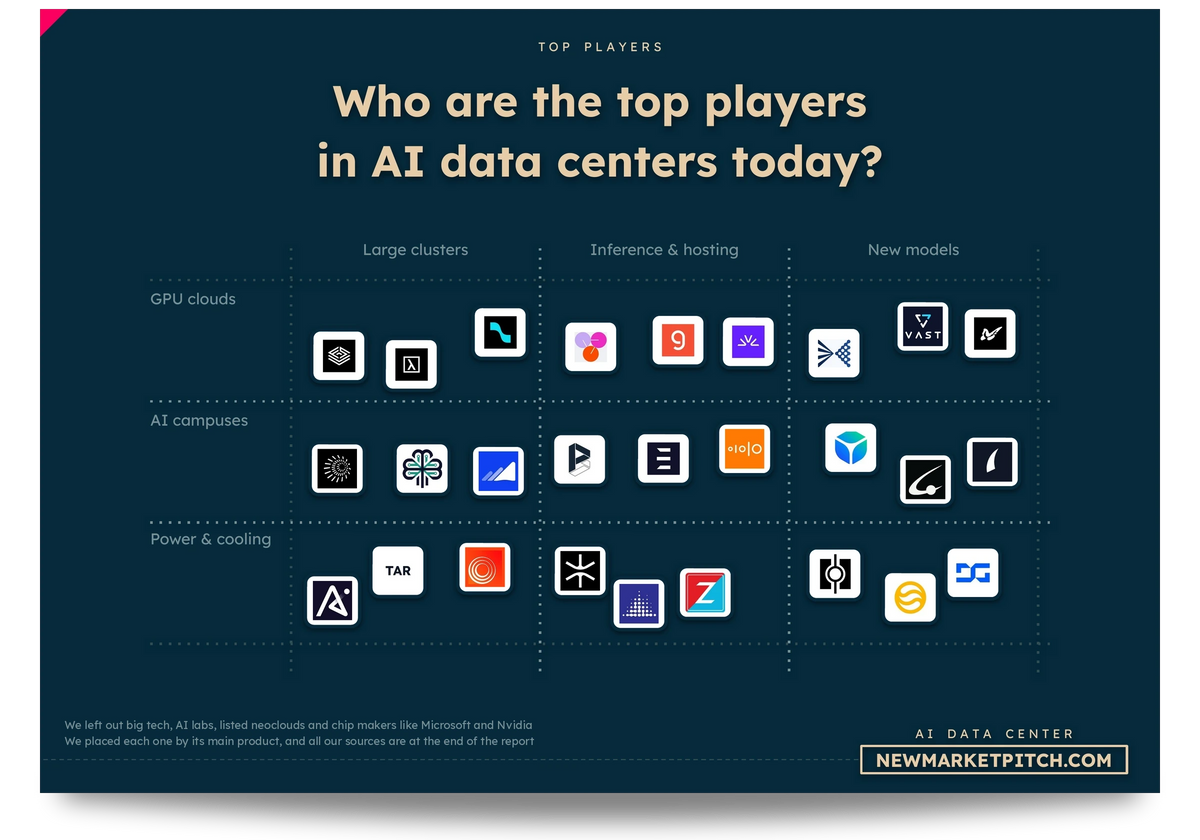
In our report covering the AI data center market, we turn what is vague and complex into simple, useful visuals. Market maps like this one show you at a glance where every startup stands.
How much does networking add to the chip-free AI data center market?
Networking adds a meaningful hardware market around AI clusters, even after we remove the semiconductor value inside switches, network cards and optical equipment.
Large AI models increasingly run across thousands or tens of thousands of accelerators. Those processors have to exchange enormous amounts of data with very low latency, which makes the network fabric far more important than in a conventional enterprise data center.
NVIDIA's Data Center networking business gives us a sense of the scale. Networking revenue reached $31.4 billion in fiscal 2026, up from $13.0 billion one year earlier and $8.6 billion the year before that.
We cannot count all $31.4 billion because NVIDIA's number includes networking silicon. But the growth tells us how much more network hardware is being attached to new AI compute.
Arista has experienced the same demand from the Ethernet side, while optical suppliers are benefiting from growing numbers of high-speed links inside clusters and between data center buildings.
As AI systems get larger, the amount of switching, fiber, optics and cabling required per cluster rises with them. That makes networking one of the more important non-chip markets sitting between the accelerator and the building.
Are hyperscalers the whole AI data center market?
No. Hyperscalers are the largest buyers, but neoclouds, Oracle, sovereign AI projects and specialized operators now represent enough spending that a hyperscaler-only estimate would materially understate the market.
CoreWeave is the clearest example. The company grew from a specialized GPU provider into a major data center and compute buyer within a few years, backed by multibillion-dollar commitments from customers and infrastructure financiers.
Crusoe, Lambda, Nscale and Fluidstack are pursuing similar models at different scales. Oracle has also become a major AI infrastructure buyer as it signs very large cloud contracts tied to model developers and enterprise customers.
Sovereign AI adds another layer. Governments and state-backed groups in Europe, the Middle East and Asia increasingly want domestic AI compute instead of relying completely on US hyperscalers.
This changes the geography of the market too. The US still dominates AI infrastructure spending, but new capacity is being financed in the Gulf, Europe and Asia because access to compute is increasingly treated as strategic infrastructure.
Hyperscaler filings remain the best window into the boom because their numbers are public and enormous. They should be treated as the core of the market rather than the market's outer boundary.

Our research about AI data centers gets updated several times a month, so you always get the latest view of where things stand.
Is AI already driving most new data center demand?
Yes. AI now appears to be responsible for most incremental global data center capacity demand, even though conventional cloud and enterprise workloads still occupy a huge installed base.
McKinsey estimates roughly 82 GW of global data center capacity demand in 2025, with approximately 44 GW linked to AI and 38 GW to other workloads.
Under its continued-momentum scenario, total demand reaches around 219 GW by 2030. AI rises to about 156 GW while non-AI workloads reach roughly 64 GW.
The more useful comparison is the capacity being added. AI adds around 112 GW between those two points. Everything else adds only about 26 GW.
That means AI accounts for roughly four-fifths of the incremental capacity in the model.
The shift explains why data center suppliers can grow much faster than conventional IT spending. Their customers are building an additional physical layer for AI rather than simply replacing existing corporate servers.
| Global capacity demand | 2025 | 2030 |
|---|---|---|
| AI workloads | ~44 GW | ~156 GW |
| Other workloads | ~38 GW | ~64 GW |
| Total | ~82 GW | ~219 GW |
| AI share | ~54% | ~71% |
| AI capacity added | - | ~112 GW |
| Other capacity added | - | ~26 GW |
| AI share of incremental growth | - | ~81% |
Could better AI models make this infrastructure market much smaller?
Better AI efficiency is unlikely to shrink total data center infrastructure spending in the near term because demand is growing faster than the amount of compute saved per task.
DeepSeek made this question much harder to dismiss. Its models showed that high-quality AI could sometimes be trained and served with fewer resources than many Western labs had assumed.
If demand for AI were fixed, that would clearly reduce infrastructure requirements.
Demand is not fixed. Cheaper inference makes more AI products economically viable, encourages more frequent model usage and allows developers to run more demanding workloads. Larger context windows, reasoning models, agents, video generation and enterprise deployments also consume additional compute.
The strongest evidence is what buyers actually did after efficiency improved. Alphabet, Microsoft, Meta and Amazon kept raising infrastructure spending rather than cancelling capacity. Microsoft and Alphabet have continued to discuss tight compute availability.
Efficiency can still change which chips companies buy and how much useful work they get from each megawatt. So far, however, we have not seen efficiency outrun the growth in AI usage.
For the non-chip market, that means fewer servers per task does not automatically translate into fewer data centers overall.
If you want more recent data on this point, please see our latest AI data center market report.

In our market report about AI data centers, you will always find fresh funding data, taken straight from our own verified funding database.
Is power now harder to secure than AI chips?
For many new AI data center projects, power has become at least as difficult to secure as the compute hardware.
The first stage of the generative AI boom revolved around GPU shortages. Buyers could find land and buildings but sometimes waited months for NVIDIA accelerators.
The bottleneck has gradually moved upstream.
Large campuses can now require hundreds of megawatts or even gigawatts. Grid connections, substations, transmission projects and generation capacity can take several years to approve and build. Transformers and some types of switchgear also carry long lead times.
Dell'Oro's latest physical-infrastructure research explicitly describes access to power as the defining challenge for the current buildout. JLL reaches the same conclusion from the property side: speed to power is now the main site-selection criterion globally.
This changes where the money goes. A company that can buy accelerators immediately still cannot monetize them if the planned facility cannot be energized.
As seen above, power has moved from supporting infrastructure toward one of the factors deciding whether an AI data center gets built at all.
How fast is the non-chip AI data center market growing right now?
The non-chip AI data center market is growing at double-digit rates overall, while the infrastructure categories most exposed to high-density AI are currently growing above 20%.
Dell'Oro's latest numbers are particularly useful because they isolate physical data center equipment rather than GPUs. Worldwide DCPI manufacturer revenue rose 28% year over year in the first quarter of 2026, reaching about $12 billion.
That was already the fifth consecutive quarter above 20% growth.
Liquid cooling is expanding faster still from a much smaller base. Electrical distribution is benefiting from higher power densities, while conventional construction grows more slowly because it includes plenty of non-AI projects and takes longer to complete.
The market therefore does not have one clean growth rate.
Ordinary shell construction may grow in the high single digits or low double digits. Power and cooling equipment can currently grow around 20% or more. Emerging AI-specific equipment can grow considerably faster.
For our overall $250 billion to $350 billion market, a low-to-mid-teens underlying growth rate is more believable than either a mature infrastructure growth rate or the 50%-plus numbers occasionally associated with individual AI hardware categories.
How large could the chip-free AI data center market become by 2030?
The non-chip AI data center buildout could absorb roughly $2.1 trillion to $2.4 trillion cumulatively through 2030, with annual spending potentially reaching $400 billion to $500 billion toward the end of the decade.
The calculation starts with McKinsey's approximately $5.2 trillion AI data center investment requirement.
If semiconductors capture roughly 54% to 60% of that value, the remaining infrastructure pool is around 40% to 46%. That produces roughly $2.1 trillion to $2.4 trillion.
JLL provides an independent check from the real-estate side. It estimates that roughly 100 GW of new global data center capacity could come online over five years, creating around $1.2 trillion of real-estate asset value. Tenant technology fit-outs could add another $1 trillion to $2 trillion, although those fit-outs include GPUs and networking silicon that we remove from our calculation.
There is plenty of uncertainty inside a forecast of this size. Accelerator prices could fall. Custom chips could reduce compute costs. Standardized construction could lower cost per MW. At the same time, rack densities could require more expensive cooling and power systems, while dedicated generation could pull additional infrastructure into the data center budget.
Those uncertainties change the exact total, but they do not really challenge the trillion-dollar order of magnitude.

In our document detailing everything you need to know about AI data center, we look at what the winners do differently, so you can learn from the best instead of guessing.
So how big is the AI data center market without counting chips?
The AI data center market excluding chips is currently about $250 billion to $350 billion a year globally, and roughly $300 billion is the best single number we would use today.
A tighter definition covering mainly buildings, on-site electrical equipment and cooling would probably produce something closer to $150 billion to $220 billion.
Adding the non-semiconductor portions of servers, networking and storage brings the market toward our $250 billion to $350 billion range.
A broader definition that also allocates dedicated generation and some grid infrastructure to AI could move the number above $350 billion.
The cumulative picture is even larger. Against roughly $5.2 trillion of AI-related data center investment projected through 2030, we estimate that around $2.1 trillion to $2.4 trillion could sit outside semiconductor value.
Chips still capture the largest piece of AI data center economics today. The physical infrastructure being built around them has nevertheless become a roughly $300 billion annual market of its own, and current spending, capacity and supplier data all point to further growth from here.
If you want more recent data on this point, please see our latest AI data center market report.
Our methodology
This analysis estimates the size of the AI data center market after removing semiconductor value. There is no reported global category called “AI data center infrastructure excluding chips,” so we triangulate the answer from capital-allocation studies, hyperscaler spending, physical-infrastructure supplier revenue, capacity growth, construction costs, cooling and power requirements, and company deployment data.
We define the market around the physical infrastructure required to house, power, cool, connect and operate AI compute. GPUs, CPUs, AI accelerators, HBM, DRAM, NAND and other semiconductor value are excluded. The non-semiconductor portions of servers, networking and storage remain included, alongside construction, racks, cabling, electrical distribution, cooling and dedicated power infrastructure where it is directly associated with the data center.
We use McKinsey's projected AI data center investment requirement as a top-down reference rather than treating it as our market size. Its approximately $5.2 trillion cumulative estimate through 2030 includes computing hardware, power and cooling infrastructure, and construction, so we apply the semiconductor/non-semiconductor split separately rather than counting the headline number directly.
For the semiconductor share, we use the CSIS reconstruction of data center capital spending based on McKinsey and SemiAnalysis data. Its estimate that roughly 54% of total data center capex ultimately flows to semiconductors gives us an independent way to isolate the infrastructure value that remains outside chips.
We then cross-check the top-down result against current operator and supplier data. Hyperscaler capital expenditure establishes the scale and direction of the buildout, but it is not added directly because company capex includes servers, chips and some assets unrelated to AI. Dell'Oro's data center physical-infrastructure revenue provides a cleaner view of power, thermal management and related equipment, while JLL's per-MW construction and fit-out estimates help anchor the physical cost of new capacity.
Capacity data is used as a separate sanity check. McKinsey's current scenario puts global data center demand at roughly 82 GW in 2025 and around 219 GW in 2030, with AI accounting for about 112 GW of the incremental capacity. We use that to judge whether the implied spending trajectory is compatible with the amount of infrastructure actually expected to be built.
Where figures overlap, we treat them as cross-checks rather than additive market segments. Hyperscaler capex, supplier revenue, construction costs and long-term investment forecasts often describe different views of the same facilities, so adding them together would materially overstate the market.
We deliberately use a range instead of false precision. The lower end reflects a tighter infrastructure boundary, while the upper end captures more of the non-semiconductor content in servers, networking, storage and directly associated power systems. The roughly $300 billion central estimate is the point where the independent approaches converge most comfortably.
Key sources used for this analysis include McKinsey on the projected AI data center investment requirement and capital allocation, CSIS on the semiconductor share of data center capital expenditure, McKinsey on global AI and non-AI data center capacity demand, McKinsey on AI workload and hyperscaler capacity trends, JLL's 2026 global data center outlook, JLL's full 2026 Global Data Center Outlook report, Dell'Oro on the liquid-cooling market, and Dell'Oro on Q1 2026 data center physical-infrastructure revenue.
Company-level evidence comes from NVIDIA's fiscal 2026 results, Microsoft's FY2026 Q4 earnings commentary, Microsoft's FY2026 Q3 earnings commentary, Meta's Q1 2026 results, Amazon's Q4 2025 results, Amazon's Q2 2026 results, Oracle's FY2026 results, and Oracle's September 2026 results.
For the power and efficiency sections, we also use Amazon's overview of its nuclear-energy investments, Amazon's updates on power projects supporting its data center footprint, DeepSeek's first-hand DeepSeek-V3 release, and the DeepSeek-V3 technical report.

If you build or invest in the AI data center market, you need to know which business models pay off now and which ones are fading. That's why our report covering it has a whole section on it.
Written by the New Market Pitch teamWe track new markets so founders and investors can move faster. About us