AI data centers: what are the biggest unsolved problems?
Whether you're building or investing in the AI data center market, our report covers everything you need to know: the players, the money, and what's coming next.
Summary
The biggest unsolved problems for AI data centers are electricity availability, slow grid connections, high-density cooling, hardware supply constraints, and the risk that enormous infrastructure investments become unprofitable before the equipment reaches the end of its useful life.
Electricity is the immediate bottleneck. Global data center consumption is projected to rise from 485 TWh in 2025 to approximately 950 TWh in 2030, but access to power depends increasingly on where a facility is built, not simply how much electricity a country generates.
The strangest part of this expansion is that a company can spend billions on land, buildings, and GPUs without having enough electricity to switch them on. Some large transformers take more than three years to obtain, and securing a power contract does not guarantee a working grid connection.
The US electricity market is already showing the strain. PJM's capacity-market prices increased roughly 11.5-fold between the 2024-2025 and 2027-2028 delivery periods, while its latest auction failed to secure enough capacity to meet its reliability requirement. Data centers are a major contributor to demand growth, though not the only cause.
Cooling is becoming an infrastructure problem of its own. HPE's GB200 NVL72 configuration draws approximately 132 kW per rack, more than four times the power of a conventional 30 kW rack. Many older facilities need substantial reconstruction to support this density.
The hardware supply chain creates a second mismatch between spending and deployment. High-bandwidth memory, advanced packaging, transformers, networking equipment, and electrical components all need to arrive together. A shortage of one critical component can hold up an otherwise completed project.
The financial risks are just as striking. CoreWeave grew revenue by approximately 168% in 2025 but still recorded a $1.17 billion net loss and $2.45 billion in depreciation and amortization. Rapid growth does not necessarily mean the underlying computing infrastructure is earning attractive returns.
GPU obsolescence makes those economics unusually difficult. Buildings can remain useful for decades, but computing hardware may lose its competitive advantage within a few years. Falling inference prices can make that worse unless demand expands quickly enough to offset the lower revenue per unit of computation.
The environmental constraints are highly local. Some facilities can expand with relatively limited water use, while evaporative cooling in water-stressed regions can create serious conflicts. Nuclear power could help supply reliable low-carbon electricity, but new projects and restarts cannot eliminate near-term grid bottlenecks.
Our conclusion is that electricity delivery is the hardest immediate problem, while capital efficiency is the biggest long-term uncertainty. The strongest operators will be those that secure power early, complete projects on schedule, keep their hardware well utilized, and earn back their investment before the next generation of chips changes the economics.

Written by the New Market Pitch teamWe track new markets so founders and investors can move faster. About us
Why are AI data centers suddenly facing so many problems?
AI data centers are growing so fast that electricity grids, equipment manufacturers, and construction companies are struggling to keep up.
The International Energy Agency's April 2026 report found that capital expenditure by five major technology companies exceeded $400 billion in 2025 and was expected to increase another 75% in 2026. That would put their combined annual spending at roughly $700 billion, although the figure also includes investments beyond data center infrastructure.
Dedicated AI data center capacity had already more than tripled in just 18 months. Meanwhile, the IEA expects global data center electricity consumption to rise from 485 terawatt-hours in 2025 to approximately 950 TWh in 2030.
Technology companies can increase their infrastructure budgets by 75% in one year. Power plants, transmission networks, and electrical-equipment factories can't expand nearly as quickly.
AI developers now compete with utilities for transformers, industrial companies for electricity, semiconductor manufacturers for advanced memory, and construction companies for qualified electricians.
Even a fully financed data center with thousands of GPUs ready for installation cannot operate until its electricity connection, cooling equipment, and supporting infrastructure are complete.
Is electricity the biggest problem for AI data centers right now?
Electricity is currently the biggest physical bottleneck for AI data centers, especially in regions where companies want to build several large computing facilities at once.
Lawrence Berkeley National Laboratory estimated that American data centers consumed approximately 178 TWh of electricity in 2023. Its June 2026 report projected that data centers could account for 11.8% of total US electricity consumption by 2030, with estimates ranging from 9.5% to 15.3%.
For comparison, the IEA expects data centers to represent approximately 3% of global electricity consumption in 2030. The much higher American percentage shows how concentrated demand has become.
The power requirements of individual projects are also changing. A 1-gigawatt data center campus operating continuously at full load would consume 8.76 TWh annually. Ten such campuses would require 87.6 TWh, equivalent to almost half the electricity consumed by all US data centers in 2023.
These are illustrative calculations, but they show the scale developers are now discussing. A gigawatt-scale AI campus needs an electricity supply comparable to that of a substantial industrial complex, along with transmission connections, substations, backup systems, and cooling infrastructure.
Location makes the problem harder. The United States can have sufficient electricity generation overall while individual regions lack the capacity to connect another large facility.
If you want more recent data on this point, please see our latest AI data center market report.

A good product starts with a real problem. In our report covering the AI data center market, we show you the ones customers still live with.
Why does connecting an AI data center to the power grid take so long?
Connecting an AI data center to the power grid can take years because utilities often need to build or upgrade major electrical infrastructure before the facility can operate.
A developer might secure land, sign customer contracts, and purchase computing equipment long before its electricity connection is ready.
Transformer manufacturing is one of the clearest examples. Research published by Rystad Energy in 2026 found that lead times exceeded 12 months for many power transformers and 24 months for the largest units.
Wood Mackenzie also reported that lead times for some substation transformers had increased from approximately 140 weeks in 2023 to more than 160 weeks.
The figures describe different equipment categories, but both point to a persistent shortage. Some critical components can take more than three years to obtain.
Large projects also need high-voltage switchgear, power cables, protection equipment, substations, and sometimes entirely new transmission lines.
Manufacturers are expanding production. Rystad expected nearly 200 gigavolt-amperes of additional transformer manufacturing capacity to come online during 2026. Yet demand is increasing simultaneously from data centers, renewable-energy projects, industrial electrification, and grid upgrades.
The Microsoft-backed restart of the former Three Mile Island Unit 1 illustrates another complication. Constellation Energy disclosed in March 2026 that transmission upgrades could affect when the plant's electricity became fully deliverable. FERC subsequently approved the transfer of interconnection rights, according to an August 2026 disclosure, but that approval does not eliminate the need for supporting grid infrastructure.
Are companies announcing more AI data centers than they can actually build?
Yes. The pipeline of announced AI data centers is growing much faster than completed operating capacity, and many proposed projects still face major obstacles before construction or commercial operation.
The IEA's April 2026 analysis found that dedicated AI data center capacity had more than tripled over 18 months. Despite this acceleration, its central forecast for global data center electricity consumption remained close to the previous year's projection.
The agency expects consumption to reach approximately 950 TWh in 2030, with equipment shortages and other development bottlenecks limiting faster expansion.
A development might have a signed lease but no grid connection, an electricity agreement but no completed substation, or a finished building with no GPUs installed.
These projects are often discussed together even though their chances of opening on schedule differ enormously.
We would therefore give much more weight to facilities that have secured electricity, received interconnection approval, begun construction, and reached commercial operation.
| Project stage | What has actually been secured | What could still delay the project |
|---|---|---|
| Announcement | Development plan | Financing, permits, power |
| Land acquisition | Control of the site | Construction approval, electricity |
| Electricity agreement | Planned supply arrangement | Grid delivery and infrastructure |
| Grid approval | Connection terms | Equipment and construction |
| Construction underway | Physical development started | Cost overruns and supply delays |
| Building completed | Facility infrastructure | Energization and IT installation |
| GPUs installed | Computing equipment deployed | Testing and utilization |
| Commercial operation | Computing capacity available | Customer demand and profitability |

If you build or invest in the AI data center market, you need to know which business models pay off now and which ones are fading. That's why our report covering it has a whole section on it.
Can the US power grid handle AI data centers without raising electricity bills?
The US power grid is already struggling to keep up with planned AI data center demand in some regions, and the cost of expanding electricity infrastructure could increasingly fall on households and businesses.
The strongest evidence comes from PJM, the electricity market serving approximately 65 million people across the eastern United States.
PJM's capacity-market prices increased from $28.92 per megawatt-day for the 2024-2025 delivery period to $329.17 for 2026-2027 and $333.44 for 2027-2028.
That is an approximately 11.5-fold increase.
These prices compensate generators for making dependable capacity available. They are different from the electricity prices households pay, but they show how expensive securing reliable supply has become.
Ahead of the 2026-2027 auction, PJM reported that projected peak demand had increased by more than 5,400 MW, while new generation and upgrades added approximately 2,700 MW.
The following auction produced a more serious warning. PJM's 2027-2028 auction secured 6,517 MW less capacity than its reliability requirement, according to the system operator's subsequent analysis. It was the first auction to miss the requirement since the market began in 2007.
Data centers are an important part of this demand growth, particularly in Virginia, although generator retirements and other market conditions also contribute.
There is also the question of who pays for new infrastructure.
Imagine a utility building a substation or transmission line primarily to serve a large AI campus. If regulators allow the utility to recover those costs across its general customer base, households and businesses may end up paying part of the bill.
Several utilities and regulators are examining special tariffs for large electricity users, including minimum purchase commitments, longer contracts, and protections against developers abandoning projects after expensive grid upgrades have begun.
A grid built for demand that never materializes can leave utilities with costly infrastructure and fewer customers than expected. That's a real risk when proposed AI projects are counted as if they were guaranteed future demand.
If you want more recent data on this point, please see our latest AI data center market report.
Why is cooling becoming such a big problem for AI data centers?
Cooling is becoming much harder for AI data centers because the latest GPU systems concentrate enormous amounts of heat inside individual racks, far beyond what many traditional facilities were designed to handle.
NVIDIA's GB200 NVL72 contains 72 Blackwell GPUs and 36 Grace CPUs in a single integrated system.
Hewlett Packard Enterprise specifies approximately 132 kilowatts of rack power for its implementation, including 115 kW of liquid-cooled components and 17 kW of air-cooled components.
Eight such racks require more than 1 MW of electrical power before accounting for additional facility overhead.
Uptime Institute's 2025 survey found that most facilities were still operating with considerably lower rack densities, with adoption concentrated around the 10-30 kW range.
A 132 kW rack draws more than four times the power of a 30 kW rack and over thirteen times that of a 10 kW rack.
Traditional air cooling becomes increasingly difficult at these densities. Moving enough air through the equipment requires large fans, sophisticated airflow management, and considerable space.
Liquid cooling can remove heat more effectively, which explains its growing adoption in advanced AI installations.
But installing liquid cooling in an existing building can be expensive. Operators may need new pipes, pumps, coolant distribution units, heat exchangers, monitoring equipment, and stronger electrical infrastructure.
A purpose-built AI campus can integrate liquid cooling from the beginning, while an older data center may require major reconstruction.
| Rack configuration | Approximate power | Cooling requirements |
|---|---|---|
| Conventional enterprise rack | 5-10 kW | Usually air cooling |
| Higher-density enterprise rack | 10-20 kW | Greater airflow |
| Dense conventional rack | 20-30 kW | Advanced air cooling |
| Accelerated computing rack | 30-60 kW | Liquid cooling increasingly attractive |
| High-density AI rack | 60-100 kW | Liquid cooling often preferred |
| HPE GB200 NVL72 | 132 kW | Liquid and air cooling |
| Eight 132 kW racks | 1,056 kW | More than 1 MW of IT load |
The first five configurations are illustrative density categories. The GB200 specification comes from HPE's published documentation.

Learning from others' mistakes is the cheapest lesson there is. In our market report about AI data centers, we look at what broke startups before you, so you don't repeat it.
Will AI data centers eventually run out of water?
Water shortages could become a serious problem for AI data centers in specific locations, especially where freshwater supplies are already under pressure. The risk depends heavily on the cooling technology used and where the facility is built.
Lawrence Berkeley National Laboratory estimated direct US data center water consumption at approximately 17.4 billion gallons in 2023.
Its projections for 2028 ranged from 37 billion to 66 billion gallons, depending on how infrastructure and cooling systems develop.
That would represent an increase of roughly 2.1 to 3.8 times in just five years.
The concern comes mainly from cooling. Evaporative systems can reduce electricity consumption but use substantial amounts of water, while dry cooling and closed-loop approaches can limit direct water consumption.
A system that saves water may consume more electricity under certain conditions, particularly in hot climates.
Google's environmental reporting shows how major operators are responding. Its 2026 report stated that the company replenished approximately 7.7 billion gallons of water in 2025, equivalent to 78% of its freshwater consumption.
That's substantial, but replenishing water through conservation and restoration projects doesn't necessarily replace the water consumed near a particular facility at the same time. For communities facing water shortages, that distinction is hard to ignore.
Can AI data centers keep growing without making climate change worse, and could nuclear power help?
AI data centers can become cleaner, and nuclear power could help, but keeping emissions under control while electricity demand grows so quickly will be extremely difficult.
The IEA estimated global data center electricity consumption at approximately 415 TWh in 2024.
Its analysis found that around 30% of the electricity supplying these facilities came from coal, 27% from renewables, 26% from natural gas, and 15% from nuclear power, with the remainder from other sources.
The IEA expects renewables to supply nearly half of additional data center electricity demand through 2030. However, natural gas and coal are also expected to meet a substantial share of the increase.
Google illustrates the mixed picture. Its 2025 environmental report recorded a 12% reduction in data center energy emissions during 2024, while its 2026 report disclosed contracts for more than 12 GW of new clean-energy capacity signed during 2025.
Yet solar and wind farms produce electricity when weather conditions allow, while AI data centers often need continuous power.
A company can purchase enough renewable electricity over a year to match its annual consumption and still rely on fossil-fuel generation during particular hours.
Nuclear energy could help address that problem because nuclear plants can provide large amounts of reliable, low-carbon electricity.
Microsoft's agreement with Constellation Energy to support the restart of the former Three Mile Island Unit 1 is one example.
The arrangement offers access to generation infrastructure that previously operated commercially, potentially avoiding some of the difficulties involved in building an entirely new nuclear facility.
Even so, the restart requires regulatory work, engineering upgrades, and transmission arrangements. Constellation's March 2026 disclosures highlighted electricity-delivery constraints. The transfer of interconnection rights subsequently received FERC approval, as reported in August 2026, although other restart and infrastructure work remained necessary.
Small modular reactors represent another approach. Google, Amazon, and Microsoft have explored nuclear partnerships and procurement arrangements, hoping that future reactor designs could provide dependable power for large computing campuses.
But commercial deployment still depends on licensing, manufacturing, construction experience, financing, and qualified suppliers.
Nuclear energy looks increasingly relevant to the industry's long-term energy strategy. For the next few years, existing generation, grid expansion, and faster deployment of other energy sources will probably have a much greater influence on how many AI data centers can actually open.
If you want more recent data on this point, please see our latest AI data center market report.

When you build or invest in the AI data center market, you need clarity, not confusion. In our document detailing everything you need to know about AI data center, we always try to put numbers on and quantify whatever is usually vague and confusing.
Are GPU, memory, and networking shortages still slowing down AI data centers?
GPU and high-bandwidth memory shortages are still limiting AI data center expansion, while networking problems can prevent installed chips from delivering their full computing performance.
The IEA's April 2026 analysis identified high-bandwidth memory as a supply constraint that had intensified over the previous six months and could persist through at least the end of 2027.
HBM is essential for advanced AI accelerators because large models need to move huge amounts of data between memory and computing units.
The requirements become clearer when we look at NVIDIA's GB200 NVL72. A single rack contains approximately 13.4 terabytes of HBM3E memory across 72 GPUs.
A deployment of 1,000 racks would therefore require approximately 13.4 petabytes of high-bandwidth GPU memory.
Advanced AI systems also depend on sophisticated chip packaging, high-performance networking, power electronics, and specialized server components. A shortage in any one of those areas can prevent a complete system from being delivered.
Even after installation, networking can limit how much useful work those GPUs perform.
NVIDIA's GB200 NVL72 connects 72 GPUs in a single NVLink domain, providing approximately 130 terabytes per second of aggregate NVLink bandwidth.
That bandwidth is designed to reduce communication delays between processors working on the same AI workload.
The difficulty increases when computing systems grow beyond a single rack. Large AI clusters require sophisticated switches, optical connections, high-speed network interfaces, and software capable of distributing work across thousands of GPUs.
Consider a computing fleet that costs $10 billion to deploy. If networking inefficiencies leave 10% of its theoretical computing capacity unavailable for productive work, the operator is carrying the cost of hardware equivalent to $1 billion of its original investment without receiving the corresponding output.
That is an illustrative scenario rather than an observed industry average.
Are AI data centers becoming too expensive to be profitable?
AI data centers are becoming extremely expensive to finance, and the financial results of major infrastructure providers show that fast revenue growth does not automatically translate into profits.
CoreWeave is a particularly useful example because its business depends directly on providing AI computing infrastructure.
According to its 2025 financial statements, CoreWeave generated $5.131 billion in revenue, compared with $1.915 billion in 2024.
That represents approximately 168% annual growth.
Yet the company still reported a net loss of $1.17 billion in 2025, alongside approximately $2.45 billion in depreciation and amortization.
Depreciation and amortization represented nearly 48% of annual revenue.
CoreWeave has to recover the expense of enormous hardware investments while paying for electricity, operations, interest, and continuing expansion.
Its debt costs are also significant. The company reported approximately $1.23 billion in net interest expense for 2025, more than three times the 2024 figure.
There is substantial demand, however. CoreWeave ended 2025 with a reported $66.8 billion revenue backlog, more than four times its backlog at the beginning of the year.
This gives the company visibility into future contracted revenue, although that revenue must still be delivered and collected over time.
We should distinguish CoreWeave from conventional data center landlords, which may own buildings and electrical infrastructure without purchasing the GPUs themselves.

In our report covering the AI data center market, we look at what the winners do differently, so you can learn from the best instead of guessing.
Could AI chips become obsolete before data centers pay them off?
Yes. AI chips can lose their commercial advantage long before the buildings housing them reach the end of their useful lives, creating a major financial risk for companies investing billions in computing hardware.
Modern data center buildings, substations, and electrical infrastructure can remain useful for decades. GPUs evolve much faster.
NVIDIA's transition from Hopper to Blackwell and Blackwell Ultra illustrates how quickly computing architectures can improve.
Google provides another example. Its 2025 environmental report stated that the Ironwood TPU delivered nearly 30 times the power efficiency of Google's first Cloud TPU from 2018, under the company's stated comparison methodology.
That improvement occurred over approximately seven years.
The financial consequences are easy to calculate.
Imagine an AI infrastructure provider investing $1 billion in GPUs and depreciating them over four years. Using straight-line depreciation and assuming no residual value, the annual expense would be $250 million.
If the equipment remains economically competitive for only three years, annual depreciation rises to approximately $333 million.
That is an additional $83 million per year.
The operator might continue using older chips for less demanding workloads, but customers will generally prefer newer hardware when it offers lower computing costs or better performance.
Long-term contracts can reduce the risk, particularly when customers commit to using specific infrastructure for several years.
If you want more recent data on this point, please see our latest AI data center market report.
Could cheaper AI inference actually hurt data center companies?
Cheaper AI inference could put pressure on data center revenue, even if AI usage keeps growing. The outcome depends on whether demand grows fast enough to compensate for falling computing prices.
AI inference has become substantially more efficient as processors, model architectures, and software have improved.
For customers, lower prices are generally beneficial. They make AI assistants, coding tools, enterprise automation, search, and more complex reasoning applications affordable for a wider range of uses.
For computing providers, falling prices create a more complicated situation.
Suppose inference prices decline by 80%. At the same workload volume, revenue falls to just 20% of its previous level.
The provider would need five times as much usage simply to maintain the same revenue, assuming an identical service mix and pricing unit.
If usage increases tenfold, revenue doubles despite the 80% price reduction.
The relationship is also affected by how much computation individual requests require. More capable reasoning models may generate longer internal reasoning sequences and consume more resources per task, even when the advertised price per token decreases.
Training and inference have different demand patterns, too. Training involves large computing jobs around model development, whereas successful inference products can generate more continuous usage.

In our research about AI data centers, we always try to gather several sources and make estimates that make sense, so you can work with solid numbers.
Can AI data centers find enough skilled workers to keep expanding?
AI data centers are already putting considerable pressure on the construction workforce, and qualified electricians, engineers, technicians, and contractors are becoming harder to find.
A 2026 workforce survey by the Associated General Contractors of America and NCCER collected 1,830 responses between July and August.
Among the 802 respondents who answered the relevant question, 28% reported working on a data center project during the previous year.
Of those working on data centers, 60% said their companies had added employees, compared with 36% of firms not involved in data center construction.
That is a 24-percentage-point difference.
The survey also found that 58% of firms performing data center work believed these projects were increasing competition for skilled workers, while 49% reported additional wage pressure.
Data centers are attracting labor even when demand for some other construction projects is weaker.
The difficulty continues after buildings are completed. AI facilities need specialists who understand high-density electrical systems, liquid cooling, equipment maintenance, and continuous operations.
Uptime Institute's 2025 survey reported that nearly two-thirds of data center operators faced difficulties recruiting or retaining qualified workers.
Are AI data centers becoming more likely to break down?
AI data centers are becoming more complicated to operate, but current evidence does not show that increasingly powerful AI hardware has caused a widespread decline in data center reliability.
Uptime Institute's 2025 Global Data Center Survey found that approximately half of respondents reported an outage at the facility they worked in or knew best during the previous three years.
Among respondents who reported an outage, 28% classified the incident as significant, serious, or severe.
The survey also found that 87% of organizations experiencing a major outage believed better management or operational processes could have prevented it.
AI facilities add several engineering challenges. Liquid cooling introduces pumps, valves, pressure monitoring, and leak-detection systems. High-density electrical equipment operates under greater loads, while large GPU clusters can experience rapid changes in power demand.
The IEA's April 2026 analysis highlighted these power fluctuations and identified battery storage as one way to stabilize data center operations.
It projected that approximately 20-25 GW of battery storage could be installed at data centers worldwide by 2030.
The available data supports concern about increasing operational complexity. It does not yet justify claims that AI data centers are becoming systematically less reliable.

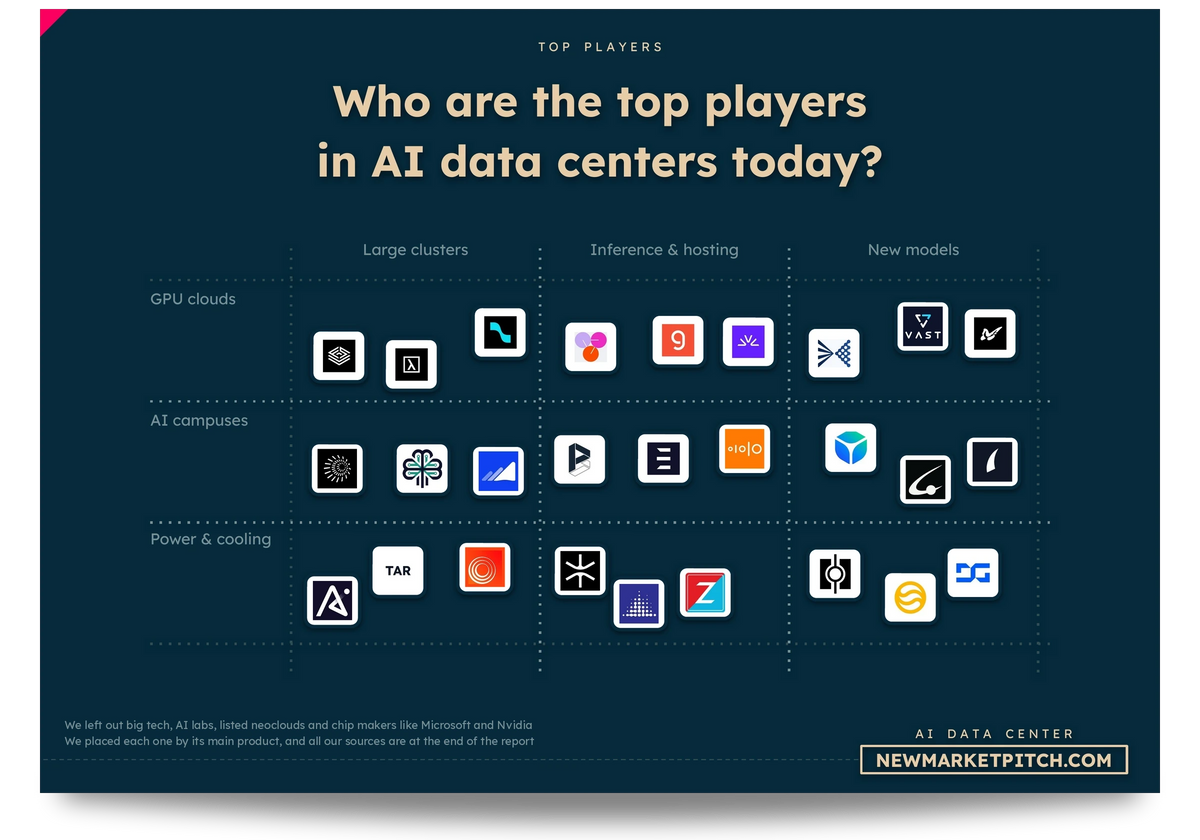
In our market report about AI data centers, we turn what is vague and complex into simple, useful visuals. Market maps like this one show you at a glance where every startup stands.
Which AI data center problems will be the hardest to solve?
Electricity delivery, grid expansion, and financing are likely to remain the hardest AI data center problems because they depend on long construction timelines, large investments, and decisions that individual technology companies cannot fully control.
Cooling systems, networking equipment, and GPUs are improving quickly. Their development still involves major engineering challenges, but companies can invest directly in better hardware and facility designs.
Grid infrastructure works differently. A developer cannot independently guarantee the approval of a new transmission line, the availability of regional generating capacity, or the delivery of a large transformer.
Those decisions involve utilities, regulators, equipment manufacturers, construction companies, and local communities.
Financing creates another difficult problem. A company may successfully secure electricity and build a technically advanced facility, only to discover that falling computing prices or faster hardware improvements reduce its expected returns.
Environmental constraints are also becoming more important. Water availability, carbon emissions, and electricity affordability can influence whether communities and regulators support new developments.
| Unsolved problem | Current severity | Main obstacle | Likely timescale |
|---|---|---|---|
| Electricity availability | Very high | Reliable power at the right location | Multi-year |
| Grid connections | Very high | Transmission and approvals | Multi-year |
| Infrastructure financing | Very high | Debt, depreciation, uncertain returns | Continuous |
| Transformer shortages | High | Manufacturing and delivery times | 1-3+ years |
| GPU obsolescence | High | Rapid hardware improvement | Continuous |
| High-density cooling | High | Engineering and retrofitting | 1-5 years |
| Chip and memory supply | High | Advanced manufacturing capacity | Multi-year |
| Electricity affordability | High | Infrastructure cost allocation | Multi-year |
| Carbon emissions | High | Continuous clean electricity | Long-term |
| Water availability | Region-dependent | Local water constraints | Continuous |
| Networking efficiency | High | Communication across large clusters | Continuous |
| Skilled workforce | High | Recruitment and training | Multi-year |
| Operational reliability | High | Increasing system complexity | Continuous |
These severity assessments are our synthesis of the available evidence rather than scores from an industry survey.
If you want more recent data on this point, please see our latest AI data center market report.
AI data centers: what are the biggest unsolved problems?
The biggest unsolved problems in AI data centers today are getting enough electricity to operating facilities, expanding power grids quickly enough, managing increasingly demanding hardware, and making sure enormous infrastructure investments generate acceptable financial returns.
Electricity delivery comes first. The IEA expects global data center power consumption to nearly double between 2025 and 2030, while US electricity-market data already shows regions where demand growth is outpacing new dependable supply.
Grid connections and electrical equipment follow closely. Transformer lead times can exceed two or three years, and large projects may require substantial transmission upgrades before a single GPU becomes operational.
Cooling and networking represent a different challenge. NVIDIA's latest rack-scale systems show how much computing density has increased, forcing operators to redesign electrical distribution, thermal management, and communication infrastructure.
But the financial problem may prove just as important over the longer term. CoreWeave's 2025 results showed 168% revenue growth alongside a $1.17 billion net loss and $2.45 billion in depreciation and amortization. That combination illustrates how difficult it can be to earn strong returns from an infrastructure business that requires so much upfront investment.
The industry also faces growing pressure over electricity prices, water consumption, and carbon emissions. These concerns will influence where facilities can be built and how much new infrastructure developers must pay for themselves.
Electricity delivery is the biggest immediate obstacle, while capital efficiency is the hardest long-term uncertainty.
The most successful AI data center companies will be those that secure reliable power, finish construction on schedule, operate their GPUs efficiently, and recover their investments before the equipment loses too much economic value.

Our document detailing everything you need to know about AI data center gets updated several times a month, so you always get the latest view of where things stand.
Our methodology
This analysis identifies the biggest unsolved problems facing AI data centers as of October 2026. We examined electricity supply, grid infrastructure, hardware and cooling requirements, equipment shortages, construction capacity, environmental constraints, operational reliability, and financial sustainability.
We assessed each problem using four criteria: its measurable impact on current projects, the scale of its potential consequences, how long it is likely to take to resolve, and how much control individual data center operators have over the outcome. Greater weight was given to constraints already affecting construction, electricity markets, equipment delivery, or financial performance.
We distinguished announced capacity from operational capacity, planned electricity supply from completed grid connections, and manufacturer specifications from equipment deployed in commercial facilities. Financial risks were assessed separately from engineering limitations because a technically successful AI data center can still generate inadequate returns.
Our analysis combined original research from energy agencies, electricity-market operators, equipment manufacturers, regulatory filings, industry surveys, and company financial statements. We prioritized measurable developments over investment announcements or industry forecasts without supporting evidence. Where figures describe hypothetical scenarios, such as gigawatt-scale campuses, GPU depreciation, or inference-price declines, they are identified as illustrative calculations.
The severity rankings reflect our assessment of the evidence rather than an official industry index. They are intended to distinguish problems that could prevent facilities from opening from those that primarily affect long-term operating costs, profitability, or environmental performance.
Key sources for energy demand and grid constraints include the International Energy Agency's April 2026 Energy and AI analysis, the IEA's Energy and AI report, Lawrence Berkeley National Laboratory's 2025 US Data Center Energy Usage Update, its 2024 US Data Center Energy Usage Report, PJM's 2027-2028 Capacity Auction Report, PJM's 2025 Annual Report, and Rystad Energy's Grid Equipment Market Outlook.
For computing hardware, cooling, and networking, we used NVIDIA's GB200 NVL72 technical specifications, HPE's GB200 NVL72 data sheet, and NVIDIA's Multi-Node NVLink Systems Tuning Guide. These documents provided specific equipment configurations, rack-power requirements, memory capacity, and interconnection characteristics.
Environmental and power-generation evidence came from Google's 2026 Environmental Report, Google's 2025 Environmental Report, Lawrence Berkeley National Laboratory's research on data center water use, Constellation Energy's Crane Clean Energy Center announcement, and Constellation's March 2026 regulatory filing. We also considered Constellation's August 2026 disclosure when assessing the status of the plant's interconnection arrangements.
For financing, workforce capacity, and reliability, we relied on CoreWeave's 2025 annual financial statements, the Associated General Contractors of America's 2026 workforce survey, Uptime Institute's 2025 Global Data Center Survey, and its 2025 Annual Outage Analysis.

Theory only gets you so far. In our report covering the AI data center market, we dig up the real signals from the field and show you the ones worth watching.
Written by the New Market Pitch teamWe track new markets so founders and investors can move faster. About us