AI data center funding tracker (57 deals)
Everything we know about the AI data center market, in one place. Get our report whether you build or invest.
Summary
AI data center funding has reached $69.22 billion across 56 financings and 38 companies, but that headline substantially overstates the scale of conventional startup fundraising. Stargate alone accounts for $45 billion in reported commitments, leaving $24.22 billion of financing activity outside the project.
Even excluding Stargate, capital is highly concentrated. Crusoe, Firmus, Nscale, Fluidstack and Lambda collectively attracted more than $16 billion, leaving a relatively small share of the market's funding available to the remaining operators.
The typical financing is unusually large. The median round reached $162.5 million, while 34 of the 56 transactions were worth at least $100 million. This is a market where nine-figure checks are more common than small venture rounds.
Repeat fundraisers dominate the capital flows. Only 11 companies recorded multiple financings, but they received $19.60 billion outside Stargate, compared with approximately $4.62 billion for businesses appearing only once. The market increasingly rewards operators capable of turning earlier financing into deployable infrastructure.
Integrated AI infrastructure operators are the main destination for investment outside exceptional hyperscale projects. The category attracted $21.48 billion across 34 transactions, considerably more than narrower compute, modular infrastructure and colocation businesses combined.
The funding ladder gets much steeper after Series A. Recorded transactions drop from 16 Series A rounds to seven Series B rounds, while median financing increases from $75 million to $230 million and then $800 million at Series C. The difficulty is less about attracting initial investors than securing the capital required for industrial-scale expansion.
Young companies can nevertheless raise extraordinary amounts. Median company age at financing was approximately 2.8 years, and businesses such as Gimlet Labs and TensorWave progressed from large Series A rounds to substantially bigger Series B financings within a short period.
Strategic investors are deeply involved. NVIDIA participated in 12 recorded financings, and 32 of the 56 rounds included at least one strategic investor. Those rounds had a $240 million median size, compared with $51 million without named strategic participation, reflecting the close connection between capital, GPUs and infrastructure partnerships.
North America leads with 32 transactions and $59.73 billion, including Stargate. Excluding that project still leaves approximately $14.73 billion, ahead of Asia-Pacific's $5.06 billion and Europe's $4.42 billion. Regional funding outside North America is particularly dependent on a few large operators.
Fundraising activity is becoming more frequent. September 2026 recorded seven deals worth approximately $7.15 billion, the busiest month by deal count in the research period. Unlike the Stargate-driven January 2025 peak, this activity came from several independently financed operators.
The main qualification is that announced funding is not always cash already received. Stargate includes infrastructure commitments, Crusoe reported an initial Series F closing, and Nscale's Series C incorporated earlier financing and corporate assets. The central question is how many companies can repeatedly convert these large financial commitments into operating capacity, customer revenue and further investment.

Written by the New Market Pitch teamWe track new markets so founders and investors can move faster. About us

In our report covering the AI data center market, you will always find fresh funding data, taken straight from our own verified funding database.
Our funding tracker covering the AI data center market
Below is the table listing all the deals. You may find our methodology at the end of this page.
And, if you want to gain a deeper understanding of the market and its current dynamics, get our report covering the AI data center market.
| Company | Category | Date | Stage | Deal size | What they do | Region | Lead investors | Country | Rank |
|---|---|---|---|---|---|---|---|---|---|
| GMI Cloud | Integrated AI Infrastructure Operators | September 2026 | Series B | $223M | Operates an AI-native GPU cloud with high-performance compute and inference infrastructure across the U.S. and Asia-Pacific. | North America | ARCHIV | United States | |
| Helix Digital Infrastructure LLC | Integrated AI Infrastructure Operators | September 2026 | Unknown | $1B | Finances, develops and operates integrated AI infrastructure spanning hyperscale data centers, power and connectivity. | North America | Not disclosed | United States | |
| Verda | AI Compute Data Centers | September 2026 | Series B | $189M | Operates a full-stack AI cloud spanning physical data centers, GPU hardware and cloud-platform services. | Europe | Emergence Capital | Finland | |
| Crusoe | Integrated AI Infrastructure Operators | September 2026 | Series D+ | $3.9B | Builds and operates vertically integrated AI factories, hyperscale campuses and AI cloud infrastructure. | North America | Atreides Management; Mubadala Capital; Valor Equity Partners | United States | |
| Rune (Liitto Technology, Inc.) | Modular AI Data Centers | September 2026 | Series A | $40M | Deploys modular RELIC AI data centers directly at utility-scale solar sites to convert available power into compute. | North America | Spark Capital | United States | |
| Gimlet Labs | Integrated AI Infrastructure Operators | September 2026 | Series B | $300M | Operates a multi-silicon AI inference cloud with managed data-center capacity optimized across heterogeneous accelerators. | North America | Andreessen Horowitz | United States | |
| Fluidstack | Integrated AI Infrastructure Operators | September 2026 | Growth Equity | $1.5B | Designs, deploys and operates dedicated AI data centers and compute infrastructure for leading AI labs. | North America | Jane Street | United States | |
| Starcloud | AI Compute Data Centers | August 2026 | Series A | $250M | Builds space-based data centers to deliver orbital AI training and inference compute. | North America | Manhattan West | United States | |
| Groq | Integrated AI Infrastructure Operators | August 2026 | Series A | $350M | Operates a global AI inference cloud across dedicated data centers using accelerated-compute clusters. | North America | Disruptive | United States | |
| Firmus | Integrated AI Infrastructure Operators | August 2026 | Growth Equity | $2B | Develops and operates high-density AI factories combining data-center, compute and energy-orchestration infrastructure. | Asia-Pacific | Not disclosed | Australia | |
| StratGrid Inc. | Hyperscale AI Campuses | July 2026 | Unknown | $1.8M | Develops behind-the-meter natural-gas-powered AI and hyperscale data-center campuses in Alberta. | North America | Not disclosed | Canada | |
| Fluidstack | Integrated AI Infrastructure Operators | July 2026 | Series A | $830M | Designs, deploys and operates dedicated AI data centers and compute infrastructure for leading AI labs. | North America | Situational Awareness | United States | |
| Together AI | Integrated AI Infrastructure Operators | July 2026 | Series C | $800M | Runs an AI-native cloud with dedicated GPU clusters and production-scale training and inference infrastructure. | North America | Aramco Ventures | United States | |
| TensorWave | AI Compute Data Centers | June 2026 | Series B | $350M | Operates an AI cloud of AMD Instinct GPU clusters for memory-intensive training and inference, backed by more than 2 GW of secured data-centre capacity. | North America | Magnetar; AMD Ventures | United States | |
| Armada | Modular AI Data Centers | May 2026 | Series B | $230M | Designs, manufactures and deploys Galleon modular data centres (up to megawatt-scale Leviathan units) that deliver AI compute at the edge. | North America | Overmatch; BlackRock; 8090 Industries | United States | |
| Nava | AI Compute Data Centers | April 2026 | Series A | $22M | Building a full-stack neocloud combining AI data centres, GPU-as-a-Service and bare-metal compute for enterprises in India and Southeast Asia. | Asia-Pacific | Greenoaks | Singapore | |
| Firmus | Integrated AI Infrastructure Operators | April 2026 | Growth Equity | $505M | Builds and operates energy-efficient “AI factory” data centres (HyperCube platform, NVIDIA reference design) supplying GPU compute capacity across Australia and Asia-Pacific. | Asia-Pacific | Coatue | Australia | |
| Starcloud | AI Compute Data Centers | March 2026 | Series A | $170M | Builds and operates orbital GPU data centers for AI training, inference and commercial cloud workloads. | North America | Benchmark; EQT Ventures | United States | |
| ai& Inc. (株式会社エーアイ・アンド) | Integrated AI Infrastructure Operators | March 2026 | Seed | $50M | Develops and operates AI data centers and a vertically integrated sovereign AI compute platform spanning heterogeneous compute, inference and model services. | Asia-Pacific | Not disclosed | Japan | |
| Gimlet Labs | Integrated AI Infrastructure Operators | March 2026 | Series A | $80M | Operates a multi-silicon inference cloud for agentic AI workloads across GPUs, CPUs and specialized accelerators. | North America | Menlo Ventures | United States | |
| Nscale | Integrated AI Infrastructure Operators | March 2026 | Series C | $2B | Owns and operates hyperscale AI data centers and a vertically integrated GPU-cloud stack spanning compute, networking, data services and orchestration. | Europe | Aker ASA; 8090 Industries | United Kingdom | |
| Neysa | Integrated AI Infrastructure Operators | February 2026 | Unknown | $600M | Provides purpose-built GPU-based AI cloud infrastructure in India for training, fine-tuning, inference and controlled enterprise deployments. | Asia-Pacific | Blackstone | India | |
| Firmus | Integrated AI Infrastructure Operators | February 2026 | Growth Equity | ≈$70M | Designs, builds and operates vertically integrated high-density AI Factories and GPU compute infrastructure across Asia-Pacific. | Asia-Pacific | Not disclosed | Australia | |
| PaleBlueDot AI | AI Compute Data Centers | January 2026 | Series B | $150M | Provides enterprise-grade AI compute through GPU cloud and dedicated cluster infrastructure for training, inference and deployment. | North America | B Capital | United States | |
| Sapience AI | AI Compute Data Centers | January 2026 | Unknown | $8.8M | Operates an EU-sovereign GPU cloud with dedicated NVIDIA compute hosted in European data centers for AI training and inference. | Europe | Not disclosed | Slovakia | |
| Bolt Data & Energy, Inc. | Hyperscale AI Campuses | December 2025 | Series A | $50M | Develops integrated large-scale AI data center campuses combining land, energy generation and GPU compute infrastructure. | North America | Not disclosed | United States | |
| HyperVault AI Data Center Limited | Hyperscale AI Campuses | November 2025 | Unknown | ≈$1B | Develops gigawatt-scale, liquid-cooled AI-ready data centers in India for hyperscalers and AI-driven organizations. | Asia-Pacific | Not disclosed | India | |
| Lambda | Integrated AI Infrastructure Operators | November 2025 | Series D+ | >$1.5B | Builds and operates GPU-dense AI factories and supercomputers sold as cloud compute for AI training and inference. | North America | TWG Global | United States | |
| Firmus | Integrated AI Infrastructure Operators | November 2025 | Growth Equity | $324.9M | Designs, builds and operates liquid-cooled AI factories and GPU infrastructure for high-density AI workloads. | Asia-Pacific | Not disclosed | Australia | |
| Crusoe | Integrated AI Infrastructure Operators | October 2025 | Series D+ | $1.4B | Builds and operates vertically integrated AI factories, data centers and GPU cloud capacity for large-scale AI training and inference. | North America | Valor Equity Partners; Mubadala Capital | United States | |
| Nscale | Integrated AI Infrastructure Operators | September 2025 | Series B | $1.1B | Develops and operates AI-native data centers alongside vertically integrated GPU compute, networking, storage and orchestration services. | Europe | Aker ASA | United Kingdom | |
| Firmus | Integrated AI Infrastructure Operators | September 2025 | Growth Equity | ≈$220.5M | Designs, builds and operates high-density AI factories and delivers GPU compute through an integrated AI infrastructure platform. | Asia-Pacific | Ellerston Capital | Australia | |
| Fermi America | Hyperscale AI Campuses | August 2025 | Series C | $100M | Develops hyperscale AI campuses combining powered-shell data centers with dedicated behind-the-meter energy infrastructure. | North America | Macquarie Group | United States | |
| Armada | Modular AI Data Centers | July 2025 | Unknown | $131M | Builds and operates ruggedized edge-computing infrastructure centered on deployable modular data centers for AI workloads. | North America | Not disclosed | United States | |
| Firmus | Integrated AI Infrastructure Operators | June 2025 | Growth Equity | ≈$180M | Builds and operates liquid-cooled AI factories and GPU-cloud infrastructure purpose-built for high-density AI workloads. | Asia-Pacific | Not disclosed | Australia | |
| Lyceum | AI Compute Data Centers | June 2025 | Seed | ≈$12M | Builds a sovereign European AI cloud using its own GPU infrastructure and European data-center capacity for high-performance AI workloads. | Europe | redalpine | Germany | |
| TensorWave | AI Compute Data Centers | May 2025 | Series A | $100M | Operates an AMD-powered AI cloud with high-density liquid-cooled GPU clusters for training, fine-tuning and inference. | North America | Magnetar; AMD Ventures | United States | |
| NexGen Cloud | AI Compute Data Centers | April 2025 | Series A | $45M | Operates Hyperstack, providing dedicated and on-demand GPU compute infrastructure for AI training and inference. | Europe | Moore & Moore Investment Group | United Kingdom | |
| Lambda | Integrated AI Infrastructure Operators | February 2025 | Series D+ | $480M | Operates AI-only GPU cloud and large-scale compute infrastructure for model training, fine-tuning and inference. | North America | Andra Capital; SGW | United States | |
| Eclairion | AI Colocation Facilities | February 2025 | Growth Equity | $52M | Operates modular high-density colocation facilities purpose-built for AI and HPC clusters. | Europe | Not disclosed | France | |
| The Stargate Project | Hyperscale AI Campuses | January 2025 | Unknown | $45B | Develops hyperscale U.S. AI data-center campuses and compute systems dedicated to OpenAI workloads. | North America | SoftBank; OpenAI | United States | |
| Nscale | Integrated AI Infrastructure Operators | December 2024 | Series A | $155M | Develops and operates AI-ready data centers, GPU superclusters and AI cloud services as a vertically integrated AI infrastructure platform. | Europe | Sandton Capital Partners | United Kingdom | |
| Verda | AI Compute Data Centers | October 2024 | Seed | $7.6M | Provides GPU-as-a-service and dedicated AI compute clusters for training and inference from Nordic data-center infrastructure. | Europe | byFounders | Finland | |
| Infinigence AI | Integrated AI Infrastructure Operators | September 2024 | Series A | ≈$70M | Operates the Infini-AI heterogeneous AI-compute cloud, pooling and scheduling accelerator clusters for large-model training and inference. | Asia-Pacific | National Social Security Fund Zhongguancun Independent Innovation Special Fund; Qiming Venture Partners; Hongtai Fund | China | |
| Nebul | Integrated AI Infrastructure Operators | June 2024 | Growth Equity | ≈$21.4M | Provides a European sovereign/private AI cloud using NVIDIA GPU superclusters deployed through European data centers. | Europe | BeStacking | Netherlands | |
| ECL (Edge Cloud Link Inc.) | Modular AI Data Centers | May 2024 | Series A | $10M | Builds and operates modular off-grid high-density data centers purpose-built for GPU-heavy AI workloads. | North America | Hyperwise Ventures | United States | |
| RunPod | Integrated AI Infrastructure Operators | May 2024 | Seed | $20M | Operates a globally distributed GPU cloud dedicated to AI model training, deployment and serverless inference. | North America | Intel Capital; Dell Technologies Capital | United States | |
| CoreWeave | Integrated AI Infrastructure Operators | May 2024 | Series C | $1.1B | Operates purpose-built GPU cloud and data-center infrastructure for large-scale AI training and inference. | North America | Coatue | United States | |
| Neysa | Integrated AI Infrastructure Operators | April 2024 | Seed | $20M | Was building a GPU-based AI cloud and platform for enterprise AI training, deployment and inference. | Asia-Pacific | Matrix Partners India; Nexus Venture Partners; NTTVC | India | |
| Foundry Technologies (now Mithril) | Integrated AI Infrastructure Operators | March 2024 | Series A | $60M | Operates a purpose-built public cloud that provides scalable GPU instances and orchestration for AI/ML training and inference workloads. | North America | Sequoia Capital; Lightspeed Venture Partners | United States | |
| Lumino | Integrated AI Infrastructure Operators | March 2024 | Seed | $2.8M | Provides a decentralized hardware-and-software compute protocol that pools capacity specifically for training and fine-tuning AI models. | North America | Not disclosed | United States | |
| Together AI | Integrated AI Infrastructure Operators | March 2024 | Series A | $106M | Provides an AI-native GPU cloud for training, fine-tuning and inference using dedicated compute pooled across specialized cloud infrastructure partners. | North America | Salesforce Ventures | United States | |
| Starcloud | AI Compute Data Centers | March 2024 | Seed | $2.4M | Develops orbital GPU data centers designed to run AI models and process customer data directly in space. | North America | Nebular | United States | |
| io.net / IO Research | Integrated AI Infrastructure Operators | March 2024 | Series A | $30M | Operates an AI cloud that aggregates distributed GPUs into configurable on-demand clusters for AI and machine-learning workloads. | North America | Hack VC | United States | |
| Lambda | Integrated AI Infrastructure Operators | February 2024 | Series C | $320M | Operates GPU cloud and dedicated AI compute infrastructure for training, fine-tuning and inference workloads. | North America | US Innovative Technology Fund (USIT) | United States | |
| HIGHRESO | AI Compute Data Centers | February 2024 | Unknown | ≈$471K | Owns and operates GPU-dedicated data centers in Japan and provides AI and HPC compute through its GPUSOROBAN cloud. | Asia-Pacific | Not disclosed | Japan |

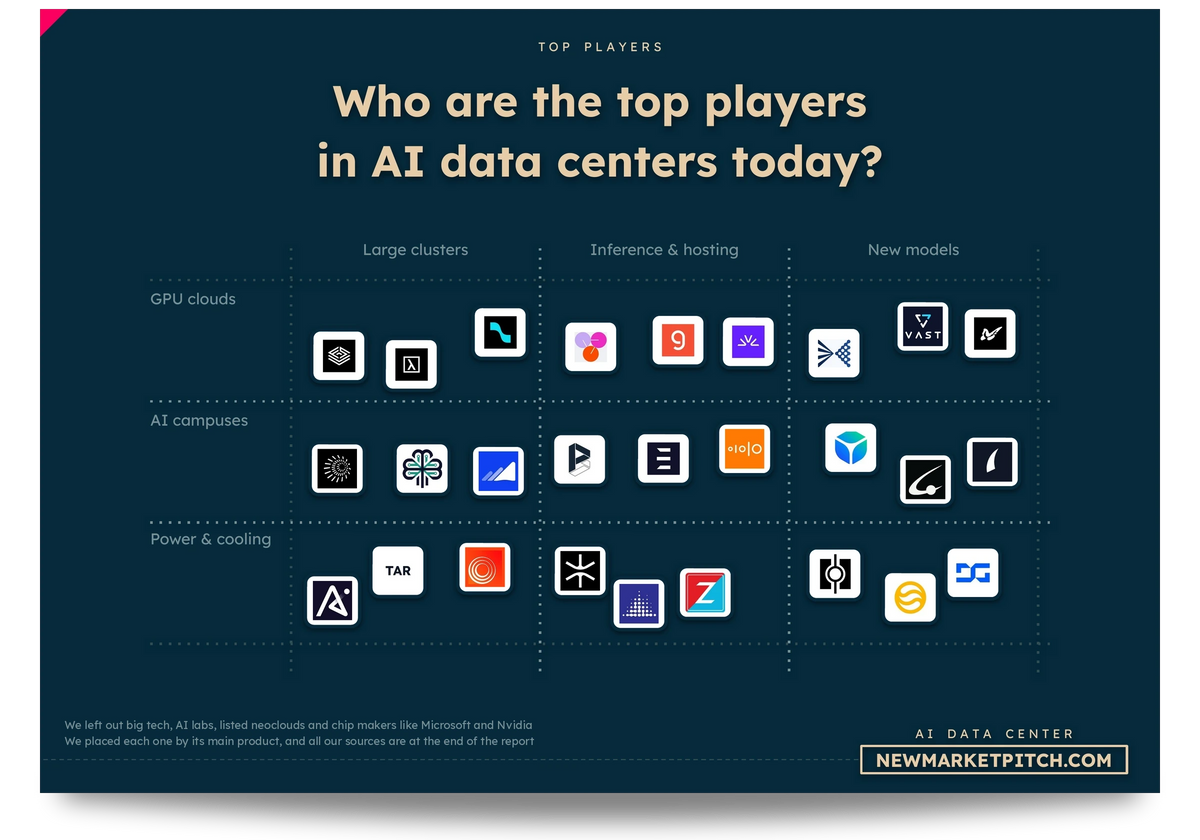
In our research about AI data centers, we turn what is vague and complex into simple, useful visuals. Market maps like this one show you at a glance where every startup stands.
Is the AI data center market really attracting $69 billion?
AI data center companies have attracted $69.22 billion in announced equity financing and commitments, but one enormous project makes the market look almost three times bigger than its underlying funding activity.
We identified 56 distinct financings across 38 companies. The Stargate Project alone accounts for $45 billion, or 65% of the total. Remove that transaction and the market comes down to $24.22 billion.
That remaining amount is still remarkable. Crusoe raised $5.275 billion during the period, Firmus $3.3 billion, and Nscale $3.255 billion. Fluidstack and Lambda also received more than $2 billion each.
Stargate deserves special treatment because its financing is different from a normal startup round. When OpenAI and SoftBank announced the project in January 2025, they described a plan to invest $500 billion in American AI infrastructure, beginning with $100 billion in deployment. The announcement named OpenAI, SoftBank, Oracle and MGX as initial equity funders but did not establish that $45 billion had already been paid into the company.
We retain the $45 billion reported commitment in our calculations while treating it separately whenever it could distort the conclusions. The more useful starting point for understanding ordinary AI data center financing is the $24.22 billion raised or committed outside Stargate.
How many AI data center startups are actually getting funded?
Only 38 companies received funding in the AI data center market during our research window, and most of them appeared just once.
Twenty-seven companies had one recorded financing, seven had two, and four had at least three. Altogether, 11 companies raised money more than once.
The companies returning to investors are especially important. Firmus completed six recorded financings, while Lambda and Nscale each completed three. Crusoe and Fluidstack raised enormous amounts through two transactions apiece.
We calculated that repeat fundraisers received $19.60 billion, compared with approximately $4.62 billion for single-round companies after excluding Stargate.
Part of the explanation is the nature of the business. Opening an AI cloud service is one investment decision; acquiring additional GPUs, securing megawatts of power and building new computing facilities requires another. The companies that can demonstrate progress have good reasons to return for significantly larger checks.
One caution is that several businesses entered the database late in the period. Their absence from subsequent funding announcements doesn't necessarily mean they failed to attract investors again.

In our market report about AI data centers, we always try to gather several sources and make estimates that make sense, so you can work with solid numbers.
Is most AI data center funding going to just a few companies?
AI data center investment is heavily concentrated among a few operators, with the ten largest funded companies capturing 94.6% of the recorded capital.
Stargate is the obvious outlier, but the concentration extends well beyond it. Crusoe, Firmus, Nscale, Fluidstack and Lambda collectively received more than $16 billion.
The largest individual rounds tell a similar story. Crusoe announced an initial closing of a $3.9 billion Series F in September 2026, following a $1.375 billion Series E in 2025. Firmus secured a $2 billion strategic equity investment in August 2026, while Nscale announced a $2 billion Series C in March.
These companies operate at a scale where financing a single expansion can cost more than the lifetime funding of dozens of smaller technology companies.
The concentration also shows which businesses investors are willing to back repeatedly. Established operators with access to computing hardware, infrastructure sites and customers have received far more money than companies still trying to establish those capabilities.
| Company | Capital raised in window | Deals |
|---|---|---|
| The Stargate Project | $45.00B | 1 |
| Crusoe | $5.275B | 2 |
| Firmus | $3.300B | 6 |
| Nscale | $3.255B | 3 |
| Fluidstack | $2.330B | 2 |
| Lambda | $2.300B | 3 |
| CoreWeave | $1.100B | 1 |
| HyperVault | $1.000B | 1 |
| Helix Digital Infrastructure | $1.000B | 1 |
| Together AI | $906M | 2 |
How much money does a typical AI data center startup raise?
The median AI data center financing is already $162.5 million, making this one of those markets where even a relatively ordinary round can involve nine figures.
The average is much higher, at $1.24 billion, but that number is heavily distorted by Stargate. The median gives a better idea of what the companies in our dataset are actually raising.
At company level, median cumulative financing is $125 million. That includes young businesses with only one round, established companies raising expansion capital and large infrastructure vehicles.
The variation is enormous. Starcloud began with a $2.4 million Seed round in March 2024. Gimlet Labs announced an $80 million Series A in March 2026, followed by a $300 million Series B in September. Fluidstack disclosed an $830 million Series A originally raised in January 2026.
So a founder looking at this market needs to distinguish between financing the initial business and financing the infrastructure required to serve large customers. The second can easily require hundreds of millions before the company reaches the age normally associated with late-stage venture funding.
Are investors still writing small checks for AI data center startups?
Small AI data center funding rounds still happen, but they account for a tiny fraction of the money flowing into the industry.
Only four recorded transactions were below $5 million. Another four fell between $5 million and $20 million. At the opposite end, 34 rounds reached at least $100 million, representing 60.7% of all financings.
Lumino's $2.8 million Seed, Starcloud's $2.4 million Seed and HIGHRESO's approximately $471,000 financing show that a company can enter the market with relatively modest capital. These examples are far removed from the financing requirements of Crusoe, Nscale or Lambda.
The economics change when a business needs to purchase substantial GPU capacity, prepare data center facilities or guarantee infrastructure availability to large customers.
We find that rounds worth $50 million or less contributed only about $344 million across the entire period. The bigger transactions accounted for nearly all the recorded funding.
| Round size | Number of deals | Share of deals | Capital raised |
|---|---|---|---|
| Below $5M | 4 | 7.1% | $7.4M |
| $5M–<$20M | 4 | 7.1% | $38.4M |
| $20M–<$50M | 7 | 12.5% | $198.4M |
| $50M–<$100M | 7 | 12.5% | $432.0M |
| $100M+ | 34 | 60.7% | $68.54B |
| All rounds | 56 | 100% | $69.22B |

Our document detailing everything you need to know about AI data center gets updated several times a month, so you always get the latest view of where things stand.
Which AI data center businesses are getting the most money?
Integrated AI infrastructure operators are attracting the broadest funding, with 34 transactions across 20 companies totaling $21.48 billion.
These businesses combine GPU computing capacity with services such as cloud provisioning, networking, storage and infrastructure operations. Crusoe, Lambda, Fluidstack, Nscale and Firmus are important examples.
Hyperscale AI Campuses technically lead the capital ranking at $46.15 billion, but Stargate supplies approximately 97.5% of that amount. Outside Stargate, the category recorded only four other financings worth around $1.15 billion.
The smaller AI Compute Data Centers category looks quite different. It includes nine companies and 12 rounds, with a median financing of just $33.5 million. TensorWave's $350 million Series B is its largest transaction.
Modular AI Data Centers received $411 million, much of it going to Armada, while AI Colocation Facilities recorded a single $52 million deal.
The category ranking makes the preference pretty clear: companies able to offer a complete infrastructure platform are absorbing substantially more capital than businesses focused on individual layers of AI computing.
| AI data center category | Deals | Companies | Total funding | Median deal |
|---|---|---|---|---|
| Hyperscale AI Campuses | 5 | 5 | $46.15B | $100M |
| Integrated AI Infrastructure Operators | 34 | 20 | $21.48B | $310M |
| AI Compute Data Centers | 12 | 9 | $1.12B | $33.5M |
| Modular AI Data Centers | 4 | 3 | $411M | $85.5M |
| AI Colocation Facilities | 1 | 1 | $52M | $52M |
Why are investors giving billions to AI infrastructure operators?
AI infrastructure operators are getting billion-dollar financings because building enough computing capacity for major AI customers requires enormous spending on equipment, electricity, buildings and operations.
Crusoe is a particularly clear example. Its September 2026 Series F announcement described a vertically integrated platform covering energy generation, AI infrastructure and cloud services. The company also reported more than $140 billion in total contracted value across its platform. That figure represents contracted value, rather than revenue already earned, but it helps explain why investors were prepared to support such an expensive expansion.
Nscale has a comparable ambition. Its March 2026 Series C was intended to accelerate infrastructure deployment across GPU computing, networking, data services and orchestration software.
Lambda's financing history also shows how quickly requirements can grow. After raising $320 million in February 2024 and $480 million in February 2025, the company announced more than $1.5 billion in additional funding in November 2025.
Aker's first-quarter 2026 shareholder letter describes the physical constraints particularly well: getting enough GPU clusters, specialized networking, electricity and cooling capacity has become a major challenge for AI infrastructure businesses.
Investors financing these operators are betting on their ability to secure and deploy those resources efficiently, often with substantial customer demand already contracted or anticipated.

In our report covering the AI data center market, we look at what the winners do differently, so you can learn from the best instead of guessing.
Is Stargate actually comparable to other AI data center startups?
Stargate operates on such a different scale that we wouldn't use its financing as a benchmark for a normal AI data center startup.
The project brings together OpenAI, SoftBank, Oracle and MGX around a major infrastructure investment program. SoftBank has financial responsibility, while OpenAI has operational responsibility.
The scale of construction is equally unusual. In July 2025, OpenAI announced an agreement with Oracle to develop another 4.5 gigawatts of American data center capacity. By April 2026, OpenAI said it had secured more than 10 gigawatts of planned US AI infrastructure capacity, already surpassing its original target.
Those announcements explain why Stargate appears so prominently in funding statistics. It was designed from the beginning around infrastructure commitments measured in tens or hundreds of billions.
For a more realistic comparison, we would look at established operators such as Crusoe, Lambda, Nscale or Fluidstack. Their rounds remain extraordinarily large, but they give a clearer picture of how investors finance identifiable AI infrastructure businesses.
How young are AI data center startups when they raise big rounds?
AI data center companies are raising serious money surprisingly young, with a median age of roughly 2.8 years at the time of financing.
For transactions above $50 million, the median company age is about 3.6 years. Companies raising below $5 million are generally much younger, with a median age under one year.
TensorWave illustrates the speed of the funding cycle. Founded in 2023, it raised $100 million in Series A funding in May 2025 and $350 million in Series B funding in June 2026.
Gimlet Labs, also founded in 2023, announced an $80 million Series A in March 2026 and a $300 million Series B less than six months later.
Then there's Fluidstack, which announced that it had raised an $830 million Series A in January 2026 at a $7.5 billion valuation. The company publicly confirmed the financing in July.
These examples show that institutional investors are prepared to fund substantial infrastructure expansion long before an operator develops a lengthy corporate history. Of course, being young does not make an enormous round easy to obtain. The companies receiving that money still need to persuade investors they can deliver capacity at scale.
Where do AI data center startups start struggling to raise their next round?
The clearest gap in AI data center fundraising appears between Series A and Series B, where the number of recorded transactions falls from 16 to seven.
The amount of money needed also jumps sharply. Median Series A financing is $75 million, while Series B reaches $230 million. Series C climbs to $800 million.
Gimlet Labs and TensorWave demonstrate that companies can successfully make the transition, but the number of businesses reaching that level is much smaller than the number securing Series A funding.
By Series D+, the median recorded check exceeds $1.4 billion. These are financings associated with substantial infrastructure expansion, and the investor pool becomes very different from the one supporting early product development.
We should be careful about interpreting the counts as startup survival rates. The companies raising Series A and Series B during the same period are not necessarily members of the same founding cohort.
Still, the funding ladder shows where financial demands become much harder to meet. Investors are willing to finance new AI infrastructure businesses, but relatively few companies attract the capital needed to become large operators.
| Funding stage | Deals | Total funding | Median round |
|---|---|---|---|
| Seed | 7 | $114.8M | $12M |
| Series A | 16 | $2.37B | $75M |
| Series B | 7 | $2.54B | $230M |
| Series C | 5 | $4.32B | $800M |
| Series D+ | 4 | $7.26B | $1.438B |
| Growth Equity | 9 | $4.87B | $220.5M |
| Unknown / bespoke | 8 | $47.74B | $365.5M |

Theory only gets you so far. In our research about AI data centers, we dig up the real signals from the field and show you the ones worth watching.
Why are so few AI compute startups reaching Series C?
The AI Compute Data Centers category has no recorded Series C, Series D+ or Growth Equity financing, even though it contains nine funded companies.
Its transactions are concentrated at Seed, Series A and Series B. The median round is $33.5 million, far below the level seen among integrated infrastructure operators.
TensorWave is one of the more advanced businesses in the category, having raised a $350 million Series B. But even that transaction remains an earlier-stage financing by conventional labels.
We see two plausible explanations for the absence of later rounds.
First, the companies are relatively young. Median company age at financing is approximately 1.7 years, so many simply haven't had time to progress further.
Second, successful providers may eventually broaden their business models. A company that begins by selling GPU compute could add owned facilities, networking, storage and more extensive infrastructure services, becoming closer to the integrated-operator category.
We cannot establish how much category migration has happened from the funding records alone. The observed result is that AI Compute has a much thinner late-stage financing record than integrated infrastructure.
Are investors mostly backing new AI data center startups or existing ones?
Investors are overwhelmingly putting money into AI data center companies that have already raised capital before, with follow-on financings accounting for 46 of the 56 transactions.
Only nine deals are classified as first financings, while one has an unknown history.
The difference becomes particularly obvious when we examine capital. Excluding Stargate, first financings account for approximately $1.12 billion, compared with $23.08 billion for follow-on transactions.
Nscale, Lambda and Firmus provide three distinct examples. Each attracted successive investments to expand its business, often with much larger amounts than in previous rounds.
The pattern makes commercial sense. Expanding a data center or GPU cloud platform can require repeated fundraising even when the company is growing successfully.
The small number of first financings doesn't mean investors have stopped supporting new businesses. The larger financial opportunities are concentrated among operators that have already shown some ability to build and run infrastructure.
Which investors keep coming back to the AI data center market?
AI data center financing has a surprisingly varied group of lead investors, despite the heavy concentration of money among funded companies.
We identified 52 distinct disclosed lead or co-lead names across 42 financings. Only seven appeared more than once.
Valor Equity Partners and Mubadala Capital participated as leads or co-leads in two Crusoe rounds totaling $5.275 billion. Aker was involved in major Nscale financings, while 8090 Industries backed transactions across integrated and modular infrastructure.
Coatue, Magnetar and AMD Ventures also appeared repeatedly.
Large AI infrastructure operators can attract different kinds of capital as they grow. Early-stage investors may finance the initial business, while growth funds, industrial investors and other institutions become relevant when expansion requires several hundred million dollars or more.
There is an important distinction between appearing in a financing and committing the entire amount. The totals below represent the full round sizes associated with each lead or co-lead, rather than the investor's individual contribution.
| Lead or co-lead investor | Deals | Combined round sizes |
|---|---|---|
| Valor Equity Partners | 2 | $5.275B |
| Mubadala Capital | 2 | $5.275B |
| Aker ASA | 2 | $3.10B |
| 8090 Industries | 2 | $2.23B |
| Coatue | 2 | $1.605B |
| Magnetar | 2 | $450M |
| AMD Ventures | 2 | $450M |

In our market report about AI data centers, we don't want to repeat what boring consulting reports say. Instead, we show you the real and latest market signals that matter.
Why is NVIDIA involved in so many AI data center funding rounds?
NVIDIA has become one of the most important strategic investors in AI data centers, appearing in 12 of the financings we tracked.
Its involvement reflects the role of GPUs in the entire industry. Infrastructure companies need reliable access to accelerator hardware, while NVIDIA benefits from the growth of customers capable of deploying increasingly large computing clusters.
Nscale provides a useful example. Its March 2026 Series C included NVIDIA, Dell, Lenovo and Nokia. Those companies have commercial relationships with technologies and equipment that AI infrastructure operators need to build functioning systems.
Other strategic backers appear frequently too. Supermicro and Microsoft's M12 each feature in three transactions, while Pegatron, AMD Ventures, Aker and Nokia appear more than once.
Overall, we identified strategic participation in 32 of 56 financings, or 57.1%.
The difference in check sizes is striking. Rounds with a named strategic investor have a median of $240 million, compared with $51 million for those without one, a roughly 4.7-fold gap.
That doesn't establish that strategic investors cause larger rounds. Large, established operators may naturally attract both more money and more industrial partners. But financing and supply-chain relationships are clearly intertwined in the AI data center industry.
Is the United States taking most of the AI data center funding?
North America attracts most AI data center investment, accounting for 32 transactions and $59.73 billion of recorded capital.
Stargate inflates that figure considerably, but the region still accounts for approximately $14.73 billion after excluding the project, more than Europe or Asia-Pacific individually.
Crusoe, Lambda, CoreWeave and Together AI are important parts of the North American funding landscape. They also show that significant capital is reaching operating businesses beyond the biggest infrastructure initiative.
Asia-Pacific recorded 13 deals worth $5.06 billion. Firmus alone accounts for approximately $3.3 billion, making the region particularly dependent on one recurring fundraiser.
Europe registered 11 transactions and $4.42 billion. Its median financing is $52 million, below North America's $196.5 million, although major transactions involving Nscale and Fluidstack show that European operators can still attract exceptional amounts.
Nscale's involvement in Stargate Norway and Stargate UK also illustrates how AI infrastructure increasingly connects commercial computing demand with national and regional ambitions to secure local AI capacity.
For now, North America has the deepest observed pool of funded companies. Europe and Asia-Pacific have credible large operators but considerably fewer businesses attracting repeated scale capital.

Learning from others' mistakes is the cheapest lesson there is. In our document detailing everything you need to know about AI data center, we look at what broke startups before you, so you don't repeat it.
Is AI data center fundraising getting busier right now?
AI data center fundraising has become noticeably busier, with September 2026 producing seven transactions, the highest monthly deal count in the period we studied.
Across the 33 completed months, the average was 1.7 deals per month and the median was just one. Several months in 2024 recorded no qualifying transactions.
September 2026 was different. The database includes Crusoe's $3.9 billion Series F, Fluidstack's $1.5 billion financing, Gimlet Labs' $300 million Series B, Verda's $189 million Series B, and transactions involving Helix and GMI Cloud.
Together, the month's seven deals represented approximately $7.15 billion.
The capital record still belongs to January 2025, when Stargate alone contributed $45 billion. But September's funding came from several separate companies, making it a better example of the market's growing transaction activity.
One unusually active month doesn't prove fundraising will keep accelerating. Still, the more frequent multi-deal months in 2026 suggest that financing is spreading across more established infrastructure businesses instead of appearing mainly through isolated announcements.
Does a billion-dollar AI data center funding round mean the company received a billion in cash?
A billion-dollar AI data center financing announcement doesn't always mean that the company received a billion dollars of new cash at the announcement date.
This distinction is particularly important because some large transactions combine cash investments with commitments, equity instruments, earlier financing or other corporate assets.
Nscale offers a concrete example. Its $2 billion Series C incorporated an earlier financing instrument and the roll-up of Aker's joint venture stake. In its first-quarter 2026 shareholder letter, Aker confirmed investing $350 million in cash while transferring its existing joint venture interest into Nscale.
Crusoe's September 2026 announcement described the initial closing of an anticipated $3.9 billion Series F. HyperVault's $1 billion entry also represents a financing commitment rather than proof that the entire amount was immediately paid.
There are similar qualifications around certain transactions involving Firmus and Helix.
These differences don't make the announcements meaningless. They do mean that we need to distinguish the reported size of an equity financing from cash that has already been funded.
For this market, announced and committed capital is a useful way to compare the scale of investment activity, provided we keep those differences visible.

If you build or invest in the AI data center market, you need to know which business models pay off now and which ones are fading. That's why our report covering it has a whole section on it.
What's the biggest problem for AI data center startups trying to scale?
The hardest part of scaling an AI data center startup appears to be securing enough capital and infrastructure to move from an initially funded compute business into a large, repeat-financed operator.
The funding ladder narrows sharply after Series A, and only 11 of the 38 companies raised more than once within the observed window.
Meanwhile, the companies that successfully attract repeated capital can move quickly into enormous financing requirements. The progression of Nscale, Lambda and Gimlet Labs illustrates how dramatically round sizes can increase.
Physical constraints add another layer of difficulty. An AI infrastructure company needs access to GPUs, power, cooling, networking and facilities while also finding customers willing to pay for the capacity.
Aker's description of these challenges in 2026 matches what we see in the financing records: once companies try to operate at scale, their capital needs begin to resemble those of major infrastructure businesses.
The open question is how many younger AI compute providers will eventually join that group. Currently, financing evidence supports a relatively small collection of businesses with the ability to secure major rounds repeatedly.
What should we actually take away from the AI data center funding data?
AI data center funding has reached enormous scale, but the money is concentrated in far fewer companies than the headline figures suggest. The market includes 38 funded businesses, and a small group of repeat fundraisers accounts for most of the capital outside Stargate.
Integrated infrastructure operators have become the main destination for recurring investment. Investors are giving them hundreds of millions or billions to expand computing capacity, acquire equipment and build the physical infrastructure required by AI customers.
The median financing is already exceptionally high, and check sizes rise dramatically after Series A. That creates a difficult transition for younger companies, especially those still focused on narrower compute services.
Strategic investors also play a major role. NVIDIA's repeated participation and the involvement of companies such as Dell, Nokia and Supermicro show how closely funding is tied to access to equipment and commercial partnerships.
The regional picture is uneven. North America attracts the most money and has the largest group of funded operators, while Europe and Asia-Pacific depend more heavily on a few companies raising very large amounts.
And we should keep the financing structures in perspective. Stargate's commitments, Nscale's combination of cash and corporate assets, and Crusoe's staged closing show why announced capital cannot always be treated as cash already received.
The most interesting question now is how many companies will manage to join the small group of established operators that can keep raising serious money. We already know that investors are willing to commit billions to AI data centers. What remains much less certain is how broadly that funding will spread as the market matures.
Our methodology
This analysis examines AI data center market fundraising from January 1, 2024, through October 8, 2026. We identified 57 funding records, consolidated one duplicated $830 million Fluidstack Series A and retained 56 distinct financings across 38 companies. We used these records to calculate deal counts, disclosed capital, round-size distributions, company concentration, funding stages, investor participation, geography and category-level differences.
We defined the market around companies whose core business involves AI data center infrastructure, integrated GPU computing operations or closely related AI cloud infrastructure. Each company was classified according to its principal operating model at the time of financing, distinguishing hyperscale campuses, integrated infrastructure operators, AI compute data centers, modular facilities and colocation providers. Businesses with only an incidental connection to AI infrastructure were excluded.
Our financing scope focused on identifiable private-company equity rounds. Ordinary debt, loans, grants and public offerings were excluded, and we reviewed extensions, additional closings and financing tranches to avoid duplication. Funding stages were retained as disclosed, rather than inferred from transaction sizes. Amounts, investor roles and financing dates were checked against company announcements, investor disclosures, regulatory records and established industry reporting.
The $69.22 billion headline measures announced equity financing and commitments, not cash necessarily received at the announcement date. Stargate's $45 billion reported commitment is the largest qualification and is isolated in several calculations, leaving $24.22 billion outside the project. We also preserve the distinctions between initial closings, future commitments and transactions containing non-cash assets. Nscale's $2 billion Series C and Crusoe's September 2026 Series F are examples where the announced amount requires this treatment.
We compared multiple dimensions rather than relying on aggregate funding alone. Deal-level statistics establish the distribution of round sizes; company-level aggregation reveals capital concentration and repeat fundraising; stages and founding years help assess maturity; and investor and geographic classifications show where financing activity is clustered. We separately examined the market with Stargate removed and compared smaller transactions with the largest rounds to assess how representative the headline totals really are. Stage counts describe transactions within the observation period, not cohort survival or graduation rates.
Following the initial compilation, we reviewed duplicate records, transaction dates, funding structures, company identities, market classifications and strategic investor participation. This included reconciling Fluidstack's January 2026 Series A with its July announcement, examining Nscale's financing structure against Aker's shareholder disclosures and distinguishing Stargate's infrastructure investment program from ordinary venture financing. These checks were used to keep financing amounts, commitments and operating investment plans appropriately differentiated.
Key sources include OpenAI's original Stargate announcement, OpenAI's Oracle infrastructure partnership update, OpenAI's infrastructure capacity update, Crusoe's Series F announcement, Crusoe's Series E announcement, Nscale's Series B disclosure, Nscale's Series C disclosure, Aker's first-quarter 2026 shareholder letter, Fluidstack's Series A confirmation, Lambda's $320 million financing announcement, Lambda's additional infrastructure financing announcement, CoreWeave's Series C announcement, Firmus's $2 billion investment announcement, Firmus's Coatue-led financing, Gimlet Labs' Series A, Gimlet Labs' Series B, TensorWave's Series A, Armada's Series B, Together AI's Series C, and Verda's financing announcement.

In our research about AI data centers, we like to show you the big picture. We know your time is precious, so we make every page quick to read and packed with as much learning as possible per minute.
Written by the New Market Pitch teamWe track new markets so founders and investors can move faster. About us