What’s funding like in the AI data center market right now?
Building a startup or looking for your next investment in AI data center? Our report gives you the full picture.
Summary
AI data center funding is much healthier right now than the headline 58% decline in total capital suggests. More companies are raising, deals are happening far more often, and the typical financing is dramatically larger, but the market has clearly shifted toward scaling proven operators rather than creating new ones.
The apparent funding decline is mostly a comparison problem. Stargate's $45 billion partner-equity commitment represented 94.6% of the previous period's recorded capital, making almost any normal twelve-month window look smaller by comparison.
Underneath that outlier, the market has expanded sharply. Deal count rose from 13 to 30 and the number of funded companies increased from 11 to 23, with at least one financing recorded in every month of the latest period.
Large rounds have effectively become normal. Twenty-two of 30 recent financings exceeded $100 million, while the overall median jumped from $131 million to $312.5 million.
The money is also much less concentrated than before. The largest current transaction represents 19.6% of capital rather than Stargate's previous 94.6%, and a growing group of companies can now support nine- or ten-figure rounds.
The weak spot is company formation. Only three recent transactions were first financings, Seed activity fell to one deal, and 90% of current transactions went to companies with an existing funding history.
Full-stack AI infrastructure operators have become the market's clear winners. They accounted for 63.3% of recent deals and 88.6% of capital as investors increasingly back companies capable of coordinating power, GPUs, networking, facilities and customer delivery rather than owning only one piece of the stack.
The funding is increasingly tied to physical deployment rather than product experimentation. Gigawatt-scale facilities, accelerator purchases, manufacturing capacity, cooling, power and multi-region infrastructure are now central uses of proceeds.
That shift is changing the investor base too. Strategic investors participated in about two-thirds of recent deals, often bringing hardware supply, manufacturing, customer relationships or infrastructure capabilities alongside their capital.
Geographically, Asia-Pacific is gaining real weight while Europe is becoming more concentrated. APAC's deal share increased to 26.7%, whereas Europe produced fewer transactions but much larger typical financings.
The result is a market that increasingly resembles industrial infrastructure finance delivered through startup equity. AI data center funding currently has a powerful scale-up engine, but a much thinner startup-formation engine.

Written by the New Market Pitch teamWe track new markets so founders and investors can move faster. About us

In our report covering the AI data center market, you will always find fresh funding data, taken straight from our own verified funding database.
All funding deals in the AI data center market over the last 24 months
Below is the table listing all the deals. You can find our methodology at the end of this page.
If you want a deeper understanding of the market and its current dynamics, get our report covering the AI data center market.
| Company | Category | Date | Stage | Deal size | What they do | Region | Lead investors | Country | Rank |
|---|---|---|---|---|---|---|---|---|---|
| GMI Cloud | Integrated AI Infrastructure Operators | September 2026 | Series B | $223M | Operates an AI-native GPU cloud with high-performance compute and inference infrastructure across the U.S. and Asia-Pacific. | North America | ARCHIV | United States | |
| Helix Digital Infrastructure LLC | Integrated AI Infrastructure Operators | September 2026 | Unknown | $1B | Finances, develops and operates integrated AI infrastructure spanning hyperscale data centers, power and connectivity. | North America | Not disclosed | United States | |
| Verda | AI Compute Data Centers | September 2026 | Series B | $189M | Operates a full-stack AI cloud spanning physical data centers, GPU hardware and cloud-platform services. | Europe | Emergence Capital | Finland | |
| Crusoe | Integrated AI Infrastructure Operators | September 2026 | Series D+ | $3.9B | Builds and operates vertically integrated AI factories, hyperscale campuses and AI cloud infrastructure. | North America | Atreides Management; Mubadala Capital; Valor Equity Partners | United States | |
| Rune (Liitto Technology, Inc.) | Modular AI Data Centers | September 2026 | Series A | $40M | Deploys modular RELIC AI data centers directly at utility-scale solar sites to convert available power into compute. | North America | Spark Capital | United States | |
| Gimlet Labs | Integrated AI Infrastructure Operators | September 2026 | Series B | $300M | Operates a multi-silicon AI inference cloud with managed data-center capacity optimized across heterogeneous accelerators. | North America | Andreessen Horowitz | United States | |
| Fluidstack | Integrated AI Infrastructure Operators | September 2026 | Growth Equity | $1.5B | Designs, deploys and operates dedicated AI data centers and compute infrastructure for leading AI labs. | North America | Jane Street | United States | |
| Starcloud | AI Compute Data Centers | August 2026 | Series A | $250M | Builds space-based data centers to deliver orbital AI training and inference compute. | North America | Manhattan West | United States | |
| Groq | Integrated AI Infrastructure Operators | August 2026 | Series A | $350M | Operates a global AI inference cloud across dedicated data centers using accelerated-compute clusters. | North America | Disruptive | United States | |
| Firmus | Integrated AI Infrastructure Operators | August 2026 | Growth Equity | $2B | Develops and operates high-density AI factories combining data-center, compute and energy-orchestration infrastructure. | Asia-Pacific | Not disclosed | Australia | |
| StratGrid Inc. | Hyperscale AI Campuses | July 2026 | Unknown | $1.8M | Develops behind-the-meter natural-gas-powered AI and hyperscale data-center campuses in Alberta. | North America | Not disclosed | Canada | |
| Fluidstack | Integrated AI Infrastructure Operators | July 2026 | Series A | $830M | Designs, deploys and operates dedicated AI data centers and compute infrastructure for leading AI labs. | North America | Situational Awareness | United States | |
| Together AI | Integrated AI Infrastructure Operators | July 2026 | Series C | $800M | Runs an AI-native cloud with dedicated GPU clusters and production-scale training and inference infrastructure. | North America | Aramco Ventures | United States | |
| TensorWave | AI Compute Data Centers | June 2026 | Series B | $350M | Operates an AI cloud of AMD Instinct GPU clusters for memory-intensive training and inference, backed by more than 2 GW of secured data-centre capacity. | North America | Magnetar; AMD Ventures | United States | |
| Armada | Modular AI Data Centers | May 2026 | Series B | $230M | Designs, manufactures and deploys Galleon modular data centres (up to megawatt-scale Leviathan units) that deliver AI compute at the edge. | North America | Overmatch; BlackRock; 8090 Industries | United States | |
| Nava | AI Compute Data Centers | April 2026 | Series A | $22M | Building a full-stack neocloud combining AI data centres, GPU-as-a-Service and bare-metal compute for enterprises in India and Southeast Asia. | Asia-Pacific | Greenoaks | Singapore | |
| Firmus | Integrated AI Infrastructure Operators | April 2026 | Growth Equity | $505M | Builds and operates energy-efficient “AI factory” data centres (HyperCube platform, NVIDIA reference design) supplying GPU compute capacity across Australia and Asia-Pacific. | Asia-Pacific | Coatue | Australia | |
| Starcloud | AI Compute Data Centers | March 2026 | Series A | $170M | Builds and operates orbital GPU data centers for AI training, inference and commercial cloud workloads. | North America | Benchmark; EQT Ventures | United States | |
| ai& Inc. (株式会社エーアイ・アンド) | Integrated AI Infrastructure Operators | March 2026 | Seed | $50M | Develops and operates AI data centers and a vertically integrated sovereign AI compute platform spanning heterogeneous compute, inference and model services. | Asia-Pacific | Not disclosed | Japan | |
| Gimlet Labs | Integrated AI Infrastructure Operators | March 2026 | Series A | $80M | Operates a multi-silicon inference cloud for agentic AI workloads across GPUs, CPUs and specialized accelerators. | North America | Menlo Ventures | United States | |
| Nscale | Integrated AI Infrastructure Operators | March 2026 | Series C | $2B | Owns and operates hyperscale AI data centers and a vertically integrated GPU-cloud stack spanning compute, networking, data services and orchestration. | Europe | Aker ASA; 8090 Industries | United Kingdom | |
| Neysa | Integrated AI Infrastructure Operators | February 2026 | Unknown | $600M | Provides purpose-built GPU-based AI cloud infrastructure in India for training, fine-tuning, inference and controlled enterprise deployments. | Asia-Pacific | Blackstone | India | |
| Firmus | Integrated AI Infrastructure Operators | February 2026 | Growth Equity | ≈$70M | Designs, builds and operates vertically integrated high-density AI Factories and GPU compute infrastructure across Asia-Pacific. | Asia-Pacific | Not disclosed | Australia | |
| PaleBlueDot AI | AI Compute Data Centers | January 2026 | Series B | $150M | Provides enterprise-grade AI compute through GPU cloud and dedicated cluster infrastructure for training, inference and deployment. | North America | B Capital | United States | |
| Sapience AI | AI Compute Data Centers | January 2026 | Unknown | $8.8M | Operates an EU-sovereign GPU cloud with dedicated NVIDIA compute hosted in European data centers for AI training and inference. | Europe | Not disclosed | Slovakia | |
| Bolt Data & Energy, Inc. | Hyperscale AI Campuses | December 2025 | Series A | $50M | Develops integrated large-scale AI data center campuses combining land, energy generation and GPU compute infrastructure. | North America | Not disclosed | United States | |
| HyperVault AI Data Center Limited | Hyperscale AI Campuses | November 2025 | Unknown | ≈$1B | Develops gigawatt-scale, liquid-cooled AI-ready data centers in India for hyperscalers and AI-driven organizations. | Asia-Pacific | Not disclosed | India | |
| Lambda | Integrated AI Infrastructure Operators | November 2025 | Series D+ | >$1.5B | Builds and operates GPU-dense AI factories and supercomputers sold as cloud compute for AI training and inference. | North America | TWG Global | United States | |
| Firmus | Integrated AI Infrastructure Operators | November 2025 | Growth Equity | $324.9M | Designs, builds and operates liquid-cooled AI factories and GPU infrastructure for high-density AI workloads. | Asia-Pacific | Not disclosed | Australia | |
| Crusoe | Integrated AI Infrastructure Operators | October 2025 | Series D+ | $1.4B | Builds and operates vertically integrated AI factories, data centers and GPU cloud capacity for large-scale AI training and inference. | North America | Valor Equity Partners; Mubadala Capital | United States | |
| Nscale | Integrated AI Infrastructure Operators | September 2025 | Series B | $1.1B | Develops and operates AI-native data centers alongside vertically integrated GPU compute, networking, storage and orchestration services. | Europe | Aker ASA | United Kingdom | |
| Firmus | Integrated AI Infrastructure Operators | September 2025 | Growth Equity | ≈$220.5M | Designs, builds and operates high-density AI factories and delivers GPU compute through an integrated AI infrastructure platform. | Asia-Pacific | Ellerston Capital | Australia | |
| Fermi America | Hyperscale AI Campuses | August 2025 | Series C | $100M | Develops hyperscale AI campuses combining powered-shell data centers with dedicated behind-the-meter energy infrastructure. | North America | Macquarie Group | United States | |
| Armada | Modular AI Data Centers | July 2025 | Unknown | $131M | Builds and operates ruggedized edge-computing infrastructure centered on deployable modular data centers for AI workloads. | North America | Not disclosed | United States | |
| Firmus | Integrated AI Infrastructure Operators | June 2025 | Growth Equity | ≈$180M | Builds and operates liquid-cooled AI factories and GPU-cloud infrastructure purpose-built for high-density AI workloads. | Asia-Pacific | Not disclosed | Australia | |
| Lyceum | AI Compute Data Centers | June 2025 | Seed | ≈$12M | Builds a sovereign European AI cloud using its own GPU infrastructure and European data-center capacity for high-performance AI workloads. | Europe | redalpine | Germany | |
| TensorWave | AI Compute Data Centers | May 2025 | Series A | $100M | Operates an AMD-powered AI cloud with high-density liquid-cooled GPU clusters for training, fine-tuning and inference. | North America | Magnetar; AMD Ventures | United States | |
| NexGen Cloud | AI Compute Data Centers | April 2025 | Series A | $45M | Operates Hyperstack, providing dedicated and on-demand GPU compute infrastructure for AI training and inference. | Europe | Moore & Moore Investment Group | United Kingdom | |
| Lambda | Integrated AI Infrastructure Operators | February 2025 | Series D+ | $480M | Operates AI-only GPU cloud and large-scale compute infrastructure for model training, fine-tuning and inference. | North America | Andra Capital; SGW | United States | |
| Eclairion | AI Colocation Facilities | February 2025 | Growth Equity | $52M | Operates modular high-density colocation facilities purpose-built for AI and HPC clusters. | Europe | Not disclosed | France | |
| The Stargate Project | Hyperscale AI Campuses | January 2025 | Unknown | $45B | Develops hyperscale U.S. AI data-center campuses and compute systems dedicated to OpenAI workloads. | North America | SoftBank; OpenAI | United States | |
| Nscale | Integrated AI Infrastructure Operators | December 2024 | Series A | $155M | Develops and operates AI-ready data centers, GPU superclusters and AI cloud services as a vertically integrated AI infrastructure platform. | Europe | Sandton Capital Partners | United Kingdom | |
| Verda | AI Compute Data Centers | October 2024 | Seed | $7.6M | Provides GPU-as-a-service and dedicated AI compute clusters for training and inference from Nordic data-center infrastructure. | Europe | byFounders | Finland |

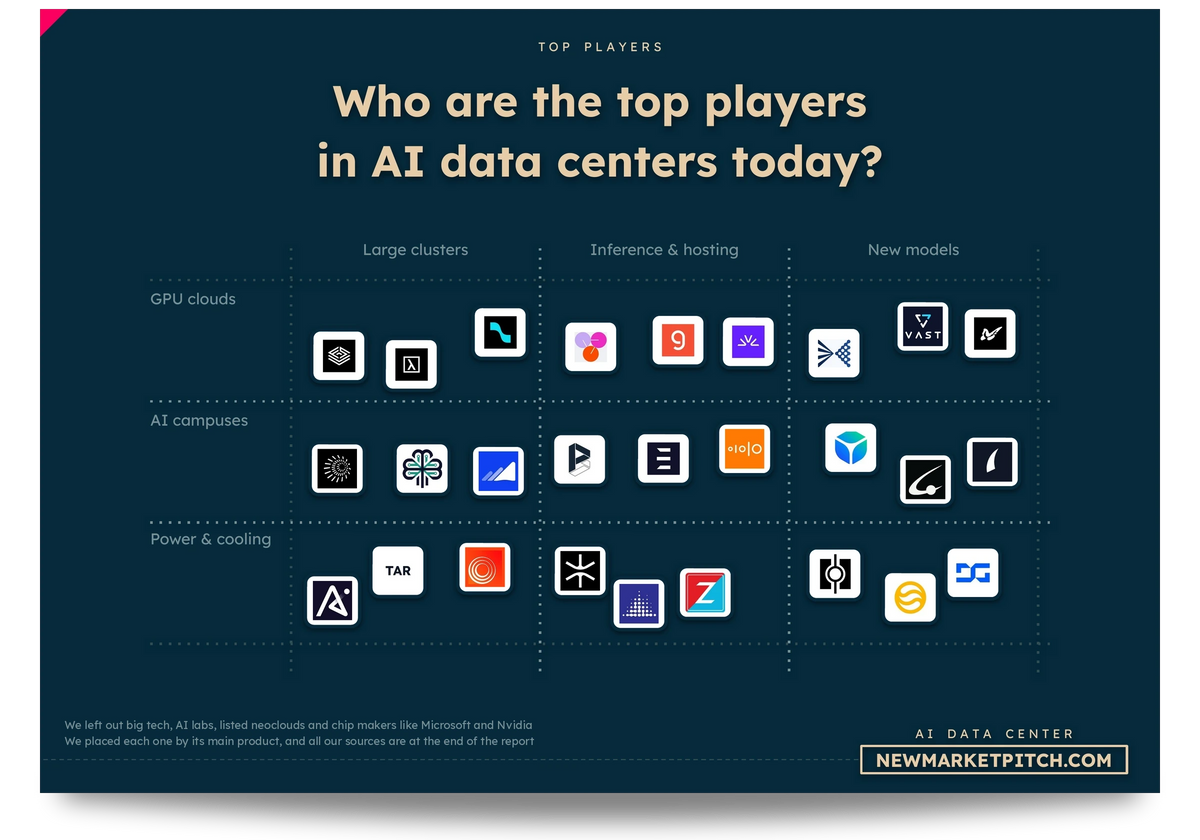
In our research about AI data centers, we turn what is vague and complex into simple, useful visuals. Market maps like this one show you at a glance where every startup stands.
Is AI data center funding actually healthier now?
AI data center funding looks much healthier today on deal activity, company breadth and typical round size, even though total recorded capital is down 58%.
We counted 30 financings across 23 companies in the latest 12 months, up from 13 deals across 11 companies in the previous period. The median round jumped from $131 million to $312.5 million, and there was at least one financing in every month.
The weakness is at the entry point. Only 10% of recent deals were first financings, down from 15.4%, while follow-ons reached 90%. Seed activity also fell from two deals to one even as the whole market more than doubled in size by deal count.
So the market is healthier in the sense that many more companies can raise serious money. It is also more mature: most of that money is going into companies that investors already know.
| Metric | Current L12M | Previous 12M | Change |
|---|---|---|---|
| Deals | 30 | 13 | +131% |
| Unique companies | 23 | 11 | +109% |
| Total capital | $19.87B | $47.58B | -58.2% |
| Median round | $312.5M | $131.0M | +138.5% |
| Average deals/month | 2.50 | 1.08 | +131% |
| First-financing share | 10.0% | 15.4% | -5.4 pp |
| Follow-on share | 90.0% | 84.6% | +5.4 pp |
| Later-stage deal share | 53.3% | 46.2% | +7.2 pp |
Did AI data center funding really fall 58%?
The 58% drop in AI data center funding is technically correct, but it gives a terrible picture of what actually happened in the market.
The previous 12 months contained Stargate's $45 billion partner-equity commitment. That one transaction represented 94.6% of all capital in the period. OpenAI described Stargate as a much broader $500 billion four-year infrastructure program, with $100 billion expected to begin deploying immediately, so the database figure is already an unusual financing compared with a normal venture round.
Look below that outlier and today's market looks completely different. Capital in rounds of $50 million or less rose from $64.6 million to $172.6 million, a 167% increase. Capital in rounds of $100 million or less was essentially unchanged at $322.6 million versus $316.6 million. At the same time, the typical financing became much larger.
Someone looking only at aggregate dollars would therefore conclude that AI data center financing collapsed. Once Stargate stops dominating the comparison, that conclusion does not hold up.
Is today's AI data center boom still driven by a few giant rounds?
AI data center funding is far less dependent on one giant deal now, even though billion-dollar rounds have become remarkably common.
The largest recent financing, Crusoe's anticipated $3.9 billion Series F, represents 19.6% of current capital. A year earlier, Stargate represented 94.6%. The top five transactions now account for 54.9% of funding compared with 98.7% previously.
The more interesting change is the number of large deals underneath the leader. We counted 22 rounds above $100 million in the latest period, compared with seven previously. Crusoe, Firmus, Lambda, Fluidstack, Nscale, Together AI, TensorWave and several others have all reached nine- or ten-figure financing territory.
As seen above, this is now a much deeper financing market. Large checks are spread across a growing cohort rather than being almost entirely explained by one project.
| Concentration | Current L12M | Previous L12M |
|---|---|---|
| Largest deal / total capital | 19.6% | 94.6% |
| Top 3 deals | 39.8% | 97.9% |
| Top 5 deals | 54.9% | 98.7% |
| Top 10 deals | 80.0% | 99.9% |
| Rounds above $50M | 24 | 10 |
| Rounds above $100M | 22 | 7 |
| $100M+ deal share | 73.3% | 53.8% |
| Capital in rounds of $100M or less | $322.6M | $316.6M |

In our market report about AI data centers, we always try to gather several sources and make estimates that make sense, so you can work with solid numbers.
Are more AI data center companies actually getting funded now?
Yes, AI data center funding is reaching a much wider group of companies now.
We found 23 funded companies in the latest 12 months compared with 11 previously. That increase is almost as large as the rise in deal count, which went from 13 to 30.
The mix is also broader than a simple list of hyperscale campus developers. Recent financings span full-stack operators such as Crusoe and Firmus, GPU-cloud businesses such as TensorWave, modular infrastructure through Armada and Rune, European platforms such as Verda, and even Starcloud's orbital data-center model.
That breadth is one of the clearest improvements in the market. More companies have managed to turn AI-compute demand into something investors consider financeable at scale.
Are investors still funding new AI data center startups?
New AI data center startups are still getting funded, but the current boom is overwhelmingly about scaling companies that already exist.
Only three recent transactions were first financings. The absolute number increased from two, yet first financings fell from 15.4% to 10% of deal activity because everything else grew much faster.
Follow-on capital tells the story more clearly. Existing companies raised $18.81 billion in the latest period versus $2.57 billion previously, and the median follow-on increased from $131 million to $324.9 million.
The entry point therefore looks relatively thin these days. Investors are putting enormous amounts behind the cohort that has already made it through the first stages of company formation, while the flow of freshly funded businesses has barely moved.
| New entrants vs existing companies | Current L12M | Previous L12M |
|---|---|---|
| First financings | 3 | 2 |
| First-financing share | 10.0% | 15.4% |
| Follow-on financings | 27 | 11 |
| Follow-on share | 90.0% | 84.6% |
| Follow-on capital | $18.81B | $2.57B |
| Median follow-on | $324.9M | $131M |
| Companies with multiple financings | 5 | 2 |
| Repeat-fundraising rate | 21.7% | 18.2% |
Have $100 million AI data center rounds become normal?
Yes. In AI data center funding today, a $100 million round barely qualifies as unusually large anymore.
Twenty-two of the 30 recent deals cleared $100 million. That means 73.3% of the market by transaction count sits in nine-digit territory.
Meanwhile, the conventional $5 million to $20 million venture round almost disappeared, falling from 15.4% to 3.3% of deals. Even Series A rounds had a $125 million median in the latest period.
The economics explain a lot of this. These companies are buying GPUs, securing power, fitting out high-density sites, building cooling systems, manufacturing modular data centers and committing to large capacity deployments. A financing that would look enormous for a software startup can be relatively ordinary when the product involves hundreds of megawatts of physical infrastructure.

Our document detailing everything you need to know about AI data center gets updated several times a month, so you always get the latest view of where things stand.
Which AI data center business model is getting the most investor attention?
Vertically integrated AI infrastructure operators are winning the funding race right now.
Their share of deals rose from 38.5% to 63.3%, while their median financing increased from $220.5 million to $600 million. They captured $17.6 billion, or 88.6% of all capital in the latest period.
Crusoe is perhaps the clearest example. The company combines energy, data-center development and AI cloud services, and its latest financing followed more than $140 billion in reported contracted value across its platform. Firmus combines AI factories, proprietary infrastructure and cloud capacity. Nscale describes its model as spanning power, data centers, GPU compute, networking and orchestration. Verda's latest $189 million financing similarly supports a full-stack AI cloud rather than a narrow infrastructure layer.
Investors increasingly seem to prefer companies that can control more of the deployment chain. With power, GPUs, networking and customer delivery all potential bottlenecks, owning more of the stack gives an operator more ways to keep projects moving.
| Category | Current deal share | Current median | Previous deal share | Previous median |
|---|---|---|---|---|
| Integrated AI Infrastructure Operators | 63.3% | $600M | 38.5% | $220.5M |
| AI Compute Data Centers | 20.0% | $160M | 30.8% | $28.5M |
| Hyperscale AI Campuses | 10.0% | $50M | 15.4% | $22.55B |
| Modular AI Data Centers | 6.7% | $135M | 7.7% | $131M |
| AI Colocation Facilities | 0% | - | 7.7% | $52M |
| Integrated operator capital share | 88.6% | - | Lower | - |
| Overall median financing | - | $312.5M | - | $131M |
Is AI data center funding moving later-stage?
Yes, AI data center funding has moved further into the scaling phase over the last year.
Early-stage deals fell from 38.5% to 30% of transactions while later-stage deals rose from 46.2% to 53.3%. Seed was especially quiet, with only one deal.
Series B went the other way, growing from one financing to six. Series C reached a $1.4 billion median, while Series D+ reached $1.5 billion.
This looks like a cohort graduating. A meaningful number of AI infrastructure companies that were proving a concept a few years ago are now financing actual deployments, larger sites and commercial expansion.
The shift also explains why overall company age barely changed while round sizes exploded. Investors do not simply seem to be financing much older businesses; they are writing much bigger checks to companies that have reached a more capital-intensive phase.
Do AI data center companies need more proof to raise big rounds now?
For the biggest AI data center rounds, proof of deployment and customer demand now looks almost as important as the technology itself.
We cannot build a clean market-wide milestone comparison because public disclosure is too inconsistent. But the companies attracting the biggest checks increasingly arrive with something tangible behind the story.
Crusoe reported more than $140 billion in contracted value when it announced its anticipated $3.9 billion Series F. Two days earlier, it had announced a multi-year agreement with Perplexity covering both frontier-model training and production inference.
Firmus has gone even further into industrial-scale proof. Its recent financing cycle sits alongside large Australian deployments, a 360 MW campus in Indonesia built around as many as 170,000 NVIDIA accelerators, and new GPU-compute agreements with Meta across Asia-Pacific.
That is a much higher bar than proving that a GPU cloud can technically work. The large-round market increasingly rewards companies that can show customers, hardware access, power and credible deployment capacity at the same time.

In our report covering the AI data center market, we look at what the winners do differently, so you can learn from the best instead of guessing.
What are AI data center companies actually raising all this money for?
AI data center funding is increasingly paying for physical rollout: more power, more GPUs, more facilities and more manufacturing capacity.
Lambda said its more-than-$1.5 billion Series E would accelerate gigawatt-scale AI factories and supercomputers. Armada paired a $230 million Series B with plans for a dedicated Arizona manufacturing facility for its modular Galleon data centers.
Firmus said its $2 billion strategic equity round would accelerate Project Southgate in Australia and prepare expansion into other Asia-Pacific markets. Crusoe said its latest capital would support AI factories ranging from large campuses to modular units while expanding Crusoe Cloud.
Nscale's $2 billion Series C has a similar flavor, with the company explicitly targeting vertically integrated deployments across Europe, North America and Asia.
The practical center of the market has moved well beyond R&D. These days, the expensive problems are deployment problems.
Are strategic investors taking over AI data center funding?
Strategic investors are becoming much more influential in AI data center financing, especially where hardware and deployment relationships matter.
Strategic participation rose from 46.2% of deals to 66.7%. More strikingly, it now appears across Series A, Series B, Series C, later-stage and growth financings rather than being confined to a few mature companies.
NVIDIA appears repeatedly because access to accelerated computing sits at the center of these businesses. AMD Ventures backed TensorWave, whose infrastructure is built around AMD Instinct GPUs. Johnson Controls invested alongside an agreement to manufacture Armada's modular systems. Samsung committed $1 billion to Helix while bringing semiconductor, construction, cloud and energy capabilities into the relationship.
A corporate investor can bring much more than cash in this market. Hardware supply, networking, manufacturing, site development and customer access can all become part of the same financing relationship, which helps explain why strategic participation has climbed so quickly.
Is Asia-Pacific becoming a serious AI data center funding hub?
Yes, Asia-Pacific has become one of the clearest areas of new momentum in AI data center funding.
The region's deal share increased from 15.4% to 26.7%, and the median transaction reached roughly $415 million. Australia alone contributed around $2.9 billion to the latest period.
Firmus is the standout example, but the regional story goes beyond one company. HyperVault brought a large Indian infrastructure commitment into the dataset, Nava is targeting India and Southeast Asia, and Japanese operators are also building sovereign AI-compute platforms.
The newest company announcements make the trend harder to dismiss as a temporary financing burst. Firmus has since announced a 360 MW NVIDIA-linked campus in Indonesia and GPU-compute agreements with Meta across Southeast Asia.
North America still leads the market, but AI data center capital is increasingly following power availability, sovereign-compute ambitions and customer demand across Asia-Pacific.

Theory only gets you so far. In our research about AI data centers, we dig up the real signals from the field and show you the ones worth watching.
Is Europe falling behind in AI data center funding?
Europe is getting fewer AI data center deals, but the companies that do raise are attracting much larger rounds than before.
Europe's deal share fell to 13.3% from 46.2%. Its median financing, however, rose from $48.5 million to roughly $509.5 million.
Nscale captures the change well. Its $2 billion Series C is funding full-stack infrastructure across Europe, North America and Asia, and the company subsequently announced another $790 million financing package for its Narvik data-center buildout in Norway. Verda's recent $189 million financing gives Europe another sizeable full-stack AI cloud platform.
The European picture is more concentrated, but it does not look starved of capital. Money is clustering around a smaller number of companies trying to operate at hyperscaler-like scale.
Are AI data center investors becoming more selective?
AI data center investors look more demanding about company maturity, even while they are funding far more companies overall.
We found roughly twice as many disclosed lead investors as in the previous period, and unique funded companies also doubled. Capital has clearly not shut down.
Yet the market's center of gravity moved toward follow-ons, Series B and later-stage rounds. Seed barely participated in the boom, and first-time financings lost share.
The bar has moved higher, rather than investor appetite moving lower. Investors are paying much more attention to AI infrastructure, but the largest checks increasingly go to companies that can show they have somewhere productive to put hundreds of millions of dollars.
Has AI data center funding become more consistent through the year?
Yes, AI data center fundraising now happens much more consistently instead of arriving in a few isolated bursts.
The latest period had no zero-deal months, compared with two previously. Median monthly deal count doubled from one to two, and median monthly capital rose from $115.5 million to about $895 million.
September was particularly strong, with seven deals and roughly $7.15 billion. But funding was already active across the rest of the year through companies such as Lambda, Firmus, Fluidstack, Nscale, Armada, TensorWave and Together AI.
The difference with the previous period is straightforward: Stargate created one enormous month, while the current market produces large transactions again and again.
Are AI data center companies raising money faster than before?
We can say that repeat fundraising is more common in AI data centers now, but we cannot honestly claim that the whole market is raising faster.
Five current-period companies raised more than once, compared with two previously, and the repeat-fundraising rate increased from 18.2% to 21.7%.
Firmus, Crusoe, Fluidstack and Starcloud all show how quickly capital can come back to companies with large deployment plans. Fluidstack is a useful reminder to be careful, though: its $830 million Series A was publicly announced in July even though the company says it actually closed in January, so counting both dates would create a fake extra transaction.
A proper funding-velocity statistic requires reliable previous-round dates for the entire sample, and public records do not provide that consistently enough. We therefore stop at the defensible conclusion: repeat financing broadened, while the exact speed of market-wide fundraising remains uncertain.

In our market report about AI data centers, we don't want to repeat what boring consulting reports say. Instead, we show you the real and latest market signals that matter.
Has AI data center funding become more like infrastructure finance than venture capital?
Yes, today's AI data center funding increasingly looks like industrial infrastructure finance delivered through startup equity.
The clearest clue is scale. Nearly three-quarters of recent transactions exceeded $100 million, the median round reached $312.5 million, and strategic investors participated in roughly two-thirds of deals.
Then look at what companies are actually financing: gigawatt-scale facilities, hundreds of thousands of accelerators, manufacturing lines, energy agreements, high-density cooling and multi-region deployments. Those are industrial problems as much as startup problems.
The companies are still venture-backed and their technology, execution speed and market position matter enormously. But the capital intensity increasingly resembles infrastructure development.
That hybrid model helps explain why full-stack operators are doing so well right now. The company that can coordinate capital, power, hardware and customers has a much better chance of actually getting capacity online.
What really changed in AI data center funding over the last 12 months?
AI data center funding became broader, more mature and much more industrial over the last 12 months, while headline capital fell for a reason that says very little about current market health.
The biggest change is breadth. We found more than twice as many financings and more than twice as many funded companies, with activity spread through every month rather than depending on one extraordinary announcement.
The second change is the normalization of very large rounds. Nine-digit financings now dominate the market, while integrated infrastructure operators have become the main destination for capital.
The third change is who benefits. Existing companies captured the overwhelming majority of recent financing, while first-time funding and seed activity failed to keep up. AI data centers currently have a much stronger scale-up engine than startup-formation engine.
Strategic investors also have a bigger role because funding increasingly sits alongside GPU supply, networking, manufacturing, energy and customer agreements. The companies that can coordinate those pieces are attracting the largest checks.
Finally, total funding is the most misleading statistic in this comparison. Stargate made the previous period look vastly bigger than the current one, but underneath that $45 billion commitment we find a market that is currently financing more companies, writing much larger typical checks and supporting a substantially deeper group of scaled operators.
Our methodology
Our objective was to build the most analytically reliable picture of AI data center fundraising activity rather than reproduce the output of a single funding database. We reviewed company and investor announcements, regulatory filings, official records, reputable financial and industry reporting, and established funding databases, then cross-checked material facts whenever multiple sources were available.
The Current L12M covers October 8, 2025 through October 7, 2026, inclusive. The Previous L12M covers October 8, 2024 through October 7, 2025, inclusive. The two periods are consecutive and do not overlap.
We applied a strict market-definition test. A company had to be meaningfully centered on AI-specific data-center infrastructure, GPU-cloud infrastructure, AI compute facilities, AI campuses or closely integrated infrastructure operations at the time of the financing. Borderline companies whose AI data-center activity was peripheral were excluded rather than forced into the dataset.
For financing amounts, we focused on identifiable equity. Debt, credit facilities, grants, loans and other non-equity financing were excluded when their amounts could be separated. When a headline financing package mixed equity and debt, only the identifiable equity component was retained. We also avoided inventing undisclosed amounts or treating a financing target as cash already received.
Each financing was treated as a separate deal when public evidence supported it as a distinct transaction. Duplicate reports of the same round were consolidated, while extensions, additional closes and tranches were reviewed individually. Fluidstack's $830 million Series A, for example, was counted once because the company said the round closed in January even though it was publicly announced later.
Some unusually large transactions require additional care. Stargate's $45 billion database figure represents aggregate partner equity commitments within a much larger infrastructure program. Crusoe has described its recent Series E and Series F figures as anticipated round totals following initial closings. Firmus described its $2 billion financing as fully subscribed with full commitments, while HyperVault involved an equity commitment rather than necessarily representing cash received in full on the announcement date. We preserve those distinctions when interpreting the numbers.
Stages, investors, founding dates and financing status were recorded only when public evidence supported them. We did not infer a stage from the size of a check, assume that a prominent investor was the lead, or manufacture precision around inconsistent founding dates.
After compiling the dataset, we performed a separate quality-control pass to look for missed transactions, recheck the two date boundaries, confirm the equity nature of the financings, reassess market eligibility and remove duplicates. The aim was to favor defensible numbers over cleaner-looking totals built on unsupported assumptions.
Key sources used for this analysis include: OpenAI on the Stargate Project, OpenAI on current Stargate infrastructure deployment, Crusoe on its Series E, Crusoe on its anticipated Series F, Crusoe on its Perplexity infrastructure agreement, Lambda on its Series E, Firmus on its $505 million strategic equity investment, Firmus on its $2 billion strategic equity investment, Armada on its $230 million Series B, Nscale on its $2 billion Series C, Nscale on its Norway financing, Fluidstack on its Series A, Together AI on its Series C, Verda on its $189 million financing, and KKR on Helix Digital Infrastructure and Samsung's commitment.

Learning from others' mistakes is the cheapest lesson there is. In our document detailing everything you need to know about AI data center, we look at what broke startups before you, so you don't repeat it.
Written by the New Market Pitch teamWe track new markets so founders and investors can move faster. About us