What are the latest funding trends in AI data centers?
Building a startup or looking for your next investment in AI data center? Our report gives you the full picture.
Summary
The latest funding trends in AI data center show a market scaling at extraordinary speed in 2026: more companies are raising, rounds are getting much larger, and $100 million-plus financings have become common among established operators.
Audited capital reached $15.62 billion across 25 financings in the current comparable period, versus $2.42 billion across 11 deals a year earlier. The median round more than doubled to $250 million, so the increase is not coming from deal volume alone.
The boom is broader than the biggest financings suggest. The top five rounds account for 66.6% of capital today, down from 87.2% in 2025, while the number of $100 million-plus rounds jumped from five to eighteen.
The market has developed a strange barbell shape. Funding of $50 million or less more than doubled in aggregate, and very large rounds exploded, but the $50 million-to-$100 million bracket has actually weakened.
New-company formation is the clearest weak spot. Only one of the 25 current transactions qualifies as a first financing, while 24 are follow-ons, meaning the flood of capital is overwhelmingly going to operators that have already entered the institutional funding cycle.
The companies attracting money are also getting older and more mature. Later-stage and growth transactions now represent 52% of deals, up from 23.1% two years ago, while the median age of funded companies has risen from roughly 2.2 years to 3.6 years.
Integrated AI infrastructure operators have become the center of gravity. They represent 16 of the 25 financings and roughly $14.4 billion, or 92.2% of audited capital, as investors increasingly favor businesses combining compute, facilities, power and cloud services.
Strategic capital is becoming structural rather than occasional. NVIDIA, AMD, telecom groups and industrial companies are appearing alongside financial investors because successful AI infrastructure operators can become major buyers of accelerators, servers, cooling equipment, power systems and connectivity.
North America still has the broadest market, with 15 deals and about $9.34 billion raised. Europe and Asia-Pacific are producing meaningful dollar totals too, but those figures are much more concentrated around a few companies such as Nscale, Fluidstack and Firmus.
2026 has already surpassed the full-year 2025 and 2024 totals. The bigger question now is no longer whether investors are willing to finance AI data centers, but whether the enormous amount of capacity being funded can be deployed quickly enough, utilized heavily enough and monetized well enough to justify the capital going into it.

Written by the New Market Pitch teamWe track new markets so founders and investors can move faster. About us

In our report covering the AI data center market, you will always find fresh funding data, taken straight from our own verified funding database.
All funding deals in the AI data center market over the last years
Below is the table listing all the deals. You can find our methodology at the end of this page.
If you want a deeper understanding of the market and its current dynamics, get our report covering the AI data center market.
| Company | Category | Date | Stage | Deal size | What they do | Region | Lead investors | Country | Rank |
|---|---|---|---|---|---|---|---|---|---|
| GMI Cloud | Integrated AI Infrastructure Operators | September 2026 | Series B | $223M | Operates an AI-native GPU cloud with high-performance compute and inference infrastructure across the U.S. and Asia-Pacific. | North America | ARCHIV | United States | |
| Helix Digital Infrastructure LLC | Integrated AI Infrastructure Operators | September 2026 | Unknown | $1B | Finances, develops and operates integrated AI infrastructure spanning hyperscale data centers, power and connectivity. | North America | Not disclosed | United States | |
| Verda | AI Compute Data Centers | September 2026 | Series B | $189M | Operates a full-stack AI cloud spanning physical data centers, GPU hardware and cloud-platform services. | Europe | Emergence Capital | Finland | |
| Crusoe | Integrated AI Infrastructure Operators | September 2026 | Series D+ | $3.9B | Builds and operates vertically integrated AI factories, hyperscale campuses and AI cloud infrastructure. | North America | Atreides Management; Mubadala Capital; Valor Equity Partners | United States | |
| Rune (Liitto Technology, Inc.) | Modular AI Data Centers | September 2026 | Series A | $40M | Deploys modular RELIC AI data centers directly at utility-scale solar sites to convert available power into compute. | North America | Spark Capital | United States | |
| Gimlet Labs | Integrated AI Infrastructure Operators | September 2026 | Series B | $300M | Operates a multi-silicon AI inference cloud with managed data-center capacity optimized across heterogeneous accelerators. | North America | Andreessen Horowitz | United States | |
| Fluidstack | Integrated AI Infrastructure Operators | September 2026 | Growth Equity | $1.5B | Designs, deploys and operates dedicated AI data centers and compute infrastructure for leading AI labs. | North America | Jane Street | United States | |
| Starcloud | AI Compute Data Centers | August 2026 | Series A | $250M | Builds space-based data centers to deliver orbital AI training and inference compute. | North America | Manhattan West | United States | |
| Groq | Integrated AI Infrastructure Operators | August 2026 | Series A | $350M | Operates a global AI inference cloud across dedicated data centers using accelerated-compute clusters. | North America | Disruptive | United States | |
| Firmus | Integrated AI Infrastructure Operators | August 2026 | Growth Equity | $2B | Develops and operates high-density AI factories combining data-center, compute and energy-orchestration infrastructure. | Asia-Pacific | Not disclosed | Australia | |
| StratGrid Inc. | Hyperscale AI Campuses | July 2026 | Unknown | $1.8M | Develops behind-the-meter natural-gas-powered AI and hyperscale data-center campuses in Alberta. | North America | Not disclosed | Canada | |
| Fluidstack | Integrated AI Infrastructure Operators | July 2026 | Series A | $830M | Designs, deploys and operates dedicated AI data centers and compute infrastructure for leading AI labs. | North America | Situational Awareness | United States | |
| Together AI | Integrated AI Infrastructure Operators | July 2026 | Series C | $800M | Runs an AI-native cloud with dedicated GPU clusters and production-scale training and inference infrastructure. | North America | Aramco Ventures | United States | |
| TensorWave | AI Compute Data Centers | June 2026 | Series B | $350M | Operates an AI cloud of AMD Instinct GPU clusters for memory-intensive training and inference, backed by more than 2 GW of secured data-centre capacity. | North America | Magnetar; AMD Ventures | United States | |
| Armada | Modular AI Data Centers | May 2026 | Series B | $230M | Designs, manufactures and deploys Galleon modular data centres (up to megawatt-scale Leviathan units) that deliver AI compute at the edge. | North America | Overmatch; BlackRock; 8090 Industries | United States | |
| Nava | AI Compute Data Centers | April 2026 | Series A | $22M | Building a full-stack neocloud combining AI data centres, GPU-as-a-Service and bare-metal compute for enterprises in India and Southeast Asia. | Asia-Pacific | Greenoaks | Singapore | |
| Firmus | Integrated AI Infrastructure Operators | April 2026 | Growth Equity | $505M | Builds and operates energy-efficient “AI factory” data centres (HyperCube platform, NVIDIA reference design) supplying GPU compute capacity across Australia and Asia-Pacific. | Asia-Pacific | Coatue | Australia | |
| Starcloud | AI Compute Data Centers | March 2026 | Series A | $170M | Builds and operates orbital GPU data centers for AI training, inference and commercial cloud workloads. | North America | Benchmark; EQT Ventures | United States | |
| ai& Inc. (株式会社エーアイ・アンド) | Integrated AI Infrastructure Operators | March 2026 | Seed | $50M | Develops and operates AI data centers and a vertically integrated sovereign AI compute platform spanning heterogeneous compute, inference and model services. | Asia-Pacific | Not disclosed | Japan | |
| Gimlet Labs | Integrated AI Infrastructure Operators | March 2026 | Series A | $80M | Operates a multi-silicon inference cloud for agentic AI workloads across GPUs, CPUs and specialized accelerators. | North America | Menlo Ventures | United States | |
| Nscale | Integrated AI Infrastructure Operators | March 2026 | Series C | $2B | Owns and operates hyperscale AI data centers and a vertically integrated GPU-cloud stack spanning compute, networking, data services and orchestration. | Europe | Aker ASA; 8090 Industries | United Kingdom | |
| Neysa | Integrated AI Infrastructure Operators | February 2026 | Unknown | $600M | Provides purpose-built GPU-based AI cloud infrastructure in India for training, fine-tuning, inference and controlled enterprise deployments. | Asia-Pacific | Blackstone | India | |
| Firmus | Integrated AI Infrastructure Operators | February 2026 | Growth Equity | ≈$70M | Designs, builds and operates vertically integrated high-density AI Factories and GPU compute infrastructure across Asia-Pacific. | Asia-Pacific | Not disclosed | Australia | |
| PaleBlueDot AI | AI Compute Data Centers | January 2026 | Series B | $150M | Provides enterprise-grade AI compute through GPU cloud and dedicated cluster infrastructure for training, inference and deployment. | North America | B Capital | United States | |
| Sapience AI | AI Compute Data Centers | January 2026 | Unknown | $8.8M | Operates an EU-sovereign GPU cloud with dedicated NVIDIA compute hosted in European data centers for AI training and inference. | Europe | Not disclosed | Slovakia | |
| Bolt Data & Energy, Inc. | Hyperscale AI Campuses | December 2025 | Series A | $50M | Develops integrated large-scale AI data center campuses combining land, energy generation and GPU compute infrastructure. | North America | Not disclosed | United States | |
| HyperVault AI Data Center Limited | Hyperscale AI Campuses | November 2025 | Unknown | ≈$1B | Develops gigawatt-scale, liquid-cooled AI-ready data centers in India for hyperscalers and AI-driven organizations. | Asia-Pacific | Not disclosed | India | |
| Lambda | Integrated AI Infrastructure Operators | November 2025 | Series D+ | >$1.5B | Builds and operates GPU-dense AI factories and supercomputers sold as cloud compute for AI training and inference. | North America | TWG Global | United States | |
| Firmus | Integrated AI Infrastructure Operators | November 2025 | Growth Equity | $324.9M | Designs, builds and operates liquid-cooled AI factories and GPU infrastructure for high-density AI workloads. | Asia-Pacific | Not disclosed | Australia | |
| Crusoe | Integrated AI Infrastructure Operators | October 2025 | Series D+ | $1.4B | Builds and operates vertically integrated AI factories, data centers and GPU cloud capacity for large-scale AI training and inference. | North America | Valor Equity Partners; Mubadala Capital | United States | |
| Nscale | Integrated AI Infrastructure Operators | September 2025 | Series B | $1.1B | Develops and operates AI-native data centers alongside vertically integrated GPU compute, networking, storage and orchestration services. | Europe | Aker ASA | United Kingdom | |
| Firmus | Integrated AI Infrastructure Operators | September 2025 | Growth Equity | ≈$220.5M | Designs, builds and operates high-density AI factories and delivers GPU compute through an integrated AI infrastructure platform. | Asia-Pacific | Ellerston Capital | Australia | |
| Fermi America | Hyperscale AI Campuses | August 2025 | Series C | $100M | Develops hyperscale AI campuses combining powered-shell data centers with dedicated behind-the-meter energy infrastructure. | North America | Macquarie Group | United States | |
| Armada | Modular AI Data Centers | July 2025 | Unknown | $131M | Builds and operates ruggedized edge-computing infrastructure centered on deployable modular data centers for AI workloads. | North America | Not disclosed | United States | |
| Firmus | Integrated AI Infrastructure Operators | June 2025 | Growth Equity | ≈$180M | Builds and operates liquid-cooled AI factories and GPU-cloud infrastructure purpose-built for high-density AI workloads. | Asia-Pacific | Not disclosed | Australia | |
| Lyceum | AI Compute Data Centers | June 2025 | Seed | ≈$12M | Builds a sovereign European AI cloud using its own GPU infrastructure and European data-center capacity for high-performance AI workloads. | Europe | redalpine | Germany | |
| TensorWave | AI Compute Data Centers | May 2025 | Series A | $100M | Operates an AMD-powered AI cloud with high-density liquid-cooled GPU clusters for training, fine-tuning and inference. | North America | Magnetar; AMD Ventures | United States | |
| NexGen Cloud | AI Compute Data Centers | April 2025 | Series A | $45M | Operates Hyperstack, providing dedicated and on-demand GPU compute infrastructure for AI training and inference. | Europe | Moore & Moore Investment Group | United Kingdom | |
| Lambda | Integrated AI Infrastructure Operators | February 2025 | Series D+ | $480M | Operates AI-only GPU cloud and large-scale compute infrastructure for model training, fine-tuning and inference. | North America | Andra Capital; SGW | United States | |
| Eclairion | AI Colocation Facilities | February 2025 | Growth Equity | $52M | Operates modular high-density colocation facilities purpose-built for AI and HPC clusters. | Europe | Not disclosed | France | |
| The Stargate Project | Hyperscale AI Campuses | January 2025 | Unknown | $45B | Develops hyperscale U.S. AI data-center campuses and compute systems dedicated to OpenAI workloads. | North America | SoftBank; OpenAI | United States | |
| Nscale | Integrated AI Infrastructure Operators | December 2024 | Series A | $155M | Develops and operates AI-ready data centers, GPU superclusters and AI cloud services as a vertically integrated AI infrastructure platform. | Europe | Sandton Capital Partners | United Kingdom | |
| Verda | AI Compute Data Centers | October 2024 | Seed | $7.6M | Provides GPU-as-a-service and dedicated AI compute clusters for training and inference from Nordic data-center infrastructure. | Europe | byFounders | Finland | |
| Infinigence AI | Integrated AI Infrastructure Operators | September 2024 | Series A | ≈$70M | Operates the Infini-AI heterogeneous AI-compute cloud, pooling and scheduling accelerator clusters for large-model training and inference. | Asia-Pacific | National Social Security Fund Zhongguancun Independent Innovation Special Fund; Qiming Venture Partners; Hongtai Fund | China | |
| Nebul | Integrated AI Infrastructure Operators | June 2024 | Growth Equity | ≈$21.4M | Provides a European sovereign/private AI cloud using NVIDIA GPU superclusters deployed through European data centers. | Europe | BeStacking | Netherlands | |
| ECL (Edge Cloud Link Inc.) | Modular AI Data Centers | May 2024 | Series A | $10M | Builds and operates modular off-grid high-density data centers purpose-built for GPU-heavy AI workloads. | North America | Hyperwise Ventures | United States | |
| RunPod | Integrated AI Infrastructure Operators | May 2024 | Seed | $20M | Operates a globally distributed GPU cloud dedicated to AI model training, deployment and serverless inference. | North America | Intel Capital; Dell Technologies Capital | United States | |
| CoreWeave | Integrated AI Infrastructure Operators | May 2024 | Series C | $1.1B | Operates purpose-built GPU cloud and data-center infrastructure for large-scale AI training and inference. | North America | Coatue | United States | |
| Neysa | Integrated AI Infrastructure Operators | April 2024 | Seed | $20M | Was building a GPU-based AI cloud and platform for enterprise AI training, deployment and inference. | Asia-Pacific | Matrix Partners India; Nexus Venture Partners; NTTVC | India | |
| Foundry Technologies (now Mithril) | Integrated AI Infrastructure Operators | March 2024 | Series A | $60M | Operates a purpose-built public cloud that provides scalable GPU instances and orchestration for AI/ML training and inference workloads. | North America | Sequoia Capital; Lightspeed Venture Partners | United States | |
| Lumino | Integrated AI Infrastructure Operators | March 2024 | Seed | $2.8M | Provides a decentralized hardware-and-software compute protocol that pools capacity specifically for training and fine-tuning AI models. | North America | Not disclosed | United States | |
| Together AI | Integrated AI Infrastructure Operators | March 2024 | Series A | $106M | Provides an AI-native GPU cloud for training, fine-tuning and inference using dedicated compute pooled across specialized cloud infrastructure partners. | North America | Salesforce Ventures | United States | |
| Starcloud | AI Compute Data Centers | March 2024 | Seed | $2.4M | Develops orbital GPU data centers designed to run AI models and process customer data directly in space. | North America | Nebular | United States | |
| io.net / IO Research | Integrated AI Infrastructure Operators | March 2024 | Series A | $30M | Operates an AI cloud that aggregates distributed GPUs into configurable on-demand clusters for AI and machine-learning workloads. | North America | Hack VC | United States | |
| Lambda | Integrated AI Infrastructure Operators | February 2024 | Series C | $320M | Operates GPU cloud and dedicated AI compute infrastructure for training, fine-tuning and inference workloads. | North America | US Innovative Technology Fund (USIT) | United States | |
| HIGHRESO | AI Compute Data Centers | February 2024 | Unknown | ≈$471K | Owns and operates GPU-dedicated data centers in Japan and provides AI and HPC compute through its GPUSOROBAN cloud. | Asia-Pacific | Not disclosed | Japan |

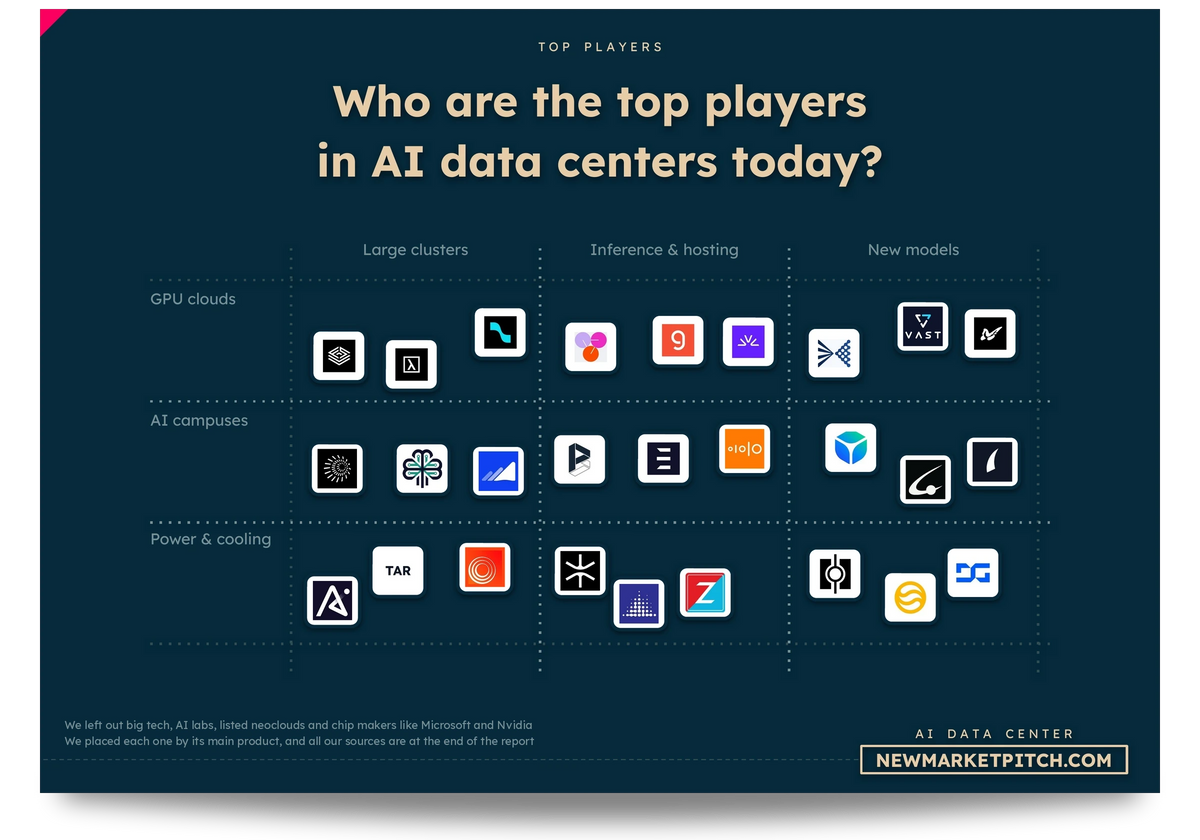
In our research about AI data centers, we turn what is vague and complex into simple, useful visuals. Market maps like this one show you at a glance where every startup stands.
Is AI data center funding really booming right now?
AI data center funding is booming in 2026, and the increase is much broader than a single giant round.
We count 25 financings in the current comparable period, up from 11 in 2025 and 13 in 2024. Twenty different companies raised money, twice as many as a year earlier. Audited capital reached $15.62 billion, compared with $2.42 billion in 2025 and $1.76 billion two years ago.
What makes this year unusual is that deal volume and round size jumped together. The median financing is now $250 million, more than twice the $115.5 million median last year and almost twelve times the $21.4 million level in 2024. Usually, a big increase in deal count brings more smaller transactions into the mix. Here, investors are funding more companies while also writing much larger checks.
By now, the AI data center market looks less like a niche venture category and more like a capital-intensive infrastructure market where nine-figure private rounds have become common.
| Metric | 2026 YTD | 2025 comparable | 2024 comparable | 2026 vs 2025 |
|---|---|---|---|---|
| Deals | 25 | 11 | 13 | +127% |
| Unique funded companies | 20 | 10 | 13 | +100% |
| Audited capital | $15.62B | $2.42B | $1.76B | +545% |
| Median round | $250M | $115.5M | $21.4M | +117% |
| Average round | $624.8M | $242.1M | $135.6M | +158% |
| Largest usable round | $3.90B | $1.10B | $1.10B | +255% |
| Companies raising multiple times | 4 | 1 | 0 | +300% |
Is the AI data center funding boom just Crusoe, Nscale and a few huge rounds?
No. The biggest AI data center rounds are enormous, but the market is actually less dependent on its top financings than it was in either of the previous two periods.
Crusoe's $3.9 billion Series F, Nscale's $2 billion Series C and Firmus's $2 billion strategic equity financing obviously move the total. Yet the top five rounds account for 66.6% of current capital, down sharply from 87.2% last year and 93.9% in 2024.
The bigger change sits below those headline deals. Eighteen financings now exceed $100 million. We counted only five at that level in comparable 2025 and three in 2024.
This is why calling the current boom "megadeal-driven" misses part of the story. Megadeals are bigger than ever, but there are also far more companies capable of raising serious nine-figure capital.
| Funding concentration | 2026 YTD | 2025 comparable | 2024 comparable |
|---|---|---|---|
| Top 1 share of capital | 25.0% | 45.4% | 62.4% |
| Top 3 share | 50.6% | 74.4% | 86.6% |
| Top 5 share | 66.6% | 87.2% | 93.9% |
| Rounds above $50M | 20 | 8 | 5 |
| Rounds above $100M | 18 | 5 | 3 |
| Median round | $250M | $115.5M | $21.4M |
| Audited capital | $15.62B | $2.42B | $1.76B |
Would AI data center funding still look strong without the giant rounds?
Yes, although the underlying AI data center market is much stronger at the very top and the small end than in the middle.
Rounds of $50 million or less brought in $122.6 million this year, against $57 million during the same period of 2025. Smaller financings have therefore more than doubled in aggregate.
The picture changes when we include everything up to $100 million. That pool represents $272.6 million today versus $309 million last year. In other words, the $50 million to $100 million bracket has been relatively weak.
So the market has developed an odd shape. Small deals are still happening, and $100 million-plus rounds have exploded. The middle has not kept pace.

In our market report about AI data centers, we always try to gather several sources and make estimates that make sense, so you can work with solid numbers.
Are more AI data center companies actually getting funded?
Yes. More AI data center companies are getting funded today, so the boom cannot be explained by the same few companies repeatedly coming back for money.
The number of funded companies doubled from 10 to 20 year over year. Even with four companies completing multiple financings this year, the breadth increase remains obvious.
At the same time, funding is becoming deeper for the companies that investors already know. Four companies raised more than once in the current period, compared with one last year and none in comparable 2024.
Investor interest has spread across a bigger group of operators, but that does not mean a new generation of startups is flooding into the market. In fact, the opposite is happening.
Are new AI data center startups struggling to get funded?
Yes. New AI data center companies are barely showing up in this year's financing activity, even though overall funding has never been stronger in our comparison.
Only one of the 25 current financings qualifies as a first financing under our financing-history check. There were two in comparable 2025 and four in 2024. First financings now represent only 4% of deals, down from 18.2% last year and 30.8% two years ago.
Follow-on rounds dominate today's market. They account for 24 of the 25 transactions, and their median size has climbed to about $275 million from $131 million last year.
The financing-history check is deliberately lightweight rather than a perfect reconstruction of every company's capitalization since formation. Even with that caveat, the gap is too wide to dismiss. These days, most AI data center money is going to companies that have already proved they can raise institutional capital.
| Financing history | 2026 YTD | 2025 comparable | 2024 comparable |
|---|---|---|---|
| First financings | 1 | 2 | 4 |
| First-financing share | 4.0% | 18.2% | 30.8% |
| Follow-ons | 24 | 9 | 8 |
| Follow-on share | 96.0% | 81.8% | 61.5% |
| Usable first-financing capital | $8.8M | $12.0M plus Stargate amount excluded | $46.6M |
| Follow-on capital | $15.61B | $2.41B | $1.70B |
| Median follow-on | $275M | $131M | $65M |
Has AI data center funding moved from startup creation to scaling?
Yes. AI data center funding is now much more about building out proven operators than creating new ones.
Early-stage transactions represented 69.2% of deals in 2024. Today that share is 32%. Later-stage and growth financings moved the other way, from 23.1% two years ago to 52% now.
Even "early stage" means something different in this market these days. Seven of the eight current seed or Series A transactions are follow-ons rather than first financings. A company can still carry a Series A label while already needing substantial capital for GPUs, data-center capacity and physical infrastructure.
Company age points in the same direction. The median company receiving funding was about 2.2 years old in 2024, roughly 3.0 years old last year and 3.6 years old now.
Investors are clearly more comfortable putting very large amounts behind companies that already have operating history, customers or infrastructure under development.

Our document detailing everything you need to know about AI data center gets updated several times a month, so you always get the latest view of where things stand.
Why are AI data center funding rounds getting so huge?
AI data center rounds are getting huge because today's leading companies need to finance power, land, buildings, GPUs and cloud capacity at the same time.
Crusoe is a good example. Its latest Series F was announced at $3.9 billion, and the company said it had more than $140 billion in total contracted value across its platform. Days later, Crusoe disclosed a $65 million annual inference agreement with Thinking Machines Lab, followed by confirmation that it is developing Google's AI data center campus in Armstrong County, Texas. Those are useful recent signs that the financing is being followed by actual customer and construction activity.
Nscale's $2 billion Series C has a similar logic. The company says the money will accelerate a vertically integrated infrastructure platform spanning GPU compute, networking, data services and orchestration.
Firmus has gone even further into physical deployment. Its $2 billion strategic equity financing supports its AI Factory rollout, and the company now says it has more than 900 MW of contracted capacity across customers. Its plans include a 360 MW NVIDIA-based campus in Indonesia designed around roughly 170,000 GPUs.
The size of these rounds makes more sense once we look at what the companies are actually trying to build.
Which part of the AI data center market is hottest right now?
Integrated AI infrastructure operators are currently attracting the most attention by a wide margin.
They account for 16 of the 25 current financings and about $14.4 billion of capital. Their deal share jumped from 36.4% last year to 64% today, while their share of audited capital reached 92.2%.
The names also show that this is broader than a single funding story. Crusoe, Nscale, Firmus, Fluidstack, Neysa, Together AI, Groq, Gimlet Labs, Verda, Helix and GMI Cloud all raised capital in the current period.
AI compute data centers are growing too. We count six deals today versus three last year and two in 2024. Their relative share slipped slightly because integrated operators grew much faster.
Investors are increasingly backing companies that can connect several pieces of the stack rather than just provide a building or a narrow layer of compute.
| Category | 2026 deals | Deal share | 2026 capital | Capital share | 2025 deals |
|---|---|---|---|---|---|
| Integrated AI infrastructure operators | 16 | 64.0% | $14.40B | 92.2% | 4 |
| AI compute data centers | 6 | 24.0% | $950.8M | 6.1% | 3 |
| Modular AI data centers | 2 | 8.0% | $270M | 1.7% | 1 |
| Hyperscale AI campuses | 1 | 4.0% | $1.75M | ~0% | 2 |
| AI colocation facilities | 0 | 0% | $0 | 0% | 1 |
| Total | 25 | 100% | $15.62B | 100% | 11 |
| Integrated-operator median round | - | - | $552.5M | - | - |

In our report covering the AI data center market, we look at what the winners do differently, so you can learn from the best instead of guessing.
Why are investors suddenly obsessed with full-stack AI infrastructure?
Investors are paying more attention to full-stack AI infrastructure because getting compute online quickly has become a business advantage of its own.
Crusoe now describes itself as vertically integrated from energy through AI cloud services. Nscale is explicitly building across GPU compute, networking, data services and orchestration. Firmus combines data-center infrastructure with NVIDIA systems and energy planning. Together AI sits further up the software stack but still raised $800 million while building a full-stack AI platform serving thousands of customers.
NVIDIA's latest moves make the shift even clearer. The company is working with Apollo, BlackRock, Blackstone, Brookfield, Goldman Sachs and KKR on financing platforms intended to mobilize more than $500 billion for AI infrastructure over time. NVIDIA describes AI-factory compute as an emerging investable infrastructure asset rather than something customers have to finance project by project.
Compute capacity is increasingly being treated like infrastructure that can support long-duration institutional capital. That's a pretty big change in how this market gets financed.
Are hyperscale AI campuses falling out of favor?
Hyperscale AI campus fundraising has cooled inside this startup funding dataset, but demand for giant AI campuses clearly has not disappeared.
Comparable 2025 included Stargate and Fermi America, while the current period contains only the much smaller StratGrid financing in this category. Hyperscale-campus deal share consequently fell from 18.2% to 4%.
Stargate itself shows why we should be careful with that comparison. OpenAI initially described a $500 billion four-year infrastructure ambition rather than a conventional $45 billion financing round, which is why we excluded the database's $45 billion figure from capital calculations. Since then, OpenAI has continued adding capacity. It said in 2026 that Stargate had already passed its original 10 GW U.S. infrastructure target.
The activity has shifted more than it has vanished. Today, a larger part of the fundraising sits directly inside operators building and selling compute rather than separate headline campus vehicles.
Are strategic investors taking over AI data center funding?
Strategic investors are becoming much more important in AI data center funding, especially in the larger scaling rounds.
We identify strategic participation in 16 current financings, equal to 64% of deals. That compares with 54.5% last year and 46.2% in 2024.
NVIDIA is the clearest recurring example. It appears around Firmus, Nscale, Together AI, Crusoe, GMI Cloud and other infrastructure businesses. AMD Ventures has backed TensorWave, while Johnson Controls and Singtel Innov8 participated in Armada's $230 million Series B. Hardware, energy, telecom and industrial companies are increasingly investing alongside traditional financial investors.
The commercial logic is straightforward. Every successful new AI cloud or factory can become a major buyer of accelerators, servers, cooling, power equipment and connectivity.
As seen above, the median strategic-participation financing has also risen sharply, from $65 million in 2024 to $275 million today. Strategic capital is showing up where the infrastructure bill is largest.

Theory only gets you so far. In our research about AI data centers, we dig up the real signals from the field and show you the ones worth watching.
Are AI data center investors becoming more selective?
Yes, but in a very specific way: more companies are getting funded, while new entrants are getting far less of the money.
If investors were simply retreating into a handful of winners, we would expect the number of funded companies to shrink. Instead, it doubled.
The filter appears later in the lifecycle. Investors are comfortable funding a growing set of operators once those companies have customers, infrastructure plans, strategic partners or earlier financing behind them.
Groq offers a useful recent example. The company raised $650 million in growth capital and then another $350 million a few weeks later as it expanded an inference cloud operating across 13 data centers. Firmus completed several financings while building contracted capacity across four countries. These are companies raising against deployment plans rather than PowerPoint-stage market entry.
For a new AI data center startup, today's market may therefore feel much tougher than the headline $15.62 billion total suggests.
Is North America still winning the AI data center funding race?
North America still has the broadest AI data center funding market, while Europe and Asia-Pacific are producing big totals from a much smaller group of companies.
North America accounts for 15 current deals and roughly $9.34 billion of capital. Its deal share rose from 45.5% last year to 60% today, with financing spread across companies including Crusoe, Groq, Together AI, TensorWave, Armada, Starcloud and others.
Europe raised around $3.03 billion through only four deals. Nscale and Fluidstack alone contribute about $2.83 billion, so Europe's total looks much broader in dollars than it really is in company count.
Asia-Pacific recorded six financings and about $3.25 billion. Firmus accounts for roughly $2.575 billion of that amount across three rounds, while Neysa contributes another $600 million of equity.
APAC does have a real capacity buildout behind the funding. NVIDIA recently said Australian infrastructure partners including Firmus, IREN, NEXTDC and AirTrunk are working toward as much as 2 GW of AI infrastructure capacity. Still, today's private funding total remains heavily concentrated around Firmus.
| Region | Current deals | Deal share | Current capital | Capital share | Comparable 2025 deals | Deal-share change |
|---|---|---|---|---|---|---|
| North America | 15 | 60.0% | $9.34B | 59.8% | 5 | +14.5 pp |
| Asia-Pacific | 6 | 24.0% | $3.25B | 20.8% | 2 | +5.8 pp |
| Europe | 4 | 16.0% | $3.03B | 19.4% | 4 | −20.4 pp |
| North America top-level interpretation | Broad | - | Broad | - | Narrower | Improving |
| Europe top-level interpretation | Narrow | - | Large | - | Broader | Weaker breadth |
| APAC top-level interpretation | Moderate | - | Firmus-heavy | - | Narrower | Improving |
| Total | 25 | 100% | $15.62B | 100% | 11 | - |

In our market report about AI data centers, we don't want to repeat what boring consulting reports say. Instead, we show you the real and latest market signals that matter.
Is the AI data center investor base getting broader too?
Yes. The AI data center investor base has widened substantially alongside the rise in deal activity.
We count 25 different disclosed lead or co-lead investors in the current period, compared with 11 last year and 17 in 2024. Lead disclosure itself only improved slightly, so better reporting does not explain the jump.
8090 Industries is the only current investor that appears as lead or co-lead on more than one deal, with two appearances. There is no single VC or private-equity firm repeatedly leading a dominant share of the market.
That breadth fits what we see elsewhere: more funded companies, lower top-five capital concentration and more corporate participation. The financing ecosystem around AI infrastructure is getting larger along with the rounds themselves.
Has 2026 already beaten previous full years for AI data center funding?
Yes. AI data center funding in the current period has already moved well past the complete 2025 and 2024 totals on both audited capital and deal count.
Full-year 2025 produced 16 deals and about $6.67 billion of usable capital after applying the same treatment to Stargate. Full-year 2024 had 15 deals and approximately $1.93 billion.
The current period already stands at 25 deals and $15.62 billion. We are therefore at about 156% of the entire 2025 deal count and 234% of its usable capital before considering the rest of the year.
We would not annualize that figure. Infrastructure funding is too lumpy, and another multibillion-dollar round can distort a quarterly comparison instantly. This year's strength has already become too large to dismiss as timing noise.
What is the biggest change in AI data center funding right now?
The biggest change in AI data center funding is that raising $100 million or more has become normal for a much wider group of established operators.
There were only three $100 million-plus deals in comparable 2024. Today we count eighteen.
At the same time, those large rounds are spread widely enough that top-five capital concentration has dropped, the number of funded companies has doubled, integrated operators are gaining market share and strategic investors are appearing more often.
The financing market has effectively moved up a weight class. A $100 million AI infrastructure round no longer automatically looks exceptional; for companies trying to deploy GPUs and power at meaningful scale, it increasingly looks like ordinary expansion capital.
What could go wrong with the AI data center funding boom?
The biggest weakness in today's AI data center funding boom is the lack of new-company formation, followed by the enormous execution burden attached to these giant rounds.
One first financing out of 25 deals is thin. It means today's funding strength tells us much more about investors' willingness to scale existing operators than about the health of the next generation of entrants.
There is also a huge difference between raising billions and earning attractive returns on billions of deployed infrastructure. Power availability, utilization, customer concentration, GPU economics and construction schedules can all change the economics quickly.
The financing structures themselves are becoming harder to compare too. Crusoe describes its $3.9 billion transaction as the initial closing of an anticipated round. Firmus's $2 billion financing was announced as fully committed strategic equity. Stargate mixes equity funding, infrastructure commitments and a multiyear investment program. Treating every headline amount as identical cash-on-balance-sheet venture funding would make the market look cleaner than it really is.
For now, the funding evidence is exceptionally strong. The harder test comes next: whether all this new capacity earns enough money to justify the amount of capital going into it.

Learning from others' mistakes is the cheapest lesson there is. In our document detailing everything you need to know about AI data center, we look at what broke startups before you, so you don't repeat it.
What is actually changing in AI data center funding?
AI data center funding is much stronger today, but the important change is deeper than the sixfold increase in audited capital.
More companies are raising money, so this is a genuine expansion in funding activity. At the same time, the market has moved sharply toward much larger rounds, with eighteen current financings above $100 million.
Existing operators are getting most of the benefit. First financings have almost disappeared from the current mix, while repeat issuers, older companies and later-stage businesses absorb nearly all the capital.
Integrated AI infrastructure companies are emerging as the clear funding center of gravity. Investors increasingly want operators that can connect power, facilities, accelerators and cloud services and then bring that capacity online quickly.
Strategic capital is also becoming part of the market's structure. NVIDIA, AMD, industrial groups, telecom companies and infrastructure players have direct economic reasons to help expand the companies that will buy and operate their technology.
And the latest operating evidence gives the boom more substance than fundraising announcements alone. Crusoe is signing large inference contracts and developing new campuses; Firmus says it has more than 900 MW contracted; Groq is scaling a 13-data-center inference footprint; and NVIDIA is helping create institutional financing platforms for AI-factory infrastructure.
The part we would watch most carefully is startup formation. Today's AI data center market looks extremely healthy if we judge it by capital available to proven operators. It looks much less open if we ask how many genuinely new companies are breaking into the funding cycle.
Our methodology
This analysis measures the latest funding trends in the AI data center market using financings announced from January 1 through October 7, 2026 and compares them with strictly equivalent January 1–October 7 periods in 2025 and 2024. Full-calendar-year 2025 and 2024 figures are used only as secondary context.
We built the dataset from company and investor announcements, regulatory records, reputable financial and industry reporting, and established funding databases, then cross-checked material transactions when multiple sources were available. The analysis focuses on qualifying private-company equity financings.
Debt, grants, loans, unconverted convertibles, public offerings and transactions whose equity component could not be isolated reliably are excluded from capital calculations. We also apply a strict market-definition test: AI data center infrastructure had to represent an overwhelming part of the company's business at the time of financing.
Each financing is treated separately, while duplicate reports of the same transaction are consolidated. Extensions, additional closes and tranches are reviewed individually to determine whether they represent genuinely separate financings. Dates, stages, investors, previous financings, operating milestones and use-of-funds information are recorded only when supported by public evidence.
We do not infer stages from round size, treat prominent investors as leads without evidence, estimate undisclosed equity amounts or create false precision where company announcements are ambiguous. The first-financing analysis is based on a separate financing-history check and is intended to distinguish obvious first institutional financings from follow-ons rather than reconstruct every company's capitalization since formation.
A few transactions require specific treatment. Fluidstack's $830 million Series A appeared twice in the database, but the company's later announcement says the money was raised in January 2026, so it is counted once. Crusoe's announced $3.9 billion Series F is retained at its stated size while preserving the fact that the company described it as the initial closing of an anticipated round.
Stargate is retained as a financing-activity event in 2025, but the database's $45 billion amount is excluded from capital calculations. OpenAI's original announcement supports a broader $100 billion initial infrastructure deployment and $500 billion four-year investment ambition rather than a clearly isolated $45 billion equity financing.
After compiling the dataset, we ran a separate quality-control pass covering missed deals, boundary dates, duplicate announcements, financing type, market eligibility and unusual transaction structures. Where credible evidence remained ambiguous, the uncertainty was kept visible rather than replaced with an assumption.
Key sources used for the analysis include OpenAI's Stargate launch announcement, OpenAI's Stargate infrastructure update, OpenAI's additional Stargate sites announcement, OpenAI's Oracle expansion announcement, Crusoe's $3.9 billion Series F announcement, Crusoe's Thinking Machines Lab agreement, Crusoe's Armstrong County campus announcement, Nscale's $2 billion Series C announcement, Firmus's $2 billion strategic equity announcement, Firmus's 170,000-GPU campus announcement, and Firmus's contracted-capacity update.
Additional operating and investor evidence comes from Together AI's $800 million Series C announcement, Groq's $650 million growth financing announcement, Groq's subsequent $350 million financing, Neysa's capital raise announcement, Armada's $230 million Series B announcement, NVIDIA's AI infrastructure financing-platform announcement, and NVIDIA's Australian AI infrastructure expansion announcement.

If you build or invest in the AI data center market, you need to know which business models pay off now and which ones are fading. That's why our report covering it has a whole section on it.
Written by the New Market Pitch teamWe track new markets so founders and investors can move faster. About us