What are the latest funding trends in AI inference?
Whether you're building or investing in the AI inference market, our report covers everything you need to know: the players, the money, and what's coming next.
Summary
AI inference startup funding has surged this year. We tracked 42 deals worth at least $12.5B, and Baseten raised the most during the period: $1.8B across 2 rounds. Investors are writing much larger checks, especially for companies already serving models in production.
Deal count grew 45% from the same period last year, while disclosed funding rose 274%. The number of companies receiving funding grew 19%. Money is growing faster than the group of companies getting it.
The year is not finished, but funding has already reached 345% of the previous full year's total. That is a partial year against a full one, not a forecast. The scale of the change is already clear.
The big change is at the top of the market. Rounds of $100M or more now make up 55% of deals with a disclosed amount, against 25% by this point last year. Smaller rounds are still happening, but large ones explain most of the jump in dollars.
Later-stage companies are getting more attention, too. They account for 59% of deals with a named stage, up from 36% in the comparable period of 2025. Seed deals have lost share even though their typical size is higher.
The growth has lasted beyond a single good quarter. Each completed quarter this year has brought in more money than the one before, although the number of deals has not climbed without interruption.
Inference-specialist compute and silicon services lead current funding. Enterprise serving companies are also raising much more, while managed API providers have fewer deals without losing their ability to attract major rounds.
Media inference is a smaller story than its funding total first suggests. The category's big checks are concentrated in fal, while GPU scheduling and inference optimization have attracted new financing across several companies.
The United States remains the main home of funded inference startups. China is attracting much larger amounts than in the comparable period last year. Europe, by contrast, has very little recorded venture activity in this specialist market.
So the latest AI inference funding trend is clear: more money is going into production infrastructure, and investors are increasingly willing to finance it at scale. The boom extends beyond a single company, but it is far stronger at the large-round end than among small checks.

Written by the New Market Pitch teamWe track new markets so founders and investors can move faster. About us

In our report covering the AI inference market, you will always find fresh funding data, taken straight from our own verified funding database.
All funding deals in the AI inference market over the last years
Below is the table listing all the deals. You can find our methodology at the end of this page.
If you want a deeper understanding of the market and its current dynamics, get our AI inference market report.
| Company | Category | Date | Stage | Deal size | What they do | Region | Lead investors | Country | Rank |
|---|---|---|---|---|---|---|---|---|---|
| fal | Multimodal and media inference services | November 2026 | Series D+ | $1.3B | Provides generative AI inference infrastructure | North America | Bessemer Venture Partners | United States | |
| General Compute | Inference-specialist compute and silicon services | October 2026 | Series A | $100M | Operates a heterogeneous inference cloud using GPUs and purpose-built chips, sold as bare metal or guaranteed token-throughput services. | North America | Blackbird Ventures, Abstract Ventures | United States | |
| Hyperbolic | Inference-specialist compute and silicon services | October 2026 | Series A | $30M | Unifies decentralized GPU compute resources | North America | Walden Catalyst Ventures | United States | |
| Simplismart | Enterprise model serving and deployment | October 2026 | Series B | $14M | Serve enterprise AI models with optimized infrastructure | Asia-Pacific | Dallas Venture Capital | India | |
| Modal | Enterprise model serving and deployment | October 2026 | Series D+ | $750M | Provides serverless AI compute infrastructure | North America | Accel | United States | |
| Infinigence AI | Enterprise model serving and deployment | October 2026 | Series C | ~$320M | Cloud computing capacity for AI models | Asia-Pacific | Not disclosed | China | |
| GPUStack | Inference orchestration, scheduling and routing | October 2026 | Seed | ~$7.4M | Develops an open-source platform that manages mixed GPU and NPU clusters and deploys and serves AI models for enterprises. | Asia-Pacific | Shuihua Future | China | |
| GMI Cloud | Inference-specialist compute and silicon services | October 2026 | Series B | $223M | GPU cloud infrastructure | North America | ARCHIV | United States | |
| Luminal | Inference engines, compilers and optimization | September 2026 | Unknown | $29M | Accelerate inference using optimized GPU compute | North America | Standard Capital | United States | |
| SiliconFlow | Managed model inference APIs | September 2026 | Series C | $125M | AI model inference cloud platform | Asia-Pacific | Not disclosed | China | |
| Gimlet Labs | Inference orchestration, scheduling and routing | September 2026 | Series B | $300M | Builds heterogeneous AI inference infrastructure | North America | Andreessen Horowitz | United States | |
| Wafer | Inference-specialist compute and silicon services | September 2026 | Series A | $40M | Inference chips and associated AI compute infrastructure | North America | Marathon Management Partners, Chemistry | United States | |
| Groq | Inference-specialist compute and silicon services | August 2026 | Series A | $350M | Provides specialized AI inference infrastructure | North America | Disruptive | United States | |
| SkyPilot | Inference orchestration, scheduling and routing | July 2026 | Seed | $20M | Schedule and operate AI inference across clouds | North America | Lux Capital | United States | |
| Infinity Artificial Intelligence Institute | Inference engines, compilers and optimization | July 2026 | Seed | $15M | Generate optimized inference kernels across accelerator types | North America | Touring Capital | United States | |
| Fireworks AI | Managed model inference APIs | July 2026 | Series D+ | $1.5B | Hosts and optimizes AI models | North America | Atreides Management, Index Ventures, TCV | United States | |
| Ollama | Edge and on-device inference software | July 2026 | Series B | $65M | Software for running generative language models | North America | Theory Ventures | United States | |
| SambaNova Systems | Inference-specialist compute and silicon services | July 2026 | Series D+ | $1.0B | Builds AI inference chips and systems | North America | General Atlantic | United States | |
| ZML | Inference engines, compilers and optimization | July 2026 | Seed | $20M | Accelerate inference via specialized GPU software | Europe | Not disclosed | France | |
| Together AI | Managed model inference APIs | July 2026 | Series C | $800M | AI model training and inference | North America | Aramco Ventures | United States | |
| Baseten | Enterprise model serving and deployment | June 2026 | Series D+ | $1.5B | Deploys and scales AI inference | North America | Altimeter Capital, Conviction, Spark Capital, Sands Capital, Wellington Management | United States | |
| Groq | Inference-specialist compute and silicon services | June 2026 | Growth Equity | $650M | Provides specialized AI inference infrastructure | North America | Disruptive, Infinitum | United States | |
| Dapple | Enterprise model serving and deployment | June 2026 | Seed | $30M | Serve AI models through managed infrastructure | North America | The Raptor Group | United States | |
| SiliconFlow | Managed model inference APIs | June 2026 | Series B | $280M+ | AI model inference cloud platform | Asia-Pacific | Ctrip Strategic Investment, Jinko Solar, Kingdee, Unicom X-WO, Shengyi Capital, Biren Strategic Investment, NIO Capital, SenseTime Strategic Investment, Giant Network, Guotai Junan Innovation Investment, GGV Capital, Walden International, Huakong Fund, CDB Capital, Zhongguancun Science City | China | |
| General Compute | Inference-specialist compute and silicon services | May 2026 | Seed | $15M | Operates a heterogeneous inference cloud using GPUs and purpose-built chips, sold as bare metal or guaranteed token-throughput services. | North America | FUSE VC | United States | |
| TensorMesh | Inference engines, compilers and optimization | May 2026 | Seed | $20M | Optimize enterprise LLM inference software execution | North America | Not disclosed | United States | |
| Modal | Enterprise model serving and deployment | May 2026 | Series C | $355M | Provides serverless AI compute infrastructure | North America | General Catalyst, Redpoint Ventures | United States | |
| RadixArk | Inference engines, compilers and optimization | May 2026 | Seed | $100M | Develops open AI infrastructure software | North America | Accel, Spark Capital | United States | |
| DeepInfra | Managed model inference APIs | May 2026 | Series B | $107M | Provides cloud-based AI model inference | North America | 500 Global, Georges Harik | United States | |
| Infinigence AI | Enterprise model serving and deployment | May 2026 | Series B | $103M | Cloud computing capacity for AI models | Asia-Pacific | Not disclosed | China | |
| Featherless.ai | Managed model inference APIs | April 2026 | Series A | $20M | Serverless inference hosting for open models | North America | AMD Ventures, Airbus Ventures | United States | |
| fal | Multimodal and media inference services | April 2026 | Series D+ | $350M | Provides generative AI inference infrastructure | North America | Sequoia Capital | United States | |
| Parasail | Managed model inference APIs | April 2026 | Series A | $32M | Cloud infrastructure for scalable model inference | North America | Touring Capital, Kindred Ventures | United States | |
| Wafer | Inference-specialist compute and silicon services | April 2026 | Seed | $4M | Inference chips and associated AI compute infrastructure | North America | Fifty Years | United States | |
| Gimlet Labs | Inference orchestration, scheduling and routing | March 2026 | Series A | $80M | Builds heterogeneous AI inference infrastructure | North America | Menlo Ventures | United States | |
| SambaNova Systems | Inference-specialist compute and silicon services | February 2026 | Series D+ | $350M+ | Builds AI inference chips and systems | North America | Vista Equity Partners, Cambium Capital | United States | |
| Cerebras Systems | Inference-specialist compute and silicon services | February 2026 | Series D+ | $1.0B | Builds wafer-scale AI computing systems | North America | Tiger Global | United States | |
| AIEEV | Managed model inference APIs | January 2026 | Seed | $415K | Provide cloud accelerated inference APIs | Asia-Pacific | Bluepoint Partners | South Korea | |
| Baseten | Enterprise model serving and deployment | January 2026 | Series D+ | $300M | Deploys and scales AI inference | North America | IVP, CapitalG | United States | |
| Inferact | Inference engines, compilers and optimization | January 2026 | Seed | $150M | Commercializes open-source AI inference software | North America | Andreessen Horowitz, Lightspeed Venture Partners | United States | |
| Runware | Multimodal and media inference services | December 2025 | Series A | $50M | Inference compute infrastructure and model hosting | North America | Dawn Capital | United States | |
| fal | Multimodal and media inference services | December 2025 | Series D+ | $140M | Provides generative AI inference infrastructure | North America | Sequoia Capital | United States | |
| Infinigence AI | Enterprise model serving and deployment | November 2025 | Series A | ~$70M | Cloud computing capacity for AI models | Asia-Pacific | Zhuhai Technology Group, Futeng Capital | China | |
| Luminal | Inference engines, compilers and optimization | November 2025 | Seed | $5.3M | Accelerate inference using optimized GPU compute | North America | Felicis | United States | |
| Spectral Compute | Inference engines, compilers and optimization | November 2025 | Seed | $6M | Compile and accelerate inference on diverse GPUs | Europe | Costanoa Ventures | United Kingdom | |
| Fireworks AI | Managed model inference APIs | October 2025 | Series C | $250M | Hosts and optimizes AI models | North America | Lightspeed Venture Partners, Index Ventures, Evantic | United States | |
| TensorMesh | Inference engines, compilers and optimization | October 2025 | Seed | $4.5M | Optimize enterprise LLM inference software execution | North America | Laude Ventures | United States | |
| Gimlet Labs | Inference orchestration, scheduling and routing | October 2025 | Seed | $12M | Builds heterogeneous AI inference infrastructure | North America | Factory | United States | |
| Inference.net | Managed model inference APIs | October 2025 | Seed | $12M | Provide distributed high throughput model inference | North America | Multicoin Capital, Andreessen Horowitz | United States | |
| Cerebras Systems | Inference-specialist compute and silicon services | September 2025 | Series D+ | $1.1B | Builds wafer-scale AI computing systems | North America | Fidelity Management & Research Company, Atreides Management | United States | |
| Modal | Enterprise model serving and deployment | September 2025 | Series B | $87M | Provides serverless AI compute infrastructure | North America | Lux Capital | United States | |
| Modular | Inference engines, compilers and optimization | September 2025 | Series C | $250M | AI inference software and accelerator runtimes | North America | US Innovative Technology Fund | United States | |
| Groq | Inference-specialist compute and silicon services | September 2025 | Growth Equity | $750M | Provides specialized AI inference infrastructure | North America | Disruptive | United States | |
| Runware | Multimodal and media inference services | September 2025 | Seed | $13M | Inference compute infrastructure and model hosting | North America | Insight Partners | United States | |
| Baseten | Enterprise model serving and deployment | September 2025 | Series D+ | $150M | Deploys and scales AI inference | North America | BOND | United States | |
| FriendliAI | Managed model inference APIs | August 2025 | Seed | $20M | Optimized cloud infrastructure for model inference | North America | Capstone Partners | United States | |
| Mako | Inference engines, compilers and optimization | August 2025 | Seed | $8.5M | Offer optimized LLM inference infrastructure | North America | M13 | United States | |
| fal | Multimodal and media inference services | July 2025 | Series C | $125M | Provides generative AI inference infrastructure | North America | Meritech Capital | United States | |
| Cerebrium | Enterprise model serving and deployment | July 2025 | Seed | $8.5M | Serverless GPU computing for AI inference | North America | Gradient | United States | |
| SiliconFlow | Managed model inference APIs | June 2025 | Series A | Undisclosed | AI model inference cloud platform | Asia-Pacific | Alibaba | China | |
| Enerzai | Edge and on-device inference software | May 2025 | Unknown | $5.7M | Software for optimized AI inference on devices | Asia-Pacific | Not disclosed | South Korea | |
| Doubleword | Enterprise model serving and deployment | May 2025 | Series A | $12M | Private high performance enterprise LLM inference | Europe | Dawn Capital | United Kingdom | |
| DeepInfra | Managed model inference APIs | April 2025 | Series A | $18M | Provides cloud-based AI model inference | North America | Felicis, Georges Harik | United States | |
| Parasail | Managed model inference APIs | April 2025 | Seed | $10M | Cloud infrastructure for scalable model inference | North America | Basis Set Ventures, Threshold Ventures, Buckley Ventures, Black Opal Ventures | United States | |
| Featherless.ai | Managed model inference APIs | March 2025 | Seed | $5M | Serverless inference hosting for open models | North America | Airbus Ventures | United States | |
| Together AI | Managed model inference APIs | February 2025 | Series B | $305M | AI model training and inference | North America | General Catalyst, Prosperity7 Ventures | United States | |
| ClustroAI | Inference engines, compilers and optimization | February 2025 | Series A | $12M | Optimize model inference on specialized hardware | North America | Forum Ventures | United States | |
| OpenInfer | Edge and on-device inference software | February 2025 | Seed | $8M | Run on device and edge model inference | North America | Cota Capital, Essence VC | United States | |
| Baseten | Enterprise model serving and deployment | February 2025 | Series C | $75M | Deploys and scales AI inference | North America | IVP, Spark Capital | United States | |
| SiliconFlow | Managed model inference APIs | February 2025 | Seed | $14M | AI model inference cloud platform | Asia-Pacific | Huachuang Capital | China | |
| fal | Multimodal and media inference services | February 2025 | Series B | $49M | Provides generative AI inference infrastructure | North America | Notable Capital | United States | |
| TrueFoundry | Enterprise model serving and deployment | February 2025 | Series A | $19M | Deploy and manage enterprise model inference | North America | Intel Capital | United States | |
| Pipeshift | Enterprise model serving and deployment | January 2025 | Seed | $2.5M | Deploy production models on private cloud GPUs | North America | Y Combinator, SenseAI Ventures | United States | |
| Ollama | Edge and on-device inference software | 2025 | Series A | $15M | Software for running generative language models | North America | Benchmark | United States | |
| Hyperbolic | Inference-specialist compute and silicon services | December 2024 | Series A | $12M | Unifies decentralized GPU compute resources | North America | Variant Fund, Polychain Capital | United States | |
| Northflank | Enterprise model serving and deployment | November 2024 | Series A | $16M | Run private GPU model serving workloads | Europe | Bain Capital Ventures | United Kingdom | |
| Northflank | Enterprise model serving and deployment | November 2024 | Seed | $6.3M | Run private GPU model serving workloads | Europe | Vertex Ventures US | United Kingdom | |
| GMI Cloud | Inference-specialist compute and silicon services | October 2024 | Series A | $15M | GPU cloud infrastructure | North America | Headline Asia | United States | |
| Simplismart | Enterprise model serving and deployment | October 2024 | Series A | $7M | Serve enterprise AI models with optimized infrastructure | Asia-Pacific | Accel | India | |
| OpenGradient | Inference orchestration, scheduling and routing | October 2024 | Seed | $8.5M | Execute distributed model inference and verification | North America | Andreessen Horowitz | United States | |
| VESSL AI | Inference orchestration, scheduling and routing | October 2024 | Series A | $12M | AI infrastructure and MLOps orchestration | Asia-Pacific | Not disclosed | South Korea | |
| Runware | Multimodal and media inference services | October 2024 | Seed | $3M | Inference compute infrastructure and model hosting | North America | Not disclosed | United States | |
| fal | Multimodal and media inference services | September 2024 | Series A | $14M | Provides generative AI inference infrastructure | North America | Kindred Ventures | United States | |
| fal | Multimodal and media inference services | September 2024 | Seed | $9M | Provides generative AI inference infrastructure | North America | Andreessen Horowitz | United States | |
| Inference.net | Managed model inference APIs | September 2024 | Seed | $500K | Provide distributed high throughput model inference | North America | Not disclosed | United States | |
| Infinigence AI | Enterprise model serving and deployment | September 2024 | Series A | ~$70M | Cloud computing capacity for AI models | Asia-Pacific | National Social Security Fund Zhongguancun Independent Innovation Special Fund, Qiming Venture Partners, Hongtai Fund | China | |
| Cerebras Systems | Inference-specialist compute and silicon services | September 2024 | Series D+ | $85M | Builds wafer-scale AI computing systems | North America | Not disclosed | United States | |
| Groq | Inference-specialist compute and silicon services | August 2024 | Series D+ | $640M | Provides specialized AI inference infrastructure | North America | BlackRock Private Equity Partners | United States | |
| Hyperbolic | Inference-specialist compute and silicon services | July 2024 | Seed | $7M | Unifies decentralized GPU compute resources | North America | Polychain Capital, Lightspeed Faction | United States | |
| Fireworks AI | Managed model inference APIs | July 2024 | Series B | $52M | Hosts and optimizes AI models | North America | Sequoia Capital | United States | |
| SiliconFlow | Managed model inference APIs | July 2024 | Seed | $14M | AI model inference cloud platform | Asia-Pacific | Not disclosed | China | |
| Prodia | Multimodal and media inference services | July 2024 | Seed | $15M | High-speed inference APIs for generative media | North America | Dragonfly Capital | United States | |
| Nota AI | Edge and on-device inference software | June 2024 | Series C | $19M | Optimize AI models for edge inference | Asia-Pacific | STIC Ventures, LB Investment | South Korea | |
| Fireworks AI | Managed model inference APIs | March 2024 | Series A | $25M | Hosts and optimizes AI models | North America | Benchmark | United States | |
| Together AI | Managed model inference APIs | March 2024 | Series A | $106M | AI model training and inference | North America | Salesforce Ventures | United States | |
| Baseten | Enterprise model serving and deployment | March 2024 | Series B | $40M | Deploys and scales AI inference | North America | IVP, Spark Capital | United States | |
| Inference AI | Managed model inference APIs | January 2024 | Seed | $4M | Deliver hosted accelerated inference model endpoints | North America | Cherubic Ventures, Maple VC | United States | |
| SiliconFlow | Managed model inference APIs | January 2024 | Seed | $7M | AI model inference cloud platform | Asia-Pacific | Sinovation Ventures | China | |
| SqueezeBits | Inference engines, compilers and optimization | January 2024 | Unknown | $1.9M | Accelerate LLM inference through model compression | Asia-Pacific | Not disclosed | South Korea |

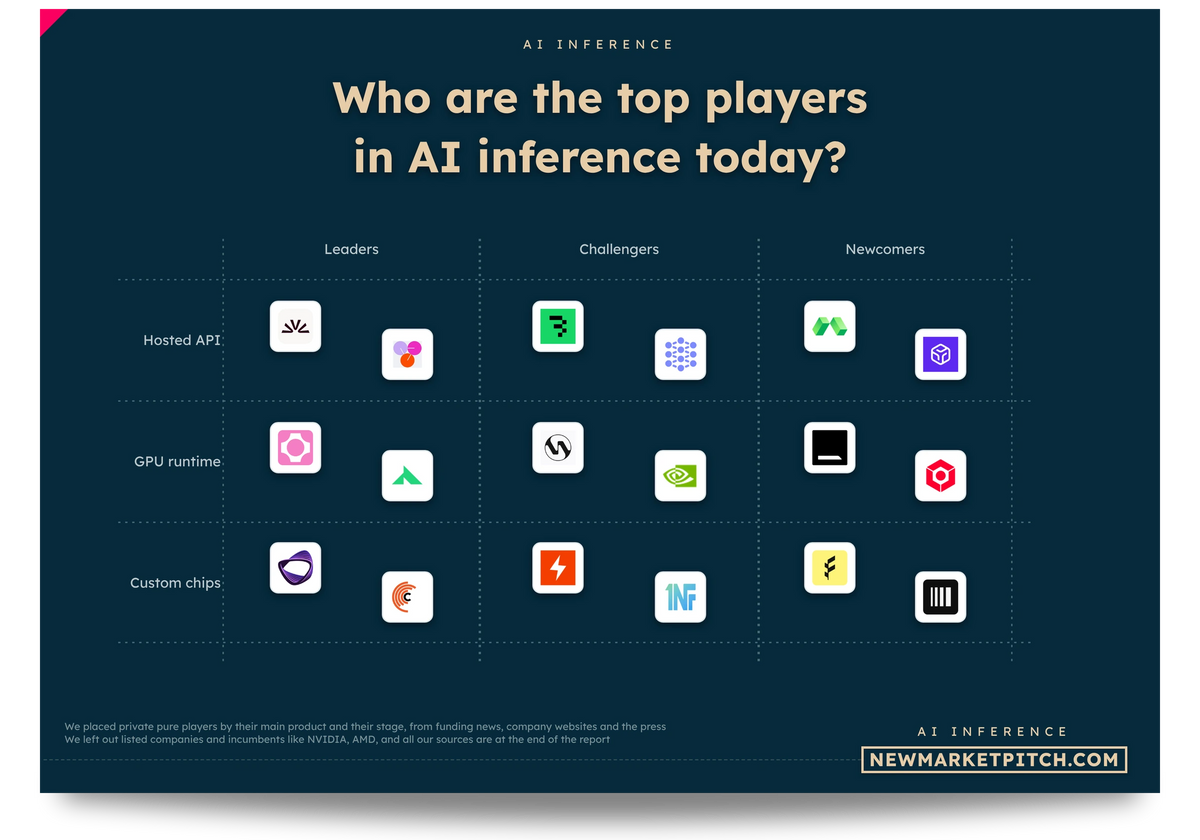
In our research about AI inference startups, we turn what is vague and complex into simple, useful visuals. Market maps like this one show you at a glance where every startup stands.
Is AI inference startup funding growing faster this year?
Funding for AI inference startups is rising fast this year, and the money is growing much faster than the number of deals.
We counted 42 financings worth at least $12.5B this year to date. The comparable period of 2025 had 29 deals worth at least $3.3B. That puts deal activity up 45% and disclosed capital up 274%. The number of funded companies rose to 31 from 26, or 19%. More startups are finding backing, but the biggest change is what investors are willing to put into each one.
Look at the largest commitments. Fireworks AI announced a $1.5B Series D+ in July 2026, Baseten raised a $1.5B Series D+ in June 2026, and Modal followed with a $750M Series D+ in October 2026. These firms do different jobs in the inference market, from hosted APIs to enterprise deployment. They all sell infrastructure used to run models, rather than models alone.
NVIDIA's August 2026 earnings commentary pointed to demand from AI-native and enterprise customers. Baseten also described growing production inference volume in its June 2026 announcement. Those are useful clues about commercial demand; the financing deals tell us how dramatically investors have responded.
Has AI inference funding already passed last year?
The AI inference market has already raised far more in this partial year than in the entire previous year.
The current year-to-date figure stands at 345% of the disclosed capital recorded in full-year 2025. Deal count has reached 124% of that completed year. This is a comparison between a partial year and a full one, not an annualized forecast. Full-year 2025 had already grown 204% in capital against full-year 2024, making the latest jump especially striking.
The companies getting funded also look more like operating infrastructure businesses than one-off technical bets. Groq announced plans to expand its global inference cloud in June 2026. Baseten described an OpenAI integration for enterprise customers in September 2026. Both announcements point to real distribution or capacity needs, although neither says how much future revenue a round will produce.
That makes the funding jump harder to dismiss as a single good press cycle. The market had large financings before, but the current activity is taking place on a much bigger scale across companies that already have services to deliver.
Are $100M AI inference rounds becoming normal?
Rounds of $100M or more are now common in AI inference, although most of the money still goes to a limited group of companies.
This year, 23 rounds were $100M or more, accounting for 55% of financings with disclosed amounts. The comparable period in 2025 had 7 such deals, or 25%; the matching period in 2024 had 2, or 9%. That change has pulled the median disclosed financing to $101.5M from $13.4M last year. The middle of the funding market has moved sharply upward.
There is still activity below the headline rounds. Excluding deals above $100M leaves at least $650M this year, against at least $401M in the same period last year, up 62%. Excluding those above $50M leaves at least $305M, versus at least $239M, up 28%. The smaller market is growing, too. It simply cannot account for the full headline increase.
The mix underneath has changed. We counted 5 rounds between $5M and under $20M this year, compared with 15 in the matching prior-year period. Meanwhile, 9 deals landed between $20M and under $50M, compared with 2 previously. NVIDIA's 2026 work on cutting serving costs shows why this layer matters. Still, these are big sums to commit before anyone knows the returns.

In our market report about AI inference startups, we always try to gather several sources and make estimates that make sense, so you can work with solid numbers.
Are new AI inference startups still getting seed funding?
New AI inference startups can still raise seed funding, even though seed rounds now make up a smaller share of deals.
We recorded 9 seed deals this year, or 21% of all rounds. In the same period of 2025, there were 13 seed deals, making up 45%. But the seed median increased to $20M from $8.5M, and current seed financings total $354M. Investors have not abandoned new teams; they are backing fewer seed transactions while making larger commitments.
The label covers very different projects. Inferact raised a $150M Seed in January 2026 for open-source inference software. RadixArk raised a $100M Seed in May 2026 for AI infrastructure tools. ZML's $20M Seed in July 2026 focuses on GPU execution optimization. The range shows how expensive it can be to build specialist infrastructure from the start.
The technical work is real. NVIDIA's March 2026 Dynamo release and the vLLM project's discussion of separating prompt processing from token generation both deal with problems that production teams face every day. But technical difficulty alone will not make every new inference startup fundable. Investors need to see a route to a product people will actually deploy.
Are late-stage AI inference companies getting most of the money?
Later-stage AI inference startups now receive most of the disclosed funding, and their share of deals has risen sharply.
Among deals with a named stage, later-stage financings represented 59% this year, against 36% over the same period in 2025. They account for 92% of disclosed capital. Series D+ alone recorded 9 rounds across 6 companies, with at least $8.1B raised. Seed and Series A remain active, but later rounds now absorb most of the checks.
Cerebras Systems raised a $1.0B Series D+ in February 2026. SambaNova Systems followed with a $1.0B Series D+ in July 2026, and fal raised a $1.3B Series D+ in November 2026. These companies sell different kinds of inference execution. Their common challenge is running services at a scale large enough to justify further investment.
Investors have also gone back to companies they recently funded. We counted 11 companies with multiple rounds in the current period, compared with 3 in the matching 2025 period. Baseten, Modal and Gimlet Labs all raised separate rounds this year. Cerebras' August 2026 inference-cloud update and Baseten's September enterprise partnership offer clues to why some of these firms can attract repeat checks, though neither guarantees a return.
The table below shows where current AI inference financing falls by stage.
| Stage | Deals | Capital | Capital share |
|---|---|---|---|
| Series D+ | 9 | $8.1B+ | 65% |
| Series C | 4 | $1.6B | 13% |
| Series B | 9 | $1.1B+ | 9% |
| Series A | 7 | $652M | 5% |
| Growth Equity | 1 | $650M | 5% |
| Seed | 9 | $354M | 3% |
| Unknown | 3 | $57M | <1% |
Capital shares are shares of disclosed capital. A plus sign means at least, as some amounts may be incomplete.
Is Series B getting bigger for AI inference startups?
Series B rounds are getting much bigger in AI inference, although Series D+ still receives the most money.
The current period has 9 Series B deals across 8 companies, equal to 21% of all financings. The matching 2025 period had 3 Series B deals, or 10%. Current Series B rounds total at least $1.1B, against $441M last year, and the Series B median rose to $103M from $87M.
Gimlet Labs raised a $300M Series B in September 2026 for technology that places inference workloads across different hardware. GMI Cloud announced a $223M Series B in October 2026 for GPU infrastructure, while DeepInfra raised a $107M Series B in May 2026 for hosted inference. These businesses are solving different parts of the serving problem, but each needs to prove it can work in production.
Google Cloud's June 2026 work with Anyscale on Ray Serve focused on higher throughput and lower latency in operational deployments. Problems like these help explain why investors pay to turn promising software into a bigger service. The reported deals do not tell us how each company plans to spend its cash.
Has AI inference funding increased every quarter lately?
AI inference funding has risen in each completed quarter this year, although deal count has not climbed every time.
Q1 2026 brought 7 deals and $1.9B. Q2 2026 had 14 deals and $3.6B, followed by 13 deals and $4.3B in Q3 2026. The completed quarters show a clear climb in dollars. The current Q4 2026 figure is partial, so it cannot be treated as the finished next step.
The older pattern was much less steady. Q3 2025 brought 10 deals and $2.5B, but Q4 2025 fell to 9 deals and $550M. Q3 2024 reached 10 deals and at least $906M before Q4 2024 recorded 8 deals and $80M. Today's run of large quarters is unusual against that history.
The operating backdrop has changed as well. NVIDIA's August 2026 results described demand across AI infrastructure customers, while Modal has expanded its multi-node execution tools. Those announcements help make sense of the activity, but quarterly financing numbers measure completed funding announcements, not model usage or sales.
The table below shows AI inference funding by quarter, including the unfinished current quarter.
| Period | Deals | Capital |
|---|---|---|
| Q1 2024 | 6 | $184M |
| Q2 2024 | 1 | $19M |
| Q3 2024 | 10 | $906M+ |
| Q4 2024 | 8 | $80M |
| Q1 2025 | 9 | $489M |
| Q2 2025 | 5 | $46M+ |
| Q3 2025 | 10 | $2.5B |
| Q4 2025 | 9 | $550M |
| 2025, quarter not known | 1 | $15M |
| Q1 2026 | 7 | $1.9B |
| Q2 2026 | 14 | $3.6B |
| Q3 2026 | 13 | $4.3B |
| Q4 2026 (partial) | 8 | $2.7B |
A plus sign means at least, because some round amounts were not publicly disclosed.

Our document detailing everything you need to know about AI inference gets updated several times a month, so you always get the latest view of where things stand.
Is the AI inference funding boom cooling off already?
There is no clear sign of an AI inference funding reversal yet, because the latest quarter is still incomplete.
Q4 2026 has recorded 8 deals and $2.7B so far. Q3 2026 finished with 13 deals and $4.3B. Comparing an unfinished quarter with a completed one would make the apparent slowdown look more convincing than it is. A few weeks without announcements cannot establish a change in investor demand.
The latest deals are still substantial. fal raised a $1.3B Series D+ in November 2026, Modal raised a $750M Series D+ in October 2026, and GMI Cloud announced a $223M Series B in October 2026. Each serves a different part of the AI execution market, from media workloads to serverless infrastructure.
Fireworks announced more inference capacity in Europe in November 2026, while Modal published customer work on AI agent simulations. These are signs that companies are still building services, not forecasts of another funding round. For now, the evidence supports continued large financings, with too little of the latest quarter completed to call a turn.
Did the AI inference funding surge start last year?
The AI inference funding boom began last year, but much larger rounds are now appearing quarter after quarter.
The earlier breakout came in Q3 2025, with 10 deals and $2.5B. That followed Q2 2025, when 5 deals brought in at least $46M. Funding then dropped in Q4 2025. In contrast, the current year has produced a climb across successive completed quarters rather than relying on one outstanding period.
Cerebras Systems' $1.1B Series D+ in September 2025 led the prior year's financing deals. Groq also raised a $750M Growth Equity round in September 2025, and Modular raised a $250M Series C that month. Investors were already backing both specialized systems and software that makes model execution faster.
What is different now is the scale of the companies and services receiving capital. Groq described plans in June 2026 to grow its global inference cloud, while Cerebras described customer demand for inference services in August 2026. We see a bigger version of an existing market, rather than a sector that suddenly appeared.
Which AI inference businesses are getting the biggest checks?
Inference-specialist compute and silicon services receive the most AI inference funding by deal count and disclosed capital right now.
This category recorded 13 deals across 8 companies and at least $3.8B in the current period, equal to 30% of disclosed capital. In the comparable period of 2025, it had 2 deals and $1.9B, representing 56% of disclosed capital. Its dollar total has grown while its share has fallen, because enterprise deployment and managed APIs have raised much larger amounts as well.
Groq and Cerebras Systems belong here because serving models is a major part of what they offer, alongside their specialized systems. A company that only sells chips does not meet our AI inference market definition. Groq's June 2026 cloud expansion and Cerebras' August 2026 operating update make the service side of the business especially relevant.
The money now reaches several parts of the stack. Enterprise platforms deploy models for customers, hosted APIs run models for developers, and scheduling software decides where workloads should run. NVIDIA's Dynamo work shows how much engineering is involved in this execution layer, even for an established technology company.
The table below shows how the current AI inference funding total breaks down by product category.
| Category | Deals | Capital | Capital share |
|---|---|---|---|
| Compute / silicon | 13 | $3.8B+ | 30% |
| Enterprise serving | 8 | $3.4B | 27% |
| Managed APIs | 8 | $2.9B+ | 23% |
| Media inference | 2 | $1.6B | 13% |
| Orchestration | 4 | $407M | 3% |
| Engines | 6 | $334M | 3% |
| On-device | 1 | $65M | 1% |
Capital shares are shares of disclosed capital. A plus sign denotes a minimum amount.

In our report covering the AI inference market, we look at what the winners do differently, so you can learn from the best instead of guessing.
Are investors losing interest in hosted AI inference APIs?
Hosted AI inference API startups are raising much more money, even though they account for fewer deals.
Managed model inference APIs recorded 8 deals, or 20% of current funding activity. In the comparable period last year, they had 9 deals and a 31% share. Yet this year's API financings brought in at least $2.9B, against at least $634M previously. The category's median rose to $116M from $16M. Fewer transactions are carrying much bigger checks.
Fireworks AI raised a $1.5B Series D+ in July 2026, and Together AI raised an $800M Series C in July 2026. In China, SiliconFlow raised at least $280M in a June 2026 Series B. These companies sell execution infrastructure for models used by others, not just access to a proprietary chatbot.
Fireworks said in July 2026 that its customers include Uber and Shopify. Its pricing separates usage-based model execution from dedicated deployments. That gives a clearer reason for investors to back established API operators: they can sell different levels of speed, capacity and reliability to different customers.
Are enterprise inference platforms pulling ahead of API providers?
Enterprise AI model-serving startups are attracting much bigger rounds, but hosted inference APIs still draw major funding.
Enterprise model serving and deployment recorded 8 deals across 5 companies this year, matching the deal count for managed APIs. Enterprise platforms raised $3.4B, while managed APIs raised at least $2.9B. The second figure is a minimum and close to the first, so the gap is too small to call a clear lead. Enterprise serving's disclosed capital was $354M in the comparable 2025 period.
Baseten raised a $300M Series D+ in January 2026 and a $1.5B Series D+ in June 2026. Modal raised a $355M Series C in May 2026 and a $750M Series D+ in October 2026. Both serve organizations that want their models deployed without building the whole execution platform themselves.
Baseten's September 2026 OpenAI integration offered enterprise customers another way to buy and use open-model inference. Modal's March 2026 case study showed Runway running real-time interactive video workloads. The practical advantage is easier deployment and more reliable execution, which can matter as much as the price of each generated token.
Is generative video becoming a major AI inference funding market?
Generative media is attracting large AI inference checks, but the current funding is concentrated in fal rather than spread across the field.
Multimodal and media inference services recorded 2 deals and $1.7B in the current period, representing 5% of deals and 13% of disclosed capital. The matching 2025 period had 3 deals and $187M. That is a substantial rise in dollars without an increase in the number of rounds.
Both current deals are for the same company: fal's $350M Series D+ in April 2026 and its $1.3B Series D+ in November 2026. fal provides infrastructure that runs image, audio and video models for other companies. It is different from a model developer whose main product is its own creative AI system.
The commercial need is easy to understand. fal's 2026 Bria customer case discusses image-model delivery to developers and businesses. Modal's March 2026 case study about Runway Characters describes serving interactive video in real time, where delays quickly become noticeable. These examples show why media inference is expensive to operate. The deal count is still too narrow to call it a market-wide funding rush.

Learning from others' mistakes is the cheapest lesson there is. In our research about AI inference startups, we look at what broke startups before you, so you don't repeat it.
Have AI inference compiler startups fallen out of favor?
Inference compiler and optimization startups still attract new rounds, although larger serving companies take a bigger share of the money.
Inference engines, compilers and optimization recorded 6 deals worth $334M this year, against 5 deals worth $281M in the comparable period last year. The category's share of disclosed capital fell to 3% from 8%, even though the actual funding total grew. That is what happens when the rest of the market starts raising far larger rounds.
Some software teams are still getting major backing early. Inferact raised a $150M Seed in January 2026 and RadixArk raised a $100M Seed in May 2026. ZML secured a $20M Seed in July 2026, while TensorMesh raised a $20M round of undisclosed stage in May 2026. Each is trying to improve how models run on available hardware.
They are also competing with tools people can use without buying a new platform. The vLLM project's September 2026 engineering work and NVIDIA's Dynamo software both address practical serving performance. Investors are still funding specialist optimizers, but those companies must show what they can do that an open-source project or a big supplier cannot easily provide.
Why are investors funding AI inference GPU scheduling?
Investors are putting more money into AI inference GPU scheduling because running models across different hardware is getting harder to manage.
Inference orchestration, scheduling and routing recorded 4 deals and $407M this year. In the same period last year, it had 1 deal and $12M. That is a noticeable change, though the category still has far fewer rounds than the biggest serving segments. Its current share is 10% of deals and 3% of disclosed capital.
Gimlet Labs raised an $80M Series A in March 2026 and a $300M Series B in September 2026. SkyPilot raised a $20M Seed in July 2026, while GPUStack raised a ~$7.4M round of undisclosed stage in October 2026. Their approaches vary, but all try to decide where compute workloads should run and how to keep machines busy.
Google Cloud discussed inference-aware routing in February 2026, explaining why ordinary network balancing misses important information about live model serving. NVIDIA's October 2026 Dynamo guidance also deals with scheduling and managing complex deployments. The investment case is concrete: better scheduling can make existing hardware more useful before a company has to buy more of it.
Does the United States still dominate AI inference funding?
The United States still dominates AI inference startup financing by a wide margin, even as other countries win more deals.
American startups recorded 32 deals across 24 companies this year, or 76% of total deal activity. They raised at least $11.6B, accounting for 93% of disclosed capital. In the comparable 2025 period, the country had 24 deals and 99% of disclosed capital. US funding has grown, but the rest of the market is receiving a larger share than before.
The country has major startups in several parts of inference. Fireworks AI offers hosted execution, Baseten and Modal focus on deployment, and Groq and Cerebras Systems combine specialist systems with model-serving services. Those are different businesses, so American dominance is not dependent on one technical approach.
NVIDIA's August 2026 earnings update and Baseten's September 2026 OpenAI partnership point to an unusually deep customer and supplier network. Country figures follow where a startup is headquartered, though. A US-headquartered company can sell inference in Europe or Asia, and that demand does not turn into US venture funding.
Is China becoming a serious competitor in AI inference funding?
China is becoming a bigger AI inference funding market, but it is nowhere near the United States in dollars raised.
We recorded 5 deals across 3 Chinese companies this year, totaling at least $835M. That represents 12% of deals and 7% of disclosed capital. The same period of 2025 had 2 Chinese deals worth at least $14M. China has made a clear advance, even though American startups still lead by a wide margin.
SiliconFlow raised at least $280M in a June 2026 Series B and $125M in a September 2026 Series C. Infinigence AI raised a $103M Series B in May 2026 and a ~$320M Series C in October 2026. Those transactions show backing for both inference APIs and infrastructure that helps enterprises run models.
SiliconFlow's company materials describe an API service, inference software and deployment options across different hardware. Caixin reported on its position in the Chinese market in September 2026. China now has locally funded providers for a real commercial need, although the deal totals do not yet support a claim that it is catching the US capital market.

If you build or invest in the AI inference market, you need to know which business models pay off now and which ones are fading. That's why our report covering it has a whole section on it.
Why is Europe raising so little AI inference funding?
Europe has very little recorded AI inference venture funding right now, despite having companies and customers that need inference services.
European startups recorded 1 AI inference deal worth $20M this year. It represents 2% of deal activity and less than 1% of disclosed capital. The comparable period of 2025 had 2 deals and $18M. These are small samples, so one extra announcement would change the picture. Even so, Europe is a long way from matching North America's funding activity.
The European round this year was ZML's $20M Seed in July 2026. The France-based startup develops software to run inference more efficiently on GPUs. Earlier UK transactions show that European founders do work on model serving, but there is no broad wave of local funding.
That should not be mistaken for a lack of customers. Fireworks discussed expanding European inference capacity in November 2026, and Modal opened a London office in August 2026 to sell across Europe. Those services can be supplied by US-headquartered companies. So the gap is in local startup funding, not in demand for inference.
Are the big VCs piling into AI inference startups?
Yes, far more venture firms are backing AI inference startups than a year ago, and many now come back for a second round.
We identified 90 distinct investors in current-year financings, compared with 57 over the same period of 2025. Investors appearing repeatedly increased to 12 from 1. Unique lead investors reached 62, although lead names were disclosed for 83% of deals, versus 97% in the earlier period. These are observed investors, not a complete count of every participant.
Five firms each led 2 rounds this year: Spark Capital, Disruptive, Accel, Andreessen Horowitz and Touring Capital. Spark Capital's 2 rounds add up to $1.6B, Accel's to $850M and Andreessen Horowitz's to $450M. Those combined round amounts are not the individual checks written by the lead firms.
The investments cover very different routes to production AI. Baseten is tying model serving to enterprise buying channels, Groq has discussed its relationship with NVIDIA, and Modal publishes examples of customers running real-time workloads. Investors can disagree on which technology wins while agreeing that somebody must run the models reliably and at scale.
So, what are the latest AI inference funding trends?
AI inference funding is growing quickly, with the strongest shift toward larger rounds for companies already running production model services.
The market did not begin with this year's biggest financings. Cerebras Systems and Groq were attracting major checks earlier, and software specialists were also getting funded. What changed is the number of big rounds spread across hosted APIs, enterprise serving, specialist systems and scheduling software. Several completed quarters of growth make it hard to explain the whole cycle with a single announcement.
We still see clear limits. The United States receives most of the money, European startups have barely participated, and a large financing does not prove a profitable service. Customers and production deployments described by NVIDIA, Baseten, Groq, Modal and fal are more useful commercial tests than funding alone. For now, the funding boom is real and unusually large, but it is strongest among businesses that have already convinced investors they can run models for paying users.
The table below shows what we found.
| Question | Answer |
|---|---|
| Is funding broadening as quickly as dollars? | No, AI inference capital rose 274% over the comparable period. Deal activity increased 45%, while the company count grew less. More money is reaching a somewhat larger group of startups. |
| Has the latest surge beaten a completed year? | Yes, current partial-year funding reached 345% of last year's full total. That comparison uses an unfinished year without an annual forecast. The financing expansion has already crossed a meaningful historical line. |
| Are giant checks now unusually common? | Yes, 55% of disclosed rounds reached $100M or more. Last year's comparable period had a 25% share. A few large financings can now change the annual picture dramatically. |
| Did ordinary inference rounds also grow? | Yes, funding excluding rounds above $50M rose 28%. That increase is much smaller than the headline capital jump. Bigger checks remain the clearest explanation for the surge. |
| Are seed startups being squeezed out completely? | No, seed companies still raised money through 9 financings. Their deal share fell to 21% from the comparable period. Early opportunities remain, but investors now make fewer seed commitments. |
| Is late-stage financing driving the market? | Yes, later-stage deals took 92% of disclosed funding. They represented 59% among deals with named stages. That leaves early-stage companies competing for a much smaller share. |
| Has the quarterly expansion actually lasted? | Yes, Q3 2026 brought $4.3B after earlier completed quarterly gains. The current quarter is incomplete and cannot confirm a reversal. Sustained funding across completed quarters is the clearest difference today. |
| Has hosted inference lost investor backing? | No, managed APIs attracted major funding despite fewer deals. Their median round reached $116M this year. Backing now favors platforms able to serve models at scale. |
| Is generative media funding spread widely? | No, current multimodal financing came through 2 fal rounds. The category received $1.6B in disclosed capital this year. That is meaningful money but a narrow set of recipients. |
| Is China close to matching American funding? | No, China recorded 5 inference financings in the current period. US startups still collected 93% of disclosed capital. China's advance has not closed the gap in funding scale. |
| Are investors returning to inference companies? | Yes, we recorded 11 companies with multiple current-period rounds. That compares with 3 companies in the earlier comparable period. Repeat financings show conviction, without proving that all bets will pay. |

In our document detailing everything you need to know about AI inference, we like to show you the big picture. We know your time is precious, so we make every page quick to read and packed with as much learning as possible per minute.
Our methodology
Our data runs through November 12, 2026. We reviewed AI inference financings from January 1, 2024 through November 12, 2026. For year-to-date comparisons, we matched January 1 through November 12 of 2026, 2025 and 2024; full-year comparisons use the completed calendar years 2025 and 2024. The current year is partial and is never annualized.
We count equity financings of qualifying private companies with announced amounts of at least $300K. Debt, grants, loans, unconverted convertibles, SAFEs and public offerings are excluded. Each distinct financing is counted once, and duplicated announcements of the same transaction are merged. Financings without a disclosed amount remain in deal counts when the transaction otherwise qualifies, but not in disclosed capital totals; this is why some amounts are minimums.
We define AI inference as production execution of trained AI models for third parties, together with the engines, compilers, optimization software and orchestration needed to serve them efficiently. Hosted model APIs, dedicated endpoints, enterprise model serving, serverless execution, on-device inference software and substantial managed inference services are included. We also retain borderline companies where actual model execution is an important core offering rather than excluding them solely for operating hardware or broader infrastructure businesses. Pure chip sales, bare GPU rental, proprietary model labs, generic MLOps and simple third-party API reselling are not sufficient on their own.
Every company included meets our startup definition: an independent venture-style technology business founded in 2000 or later and built for rapid growth, including recently listed companies within five years of listing and recently acquired businesses within three years of acquisition. Stage classifications follow the reported financing stage, with early and later stages grouped consistently; categories reflect our own distinction between the core model-execution functions. Country and regional attribution follow headquarters location, not where investors, customers or compute facilities happen to be based.
We begin with company announcements, regulatory filings and reliable press coverage, using database-only reports under a stricter confirmation rule. Rounds confirmed by a company announcement, a press article or a regulatory filing are counted in full. Where no article exists, a round is counted only when at least two recognised databases agree on its date (within one month) and amount (within 5%), and it is marked as low confidence; a round found in a single database stays in the company's history but is left out of totals. For companies that have raised more than $100M, every round counted is backed by an article.
We record individual rounds by company, date, stage, public amount and investor participation, then compare fair calendar windows rather than extrapolating the current year. A larger total in an outside article may include debt, chip-only companies, large incumbent divisions or transactions below and beyond our specified market boundaries. A smaller total may omit undisclosed and borderline deals that satisfy our definitions. The relevant question is whether the inclusion rules are applied consistently across the comparison periods.
Quarterly totals follow the best-supported announcement date. One financing from 2025 is dated only by the year, so it is counted in that year's total but not assigned to a quarter. The latest quarter is incomplete; we do not treat it as a full-quarter observation. We interpret counts, medians and capital shares with attention to the public disclosure coverage of the underlying deals, and do not mistake investment totals for revenue, cash utilization or financial returns.
Key sources include Baseten June 2026 financing announcement and its description of inference demand, Baseten January 2026 announcement of continued enterprise-platform funding, September 2026 partnership connecting Baseten model inference to OpenAI enterprise workflows, Fireworks July 2026 financing and specialized enterprise inference business, Distinction between token-priced inference and dedicated deployments, Fireworks November 2026 announcement of expanded European inference capacity, Modal August 2026 London office and European expansion, Groq June 2026 announcement describing operational inference-cloud expansion, Groq August 2026 NVIDIA Cloud Partner certification and infrastructure collaboration, Cerebras August 2026 inference-cloud operating update, Modal May 2026 financing announcement and company description of production workloads, March 2026 real-time video serving deployment at Runway, Modal 2026 engineering, customer and product announcements, fal and Bria 2026 generative-media serving case study, SiliconFlow's inference technology, deployment models and customer markets, September 2026 Chinese industry reporting on SiliconFlow, NVIDIA August 2026 results and commentary on enterprise AI infrastructure demand, NVIDIA inference operating economics and cost-per-token benchmarks, NVIDIA March 2026 description of distributed inference serving, October 2026 NVIDIA technical discussion of inference orchestration on Kubernetes, June 2026 Google and Anyscale work on throughput and latency for model serving, February 2026 Google inference-aware routing deployment, and September 2026 vLLM engineering explanation of disaggregated model serving.

When you build or invest in the AI inference market, you need clarity, not confusion. In our report covering the AI inference market, we always try to put numbers on and quantify whatever is usually vague and confusing.
Written by the New Market Pitch teamWe track new markets so founders and investors can move faster. About us