What are the top AI inference startups by total funding raised?
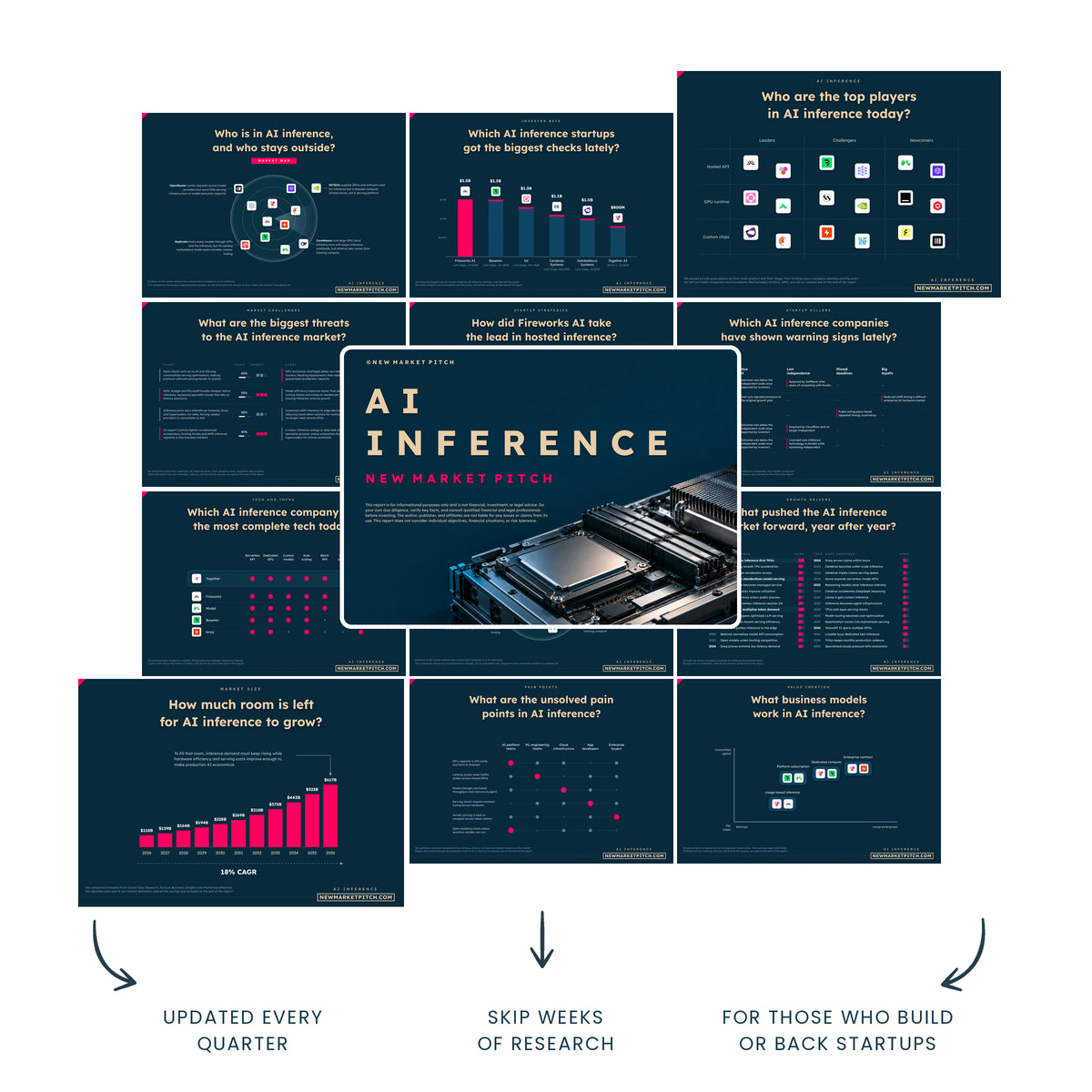
Whether you're building or investing in the AI inference market, our report covers everything you need to know: the players, the money, and what's coming next.
Summary
Cerebras Systems has raised the most equity of any AI inference startup, with $9.3B across its lifetime. It leads the 66 companies we track by a wide margin, while only 8 companies have reached the billion-dollar funding level.
A large IPO helped put Cerebras so far ahead. Its long private funding history matters too, but the public offering changed the scale of the comparison.
Groq and SambaNova Systems follow a hardware-heavy route. Both also sell inference services, which makes them direct competitors to businesses running models on more conventional infrastructure.
Baseten and fal show how much money investors will put into model serving without a custom processor. Their customers need dependable execution, whether the workload is an enterprise language model or a stream of generated videos.
Fireworks AI and Together AI have raised heavily around open-model inference. Modal has drawn major funding for serverless execution, where developers want computing capacity to appear when their applications need it.
That gives the market several serious approaches. Companies can design their own computing systems, manage model endpoints, build faster software or make cloud capacity easier to use.
The American lead is still striking. China has credible contenders in Infinigence AI and SiliconFlow, while South Korea and Europe have smaller, more specialized software businesses.
Most inference startups operate with far less money than the names in the headlines. We count 46 companies, or 70%, in the lowest funding bracket.
Age does not explain every gap. Some young runtime companies have secured major first rounds, while several established inference providers have not announced comparable recent financing.
Our conclusion is straightforward: Cerebras Systems leads on lifetime funding, but it has not settled the battle for AI inference customers. Investors are financing several ways of making trained models run faster, more reliably and at lower cost.

Written by the New Market Pitch teamWe track new markets so founders and investors can move faster. About us

In our report covering the AI inference market, you will always find fresh funding data, taken straight from our own verified funding database.
Top startups in the AI inference market ranked by total funding raised
Here is the current ranking of the AI inference startups that raised the most, with the total each one has raised and our confidence level.
If you want to go deeper into the AI inference startup landscape, check our report covering the AI inference market.
| # | Startup | Total raised | Last round | Status | Confidence |
|---|---|---|---|---|---|
| $1B and above | |||||
| 1 | Cerebras SystemsBuilds wafer-scale AI computing systems | $9.3B1 | May 2026$6.4B · IPO | IPO | Full |
| 2 | GroqProvides specialized AI inference infrastructure | $2.8B+ | Aug 2026$350M · Series A | Active | Full |
| 3 | SambaNova SystemsBuilds AI inference chips and systems | $2.5B+ | Jul 2026$1.0B · Series F | Active | Full |
| 4 | BasetenDeploys and scales AI inference | $2.1B | Jun 2026$1.5B · Series F | Active | Full |
| 5 | falProvides generative AI inference infrastructure | $2.0B | Nov 2026$1.3B · Series F | Active | Full |
| 6 | Fireworks AIHosts and optimizes AI models | $1.8B | Jul 2026$1.5B · Series D | Active | Full |
| 7 | Together AIAI model training and inference | $1.3B | Jul 2026$800M · Series C | Active | Full |
| 8 | ModalProvides serverless AI compute infrastructure | $1.2B | Oct 2026$750M · Series D | Active | Full |
| $500M to $1B | |||||
| 9 | Infinigence AICloud computing capacity for AI models | $591M | Oct 2026~$320M · Series C | Active | Partial |
| $100M to $500M | |||||
| 10 | SiliconFlowAI model inference cloud platform | $440M+ | Sep 2026$125M · Series C | Active | Strong |
| 11 | Gimlet LabsBuilds heterogeneous AI inference infrastructure | $392M | Sep 2026$300M · Series B | Active | Full |
| 12 | ModularAI inference software and accelerator runtimes | $380M | Sep 2025$250M · Series C | Acquired | Full |
| 13 | GMI CloudGPU cloud infrastructure | $238M | Oct 2026$223M · Series B | Active | Full |
| 14 | AnyscaleDeploy distributed Ray Serve inference workloads | $160M | Dec 2021$100M · Series C | Active | Full |
| 15 | InferactCommercializes open-source AI inference software | $150M | Jan 2026$150M · Seed | Active | Full |
| 16 | DeepInfraProvides cloud-based AI model inference | $133M+ | May 2026$107M · Series B | Active | Full |
| 17 | OctoAIAccelerate and serve production AI inference | $132M | Nov 2021$85M · Series C | Acquired | Full |
| 18 | General ComputeOperates a heterogeneous inference cloud using GPUs and purpose-built chips, sold as bare metal or guaranteed token-throughput services. | $115M | Oct 2026$100M · Series A | Active | Full |
| 19 | ClarifaiDeploy production AI inference across infrastructure | $101M | Oct 2021$60M · Series C | Active | Full |
| 20 | RadixArkDevelops open AI infrastructure software | $100M | May 2026$100M · Seed | Active | Full |
| Below $100M | |||||
| 21 | OllamaSoftware for running generative language models | $80M | Jul 2026$65M · Series B | Active | Full |
| 22 | RunwareInference compute infrastructure and model hosting | $66M | Dec 2025$50M · Series A | Active | Full |
| 23 | ReplicateHosted generative model APIs and deployments | $63M | Dec 2023$40M · Series B | Acquired | Full |
| 24 | Deci AIOptimize and compress models for fast inference | $55M+ | Jul 2022$25M · Series B | Acquired | Partial |
| 25 | Neural MagicOptimize sparse model inference on commodity hardware | $55M | Oct 2021$30M · Series A | Acquired | Full |
| 26 | HyperbolicUnifies decentralized GPU compute resources | $50M | Oct 2026$30M · Series A1 | Active | Full |
| 27 | WaferInference chips and associated AI compute infrastructure | $44M | Sep 2026$40M · Series A | Active | Full |
| 28 | ParasailCloud infrastructure for scalable model inference | $42M | Apr 2026$32M · Series A | Active | Full |
| 29 | Nota AIOptimize AI models for edge inference | $39M | Jun 2024$19M · Series C | IPO | Full |
| 30 | MorehOptimize AI execution across accelerator architectures | $36M | Oct 2023$22M · Series B | Active | Full |
| 31 | LuminalAccelerate inference using optimized GPU compute | $34M | Sep 2026$29M · Other | Active | Full |
| 32 | DappleServe AI models through managed infrastructure | $30M | Jun 2026$30M · Seed | Active | Full |
| 33 | CentMLOptimize GPU model inference throughput and cost | $27M | Oct 2023$27M · Seed | Acquired | Full |
| 34 | FriendliAIOptimized cloud infrastructure for model inference | $26M+ | Aug 2025$20M · Seed | Active | Full |
| 35 | Featherless.aiServerless inference hosting for open models | $25M | Apr 2026$20M · Series A | Active | Full |
| 36 | NorthflankRun private GPU model serving workloads | $25M+ | Nov 2024$16M · Series A | Active | Strong |
| 37 | TensorMeshOptimize enterprise LLM inference software execution | $24M | May 2026$20M · Other | Active | Full |
| 38 | SimplismartServe enterprise AI models with optimized infrastructure | $21M | Oct 2026$14M · Series B | Active | Full |
| 39 | SaladCloudDistributed cloud using consumer GPUs | $20M+ | Apr 2022$17M · Series A | Active | Full |
| 40 | SkyPilotSchedule and operate AI inference across clouds | $20M | Jul 2026$20M · Seed | Active | Full |
| 41 | ZMLAccelerate inference via specialized GPU software | $20M | Jul 2026$20M · Seed | Active | Full |
| 42 | TrueFoundryDeploy and manage enterprise model inference | $19M | Feb 2025$19M · Series A | Active | Full |
| 43 | ProdiaHigh-speed inference APIs for generative media | $16M | Jul 2024$15M · Seed | Active | Full |
| 44 | VESSL AIAI infrastructure and MLOps orchestration | $16M+ | Oct 2024$12M · Series A | Active | Full |
| 45 | DoublewordPrivate high performance enterprise LLM inference | $15M | May 2025$12M · Series A | Active | Full |
| 46 | Infinity Artificial Intelligence InstituteGenerate optimized inference kernels across accelerator types | $15M | Jul 2026$15M · Seed | Active | Full |
| 47 | ClustroAIOptimize model inference on specialized hardware | $12M | Feb 2025$12M · Series A | Active | Full |
| 48 | Inference.netProvide distributed high throughput model inference | $12M | Oct 2025$12M · Seed | Active | Full |
| 49 | Lepton AIDeploy AI inference and GPU workloads | $11M | May 2023$11M · Seed | Acquired | Full |
| 50 | LablupOrchestrate accelerator workloads including production inference | $9.2M | Apr 2023$7.8M · Series A | Active | Full |
| 51 | MorgenrotGPU cloud computing and cluster management | $9.2M+ | Jul 2026$680K · Series B | Active | Partial |
| 52 | BentoMLAI model serving and deployment | $9M | Jun 2023$9M · Seed | Acquired | Full |
| 53 | CerebriumServerless GPU computing for AI inference | $8.6M+ | Jul 2025$8.5M · Seed | Active | Full |
| 54 | KoyebDeploy serverless AI inference on GPUs | $8.5M | Nov 2023$7M · Seed | Acquired | Full |
| 55 | MakoOffer optimized LLM inference infrastructure | $8.5M | Aug 2025$8.5M · Seed | Active | Full |
| 56 | OpenGradientExecute distributed model inference and verification | $8.5M | Oct 2024$8.5M · Seed | Active | Full |
| 57 | EnerzaiSoftware for optimized AI inference on devices | $8.3M | May 2025$5.7M · Other | Active | Full |
| 58 | OpenInferRun on device and edge model inference | $8M | Feb 2025$8M · Seed | Active | Full |
| 59 | GPUStackDevelops an open-source platform that manages mixed GPU and NPU clusters and deploys and serves AI models for enterprises. | $7.4M | Oct 2026~$7.4M | Active | Low |
| 60 | Spectral ComputeCompile and accelerate inference on diverse GPUs | $6M | Nov 2025$6M · Seed | Active | Full |
| 61 | Inference AIDeliver hosted accelerated inference model endpoints | $4M | Jan 2024$4M · Seed | Active | Full |
| 62 | BeamServerless cloud for AI applications | $3.5M | May 2022$3.5M · Seed | Active | Low |
| 63 | PipeshiftDeploy production models on private cloud GPUs | $2.5M | Jan 2025$2.5M · Seed | Active | Full |
| 64 | SqueezeBitsAccelerate LLM inference through model compression | $1.9M | Jan 2024$1.9M · Other | Acquired | Low |
| 65 | SegmindDeploy generative image and video inference APIs | $1M | May 2023$1M · Seed | Active | Full |
| 66 | AIEEVProvide cloud accelerated inference APIs | $415K | Jan 2026~$415K · Seed | Active | Low |
No startups match this search.
- Includes the primary proceeds of its IPO.

In our research about AI inference startups, we turn what is vague and complex into simple, useful visuals. Market maps like this one show you at a glance where every startup stands.
Is Cerebras Systems still the best-funded AI inference startup?
Cerebras Systems remains the best-funded AI inference startup, with $9.3B raised since it was founded.
That puts Cerebras ahead of every other specialist company among the 66 we track. The company is publicly listed now, but we still count it as a startup for this historical comparison. We include the money it raised before going public and the primary proceeds of its IPO, then stop there.
Cerebras builds huge wafer-scale processors and sells access to AI model execution. The inference service is why it belongs here. Companies selling chips without a significant paid service for running models are outside this market. Its business is also different from a software platform that can choose among GPUs already on the market: Cerebras must build and deploy its own computing systems.
The company's filings show that commercial deployment continues after the IPO. A quarterly SEC filing covering the period to June 2026 described an agreement to lease hardware to AWS, although those leases had not started and no related revenue had been recognized by the reporting date. We therefore would not confuse a large funding total with completed sales. Cerebras leads on the amount of equity secured, while its long-term advantage in inference performance and costs remains a separate question.
Did Cerebras Systems pull ahead because of one huge IPO?
Yes, Cerebras Systems' $6.4B IPO in May 2026 gave the AI inference funding leader an enormous advantage.
No other AI inference startup has raised that much in a single round. Cerebras also has the longest round history in this group, with 10 recorded equity rounds. Its September 2025 financing was the largest round recorded among these companies that year, so the IPO followed years of expensive development.
That sequence makes sense for wafer-scale computing. Cerebras had to pay for chip design, systems engineering and commercial deployments before becoming a public company. By contrast, model-serving firms such as Baseten and Fireworks AI can build services around accelerators developed by other businesses. They still need substantial capital, but their spending priorities are different.
Cerebras announced in May 2026 that the IPO had closed, and a later SEC filing covering the quarter to June 2026 describes an AWS hardware-leasing arrangement and its accounting status. We count the offering's primary proceeds because they raised money for the business. We exclude the later trading of its shares between investors. That is why its IPO can change the lifetime fundraising comparison without any change to what the company had previously raised privately.

In our market report about AI inference startups, we always try to gather several sources and make estimates that make sense, so you can work with solid numbers.
Is Groq still raising money after its NVIDIA deal?
Groq is still raising money for AI inference after the NVIDIA deal, and has raised at least $2.8B in historical equity.
The company recorded a $350M Series A in August 2026 and continues to operate GroqCloud. NVIDIA's December 2025 agreement licensed Groq's inference technology and involved hiring its founder and other employees. Groq said at the time that it would remain an independent company and that GroqCloud would keep running without interruption.
The deal also explains the valuation story that has confused some readers. Groq's $3.5B valuation in August 2026 followed a $6.9B valuation in September 2025 because the licensing transaction paid money to investors. Groq says the later price reflects the company after that transaction, rather than a conventional down round. We keep the earlier equity funding in the lifetime total because investors financed the technology that made the licensing agreement possible.
Groq is now focused on serving models through its cloud. Its August 2026 announcement that it joined the NVIDIA Cloud Partner program provides further evidence that it remains in the inference business. Its fundraising history and its current ownership structure answer different questions, and treating the technology license like a full acquisition would get both wrong.
Has SambaNova Systems raised as much as Groq?
SambaNova Systems has raised at least $2.5B for AI inference, alongside Groq's minimum of $2.8B.
Both figures are minimums, so we would not make a precise claim about how far apart the companies stand. SambaNova's $1.0B round in July 2026 helped finance the next stage of its specialized computing and model-execution business.
SambaNova now has two concrete paths into customers' data centers. In October 2026, it said Oracle planned to deploy SambaNova inference chips on Oracle Cloud Infrastructure. In November, it announced that Supermicro would build inference systems combining SambaNova processors with NVIDIA GPUs. The two companies use a planning figure of 10,000 SN50 chips for a phased rollout, which shows the intended scale but is not a firm order.
Groq has pursued its own cloud service alongside hardware partnerships. SambaNova is trying to get its systems distributed through large infrastructure partners. These are expensive ways to compete, because custom accelerators demand serious design work and reliable access to customers' production workloads. Yet the funding records show investors are still willing to support specialized inference hardware. We cannot tell from the sums raised which company has better margins or faster models in real deployments.

Our document detailing everything you need to know about AI inference gets updated several times a month, so you always get the latest view of where things stand.
Can Baseten really raise billions without building chips?
Yes, Baseten has raised $2.1B as an AI inference platform built around deploying and running models, rather than designing processors.
Its $1.5B round in June 2026 is a particularly strong example of how much investors will put behind production model serving. Baseten's job is to help customers run their models reliably, scale requests and use available computing hardware efficiently. That is something companies will pay for even when the chips come from NVIDIA or another supplier.
Baseten's own June 2026 announcement reported that revenue had grown 20x and inference volume 40x over the preceding year. Those are company-reported growth figures, rather than audited long-term forecasts, but they explain why the latest financing attracted attention. An earlier engineering article written with Google Cloud showed how Baseten worked on scheduling and cost-performance using Blackwell GPU instances.
The business is expensive to grow because customers expect fast responses and stable service while traffic changes throughout the day. Still, Baseten can improve performance by changing software and operations without inventing a new chip. Its financing makes one point clear: owning the processor is no longer a condition for entering the largest funding group in AI inference.
Can image and video AI inference really support a billion-dollar startup like fal?
fal has raised $2.0B by building AI inference infrastructure for images, video, audio and other generative media.
The company's November 2026 $1.3B round shows that media workloads can draw the kind of financing normally associated with language-model infrastructure. Those workloads place different demands on computing systems: video jobs may be long and expensive, while interactive audio has to respond quickly.
fal lets developers call hosted models through APIs or deploy their own models without managing every piece of the underlying computing stack. In its November 2026 company update, fal described media models being used in entertainment, advertising, e-commerce, gaming and marketing workflows. It also announced financing linked to new capacity and further research.
That customer mix matters. A production media service needs reliable queues, predictable completion times and support for models that keep changing. Those are practical problems for businesses that generate assets at volume. Baseten and Fireworks AI serve overlapping technical needs, but fal has built its position around particularly demanding creative workloads. Its funding demonstrates that AI inference can support large specialist platforms without forcing every company to become a general-purpose language-model cloud.
Can Fireworks AI and Together AI compete with the biggest inference companies?
Fireworks AI and Together AI now have enough funding to be serious competitors in production AI inference, even against hardware-heavy providers.
Fireworks AI has raised $1.8B, including a $1.5B round in July 2026. Together AI has raised $1.3B, following an $800M Series C in July 2026. Both run and optimize models for developers, with an emphasis on workloads that need more control than a simple public chatbot API offers.
Fireworks provides serverless, dedicated and reserved inference options. Together AI combines inference with tools that help teams develop, customize and deploy open models. An October 2026 announcement with IBM and NVIDIA described a plan for dedicated inference capacity on IBM Cloud. That deal gives Together another route to enterprise customers without forcing it to build every hardware layer itself.
The money raised has allowed both companies to compete on serving performance, deployment flexibility and customer support. It does not tell us which provider can serve a request most cheaply. Hardware partners, workload mix and actual utilization will matter. What the funding does establish is that model execution software and its operating platform can attract sums that once seemed reserved for chip designers.

In our report covering the AI inference market, we look at what the winners do differently, so you can learn from the best instead of guessing.
Is serverless AI inference turning Modal into a major player?
Modal has become one of the most heavily funded serverless AI inference providers, with $1.2B raised.
Its $750M round in October 2026 gives Modal substantial resources to build a platform that starts computing jobs when customers need them. A developer can run an inference endpoint, a voice workflow or a batch of image-generation tasks without managing a permanent GPU fleet.
That convenience has a difficult engineering side. Starting GPU workers takes time; serving a model also depends on getting its weights into memory quickly. Modal's product work addresses these problems through scheduling, caching and options for dedicated or autoscaled endpoints. Its June 2026 engineering release discussed speculative decoding and Auto Endpoints for faster language-model responses.
Modal is therefore selling something different from a fixed-capacity inference rack. Customers buy a way to run code and models together while leaving much of the infrastructure management to the platform. We would not assume serverless wins every price comparison, especially for steady high-volume traffic. But Modal's financing shows that flexible execution has become a large business opportunity within AI inference.
Are Chinese AI inference startups catching the American leaders?
Chinese AI inference startups have reached substantial funding totals, although the largest American providers remain far ahead.
Infinigence AI has raised $591M, while SiliconFlow has raised at least $440M. These companies give Chinese enterprises and developers ways to serve models on infrastructure available in their own market. Their products focus on production execution and access to computing resources, rather than merely selling a consumer AI application.
SiliconFlow's company materials describe support for DeepSeek models, Huawei Cloud integrations and private enterprise deployments. Infinigence AI also sells cloud computing capacity for running large AI models. The companies sit in a market shaped by local hardware supply, software compatibility and customers' deployment requirements.
Only 3 China-based companies fit this narrowly defined category. That is far from a count of every Chinese AI company or accelerator supplier. A major chip vendor with no substantial paid model-execution service would not qualify here. Even with that narrow boundary, Infinigence AI and SiliconFlow show that substantial inference infrastructure financing is happening outside the United States. The size of their historical equity totals alone cannot establish who will win local customers.

Learning from others' mistakes is the cheapest lesson there is. In our research about AI inference startups, we look at what broke startups before you, so you don't repeat it.
Are the biggest AI inference fundraisers all American?
Yes, every AI inference startup that has raised $1B or more is based in the United States, from Cerebras Systems and Groq to Baseten, Fireworks AI and Modal.
The country is also home to 48 of the 66 specialist companies we track, or 73% by company count. It benefits from large pools of venture financing, cloud customers and engineering talent, all of which help companies that need to build and sell demanding infrastructure. But a head-office address says nothing about where a company hosts its servers or serves its customers.
Outside the United States, South Korea has 7 companies, including the model optimizer Nota AI and accelerator-software developer Moreh. China has 3, including Infinigence AI and SiliconFlow. European businesses such as Northflank, ZML, Doubleword and Spectral Compute have generally raised smaller sums while concentrating on deployment, privacy or better use of existing hardware. In July 2026, TechCrunch covered ZML's cross-chip inference software, a useful example of that approach.
We see a clear American lead in the number of specialist businesses, not proof that the United States owns a similar share of global inference capacity or customer revenue. The geography of demand and the geography of startup headquarters are different things.
The table below shows the number and share of tracked AI inference startups headquartered in each country.
| Country | Startups | Share |
|---|---|---|
| United States | 48 | 73% |
| South Korea | 7 | 11% |
| China | 3 | 5% |
| United Kingdom | 3 | 5% |
| Canada | 1 | 2% |
| France | 1 | 2% |
| India | 1 | 2% |
| Israel | 1 | 2% |
| Japan | 1 | 2% |
Is AI inference funding still mostly about chips?
No, AI inference investors now put major sums into the software and services that actually run models, as well as specialized chips.
Cerebras Systems, Groq and SambaNova Systems represent the computing-system route. Baseten, fal, Fireworks AI, Together AI and Modal show how far serving platforms can go without making their own processors. A smaller group works on runtimes, compilers and scheduling software.
The distinction between these businesses is getting less rigid. SambaNova wants Oracle and Supermicro to put its processors in systems customers can use. Fireworks optimizes model execution across hardware it does not design. Modal makes it easier for developers to run jobs on available computing capacity, while Modular works on the software that helps accelerators execute model code efficiently.
These products solve related problems, but they have different spending needs. Chip designers fund hardware research and deployment. Hosted serving platforms need GPUs, software engineers and support teams. Runtime developers can often start with less physical infrastructure. We therefore read the funding totals as evidence of several competing paths to faster and cheaper inference. They do not measure the proportion spent on chips, and they do not reveal which technical design will eventually deliver the best costs.

If you build or invest in the AI inference market, you need to know which business models pay off now and which ones are fading. That's why our report covering it has a whole section on it.
Is there a huge funding gap between AI inference leaders and the rest?
AI inference startups face a huge funding gap between a handful of billion-dollar companies and everyone else.
We count 8 companies with at least $1B in lifetime funding, or 12% of the group. At the other end, 46 companies, or 70%, are in the lowest funding bracket. The median cumulative total is at least $26M, so a typical company's financial history looks nothing like a headline billion-dollar round.
Only 1 company sits between $500M and the billion-dollar mark, while 11 fall into the bracket immediately below. The sharp gap partly reflects what these businesses build. A provider running a large fleet of accelerators needs to finance capacity before every customer arrives. An optimizer working on compression or a runtime can start by writing software and selling integration work.
That difference does not make the smaller firms unimportant. Moreh and Nota AI work on efficient execution, while Northflank and Doubleword address deployment problems that large infrastructure providers do not automatically solve. We see a genuinely uneven funding market. The distribution is the useful finding; it does not justify calling every lower-funded company a weaker competitor.
Does raising $100M still make an AI inference startup unusual?
A nine-figure lifetime equity total still makes an AI inference startup unusual.
We count 20 companies at or above that line. DeepInfra has raised at least $133M, OctoAI raised $132M before acquisition, General Compute has raised $115M and Clarifai has raised $101M. These businesses reached the same broad funding level with different products and at different points in the industry's development.
DeepInfra sells model inference through hosted APIs. OctoAI focused on making inference fast and easy to deploy before it was acquired. General Compute offers heterogeneous inference infrastructure, and Clarifai has spent years building production model deployment software. The capital supports different work: renting accelerator capacity, engineering runtimes, serving enterprise customers or expanding distribution.
A nine-figure total can fund significant progress, but its value depends on how much computing equipment the business must operate. The number also says little about profitability or retention. Even so, against the wider funding distribution, it remains an unusual financing achievement. We should not let the largest IPO or private round reset expectations for every company that serves AI models.

In our document detailing everything you need to know about AI inference, we like to show you the big picture. We know your time is precious, so we make every page quick to read and packed with as much learning as possible per minute.
Can a brand-new AI inference company raise serious money immediately?
Young AI inference startups can raise large first rounds when their technology already matters to developers.
Inferact raised $150M in a Seed round in January 2026, while RadixArk raised $100M in a Seed round in May 2026. Both work on open inference infrastructure, where a company can be new even if its founders and software have long-standing credibility in the developer community.
Inferact was created by people behind vLLM, a widely used open-source engine for serving large language models. The company's launch announcement describes a plan to improve that engine and sell the reliability and support needed for large production installations. RadixArk tackles related software problems. Investors can therefore assess proven code and technical leadership rather than waiting for a long history of conventional fundraising rounds.
The pattern goes beyond open-source runtimes. Gimlet Labs has raised $392M across 3 rounds, including a $300M Series B in September 2026, as it works on scheduling inference across different kinds of computing hardware. Such financing creates room to build, but customers still have to adopt the resulting products. A big first check is evidence of investor confidence, not a completed commercial victory.
Will AI inference software keep attracting money without owning GPUs?
AI inference runtimes and optimization software can attract major equity funding without owning a large GPU fleet.
Modular raised $380M before it was acquired, Inferact has raised $150M and RadixArk has secured substantial Seed funding. Instead of selling raw computing capacity, these companies work on the code that helps models run faster or use more hardware options. Their products can become useful across many deployment environments.
Modular's MAX runtime and compiler aim to improve performance and portability. The company expanded access to parts of its inference software in October 2026. Inferact works around vLLM, while RadixArk builds open inference infrastructure. Such tools can reduce wasted memory, improve scheduling and make it easier to run production workloads on available accelerators.
For a customer already paying for GPUs, software that increases throughput may be more attractive than buying another machine. That gives runtime companies a clear path to customers, even if they carry much smaller hardware costs than chip developers. We cannot turn the amount each startup has raised into a benchmark ranking. Still, the financing is strong evidence that investors see commercial value in software that works across processors and cloud platforms.
Do AI inference startups need a long history of funding rounds?
No, AI inference companies can reach meaningful funding totals with one round, although the biggest infrastructure businesses usually raise repeatedly.
We count 23 companies with one recorded equity financing. Inferact and RadixArk secured substantial Seed rounds, while Dapple raised $30M in a Seed round in June 2026. At the other end, Cerebras Systems completed 10 qualifying rounds while developing its computing systems and taking the business public.
A one-round company is not necessarily an inexperienced one. Founders may already have built popular open-source tools or operated infrastructure at other businesses. That can make investors comfortable putting substantial money into an early company. Older firms may instead raise in stages as they buy capacity, hire sales teams and expand their product range.
The number of rounds tells us about financing history, not whether customers love the product. A startup could do well with a small budget, while another might need continual investment to keep large systems running. It is useful to compare how much money businesses have secured, but round count alone cannot tell us which ones will become durable inference providers.

When you build or invest in the AI inference market, you need clarity, not confusion. In our report covering the AI inference market, we always try to put numbers on and quantify whatever is usually vague and confusing.
Have Anyscale and Clarifai fallen behind the new inference startups?
Anyscale and Clarifai have been overtaken in lifetime equity funding by several newer AI inference providers.
Anyscale has raised $160M; its last recorded financing was a $100M Series C in December 2021. Clarifai has raised $101M; its last was a $60M Series C in October 2021. Both have worked on production AI for years, but the newest large financings have changed the funding comparison.
Anyscale uses Ray Serve and related tools to help customers deploy and scale model workloads. Clarifai provides ways to run models across different infrastructure. Those products have continued to develop. A company can keep selling and shipping software without announcing another big equity round, so we would not take an older financing date as evidence that its business has stalled.
The competitive difference is practical. A startup with fresh, large funding may be able to reserve computing capacity, hire more engineers or pay for a broader sales effort. Anyscale and Clarifai must compete with that spending power while relying on the capabilities and customer relationships they have built. Their funding positions have clearly slipped relative to newer challengers. Their current operating performance needs a different set of evidence.
Which AI inference startups have already been bought?
Several well-funded AI inference startups have already been bought, including OctoAI, Replicate and Neural Magic.
We include 10 acquired businesses. OctoAI raised $132M, Replicate raised $63M and Neural Magic raised $55M before their acquisitions. All three helped develop the serving or optimization software used by AI developers, though they approached the problem differently.
Cloudflare announced in November 2025 that it would acquire Replicate and bring model execution closer to its developer platform. Red Hat completed its acquisition of Neural Magic in January 2025 to strengthen generative AI inference optimization. Those are useful examples of why companies with meaningful funding histories can disappear as independent names while their technology remains in use.
Other acquired businesses in the group include Modular, Deci AI, CentML, Lepton AI, BentoML and Koyeb. Their sale prices do not count as money raised by the startup. We stop counting at the acquisition and keep what each company raised before it. Leaving them out would erase the investment that helped build technologies now controlled by larger companies.
The table below shows selected acquired AI inference companies and the dates of their final recorded equity rounds.
| Startup | Total raised | Last round |
|---|---|---|
| Modular | $380M | September 2025 |
| OctoAI | $132M | November 2021 |
| Replicate | $63M | December 2023 |
| Deci AI | $55M+ | July 2022 |
| Neural Magic | $55M | October 2021 |
| CentML | $27M | October 2023 |
| Lepton AI | $11M | May 2023 |
| BentoML | $9M | June 2023 |
| Koyeb | $8.5M | November 2023 |

A good product starts with a real problem. In our research about AI inference startups, we show you the ones customers still live with.
Which AI inference startups have already gone public?
Two AI inference startups have already gone public: Cerebras Systems in the United States and Nota AI in South Korea.
Cerebras has raised far more, while Nota AI focuses on compressing and optimizing models so they can run on varied computing hardware. Nota AI's listing on Korea's KOSDAQ exchange in November 2025 also shows that exit opportunities exist outside the United States.
The important distinction is what money actually reaches the business. Shares sold by the company in its IPO produce capital it can use. Shares that investors later trade with one another do not. A public company's market value may rise dramatically without the company receiving a new dollar from that trading.
We therefore include primary IPO proceeds and stop counting at the listing. We use the same approach to preserve financing histories of recently acquired companies, stopping when the acquisition happens. This lets a reader compare the equity that financed each startup's development without treating public-market activity as additional startup fundraising.
So, which AI inference startups have raised the most money?
Cerebras Systems is the number one AI inference startup by total equity funding, with $9.3B raised.
Its long financing history and huge IPO created a clear lead. Groq and SambaNova Systems have also raised large sums to build specialist hardware and inference services. Baseten, fal, Fireworks AI, Together AI and Modal show that the software and service side of the market now attracts enormous backing too.
The wider picture is easy to miss if we look only at the leaders. Infinigence AI and SiliconFlow have brought substantial Chinese financing into the field. Inferact and Gimlet Labs show how investors can also back software designed to remove a specific execution bottleneck. Many smaller businesses focus on similar problems with far less equity.
A funding lead gives Cerebras more financial resources for its chosen approach. It does not establish the fastest service, the cheapest inference or the best customer retention. Today's market still has several viable ways to run trained models. The amount raised tells us how strongly each has been financed, while actual customer demand will decide which approaches last.
The table below shows what we found.
| Question | Answer |
|---|---|
| Did going public change the funding race? | Cerebras took the lifetime funding lead by a wide margin. Its $6.4B IPO is the biggest single raise in AI inference. A stock market listing can change a company's total almost overnight. |
| Did Groq disappear after the NVIDIA agreement? | Groq continues operating an independent model-serving cloud for customers. It has raised at least $2.8B in historical equity. The licensing deal changed its business without erasing previous funding. |
| Can serving software attract enormous private rounds? | Baseten shows that owning a chip design is unnecessary. Its historical funding has reached $2.1B in equity. Customers pay for reliable inference on hardware already available. |
| Does generative media support a large infrastructure business? | fal has made media-model execution a heavily financed specialty. The company has raised $2.0B in total equity. Video and audio workloads need infrastructure beyond basic text APIs. |
| Are open-model execution platforms serious financial rivals? | Fireworks AI has joined the largest private inference fundraisers. Its historical equity raised totals $1.8B across multiple rounds. Efficient model execution can draw large amounts of investment. |
| Can serverless serving win investor backing at scale? | Modal brings major funding to programmable serverless AI inference. Its lifetime funding total has reached $1.2B in equity. Developers increasingly want elastic execution instead of permanent GPU fleets. |
| Have Chinese specialists entered the upper funding group? | Infinigence AI has secured a substantial funding base in China. Its total stands at $591M in historical equity funding. Local model deployment requirements support specialist infrastructure providers too. |
| Is the American lead broader than a few giants? | United States companies dominate the number of specialist inference providers. We track 48 startups headquartered in the country. That count cannot establish their worldwide share of inference revenue. |
| Has billion-dollar funding become the normal outcome? | Billion-dollar totals still belong to a small minority. We count 8 companies that have reached at least $1B. Most inference specialists have raised substantially less outside equity. |
| Can an inference startup start with a huge round? | Inferact launched with a very large initial equity financing. Its January 2026 Seed round brought in $150M. Proven open-source expertise can persuade investors before lengthy fundraising histories. |
| Are big companies buying up inference startups? | Larger companies keep buying AI inference software businesses. We count 10 acquired startups, including Modular, OctoAI and Replicate. Their earlier equity still financed products later absorbed by buyers. |

In our market report about AI inference startups, we try to remove everything that could confuse you, especially if you're investing or building in this market.
Our methodology
Our data runs through November 12, 2026. We define AI inference as specialist businesses that execute trained models for third parties or provide essential serving engines, optimization software and inference-focused orchestration. Hosted APIs, managed endpoints, execution runtimes and hardware makers with substantive paid inference services qualify; firms on the boundary are included when execution is a principal product, not merely a side feature. Every entry meets our startup definition: an independent, technology-led company founded in 2000 or later and never listed or listed within the last five years. Recently listed, acquired and shut-down companies keep their historical place and current status; fundraising ends at the IPO, with primary proceeds included, or at the acquisition.
A total counts equity raised since founding, including the oldest private rounds and primary proceeds from a qualifying IPO. We exclude debt, venture debt, grants, unconverted convertibles and SAFEs, post-IPO offerings and secondary share sales; a converted SAFE remains in the round that absorbed it. Duplicate reports of the same round are merged. A total with a plus sign is a minimum because at least one financing amount has not been publicly disclosed. This ranking covers the entire financing history of each business rather than only recent deals.
Rounds confirmed by a company announcement, a press article or a regulatory filing are counted in full. Where no article exists, a round is counted only when at least two recognised databases agree on its date (within one month) and amount (within 5%), and it is marked as low confidence; a round found in a single database stays in the company's history but is left out of totals. For companies that have raised more than $100M, every round counted is backed by an article.
We do not adopt aggregate totals from Crunchbase, PitchBook or similar commercial databases because they can mix equity with debt, grants, commitments or estimates. Such databases are not the only basis for fully confirmed amounts, and a round established only through two agreeing databases remains low confidence. If a company or publication gives a different total, we retain our independently sourced equity-round sum and explain material gaps beneath the full ranking. Funding confidence is classified Full, Strong, Partial or Low to show how much of the recorded total rests on corroborated rounds.
That approach explains why a familiar headline number may differ from our figure, why a business acquired by a larger platform still appears, and why a major chip company or GPU lessor can be absent. Chip sales without a substantive model execution service, undifferentiated GPU rental, proprietary model labs, gateways that only pass requests onward and applications that consume models are outside this market. We also distinguish announced acquisition prices and market valuations from money actually raised through equity issuance.
Groq remains an independent inference cloud following NVIDIA's nonexclusive technology license, so we retain its historical equity rounds despite the licensing transaction and resulting valuation change. We treat Cerebras Systems as eligible because its paid inference service accompanies its custom computing systems; Nota AI remains eligible following its recent listing, and acquired inference specialists retain their pre-acquisition totals. These choices keep a lifetime fundraising comparison consistent across changing company statuses.
Key sources include Cerebras Systems IPO closing, listing and primary proceeds, Cerebras SEC filing and AWS hardware-leasing arrangement, Groq and NVIDIA licensing agreement and Groq's independence, Groq's continued cloud operations and NVIDIA partner status, Groq's August 2026 round, $3.5B valuation and comparison with its September 2025 valuation, SambaNova and Oracle inference infrastructure collaboration, SambaNova and Supermicro disaggregated inference systems, Baseten's June 2026 financing announcement and operating momentum, Baseten and Google Cloud engineering evidence, fal's media inference focus and November 2026 financing announcement, Fireworks inference engines and deployment options, Together AI's enterprise inference collaboration with IBM and NVIDIA, Together AI's production deployment features, Modal's 2026 Auto Endpoints and speculative decoding work, SiliconFlow's China-based inference cloud development and partnerships, ZML's cross-hardware inference software release, Moreh's accelerator orchestration and commercial history, Nota AI's listing and model optimization business, Inferact's founding, vLLM work and Seed financing, Gimlet Labs' Series B and heterogeneous inference strategy, Modular's MAX inference runtime and compiler announcement, Anyscale's Ray Serve and vLLM-based deployment service, Cloudflare's acquisition of Replicate, and Red Hat's completed acquisition of Neural Magic.
In our document detailing everything you need to know about AI inference, you will always find fresh funding data, taken straight from our own verified funding database.
Written by the New Market Pitch teamWe track new markets so founders and investors can move faster. About us