AI inference funding tracker
Whether you're building or investing in the AI inference market, our report covers everything you need to know: the players, the money, and what's coming next.
Summary
AI inference startups raised at least $17.3B across 101 deals involving 51 companies. Groq raised the most during the period, with $2.4B across 4 rounds. There is serious money here, although most startups will never see checks of that size.
The typical AI inference round was $25M. That is a useful number to remember when billion-dollar financing announcements make the entire market look much richer than it is.
A few enormous transactions explain much of the total. The 31 deals above $100M brought in $15.6B. These financings belong to a different world from the checks that support small inference software teams.
The biggest pool of money went to inference-specialist compute and silicon services. Managed model APIs and enterprise serving platforms also attracted investors, but their products need different amounts of hardware, staff and upfront spending.
Small software companies have not vanished. We tracked 32 Seed deals, even though the later stages took most of the disclosed money. A busy early-stage market can coexist with a small group of extremely well-funded operators.
Investors are also backing companies early. The median age at financing was 3 years, rising to 4 years for rounds above $50M. Inference infrastructure is getting large checks before many businesses have long operating histories.
Already funded companies received most of the money. We counted 74 follow-on deals totaling at least $16.6B, showing how often investors put more money into an operator they already know.
American companies took a commanding share, with 76 deals and at least $16.1B. China has funded serious inference providers too, while Europe's specialist funding remains much smaller.
The money comes in bursts. July 2026 alone produced 8 deals and $3.4B, compared with a completed-month median of 2 deals and $111M. One huge financing can change the apparent mood of the market.
For now, the real dividing line is what a company must build to deliver its service. An inference compiler, a managed API and a custom-chip cloud can all win customers, but the money needed to keep each one running looks very different.

Written by the New Market Pitch teamWe track new markets so founders and investors can move faster. About us

In our report covering the AI inference market, you will always find fresh funding data, taken straight from our own verified funding database.
Our funding tracker covering the AI inference market
Below is the table listing all the deals. You can find our methodology at the end of this page.
If you want a deeper understanding of the market and its current dynamics, get our AI inference market report.
| Company | Category | Date | Stage | Deal size | What they do | Region | Lead investors | Country | Rank |
|---|---|---|---|---|---|---|---|---|---|
| fal | Multimodal and media inference services | November 2026 | Series D+ | $1.3B | Provides generative AI inference infrastructure | North America | Bessemer Venture Partners | United States | |
| General Compute | Inference-specialist compute and silicon services | October 2026 | Series A | $100M | Operates a heterogeneous inference cloud using GPUs and purpose-built chips, sold as bare metal or guaranteed token-throughput services. | North America | Blackbird Ventures, Abstract Ventures | United States | |
| Hyperbolic | Inference-specialist compute and silicon services | October 2026 | Series A | $30M | Unifies decentralized GPU compute resources | North America | Walden Catalyst Ventures | United States | |
| Simplismart | Enterprise model serving and deployment | October 2026 | Series B | $14M | Serve enterprise AI models with optimized infrastructure | Asia-Pacific | Dallas Venture Capital | India | |
| Modal | Enterprise model serving and deployment | October 2026 | Series D+ | $750M | Provides serverless AI compute infrastructure | North America | Accel | United States | |
| Infinigence AI | Enterprise model serving and deployment | October 2026 | Series C | ~$320M | Cloud computing capacity for AI models | Asia-Pacific | Not disclosed | China | |
| GPUStack | Inference orchestration, scheduling and routing | October 2026 | Seed | ~$7.4M | Develops an open-source platform that manages mixed GPU and NPU clusters and deploys and serves AI models for enterprises. | Asia-Pacific | Shuihua Future | China | |
| GMI Cloud | Inference-specialist compute and silicon services | October 2026 | Series B | $223M | GPU cloud infrastructure | North America | ARCHIV | United States | |
| Luminal | Inference engines, compilers and optimization | September 2026 | Unknown | $29M | Accelerate inference using optimized GPU compute | North America | Standard Capital | United States | |
| SiliconFlow | Managed model inference APIs | September 2026 | Series C | $125M | AI model inference cloud platform | Asia-Pacific | Not disclosed | China | |
| Gimlet Labs | Inference orchestration, scheduling and routing | September 2026 | Series B | $300M | Builds heterogeneous AI inference infrastructure | North America | Andreessen Horowitz | United States | |
| Wafer | Inference-specialist compute and silicon services | September 2026 | Series A | $40M | Inference chips and associated AI compute infrastructure | North America | Marathon Management Partners, Chemistry | United States | |
| Groq | Inference-specialist compute and silicon services | August 2026 | Series A | $350M | Provides specialized AI inference infrastructure | North America | Disruptive | United States | |
| SkyPilot | Inference orchestration, scheduling and routing | July 2026 | Seed | $20M | Schedule and operate AI inference across clouds | North America | Lux Capital | United States | |
| Infinity Artificial Intelligence Institute | Inference engines, compilers and optimization | July 2026 | Seed | $15M | Generate optimized inference kernels across accelerator types | North America | Touring Capital | United States | |
| Fireworks AI | Managed model inference APIs | July 2026 | Series D+ | $1.5B | Hosts and optimizes AI models | North America | Atreides Management, Index Ventures, TCV | United States | |
| Ollama | Edge and on-device inference software | July 2026 | Series B | $65M | Software for running generative language models | North America | Theory Ventures | United States | |
| SambaNova Systems | Inference-specialist compute and silicon services | July 2026 | Series D+ | $1.0B | Builds AI inference chips and systems | North America | General Atlantic | United States | |
| ZML | Inference engines, compilers and optimization | July 2026 | Seed | $20M | Accelerate inference via specialized GPU software | Europe | Not disclosed | France | |
| Together AI | Managed model inference APIs | July 2026 | Series C | $800M | AI model training and inference | North America | Aramco Ventures | United States | |
| Baseten | Enterprise model serving and deployment | June 2026 | Series D+ | $1.5B | Deploys and scales AI inference | North America | Altimeter Capital, Conviction, Spark Capital, Sands Capital, Wellington Management | United States | |
| Groq | Inference-specialist compute and silicon services | June 2026 | Growth Equity | $650M | Provides specialized AI inference infrastructure | North America | Disruptive, Infinitum | United States | |
| Dapple | Enterprise model serving and deployment | June 2026 | Seed | $30M | Serve AI models through managed infrastructure | North America | The Raptor Group | United States | |
| SiliconFlow | Managed model inference APIs | June 2026 | Series B | $280M+ | AI model inference cloud platform | Asia-Pacific | Ctrip Strategic Investment, Jinko Solar, Kingdee, Unicom X-WO, Shengyi Capital, Biren Strategic Investment, NIO Capital, SenseTime Strategic Investment, Giant Network, Guotai Junan Innovation Investment, GGV Capital, Walden International, Huakong Fund, CDB Capital, Zhongguancun Science City | China | |
| General Compute | Inference-specialist compute and silicon services | May 2026 | Seed | $15M | Operates a heterogeneous inference cloud using GPUs and purpose-built chips, sold as bare metal or guaranteed token-throughput services. | North America | FUSE VC | United States | |
| TensorMesh | Inference engines, compilers and optimization | May 2026 | Seed | $20M | Optimize enterprise LLM inference software execution | North America | Not disclosed | United States | |
| Modal | Enterprise model serving and deployment | May 2026 | Series C | $355M | Provides serverless AI compute infrastructure | North America | General Catalyst, Redpoint Ventures | United States | |
| RadixArk | Inference engines, compilers and optimization | May 2026 | Seed | $100M | Develops open AI infrastructure software | North America | Accel, Spark Capital | United States | |
| DeepInfra | Managed model inference APIs | May 2026 | Series B | $107M | Provides cloud-based AI model inference | North America | 500 Global, Georges Harik | United States | |
| Infinigence AI | Enterprise model serving and deployment | May 2026 | Series B | $103M | Cloud computing capacity for AI models | Asia-Pacific | Not disclosed | China | |
| Featherless.ai | Managed model inference APIs | April 2026 | Series A | $20M | Serverless inference hosting for open models | North America | AMD Ventures, Airbus Ventures | United States | |
| fal | Multimodal and media inference services | April 2026 | Series D+ | $350M | Provides generative AI inference infrastructure | North America | Sequoia Capital | United States | |
| Parasail | Managed model inference APIs | April 2026 | Series A | $32M | Cloud infrastructure for scalable model inference | North America | Touring Capital, Kindred Ventures | United States | |
| Wafer | Inference-specialist compute and silicon services | April 2026 | Seed | $4M | Inference chips and associated AI compute infrastructure | North America | Fifty Years | United States | |
| Gimlet Labs | Inference orchestration, scheduling and routing | March 2026 | Series A | $80M | Builds heterogeneous AI inference infrastructure | North America | Menlo Ventures | United States | |
| SambaNova Systems | Inference-specialist compute and silicon services | February 2026 | Series D+ | $350M+ | Builds AI inference chips and systems | North America | Vista Equity Partners, Cambium Capital | United States | |
| Cerebras Systems | Inference-specialist compute and silicon services | February 2026 | Series D+ | $1.0B | Builds wafer-scale AI computing systems | North America | Tiger Global | United States | |
| AIEEV | Managed model inference APIs | January 2026 | Seed | $415K | Provide cloud accelerated inference APIs | Asia-Pacific | Bluepoint Partners | South Korea | |
| Baseten | Enterprise model serving and deployment | January 2026 | Series D+ | $300M | Deploys and scales AI inference | North America | IVP, CapitalG | United States | |
| Inferact | Inference engines, compilers and optimization | January 2026 | Seed | $150M | Commercializes open-source AI inference software | North America | Andreessen Horowitz, Lightspeed Venture Partners | United States | |
| Runware | Multimodal and media inference services | December 2025 | Series A | $50M | Inference compute infrastructure and model hosting | North America | Dawn Capital | United States | |
| fal | Multimodal and media inference services | December 2025 | Series D+ | $140M | Provides generative AI inference infrastructure | North America | Sequoia Capital | United States | |
| Infinigence AI | Enterprise model serving and deployment | November 2025 | Series A | ~$70M | Cloud computing capacity for AI models | Asia-Pacific | Zhuhai Technology Group, Futeng Capital | China | |
| Luminal | Inference engines, compilers and optimization | November 2025 | Seed | $5.3M | Accelerate inference using optimized GPU compute | North America | Felicis | United States | |
| Spectral Compute | Inference engines, compilers and optimization | November 2025 | Seed | $6M | Compile and accelerate inference on diverse GPUs | Europe | Costanoa Ventures | United Kingdom | |
| Fireworks AI | Managed model inference APIs | October 2025 | Series C | $250M | Hosts and optimizes AI models | North America | Lightspeed Venture Partners, Index Ventures, Evantic | United States | |
| TensorMesh | Inference engines, compilers and optimization | October 2025 | Seed | $4.5M | Optimize enterprise LLM inference software execution | North America | Laude Ventures | United States | |
| Gimlet Labs | Inference orchestration, scheduling and routing | October 2025 | Seed | $12M | Builds heterogeneous AI inference infrastructure | North America | Factory | United States | |
| Inference.net | Managed model inference APIs | October 2025 | Seed | $12M | Provide distributed high throughput model inference | North America | Multicoin Capital, Andreessen Horowitz | United States | |
| Cerebras Systems | Inference-specialist compute and silicon services | September 2025 | Series D+ | $1.1B | Builds wafer-scale AI computing systems | North America | Fidelity Management & Research Company, Atreides Management | United States | |
| Modal | Enterprise model serving and deployment | September 2025 | Series B | $87M | Provides serverless AI compute infrastructure | North America | Lux Capital | United States | |
| Modular | Inference engines, compilers and optimization | September 2025 | Series C | $250M | AI inference software and accelerator runtimes | North America | US Innovative Technology Fund | United States | |
| Groq | Inference-specialist compute and silicon services | September 2025 | Growth Equity | $750M | Provides specialized AI inference infrastructure | North America | Disruptive | United States | |
| Runware | Multimodal and media inference services | September 2025 | Seed | $13M | Inference compute infrastructure and model hosting | North America | Insight Partners | United States | |
| Baseten | Enterprise model serving and deployment | September 2025 | Series D+ | $150M | Deploys and scales AI inference | North America | BOND | United States | |
| FriendliAI | Managed model inference APIs | August 2025 | Seed | $20M | Optimized cloud infrastructure for model inference | North America | Capstone Partners | United States | |
| Mako | Inference engines, compilers and optimization | August 2025 | Seed | $8.5M | Offer optimized LLM inference infrastructure | North America | M13 | United States | |
| fal | Multimodal and media inference services | July 2025 | Series C | $125M | Provides generative AI inference infrastructure | North America | Meritech Capital | United States | |
| Cerebrium | Enterprise model serving and deployment | July 2025 | Seed | $8.5M | Serverless GPU computing for AI inference | North America | Gradient | United States | |
| SiliconFlow | Managed model inference APIs | June 2025 | Series A | Undisclosed | AI model inference cloud platform | Asia-Pacific | Alibaba | China | |
| Enerzai | Edge and on-device inference software | May 2025 | Unknown | $5.7M | Software for optimized AI inference on devices | Asia-Pacific | Not disclosed | South Korea | |
| Doubleword | Enterprise model serving and deployment | May 2025 | Series A | $12M | Private high performance enterprise LLM inference | Europe | Dawn Capital | United Kingdom | |
| DeepInfra | Managed model inference APIs | April 2025 | Series A | $18M | Provides cloud-based AI model inference | North America | Felicis, Georges Harik | United States | |
| Parasail | Managed model inference APIs | April 2025 | Seed | $10M | Cloud infrastructure for scalable model inference | North America | Basis Set Ventures, Threshold Ventures, Buckley Ventures, Black Opal Ventures | United States | |
| Featherless.ai | Managed model inference APIs | March 2025 | Seed | $5M | Serverless inference hosting for open models | North America | Airbus Ventures | United States | |
| Together AI | Managed model inference APIs | February 2025 | Series B | $305M | AI model training and inference | North America | General Catalyst, Prosperity7 Ventures | United States | |
| ClustroAI | Inference engines, compilers and optimization | February 2025 | Series A | $12M | Optimize model inference on specialized hardware | North America | Forum Ventures | United States | |
| OpenInfer | Edge and on-device inference software | February 2025 | Seed | $8M | Run on device and edge model inference | North America | Cota Capital, Essence VC | United States | |
| Baseten | Enterprise model serving and deployment | February 2025 | Series C | $75M | Deploys and scales AI inference | North America | IVP, Spark Capital | United States | |
| SiliconFlow | Managed model inference APIs | February 2025 | Seed | $14M | AI model inference cloud platform | Asia-Pacific | Huachuang Capital | China | |
| fal | Multimodal and media inference services | February 2025 | Series B | $49M | Provides generative AI inference infrastructure | North America | Notable Capital | United States | |
| TrueFoundry | Enterprise model serving and deployment | February 2025 | Series A | $19M | Deploy and manage enterprise model inference | North America | Intel Capital | United States | |
| Pipeshift | Enterprise model serving and deployment | January 2025 | Seed | $2.5M | Deploy production models on private cloud GPUs | North America | Y Combinator, SenseAI Ventures | United States | |
| Ollama | Edge and on-device inference software | 2025 | Series A | $15M | Software for running generative language models | North America | Benchmark | United States | |
| Hyperbolic | Inference-specialist compute and silicon services | December 2024 | Series A | $12M | Unifies decentralized GPU compute resources | North America | Variant Fund, Polychain Capital | United States | |
| Northflank | Enterprise model serving and deployment | November 2024 | Series A | $16M | Run private GPU model serving workloads | Europe | Bain Capital Ventures | United Kingdom | |
| Northflank | Enterprise model serving and deployment | November 2024 | Seed | $6.3M | Run private GPU model serving workloads | Europe | Vertex Ventures US | United Kingdom | |
| GMI Cloud | Inference-specialist compute and silicon services | October 2024 | Series A | $15M | GPU cloud infrastructure | North America | Headline Asia | United States | |
| Simplismart | Enterprise model serving and deployment | October 2024 | Series A | $7M | Serve enterprise AI models with optimized infrastructure | Asia-Pacific | Accel | India | |
| OpenGradient | Inference orchestration, scheduling and routing | October 2024 | Seed | $8.5M | Execute distributed model inference and verification | North America | Andreessen Horowitz | United States | |
| VESSL AI | Inference orchestration, scheduling and routing | October 2024 | Series A | $12M | AI infrastructure and MLOps orchestration | Asia-Pacific | Not disclosed | South Korea | |
| Runware | Multimodal and media inference services | October 2024 | Seed | $3M | Inference compute infrastructure and model hosting | North America | Not disclosed | United States | |
| fal | Multimodal and media inference services | September 2024 | Series A | $14M | Provides generative AI inference infrastructure | North America | Kindred Ventures | United States | |
| fal | Multimodal and media inference services | September 2024 | Seed | $9M | Provides generative AI inference infrastructure | North America | Andreessen Horowitz | United States | |
| Inference.net | Managed model inference APIs | September 2024 | Seed | $500K | Provide distributed high throughput model inference | North America | Not disclosed | United States | |
| Infinigence AI | Enterprise model serving and deployment | September 2024 | Series A | ~$70M | Cloud computing capacity for AI models | Asia-Pacific | National Social Security Fund Zhongguancun Independent Innovation Special Fund, Qiming Venture Partners, Hongtai Fund | China | |
| Cerebras Systems | Inference-specialist compute and silicon services | September 2024 | Series D+ | $85M | Builds wafer-scale AI computing systems | North America | Not disclosed | United States | |
| Groq | Inference-specialist compute and silicon services | August 2024 | Series D+ | $640M | Provides specialized AI inference infrastructure | North America | BlackRock Private Equity Partners | United States | |
| Hyperbolic | Inference-specialist compute and silicon services | July 2024 | Seed | $7M | Unifies decentralized GPU compute resources | North America | Polychain Capital, Lightspeed Faction | United States | |
| Fireworks AI | Managed model inference APIs | July 2024 | Series B | $52M | Hosts and optimizes AI models | North America | Sequoia Capital | United States | |
| SiliconFlow | Managed model inference APIs | July 2024 | Seed | $14M | AI model inference cloud platform | Asia-Pacific | Not disclosed | China | |
| Prodia | Multimodal and media inference services | July 2024 | Seed | $15M | High-speed inference APIs for generative media | North America | Dragonfly Capital | United States | |
| Nota AI | Edge and on-device inference software | June 2024 | Series C | $19M | Optimize AI models for edge inference | Asia-Pacific | STIC Ventures, LB Investment | South Korea | |
| Fireworks AI | Managed model inference APIs | March 2024 | Series A | $25M | Hosts and optimizes AI models | North America | Benchmark | United States | |
| Together AI | Managed model inference APIs | March 2024 | Series A | $106M | AI model training and inference | North America | Salesforce Ventures | United States | |
| Baseten | Enterprise model serving and deployment | March 2024 | Series B | $40M | Deploys and scales AI inference | North America | IVP, Spark Capital | United States | |
| Inference AI | Managed model inference APIs | January 2024 | Seed | $4M | Deliver hosted accelerated inference model endpoints | North America | Cherubic Ventures, Maple VC | United States | |
| SiliconFlow | Managed model inference APIs | January 2024 | Seed | $7M | AI model inference cloud platform | Asia-Pacific | Sinovation Ventures | China | |
| SqueezeBits | Inference engines, compilers and optimization | January 2024 | Unknown | $1.9M | Accelerate LLM inference through model compression | Asia-Pacific | Not disclosed | South Korea |

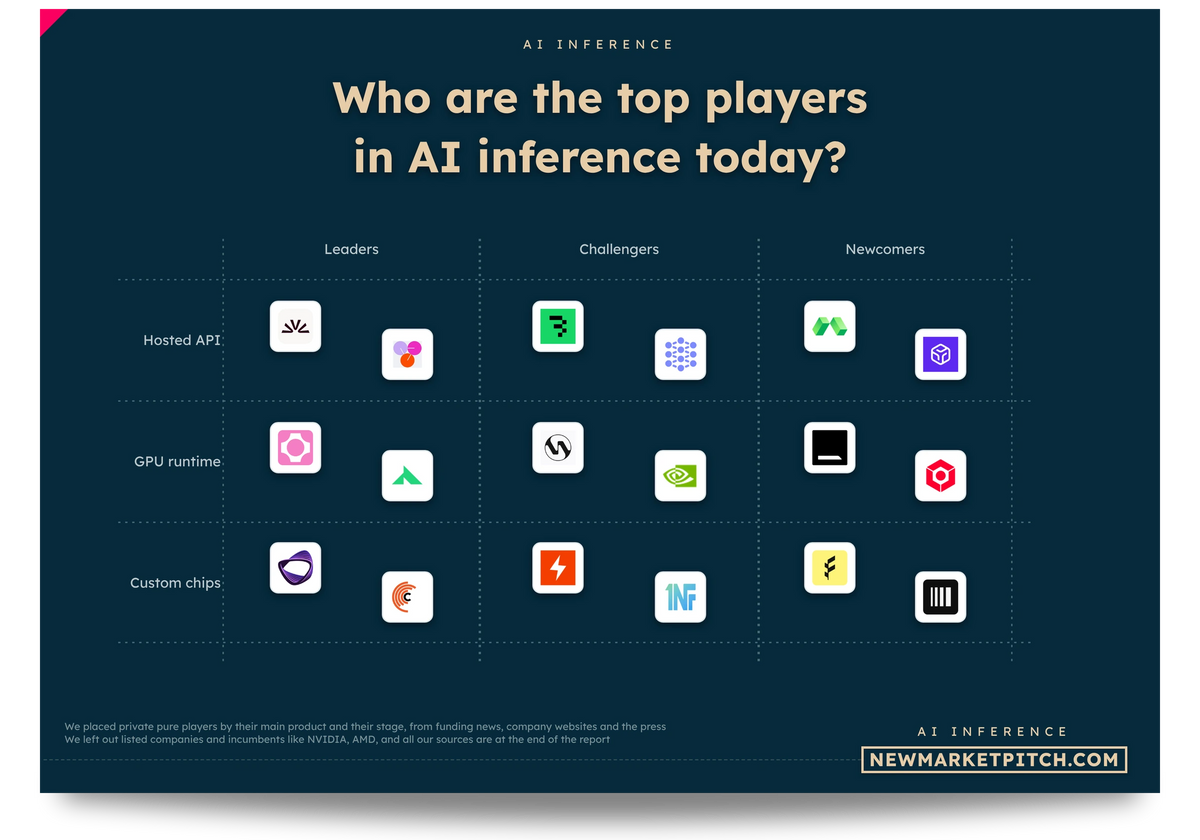
In our research about AI inference startups, we turn what is vague and complex into simple, useful visuals. Market maps like this one show you at a glance where every startup stands.
Why are investors putting so much money into AI inference?
AI inference is getting huge venture checks because companies need reliable ways to run trained AI models for real customers, every day.
We tracked 101 financings across 51 specialist companies, worth at least $17.3B over the full period. Some businesses rent model-serving software to enterprises. Others run hosted APIs, build faster execution engines or combine custom chips with a paid inference service. All compete to make production AI faster, cheaper or easier to operate.
The customer use cases help explain the size of the bets. Fireworks AI described enterprises running specialized models on their own data in its July 2026 announcement. Baseten has documented improvements to the way it routes live model requests. Groq's June 2026 announcement linked its financing to expansion of an inference cloud built for low latency. These companies sell different products, yet each needs to keep models running when customers send requests.
That creates very different costs. An optimization team may mainly hire engineers. A provider promising dedicated inference capacity must also secure accelerators and keep them busy. We can see why investors fund both, but the large infrastructure rounds should never set expectations for the typical software startup.
Is AI inference funding mostly a few giant rounds?
Yes, giant AI inference rounds account for most of the disclosed money, even though many smaller companies still raise funding.
The 31 deals above $100M represent 31% of all tracked transactions and $15.6B in disclosed funding. The wider bracket of $100M or more contains 33 deals across 17 companies and $15.8B.
Look at the biggest checks. Fireworks AI raised a $1.5B Series D+ in July 2026, Baseten raised a $1.5B Series D+ in June 2026, and Cerebras Systems raised a $1.0B Series D+ in February 2026. Now compare those with Featherless.ai's $20M Series A in April 2026 and Infinity Artificial Intelligence Institute's $15M Seed in July 2026. They fund businesses whose capital needs are far apart.
That gap is what drives the headline total. It does not mean every AI inference startup is suddenly easy to finance. Investors can support small software products and enormous compute deployments at the same time. When the biggest rounds close, they dominate the money without representing the experience of most founders.
How much does a typical AI inference startup raise?
A typical AI inference startup raised $24M across its rounds, and a typical single round is $25M, far below the billion-dollar deals that get the headlines.
Round sizes climb with the stage. Seed rounds have an $8.5M median, compared with $20M at Series A and $76M at Series B. Investors write larger checks as firms move toward full production, but plenty of startups do not reach those stages.
Take Featherless.ai, which raised a $5M Seed in March 2025 and a $20M Series A in April 2026. Parasail went from a $10M Seed in April 2025 to a $32M Series A in April 2026. Both provide model execution without owning a custom-chip cloud. The normal checks are smaller than the financings for companies building whole compute systems.
Smaller deals still matter. The under-$5M bracket contains 8 deals across 8 companies and $21M, while the $5M to under $20M bracket contains 36 deals across 30 companies and $404M. That is where an inference startup can begin with a narrow product and see whether paying customers follow.
Are small AI inference funding rounds disappearing?
No, small AI inference rounds are still common enough to support new software teams, although they bring in little of the overall capital.
There were 36 financings in the $5M to under $20M bracket. Another 13 deals fell between $20M and under $50M, bringing in $375M. We also recorded 9 deals from $50M to under $100M, worth $634M. This gives founders several realistic financing sizes between an early product and a large production platform.
The smaller deals are not all for the same kind of business. SqueezeBits raised a $1.9M round of undisclosed stage in January 2024 for model compression. Pipeshift's $2.5M Seed in January 2025 supported private-cloud model deployment. Wafer's $4M Seed in April 2026 backed a company working on chips and related inference infrastructure. Their likely spending needs differ even when their initial checks look similar.
We would be more worried about market access if every round started at an infrastructure-scale price. Instead, investors still finance specialized tools. The hard question comes later: can a team deliver enough speed, reliability or customer savings to turn that first check into a lasting business?

In our market report about AI inference startups, we always try to gather several sources and make estimates that make sense, so you can work with solid numbers.
Which AI inference businesses get the most investor money?
AI inference companies that run specialist compute and silicon services get the most disclosed capital; managed APIs lead by number of deals.
Inference-specialist compute and silicon services took 37% of the disclosed money. Managed model inference APIs accounted for 24 deals and 22% of disclosed capital. Enterprise model serving drew substantial funding too. The difference between deal count and dollars tells us how expensive each kind of business is to build.
Groq and Cerebras Systems sell inference services tied to specialized processors. Baseten helps enterprises deploy and scale models, while Modal offers serverless execution for developers. Modular focuses on the compiler and runtime software that makes execution more efficient. All solve production problems, but a company buying or developing compute capacity has much larger upfront obligations than a team writing optimization code.
That also changes what investors need to believe. For a compiler, the crucial proof may be better performance and adoption by developers. For a managed provider, it is paying usage, reliable service and enough workload to cover compute bills. For a chip-linked operator, financing also depends on supply, deployment and utilization. The table below shows the funding split across the seven AI inference business categories.
| Category | Deals | Companies | Capital | Capital share |
|---|---|---|---|---|
| Specialist compute | 21 | 8 | $6.4B+ | 37% |
| Enterprise serving | 21 | 10 | $3.9B | 23% |
| Managed APIs | 23 | 10 | $3.7B+ | 21% |
| Multimodal services | 11 | 3 | $2.1B | 12% |
| Compilers | 13 | 11 | $622M | 4% |
| Orchestration | 7 | 5 | $440M | 3% |
| On-device software | 5 | 4 | $113M | 1% |
Why do Groq and Cerebras need so much funding?
Groq and Cerebras Systems need large sums because they run AI inference services built around expensive specialist computing hardware.
They belong to inference-specialist compute and silicon services, a category with 21 deals across 8 companies and a $92M median round. A company in this category must do more than design a fast processor. It needs software that works with customer models, deployment capacity and enough service reliability for production workloads.
Groq's June 2026 announcement tied its $650M Growth Equity round to a broader global inference cloud. Cerebras Systems completed a $1.0B Series D+ in February 2026, listed on Nasdaq in May 2026 and offers wafer-scale computing as a model execution service. SambaNova Systems raised a $1.0B Series D+ in July 2026; its September 2026 technical work focused on how data movement affects inference performance. Each product tackles serving speed and efficiency through a different hardware design.
The danger is straightforward. Buying capacity before customer demand catches up can be expensive, and better chips elsewhere can quickly change the competitive picture. A large round gives these companies room to build. Investors still need customers to use the hardware often enough to make that spending worthwhile.
Can AI inference API startups raise big money without owning chips?
Yes, hosted AI inference APIs can attract serious funding without selling their own processors, although efficient execution still costs money.
Managed model inference APIs recorded 24 deals involving 10 companies and at least $3.7B in capital. Their $20M median round is much smaller than the specialist compute median. An API can be easy for customers to start using, but running the models behind it remains a technically demanding service.
Fireworks AI offers hosted and optimized model execution. Together AI serves models and also provides training infrastructure. Featherless.ai and Parasail focus on developer-friendly inference access. Those businesses differ from a provider that simply sends requests to someone else's API. The funded operators offer model execution or software that materially improves how it runs.
Enterprise serving is a closely related option. Baseten helps companies deploy their own models, and Modal lets engineers run custom inference code without managing servers. In its October 2025 engineering post, Baseten described cache-aware routing; Modal's May 2026 work explained faster serverless GPU startup. These improvements can save money or reduce response delays for customers. The best API businesses will need such advantages, because a simple endpoint alone is easy for a larger cloud platform to copy.

Our document detailing everything you need to know about AI inference gets updated several times a month, so you always get the latest view of where things stand.
Are investors funding AI inference for images and video too?
Image and video AI inference has attracted major investment, but the money sits with a small group of providers.
Multimodal and media inference services account for 11 deals involving 3 companies and $2.1B in disclosed funding. Image, video and audio generation can involve longer jobs and uneven surges in demand, so providers must manage queuing, GPU capacity and turnaround times in ways that differ from ordinary text requests.
fal offers execution of media models through APIs, while Runware specializes in fast image and media generation. fal raised a $350M Series D+ in April 2026 and a $1.3B Series D+ in November 2026. Runware raised a $50M Series A in December 2025. Those are different-sized bets on the same practical problem: businesses want to run large volumes of creative models without building the infrastructure themselves.
In its November 2026 announcement, fal discussed uses in advertising, entertainment, games and e-commerce. That helps explain the customer demand, but it does not mean many startups are sharing this pool of capital. Media inference is already a serious part of the market, with much of its funding going to returning companies.
Why are investors paying for AI inference compilers?
Investors fund AI inference compilers because faster execution can save customers money on hardware they already use.
The inference engines, compilers and optimization category received $622M across 13 deals involving 11 companies. Its $15M median round is closer to software funding than to the large checks written for custom-chip clouds. The product can be a runtime, a kernel generator or a tool that gets more output from a GPU.
Modular is one visible example. Its MAX runtime aims to make serving work across hardware and software environments, and its October 2026 announcement expanded access to that technology. Inferact raised a $150M Seed in January 2026 to commercialize open-source inference software. RadixArk's $100M Seed in May 2026 backed another ambitious infrastructure software effort. Large early checks are possible even without building a processor factory.
There is a catch: performance improvements are hard to keep exclusive. NVIDIA improves its own serving software, and open-source projects can adopt similar techniques. We would look for repeat usage, customer integration and proven speed or cost advantages. A clever benchmark alone will not protect a compiler company for long.
Can an AI inference scheduler raise big money without making chips?
Yes, AI inference schedulers can raise major rounds by making different GPUs and other accelerators work together more efficiently.
The orchestration, scheduling and routing category drew $440M from 7 deals involving 5 companies. Its median round was $12M. Much of the commercial value comes from choosing where a model runs, how work is divided and how spare capacity is used.
Gimlet Labs raised an $80M Series A in March 2026, followed by a $300M Series B in September 2026 led by Andreessen Horowitz. Its approach spreads model execution across different accelerator types. SkyPilot raised a $20M Seed in July 2026 for operating AI workloads across clouds. OpenGradient's $8.5M Seed in October 2024 addressed distributed model execution and verification.
These products solve related but distinct problems. Multi-cloud scheduling helps customers move work between providers. More advanced orchestration decides which hardware should perform parts of an inference task. Gimlet's September 2026 work with Cerebras showed how those ideas can meet specialist processors. Investors clearly see value in squeezing more useful work from existing machines. The risk is that cloud operators build similar scheduling into their own products.

In our report covering the AI inference market, we look at what the winners do differently, so you can learn from the best instead of guessing.
Is on-device AI inference being ignored by investors?
On-device AI inference is getting venture funding, but its funding pool is small beside cloud-based model execution.
Edge and on-device inference software drew 5 deals across 4 companies, totaling $113M. The category's median round was $15M, and its share of disclosed market capital was 1%. That does not tell us how many people use local models; it tells us where private investors have written checks.
Ollama helps developers run models on their own computers and connect them to coding workflows. Its January 2026 announcement also explained ways to work with local and hosted models. Ollama raised a $65M Series B in July 2026. Nota AI raised a $19M Series C in June 2024 for edge model optimization, while OpenInfer completed an $8M Seed in February 2025.
Local inference avoids part of the spending that makes hosted compute so expensive. Customers may supply the hardware themselves. The challenge is earning money from software that developers often expect to be free or open. We see a real investment niche here, just one that has not drawn the massive infrastructure rounds found in hosted inference.
Do AI inference startups actually make it to Series C and beyond?
Yes, AI inference startups reach Series C and later rounds, but only a small group gets the truly enormous checks.
Series C accounted for 9 deals involving 9 companies and $2.3B in disclosed capital. Series D+ accounted for 14 deals involving 7 companies and at least $10.2B. Seed was busier by deal count, with 32 deals and $557M. The gap between activity and capital gets much wider at the later stages.
Baseten's financing history shows how quickly a mature serving business can raise again. Baseten's $75M Series C in February 2025 was followed by a $150M Series D+ in September 2025, a $300M Series D+ in January 2026 and a $1.5B Series D+ in June 2026. Cerebras Systems' February 2026 financing shows the scale of capital needed for a hardware-backed service. Few companies can raise that way.
Among deals with a named stage, 59% were early stage. Later-stage financings took 90% of the disclosed capital among that named-stage group. Many teams still get early checks, while the biggest commitments go to the operators that investors already trust with production-scale spending. The table below shows the funding recorded at each stage.
| Stage | Deals | Companies | Capital | Capital share |
|---|---|---|---|---|
| Series D+ | 14 | 7 | $10.2B+ | 59% |
| Series C | 9 | 9 | $2.3B | 13% |
| Series B | 14 | 13 | $1.6B+ | 9% |
| Growth Equity | 2 | 1 | $1.4B | 8% |
| Series A | 25 | 23 | $1.1B+ | 7% |
| Seed | 32 | 29 | $557M | 3% |
| Unknown | 5 | 5 | $64M | <1% |
How young are AI inference companies when they get big checks?
AI inference companies can raise major rounds while still young, although bigger financings tend to come after more time in business.
The median age at financing was 3 years. For rounds above $50M it was 4 years, compared with 1 year for rounds under $5M. Those are ages when the money arrived, rather than the years companies spent between financings.
The reason is practical. A compiler company can start with a handful of experienced engineers. A production inference service must deliver consistent response times, uptime and usable capacity when customers are sending real traffic. Modal's May 2026 engineering write-up on serverless GPUs showed the work behind short startup delays. Baseten's October 2025 routing improvements showed how much effort goes into serving models efficiently after they have shipped.
There are exceptions. Inferact raised a $150M Seed in January 2026, and RadixArk raised a $100M Seed in May 2026. Both show that a compelling software team can get an unusually large early check. Still, investors generally write the very biggest checks when there is more of a production business to finance.
Can a brand-new AI inference startup still get funded?
Yes, new AI inference startups are still receiving first financings, even while returning companies take most of the money.
We counted 18 first financings across 18 companies, worth $439M in total. Their median was $10M, and they represented 3% of disclosed capital. That is evidence of new companies entering the funded market, rather than all the money staying with established names.
The first checks go to quite different ideas. Inferact's $150M Seed in January 2026 financed open-source inference software commercialization. SkyPilot's $20M Seed in July 2026 backed multi-cloud operation. Infinity Artificial Intelligence Institute's $15M Seed in July 2026 funded optimized inference kernels. These companies do not need to sell the same product or raise the same size of round.
Follow-on rounds are where most money goes, with 74 deals across 35 companies worth at least $16.6B. That is understandable in a market where serving larger workloads may require repeated capacity expansion. But first checks still happen. For a founder starting today, the useful comparison is with other young software or infrastructure teams, rather than the biggest growth deals.

Learning from others' mistakes is the cheapest lesson there is. In our research about AI inference startups, we look at what broke startups before you, so you don't repeat it.
Is most AI inference funding going to American startups?
By far. American AI inference startups are receiving the overwhelming majority of disclosed investment in this market.
United States-headquartered companies completed 76 deals across 37 companies and raised at least $16.1B. That amounts to 93% of the disclosed capital. The result covers several kinds of businesses, rather than depending entirely on one hardware developer.
Groq and Cerebras Systems sell specialist compute services. Fireworks AI and Together AI provide model execution through hosted platforms, while Baseten and Modal focus on enterprise or developer deployment. There is also a large home market for these products. Fireworks named Uber and Shopify as production customers in its October 2025 announcement. Groq has worked with Bell Canada on sovereign inference infrastructure since May 2025, showing that American suppliers can sell outside the United States too.
Asia-Pacific recorded 21 deals involving 10 companies and at least $1.1B. Europe recorded 5 deals across 4 companies and $60M. We assign countries using headquarters, not the location of a data center or customer. The numbers therefore describe where independent providers raise money. On that measure, the United States has a very large lead today.
Can Chinese AI inference startups compete with American providers?
Chinese AI inference startups already offer serious competing services, but American companies have raised far more money.
China recorded 11 deals involving 3 companies and at least $1.0B in disclosed capital. Those financings are concentrated in a few businesses rather than spread across a large population of startups. They nevertheless show that a funded inference-services industry exists outside the United States.
SiliconFlow sells hosted access to AI models through a developer API. SiliconFlow raised at least $280M in a Series B in June 2026 and $125M in a Series C in September 2026. Infinigence AI serves a more enterprise-focused infrastructure need and raised a ~$320M Series C in October 2026. Both are building around demand for fast, affordable model execution, though their customer relationships and infrastructure approaches differ.
The challenge is wider than raising cash. Providers compete on model access, pricing, response speed and reliability. Chinese companies can build services around domestic models and hardware, but the largest American operators also sell to global customers. China is a genuine second market for specialist inference funding, not yet a financing peer to the United States.
Why do European AI inference startups raise so much less?
European AI inference startups raise less mostly because none of them runs the kind of costly compute service that draws giant rounds.
Europe recorded 5 deals involving 4 companies and $60M, representing <1% of disclosed funding. Those figures cover independent inference providers, not all European AI research or the cloud capacity that large international companies operate in Europe.
The deals are real and quite specific. ZML raised a $20M Seed in July 2026 to speed up inference through GPU software. Doubleword raised a $12M Series A in May 2025 for private enterprise model serving. Spectral Compute raised a $6M Seed in November 2025 to work on compilers across GPU architectures. Northflank completed a $16M Series A in November 2024 for private model-serving workloads.
These companies are tackling problems with global demand, especially private deployment and faster execution. Yet our funding history shows mostly software-sized checks, with few specialist operators building enormous compute fleets. That helps explain the gap with the American market. It says little about the quality of European engineers and much more about which inference businesses investors have financed so far.
Does AI inference funding come steadily or in big waves?
AI inference funding comes in sudden waves, with large monthly totals often driven by a few companies closing huge rounds.
Across 34 completed months, the median was 2 deals and $111M per month, while 3 months had no deal at all. July 2026 had the most financings, with 8 deals, and the highest disclosed total at $3.4B. It stands well outside what a normal month looks like.
Several large deals happened together. Fireworks AI's $1.5B Series D+ in July 2026 coincided with Together AI's $800M Series C and SambaNova Systems' $1.0B Series D+. They serve related customer demand, but each company's financing was its own event. We would not treat that month as a new standard for how much money will arrive regularly.
The pattern has appeared before. September 2025 saw 6 deals and $2.4B, while February 2025 had 7 deals and $482M. August 2024 recorded 2 deals and at least $640M, including Groq's $640M Series D+ that month. The right reading is that important inference companies sometimes close very large rounds at the same time. Monthly totals can jump even when the number of funded startups changes much less.

If you build or invest in the AI inference market, you need to know which business models pay off now and which ones are fading. That's why our report covering it has a whole section on it.
Are Sequoia and Andreessen Horowitz funding AI inference startups?
Yes, Sequoia Capital and Andreessen Horowitz back AI inference startups, alongside several other major venture and growth investors.
We identified 174 participating investors, and 35 appeared more than once. Named lead investors were available for 86% of deals. Spark Capital led the most rounds in the period, with 4, while Sequoia Capital and Andreessen Horowitz each led 3. The combined size of Spark-led rounds was $1.7B; that is the total financing raised in those rounds, not Spark's own investment.
The investors back different kinds of inference businesses. Andreessen Horowitz led Gimlet Labs' $300M Series B in September 2026. Sequoia Capital led fal's $350M Series D+ in April 2026. Accel led Modal's $750M Series D+ in October 2026. These examples cover orchestration, media inference and serverless infrastructure rather than one narrow technology bet.
Major venture firms are clearly willing to lead inference deals. But they are judging different risks: software adoption, model-serving costs and, in hardware-linked services, the financing of compute capacity. Having a famous fund on board does not make these businesses work the same way.
Can NVIDIA, AWS and Google make inference startups irrelevant?
Only partly. NVIDIA, AWS and Google can squeeze independent AI inference startups that sell ordinary model endpoints, but specialists with faster execution or harder-to-copy service still have room.
The large platforms already control much of the hardware, cloud infrastructure and enterprise purchasing process. NVIDIA works to improve inference performance through its hardware and software stack. AWS has published guidance on choosing more efficient production serving configurations. Google Cloud made inference-aware gateway and deployment tooling generally available in September 2025. Those tools can bring faster and cheaper inference to customers who already use the platforms.
Independent providers still have ways to win. Baseten offers managed execution for customer-specific models. Modal makes it simpler to run changing workloads without running servers continuously. Gimlet Labs aims to schedule inference across accelerator types, which matters when customers do not want a single hardware choice. Groq shows both sides: in December 2025 it licensed its inference technology to NVIDIA on a non-exclusive basis and saw founder Jonathan Ross join NVIDIA, yet Groq stayed independent and kept GroqCloud running.
The threat is serious, but it differs by product. A company reselling a plain API call has little protection. A provider with faster execution, better service or difficult-to-copy customer integration has something to sell. We expect the struggle over price and performance to keep deciding which startups can turn investor money into sustainable businesses.
So, how much money is really going into AI inference startups?
AI inference has become a heavily funded startup market, but most of the money goes to a small group building production infrastructure at scale.
Investors are still backing first-time founders, runtime specialists, enterprise deployment tools and on-device software. Yet the biggest checks follow companies that need large compute fleets or that already serve significant model workloads. The range of business models matters more than any single headline total.
The largest single deal in the period was Fireworks AI's $1.5B Series D+ in July 2026. Groq raised the most capital across all its tracked rounds, with $2.4B. Spark Capital was the most active lead investor, with 4 rounds led. Those are three different answers: biggest transaction, most-financed company and busiest named lead.
Our judgment is that the market has real staying power, but the financing is uneven. A fast compiler, a dependable model-serving platform and a specialist inference cloud can each be valuable. They need different resources, and investors expect different proof before writing another check.
The table below shows what we found.
| Question | Answer |
|---|---|
| Is the inference funding total spread evenly? | No, a relatively small group attracts most of the money. We tracked 101 deals across 51 AI inference companies. The headline tells little about funding available to an average founder. |
| Have giant inference rounds become the norm? | No, smaller financings still make up most transactions. Deals above $100M attracted $15.6B of disclosed capital. Large infrastructure plans explain why those checks dominate the total. |
| Can inference software get funded without custom chips? | Yes, investors finance dedicated software for production model execution. The compiler category raised $622M across the period. Teams can win backing by improving speed and operating costs. |
| Do hosted APIs still attract serious investment? | Yes, managed inference APIs remain an important funded category. Their 23 deals involved 10 companies during our coverage. Developers pay for reliable model execution rather than only access. |
| Can specialist inference hardware attract massive checks? | Yes, compute services draw the biggest share of funding. The category raised at least $6.4B across its companies. Those businesses also face unusually high deployment and utilization costs. |
| Does on-device inference still have investor support? | Yes, local AI execution attracts some private funding today. We tracked $113M across its specialist software category. The business needs less cloud capacity but faces monetization questions. |
| Are mature inference companies still raising money? | Yes, late-stage infrastructure providers are receiving substantial checks. Series D+ rounds brought at least $10.2B into the market. Only 7 companies received those financings across the period. |
| Can brand-new inference teams find a first investor? | Yes, funding for new inference companies has not stopped. First financings totaled $439M across the tracked window. Returning companies still receive a much bigger share of money. |
| Has the United States lost its funding lead? | No, American startups still dominate independent inference financing today. American startups raised at least $16.1B during the period. China has serious providers, but the funding gap remains large. |
| Do inference investments arrive evenly through the year? | No, large checks make some months far busier. July 2026 alone recorded $3.4B in disclosed financing. The typical completed month was far quieter by comparison. |
| Are familiar venture firms still leading inference deals? | Yes, major generalist funds continue to lead startup financings. Spark Capital led 4 deals during the period. Sequoia Capital and Andreessen Horowitz also backed different execution technologies. |

In our document detailing everything you need to know about AI inference, we like to show you the big picture. We know your time is precious, so we make every page quick to read and packed with as much learning as possible per minute.
Our methodology
Our data runs through November 12, 2026. We cover financings from January 1, 2024 through November 12, 2026, using a continuous period rather than treating the current calendar year as complete. We track private-company equity financings of at least $300K and exclude debt, grants, loans, unconverted convertibles, SAFEs and public offerings.
We define AI inference as specialist execution of trained models for third-party production customers or the runtime, compiler, optimization and scheduling technology essential to that execution. Covered products include hosted inference APIs, dedicated endpoints, enterprise model serving, serverless execution, on-device runtimes and genuine cross-hardware execution orchestration. We include borderline compute or chip developers when a substantial paid inference service is a central product, rather than deleting such cases to make the market artificially tidy.
We exclude processor-only vendors, capacity-only GPU clouds, proprietary-model labs, generic MLOps and observability products, routing-only resellers, end-user applications, hyperscalers and incumbent divisions. Every company counted meets our startup definition: independent, founded in 2000 or later, built to grow around a new product or technology, and financed by venture capital, angels, grants or founders. A company listed within the last 5 years remains eligible, as does a company acquired within the last 3 years as part of its acquirer.
Each financing is counted once, and duplicate reports of the same announcement are merged. Rounds without a public amount count toward the deal total but not the disclosed-capital sum; consequently, some totals are minimums. Stages retain the announced labels and are grouped into Seed, Series A, Series B, Series C, Series D+, Growth Equity and Unknown. Headquarters determines country and region, while each business receives our primary product-category classification.
Rounds confirmed by a company announcement, a press article or a regulatory filing are counted in full. Where no article exists, a round is counted only when at least two recognised databases agree on its date (within one month) and amount (within 5%), and it is marked as low confidence; a round found in a single database stays in the company's history but is left out of totals. For companies that have raised more than $100M, every round counted is backed by an article.
We prioritize company announcements, filings and reliable reporting, using database-only evidence subject to the stricter corroboration test above. A total may differ from a broad AI infrastructure headline because we exclude training-only vendors, bare GPU rentals and application businesses; it may also differ from company lifetime funding because this article starts in January 2024. Likewise, a thin recent month is not treated as proof that funding suddenly stopped: large rounds close irregularly, and a partial month is not a completed comparison period.
Key sources include Fireworks July 2026 Series D announcement and specialized-model production demand, Fireworks October 2025 Series C and named enterprise customers, Baseten June 2026 financing announcement and inference volume growth, Baseten October 2025 production cache-aware routing improvements, Groq June 2026 capital raise and cloud expansion strategy, Groq and NVIDIA December 2025 licensing arrangement, Groq and Bell Canada inference infrastructure partnership, Cerebras February 2026 financing and wafer-scale inference offering, Modal May 2026 engineering description of serverless GPU scaling, Modular October 2026 MAX compiler and runtime availability, Gimlet September 2026 financing and heterogeneous execution strategy, Gimlet and Cerebras September 2026 inference collaboration, SambaNova September 2026 explanation of inference bandwidth economics, fal November 2026 announcement and commercial uses of generative media, Ollama January 2026 local model and hosted model workflows, DeepInfra June 2026 product pricing for asynchronous inference, NVIDIA inference cost and performance engineering, AWS production inference optimization and deployment trade-offs, Google Cloud September 2025 inference gateway and cost optimization, SiliconFlow hosted model inference product and pricing model, and Cerebras May 2026 Nasdaq listing.

When you build or invest in the AI inference market, you need clarity, not confusion. In our report covering the AI inference market, we always try to put numbers on and quantify whatever is usually vague and confusing.
Written by the New Market Pitch teamWe track new markets so founders and investors can move faster. About us