What are the most valuable AI inference startups?
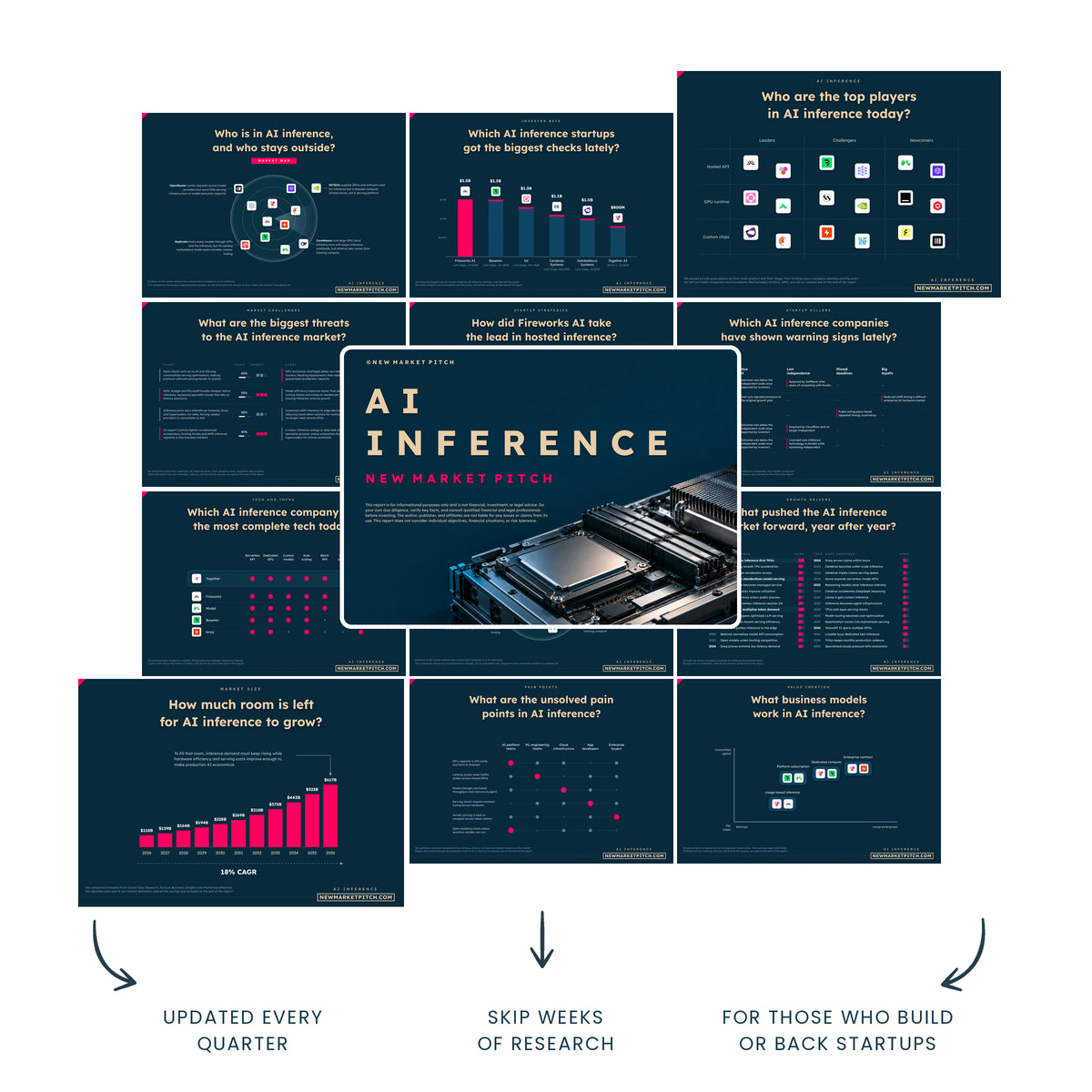
Whether you're building or investing in the AI inference market, our report covers everything you need to know: the players, the money, and what's coming next.
Summary
Fireworks AI is the most valuable independent AI inference startup, valued at $17.5B. fal is close behind: the gap between the two is just 1.1x. There is no runaway leader yet.
That narrow gap hides a bigger difference in what these companies sell. Fireworks runs and adapts AI models for production use, while fal specializes in the image, video and audio models used by media businesses.
Modal is another leading name, but its business goes beyond model inference. Developers also use its serverless platform to run code and give AI agents isolated environments to work in. That makes comparisons with pure model hosts less straightforward.
Baseten shows why enterprise deployment has become so valuable. Companies will pay for reliable performance, control over their own models and infrastructure that can handle production traffic without constant engineering work.
SambaNova Systems takes a different route. It sells inference through a combination of custom hardware and software, so the most valuable companies in this market are not all building on the same technology.
Together AI remains a serious competitor in open-model serving, and Groq continues to sell specialized inference through its own cloud. Neither has dropped out of the race simply because others carry higher private prices.
The very highest valuations are unusual. We count 5 independent inference startups worth at least $10B and 11 confirmed unicorns. Most of the companies in this market are worth considerably less.
American startups dominate the list, but China has credible challengers. Comparing them requires care because some Chinese valuations are estimated ranges rather than prices disclosed in completed rounds.
A big valuation tells us what investors paid or believe a company could be worth. It says much less about profit, the cost of running models or how easily customers can switch to a cheaper provider.
Our judgment is that AI inference has already produced several valuable businesses, with Fireworks AI in first place for now. The next test is whether their technical advantages turn into lasting customer relationships as running AI gets cheaper.

Written by the New Market Pitch teamWe track new markets so founders and investors can move faster. About us

In our report covering the AI inference market, we turn what is vague and complex into simple, useful visuals. Market maps like this one show you at a glance where every startup stands.
Top startups in the AI inference market ranked by valuation
Here is the current ranking of the most valuable AI inference startups. For each one you will also find our confidence level and the valuation basis we used.
If you want to go deeper into the AI inference startup landscape, check our report covering the AI inference market.
| # | Startup | Valuation | Confidence | Valuation basis | Last round | Total funding |
|---|---|---|---|---|---|---|
| Private startups | ||||||
| 1 | Fireworks AIHosts and optimizes AI models | $17.5Bas of Jul 2026 | Full | Announced private round valuation | $1.5BSeries D · Jul 2026 | $1.8Bvalued at 9.6× this |
| 2 | falProvides generative AI inference infrastructure | $16.0Bas of Nov 2026 | Full | Announced private round valuation | $1.3BSeries F · Nov 2026 | $2.0Bvalued at 8.1× this |
| 3 | ModalProvides serverless AI compute infrastructure | $15.75Bas of Oct 2026 | Full | Announced private round valuation | $750MSeries D · Oct 2026 | $1.2Bvalued at 13.0× this |
| 4 | BasetenDeploys and scales AI inference | $13.0Bas of Jun 2026 | Full | Announced private round valuation | $1.5BSeries F · Jun 2026 | $2.1Bvalued at 6.2× this |
| 5 | SambaNova SystemsBuilds AI inference chips and systems | $11.0Bas of Jul 2026 | Full | Announced private round valuation | $1.0BSeries F · Jul 2026 | $2.5B+valued at 4.4× this |
| 6 | Together AIAI model training and inference | $8.3Bas of Jul 2026 | Full | Announced private round valuation | $800MSeries C · Jul 2026 | $1.3Bvalued at 6.2× this |
| 7 | GroqProvides specialized AI inference infrastructure | $3.5Bas of Aug 2026 | Full | Announced private round valuation | $350MSeries A · Aug 2026 | $2.8B+valued at 1.2× this |
| 8 | Infinigence AICloud computing capacity for AI models | $2.1B–$4.0Bas of Oct 2026 | Low | Estimated from last round | ~$320MSeries C · Oct 2026 | $591Mvalued at 5.2× this |
| 9 | Gimlet LabsBuilds heterogeneous AI inference infrastructure | $3.0Bas of Sep 2026 | Full | Announced private round valuation | $300MSeries B · Sep 2026 | $392Mvalued at 7.7× this |
| 10 | GMI CloudGPU cloud infrastructure | $1.5B–$2.8Bas of Oct 2026 | Low | Estimated from last round | $223MSeries B · Oct 2026 | $238Mvalued at 9.0× this |
| 11 | SiliconFlowAI model inference cloud platform | $833M–$1.6Bas of Sep 2026 | Low | Estimated from last round | $125MSeries C · Sep 2026 | $440M+valued at 2.7× this |
| 12 | DeepInfraProvides cloud-based AI model inference | $840M–$1.4Bas of Nov 2026 | Partial | Comparables-based estimate | $107MSeries B · May 2026 | $133M+valued at 8.3× this |
| 13 | AnyscaleDeploy distributed Ray Serve inference workloads | $1.0Bas of Dec 2021 | Full | Announced private round valuation | $100MSeries C · Dec 2021 | $160Mvalued at 6.2× this |
| 14 | General ComputeOperates a heterogeneous inference cloud using GPUs and purpose-built chips, sold as bare metal or guaranteed token-throughput services. | $800M | Full | Announced private round valuation | $100MSeries A · Oct 2026 | $115Mvalued at 7.0× this |
| 15 | InferactCommercializes open-source AI inference software | $800M | Full | Announced private round valuation | $150MSeed · Jan 2026 | $150Mvalued at 5.3× this |
| 16 | OllamaSoftware for running generative language models | $433M–$812Mas of Jul 2026 | Low | Estimated from last round | $65MSeries B · Jul 2026 | $80Mvalued at 7.8× this |
| 17 | RadixArkDevelops open AI infrastructure software | $400M | Full | Announced private round valuation | $100MSeed · May 2026 | $100Mvalued at 4.0× this |
| 18 | RunwareInference compute infrastructure and model hosting | $250M–$417Mas of Dec 2025 | Low | Estimated from last round | $50MSeries A · Dec 2025 | $66Mvalued at 5.1× this |
| 19 | WaferInference chips and associated AI compute infrastructure | $200M–$333Mas of Sep 2026 | Low | Estimated from last round | $40MSeries A · Sep 2026 | $44Mvalued at 6.1× this |
| 20 | ParasailCloud infrastructure for scalable model inference | $160M–$267Mas of Apr 2026 | Low | Estimated from last round | $32MSeries A · Apr 2026 | $42Mvalued at 5.1× this |
| 21 | MorehOptimize AI execution across accelerator architectures | $147M–$275Mas of Oct 2023 | Low | Estimated from last round | $22MSeries B · Oct 2023 | $36Mvalued at 5.8× this |
| 22 | LuminalAccelerate inference using optimized GPU compute | $117M–$292Mas of Sep 2026 | Low | Estimated from last round | $29MOther · Sep 2026 | $34Mvalued at 5.9× this |
| 23 | HyperbolicUnifies decentralized GPU compute resources | $150M–$250Mas of Oct 2026 | Low | Estimated from last round | $30MSeries A1 · Oct 2026 | $50Mvalued at 4.0× this |
| 24 | DappleServe AI models through managed infrastructure | $120M–$200Mas of Jun 2026 | Low | Estimated from last round | $30MSeed · Jun 2026 | $30Mvalued at 5.3× this |
| 25 | TensorMeshOptimize enterprise LLM inference software execution | $80M–$200Mas of May 2026 | Low | Estimated from last round | $20MOther · May 2026 | $24Mvalued at 5.7× this |
| 26 | SimplismartServe enterprise AI models with optimized infrastructure | $93M–$175Mas of Oct 2026 | Low | Estimated from last round | $14MSeries B · Oct 2026 | $21Mvalued at 6.4× this |
| 27 | Featherless.aiServerless inference hosting for open models | $100M–$167Mas of Apr 2026 | Low | Estimated from last round | $20MSeries A · Apr 2026 | $25Mvalued at 5.3× this |
| 28 | TrueFoundryDeploy and manage enterprise model inference | $95M–$158Mas of Feb 2025 | Low | Estimated from last round | $19MSeries A · Feb 2025 | $19Mvalued at 6.7× this |
| 29 | SaladCloudDistributed cloud using consumer GPUs | $85M–$142Mas of Apr 2022 | Low | Estimated from last round | $17MSeries A · Apr 2022 | $20M+valued at 5.6× this |
| 30 | FriendliAIOptimized cloud infrastructure for model inference | $80M–$133Mas of Aug 2025 | Low | Estimated from last round | $20MSeed · Aug 2025 | $26M+valued at 4.1× this |
| 31 | NorthflankRun private GPU model serving workloads | $80M–$133Mas of Nov 2024 | Low | Estimated from last round | $16MSeries A · Nov 2024 | $25M+valued at 4.3× this |
| 32 | SkyPilotSchedule and operate AI inference across clouds | $80M–$133Mas of Jul 2026 | Low | Estimated from last round | $20MSeed · Jul 2026 | $20Mvalued at 5.3× this |
| 33 | ZMLAccelerate inference via specialized GPU software | $80M–$133Mas of Jul 2026 | Low | Estimated from last round | $20MSeed · Jul 2026 | $20Mvalued at 5.3× this |
| 34 | ClustroAIOptimize model inference on specialized hardware | $60M–$100Mas of Feb 2025 | Low | Estimated from last round | $12MSeries A · Feb 2025 | $12Mvalued at 6.7× this |
| 35 | DoublewordPrivate high performance enterprise LLM inference | $60M–$100Mas of May 2025 | Low | Estimated from last round | $12MSeries A · May 2025 | $15Mvalued at 5.4× this |
| 36 | Infinity Artificial Intelligence InstituteGenerate optimized inference kernels across accelerator types | $60M–$100Mas of Jul 2026 | Low | Estimated from last round | $15MSeed · Jul 2026 | $15Mvalued at 5.3× this |
| 37 | ProdiaHigh-speed inference APIs for generative media | $60M–$100Mas of Jul 2024 | Low | Estimated from last round | $15MSeed · Jul 2024 | $16Mvalued at 5.0× this |
| 38 | VESSL AIAI infrastructure and MLOps orchestration | $60M–$100Mas of Oct 2024 | Low | Estimated from last round | $12MSeries A · Oct 2024 | $16M+valued at 5.1× this |
| 39 | Inference.netProvide distributed high throughput model inference | $47M–$79Mas of Oct 2025 | Low | Estimated from last round | $12MSeed · Oct 2025 | $12Mvalued at 5.3× this |
| 40 | GPUStackDevelops an open-source platform that manages mixed GPU and NPU clusters and deploys and serves AI models for enterprises. | $30M–$74Mas of Oct 2026 | Low | Estimated from last round | ~$7.4MOct 2026 | $7.4Mvalued at 7.0× this |
| 41 | LablupOrchestrate accelerator workloads including production inference | $39M–$65Mas of Apr 2023 | Low | Estimated from last round | $7.8MSeries A · Apr 2023 | $9.2Mvalued at 5.6× this |
| 42 | CerebriumServerless GPU computing for AI inference | $34M–$57Mas of Jul 2025 | Low | Estimated from last round | $8.5MSeed · Jul 2025 | $8.6M+valued at 5.3× this |
| 43 | MakoOffer optimized LLM inference infrastructure | $34M–$57Mas of Aug 2025 | Low | Estimated from last round | $8.5MSeed · Aug 2025 | $8.5Mvalued at 5.3× this |
| 44 | OpenGradientExecute distributed model inference and verification | $34M–$57Mas of Oct 2024 | Low | Estimated from last round | $8.5MSeed · Oct 2024 | $8.5Mvalued at 5.3× this |
| 45 | OpenInferRun on device and edge model inference | $32M–$53Mas of Feb 2025 | Low | Estimated from last round | $8MSeed · Feb 2025 | $8Mvalued at 5.3× this |
| 46 | EnerzaiSoftware for optimized AI inference on devices | $23M–$57Mas of May 2025 | Low | Estimated from last round | $5.7MOther · May 2025 | $8.3Mvalued at 4.8× this |
| 47 | Spectral ComputeCompile and accelerate inference on diverse GPUs | $24M–$40Mas of Nov 2025 | Low | Estimated from last round | $6MSeed · Nov 2025 | $6Mvalued at 5.3× this |
| 48 | Inference AIDeliver hosted accelerated inference model endpoints | $16M–$27Mas of Jan 2024 | Low | Estimated from last round | $4MSeed · Jan 2024 | $4Mvalued at 5.3× this |
| 49 | BeamServerless cloud for AI applications | $14M–$23Mas of May 2022 | Low | Estimated from last round | $3.5MSeed · May 2022 | $3.5Mvalued at 5.3× this |
| 50 | PipeshiftDeploy production models on private cloud GPUs | $10M–$17Mas of Jan 2025 | Low | Estimated from last round | $2.5MSeed · Jan 2025 | $2.5Mvalued at 5.3× this |
| 51 | MorgenrotGPU cloud computing and cluster management | $4.5M–$8.5Mas of Jul 2026 | Low | Estimated from last round | $680KSeries B · Jul 2026 | $9.2M+valued at 0.7× this |
| 52 | SegmindDeploy generative image and video inference APIs | $4M–$6.7Mas of May 2023 | Low | Estimated from last round | $1MSeed · May 2023 | $1Mvalued at 5.3× this |
| 53 | AIEEVProvide cloud accelerated inference APIs | $1.7M–$2.8Mas of Jan 2026 | Low | Estimated from last round | ~$415KSeed · Jan 2026 | $415Kvalued at 5.3× this |
| Listed in the last 5 years or acquired in the last 3 years · not ranked | ||||||
| Cerebras Systems1Builds wafer-scale AI computing systems | $21.82Bas of Nov 2026 | Full | Public market cap | $6.4BIPO · May 2026 | $9.3Bvalued at 2.3× this | |
No startups match this search.
- Total funding includes the primary proceeds of its IPO.

Our research about AI inference startups gets updated several times a month, so you always get the latest view of where things stand.
Is Fireworks AI really the most valuable AI inference startup?
Fireworks AI is currently the most valuable independent AI inference startup, with an announced valuation of $17.5B.
In July 2026, the company said it had passed $1B in annualized revenue and was serving more than 40 trillion tokens a day. It also said 95% of those tokens came from models adapted for particular customers or tasks. Those are Fireworks' own operating figures, not audited profit numbers. Still, they show that customers are using its infrastructure heavily rather than simply reserving computing capacity.
Fireworks names Uber and Shopify among its customers. Its pitch is simple: businesses can adapt open models and run them reliably without building their own serving stack. That puts the company in a different position from a lab selling access mainly to its own models. Investors including Atreides Management, Index Ventures and TCV backed its July financing.
Being the most valuable does not make Fireworks the fastest or cheapest provider for every model. But it has evidence of large-scale usage, paying demand and a clear product. For now, that combination puts it ahead on private-company value.
Can fal catch Fireworks AI in valuation?
fal can catch Fireworks AI in the AI inference market, because the generative-media specialist is already valued at $16.0B and sits only 1.1x behind the leader.
The companies make money from different kinds of model execution. Fireworks is heavily focused on language models and AI agents. fal runs image, video and audio models for developers and businesses. A video job can take far longer to execute than a short text request, so the infrastructure and buying decisions are different too.
Bloomberg reported in early November 2026 that Bessemer Venture Partners led fal's latest financing. It also reported that limited computing capacity had forced fal to restrict demand during the summer. fal's own November announcement described customers in advertising, entertainment, gaming and e-commerce. That is evidence of a real market, although neither account tells us how profitable each generated video is.
fal could become the highest-valued independent inference startup without replacing Fireworks in language-model serving. Its bigger question is whether customers will keep choosing fal as model makers and competing infrastructure providers offer more ways to run media models.

In our market report about AI inference startups, we look at what the winners do differently, so you can learn from the best instead of guessing.
Is Modal really an AI inference company?
Yes, Modal belongs in the AI inference market, but its $15.75B valuation also reflects a much broader serverless computing business.
In October 2026, Modal said it had exceeded $1B in annualized run rate. The company runs inference jobs and image-generation workloads, but developers also use it for training and isolated environments where AI agents execute code. Modal said its Sandboxes product alone had reached a $300M run rate. That makes it hard to explain the full valuation through model-serving revenue alone.
Customers named by Modal include DoorDash, Cognition, Ramp, Linear and Runway. Their workloads range from agent execution to generative media, with different demands on startup speed, scheduling and computing capacity. What they share is a need to run code or models without managing a fixed fleet of servers.
Modal's wide product range could be a strength because customers may use more of its platform over time. It also means investors comparing Modal with a specialist such as Fireworks or Baseten should be careful. Its growth proves strong demand for flexible AI computing, although it does not measure inference alone.
Is Baseten's valuation too high right now?
Baseten's $13.0B AI inference valuation is ambitious, but its unusually strong business growth gives the price a real foundation.
In June 2026, Baseten said revenue had grown 20x in a year while inference volume had risen 40x. That is stronger evidence than a funding announcement by itself: customers are paying more and running far more work on the platform. Baseten helps businesses deploy custom models, tune their performance and keep them available as production traffic changes.
For those customers, buying raw GPU time is only the starting point. They need low latency, predictable capacity and ways to update models without breaking their applications. This is also where Baseten differs from a simple shared API host. Its move into post-training shows how closely adapting a model and running it in production can be connected.
The growth figures leave one important question unanswered. Inference volume rose faster than revenue, which could reflect cheaper serving, a different workload mix or improved efficiency. We cannot tell from those headline rates how much margin Baseten keeps. The company has earned its place among the most valuable inference startups, but the available evidence does not prove the valuation is cheap.

In our document detailing everything you need to know about AI inference, you will always find fresh funding data, taken straight from our own verified funding database.
Does SambaNova count as an AI inference startup if it makes chips?
SambaNova Systems counts as an AI inference startup because it sells model-execution systems and services alongside its custom hardware, and its announced valuation is $11.0B.
The company described JPMorganChase choosing its dataflow processors for on-premises inference in its July 2026 financing announcement. Customers can buy an integrated approach to running models, with software and deployment support, rather than just a chip design. That is why SambaNova counts: it sells the running of trained AI models to customers, not just chips.
Fireworks AI and Together AI work mainly on serving models through accelerator infrastructure. SambaNova and Groq try to improve execution partly through purpose-built chips. Gimlet Labs, valued at $3.0B after its September 2026 financing, takes another approach: its software spreads inference work across different hardware types. Its promise is to make existing computing capacity work harder without relying on one architecture to win.
These approaches compete for customer workloads, but they carry different costs. Custom hardware needs manufacturing, systems integration and sales support. Software-heavy platforms face their own hosting bills. We would judge SambaNova by the cost and reliability of actual deployments, not by the claim that custom chips must always beat GPUs.
Has Together AI fallen behind Fireworks AI?
Together AI trails Fireworks AI in private valuation, but its $8.3B price still puts it among the leading open-model inference startups.
Together named Cognition, Decagon, ElevenLabs, Cursor and Suno among its customers in July 2026. Those businesses build different kinds of AI products, from coding agents to voice applications. Together also offers training and fine-tuning, so a customer can adapt a model and then run it without changing providers.
One useful example is its July launch of Provisioned Throughput. Developers often start with a flexible API and later need reserved capacity when usage becomes predictable. Together offered a way to reserve open-model throughput with token-based pricing and a 99% uptime commitment. That tackles a real operational problem beyond competing for the cheapest public API calls.
Fireworks has the higher private price for now. That does not tell us which service is faster on a particular model or which company has better margins. Together remains a credible alternative for customers who want open models, dedicated capacity and model adaptation in one place.
Did Groq really lose half its value after the NVIDIA deal?
On paper, yes: Groq's AI inference valuation fell from $6.9B to $3.5B, but that drop reflects NVIDIA's licensing deal and the payout to investors, not a failed funding round.
Groq's current $3.5B valuation applies to its post-licensing inference-cloud business. In December 2025, NVIDIA licensed Groq's chip technology on a non-exclusive basis and hired its founder and other employees. Groq said it would remain independent and continue running GroqCloud. Its earlier $6.9B price in September 2025 covered the business before that transaction and the related payout to investors.
Groq was still operating after the deal. In August 2026, Groq announced a $350M Series A and said it served more than six million developers across 13 data centers. Those are company-reported operating measures, but they show that GroqCloud kept selling inference after the licensing agreement.
Comparing the two private valuations without the transaction would give the wrong impression. Investors were pricing a different set of assets and rights after NVIDIA's agreement. Groq told TechCrunch in August 2026 that it does not see the new financing as a down round, and we treat the current figure as the value of the continuing independent business.

Learning from others' mistakes is the cheapest lesson there is. In our report covering the AI inference market, we look at what broke startups before you, so you don't repeat it.
How many AI inference startups are actually unicorns?
Only 11 independent AI inference startups are confirmed unicorns, so billion-dollar valuations remain the exception.
We count a unicorn only when its entire estimated range clears the billion-dollar threshold, or when its stated valuation meets that threshold. A range that reaches it only at the high end does not count. Another 40 companies are valued below $1B, making up 75% of startups by number. SiliconFlow and DeepInfra sit in between, with estimated ranges that straddle the threshold. A glance at the biggest deals makes the rest of the market look richer than it is.
There is also a huge difference in the businesses behind the prices. Fireworks AI and Baseten run enterprise-scale model-serving platforms. Featherless.ai offers serverless hosting for open models; Cerebrium focuses on serverless GPU execution. A useful product aimed at a specific developer problem can be much smaller in private value than a broad production platform.
Smaller companies can have excellent technology. Investors have simply put the highest prices on a relatively small group with more scale, customers or a stronger growth story. The unicorn label alone hides that difference.
Which AI inference startups are worth more than $10B?
Five independent AI inference startups are valued at $10B or more, Fireworks AI, fal, Modal, Baseten and SambaNova Systems, each with a price announced in a financing round.
There is no single kind of company in that group. Fireworks hosts and adapts models, fal handles generative media, Modal runs flexible computing jobs, Baseten deploys enterprise models, and SambaNova combines custom systems with inference services. They sell different ways to get trained models running for paying customers.
That variety is important because two platforms can both be valuable without competing for every contract. A buyer running video generation may have no need for an enterprise private-model platform. A company with strict deployment rules may care more about control and reliability than access to a long list of public models. The highest private valuations reflect those different customer needs.
The table below shows the highest-valued independent AI inference startups with stated prices.
| Startup | Valuation | Main offering |
|---|---|---|
| Fireworks AI | $17.5B | Model hosting |
| fal | $16.0B | Media inference |
| Modal | $15.75B | Serverless compute |
| Baseten | $13.0B | Enterprise inference |
| SambaNova Systems | $11.0B | Inference systems |
| Together AI | $8.3B | Open-model platform |
| Groq | $3.5B | Specialized cloud |

In our research about AI inference startups, we always try to gather several sources and make estimates that make sense, so you can work with solid numbers.
Are Chinese AI inference startups catching up with the US?
Chinese AI inference startups have serious contenders, but they have not caught the American leaders on disclosed private valuations.
The biggest announced prices all belong to American companies. In China, Infinigence AI is estimated at $2.1B–$4.0B, while SiliconFlow is estimated at $833M–$1.6B. We derived both ranges from the size of each last equity round, dating Infinigence AI to October 2026 and SiliconFlow to September 2026. Neither company nor its investors announced those valuations.
Those figures describe a specific market, not every Chinese AI business. We include specialist companies that execute trained models for customers. Major model laboratories, general-purpose cloud divisions and chip-only vendors fall outside the comparison in both countries. China can be strong in those markets without leading this particular valuation list.
For now, the clearest American advantage is the number of inference specialists with very large, explicitly announced private values. China's challengers are worth watching. But their values are only estimates, so a straight comparison with announced American prices would look more solid than it really is.
Is Anyscale still a billion-dollar company?
Anyscale's latest stated private valuation is $1.0B, but that old price tells us less about its AI inference business today than a recent financing would.
The valuation dates to December 2021. Since then, Ray Serve has become an important part of how companies run distributed model workloads, including replicas, routing and autoscaling. In June 2026, Anyscale and Google Cloud described changes to Ray Serve LLM aimed at lowering the overhead of serving large language models. The technology has clearly moved on since the financing that set its price.
There is a second reason to be careful. In July 2026, Anyscale agreed to be acquired by Nscale. Nscale's November filings still described the transaction as pending and subject to closing conditions. Until the deal closes, Anyscale is still an independent startup, and its old funding valuation is not the acquisition price.
The company may be valuable to a larger infrastructure provider because scheduling and serving software makes computing capacity easier to use. But there is no sound basis for presenting its older private financing figure as a freshly negotiated price today.

If you build or invest in the AI inference market, you need to know which business models pay off now and which ones are fading. That's why our report covering it has a whole section on it.
Can DeepInfra compete with Fireworks AI?
DeepInfra can compete with Fireworks AI in open-model inference, although its estimated valuation of $840M–$1.4B is far below the top announced prices.
DeepInfra said in May 2026 that its token volume had grown 25x since its previous financing. It also described infrastructure spread across eight U.S. data centers. Developers can use its APIs to run a broad selection of open models without managing the machines themselves. That is meaningful operating activity, even if it does not tell us DeepInfra's profit margin.
The company emphasizes control of its serving infrastructure and competitive execution costs. For a customer choosing between DeepInfra, Fireworks and Together AI, the practical questions are speed, reliability, available models and price. A larger venture valuation does not automatically make an endpoint better for a particular workload.
The range is our estimate based on comparable companies and business indicators, not a valuation disclosed by DeepInfra or its investors. That gives us a useful sense of its size without pretending to know an exact current market price. DeepInfra looks like a real competitor, especially for developers willing to switch providers to save money.
Can open-source AI inference software make serious money?
Open-source AI inference software can support a valuable startup, but free adoption only becomes a business when enough customers pay for deployment, support or hosted execution.
Inferact is valued at $800M and has raised $150M in equity, according to its January 2026 launch. Its founders helped build vLLM, the open-source engine that improved how language models use GPU memory and process requests together. Berkeley's original work showed how software could increase throughput without requiring a different model or processor.
RadixArk, with an announced $400M valuation, is also building open inference infrastructure. Ollama has taken another route by making it easy to run models locally while adding hosted execution. We estimate Ollama at $433M–$812M from the size of its $65M Series B in July 2026; that range is dated to the round and was not announced as a valuation by investors.
The hard part comes after developers adopt the free tools. Cloud platforms can run open-source software too. These startups need to make managed deployment, optimization or reliability useful enough that customers would rather pay than maintain the whole stack themselves.

In our document detailing everything you need to know about AI inference, we like to show you the big picture. We know your time is precious, so we make every page quick to read and packed with as much learning as possible per minute.
Are image and video AI inference startups catching up with text-model hosts?
fal has made image and video AI inference a top-tier valuation business, but most media hosting startups are worth far less.
fal runs image, video and audio models used in advertising, entertainment, games and online retail, according to its November 2026 announcement. Those jobs can need queues, custom workflows and large media files rather than short text responses. A provider that makes those tasks reliable can become deeply embedded in a customer's production process.
The other media specialists show how uneven the market still is. We estimate Runware at $250M–$417M from its December 2025 round and Prodia at $60M–$100M from its July 2024 round. Neither company announced a valuation. Both remain far smaller in private value than the top generative-media platform.
We would not expect every successful image API to receive a comparable valuation. The bigger business opportunity is serving media generation that companies run repeatedly at scale, where speed, workflow integration and reliability become reasons to stay with a provider.
Why aren't on-device AI inference startups worth billions yet?
On-device AI inference startups are useful, but their current private valuations remain much smaller than those of major hosted-model platforms.
Running a model on a phone, computer or embedded device can keep information local and reduce the need for network access. The trade-off is that developers must work with limited memory, power and hardware options. OpenInfer focuses on edge execution, while South Korea's Enerzai develops software to make on-device inference more efficient.
We estimate OpenInfer at $32M–$53M from its February 2025 equity round and Enerzai at $23M–$57M from its May 2025 round. Neither company announced a valuation. France's ZML, which released software in July 2026 to run inference across different types of chips, is estimated at $80M–$133M from its July 2026 round.
The challenge for these companies is turning an important technical improvement into a paid product. Device manufacturers, chip suppliers and open-source projects can bundle similar features. The market may grow, but today's valuation leaders mostly sell services that businesses use and pay for continuously.
Is Cerebras worth more than Fireworks AI?
Yes, on paper Cerebras Systems is worth more than Fireworks AI in AI inference, but Cerebras is listed on the stock market, so its value and a private round price are different kinds of numbers.
Cerebras combines specialized computing systems with inference services, so it clearly competes in model execution. Its separate public-market capitalization is $21.82B. That value comes from shares trading on the stock market, while the Fireworks figure comes from a private financing. The two prices can move differently, even when the companies serve overlapping customers.
Cerebras completed its IPO in May 2026, according to its SEC filings. Public investors can examine more detailed financial disclosures, and the company's market capitalization changes as its shares trade. A private startup's last announced valuation may remain on record for months without a new market test.
Cerebras is still a real competitor in inference. Being listed only changes how its value should be compared.

When you build or invest in the AI inference market, you need clarity, not confusion. In our report covering the AI inference market, we always try to put numbers on and quantify whatever is usually vague and confusing.
What happened to Replicate, the AI inference startup?
Replicate is no longer an independent AI inference startup because Cloudflare acquired the model-hosting company, although its product remains relevant to developers.
Cloudflare announced the agreement in November 2025 and confirmed in December 2025 that Replicate had joined it. Replicate was known for making it easy to run public and custom models through hosted APIs, including image-generation models. That placed it in competition with independent hosts such as fal and DeepInfra.
Cloudflare bought those capabilities to bring more model execution into its Workers platform and network. Replicate's product can still matter to users without being priced as a standalone company in a new private round. That is why its absence from a list of independent inference startups says little about whether developers liked the service.
Acquisitions are part of how this market develops. Some model-serving tools become products inside larger cloud businesses, while others continue raising money as independent specialists. We keep those two outcomes separate when comparing valuations.
Could cheaper AI inference crush today's most valuable startups?
Cheaper AI inference could seriously hurt highly valued serving startups if they have to cut prices faster than they lower their own costs.
Developers can already compare providers through services such as Hugging Face's inference integrations. Cloudflare publishes prices for model execution, and DeepInfra competes partly on efficient serving. That makes it difficult to charge a lasting premium for a service that simply resells computing power with little improvement of its own.
Lower prices can also attract more usage. Better batching, caching and scheduling let a machine finish more requests, which can cut costs for the provider as well as the customer. Research behind vLLM showed how much software can improve GPU throughput. The business question is how much of those gains the inference company gets to keep.
The startups with the best chance of protecting their prices are likely to offer something harder to replace: tuned execution software, reliable capacity or deep integration with customer workflows. If their customers can move every model to a cheaper endpoint with almost no effort, today's high valuations will be harder to defend.

A good product starts with a real problem. In our research about AI inference startups, we show you the ones customers still live with.
Are AI inference startup valuations getting ahead of the businesses?
Some AI inference startup valuations may be running ahead of the businesses, because the public numbers show growth and funding but not profit.
For companies with stated valuations and complete equity-funding totals, Modal has the highest valuation-to-funding ratio at 13.0x. RadixArk has the lowest at 4.0x. This compares the value placed on a company with the money investors have paid into it over time. It is a comparison with financing, not a revenue multiple, and it says nothing directly about profit.
The distinction matters across very different businesses. Groq and SambaNova operate hardware-intensive systems, while software-focused startups may need less capital to build an execution layer. Gimlet Labs shows that investors will also pay a high price for newer software that hasn't yet reached the scale of older serving platforms. A large financing does not settle those questions.
The table below shows stated AI inference valuations relative to complete equity funding totals, ordered by the reported ratio.
| Startup | Value / raised |
|---|---|
| Modal | 13.0x |
| Fireworks AI | 9.6x |
| fal | 8.1x |
| Gimlet Labs | 7.7x |
| General Compute | 7.0x |
| Baseten | 6.2x |
| Together AI | 6.2x |
| Anyscale | 6.2x |
| Inferact | 5.3x |
| RadixArk | 4.0x |
So, which AI inference startups are worth the most today?
Fireworks AI is the most valuable independent AI inference startup today, followed by fal and Modal, with several other companies close enough to matter.
The leading businesses are not selling identical products. Fireworks runs and adapts models for production, fal specializes in media generation, and Modal sells the flexible computing platform that inference and other AI jobs run on. Baseten focuses on enterprise deployment, while SambaNova delivers inference through specialized systems. Different customer needs have created several valuable kinds of company.
We would be careful about treating every private valuation as proof of lasting success. Some prices were announced in financing rounds, while other companies have estimated ranges. Most specialists are still below unicorn status, and well-known names such as Cerebras and Replicate have a different ownership status. What will decide the long-term winners is whether customers keep paying as running models gets cheaper.
The table below shows what we found.
| Question | Answer |
|---|---|
| Is the leading AI inference startup far ahead? | Fireworks AI leads, but its nearest challenger remains very close. The gap is just 1.1x on current private valuations. Another major financing could change the order of the leaders. |
| Can media inference compete with language-model hosting? | Yes, fal already ranks among the most valuable specialists. Its valuation is $16.0B as demand for media execution grows. That creates a serious competitor outside traditional text-model serving. |
| Is Modal's price explained by inference alone? | No, Modal also sells broader serverless execution and agent sandboxes. Its valuation is $15.75B following rapid company-reported growth. Buyers should not read that entire price as inference revenue. |
| Have enterprise inference platforms become big businesses? | Yes, Baseten has shown rapid growth in production workloads. Its announced valuation stands at $13.0B after strong reported expansion. The business still has to protect margins as usage grows. |
| Can custom hardware support a high inference valuation? | Yes, SambaNova sells systems and model-execution services together. Its announced private valuation is $11.0B under that model. Custom hardware must still prove its cost advantage in deployment. |
| Did NVIDIA leave Groq without an inference business? | No, GroqCloud continues operating after the non-exclusive technology license. Its current valuation is $3.5B for the remaining company. The older private price covered different economic rights and assets. |
| Are billion-dollar inference startups already the majority? | No, confirmed unicorns are still a minority of specialists. We count 11 that fully clear the valuation threshold. A high endpoint alone cannot turn an estimated range into one. |
| Do small inference startup valuations still dominate? | Yes, the biggest fundraising stories hide a wider market. There are 40 independent startups valued below $1B. A useful developer tool does not guarantee unicorn pricing. |
| Are Chinese inference specialists leading the private market? | Not on the largest announced private valuation prices today. Infinigence AI, China's top name, is estimated at $2.1B–$4.0B. China's notable challengers still have estimates rather than disclosed prices. |
| Should Cerebras and Replicate join private startup comparisons? | No, their ownership status changes how they should be counted. Cerebras now has a separate $21.82B public-market valuation as a listed company. Replicate became part of Cloudflare after its acquisition closed. |
| Does a high valuation prove good operating economics? | No, financing prices cannot tell us what margins actually are. Modal reaches a 13.0x ratio of valuation to equity raised. Ongoing customer demand and costs will decide whether prices hold. |

In our market report about AI inference startups, we try to remove everything that could confuse you, especially if you're investing or building in this market.
Our methodology
Our data runs through November 12, 2026. We define AI inference as the provision of production model-execution services and the runtimes, schedulers, compilers and optimization software directly needed to serve trained models efficiently, including on-device execution and commercially operated inference services built around custom chips. We include businesses at the boundary of that definition rather than silently exclude them. Every company in the main ranking is treated as an independent startup under our definition of a company founded in 2000 or later, built for rapid growth and funded by equity or its founders; acquired and publicly listed companies are shown separately when their status requires it.
Every startup in this ranking has raised equity funding, and each valuation comes with a confidence level that shows how it was obtained. A Full rating means the company announced the valuation itself, or several independent sources report the same figure. A Strong rating means a credible press report gives the valuation, or it follows directly from the terms of a funding round, such as the amount raised and the stake sold.
When no valuation has been disclosed, it is estimated. A Partial rating means the startup was compared with similar companies at the same stage, using indicators such as revenue, deal terms or recent transactions in the sector. A Low rating means the only reliable data point is the last equity round: the valuation is then derived from the amount raised and the share of the company that startups usually give up at that stage, which is why it is shown as a range and dated to that round.
Several safeguards keep these figures honest. Valuations that appear only in commercial databases, with no article or company statement behind them, are not used, and neither are share sales between existing shareholders, which often take place at a discount or a premium. Rounds older than five years are not used to estimate a valuation, debt and grants never count as equity, and companies whose claims are disputed are left out of the ranking. Startups that have since been acquired or have gone public are listed separately, valued at their acquisition price or market capitalization rather than at a past private round.
We order companies with estimated valuation ranges by the midpoint, rather than by their optimistic or pessimistic endpoint. Total funding counts equity only, excluding grants, debt and post-IPO offerings; a "+" indicates a disclosed minimum, not a precisely complete total. We count a round only when a company statement, filing or press report confirms it, or when two recognized databases agree on date and amount despite no article, in which case confidence is low and we never use that fallback for a company above $100M raised. A round appearing in one database alone is excluded from totals, and database-only valuation claims are never accepted.
A last-round estimate can rank above an older announced valuation without becoming more certain than that announced price. The ordering follows the midpoint, and a Low range reflects the typical equity surrendered for funding of that stage and size as of the round date, not a valuation confirmed by an investor. The confidence level permits readers to weigh both. Groq's current value refers to the company after its NVIDIA technology license and investor payout, not an ordinary down round. Anyscale remains subject to a pending Nscale acquisition, so its older financing value is not an acquisition price.
We also separate the listed Cerebras Systems and the acquired Replicate from independent private companies: their competitive relevance does not make their pricing comparable to a fresh private financing. The data covers each company's equity funding history, not only recent deals; other market articles may use shorter periods to analyze funding activity. This distinction prevents historical fundraising totals, transaction prices and current public capitalizations from being confused.
Key sources include Fireworks July 2026 valuation, customers and annualized revenue, fal financing and capacity constraints, fal's November 2026 media-inference announcement, Modal annualized revenue, Sandboxes and financing, Baseten financing and reported growth, SambaNova financing and JPMorganChase deployment, Together AI customers and funding, Together AI capacity offering, Groq's NVIDIA technology license and independence, Groq's August 2026 financing and operating footprint, Groq's view that the August 2026 round is not a down round, Gimlet Labs' heterogeneous inference architecture, Anyscale's pending acquisition agreement, Nscale filing describing Anyscale acquisition status, DeepInfra reported token growth and infrastructure, Inferact founding team, funding and vLLM, RadixArk open infrastructure business and valuation, Original vLLM performance research, Ollama product adoption and financing, ZML cross-architecture inference software, Cerebras May 2026 public listing, Replicate acquisition completion, Interoperable inference providers and modalities, and Public inference billing and provider competition.
In our document detailing everything you need to know about AI inference, we turn what is vague and complex into simple, useful visuals. Market maps like this one show you at a glance where every startup stands.
Written by the New Market Pitch teamWe track new markets so founders and investors can move faster. About us