What are the top AI inference startups by revenue?
Whether you're building or investing in the AI inference market, our report covers everything you need to know: the players, the money, and what's coming next.
Summary
Fireworks AI leads AI inference startup revenue rankings on a company-disclosed annualized sales figure, a >$1B revenue run-rate reported on Jul 15, 2026. fal follows on a press-reported $800M revenue run-rate for September 2026, ahead of Baseten at $600M. Modal also reported a >$1B revenue run-rate on Oct 14, 2026, but it is shown without a rank because that figure covers its whole company.
These numbers tell us that businesses are paying serious money to run AI models inside working products. The companies getting paid have different strengths, though, and that changes how we read their sales.
Fireworks AI focuses on serving customized models. Modal gives developers a wider computing platform, with inference alongside sandboxes and other execution jobs. The published figures cover different mixes of work.
Together AI serves large language-model workloads, but its published figure is bookings, not revenue. fal has made media inference into a business in its own right, helping apps generate images and videos for their users.
Baseten sells another kind of service: getting a model into production, keeping it fast, and handling the operational work. That solves a problem companies face long after the first demo.
DeepInfra adds evidence that rising sales come with real traffic. Its disclosures describe large volumes of model requests, as well as customers building products on those requests.
Cerebras Systems and Groq also sell inference services, using their own chip technologies. We count their inference-related revenue, where the scope is available, rather than treating all hardware sales as inference sales.
Further down, the picture gets less clear. Clarifai has an older third-party estimate, Gimlet Labs has a disclosed minimum, and other providers report users or contracts instead of revenue.
SiliconFlow in China and Nota AI in South Korea show that paying inference customers exist beyond the United States. Their businesses also show how different cloud execution and on-device optimization can be.
For now, Fireworks AI holds the top spot on reported annualized sales, while Modal's comparable figure is company-wide and unranked. We can identify the biggest disclosed figures, but run-rates, estimates, and full-year revenue still answer different questions.

Written by the New Market Pitch teamWe track new markets so founders and investors can move faster. About us

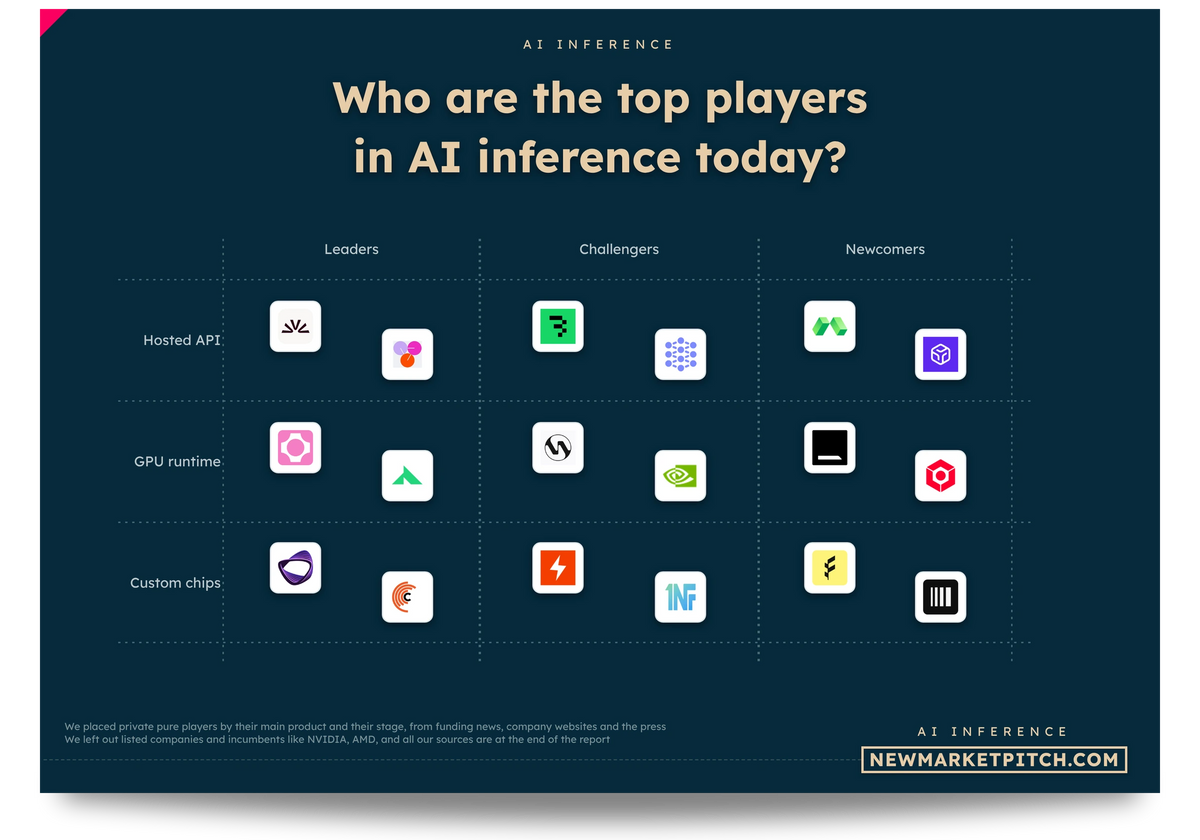
In our report covering the AI inference market, we turn what is vague and complex into simple, useful visuals. Market maps like this one show you at a glance where every startup stands.
The ranking of top startups in the AI inference market by revenue
Below is a table ranking the startups of this market by their current revenue scale. You can find our methodology at the end of this page.
If you want a deeper understanding of the market and its current dynamics, get our report on the AI inference market.
| Ranking | Company | Latest Metric | Metric Type | Freshness | Disclosed When | Source Quality | Confidence | Segment | Why This Ranking | Local Metric | Country |
|---|---|---|---|---|---|---|---|---|---|---|---|
| 1 | Fireworks AI | >$1B | Revenue Run-Rate | Very Fresh · 4mo | Jul 15, 2026 | Company Disclosed | Medium | Managed model inference APIs | Company-disclosed >$1B annualized revenue run-rate in July 2026; current sales pace, not recognized full-year revenue. The disclosure is very fresh. | us | |
| 2 | fal | $800M | Revenue Run-Rate | Very Fresh · 2mo | Sep 25, 2026 | Credible Reported | Medium | Multimodal and media inference services | Annualized revenue run-rate as of Sep 2026 reported by the press. ARR and run-rates annualize current sales; they are not recognized revenue. | us | |
| 3 | Baseten | $600M | Revenue Run-Rate | Fresh · 8mo | May 26, 2026 | Credible Reported | Medium | Enterprise model serving and deployment | Annualized revenue run-rate as of Mar 2026 reported by the press. ARR and run-rates annualize current sales; they are not recognized revenue. Ahead of Cerebras Systems, whose smaller figure is better documented. | us | |
| 4 | Cerebras Systems | $152M | Segment Revenue | Fresh · 11mo | May 4, 2026 | Company Disclosed | Medium | Inference-specialist compute and silicon services | Revenue of one segment for 2025 disclosed by the company. Only the ai inference part of its revenue is ranked; the company also sells outside this market. Ranks below Baseten, whose larger figure is an annualized run-rate. | us | |
| 5 | DeepInfra | >$105M | Revenue Run-Rate | Very Fresh · 2mo | Sep 29, 2026 | Company Disclosed | Medium | Managed model inference APIs | Annualized revenue run-rate as of Sep 2026 disclosed by the company. ARR and run-rates annualize current sales; they are not recognized revenue. | us | |
| 6 | Gimlet Labs | >$10M | Partial-Period Revenue | Period not stated · collected 8mo ago | Period not stated | Company Disclosed | Low | Inference orchestration, scheduling and routing | Revenue for part of a year, period not stated (collected Mar 2026) disclosed by the company. It covers only part of the year or of the business, so it is ranked as a minimum. | us | |
| 7 | Nota AI | ~$9.07M | Fiscal-Year Revenue | Fresh · 11mo | Nov 13, 2026 | Filed / Audited | High | Edge and on-device inference software | Fiscal-year revenue for the year to Dec 2025 from a regulatory filing. | KRW 13.1B | kr |
| 8 | SiliconFlow | ~$7.9M | Annual Revenue | Fresh · 11mo | Sep 22, 2026 | Credible Reported | Medium | Managed model inference APIs | Annual revenue for the year to Dec 2025 reported by the press. | CNY 55.3M | cn |
| NR | Modal | >$1B | Revenue Run-Rate | Very Fresh · 1mo | Oct 14, 2026 | Company Disclosed | Medium | Enterprise model serving and deployment | Annualized revenue run-rate as of Oct 2026 disclosed by the company; the company also sells outside this market and its ai inference share is not published (share not published), so it is shown without a rank. | us | |
| NR | Groq | >$40M | Segment Revenue | Fresh · 11mo | 2026 | Third-Party Estimate | Low | Inference-specialist compute and silicon services | Analyst estimate of revenue of one segment for the year to Dec 2025, not a company figure; a single analyst estimate with no second independent source, so it is shown without a rank. | us | |
| NR | Clarifai | $16.2M | Annual Revenue | Aging · 29mo | Oct 5, 2026 | Third-Party Estimate | Low | Enterprise model serving and deployment | Automated estimate of annual revenue for the year to Jun 2024 from a company-data website, not a company figure; an automated estimate from a company-data website with no second independent source, so it is shown without a rank. | us | |
| NR | Together AI | $1.15B (bookings, not revenue) | Bookings | Very Fresh · 5mo | Jul 1, 2026 | Company Disclosed | Medium | Managed model inference APIs | Bookings as of Jun 2026 disclosed by the company; not revenue, so it is not ranked against revenue figures. | us | |
| NR | GMI Cloud | >$600M (bookings, not revenue) | Bookings | Very Fresh · 1mo | Oct 1, 2026 | Company Disclosed | Medium | Inference-specialist compute and silicon services | Bookings as of Oct 2026 disclosed by the company; the company also sells outside this market and its ai inference share is not published (share not published), so it is shown without a rank. | us | |
| NR | OctoAI | $3M (other measure, not revenue) | Other Financial Metric | Historical · 60mo | Nov 2021 | Credible Reported | Medium | Enterprise model serving and deployment | Other financial metric for the year to Nov 2021 reported by the press; not revenue, so it is not ranked against revenue figures. | us | |
| NR | General Compute | $100M (bookings, not revenue) | Bookings | Very Fresh · 1mo | Oct 27, 2026 | Credible Reported | Medium | Inference-specialist compute and silicon services | Bookings as of Oct 2026 reported by the press; not revenue, so it is not ranked against revenue figures. | us | |
| NR | Replicate | >2M users | Users | Historical · 35mo | Dec 5, 2023 | Credible Reported | Medium | Managed model inference APIs | The press reported >2M users in December 2023, a reach measure rather than revenue. It cannot establish an annual sales figure and has no rank. | us |

Our research about AI inference startups gets updated several times a month, so you always get the latest view of where things stand.
Is AI inference already making real money, or is it still hype?
AI inference startups are already earning substantial sales from customers running models in real products.
Fireworks AI, Modal, fal, Baseten, and DeepInfra have published or reported commercial measures, while developers can point to specific services handling production work.
Training builds the model once, but a voice assistant, coding agent, or image app has to run it every time someone asks for a result. When that app becomes popular, inference becomes an ongoing expense. Many developers would rather buy a service that handles speed, outages, and capacity than operate the hardware themselves.
We can see that work happening. Fireworks AI said in July 2026 that it handled more than 40 trillion tokens daily. Together AI reported hundreds of trillions of monthly tokens in its October work with IBM and NVIDIA. DeepInfra named LiveKit and OpenCode among production customers in September. These companies count usage differently, so we wouldn't compare token totals as if they were sales.
There is still a gap between a fast-growing service and a profitable one. The public numbers seldom show how much GPU capacity costs, how long customers stay, or how much sales are recognized over a full year. Even with those limits, paying demand is firmly established.
The table below shows the different kinds of commercial figures behind that demand.
| Company | Revenue metric | Confidence |
|---|---|---|
| Fireworks AI | Revenue Run-Rate | Medium |
| Modal | Revenue Run-Rate | Medium |
| Together AI | Revenue Run-Rate | Low |
| fal | Revenue Run-Rate | Medium |
| Baseten | Revenue Run-Rate | Medium |
| Cerebras Systems | Segment Revenue | Medium |
| DeepInfra | Revenue Run-Rate | Medium |
Does a $1B AI inference run-rate mean $1B in actual sales?
No, a $1B AI inference run-rate describes how fast a company is selling at a particular point, annualized over twelve months.
It does not mean the business already recognized that much revenue during a completed year.
Fireworks AI made its run-rate announcement in July 2026, while Modal made a similar announcement in October. The reporting dates matter. A company whose customers start spending heavily late in the year can have a very high run-rate and still book a much smaller amount for that year. The current pace can also slow if model prices fall or a large customer leaves.
fal, Baseten, and DeepInfra also appear with run-rates, while Together AI appears with bookings. Cerebras Systems has a different measure: revenue from an inference-related segment across FY2025. SiliconFlow and Nota AI report annual revenue. We keep all of those descriptions attached to the figures rather than calling each one annual sales.
A run-rate helps us see which providers are handling big commercial workloads today. It tells us much less about cash collected, repeat business, or profit. Those questions need completed-period accounts and customer data that private companies rarely publish.

In our market report about AI inference startups, we look at what the winners do differently, so you can learn from the best instead of guessing.
Which is bigger in AI inference, Fireworks AI or Modal?
Fireworks AI holds the top spot on the revenue figures available today, while Modal's >$1B run-rate is company-wide, its AI inference share is not published, and it is shown without a rank.
Both disclose a >$1B revenue run-rate, and neither disclosure proves higher recognized sales than the other.
Fireworks AI is built around model customization and serving. It said in July that more than 95% of its tokens came from models customized for customer data and tasks. Modal's October release covered a wider developer platform: inference, functions, training infrastructure, and isolated sandboxes.
Those are different businesses to buy from. A company might choose Fireworks AI to serve a specialized model with predictable performance. It might choose Modal to run that model and the surrounding jobs on one computing platform. Modal also described revenue from Sandboxes, which means its company-wide number cannot be read as pure model-serving revenue.
The dates are not the main issue. Modal's figure came later, and both are reported as minimums with no exact dollar amount beyond that threshold. Modal's covers its whole company and its inference share is not published, so it is shown without a rank. We cannot say which one made more money over a finished financial year.
Why do companies pay Fireworks AI instead of running models themselves?
Fireworks AI makes money from companies that need customized AI models served quickly and reliably, without building an entire inference team.
The business is especially attractive when a model has to work with a customer's own data, rules, and workloads.
Its July 2026 announcement named enterprise customers including Uber and Shopify. The company said more than 95% of processed tokens came from specialized models. That detail tells us more than a developer-signup count: it points to ongoing work on models that are adapted for actual customers.
A standard model API is easy to compare on price and speed. Customized deployments often have more moving parts, including model weights, security settings, load patterns, and testing. Moving all of that to another provider can take work, although Fireworks AI has not published customer retention data that would let us measure the effect.
Fireworks AI also said its annualized revenue had grown fivefold year over year, alongside a rise in daily token traffic from 15 trillion to more than 40 trillion. The two trends support the commercial story. Neither tells us what the company earns after paying for hardware and power.
Is Modal earning its money from AI inference alone?
No, Modal sells a wider computing platform, with AI inference as an important part of it.
Its company-wide run-rate covers products beyond serving trained models.
The October 2026 announcement included serverless functions, inference endpoints, isolated agent sandboxes, training work, and reinforcement-learning infrastructure. Modal said Sandboxes alone had reached a $300M run-rate. That is a separate disclosure about one product, and there is no published inference-only share of the total.
Its customer examples fit that breadth. DoorDash has used Modal to take work into production. Cognition and Ramp use infrastructure for background agents, while Runway runs video-related workloads. The company also describes operating across more than 20 clouds, so buyers are paying for a managed execution layer rather than only access to a single GPU cluster.
For an AI agent, serving the model may be one step among many. The same task can involve executing code, opening a sandbox, and processing results. Modal wants to host that whole sequence. This makes the business commercially interesting, but it also makes a direct comparison with a pure inference API provider less precise.

In our document detailing everything you need to know about AI inference, you will always find fresh funding data, taken straight from our own verified funding database.
Is Together AI really selling more inference than fal?
Together AI has no revenue rank, and its bookings do not show that it sells more AI inference than fal.
Together AI disclosed $1.15B of bookings as of June 2026, which is not revenue; fal has an $800M press-reported revenue run-rate for September 2026.
The distinction is important. Together AI's number measures bookings, while The Information reported fal's run-rate. Neither is a completed-year audited result, and they describe different dates. Together AI's figure is bigger on paper, but bookings don't prove it actually earned more.
Together AI serves a wide mix of models and enterprise workloads. In October 2026, it described using NVIDIA B300 infrastructure on IBM Cloud and serving hundreds of trillions of tokens monthly. fal concentrates on media generation. Its work with Quora's Poe shows how a provider can become part of the machinery behind an app's image and video features.
The providers also face different costs. Creating a video and generating text involve different hardware time and pricing, even if both are called inference. The figures tell us which businesses claim big yearly sales. They don't tell us which one has better margins or longer contracts.
Why is fal making so much money from AI images and video?
fal has turned AI image, video, and audio generation into a large inference business by making many models available through one service.
Developers can switch between models without building a new serving system for each one.
The company markets more than 1,400 endpoints covering image, video, audio, 3D, and other media workloads. It offers serverless scaling for uneven traffic and dedicated capacity for customers who need predictable performance. A video tool that suddenly goes viral can need a lot of compute on short notice.
The strongest evidence comes from customers. fal says it handles half of Quora's Poe image and video generation. It helped Bria bring models to developers faster, and Bria described tens of millions of generations through the platform during 2026. VEED and Genspark also appear in fal's customer material. Those examples cover consumer traffic, model distribution, and software companies building creative features.
Video generation can be costly to serve, so a busy platform is not automatically a highly profitable one. Still, these use cases explain the sales: developers pay fal because they want the models working inside their products, even when demand changes quickly.

Learning from others' mistakes is the cheapest lesson there is. In our report covering the AI inference market, we look at what broke startups before you, so you don't repeat it.
Is Baseten actually getting paid to run companies’ AI models?
Yes, Baseten is turning production AI model deployment into a significant business.
The Information reported a $600M revenue run-rate for March 2026, and the company's customer cases show what buyers pay it to do.
Baseten said in June that its revenue had grown 20 times in a year while inference volume grew 40 times. Those are company-reported growth rates, not a completed-year sales statement. The gap also reminds us that traffic and money do not necessarily rise at the same speed.
Poolside is a practical example. According to Baseten, bringing its Laguna models into production took seven weeks, including serving improvements, security work, traffic testing, and automated updates. The OpenCode case describes faster responses and lower inference costs. These jobs require engineers, software, and dependable service once the model has launched.
Baseten also introduced a product for model labs that want to offer their own branded APIs without running the entire back end. In other words, customers buy the ability to launch and keep serving a model. The harder test will be whether those customers keep paying as the big cloud providers improve their deployment tools.
Is DeepInfra’s AI inference growth coming from real usage?
DeepInfra has disclosed rising AI inference sales alongside much heavier production traffic.
Its company statement put revenue run-rate at >$105M in September 2026 and said it processed 22 trillion tokens a week.
DeepInfra reported that token volume had more than tripled since May and that annual recurring revenue was almost fourteen times the year-earlier level. Those measures cover different periods, so we cannot turn them into an exact price-per-token trend. But growing sales alongside growing traffic is better evidence than a big customer announcement alone.
LiveKit gives the numbers a practical meaning. Its voice applications need fast first responses and steady token generation, because a conversation becomes awkward when the system pauses. DeepInfra also named OpenCode and Humans& among customers and said it supported more than 200 open models.
Getting beyond $100M of annualized sales shows that developers are spending serious money on the service. It still leaves the harder business questions open: how much revenue is recurring, what customers cost to serve, and how concentrated demand is. DeepInfra's disclosures answer the demand question much better than the profit question.

In our research about AI inference startups, we always try to gather several sources and make estimates that make sense, so you can work with solid numbers.
Do AI inference chip startups make as much money as software providers?
No, the disclosed inference-service figures for chip-focused startups are below the largest software-serving run-rates.
Cerebras Systems reports $152M of FY2025 inference segment revenue, while Groq has a >$40M analyst-estimated FY2025 segment minimum.
Both sell a service that runs models, so they belong in the inference market. Cerebras offers model execution on its wafer-scale systems, with developer pricing and enterprise capacity. Groq built an inference cloud around specialized processors and described a broad data-center footprint during 2026. These offerings go beyond selling a processor to someone else.
The numbers still need care. Cerebras reports a segment of completed-year revenue. Groq's number is an analyst estimate, also for a segment. The largest hosted-service providers report annualized sales at later points. Different scopes and dates make any simple revenue gap less meaningful than it looks.
For custom chips, the commercial test is whether speed and cost advantages lead customers to keep using the service. More data centers and faster benchmark results can help win customers, but neither is the same as revenue. We treat the segment figures as proof of paid business, not a complete verdict on the chip strategies.
Can Cerebras turn faster AI inference into steady sales?
Cerebras Systems can charge for very fast AI inference, but the public numbers do not yet tell us how steady its repeat spending is.
Its $152M of FY2025 segment revenue covers the inference-related business, not all Cerebras sales.
Customers can buy model execution through pay-as-you-go access or enterprise arrangements. In August 2026, Cerebras described serving an OpenAI model at up to 750 output tokens per second in a fast configuration. Speed matters when an assistant speaks, when a coding agent runs many steps, or when people are waiting for a model to finish a task.
Still, a high token speed only helps the business if customers value it enough to pay the price. They may care just as much about uptime, model choice, integration work, and cost per completed task. A faster system with underused capacity can be an expensive one to run.
That is why the completed-year segment figure is useful. It shows customers have paid for the service, whereas a performance test shows what the machine can do. Cerebras has evidence of both. We would need renewal and cost data before judging how profitable that speed is.
How much revenue does Groq make from AI inference?
Groq's best available AI inference revenue figure is a >$40M analyst-estimated FY2025 segment minimum.
It is not a certified company total, despite Groq's huge developer audience.
Groq said in August 2026 that its cloud reached more than six million developers, Fortune 500 businesses, and many AI-native companies. Its announcements also described thirteen data centers and trillions of tokens handled each week. Those are useful measures of adoption and capacity, but a free developer account and a large paying customer do not contribute the same revenue.
This is particularly important for a business that operates specialized hardware. Large facilities must be built and kept busy, while customers can change models and usage patterns quickly. Developer interest does not show how much of the infrastructure is paid for or how much margin remains after operating costs.
Groq's non-exclusive licensing agreement with NVIDIA in December 2025 shows the strategic value of its technology outside its hosted cloud. It does not give us a better inference sales number. For now, the estimate gives a rough scale; paid customer breakdowns and reported segment accounts would tell us much more.

If you build or invest in the AI inference market, you need to know which business models pay off now and which ones are fading. That's why our report covering it has a whole section on it.
Do millions of AI inference developers mean millions of paying customers?
No, the number of developers trying an AI inference service does not tell us how many pay for it.
Groq, Together AI, fal, and Replicate all built large audiences, but developer accounts are different from revenue.
Groq's August 2026 announcement described more than six million developers. Together AI said in October that over a million developers used its platform. fal also markets a large developer community. Replicate, which Cloudflare bought in December 2025, had >2M users in December 2023 according to Forbes. Replicate therefore remains unranked on revenue: that figure measures people, not sales.
For a startup, a free experiment can be valuable if it later becomes a production application. But the same account count could include hobby projects, trials, and businesses with different monthly bills. Paying enterprises may also arrive through private contracts rather than self-service signups.
We put more weight on evidence of work continuing in a real product. fal supports Poe's media features; Baseten runs model deployments; DeepInfra serves LiveKit. Those examples show real money being spent, even though each customer's bill stays private. OctoAI, acquired by NVIDIA in 2024, also has no qualifying recent revenue figure, so we make no sales comparison from its older reported metric.
Can AI inference startups count bookings as revenue?
AI inference bookings and contracted capacity are commitments, so startups cannot count them as revenue already earned.
GMI Cloud and General Compute report significant contracts but do not get a revenue rank from them.
GMI Cloud disclosed >$600M of bookings tied to contracted ARR in October 2026. It also sells services outside the inference market, and it did not publish the inference-only share. TechCrunch reported $100M of contracted ARR for General Compute in October 2026. Both figures show demand from customers committing to capacity. Neither is a completed period of earned sales.
Compute agreements can cover future delivery, reserved infrastructure, milestones, and changing usage. A customer can sign a big contract before all the machines are deployed or before the whole agreement is billed. The provider must still deliver what was promised.
We can compare the commercial strategies of those companies with model-serving startups. What we cannot do is use a bookings number as if it were annual revenue. That would make a provider with future commitments appear directly comparable with one that has already delivered the service.

In our document detailing everything you need to know about AI inference, we like to show you the big picture. We know your time is precious, so we make every page quick to read and packed with as much learning as possible per minute.
What are businesses actually buying from AI inference startups?
Companies buy AI inference services to make models work reliably in production without operating every part of the system themselves.
The products range from simple APIs to managed deployments and software that makes different chips work together.
fal sells the ability to generate media inside an application. Fireworks AI and DeepInfra run customized and open models behind production APIs. Baseten handles deployments and model updates. Gimlet Labs focuses on scheduling jobs across different processors, so customers can use their available hardware more efficiently. These providers solve related problems, but buyers pay for different things.
A real-time voice app cares about low delay. A creative app wants to handle unpredictable peaks in demand. An enterprise buying dedicated hosting may care most about control, security, and stable performance. TechCrunch reported in March 2026 that Gimlet Labs was already working with a major model developer and a large cloud operator, though it did not name them. Gimlet disclosed >$10M of partial-period revenue, with the earning period unspecified.
NVIDIA's Triton documentation describes techniques such as combining requests into batches to improve throughput. Those techniques are widely available. A specialist still has to make them valuable for a particular workload, then keep the service dependable enough that customers pay for it.
The table below shows how the revenue measures differ across these products.
| Company | Country | Revenue metric |
|---|---|---|
| Fireworks AI | US | Revenue Run-Rate |
| Together AI | US | Revenue Run-Rate |
| fal | US | Revenue Run-Rate |
| Cerebras Systems | US | Segment Revenue |
| Gimlet Labs | US | Annual Revenue |
| SiliconFlow | CN | Annual Revenue |
| Nota AI | KR | Annual Revenue |
Are American startups the only ones earning AI inference revenue?
No, American startups have the largest disclosed AI inference run-rates, but companies in China and South Korea also report sales from model execution and optimization.
SiliconFlow and Nota AI provide two quite different examples.
Caixin reported ~$7.9M of 2025 annual revenue for China's SiliconFlow, from an original amount of CNY 55.3M. It also reported 650% revenue growth, alongside continuing losses. That makes it a useful example of genuine customer demand in a market where independent companies compete with very large cloud providers.
South Korea's Nota AI filed ~$9.07M of 2025 fiscal-year revenue from edge AI and model optimization. Its NetsPresso tools help businesses run models on devices where memory, power, or a network connection can be limited. The customer is buying a different service from one that charges per token in a remote data center.
We should avoid reading a country-wide market share into these startup figures. Established Chinese technology groups and US hyperscalers sell inference too, but they do not belong to this ranking. What the figures prove is that paid inference work extends outside the US, using more than one kind of business model.

When you build or invest in the AI inference market, you need clarity, not confusion. In our report covering the AI inference market, we always try to put numbers on and quantify whatever is usually vague and confusing.
Is SiliconFlow making real money from AI inference in China?
SiliconFlow is earning revenue from model inference in China, although the company is still loss-making.
Caixin reported annual revenue for 2025 of ~$7.9M, or CNY 55.3M in the original currency.
The reported 650% growth from the prior year shows genuine momentum, but the company faces a difficult field. China's large cloud and internet businesses already offer model execution at scale, while smaller developers often look for low prices and a wide choice of models. SiliconFlow has to win on performance, flexibility, or developer experience as well as price.
Traffic can rise quickly without sales rising at the same pace. A model request may be tiny or expensive, sold at a discount, or processed under an enterprise agreement. Caixin's account described strong activity but also substantial losses, so we cannot equate model usage with healthy earnings.
The interesting part of SiliconFlow's story is that an independent provider can attract paying customers alongside huge incumbents. The available evidence supports that conclusion. It gives us no reason to claim that SiliconFlow has already reached the margins or commercial scale of the largest US providers.
Can AI inference startups earn money without running cloud servers?
Yes, AI inference startups can make money by helping models run directly on devices rather than selling remote API calls.
Nota AI's ~$9.07M of filed 2025 fiscal-year revenue shows that edge optimization already has paying customers.
Nota AI builds NetsPresso software to adapt models for hardware with limits on memory, processing power, and energy. It also builds tools for generative AI that runs on devices. The business problem is easy to understand: a manufacturer may want a model to respond quickly, use little battery power, or work when the network is unavailable.
That customer might pay for software, engineering work, or an enterprise deployment instead of being charged per token. We would not compare the number of edge devices with a cloud provider's token traffic, because the billing models are completely different.
Nota AI listed on KOSDAQ in November 2025, as its year-end review recalls. The company is a concrete example of inference sales happening off the network. It doesn't prove edge optimization is bigger than cloud serving, and it doesn't need to in order to show a viable business.
Can inference startups really compete with AWS, Google, and NVIDIA?
Specialist AI inference startups are winning production work despite competition from AWS, Google, and NVIDIA.
They usually win by solving a narrower problem better or by saving a customer the work of operating the service.
AWS sells managed inference through Bedrock, with controls for latency and costs. Google Cloud provides model hosting and a large range of infrastructure options. NVIDIA's Triton software already handles useful serving tasks such as batching requests. These companies have big advantages in hardware access, distribution, and engineering teams.
The startups have chosen more specific jobs. Fireworks AI serves customized models. fal specializes in media generation. Baseten manages model launches for enterprise teams and model makers. Gimlet Labs works on distributing inference jobs across different hardware. Together AI's October partnership with IBM and NVIDIA is another route: a specialist can buy infrastructure from a giant while still selling its own serving product to developers.
We cannot measure how many customers switch from a hyperscaler or how long the startups keep them, because those numbers are not public. But the customer projects already underway show that the big platforms have not captured every workload. Specialists still need to prove their edge lasts as the giants get better.

A good product starts with a real problem. In our research about AI inference startups, we show you the ones customers still live with.
Will cheaper AI inference hurt the startups selling it?
Lower AI inference prices can hurt startups that sell undifferentiated model calls, while helping providers whose services become more useful as usage grows.
The outcome depends on whether higher volume and better efficiency compensate for lower prices.
Take three workloads. A voice assistant needs fast responses. A video generator needs complete clips within a reasonable time. A coding agent needs to finish tasks without repeated failures. Customers may pay more for reliable outcomes even when the cheapest published token price falls. AWS has explained how caching, service tiers, and reasoning settings change inference bills beyond the headline price per token.
The company disclosures show both sides. DeepInfra reported higher annualized sales alongside more token traffic. Baseten said its inference volume grew faster than revenue over the previous year. NVIDIA's serving documentation shows how batching can cut the cost of processing requests. These facts explain why a busy service may become cheaper to operate without automatically earning more on every request.
The hardest position is selling capacity that customers can replace in a few clicks. A provider that improves a customer's finished product has a better reason to keep getting paid, even as the basic compute becomes cheaper.
So, which AI inference startups are making the most money today?
Fireworks AI holds the top disclosed AI inference startup revenue position today.
Their figures describe annualized run-rates, and we cannot name a single winner in recognized full-year revenue from them.
fal comes next on a press-reported run-rate, with Baseten following on another press-reported figure. These services handle different workloads, from open and customized language models to media generation and enterprise deployment. These figures prove that customers are paying, even if they aren't all measured the same way.
Cerebras Systems and Groq give us evidence of commercial inference on specialized hardware. DeepInfra has paired its sales disclosure with production traffic and named customers. Smaller businesses such as Gimlet Labs, SiliconFlow, and Nota AI show other ways to sell model execution. Clarifai has a $16.2M automated annual revenue estimate for the year ended June 2024, which is less certain and older than a recent company disclosure.
GMI Cloud, General Compute and Together AI have no revenue rank because their reported figures are bookings. Replicate and OctoAI also lack qualifying revenue measures, even though larger companies have bought them. We would rather leave those positions unfilled than turn users or commitments into sales.
The table below shows what we found.
| Question | Answer |
|---|---|
| Is there one undisputed top seller? | Fireworks AI ranks first on reported run-rate rather than recognized sales. It reported >$1B, and Modal also reported >$1B but is shown without a rank. Neither figure is a completed fiscal-year total. |
| Can annualized sales be called earned revenue? | No, a run-rate measures a current selling pace. Modal said its Sandboxes product had a $300M run-rate. That is different from a completed fiscal-year total. |
| Are Together AI's commercial claims company-certified? | No, its reported figure is bookings rather than revenue. Together AI disclosed $1.15B of bookings and is shown without a rank. Bookings carry less certainty than recognized revenue. |
| Are AI images and video driving sales? | Yes, fal serves real media-generation products at scale. Its Sep 2026 press-reported revenue run-rate was $800M. These workloads bring inference spending well beyond text chatbots. |
| Can managed model deployment become a business? | Yes, Baseten handles live model launches and operations. Its Mar 2026 press-reported revenue run-rate was $600M. Customers are paying to avoid running everything themselves. |
| Do custom chips generate paid model execution? | Yes, Cerebras sells inference on its specialized systems. Its disclosed FY2025 inference segment revenue was $152M. That figure captures a narrower business than company-wide sales. |
| Does production traffic support rising inference sales? | Yes, DeepInfra has disclosed both growing usage and sales. Its reported Sep 2026 revenue run-rate was >$105M. The figures support demand without revealing margins or retention. |
| Are Groq's developer accounts paying accounts? | Not necessarily, because signups include different kinds of users. Groq reported more than six million developers in Aug 2026. That total cannot establish the number of paying customers. |
| Are giant cloud contracts the same as sales? | No, future cloud capacity commitments count as bookings. General Compute reported $100M of contracted ARR in Oct 2026. It therefore has no revenue rank from that disclosure. |
| Does China have independent inference businesses? | Yes, SiliconFlow reported paying model-serving activity in China. Its 2025 annual revenue was ~$7.9M in Caixin's account. Strong sales growth still came alongside reported losses. |
| Can inference software sell without cloud tokens? | Yes, Nota AI sells tools for running models on devices. Its disclosed fiscal-year revenue in 2025 was ~$9.07M. Those sales come from a different billing model. |

In our market report about AI inference startups, we try to remove everything that could confuse you, especially if you're investing or building in this market.
Our methodology
Our data runs through November 12, 2026. We define AI inference as production execution of trained models for external customers and the software that makes that execution efficient, including managed APIs, deployment platforms, runtimes, on-device optimization, and specialized serving hardware offered as a commercial service. We include genuine boundary cases when execution is a central product, rather than omitting them by default. Every ranked business qualifies as a startup under our fixed definition: founded in 2000 or later, innovation-led, funded by founders or outside backers, and still private or listed within the last five years. Established technology groups are excluded even when their inference sales are larger.
We reviewed company announcements, investor material, annual reports, regulatory filings, and reputable news reporting across company histories, including the last ten years. Financial disclosures use different measures, so we retain their original meaning. Annual revenue, ARR, annualized run-rates, segment revenue, and partial-period revenue are not silently converted into one another. Bookings, contracted capacity, GMV, forecasts, developer totals, and other operating statistics are never treated as revenue, and we do not derive revenue from token prices or user counts.
We select one figure for each company, prioritizing figures from the most recent eighteen months, then stronger sources in this order: filings or direct company disclosures, credible press, analyst estimates, and automated company-data estimates. Where evidence is otherwise comparable, completed-year revenue takes priority over ARR or run-rate, followed by partial or segment figures treated as minimums. Companies are placed according to the selected figure; a range uses its midpoint and a minimum its lower bound. Figures more than three years old and figures that do not measure revenue are shown without a rank.
We display freshness as Very Fresh, Fresh, Aging, or Historical based on elapsed months since the reported period, and distinguish confidence from apparent size. High means recent exact full-year revenue sourced to a filing or company. Medium covers ARR, run-rates, partial periods, press figures, minimums, and figures eighteen to thirty months old. Low applies to estimates, wide ranges, or older observations. Non-dollar currencies are converted at fixed exchange rates with the original amount retained, and a large automated estimate is not ranked without corroboration from a second source.
A fair objection is that a large estimated run-rate can appear above a smaller, more reliable annual sales number. We retain the disclosed ordering because selecting only completed fiscal-year reports would exclude much of a fast-growing private market and falsely imply that undisclosed companies make nothing. The metric and confidence labels show exactly what supports each position; the positions are not claims of equivalent accounting quality. When a business also sells outside inference, a disclosed inference segment is preferable, and companies with only unrelated group-wide commitments or usage totals remain unranked.
This is a historical comparison of each company's available commercial evidence to date, not an estimate of all sales earned by the AI inference industry. A change in model mix, acquisition, accounting period, or commercial scope can make two legitimate disclosures incomparable. The appropriate reading is the best evidenced current scale for each eligible startup, with explicit boundaries around what it proves.
Key sources include Fireworks AI July 2026 annualized sales and specialized-model traffic, Fireworks AI enterprise customers, run-rate growth and daily token volume, Modal October 2026 company run-rate, customer examples, and Sandboxes scope, Together AI enterprise GPU partnership and reported token volume, Reported fal revenue run-rate and inference demand, fal production customers and deployments, Reported Baseten revenue run-rate, Baseten company-reported growth in sales and inference volume, Baseten platform for model creators and commercial deployments, Baseten production launch of Poolside's Laguna models, DeepInfra run-rate, token processing, and customer names, Cerebras Systems company disclosure for FY2025 segment revenue, Cerebras production inference pricing and service offerings, Cerebras serving an OpenAI model at up to 750 tokens per second, Groq datacenter footprint and developer adoption, Groq non-exclusive inference technology licensing agreement with NVIDIA, Gimlet Labs company revenue minimum and heterogeneous orchestration, SiliconFlow annual revenue and Chinese model-serving market, Nota AI annual revenue and on-device business, GMI Cloud bookings and infrastructure scope, General Compute contracted ARR rather than earned revenue, Cloudflare acquisition of Replicate, Clarifai compute orchestration product and deployment models, NVIDIA dynamic batching and serving efficiency, AWS documentation of inference price and workload cost drivers, Amazon Bedrock low-latency inference service capabilities, and Modal commercial growth and wide compute product scope.
In our document detailing everything you need to know about AI inference, we turn what is vague and complex into simple, useful visuals. Market maps like this one show you at a glance where every startup stands.
Written by the New Market Pitch teamWe track new markets so founders and investors can move faster. About us