Is the AI materials discovery market big or still in labs?
Whether you're building or investing in the AI materials discovery market, our report covers everything you need to know: the players, the money, and what's coming next.
Summary
The AI materials discovery market is already a real commercial business, but much of its most ambitious technology is still in laboratories. Industrial customers are beginning to adopt AI discovery platforms, while the revenue generated by specialist startups remains far smaller than their funding and valuations suggest.
Grand View Research estimates the broad market at $968.4 million in 2026, up from $741.3 million in 2025. Software accounted for approximately $408 million of the 2025 market, but even that figure includes established modeling tools and applications beyond industrial materials discovery.
Investment is running ahead of measurable commercial demand. CuspAI raised $450 million at a reported $2.6 billion valuation in July 2026, while Orbital Industries raised $50 million in May. Those two rounds alone represent more than half the estimated annual market size for 2026.
The scientific achievements are enormous, but their commercial meaning is often exaggerated. Google DeepMind predicted 2.2 million crystal structures, yet only 736 had been independently synthesized when its research appeared. Microsoft's screening of 32 million battery-material candidates ultimately produced one experimental prototype.
Physical validation remains a difficult hurdle. Berkeley's autonomous A-Lab demonstrated automated synthesis, but a subsequent correction clarified its novelty claims and left some compound identifications inconclusive. Finding a promising structure is much easier than proving it can become a useful industrial material.
The clearest commercial traction comes from improving existing industrial research workflows. BASF ECMS licensed Orbital's catalyst discovery platform, while Perstorp deployed Citrine Informatics to optimize specialty chemical formulations. These are identifiable industrial customers, although the financial values of their arrangements remain undisclosed.
Formulation optimization may become a bigger business sooner than revolutionary materials discovery. Manufacturers can use the same AI platform repeatedly to improve coatings, catalysts, polymers and other products without changing their factories or waiting years for a fundamentally new material to qualify.
Manufacturing is the industry's main bottleneck. Battery materials need durability and safety testing, semiconductor materials must meet demanding process requirements, and new magnets have to compete on performance and production costs. Faster discovery does not eliminate those constraints.
The market is also dividing into different business models. Software vendors can commercialize research tools without owning production facilities, while companies developing proprietary physical materials may capture greater value but face much longer and more expensive commercialization cycles.
Google, Microsoft and NVIDIA are making advanced scientific AI more accessible, increasing pressure on basic discovery tools. Specialist companies are more likely to defend their position through proprietary industrial data, laboratory integration and relationships with manufacturers.
Grand View Research forecasts a $6.39 billion market by 2033, but that requires industrial adoption far beyond what public customer disclosures currently demonstrate. The decisive evidence will be repeat contracts, meaningful software revenue and AI-discovered materials entering commercial production. Until then, the market's scientific potential is much larger than its proven business.

Written by the New Market Pitch teamWe track new markets so founders and investors can move faster. About us
Why is AI materials discovery suddenly attracting so much money?
AI materials discovery is attracting hundreds of millions of dollars because investors now believe the technology could become useful across major industries, from semiconductors to chemicals and data centers. Commercial evidence is starting to catch up with the scientific breakthroughs, although the gap remains large.
Google DeepMind helped bring attention to the field in 2023 when its GNoME model predicted 2.2 million crystal structures, including 380,000 particularly stable candidates. Microsoft and Pacific Northwest National Laboratory subsequently used AI to narrow more than 32 million possible battery materials to just 18 promising candidates.
Those were primarily research achievements. The more recent change is happening on the business side.
CuspAI raised $450 million in July 2026 at a reported $2.6 billion valuation, bringing its disclosed funding above $650 million. Its AI Materials Foundry now brings together more than 45 organizations, including NVIDIA, Meta, Samsung, Hyundai and Lam Research. Orbital Industries also raised $50 million in May 2026 to expand its AI-based materials and industrial hardware business.
Together, those two financing rounds brought in $500 million within roughly two months. For comparison, Grand View Research estimates the entire global AI materials discovery market generated $741.3 million in 2025, although that figure uses a much broader definition than startup software revenue.
Investors are betting on an industry several times larger than the one we can currently measure.
How big is the AI materials discovery market today?
The global AI materials discovery market is approaching $1 billion in annual revenue according to industry estimates, but the market for specialized AI discovery software is considerably smaller.
Grand View Research values the broad market at $741.3 million in 2025 and estimates $968.4 million in 2026, with a forecast of $6.39 billion by 2033. Its definition includes software, computing hardware, laboratory infrastructure and professional services used in materials research.
That distinction changes the answer substantially.
Software represented about 55% of the market in 2025. Applying that share to the reported total gives approximately $408 million in software revenue. Even this narrower number includes established computational modeling and materials informatics products alongside newer AI-native platforms.
The report also includes pharmaceutical and biotechnology research, which accounted for more than 30% of the market. Those activities overlap with drug discovery and can make industrial materials discovery appear larger than it really is.
We cannot reliably calculate the revenue generated specifically by independent AI-native materials discovery startups because most do not publish their sales.
The available figures are useful for understanding the scale, provided we keep their definitions separate.
| Market measure | Amount | What it represents |
|---|---|---|
| Broad market, 2025 | $741.3M | Industry estimate |
| Broad market, 2026 | $968.4M | Industry estimate |
| Software share, 2025 | 55% | Software and modeling tools |
| Implied software market, 2025 | ~$408M | Calculated from reported figures |
| Chemicals segment, 2025 | ~$222M | 30% of the broad market |
| Pharmaceutical and biotech share | >30% | Includes adjacent research |
| Broad market forecast, 2033 | $6.39B | Projected annual revenue |
| AI-native specialist revenue | Undisclosed | No reliable consolidated figure |
The categories overlap and cannot be added together.
If you want more recent data on this point, please see our latest AI materials discovery market report.

Your time is limited. In our report covering the AI materials discovery market, we put numbers on each part of the market, so you can see where it makes sense to focus.
Are AI companies really discovering millions of new materials?
AI materials discovery systems can identify millions of promising structures, but the number of experimentally verified materials is still tiny by comparison.
Google DeepMind's GNoME model predicted 2.2 million crystal structures, including 380,000 candidates judged particularly stable. When DeepMind published the results in November 2023, it identified 736 structures that other researchers had independently produced experimentally.
Those 736 structures amounted to approximately 0.19% of the 380,000 most stable predictions. That percentage is not a failure rate, since researchers had never attempted to manufacture every candidate. It does show how far computational discovery is from comprehensive physical validation.
Microsoft's battery research provides another example. Researchers began with more than 32 million possible material combinations, reduced them to 18 promising candidates and eventually produced an experimental battery using one of the selected materials.
The reduction from millions of possibilities to a handful of experiments is extremely valuable. Traditional materials research often requires expensive trial-and-error work, and AI can eliminate unsuitable candidates before they reach the laboratory.
However, a predicted stable crystal may have no useful industrial properties, or it may be too expensive to manufacture.
The impressive discovery numbers are best understood as measures of research capability. They tell us surprisingly little about commercial output.
Can AI materials discovery actually produce new materials in the real world?
AI materials discovery has already produced physical materials in laboratories, but some of its most prominent experimental claims have needed correction.
Lawrence Berkeley National Laboratory's autonomous A-Lab initially reported synthesizing 41 of 58 targeted compounds during 17 days of experiments. Its system combined AI planning, robotics and automated analysis to conduct experiments with limited human intervention.
The project attracted criticism over whether the materials were genuinely new and whether the system had correctly identified its experimental products.
Nature published an author correction in January 2026. The researchers clarified that some materials described as new were new to their prediction platform rather than new to science. A manual review confirmed 36 of 40 reported successful identifications, leaving four inconclusive.
That correction changes how we should interpret the original demonstration. Automated materials synthesis is possible, but accurately identifying the resulting compounds remains a serious technical challenge.
Other projects have shown physical results through different approaches.
Microsoft and PNNL produced a working battery prototype using an AI-selected electrolyte material. Materials Nexus synthesized its rare-earth-free MagNEx magnet with researchers at the University of Sheffield and the Henry Royce Institute.
The scientific progress is credible. What we still need to see is whether these materials can consistently outperform established alternatives under industrial conditions.
If you want more recent data on this point, please see our latest AI materials discovery market report.

In our research about AI for materials discovery, we always try to gather several sources and make estimates that make sense, so you can work with solid numbers.
Which AI-discovered materials are closest to becoming real products?
AI-discovered materials are closest to commercialization in catalysts, cooling systems and specialty chemical formulations, where companies can test improvements against specific industrial requirements.
Orbital Industries offers one of the clearest examples. After developing AI-designed materials for applications including cooling and carbon removal, the company announced a licensing agreement with BASF Environmental Catalyst and Metal Solutions in August 2026.
BASF ECMS is using Orbital's CurieOS platform to support catalyst discovery for automotive emissions applications. This is a meaningful commercial milestone because an established industrial manufacturer is adopting specialized AI technology for its own materials research.
Orbital has also developed a PFAS-free cooling material for its data center business, although publicly available information does not yet establish large-scale production volumes.
CuspAI is taking a different route. Its AI Materials Foundry connects AI researchers with industrial partners including Applied Materials, Hyundai, Lam Research and Johnson Matthey. The company's near-term research is particularly focused on semiconductor materials, where improvements in fabrication processes can create substantial value.
Materials Nexus has demonstrated the synthesis of MagNEx, a rare-earth-free magnetic material, but still faces the challenge of bringing such materials into commercially competitive production.
Specialty chemicals may offer an easier starting point. Companies can use AI to improve existing formulations without inventing a fundamentally new material or rebuilding manufacturing infrastructure.
The commercial progress varies substantially between projects.
| Company or project | Materials focus | Latest relevant milestone | Commercial stage |
|---|---|---|---|
| Orbital Industries | Catalysts and cooling | BASF licensing agreement | Industrial platform deployment |
| Citrine Informatics | Specialty chemical formulations | Perstorp deployment | Commercial R&D software |
| CuspAI | Semiconductors and advanced materials | AI Materials Foundry launched | Industrial partnerships |
| Materials Nexus | Rare-earth-free magnets | MagNEx synthesized and tested | Pre-scale development |
| Microsoft–PNNL | Battery materials | Working experimental prototype | Laboratory validation |
| Berkeley A-Lab | Inorganic compounds | Autonomous synthesis experiments | Research demonstration |
| Google DeepMind GNoME | Crystal structures | Large predicted materials dataset | Research infrastructure |
Are industrial companies actually paying for AI materials discovery?
Industrial companies are buying or deploying AI materials discovery technology, but disclosed customer revenue remains surprisingly scarce.
Orbital's agreement with BASF ECMS is one of the strongest recent examples. BASF agreed to license CurieOS for catalyst research, turning Orbital's technology into an industrial product with an identifiable customer. Neither party disclosed the agreement's financial value.
Citrine Informatics provides another example of commercial adoption. In April 2026, specialty chemicals manufacturer Perstorp announced that it was deploying Citrine's platform to develop alkyd emulsions.
Perstorp's researchers use the system to examine thousands of formulation possibilities and identify promising combinations more quickly. The objective is to reduce experiments, material consumption and development costs while responding faster to customer requirements.
Perstorp is using AI within an established industrial workflow. The company already manufactures specialty chemicals and has clear reasons to improve formulation efficiency.
CuspAI's partner network shows strong industrial interest, although collaborations do not necessarily translate into paying subscriptions. Some may involve shared research, laboratory access or joint development.
We found credible examples of enterprise adoption, especially in chemicals and catalysts. However, the public disclosures do not establish how much customers are spending or whether those contracts are recurring.
That remains one of the biggest missing pieces in the market-size debate.

In our market report about AI for materials discovery, we don't want to repeat what boring consulting reports say. Instead, we show you the real and latest market signals that matter.
Can AI really cut years from materials development?
AI can shorten the early stages of materials discovery dramatically, but there is much less evidence that it reduces the entire journey from laboratory research to industrial production by the same amount.
Microsoft and PNNL reduced more than 32 million computational candidates to 18 before concentrating on experimental validation. Researchers then produced a working battery prototype in less than nine months after receiving the computational shortlist.
Materials Nexus reported developing and testing its MagNEx magnet in approximately three months. The company described its discovery approach as around 200 times faster than conventional methods.
These are impressive results, although the comparisons concern specific research activities and are not standardized across projects.
The problem appears later in the development process.
A battery material still needs cycling, safety and reliability testing. A semiconductor material must satisfy extremely strict manufacturing requirements. A new magnet needs competitive performance, durability, cost and a reliable production process.
Those requirements do not disappear when the initial discovery takes days instead of months.
The strongest case for AI today is faster screening and experimentation. We have good evidence for that. Claims about equally dramatic reductions in total commercialization time are much harder to support.
If you want more recent data on this point, please see our latest AI materials discovery market report.
Why are AI-discovered materials still struggling to reach factories?
AI-discovered materials frequently struggle to reach factories because manufacturing and qualification are often harder than finding the initial compound.
Consider battery chemistry. A material can perform well in a small laboratory cell and still fail after hundreds of charge cycles, require impractical processing conditions or introduce safety problems.
Semiconductor materials face another set of constraints. Even a promising improvement in electrical or thermal properties can become commercially useless if it creates contamination, reduces production yield or requires expensive changes to fabrication equipment.
Magnets illustrate the same problem. Materials Nexus has demonstrated a rare-earth-free alternative, but replacing established rare-earth magnets involves manufacturing economics, magnetic performance, temperature stability and supply-chain reliability.
These problems explain why AI materials discovery startups often need access to physical laboratories and industrial partners rather than simply more computing power.
They also create a difficult business decision. Companies can focus on selling research software and leave industrial qualification to customers, or pursue the development of physical products themselves.
The second approach offers potentially greater financial rewards, but it introduces manufacturing costs, longer development cycles and much larger capital requirements.

In our document detailing everything you need to know about AI materials discovery, we like to show you the big picture. We know your time is precious, so we make every page quick to read and packed with as much learning as possible per minute.
Is AI materials discovery going to become a software business?
AI materials discovery is already becoming a software business, although some of the best-funded companies are trying to capture more value by developing physical materials and industrial products themselves.
Citrine Informatics illustrates the software model. Manufacturers use its platform to analyze experimental data, predict properties and improve formulations. Citrine can sell research technology without owning the factories that make the finished products.
Orbital Industries combines software with physical products. Its CurieOS platform can be licensed to outside manufacturers, while its industrial operations develop materials and hardware for data centers.
CuspAI is building a platform connected to computing infrastructure, laboratories and major industrial partners. Its AI Materials Foundry could support licensing, collaborative research and other forms of commercial development, although its future revenue breakdown remains undisclosed.
Materials Nexus is more directly focused on developing new materials that can eventually be manufactured and sold.
The differences are significant for investors.
A software company can potentially add customers without building new manufacturing facilities. A company developing physical materials may ultimately capture greater value from successful discoveries, but it must also deal with production economics, qualification and supply chains.
Right now, software is the easier business to commercialize. The biggest potential financial rewards may sit further downstream, especially for companies that develop materials manufacturers cannot easily reproduce.
Could AI materials discovery become big without inventing revolutionary materials?
AI materials discovery could build a substantial business simply by helping manufacturers improve materials they already use. This may actually be its most reliable commercial opportunity.
Many industrial research projects involve adjusting existing formulations rather than inventing something completely new.
A coatings manufacturer might want greater durability without increasing costs. A chemical producer might need a formulation that meets new environmental requirements. A semiconductor supplier might be searching for materials that improve production yields.
AI can help these companies test combinations computationally, select promising candidates and reduce the number of physical experiments.
Perstorp's collaboration with Citrine is a concrete example. Its researchers are using predictive formulation tools to develop alkyd emulsions, with the aim of finding suitable compositions faster and reducing laboratory work.
Orbital's catalyst platform addresses a related opportunity. Automotive emissions catalysts must balance performance, durability and the use of expensive materials. Improvements in those properties can have measurable commercial value.
These applications have an advantage over speculative scientific breakthroughs: customers already know what problem they need to solve.
Chemical formulations, industrial catalysts, polymers and semiconductor materials offer repeated opportunities for optimization. A manufacturer can keep using the same discovery platform across different products and research programs.
That recurring demand could support a meaningful software market even if relatively few completely new materials reach industrial production.
If you want more recent data on this point, please see our latest AI materials discovery market report.

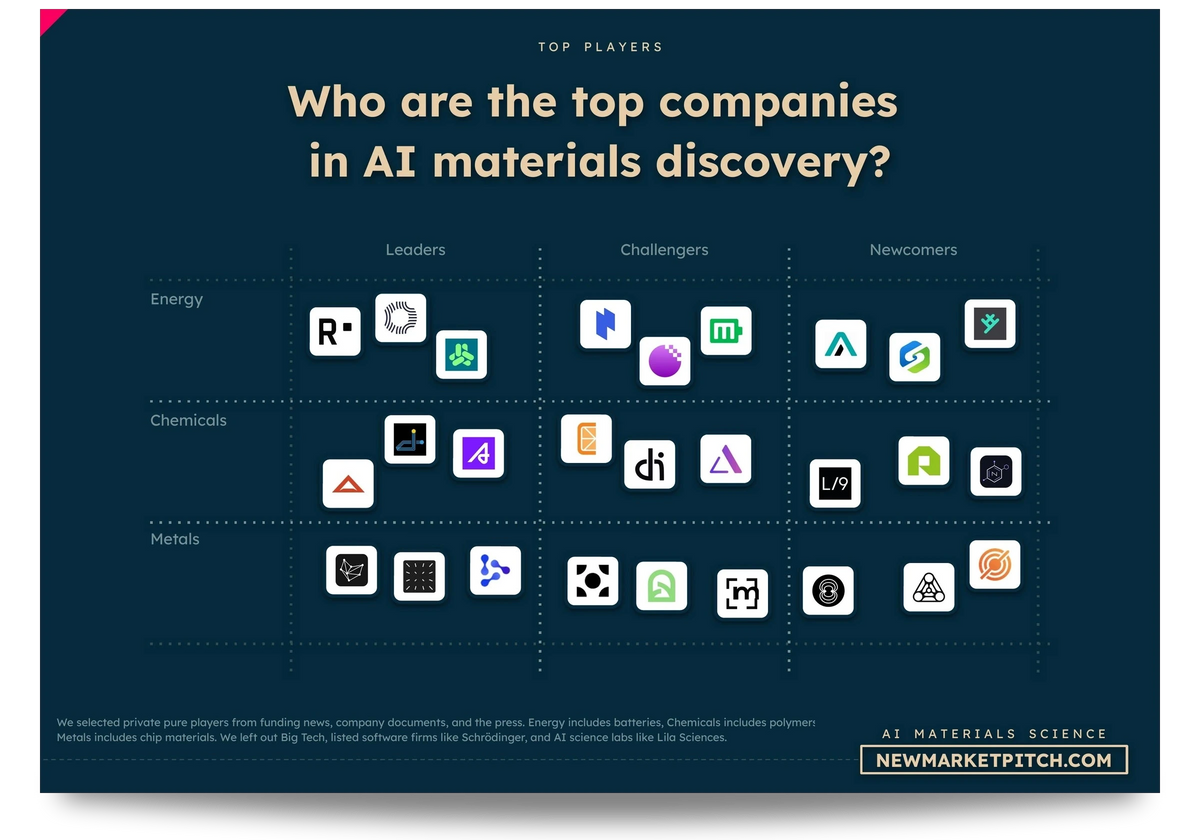
In our report covering the AI materials discovery market, we turn what is vague and complex into simple, useful visuals. Market maps like this one show you at a glance where every startup stands.
Will Google, Microsoft and NVIDIA take over AI materials discovery?
Google, Microsoft and NVIDIA are becoming important technology providers for AI materials discovery, but specialist companies still have advantages in industrial data, laboratory integration and customer relationships.
Google DeepMind's GNoME project made hundreds of thousands of predicted stable structures available to researchers. Microsoft's Azure Quantum Elements provides tools for scientific computing and materials research. NVIDIA supplies computing technology used across scientific AI and participates in CuspAI's materials ecosystem.
These developments make advanced modeling capabilities more accessible and put pressure on startups whose main product is simply generating or screening candidate materials.
An industrial discovery system needs much more than a model trained on public scientific data, however.
A specialty chemicals manufacturer may hold decades of proprietary experimental results. Semiconductor companies have process information tied to specific production equipment. Catalyst developers need laboratory measurements under realistic operating conditions.
Those datasets are commercially valuable because they describe how materials behave in the environments customers actually care about.
Citrine's work with Perstorp shows why specialized software can remain useful even as general-purpose AI models improve. The platform is being applied to a narrowly defined formulation problem using industrial knowledge and experimental requirements.
Competition around foundational models will increase. Specialist vendors will have to defend their position through proprietary data, physical validation and integration into customers' research processes.
Are AI materials discovery startups getting overvalued?
Some AI materials discovery valuations look aggressive compared with the revenue currently visible in the market, particularly for startups whose products are still being tested with industrial partners.
CuspAI's reported $2.6 billion valuation after its July 2026 funding round offers a useful example.
That is approximately 3.5 times the $741.3 million estimated annual revenue of the entire broad AI materials discovery market in 2025. The comparison involves valuation and revenue, which measure different things, but it shows how much future market expansion investors are expecting.
CuspAI's valuation also rose sharply from the approximately $520 million reported around its previous financing in September 2025. That represents roughly a fivefold increase in less than a year.
The company has attracted important industrial partners, assembled a large research network and secured substantial funding. However, it has not publicly disclosed a revenue base that would allow us to assess its valuation against sales or margins.
Orbital's $50 million financing adds to the broader pattern, although the company is pursuing physical products and industrial infrastructure alongside discovery software.
CuspAI's more than $650 million in disclosed funding is also close to the entire $741.3 million broad market estimate for 2025. One startup's cumulative financing is approaching the estimated annual sales of a sector that includes established technology providers.
That does not automatically make the valuation unreasonable. Investors are pricing in a future where AI materials discovery serves a far larger share of industrial research and potentially creates valuable proprietary materials.
Still, the gap between investment and verified customer revenue is unusually wide. We would need much stronger evidence of commercial spending to treat today's largest valuations as supported by existing market demand.
If you want more recent data on this point, please see our latest AI materials discovery market report.

Our research about AI for materials discovery gets updated several times a month, so you always get the latest view of where things stand.
Can the AI materials discovery market really reach $6 billion?
The AI materials discovery market could exceed $6 billion in annual revenue, but reaching that size would require a much broader base of paying industrial customers than we can currently identify.
Grand View Research forecasts $6.39 billion by 2033, up from an estimated $968.4 million in 2026. Its projected annual growth rate of 30.9% implies the market would become approximately 6.6 times larger over seven years.
The forecast covers a broad technology category. A narrower market for specialized industrial materials discovery software would require its own demand assumptions.
Consider two hypothetical scenarios. Five hundred companies spending $500,000 per year would create a $250 million market. Two thousand companies spending $1 million annually would generate $2 billion.
Those spending levels are illustrations rather than observed contract averages. They show the level of adoption needed to build a sizable standalone software business.
Industrial research budgets are certainly large enough to support substantial spending. BASF, for example, reported approximately €2 billion in research and development expenses in 2025.
But a large R&D budget does not tell us how much a manufacturer is willing to spend on outside AI discovery platforms. Much of that money already supports scientists, laboratories, testing equipment and existing research programs.
The strongest route to a multibillion-dollar market would be AI becoming a routinely purchased technology across chemicals, semiconductors, batteries and other materials-intensive industries.
The recent deployment agreements provide early evidence for that possibility. We have yet to see customer adoption on the scale required by the forecast.
Is the AI materials discovery market actually big, or mostly still in labs?
The AI materials discovery market has moved beyond the laboratory, but it is still a relatively small commercial industry compared with the amount of money investors are putting into it.
Our research points to a broad market approaching $1 billion, including software, hardware, laboratory systems and services. Specialized AI-native discovery software accounts for only part of that figure, and publicly disclosed revenue remains too limited to calculate its size precisely.
There has nevertheless been meaningful commercial progress.
Orbital has secured a licensing agreement with BASF ECMS. Citrine's technology is being deployed by Perstorp. CuspAI has attracted major industrial partners and substantial capital. Meanwhile, projects from DeepMind, Microsoft and academic laboratories have demonstrated increasingly sophisticated scientific capabilities.
The biggest uncertainty is industrial scale. Laboratory prototypes, promising formulations and research partnerships are appearing much faster than commercially qualified materials and disclosed customer revenue.
Our judgment is that AI materials discovery is already a real business, with its clearest opportunities in industrial software, formulation optimization and catalyst development. But the multibillion-dollar market that investors are betting on is still largely ahead of us.
The next stage will be decided by repeat customers, larger software contracts and materials that actually reach manufacturing. Those results will tell us far more about the industry's size than another million predicted compounds.

In our market report about AI for materials discovery, you will always find fresh funding data, taken straight from our own verified funding database.
Our methodology
This analysis examines whether AI materials discovery has become a meaningful commercial market or remains primarily a research activity. We assessed seven dimensions: market size, computational discovery, experimental validation, industrial adoption, commercialization timelines, business models and investment valuations.
For each dimension, we collected recent evidence from scientific publications, original company disclosures, industrial customer announcements and market research. We then aggregated the findings across projects and companies, compared their maturity and assessed what they collectively show about the industry's commercial progress. This approach gives greater weight to demonstrated customer adoption and physical validation than to discovery claims or investment announcements alone.
For market sizing, we used Grand View Research's estimates of $741.3 million for 2025 and $968.4 million for 2026, alongside its component breakdown and $6.39 billion forecast for 2033. We treated the broad market and its implied software segment separately because the underlying categories include hardware, research services, established modeling software and adjacent biotechnology applications. Our calculated $408 million software figure applies the reported 55% component share to the 2025 market estimate.
For scientific progress, we examined Google DeepMind's GNoME research, Microsoft's collaboration with Pacific Northwest National Laboratory and the autonomous A-Lab project at Lawrence Berkeley National Laboratory. We compared the numbers of computational predictions, experimentally synthesized compounds and working prototypes, and incorporated the January 2026 correction to the A-Lab study when assessing experimental validation.
For industrial adoption, we prioritized identifiable manufacturers deploying discovery technology in actual research workflows. Orbital Industries' licensing agreement with BASF Environmental Catalyst and Metal Solutions and Perstorp's deployment of Citrine Informatics provide particularly useful examples. We distinguished confirmed licensing or deployment from broader research partnerships, and did not equate customer adoption with undisclosed contract revenue.
For commercialization, we compared projects at different stages, from predicted crystal structures and laboratory prototypes to formulation software and industrial licensing. We evaluated the practical requirements for batteries, semiconductor materials, magnets, catalysts and specialty chemicals, including manufacturing compatibility, testing, qualification and production economics. This allowed us to assess whether faster computational discovery was also translating into faster industrial deployment.
For investment comparisons, we considered CuspAI's reported financing and valuation, Orbital's announced funding and the size of the estimated market. We kept cumulative startup financing, company valuations and annual market revenue distinct. The comparison tests the scale of investor expectations relative to observed industry revenue; it is not a direct valuation multiple for the startups involved.
For the long-term outlook, we compared the published market forecast with illustrative industrial customer-spending scenarios. Those scenarios are calculations, not observed contract averages. We also used BASF's reported research and development expenditure to establish the scale of industrial research budgets without assuming that such budgets translate directly into purchases of external AI software.
Key sources include Grand View Research's AI materials discovery market report, Google DeepMind's GNoME announcement, the original GNoME study in Nature, Microsoft's AI battery discovery report, and Pacific Northwest National Laboratory's experimental findings.
For autonomous synthesis and experimental reliability, we consulted the original A-Lab research in Nature and its January 2026 author correction. For industrial adoption and financing, we used Orbital Industries' Series B announcement, its BASF ECMS licensing announcement, Perstorp's Citrine Informatics partnership announcement, and Citrine's corresponding disclosure. Industrial research spending was contextualized using BASF's 2025 annual report.
The resulting assessment is based on the structured aggregation of these recent scientific, commercial and financial findings. We evaluated the evidence within each dimension before comparing the results across the market, giving greater confidence to established deployments and experimental outcomes than to projected spending or potential future applications.

In our document detailing everything you need to know about AI materials discovery, we look at what the winners do differently, so you can learn from the best instead of guessing.
Written by the New Market Pitch teamWe track new markets so founders and investors can move faster. About us