Can AI materials discovery make money without a factory?
Whether you're building or investing in the AI materials discovery market, our report covers everything you need to know: the players, the money, and what's coming next.
Summary
Yes, AI materials discovery can make money without owning a factory. Software subscriptions and paid industrial research offer the clearest path to recurring revenue, while licensing proprietary materials and collecting royalties provide potentially larger but considerably less proven upside.
The commercial opportunity is already taking shape. BASF has licensed Orbital Industries' CurieOS platform for catalyst development, Hyundai has partnered with CuspAI, and Citrine Informatics has documented industrial applications with chemical and materials manufacturers. Still, most private companies disclose little about contract values or recurring revenue.
Scientific software offers the strongest financial benchmark. Schrödinger generated $199.5 million in software revenue in 2025 at a 74% gross margin, demonstrating that computational research tools can become substantial businesses. The caveat is that its customers extend beyond materials science, and the company remained unprofitable overall.
The distinction between software and royalties is largely about when revenue arrives. A manufacturer can pay for better predictions and fewer experiments immediately, whereas a newly discovered electrolyte or catalyst may require years of testing, qualification and production before generating royalties.
Manufacturers have reasons to pay beyond discovering entirely new substances. Citrine reported a 21% average mechanical-performance improvement and a 58% reduction in process-variability uncertainty in one industrial project. Improving an existing formulation can create commercial value without launching a new material.
The sheer number of AI-generated materials is a misleading measure of business potential. Google DeepMind's GNoME identified 2.2 million predicted stable crystal structures, but computational stability does not establish manufacturability, acceptable cost or industrial demand. One commercially qualified formulation could be worth more than millions of unused predictions.
A factory-free business does not have to be laboratory-free. Citrine can work with experiments conducted by customers, while companies such as Kebotix use automated research infrastructure. The economic choice is whether owning experimental capacity improves discovery speed enough to justify its costs.
Royalties could eventually create substantial income without manufacturing investment. At a hypothetical 3% royalty rate, $50 million of annual licensed-product sales would yield $1.5 million, while $500 million would yield $15 million. Those figures illustrate the opportunity, not demonstrated industry royalty rates.
Intellectual-property ownership determines who captures the upside. A software provider may allow manufacturers to retain ownership of discoveries, making subscriptions its primary source of revenue. A company developing its own proprietary materials needs patents, technical know-how and licensing contracts that preserve its economic participation after production moves to industrial partners.
Open scientific models will make generic material prediction harder to monetize. The more defensible businesses are likely to combine proprietary experimental data, integration with industrial workflows and measurable improvements in performance or development costs. Specialty chemicals, catalysts, polymers and battery electrolytes appear particularly suitable for this approach.
Our conclusion is that the strongest factory-free model combines recurring software or research income with selective ownership of valuable discoveries. It finances current operations through services manufacturers already need, while retaining potential royalty upside from materials that successfully reach commercial production. The missing proof is widespread profitability among pure-play materials AI specialists, particularly those relying on royalties.

Written by the New Market Pitch teamWe track new markets so founders and investors can move faster. About us

A good product starts with a real problem. In our report covering the AI materials discovery market, we show you the ones customers still live with.
Why are big manufacturers paying attention to AI materials discovery now?
AI materials discovery is starting to attract serious industrial customers because companies can use it to develop better chemicals, batteries and industrial materials without spending years testing every possible formulation.
In August 2026, Orbital Industries announced that BASF Environmental Catalyst and Metal Solutions would license its CurieOS platform for automotive catalyst development. Hyundai Motor Group entered a strategic partnership with CuspAI in November 2025 to develop materials for next-generation mobility. Meanwhile, Citrine Informatics has documented AI applications involving Stepan, Huntsman Building Solutions and Dorfner, covering specialty chemicals, insulation and coatings.
These deals reveal two ways to make money. Some startups sell software that helps manufacturers discover materials more efficiently. Others develop proprietary materials and hope to earn licensing fees or royalties when manufacturers use them.
The first model can generate revenue before any new material reaches production. The second has greater potential upside but depends heavily on manufacturing partners, testing and customer adoption.
Both are attracting industrial interest, although public evidence of recurring software revenue is considerably stronger than evidence of substantial royalties from AI-discovered materials.
Can an AI materials discovery startup really operate without a factory?
AI materials discovery startups can operate without owning manufacturing facilities, and several companies have built their businesses around that approach.
Citrine Informatics provides software that manufacturers use alongside their existing laboratories. Kebotix combines AI with automated experimentation and offers discovery services and enterprise software. Aionics develops battery electrolyte formulations while working with outside chemical suppliers. CuspAI uses generative models, simulation and experimental validation to develop new materials.
These companies can leave industrial production to established chemical manufacturers. That removes the need to finance commercial-scale factories, manage raw-material procurement or operate production lines.
However, most useful materials still require physical experimentation. A promising molecular structure must be synthesized, tested and validated before a customer can use it.
Some startups therefore operate research laboratories, while others use contract laboratories or customer facilities. A small research laboratory is a very different financial commitment from a full industrial manufacturing plant.
For investors and founders, the factory-free proposition is attractive precisely because production can remain someone else's responsibility.

If you build or invest in the AI materials discovery market, you need to know which business models pay off now and which ones are fading. That's why our report covering it has a whole section on it.
Can AI materials discovery software make serious money on its own?
AI materials discovery software can generate meaningful recurring revenue, although the strongest financial benchmark comes from scientific software companies serving more than just materials research.
Schrödinger reported $199.5 million in software revenue for 2025, up 10.6% from 2024. Its software gross margin reached 74%, according to the company's February 2026 financial results. Total revenue reached $255.9 million, including $56.4 million from drug discovery activities.
Schrödinger serves pharmaceutical and materials science customers, so its $199.5 million cannot be treated as revenue from materials discovery alone. Nevertheless, it shows that industrial and scientific customers are willing to pay substantial amounts for predictive modeling software.
More specialized companies are pursuing similar economics. Citrine sells materials informatics software that helps chemical manufacturers predict properties and optimize formulations. Matmerize focuses on polymer informatics, while Kebotix offers AI-assisted molecular and materials development tools.
The attraction is straightforward. Software can be sold repeatedly without the developer manufacturing the materials being studied. Once a platform works across several customers, additional revenue does not require a proportional increase in production capacity.
We still lack reliable public revenue figures for most pure-play materials AI startups. Schrödinger proves that scientific modeling software can become a large business, but the financial scale of specialist AI materials discovery remains much less established.
If you want more recent data on this point, please see our latest AI materials discovery market report.
Are manufacturers actually buying AI materials discovery tools or just testing them?
Industrial manufacturers are moving beyond early AI materials discovery experiments, but most publicly announced relationships still reveal little about contract values or long-term spending.
Orbital Industries' agreement with BASF ECMS is particularly interesting because it involves licensing a named platform, CurieOS, for automotive catalyst development. That is more concrete than a general announcement that two companies will explore AI together.
Hyundai's partnership with CuspAI demonstrates interest from a major automotive manufacturer, although the companies did not disclose committed spending, licensing fees or expected royalty income.
Citrine provides another perspective through customer case studies. Its work covers practical formulation problems, including performance optimization, fire testing and replacement of restricted chemicals. These are problems industrial laboratories already spend money solving.
The distinction between these examples is important. A research partnership shows that a manufacturer sees potential. A software deployment indicates that a company is putting the technology to work. A paid license provides stronger evidence of commercial demand.
We can find examples across all three categories. What remains scarce is disclosure of annual contract values, customer retention and recurring revenue among privately held materials AI specialists.

Learning from others' mistakes is the cheapest lesson there is. In our market report about AI for materials discovery, we look at what broke startups before you, so you don't repeat it.
Which AI materials discovery business models can work without manufacturing?
Several AI materials discovery business models can operate without a factory, but their revenue potential and financial risks are quite different.
Software subscriptions offer the clearest route to repeatable payments. Research contracts generate money from specific projects. Platform licensing lets manufacturers use proprietary technology, while material royalties allow developers to earn revenue from successful inventions.
The most attractive approach depends on whether the startup owns a discovery platform, a commercially valuable material or both.
| Business model | Company example | What customers pay for | Main difficulty |
|---|---|---|---|
| Materials AI software | Citrine Informatics | Predictive modeling and R&D tools | Keeping customers subscribed |
| Scientific simulation | Schrödinger | Computational modeling software | Broad software competition |
| Discovery platform licensing | Orbital Industries | Access to CurieOS | Undisclosed contract economics |
| Automated research | Kebotix | AI tools and research services | Laboratory and integration costs |
| Custom material development | Aionics | Battery electrolyte development | Testing and qualification |
| Joint industrial research | CuspAI | Collaborative materials development | Long commercialization timelines |
| Proprietary material licensing | IP-focused discovery developers | Rights to patented inventions | Finding commercial manufacturers |
| Production royalties | Licensed material developers | Share of licensed product sales | Dependence on production volumes |
Software companies are effectively selling the ability to make better research decisions repeatedly. Licensing businesses can make money from individual discoveries, sometimes for many years after the original research is finished.
A startup can also combine these approaches. Research fees could cover development costs, software subscriptions could provide recurring revenue, and royalties could preserve an interest in discoveries that eventually reach commercial production.
The difficulty is negotiating contracts that let the discovery company retain enough of the value created.
Does AI materials discovery save manufacturers enough money to justify the cost?
AI materials discovery can save manufacturers real money by reducing unnecessary experiments and improving material performance, and some industrial case studies already show measurable improvements.
Citrine Informatics reported a ten-month project involving glass-fiber-reinforced polymers in which AI-assisted development achieved a 21% average improvement in mechanical performance and reduced process variability uncertainty by 58%.
Another Citrine case study involving a chemical and plastics manufacturer reported predictions of three material properties with less than 8% error in a single-blind evaluation. That allowed the customer to identify promising formulations before conducting more physical tests.
Both examples address expensive industrial problems. A manufacturer can spend considerable time testing formulations that ultimately fail to meet specifications. Better predictions can reduce that effort and help researchers concentrate on candidates with a greater chance of success.
The economics depend on the size of the customer's research budget. For illustration, if AI cuts annual testing costs by $1 million, a $200,000 software subscription would consume 20% of those gross savings. That is a hypothetical calculation rather than a disclosed Citrine contract.
These published improvements come from company case studies and should be treated as reported project outcomes, rather than universal performance benchmarks.
Still, the commercial logic is convincing when a tool repeatedly saves expensive laboratory work. Manufacturers can justify paying for software even when the software vendor never owns the resulting material.

When you build or invest in the AI materials discovery market, you need clarity, not confusion. In our document detailing everything you need to know about AI materials discovery, we always try to put numbers on and quantify whatever is usually vague and confusing.
Why don't millions of AI-discovered materials translate into millions of sales?
AI materials discovery has become extremely good at generating potential materials, but most of those predictions are still far from becoming products customers can buy.
Google DeepMind's GNoME project reported 2.2 million predicted new stable crystal structures in 2023, including around 380,000 particularly stable candidates. That represented a major increase in the number of computationally identified materials.
Yet a theoretically stable crystal may be difficult or expensive to synthesize. It may perform poorly under actual operating conditions, require unavailable ingredients or fail to work with existing production equipment.
The requirements become even more demanding in industries such as batteries, semiconductors and automotive components, where manufacturers need reliable performance over many years.
Public materials databases also make theoretical discoveries easier for competitors to access. A startup offering a large catalogue of predicted materials may have little commercial advantage if other researchers can generate comparable structures.
There's a huge difference between scientific output and something a customer will actually pay for. One validated industrial formulation could generate more revenue than millions of predictions that never leave a database.
If you want more recent data on this point, please see our latest AI materials discovery market report.
Can an AI materials discovery startup sell inventions instead of manufacturing them?
AI materials discovery companies can license inventions to established manufacturers, allowing them to earn money from technologies produced elsewhere.
Orbital Industries provides a useful example of how this could develop. The company used its CurieOS platform to discover and engineer a PFAS-free cooling material for its data-center activities. In August 2026, it announced an agreement allowing BASF ECMS to use the same platform for automotive catalyst research.
The agreement shows that a discovery platform developed around one application can be licensed into another industry. However, the publicly disclosed arrangement concerns access to CurieOS. It does not establish that Orbital earns royalties on every catalyst BASF produces.
Aionics uses another factory-free approach. The company develops battery electrolyte formulations and works with chemical partners that can help supply those formulations. This leaves industrial chemical production outside the discovery company's main operations.
Licensing the resulting invention requires clear contractual rights. A manufacturer might pay an upfront fee, development milestones, minimum annual payments or royalties based on licensed sales.
For a startup, the difficult part comes after discovery. The manufacturer must decide that the invention performs better than available alternatives, can be produced economically and is worth bringing into its supply chain.
Factory-free commercialization is entirely possible, but the manufacturer still has considerable influence over whether a discovery becomes a meaningful source of revenue.

In our report covering the AI materials discovery market, we look at what the winners do differently, so you can learn from the best instead of guessing.
How much money could AI materials discovery royalties actually generate?
Royalties from AI-discovered materials could generate millions of dollars annually without factory ownership, but only when the underlying inventions reach substantial commercial sales.
Consider a material generating $50 million in annual licensed sales. With a hypothetical royalty rate of 3%, its developer would receive $1.5 million per year. At $500 million in sales, the same rate would generate $15 million.
The royalty base matters enormously. A contract might apply to the value of a specialty chemical, a specific component or another narrowly defined licensed product. Developing an additive used inside a $10,000 battery system does not automatically entitle its inventor to a percentage of the full battery price.
Because materials AI companies rarely disclose their royalty agreements, we should treat these figures as financial scenarios rather than observed industry rates.
| Annual licensed sales | 1% royalty | 3% royalty | 5% royalty |
|---|---|---|---|
| $5M | $50K | $150K | $250K |
| $10M | $100K | $300K | $500K |
| $25M | $250K | $750K | $1.25M |
| $50M | $500K | $1.5M | $2.5M |
| $100M | $1M | $3M | $5M |
| $250M | $2.5M | $7.5M | $12.5M |
| $500M | $5M | $15M | $25M |
| $1B | $10M | $30M | $50M |
Is selling materials AI software a better business than waiting for royalties?
Selling AI materials discovery software currently looks like the more reliable business model because customers can pay for research tools long before a newly discovered material reaches the market.
Schrödinger's financial results illustrate the opportunity. Its software business generated approximately $148 million in gross profit on $199.5 million of revenue in 2025, using the company's reported 74% gross margin.
However, Schrödinger still recorded a consolidated net loss of $103.3 million that year. Its operating expenses reached $309.5 million, showing how expensive scientific software development can remain even with attractive gross margins.
A royalty-focused materials startup faces a different problem. It might spend years developing a new electrolyte or catalyst before the product passes industrial qualification. Until commercial production begins, royalty income may be negligible.
This makes research fees and software subscriptions particularly valuable. They can help finance scientific development while the company works toward discoveries with potentially larger long-term payoffs.
Software and paid research offer earlier revenue, while royalties provide upside after successful commercialization. A company that can do both has more options than one betting everything on a future industrial launch.
There is still too little publicly disclosed information to say how many materials AI startups are profitable under either approach. But for a young company that needs to cover payroll, computing and laboratory costs, relying exclusively on future royalties is a much riskier choice.
If you want more recent data on this point, please see our latest AI materials discovery market report.

Your time is limited. In our research about AI for materials discovery, we put numbers on each part of the market, so you can see where it makes sense to focus.
Does an AI materials startup need its own laboratory to succeed?
AI materials discovery startups don't necessarily need their own laboratories, although relying entirely on external testing can become expensive and slow as research activity increases.
Citrine's approach illustrates how a software company can work with data and experiments generated inside customer laboratories. That keeps much of the physical research infrastructure with the manufacturer.
Kebotix has taken a more integrated route by combining machine learning with automated laboratory workflows. Periodic Labs, which reportedly raised $300 million in seed funding in 2025, has also put laboratory automation at the center of its scientific AI strategy.
The main reason is the feedback between prediction and experimentation. A model proposes a material, researchers test it, and the results help improve the next prediction. Faster testing can make the discovery process more productive.
A scientific review published in Nature Reviews Chemistry in July 2026 identified experimental throughput, repeatable workflows and reliable data records as important challenges for autonomous laboratories.
Owning a laboratory therefore makes sense for some businesses, especially when repeated experiments are central to improving their models. Others can use contract research organizations or manufacturer facilities.
Either way, the company can remain factory-free. The financial question is whether internal experimentation saves enough time and outsourcing costs to justify the equipment and staff.
Can AI materials startups stop manufacturers from copying their discoveries?
AI materials discovery startups can protect inventions through patents, trade secrets and contracts, but they need clearly established ownership of the materials and technologies they develop.
Citrine Informatics says customers retain ownership of the material intellectual property they create using its software. That makes sense for a platform vendor selling tools to industrial laboratories, although it limits the company's ability to collect royalties from customer-owned inventions.
A company that wants licensing income must negotiate different rights. It might own a patented composition, a manufacturing method, proprietary formulation data or specific technical know-how.
AI-assisted invention also raises legal questions. In November 2025, the US Patent and Trademark Office clarified that existing inventorship standards apply regardless of AI involvement. Only natural persons can be named inventors, but using AI does not automatically prevent an invention from receiving patent protection.
Even a strong patent cannot guarantee commercial dominance. Industrial customers may develop alternative formulations or rely on proprietary processing expertise that a startup cannot easily reproduce.
This is where large manufacturers have an advantage. Their internal laboratories often possess years of experimental results, specialized equipment knowledge and established customer relationships.
A factory-free startup needs intellectual property that competitors cannot easily work around, together with contracts that preserve its rights when industrial partners improve or manufacture the invention.

In our market report about AI for materials discovery, we always try to gather several sources and make estimates that make sense, so you can work with solid numbers.
Will free AI models destroy the materials discovery software market?
Open-source AI models will put pressure on generic materials discovery software, but specialized industrial platforms still have room to charge customers for capabilities that public models cannot easily reproduce.
Google DeepMind's GNoME research and the Materials Project have made large datasets and computational tools more accessible. Researchers can also use open-source simulation libraries and machine-learning frameworks to build their own discovery systems.
That makes basic candidate generation a weaker product to sell. If an industrial laboratory can find similar structures using publicly available software, it has less reason to pay a startup for access to another model.
The harder work involves predicting performance under specific industrial conditions. A polymer manufacturer needs to know how a formulation behaves with its own ingredients and processing equipment. A battery manufacturer needs electrolyte compatibility with a particular cell design. A semiconductor supplier may need extremely precise chemical purity and long-term reliability.
Citrine's industrial applications show why proprietary datasets and customer workflows matter. Its customers are trying to solve actual formulation and testing problems rather than simply generate more hypothetical molecules.
Generic prediction capabilities will probably become cheaper as scientific AI advances. Startups whose products depend mainly on exclusive access to broadly available model architectures will face greater pressure.
Companies with strong industrial integrations, proprietary experimental data and measurable customer results should have a better chance of maintaining pricing power. Selling another prediction model alone looks increasingly difficult.
If you want more recent data on this point, please see our latest AI materials discovery market report.
Which materials can make the most money for factory-free AI startups?
Specialty chemicals, catalysts, battery electrolytes and other high-value formulations look like the most promising opportunities for factory-free AI materials companies because improvements in performance can be commercially valuable without requiring the startup to build a production plant.
The customer relationships we examined are concentrated around practical industrial applications. Citrine works on formulation problems involving polymers, coatings and specialty chemicals. Aionics focuses on battery electrolytes. CuspAI's Hyundai collaboration targets next-generation automotive materials.
These markets already have established manufacturers capable of testing and producing new formulations. A startup can concentrate on discovery and let its customer handle commercial production.
Bulk chemicals present a tougher challenge. Their economics depend heavily on feedstock costs, production efficiency, logistics and manufacturing scale. A superior material prediction may offer little value if producing the substance remains expensive.
The following comparison reflects commercialization characteristics rather than estimated profit margins, which vary significantly between individual products and contracts.
| Material segment | Factory-free opportunity | Biggest obstacle |
|---|---|---|
| Specialty polymers | Formulation software and licensing | Qualification for specific customers |
| Industrial catalysts | Platform and material IP licensing | Long industrial validation cycles |
| Battery electrolytes | Custom formulation development | Safety and cell compatibility |
| Coatings and adhesives | Performance optimization | Durability and production cost |
| Semiconductor chemicals | Predictive design and licensing | Extremely strict purity requirements |
| Thermal management fluids | Proprietary formulations | Equipment compatibility |
| Carbon capture sorbents | Materials IP and industrial partnerships | Cost of the complete capture system |
| Bulk commodity chemicals | Process optimization software | Price competition and manufacturing scale |

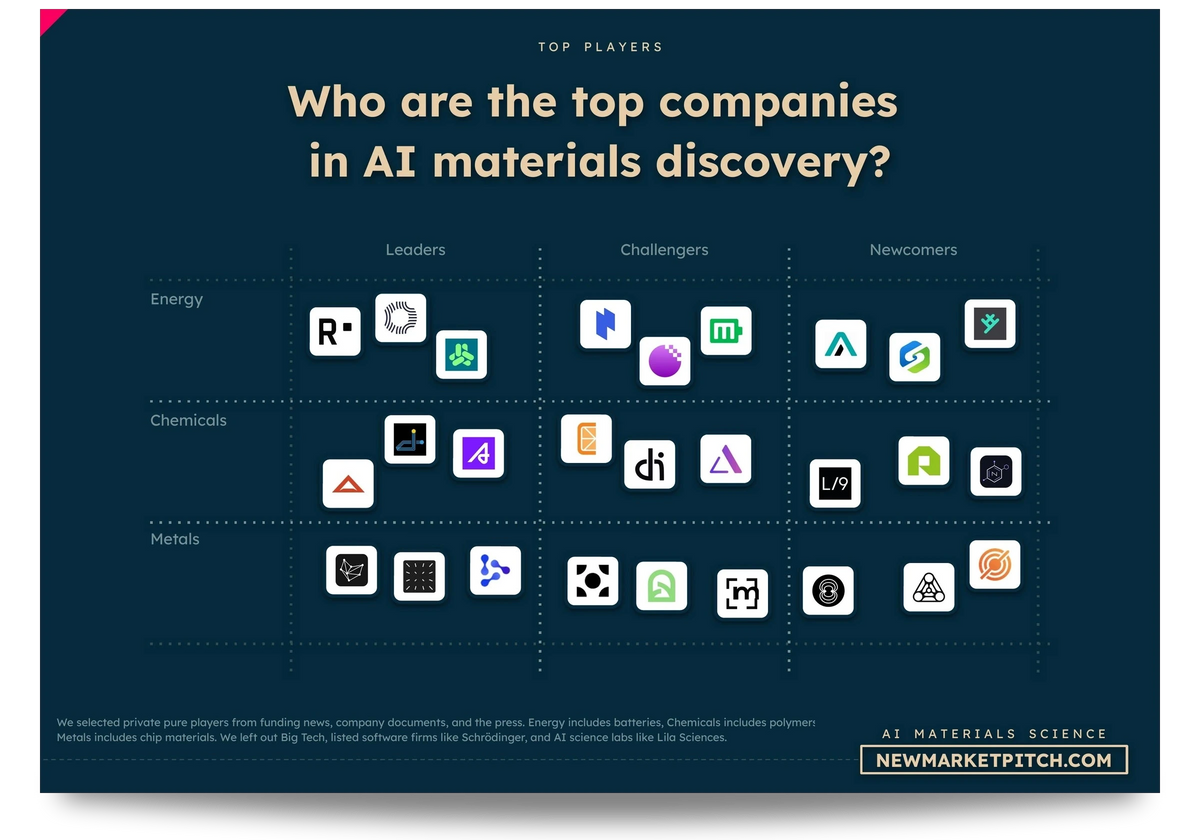
In our document detailing everything you need to know about AI materials discovery, we turn what is vague and complex into simple, useful visuals. Market maps like this one show you at a glance where every startup stands.
Can AI materials discovery startups grow without eventually building factories?
AI materials discovery companies can grow without moving into manufacturing, particularly when their software works across multiple customers and their industrial partners handle production.
For a software vendor, serving another laboratory mainly involves deployment, computing, training and customer support. Costs increase as the company grows, but additional customers do not require equivalent increases in chemical production capacity.
Custom discovery services are less scalable. A new industrial project may require substantial scientific work, new data collection and repeated experiments. Revenue can increase alongside the number of projects, but staffing and laboratory expenses can rise too.
Licensing offers a different opportunity. Once a material has passed qualification, a manufacturer's production growth can translate into higher royalties without the developer expanding its own facilities. This depends on the agreement's terms and the manufacturer's commercial success.
Orbital's use of CurieOS across cooling materials and automotive catalyst research provides an early example of how one platform can serve several material categories. The commercial agreement with BASF shows that the technology has applications outside its original development program, although financial results are not yet available to judge its scaling economics.
For a startup, avoiding factories removes a huge potential financial burden. It also means giving up control of production schedules, manufacturing quality and distribution.
Growth without factories is therefore possible, but the strongest companies will need either software customers who keep paying or manufacturing partners capable of turning licensed discoveries into recurring sales.
How can we tell whether an AI materials discovery company is actually making money?
The clearest test of an AI materials discovery business is whether it generates repeatable customer revenue that exceeds the cost of running its software, scientific research and commercial operations.
For software companies, we would look at recurring revenue, contract renewals, gross margins and customer expansion. Schrödinger provides unusually detailed financial disclosures for a scientific software company, making it possible to compare software revenue with development and operating costs.
For research-service companies, the useful figures are paid projects, repeat contracts, revenue per project and the expenses needed to deliver results.
For royalty businesses, we would want to know how many materials have passed industrial qualification, how many are actually being manufactured and how much licensing income the company receives.
Industrial partnerships alone cannot answer those questions. A major automotive manufacturer may work with a startup for years without committing to buy or commercialize a particular material.
The public information available for CuspAI, Aionics, Citrine and other private specialists generally does not provide enough consistent financial detail to calculate sector-wide profitability.
This leaves a gap between growing commercial interest and proven business economics. We can identify companies selling discovery tools and entering industrial agreements, but we cannot yet demonstrate that the typical materials AI startup earns attractive profits.

Our report covering the AI materials discovery market gets updated several times a month, so you always get the latest view of where things stand.
Can AI materials discovery make money without a factory?
Yes. AI materials discovery can make money without owning a factory, and companies are already showing that industrial customers will pay for scientific software, discovery platforms and materials development expertise.
Schrödinger's $199.5 million in annual scientific software revenue provides the strongest financial benchmark for an asset-light computational business, although much of its activity serves pharmaceuticals and the company remains unprofitable overall. Specialized materials AI vendors such as Citrine and Kebotix address paid industrial research needs, while Orbital Industries' agreement with BASF demonstrates how a discovery platform can be licensed to a major manufacturer.
The evidence becomes thinner when we look at royalties from AI-discovered materials. Public disclosures still provide few examples of pure-play materials AI companies generating substantial, recurring royalty income from inventions produced by external manufacturers.
That makes software subscriptions and paid industrial research the most credible near-term businesses. They allow companies to earn money while customers use their technology, rather than waiting years for a particular discovery to reach production.
There is also a good argument for retaining intellectual property in selected discoveries. A successful licensed catalyst, battery material or specialty chemical could generate meaningful royalty revenue without requiring the startup to manufacture the product.
Factory-free AI materials discovery is commercially viable, but the business model matters enormously. A startup selling useful software to industrial laboratories has a clearer path to recurring revenue than one depending entirely on future materials royalties.
The companies worth watching are those that combine repeatable software income, strong experimental validation and contracts that let them participate financially when a discovery reaches industrial production. They can benefit from the economics of materials innovation while leaving the enormous cost of running factories to established manufacturers.
If you want more recent data on this point, please see our latest AI materials discovery market report.
Our methodology
This analysis examines whether AI materials discovery can support a profitable business without factory ownership, and which business models have the strongest economic foundations. We approached that question by separating the commercial opportunity into distinct dimensions: demonstrated revenue, industrial customer demand, software economics, research and laboratory costs, commercialization requirements, intellectual-property ownership and potential licensing income.
For each dimension, we examined fresh evidence from reported financial results, manufacturer agreements, customer case studies, scientific publications and official regulatory materials. We collected the relevant observations, assessed the strength of each one individually, then aggregated the evidence across companies and business models. This approach gives greater weight to repeatable commercial activity and measurable industrial outcomes than to the volume of AI-generated predictions or the prominence of individual partnerships.
Our commercial assessment distinguishes research collaborations, actual platform deployments, licensing agreements and disclosed financial performance. These represent different levels of evidence. A manufacturer exploring a technology provides information about industrial interest, while a paid deployment or independently reported revenue provides a firmer basis for assessing commercial demand. We also separate company-reported technical improvements from independently established financial results.
To evaluate software economics, we use Schrödinger's reported 2025 revenue, gross margin and operating expenses as a financial reference for scientific computing businesses. Its pharmaceutical and materials activities are considered together only where the company reports combined software financials; we do not attribute that entire business to materials discovery. For private specialists, our assessment focuses on observable products, customer relationships and commercialization arrangements rather than unsupported estimates of profitability.
We also examined how a predicted material progresses through experimental validation, qualification, industrial production and commercial sales. Those stages have very different capital requirements and revenue implications. The royalty calculations are explicitly hypothetical scenarios based on defined sales volumes and royalty percentages, rather than estimates of prevailing contractual rates. Intellectual-property rights are considered separately because ownership of the software, the resulting invention and the manufacturing process can determine how the economic value is divided.
Key commercial and financial sources include Schrödinger's full-year 2025 financial results, Orbital Industries' announcement of its BASF ECMS licensing agreement, Hyundai Motor Group's CuspAI partnership announcement, and the official product and business descriptions published by Citrine Informatics, Kebotix, Aionics and Matmerize.
For industrial outcomes, we examined Citrine's published customer research, including its polymer formulation performance study, its work with Stepan, the Dorfner case study and its broader collection of industrial applications. These sources help connect AI-assisted research to practical formulation problems, while their reported performance results are treated as company-published project outcomes.
The scientific foundation draws on Google DeepMind's original GNoME announcement, the associated Nature research on scaling deep learning for materials discovery, Lawrence Berkeley National Laboratory's account of the Materials Project, the Nature Reviews Chemistry analysis of self-driving laboratories, and Nature Synthesis research on scale-aware laboratory development. These publications inform our assessment of the gap between computational discovery, experimental reproducibility and industrially usable materials.
For intellectual property, we used Citrine's explanation of customer data and IP ownership and the United States Patent and Trademark Office's November 2025 guidance on AI-assisted inventions. Together with the commercial and scientific evidence, these sources support a structured comparison of where factory-free businesses can generate revenue, what they must spend to deliver results, and which contractual and technical conditions determine whether they can retain the value of successful discoveries.

In our research about AI for materials discovery, we don't want to repeat what boring consulting reports say. Instead, we show you the real and latest market signals that matter.
Written by the New Market Pitch teamWe track new markets so founders and investors can move faster. About us