What are the most valuable AI materials discovery startups?
Whether you're building or investing in the AI materials discovery market, our report covers everything you need to know: the players, the money, and what's coming next.
Summary
Periodic Labs and CuspAI are the most valuable AI materials discovery startups today, valued at $7.5B and $2.6B, respectively. Periodic Labs leads by a substantial margin, with a valuation nearly three times that of its closest competitor.
Only two of the 65 AI materials discovery startups in our ranking are unicorns. Together, Periodic Labs and CuspAI represent approximately $10.1B of the sector's estimated $15.8B aggregate valuation, showing just how heavily investors are concentrating their bets.
The valuation gap is remarkable. Deep Principle, the third-ranked company, is valued at $300M–$550M, while Orbital Industries, at $330M–$500M, and Cambium, at $399M, follow, all below $600 million. No other startup is even close to the billion-dollar threshold.
The biggest valuations favor companies trying to automate the entire scientific discovery process. Periodic Labs is building AI-powered robotic laboratories, while CuspAI combines generative models with industrial research partnerships. Both are pursuing much larger opportunities than software designed for a single laboratory task.
Periodic Labs has raised more than CuspAI, at $1.1B versus $580M, thanks to an $808M Series A in June 2026. CuspAI's valuation increased roughly fivefold between September 2025 and July 2026, supported by a $450M financing round and an industrial network that includes more than 45 founding partners.
The scientific progress behind these valuations is substantial. Google DeepMind's GNoME identified approximately 2.2 million candidate crystal structures, Microsoft developed MatterGen for targeted materials generation, and Berkeley Lab's autonomous A-Lab successfully synthesized 36 target materials during a 17-day experiment.
Commercialization remains the tougher problem. Predicting or synthesizing a new material does not automatically make it affordable, reliable, or suitable for mass production. The companies that can repeatedly cross that gap will have a major advantage.
Some smaller startups are already building more direct commercial relationships. Albert Invent sells chemistry R&D software to industrial companies, Kyulux has OLED materials licensing agreements, and Mitra Chem has reached battery cathode production milestones. Their valuations are smaller, but their products address established customer spending.
The United States dominates the highest private valuations, although China, the United Kingdom, France, Germany, and Japan have strong positions in specialized materials technologies. Manufacturing expertise and access to industrial customers may eventually matter as much as access to the best AI models.
Deep Principle, Orbital Industries, Cambium, and Albert Invent are the clearest candidates for the next unicorns based on their current valuations. For now, the market's biggest unanswered question is whether general-purpose AI discovery platforms can turn scientific breakthroughs into repeatable, profitable industrial businesses.

Written by the New Market Pitch teamWe track new markets so founders and investors can move faster. About us

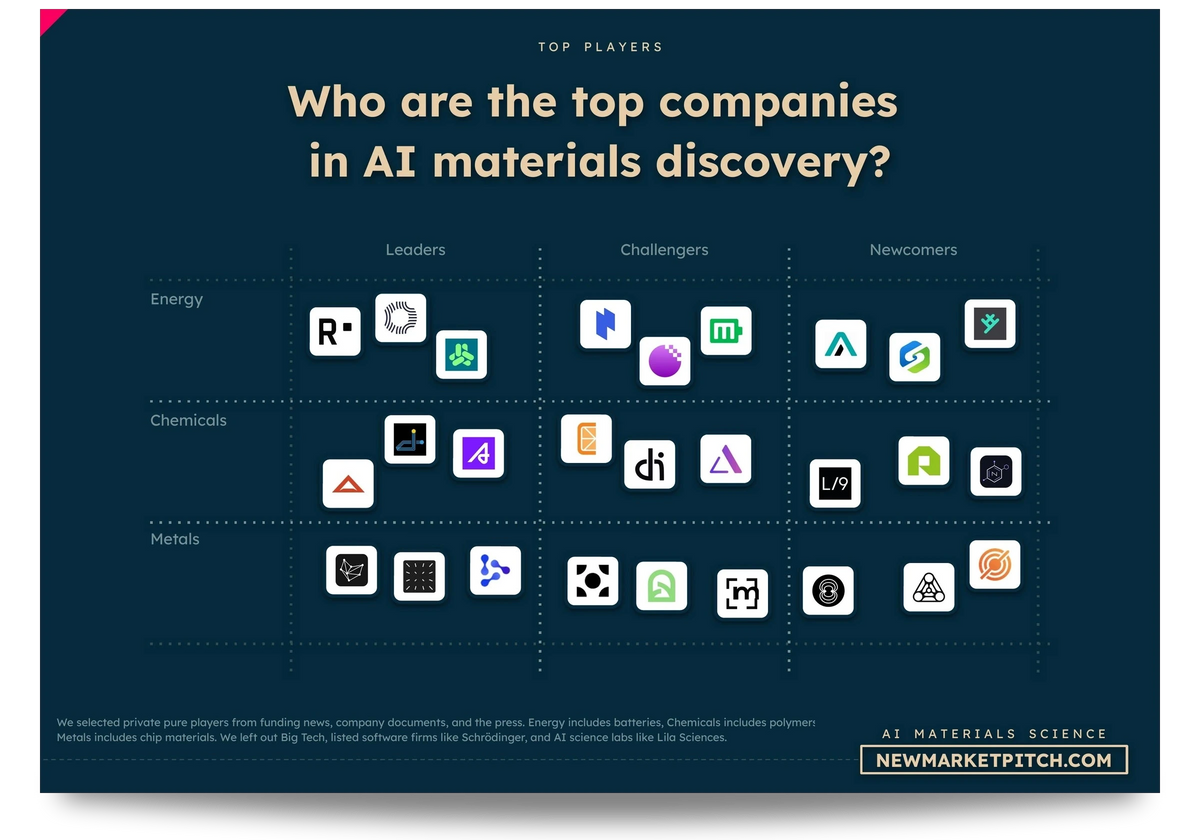
In our report covering the AI materials discovery market, we turn what is vague and complex into simple, useful visuals. Market maps like this one show you at a glance where every startup stands.
Top startups in the AI materials discovery market ranked by valuation
Here is an updated table that ranks the top startups in the AI materials discovery market based on their latest reported or estimated valuations.
If you need to dig deeper and get more detailed data, please check our report covering the AI materials discovery market.
| # | Startup | Valuation | Confidence | Valuation basis | Last round | Total funding |
|---|---|---|---|---|---|---|
| Private startups | ||||||
| 1 | Periodic LabsAutonomous AI scientific discovery laboratories | $7.5Bas of Jun 2026 | Strong | Implied valuation from raise | $808MSeries A · Jun 2026 | $1.1Bvalued at 6.8× this |
| 2 | CuspAIGenerative AI for novel materials | $2.6Bas of Jul 2026 | Strong | Implied valuation from raise | $450MSeries B · Jul 2026 | $580Mvalued at 4.5× this |
| 3 | Deep PrincipleAI-driven chemical and materials discovery | $300M–$550M | Partial | Implied valuation from raise | UndisclosedSeries A++ · Jul 2026 | $14M+valued at 30.4× this |
| 4 | Orbital IndustriesAI-designed materials and industrial infrastructure | $330M–$500M | Partial | Implied valuation from raise | $50MSeries B · May 2026 | $71M+valued at 5.9× this |
| 5 | CambiumAI-designed advanced industrial materials | $399Mas of Jan 2026 | Strong | Implied valuation from raise | $100MSeries B · Jan 2026 | $127M+valued at 3.1× this |
| 6 | Albert InventAI platform for chemistry R&D | $343Mas of Oct 2026 | Strong | Implied valuation from raise | $55MSeries B · Oct 2026 | $105M+valued at 3.3× this |
| 7 | Mitra ChemAI-accelerated battery cathode development | $298Mas of Jun 2025 | Partial | Implied valuation from raise | $16MSeries B extension · Jun 2025 | $105Mvalued at 2.8× this |
| 8 | Radical AIAutonomous AI materials development | $220M–$370M | Partial | Implied valuation from raise | $55MSeed+ · Jul 2025 | $55M+valued at 5.4× this |
| 9 | KyuluxNext-generation OLED emitter materials | $240M–$320M | Partial | Comparables-based estimate | $6MVenture equity · May 2026 | $137M+valued at 2.0× this |
| 10 | OTI LumionicsAdvanced OLED materials and display technology | $220M–$330M | Partial | Comparables-based estimate | $55MSeries B · Oct 2022 | $55M+valued at 5.0× this |
| 11 | UncountableAI-powered industrial R&D software | $260Mas of Jun 2025 | Partial | Implied valuation from raise | $27MSeries A · Jun 2025 | $35Mvalued at 7.3× this |
| 12 | AlloyedComputational alloy design and manufacturing | $220M–$290M | Partial | Comparables-based estimate | $19MEquity financing · Mar 2025 | $73M+valued at 3.5× this |
| 13 | HolyvoltAI-powered battery chemistry discovery | $245Mas of Oct 2026 | Strong | Implied valuation from raise | $45MSeries B · Oct 2026 | $75Mvalued at 3.3× this |
| 14 | ApohaAI measurement of molecular behavior | $160M–$280M | Partial | Implied valuation from raise | UndisclosedUnlettered round · Jun 2026 | $36Mvalued at 6.1× this |
| 15 | RhinovatePhysical AI for autonomous materials research | $105M–$165M | Partial | Implied valuation from raise | ~$28MPre-Series A · Sep 2026 | $28M+valued at 4.8× this |
| 16 | Quantum FormaticsAI-driven next-generation superconductor discovery | $65M–$150M | Low | Active raise valuationEstimated | Undisclosed | |
| 17 | ChemixAI-designed electric vehicle batteries | $70M–$130M | Low | Comparables-based estimate | $20MSeries A · Apr 2024 | $30Mvalued at 3.3× this |
| 18 | Deep Material1AI-developed high-performance metal alloys | $75M–$120M | Partial | Implied valuation from raise | ~$14MSeries A+ · Sep 2026 | ~$14Mvalued at 7.0× this |
| 19 | MatSource1AI-driven industrial materials development | $75M–$120M | Partial | Implied valuation from raise | UndisclosedSeed · Aug 2026 | $15Mvalued at 6.5× this |
| 20 | LongXun KuangTeng1GPU-accelerated materials simulation software | $80M–$110M | Partial | Implied valuation from raise | UndisclosedSeries B · Sep 2026 | $15Mvalued at 6.3× this |
| 21 | Citrine InformaticsAI platform for materials R&D | $55M–$105M | Low | Comparables-based estimate | $2.6MSeries C · Jan 2025 | $64Mvalued at 1.2× this |
| 22 | Woshi Digital TechnologyAI-driven chemical synthesis automation | $55M–$105M | Low | Comparables-based estimate | UndisclosedSeries B+ · Aug 2026 | ~$12Mvalued at 7.0× this |
| 23 | MattiqSustainable industrial chemical process discovery | $65M–$90M | Partial | Comparables-based estimate | UndisclosedSeries A · 2025 | $20M+valued at 3.9× this |
| 24 | NobleAI1AI-powered chemical and materials informatics | $45M–$85M | Low | Comparables-based estimate | $10MSeries A extension · Apr 2024 | $30M+valued at 2.1× this |
| 25 | Cosmos InnovationAI optimization of semiconductor materials | $45M–$85M | Partial | Comparables-based estimate | UndisclosedSeries B · Nov 2025 | $20Mvalued at 3.2× this |
| 26 | Multiscale TechnologiesPhysics-informed AI for industrial materials | $45M–$70M | Partial | Comparables-based estimate | $11MSeries A · Sep 2024 | $22Mvalued at 2.7× this |
| 27 | DuniaAutonomous laboratories for materials discovery | $42M–$65M | Partial | Comparables-based estimate | $12MSeed · Oct 2024 | $12M+valued at 4.7× this |
| 28 | EntalpicGenerative AI for industrial chemistry | $43M–$63M | Partial | Comparables-based estimate | UndisclosedCorporate Minority · Oct 2026 | $9.4M+valued at 5.6× this |
| 29 | KebotixAI-driven autonomous chemistry laboratories | $35M–$65M | Low | Comparables-based estimate | $5MVenture equity · Aug 2024 | $24Mvalued at 2.1× this |
| 30 | AltroveAI discovery of critical-material alternatives | $38M–$58M | Strong | Implied valuation from raise | $10MSeed · Oct 2025 | $14Mvalued at 3.4× this |
| 31 | Discovered MaterialsAI semiconductor materials discovery | $36M–$60M | Strong | Implied valuation from raise | $9MSeed · Aug 2026 | $9Mvalued at 5.3× this |
| 32 | PolaronAI-driven materials microstructure design platform | $32M–$53M | Partial | Implied valuation from raise | $8MSeed · Feb 2026 | $8M+valued at 5.3× this |
| 33 | alqemAI discovery of advanced materials | $35M–$50M | Partial | Implied valuation from raise | ~$9.4MPre-Seed · Jul 2026 | $9.4Mvalued at 4.5× this |
| 34 | Materials NexusAI-designed sustainable advanced materials | $27M–$55M | Low | Comparables-based estimate | ~$3.4MSeed / extension · Jan 2025 | $6Mvalued at 6.8× this |
| 35 | Solena MaterialsAI-designed sustainable protein fibers | $30M–$44Mas of Oct 2026 | Partial | Comparables-based estimate | $1.6MVenture financing · May 2026 | $12Mvalued at 3.0× this |
| 36 | Soge Intelligent ComputingAI computational materials discovery platform | $20M–$50M | Low | Comparables-based estimate | UndisclosedSeed · Sep 2026 | Undisclosed |
| 37 | Atomic TessellatorAI atomic-scale materials simulation | $27M–$42M | Strong | Implied valuation from raise | ~$8.1MSeed · Apr 2026 | $8.1M+valued at 4.3× this |
| 38 | AionicsAI battery materials discovery | $22M–$42M | Low | Comparables-based estimate | $502KSeed · Apr 2026 | $5.2M+valued at 6.2× this |
| 39 | Copernic CatalystsAI-designed industrial chemical catalysts | $25M–$38M | Partial | Comparables-based estimate | $8MSeed Prime · Nov 2024 | $10Mvalued at 3.1× this |
| 40 | Atinary TechnologiesAI optimization of laboratory experiments | $22M–$36M | Partial | Comparables-based estimate | UndisclosedCorporate Minority · Aug 2026 | $5Mvalued at 5.8× this |
| 41 | Matter MachineAI-guided crystalline materials discovery | $23M–$34M | Strong | Implied valuation from raise | ~$5.3MPre-Series A · Oct 2026 | $5.3Mvalued at 5.4× this |
| 42 | Green DynamicsAI-powered sustainable materials discovery | $18M–$38M | Low | Proxy-based estimate | UndisclosedSeed | Undisclosed |
| 43 | Materials.ZoneMaterials informatics and optimization software | $18M–$36M | Low | Comparables-based estimate | UndisclosedSeries B · Jun 2026 | $11Mvalued at 2.5× this |
| 44 | Alchemy CloudAI software for chemical formulation | $16M–$32M | Low | Comparables-based estimate | $1MEquity · Sep 2026 | $7.3M+valued at 3.3× this |
| 45 | Heguang ZhichengAI-driven advanced materials research | $15M–$30M | Low | Implied valuation from raise | UndisclosedSeed · Aug 2026 | Undisclosed |
| 46 | Mat3raCloud-based atomic materials simulation | $12M–$25M | Partial | Comparables-based estimate | $3MSeed · Feb 2022 | $3.9Mvalued at 4.8× this |
| 47 | PhaseTreeAI simulations for sustainable materials | $13M–$23M | Partial | Implied valuation from raise | $3.2MSeed · Mar 2025 | $3.2Mvalued at 5.6× this |
| 48 | Phaseshift TechnologiesAI-designed advanced alloys and composites | $12M–$23M | Low | Comparables-based estimate | $3MSeed · Oct 2024 | $3M+valued at 5.8× this |
| 49 | RARA FactoryAI discovery of rare-earth alternatives | $13M–$22M | Partial | Implied valuation from raise | ~$3.7MSeed · Jan 2026 | $3.7M+valued at 4.7× this |
| 50 | Osium AIGenerative AI for sustainable materials | $10M–$21M | Low | Comparables-based estimate | $3MSeed · Nov 2023 | $3Mvalued at 5.2× this |
| 51 | Meissner TechnologiesAI-discovered superconductors for quantum computing | $11M–$19M | Strong | Implied valuation from raise | $2.6MPre-Seed · Sep 2026 | $5.6M+valued at 2.7× this |
| 52 | SynMatAIAI foundation models for materials | $11M–$19M | Partial | Implied valuation from raise | ~$1.4MAngel+ · Sep 2026 | ~$6Mvalued at 2.5× this |
| 53 | Fuan Intelligent TechnologyAI-powered computational materials discovery | $13M–$16M | Strong | Implied valuation from raise | ~$2.8MSeed · May 2026 | $2.8Mvalued at 5.2× this |
| 54 | DeepVerseAI materials research and formulation | $9M–$19M | Low | Comparables-based estimate | ~$2.8MSeed · Mar 2023 | $2.8Mvalued at 5.0× this |
| 55 | IntellegensMachine learning for industrial R&D | $8M–$20M | Low | Proxy-based estimate | ~$400KSeed · Jun 2020 | $600K+valued at 23.3× this |
| 56 | CrowdChemAI intelligence for chemical materials | $8M–$15M | Partial | Comparables-based estimate | $2MPre-Series A · Sep 2024 | $2.6Mvalued at 4.5× this |
| 57 | Mater-AIAI discovery of thermoelectric materials | $8M–$15M | Partial | Implied valuation from raise | ~$2MPre-Seed · Dec 2025 | $2Mvalued at 5.8× this |
| 58 | XatomsAI-discovered materials for water purification | $8M–$15M | Partial | Implied valuation from raise | $1.5MPre-Seed · Jun 2025 | $2Mvalued at 5.8× this |
| 59 | PolymerizeAI materials informatics SaaS platform | $7M–$15M | Partial | Comparables-based estimate | UndisclosedSeed extension · Mar 2025 | $6.6M+valued at 1.7× this |
| 60 | ExoMatterAI-powered industrial materials selection | $7M–$13M | Partial | Comparables-based estimate | ~$1.8MPre-Seed · Oct 2024 | $1.8Mvalued at 5.4× this |
| 61 | Nextmol1AI computational chemistry simulation software | $5M–$12M | Low | Proxy-based estimate | $230KSeed · Feb 2024 | $230Kvalued at 37.0× this |
| 62 | AIxtalAI-assisted molecular materials exploration | $5M–$10M | Low | Comparables-based estimate | ~$3MSeries A · Sep 2025 | $3.1M+valued at 2.4× this |
| 63 | SimrekaAI materials formulation simulation software | $3M–$10M | Low | Proxy-based estimate | UndisclosedSeed · Jun 2019 | Undisclosed |
| 64 | Quantum BoostAI-powered chemical formulation optimization | $2M–$7M | Low | Proxy-based estimate | $770KPre-Seed · Apr 2022 | $770K+valued at 5.8× this |
| Listed or acquired since 2022 · not ranked | ||||||
| QuantistryAI-powered quantum chemistry simulations | $10M–$20M | Low | Comparables-based estimate | $3.3MSeed · Mar 2024 | $3.3M+valued at 4.5× this | |
No startups match this search.
- Total funding is a minimum: undisclosed rounds may raise these totals.

Our research about AI for materials discovery gets updated several times a month, so you always get the latest view of where things stand.
Which AI materials discovery startups are worth the most today?
Periodic Labs and CuspAI are currently the two most valuable AI materials discovery startups, with valuations of $7.5B and $2.6B, respectively.
The gap with everyone else is striking. Deep Principle ranks third at $300M–$550M, followed by Orbital Industries at $330M–$500M and Cambium at $399M. At $7.5B, Periodic Labs is worth more than 13 times Deep Principle's highest estimate.
The two leaders are taking slightly different approaches. Periodic Labs wants to automate scientific experiments using AI models and robotics, while CuspAI is building a materials discovery platform around generative AI, industrial data, and research partnerships.
Further down, the market becomes much more specialized. Albert Invent develops chemistry R&D software, Radical AI works on autonomous materials research, Mitra Chem develops battery cathodes, and Kyulux focuses on OLED emitters.
The biggest valuations belong to companies trying to change the entire discovery process. Startups developing specific materials or software for individual research tasks generally command much smaller valuations.
How many AI materials discovery startups are unicorns?
Only two of the 65 AI materials discovery startups in our ranking are unicorns today: Periodic Labs and CuspAI.
That means just 3.1% have reached the $1 billion threshold. The other 63 companies are valued below it, and even the highest valuation range among them, Deep Principle's $300M–$550M, remains well short.
What's particularly interesting is how much of the sector's value sits with those two companies. Across all 65 startups, the combined valuation is approximately $14.8B–$16.8B. Periodic Labs and CuspAI together account for $10.1B, representing roughly 64% of the total.
That's an unusually concentrated picture for a field involving battery chemistry, semiconductors, industrial software, advanced alloys, and dozens of other applications.
Investors are clearly placing a much higher price on companies that could become general-purpose scientific platforms than on those serving narrower industrial markets.

In our market report about AI for materials discovery, we look at what the winners do differently, so you can learn from the best instead of guessing.
Why are AI materials discovery startups suddenly worth billions?
AI materials discovery valuations have climbed into the billions because researchers can now demonstrate scientific capabilities that would have seemed unrealistic a few years ago. Commercial adoption, though, remains much less advanced.
In November 2023, Google DeepMind published its GNoME research in Nature. The system identified approximately 2.2 million candidate crystal structures, including 381,000 new entries on an updated computational stability benchmark. That was a huge expansion of the known search space for potentially useful inorganic materials.
Microsoft Research took another step with MatterGen, published in Nature in January 2025. Its generative model could design materials toward specified properties rather than merely search for stable structures. The researchers reported that its generated structures were more than twice as likely to be novel and stable as those from earlier generative approaches. One experimentally synthesized candidate achieved a measured property within 20% of its intended target.
These developments help explain why companies such as Periodic Labs and CuspAI have attracted enormous investor attention. A discovery platform that repeatedly finds useful battery materials, semiconductor compounds, or industrial catalysts could become extremely valuable.
But the financial leap is still much bigger than the demonstrated industrial leap. Predicting a promising crystal is considerably easier than manufacturing it reliably at a competitive cost.
Investors are paying for the possibility that AI will eventually shorten a research process that traditionally requires years of laboratory work.
Is Periodic Labs really worth more than CuspAI?
Periodic Labs is worth considerably more than CuspAI today, with a valuation of $7.5B compared with $2.6B.
That puts Periodic Labs at roughly 2.9 times CuspAI's valuation. It has also raised more money: $1.1B versus $580M, most of it through an $808M Series A in June 2026.
Periodic Labs was founded in 2025 by Liam Fedus, formerly at OpenAI, and Ekin Dogus Cubuk, formerly at Google DeepMind. The company is developing AI-powered laboratories where models, robots, and scientific instruments work together to design and test materials.
Its ambitions extend into industrial applications. On its website, Periodic Labs describes work with a semiconductor manufacturer dealing with heat dissipation, where custom AI agents help researchers analyze experimental data.
CuspAI is pursuing a broader partnership model. Its AI Materials Foundry brings together industrial companies, computing providers, laboratories, and scientific expertise. More than 45 founding partners were announced in July 2026.
Periodic Labs has the larger private valuation, but that alone doesn't mean it generates more revenue, has more paying customers, or has developed more commercially successful materials than CuspAI. Those comparisons remain difficult without public financial figures.

In our document detailing everything you need to know about AI materials discovery, you will always find fresh funding data, taken straight from our own verified funding database.
Can CuspAI catch up with Periodic Labs?
CuspAI has already shown that its valuation can rise extraordinarily quickly, making it one of the strongest candidates to narrow the gap with Periodic Labs.
In September 2025, CuspAI's Series A valued the company at approximately $520M. Its July 2026 Series B raised $450M at a reported $2.6 billion valuation. That's a fivefold increase in about ten months.
The financing came alongside a major expansion of the company's industrial network. CuspAI announced more than 45 founding partners for its AI Materials Foundry, including NVIDIA, Meta, Samsung, Hyundai Motor Group, Henkel, Applied Materials, Tokyo Electron, and Lam Research.
These names cover several very different markets. Semiconductor manufacturers need new materials to improve chip performance and energy efficiency. Automotive companies are interested in batteries and advanced manufacturing. Chemicals groups need better formulations and production processes.
CuspAI's challenge now is converting these relationships into paid research projects, commercially validated materials, and recurring business.
A second fivefold increase from its reported July 2026 financing level would take CuspAI far beyond its current valuation. That's a pretty big ask. The next increase will be harder to justify without clearer commercial results.
Which AI materials discovery startups have raised the most money?
Periodic Labs has raised the most among AI materials discovery startups, with $1.1B, followed by CuspAI at $580M.
Kyulux comes next among the companies with the largest totals, at $137M+, followed by Cambium at $127M+, Mitra Chem at $105M and Albert Invent at $105M+.
The top five alone account for $2.1B+ in funding. That's a substantial concentration of investment in a handful of companies pursuing very different approaches to scientific research.
The funding history also tells us something about business models. Kyulux has raised capital across several rounds since 2016 to develop OLED emitter technologies. Cambium develops advanced industrial materials, where physical testing and manufacturing expertise require significant investment.
Albert Invent has a different profile. Its October 2026 $55M Series B, led by TCV, supports chemistry-native AI software used to organize scientific data and improve research workflows.
Funding is particularly useful for comparing investor appetite because most private materials discovery startups do not publish comparable revenue or profitability figures. Still, the amount raised tells us how much capital a company has attracted, rather than how much its business is worth or how successfully it has commercialized its technology.

Learning from others' mistakes is the cheapest lesson there is. In our report covering the AI materials discovery market, we look at what broke startups before you, so you don't repeat it.
Are investors putting more money into AI laboratories or materials discovery software?
The biggest AI materials discovery valuations currently favor platforms that combine advanced AI with a larger part of the scientific discovery process, while specialized software companies still attract meaningful funding.
Periodic Labs is building automated laboratories. CuspAI combines generative models, research data, and an industrial foundry network. Radical AI raised $55M in July 2025 to pursue autonomous materials development, including the connection between computational design, physical creation, and real-world performance.
Software companies approach the market differently. Albert Invent helps chemical R&D teams work with their experimental data and formulations. Uncountable develops industrial research software, while Citrine Informatics focuses on materials informatics.
The economics differ considerably. Software can be sold repeatedly to research teams without building a new laboratory for each customer. Autonomous laboratories need physical equipment, technicians, maintenance, and consumables, although they may eventually produce much more valuable discoveries.
Companies such as Cambium, Alloyed, and Mitra Chem face another challenge: developing materials that meet customers' performance and manufacturing requirements.
For investors, the attraction of an autonomous discovery platform is the possibility of serving many industries through the same underlying technology. Whether that approach is actually cheaper than conventional R&D remains to be seen.
| Business model | Representative startups | What customers pay for | Main challenge |
|---|---|---|---|
| Autonomous laboratories | Periodic Labs, Radical AI, Dunia | Faster experimental discovery | Laboratory costs and reliability |
| Generative discovery | CuspAI, Deep Principle | New material candidates | Physical validation |
| Chemistry R&D software | Albert Invent, Uncountable | Better research workflows | Competition and customer retention |
| Materials informatics | Citrine Informatics, Materials.Zone | Better use of experimental data | Data quality and integration |
| Battery materials | Mitra Chem, Aionics | Improved battery chemistry | Industrial qualification |
| Advanced alloys | Alloyed, Phaseshift Technologies | Specific material performance | Manufacturing scale-up |
| OLED materials | Kyulux, OTI Lumionics | Better display materials | Device reliability and adoption |
Can autonomous AI laboratories actually discover new materials?
Autonomous AI laboratories can already synthesize new materials with limited human intervention, but their ability to generate useful discoveries cheaply and consistently is still being tested.
One of the clearest demonstrations came from Lawrence Berkeley National Laboratory. In a study published in Nature, its A-Lab completed 353 experiments over 17 days and successfully synthesized 36 of 57 target inorganic materials.
That's a 63% success rate, with more than two successful target syntheses per day. The system combined computational predictions, machine learning, robotic experimentation, and feedback from laboratory instruments.
The 36-of-57 figure comes from the corrected scientific record, which revised the initially reported results after questions were raised about how the experiments had been interpreted.
The experiment shows why companies such as Periodic Labs, Radical AI, and Dunia are attracting attention. Automated systems can perform repeated experiments and use the results to guide subsequent attempts.
But there's still a big gap between a successful laboratory experiment and a useful industrial product. Synthesizing a material doesn't establish its commercial usefulness, production cost, long-term stability, or performance inside an actual manufactured product.
The next convincing benchmark would be a laboratory repeatedly producing materials that customers can manufacture and use, with measurable savings against conventional R&D.

Your time is limited. In our research about AI for materials discovery, we put numbers on each part of the market, so you can see where it makes sense to focus.
Is Albert Invent becoming a major AI chemistry startup?
Albert Invent has become one of the better-funded AI chemistry software startups, with a valuation of $343M and $105M+ raised.
Its October 2026 $55M Series B is especially relevant because it came with concrete information about how the company is being used. Albert named AkzoNobel, BASF, Chemours, Clorox, Henkel, Kenvue, and other industrial organizations among its partners.
These companies regularly work on formulations, product specifications, chemical ingredients, and manufacturing requirements. For them, improving existing research can be valuable even without discovering a completely new material.
Albert's software helps teams search previous experiments, analyze formulation data, suggest candidates, and design new tests. That makes it useful for recurring work, such as replacing ingredients, reducing development time, or adapting products to regulatory changes.
The company is competing in a different part of the market from Periodic Labs and CuspAI. Its immediate opportunity is selling useful software to companies that already employ chemists and run laboratories.
Albert has established a meaningful financing and partnership position. The next commercial milestones are growing recurring revenue, expanding existing accounts, and becoming part of the everyday research process at major industrial customers.
Can smaller AI materials discovery startups beat the billion-dollar companies?
Smaller AI materials discovery startups can win important industrial customers without matching the scale of Periodic Labs or CuspAI.
Consider three businesses operating in very different markets. Mitra Chem develops battery cathode materials, Kyulux specializes in OLED emitters, and Alloyed uses computational methods to design advanced alloys.
Each can become commercially important by solving a specific technical problem better than competing materials.
Mitra Chem's partnership with General Motors is a useful example. In August 2023, GM announced it was leading a $60M Series B financing round to help develop iron-based battery cathodes, including lithium manganese iron phosphate. The goal was to support more affordable electric-vehicle batteries.
Kyulux has its own industrial validation. Its 2025 factbook identifies Samsung Display, LG Display, Sony, and Japan Display among its strategic investors. In February 2026, Kyulux also announced a licensing agreement with SK Materials JNC for next-generation OLED materials.
These partnerships put specialized startups close to customers with precise technical requirements.
A general-purpose AI model may identify thousands of promising compounds, but manufacturers still need reliable materials that satisfy their production constraints. That's where deep specialization can beat a much bigger technology platform.

In our market report about AI for materials discovery, we always try to gather several sources and make estimates that make sense, so you can work with solid numbers.
Are AI battery materials startups worth more than OLED materials startups?
OLED materials startups currently command valuations broadly comparable to, and in some cases higher than, the AI battery materials companies in our ranking.
Mitra Chem is valued at $298M, while Kyulux stands at $240M–$320M and OTI Lumionics at $220M–$330M. Their valuations overlap significantly.
Further down the battery category, Chemix is valued at $70M–$130M and Aionics at $22M–$42M.
The two industries offer very different commercial opportunities.
Battery materials can influence electric-vehicle costs, energy density, charging performance, and reliance on specific raw materials. Successful commercialization may require years of testing, safety validation, and production scale-up.
OLED emitters are evaluated against equally demanding but different requirements: efficiency, brightness, operational lifetime, display quality, and compatibility with manufacturing processes.
Kyulux has made commercial progress through material shipments, industry investment, and licensing activity. Mitra Chem has announced multi-ton cathode production milestones and commercial sample shipments.
Battery materials startups don't automatically deserve higher valuations just because electric vehicles represent a huge market. The ability to meet precise industrial requirements matters much more.
Is the United States leading the AI materials discovery market?
The United States leads AI materials discovery in top-end startup valuations, although China and Europe have established strong positions across different materials technologies.
Periodic Labs holds the highest valuation, while US companies such as Cambium, Albert Invent, Radical AI, and Mitra Chem also occupy prominent positions.
China is particularly visible in computational materials research. Deep Principle, Rhinovate, Deep Material, MatSource, LongXun KuangTeng, and SynMatAI work across discovery platforms, simulation, and industrial applications.
The United Kingdom has CuspAI, Orbital Industries, Alloyed, Polaron, and several other companies. France contributes Entalpic, Altrove, and Osium AI, while Germany hosts Dunia, alqem, Quantistry, and ExoMatter.
Japan has Kyulux and CrowdChem, while Canada is represented by OTI Lumionics and Xatoms.
The interesting difference is that American companies dominate the largest financing deals, while specialized scientific and manufacturing capabilities are spread across many countries.
That makes sense for a field tied closely to industrial supply chains. The best location for developing a battery material, semiconductor compound, or display emitter may depend on where the manufacturing customers and research facilities are.
For now, the US has the clearest lead in attracting the biggest private valuations. That doesn't establish an equivalent lead in every materials technology.

If you build or invest in the AI materials discovery market, you need to know which business models pay off now and which ones are fading. That's why our report covering it has a whole section on it.
Can Chinese AI materials discovery startups catch up with US competitors?
Chinese AI materials discovery startups are credible competitors, particularly in technologies linked to manufacturing, but their valuations remain far below the leading American companies.
Deep Principle is China's highest-ranked company at $300M–$550M. Rhinovate follows at $105M–$165M, while LongXun KuangTeng, Deep Material, MatSource, and others operate at smaller valuations.
China has a practical advantage in certain applications: a large industrial base where materials research can connect directly with battery manufacturing, chemical production, electronics, and advanced manufacturing.
That connection is valuable because scientific research usually becomes commercially meaningful only after repeated testing under real production requirements.
Valuation differences, however, are a poor measure of scientific ability. Financing markets differ by country, and private valuations depend partly on investor access, expected exits, and available capital.
There is also little comparable public revenue information to determine whether Chinese or American materials discovery startups are more commercially efficient.
China is already competitive in several specialized areas. Closing the valuation gap with Periodic Labs and CuspAI would require Chinese companies to demonstrate an opportunity of similar financial scale, rather than simply publishing more research or raising additional funding.
Which AI materials discovery startups are closest to making real money?
AI materials discovery startups selling software to existing R&D teams or working directly with industrial manufacturers currently have the clearest path to recurring commercial revenue.
Albert Invent is a good example. Chemical companies already spend money on research software, laboratory systems, and formulation management. Albert can sell into those established activities rather than waiting for a major scientific breakthrough.
Kyulux offers a different kind of commercial progress. Its OLED technology has moved into material shipments, strategic industrial relationships, and licensing agreements. These are stronger indicators of customer interest than laboratory publications alone.
Mitra Chem has also moved beyond computational design. Its company announcements describe multi-ton LFP cathode material production in February 2024 and commercial LMFP sample shipments beginning in December 2023.
Polaron provides a newer example. In February 2026, the Imperial College London spinout announced an $8M financing round and described industrial applications of its AI-based microstructure analysis, including a battery electrode project reporting an energy-density improvement exceeding 10%.
Comparable revenue figures are still scarce, so a reliable revenue ranking isn't possible.
There is nevertheless a big commercial difference between companies demonstrating scientific potential and those whose products are already being tested, licensed, or integrated into customers' development processes.
| Commercial activity | Company | Documented example |
|---|---|---|
| Enterprise partnerships | Albert Invent | BASF, AkzoNobel, Henkel and other industrial organizations |
| Materials licensing | Kyulux | SK Materials JNC agreement announced in 2026 |
| Industrial investment | Mitra Chem | General Motors-led Series B |
| Production milestone | Mitra Chem | Multi-ton LFP cathode material production |
| Industrial software deployment | Polaron | Materials design tools used by manufacturers |
| Research collaboration | CuspAI | AI Materials Foundry with over 45 founding partners |
| Industrial AI application | Periodic Labs | Semiconductor heat-dissipation research support |

In our report covering the AI materials discovery market, we don't want to repeat what boring consulting reports say. Instead, we show you the real and latest market signals that matter.
Could Google and Microsoft replace AI materials discovery startups?
Google and Microsoft could make some AI materials discovery software much less valuable by improving the underlying models, but replacing specialized laboratories and industrial relationships would be considerably harder.
Google DeepMind's GNoME and Microsoft's MatterGen demonstrate how much advanced materials modeling can improve through research conducted outside independent startups.
If computational models become cheaper and widely accessible, companies selling relatively basic prediction tools may face stronger competition.
The more defensible businesses will probably be those combining modeling with proprietary experimental data, industrial expertise, and customer-specific workflows.
Periodic Labs is investing in physical experimentation. CuspAI is building an industrial discovery network. Albert Invent integrates into chemical R&D processes, while Polaron links microstructure images with manufacturing performance.
These capabilities take more than a publicly available model to reproduce.
Polaron's approach is particularly interesting because manufacturing outcomes depend on the microscopic structures created during production, not only on an idealized atomic composition. Its work focuses on connecting processing conditions, internal structure, and measured performance.
Major AI laboratories will remain powerful competitors in general-purpose scientific models. Industrial data, laboratory execution, and manufacturing knowledge offer startups a more credible way to maintain an advantage.
Which AI materials discovery startups could become the next unicorns?
Deep Principle, Orbital Industries, Cambium, and Albert Invent are among the strongest candidates to become the next AI materials discovery unicorns based on their current valuation positions, although none is close enough to make a $1 billion outcome imminent.
Deep Principle has the highest upper valuation bound among the companies below the two leaders, at $300M–$550M. Orbital Industries stands at $330M–$500M, Cambium at $399M, and Albert Invent at $343M.
Reaching $1 billion would require substantial appreciation even for these companies.
Deep Principle would need to almost double from the upper end of its current valuation range. Albert Invent would need to reach nearly three times its current valuation. Cambium's $399M is less than half the unicorn threshold.
What gets them there will differ. A computational discovery platform needs to prove that it produces useful results repeatedly. Industrial materials developers need manufacturing and customer adoption. Enterprise software businesses need stronger recurring revenue and customer retention.
Cambium's financing history offers one concrete benchmark: private-market transaction data from Forge indicates a roughly $399M valuation associated with its early-2026 financing.
Albert Invent's recent Series B also demonstrates investor demand for commercially focused chemistry AI.
Among these companies, validated customer contracts, product revenues, and repeatable industrial performance deserve much more attention than the number of materials predicted by their AI systems.

In our research about AI for materials discovery, we like to show you the big picture. We know your time is precious, so we make every page quick to read and packed with as much learning as possible per minute.
Are smaller AI materials discovery startups undervalued?
Some smaller AI materials discovery startups could eventually be worth far more than their current estimates, but low valuations by themselves tell us very little about whether a company is cheap.
Citrine Informatics is valued at $55M–$105M despite having raised $64M. Its lower valuation bound is below the amount raised, which can happen when past investment has not yet translated into equivalent current business value.
Kebotix stands at $35M–$65M with $24M raised, and NobleAI is valued at $45M–$85M with at least $30M in reported funding.
At the smaller end, Materials Nexus is valued at $27M–$55M and Polaron at $32M–$53M. Both work on problems where technical advantages can be measured against industrial needs.
Polaron's $8M funding round and reported battery electrode improvements show how even relatively young companies can develop useful technology without enormous financing.
Materials Nexus, now operating as MatNex, is pursuing materials designed to industrial specifications, starting with rare-earth-free magnets.
These companies may become substantially more valuable if they prove their technology can meet manufacturing requirements and generate repeat business.
But investors also have to account for long customer qualification cycles, capital requirements, and the possibility that a promising material never reaches commercial production.
Are AI materials discovery startup valuations actually justified?
AI materials discovery is a genuinely promising market, but the biggest startup valuations currently depend on scientific and commercial progress that has yet to be demonstrated at scale.
The technical progress is impressive. Google DeepMind has greatly expanded computational materials discovery, Microsoft has demonstrated targeted materials generation, and automated laboratories have successfully performed hundreds of experiments with limited human intervention.
Commercial progress is also improving, although unevenly. Albert Invent has named major chemical industry partners, Kyulux has reported licensing and materials shipments, Mitra Chem has reached production milestones, and CuspAI has assembled an unusually broad industrial research network.
Yet the financial expectations remain extraordinarily concentrated. Periodic Labs and CuspAI are currently worth far more than the rest of the sector, despite limited public information about their recurring revenue and profitability.
For the leading platforms to justify their valuations over time, they will need to make discovering useful materials measurably faster and cheaper, then capture part of the economic value created.
AI materials discovery already has real scientific and industrial value. Established software and specialized materials companies can increasingly be judged by customer activity and product adoption. The multibillion-dollar leaders are a much larger bet on what scientific research could become.
The companies that ultimately justify the highest valuations will be those that consistently turn AI-generated predictions into materials that manufacturers can use and customers are willing to pay for.

When you build or invest in the AI materials discovery market, you need clarity, not confusion. In our market report about AI for materials discovery, we always try to put numbers on and quantify whatever is usually vague and confusing.
Our methodology
This analysis ranks 65 independent private startups in the AI materials discovery market, covering AI-driven materials design, computational discovery, autonomous laboratories, materials informatics, and related industrial technologies. We excluded large established corporations, their subsidiaries, and companies that had already been acquired or gone public.
We estimated current private-market valuations using completed funding rounds, company and investor announcements, regulatory filings, credible financial reporting, private-market transaction information, and comparable businesses. Recently completed financings received the greatest weight. Older valuations were assessed alongside subsequent funding, commercial developments, and changes in market conditions.
When a company disclosed a financing amount without a valuation, we considered its funding stage, plausible investor dilution, and comparable transactions. Where financial information was available, we also considered revenue multiples, growth, business maturity, geography, and operating performance. Valuation ranges reflect differences in the strength and recency of financial information rather than a single mechanical formula.
We examined commercialization progress through industrial partnerships, licensing agreements, customer adoption, materials production, and scientific milestones. These developments are particularly relevant in materials discovery, where computational predictions can precede commercial manufacturing by several years. Funding totals represent cumulative reported capital raised and are separate from company valuations.
We also considered the different economics of autonomous laboratories, enterprise research software, computational discovery platforms, and specialized materials manufacturers. Scientific publications and technical achievements helped us assess competitive positioning, but they were not treated as substitutes for commercial revenue or completed financial transactions.
A company can appear in this ranking even when its total funding is undisclosed: its position depends on its valuation, not on the capital it has raised.
Key sources include company and investor announcements from Periodic Labs, CuspAI, Albert Invent, Radical AI, Cambium, Mitra Chem, and Kyulux; Google DeepMind's GNoME research published in Nature in November 2023; Microsoft Research's MatterGen study published in Nature in January 2025; Lawrence Berkeley National Laboratory's A-Lab research and corrected scientific results; General Motors' August 2023 Mitra Chem investment announcement; Kyulux's 2025 factbook and February 2026 licensing announcement; Imperial College London's February 2026 Polaron financing announcement; and Forge's private-market financing information for Cambium.
Our approach prioritizes recent financing transactions, credible financial reporting, and verifiable operating developments. A valuation range represents the current estimated private-market value of a business, not a guaranteed sale price, and should be distinguished from cumulative funding, scientific potential, or future commercial opportunity.

A good product starts with a real problem. In our document detailing everything you need to know about AI materials discovery, we show you the ones customers still live with.
Written by the New Market Pitch teamWe track new markets so founders and investors can move faster. About us