What are the top AI materials discovery startups by revenue?
Whether you're building or investing in the AI materials discovery market, our report covers everything you need to know: the players, the money, and what's coming next.
Summary
XtalPi, Alloyed, and PhysicsX lead our ranking of AI materials discovery startups by revenue. XtalPi ranks first with CNY 265M (~$36.8M) in FY2025 AI for Science intelligent solutions revenue, followed by Alloyed with £16.2M (~$21.3M) in 2025 sales and PhysicsX with an unverified ~$62.7M annual revenue estimate.
The ranking depends heavily on the quality of financial evidence. XtalPi has audited segment revenue and Alloyed has reported company sales, while most competitors rely on third-party estimates that are harder to verify and sometimes several years old.
The largest estimated businesses are not necessarily the largest confirmed earners. PhysicsX, Chemify, and Cambium Biomaterials all have figures above XtalPi's $36.8M, but those amounts come from modeled estimates or legacy manufacturing operations rather than comparable audited AI materials revenue.
XtalPi's growth is unusually well documented. Its AI for Science intelligent solutions business expanded from CNY 23.45M in 2021 to CNY 264.69M in 2025, roughly an elevenfold increase, although the segment also serves biopharmaceutical applications.
Manufacturing is already an important part of the revenue picture. Alloyed produces advanced metal components, OTI Lumionics develops electronic materials, and Cambium has acquired composites production facilities, so their commercial scale extends beyond selling AI software.
Funding has raced ahead of verified revenue. PhysicsX raised $300M in June 2026, while CuspAI raised $450M in July and assembled more than 45 founding partners for its AI Materials Foundry, despite having no independently confirmed annual sales figure.
Materials informatics software has found paying industrial users. Uncountable reports deployments across more than 175 enterprise product-development teams, MI-6 counts over 200 paying corporate customers, and Polymerize reports usage by more than 500 R&D teams.
Physical validation remains central to the market. Materials Nexus has synthesized an AI-designed rare-earth-free magnet, OTI Lumionics has tripled its automated testing throughput, and autonomous chemistry companies are connecting computational design directly to laboratory experiments.
Large commercial commitments should not be mistaken for recognized revenue. SandboxAQ's $500M U.S. government R&D award, CuspAI's founding partnerships, and individual enterprise licensing announcements reveal activity without establishing comparable annual sales.
No dedicated AI materials discovery startup in our ranking has independently verified annual revenue above $100M. The next major milestone will be converting scientific breakthroughs, enterprise adoption, and large financing rounds into repeatable sales with sustainable economics.

Written by the New Market Pitch teamWe track new markets so founders and investors can move faster. About us

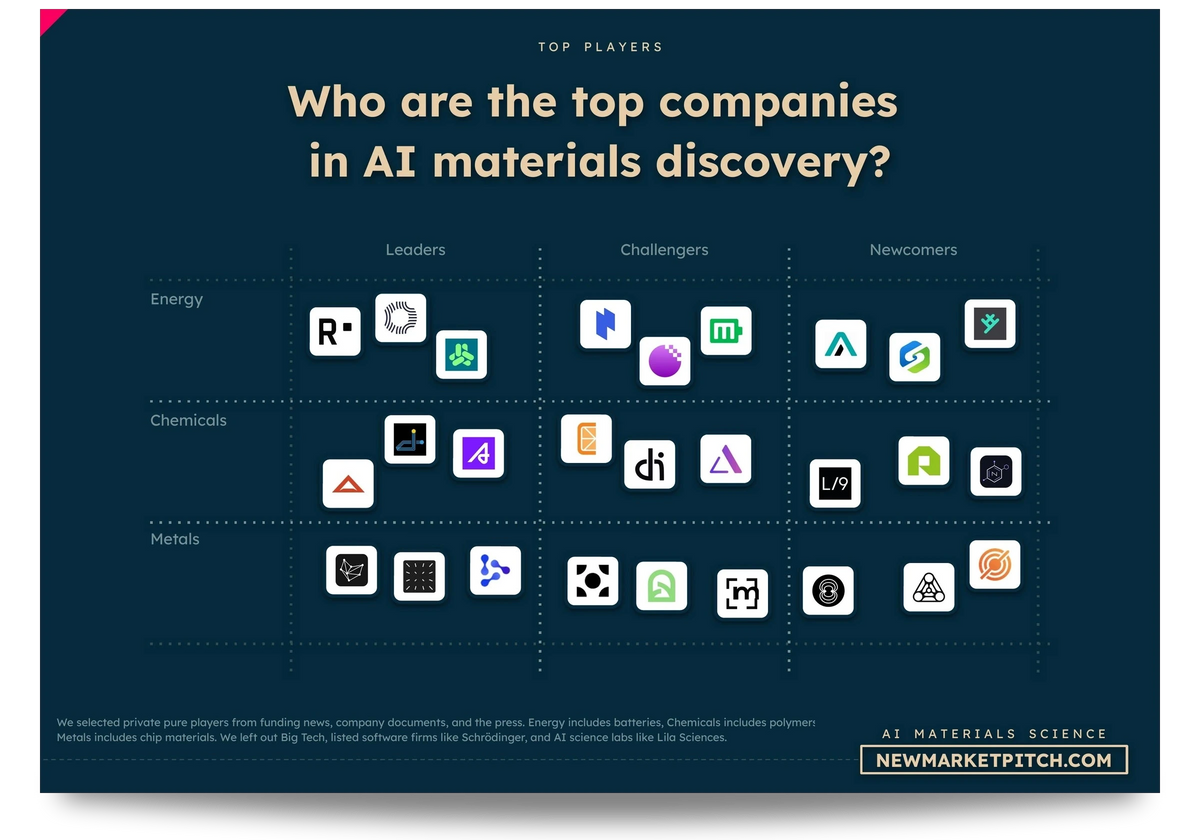
In our report covering the AI materials discovery market, we turn what is vague and complex into simple, useful visuals. Market maps like this one show you at a glance where every startup stands.
The ranking of top startups in the AI materials discovery market by revenue
Below is a table ranking the startups of this market by their current revenue scale. You can find our methodology at the end of this page.
If you want a deeper understanding of the market and its current dynamics, get our report on the AI materials discovery market.
| Ranking | Company | Latest Metric | Metric Type | Freshness | Disclosed When | Source Quality | Confidence | Segment | Why This Ranking | Local Metric | Country |
|---|---|---|---|---|---|---|---|---|---|---|---|
| 1 | XtalPi | ~$36.8M | Segment Revenue | Fresh · 10mo | Mar 25, 2026 | Filed / Audited | Medium | AI Science Platforms | Ranks ahead of larger modeled figures because it has audited segment sales; the segment also contains robotics, molecular building blocks and nonmaterials applications. | CNY 265M | cn |
| 2 | Alloyed | ~$21.3M | Annual Revenue | Fresh · 10mo | Jan 2026 | Credible Reported | Medium | AI Alloy Design | Recognized company revenue is more defensible than larger modeled figures below, but includes components and manufacturing as well as computational alloy discovery. | £16.2M | gb |
| 3 | PhysicsX | ~$62.7M | Annual Revenue | Fresh · 13mo | Sep 14, 2026 | Third-Party Estimate | Low | Physics AI Engineering | The large modeled total is placed below directly reported sales because hardware and engineering simulation extend far beyond materials discovery. | gb | |
| 4 | Chemify | ~$39.5M | Annual Revenue | Fresh · 10mo | Sep 2, 2026 | Third-Party Estimate | Low | Autonomous Chemistry Labs | A large unconfirmed model estimate ranks above smaller estimates; chemistry synthesis and pharmaceutical discovery are also included, reducing materials comparability. | gb | |
| 5 | OTI Lumionics | ~$25–50M | Annual Revenue | Very Fresh · 1mo | Sep 2026 | Third-Party Estimate | Low | AI Electronic Materials | The recent, broad third-party estimate overlaps Chemify but is less precise; modeled sales of OLED materials are not isolated from AI-led discovery. | ca | |
| 6 | Albert Invent | ~$28.4M | Annual Revenue | Fresh · 13mo | Sep 10, 2026 | Third-Party Estimate | Low | AI Chemical Formulation | Below stronger disclosures and the wider OTI revenue range; the Growjo-derived annual estimate is not validated by filed accounts. | us | |
| 7 | Cambium Biomaterials | ~$50M | Segment Revenue | Aging · 20mo | Feb 2025 | Company Disclosed | Low | AI Composite Materials | The figure is legacy SHD composite-manufacturing turnover, not Cambium consolidated or AI-discovery revenue; ranked conservatively despite its nominal size. | us | |
| 8 | NobleAI | ~$15.9M | Annual Revenue | Undated | Third-Party Estimate | Low | Materials Informatics | An undated model of enterprise-wide annual sales without verification; relative placement among modeled companies remains uncertain. | us | ||
| 9 | Uncountable | ~$13.1M | Annual Revenue | Undated | Third-Party Estimate | Low | Materials Informatics | An undated employee-driven estimate ranks below time-bounded revenue evidence; the company separately confirms more than 150 customers worldwide. | us | ||
| 10 | Citrine Informatics | $12.1M | Annual Revenue | Aging · 23mo | Aug 10, 2026 | Third-Party Estimate | Low | Materials Informatics | A dated $12.1M figure is favored over an undated ~$13.4M external model, but its original source is unrecorded; ranking remains tentative. | us | |
| 11 | Mitra Chem | ~$12.2M | Annual Revenue | Undated | Third-Party Estimate | Low | AI Battery Materials | Third-party company-wide revenue model, not confirmed battery-material sales; position relative to adjacent undated models is approximate. | us | ||
| 12 | CuspAI | ~$7.5M | Annual Revenue | Undated | Third-Party Estimate | Low | Generative Materials AI | The broad third-party model is less reliable than official partner-adoption evidence; more than 45 foundry partners are not necessarily customers. | gb | ||
| 13 | MaterialsZone | ~$5.9M | Annual Revenue | Undated | Third-Party Estimate | Low | Materials Informatics | Undated algorithmic revenue estimate; the platform spans R&D records and material-property discovery rather than solely AI design. | il | ||
| 14 | Alchemy Cloud | ~$5.1M | Annual Revenue | Undated | Third-Party Estimate | Low | AI Chemical Formulation | Model-based annual sales are unverified; industrial R&D workflow revenue is broader than standalone AI material discovery. | us | ||
| 15 | Simreka | ~$4.3M | Annual Revenue | Fresh · 13mo | Aug 10, 2026 | Third-Party Estimate | Low | Materials Informatics | The date-bounded modeled revenue is useful but unconfirmed and should not outrank comparable verified annual revenue figures. | de | |
| 16 | Polymerize | ~$4.2M | Annual Revenue | Fresh · 13mo | Aug 10, 2026 | Third-Party Estimate | Low | Materials Informatics | A modeled estimate, rather than revenue disclosed by management; company separately reports 500 or more R&D teams using the platform. | sg | |
| 17 | Kebotix | ~$3.5M | Annual Revenue | Undated | Third-Party Estimate | Low | Autonomous Materials Labs | A low-confidence employee-based estimate for a self-driving materials lab; no recognized sales confirmation or dating. | us | ||
| 18 | Quantistry | ~$2.2M | Annual Revenue | Fresh · 13mo | Sep 18, 2025 | Third-Party Estimate | Low | Atomistic Simulation | A smaller but date-bounded model estimate, not verified customer spending; chemistry simulation includes material and molecular R&D. | de | |
| 19 | ExoMatter | ~$1.6M | Annual Revenue | Undated | Third-Party Estimate | Low | AI Materials Selection | Undated modeled revenue for AI-assisted materials selection, beneath newer and better-specified estimates. | de | ||
| 20 | Materials Nexus | ~$1.3M | Annual Revenue | Undated | Third-Party Estimate | Low | Generative Materials AI | Undated estimate of total company sales; computational material design is central but revenue has not been confirmed. | gb | ||
| 21 | MI-6 | >200 paying customers | Paying Customers | Very Fresh · 5mo | May 26, 2026 | Company Disclosed | Low | Materials Informatics | A directly reported paying-company count indicates real SaaS adoption, but no contract value or revenue is available; ranks below any quantified sales. | jp | |
| 22 | Mat3ra | >30K users | Users | Very Fresh · 4mo | Jun 2026 | Company Disclosed | Low | Atomistic Simulation | A large platform user figure is not a paying-customer metric; ranks below MI-6 because purchasing activity is unquantified. | us | |
| 23 | SandboxAQ | $500M | Other Scale Signal | Very Fresh · 4mo | Jun 17, 2026 | Company Disclosed | Low | AI Quantum Chemistry | The $500M government R&D award is neither earned revenue nor private bookings; a strong project-scale signal deliberately ranks below revenue and adoption figures. | us | |
| 24 | Orbital Industries | 1 enterprise license | Other Scale Signal | Very Fresh · 2mo | Aug 5, 2026 | Company Disclosed | Low | Generative Materials AI | A named enterprise platform deployment demonstrates monetization potential, but license value and total number of paying customers are unknown. | gb | |
| 25 | Novyte Materials | ~7–9 paying customers | Paying Customers | Very Fresh · 3mo | Jul 8, 2026 | Credible Reported | Low | Materials Informatics | Founder-confirmed early paying adoption is more concrete than unreported peers; ~7–9 is an approximate interpretation, not an exact disclosed count. | in | |
| NR | Lila Sciences | Not disclosed | Other Scale Signal | Undated | Company Disclosed | Low | Autonomous Materials Labs | Materials and chemistry self-driving labs are core to the platform; financing and laboratory scale are not evidence of recognized customer sales. | us | ||
| NR | Periodic Labs | Not disclosed | Other Scale Signal | Undated | Company Disclosed | Low | Autonomous Materials Labs | Automated physical experiments aim to discover new materials, but the company has published no comparable commercial-scale measure. | us | ||
| NR | Radical AI | Not disclosed | Other Scale Signal | Undated | Company Disclosed | Low | Autonomous Materials Labs | Published scientific experiment counts are research throughput, not purchases; no verified sales or paying-client count. | us | ||
| NR | Dunia | Not disclosed | Other Scale Signal | Undated | Company Disclosed | Low | Autonomous Materials Labs | Autonomous materials experiments and industrial collaborations are documented, but contract value and revenue are not reported. | de | ||
| NR | Entalpic | Not disclosed | Other Scale Signal | Undated | Company Disclosed | Low | Generative Materials AI | AI catalysts and atomistic materials design have scientific and industrial partnerships, without disclosed revenue. | fr | ||
| NR | DP Technology | Not disclosed | Other Scale Signal | Undated | Company Disclosed | Low | AI Science Platforms | Scientific AI covers both materials and drug design; no reliable materials segment revenue is reported. | cn |

Our research about AI for materials discovery gets updated several times a month, so you always get the latest view of where things stand.
Why are AI materials discovery startups attracting so much attention now?
AI materials discovery startups are getting much more attention because several companies have started turning their technology into industrial products, while investors are pouring hundreds of millions into the next generation of automated scientific laboratories.
In June 2026, PhysicsX raised $300M at an approximately $2.4B valuation. A month later, CuspAI announced a $450M financing round at a $2.6B valuation and launched an AI Materials Foundry involving more than 45 partners. Meanwhile, XtalPi reported 62.6% annual growth in its AI for Science intelligent solutions business for FY2025.
These three companies show how quickly the market is changing. PhysicsX already sells AI engineering software to industrial customers. CuspAI is building a network of AI models, scientific data, computing resources, and laboratories. XtalPi has an established business generating reported revenue from scientific automation.
The demand comes from industries with expensive development problems. Semiconductor manufacturers need new process chemicals, battery developers are searching for better materials, and aerospace companies want components that are lighter, stronger, or more resistant to extreme temperatures.
What has changed is the amount of money and industrial infrastructure going into AI-driven discovery. The interesting question now is which startups are actually making money from these technologies, rather than simply raising capital to develop them.
Which AI materials discovery startups make the most revenue?
XtalPi currently ranks first among AI materials discovery startups by revenue, followed by Alloyed, PhysicsX, Chemify, and OTI Lumionics.
XtalPi recorded CNY 265M (~$36.8M) in FY2025 AI for Science intelligent solutions revenue. Alloyed reported £16.2M (~$21.3M) in annual revenue for 2025. PhysicsX, in third place, has a much larger externally estimated figure of ~$62.7M, but it has not confirmed that amount through published accounts.
The difference comes down to the evidence behind the numbers. XtalPi has audited segment sales, and Alloyed has reported company revenue. PhysicsX, Chemify, OTI Lumionics, and several others rely on third-party estimates that may cover activities beyond materials discovery.
Cambium Biomaterials is another special case. Its ~$50M benchmark comes from legacy SHD Composite Materials turnover before the acquisition, rather than from Cambium's consolidated AI materials business.
The first ten positions show how varied this market already is. The ranking weighs financial evidence alongside revenue scale, rather than simply sorting unverified estimates from largest to smallest.
| Rank | Startup | Revenue or estimate | Metric and period |
|---|---|---|---|
| 1 | XtalPi | CNY 265M | Segment revenue, FY2025 |
| 2 | Alloyed | £16.2M | Annual revenue, 2025 |
| 3 | PhysicsX | ~$62.7M | Estimated annual revenue, Sep 2025 |
| 4 | Chemify | ~$39.5M | Estimated annual revenue, 2025 |
| 5 | OTI Lumionics | ~$25–50M | Estimated annual revenue, Sep 2026 |
| 6 | Albert Invent | ~$28.4M | Estimated annual revenue, Sep 2025 |
| 7 | Cambium Biomaterials | ~$50M | Legacy SHD turnover, Feb 2025 reference |
| 8 | NobleAI | ~$15.9M | Estimated annual revenue, undated |
| 9 | Uncountable | ~$13.1M | Estimated annual revenue, undated |
| 10 | Citrine Informatics | $12.1M | Third-party annual revenue figure, Nov 2024 |

In our market report about AI for materials discovery, we look at what the winners do differently, so you can learn from the best instead of guessing.
How much revenue does XtalPi make from AI materials discovery?
XtalPi is the highest-ranked AI materials discovery startup, with CNY 265M (~$36.8M) in FY2025 AI for Science intelligent solutions revenue, up 62.6% from the previous year.
According to XtalPi's 2025 annual report, this segment generated CNY 264.69M, compared with CNY 162.77M in FY2024. That's an increase of approximately CNY 102M in a year.
The longer history is even more interesting. Revenue from the business now called AI for Science intelligent solutions rose from CNY 23.45M in FY2021 to CNY 264.69M in FY2025, an increase of roughly 11.3 times over four years. Growth has been sustained across several reporting periods rather than coming from one unusually large contract.
XtalPi's business covers intelligent robotics, scientific software, automated laboratories, and applications spanning both materials development and biopharmaceuticals. Its reported segment revenue therefore cannot be treated as exclusively materials-discovery sales.
The company also operates a much larger drug discovery business, which we keep separate from the selected figure.
Still, XtalPi stands out because we can trace its commercial growth through audited financial statements. Very few competitors offer that level of visibility.
Is Alloyed one of the biggest AI materials discovery startups?
Alloyed is the second-ranked AI materials discovery startup by revenue, with £16.2M (~$21.3M) in reported 2025 annual sales and an established business making advanced metal components.
The Sunday Times 100 Tech ranking published in early 2026 reported that Alloyed had achieved three-year annual sales growth of 53.19%. Exports accounted for more than half its revenue, and customers included Microsoft, Google, and BMW.
Alloyed combines computational alloy design with additive manufacturing and specialist metal-component production. Its technology helps engineers develop materials with specific mechanical properties and manufacture components that take advantage of those properties.
This business model gives Alloyed several ways to make money. It can work on new alloys, offer engineering expertise, and manufacture physical products for industrial customers.
More than half of sales coming from international customers suggests Alloyed has found demand well beyond its original UK engineering network.
Its £16.2M figure covers the broader company, including manufacturing. Nevertheless, those are reported commercial sales, giving Alloyed stronger financial evidence than most private AI materials startups.

In our document detailing everything you need to know about AI materials discovery, you will always find fresh funding data, taken straight from our own verified funding database.
Is PhysicsX already making more revenue than other AI materials startups?
PhysicsX has one of the largest estimated revenue figures among AI materials discovery startups, at ~$62.7M as of September 2025, but its third-place ranking reflects the weaker evidence behind that amount.
The estimate comes from GetLatka and has not been confirmed by the company. PhysicsX has, however, disclosed several useful growth figures.
In June 2026, PhysicsX announced that recognized revenue had doubled year over year, booked revenue had tripled, and its customer count had more than doubled over the previous year.
The distinction between recognized and booked revenue is important here. The first measures revenue recorded under accounting rules, while the second captures contracted business that may be delivered later. PhysicsX reported strong growth in both.
The company's AI models help engineers simulate physical behavior and test designs across aerospace, semiconductors, automotive, energy, and industrial machinery. Materials discovery is one application within this wider engineering business.
PhysicsX also raised $300M at an approximately $2.4B valuation in June 2026. That financing gives it considerable resources to expand, although the valuation should not be confused with revenue.
Among the higher-ranked companies, PhysicsX has some of the clearest company-reported growth indicators. What remains missing is a verified revenue total that would allow a direct financial comparison with XtalPi and Alloyed.
Are Chemify and OTI Lumionics making significant revenue?
Chemify and OTI Lumionics appear to have built substantial commercial operations, with estimated annual revenue of ~$39.5M and ~$25–50M respectively, although neither estimate has been independently confirmed.
Chemify ranks fourth with an estimated ~$39.5M for 2025. Its technology combines AI, chemical programming, and robotics to design and synthesize molecules. The company works across chemistry, pharmaceuticals, and materials development.
Its Chemifarm facility in Glasgow represents an important part of that strategy. Chemify wants to automate the production and testing of compounds, allowing customers to move from a digital chemical design to an actual synthesized molecule.
OTI Lumionics ranks fifth with a modeled ~$25–50M annual revenue range as of September 2026. The company specializes in advanced electronic materials, particularly for OLED displays.
According to an engineering case study published by Beckhoff in June 2025, OTI introduced an automated materials-testing system that tripled testing throughput. The system supports precisely controlled deposition and validation of advanced electronic materials.
That threefold improvement is a measurable operational result. It shows how automation can increase the number of materials a laboratory evaluates without expanding manual testing at the same rate.
Chemify is building a broad automated chemistry platform, while OTI is more closely tied to specific electronic-material applications. Both combine computational methods with physical laboratory work, and both have broader activities than pure AI discovery software.

Learning from others' mistakes is the cheapest lesson there is. In our report covering the AI materials discovery market, we look at what broke startups before you, so you don't repeat it.
How big are Albert Invent and Cambium Biomaterials today?
Albert Invent ranks sixth with approximately ~$28.4M in estimated annual revenue, while Cambium Biomaterials ranks seventh using a ~$50M legacy manufacturing benchmark from SHD Composite Materials.
Albert sells software for chemical R&D and formulation development. Its platform helps scientists organize experiments, analyze historical data, predict results, and develop new formulations.
In October 2026, Albert announced a $55M Series B financing. The company identified relationships with major industrial businesses including AkzoNobel, Avient, BASF, Chemours, Henkel, and Nouryon.
Those customer relationships offer more concrete evidence of commercial adoption than the financing itself. However, Albert's ~$28.4M revenue estimate remains unverified.
Cambium operates a different business. In December 2025, it acquired SHD Composite Materials, an established manufacturer of advanced composites with facilities in the United Kingdom, United States, and Slovenia.
The approximately $50M turnover benchmark refers to SHD before the acquisition. It cannot be presented as Cambium's consolidated revenue or revenue generated specifically by AI materials discovery.
The acquisition gave Cambium manufacturing facilities, an existing customer base, and experience producing qualified composites for demanding industries.
These are two quite different ways to build a materials business. Albert sells R&D software, while Cambium combines computational materials development with physical manufacturing.
Which AI materials discovery startups have more than $10M in revenue?
Eleven AI materials discovery startups have selected revenue figures or estimates above $10M, although only a few have sufficiently strong public disclosures to confirm the amounts independently.
The group includes XtalPi, Alloyed, PhysicsX, Chemify, OTI Lumionics, Albert Invent, Cambium Biomaterials, NobleAI, Uncountable, Citrine Informatics, and Mitra Chem, in ranking order.
The gap in evidence is striking. XtalPi's figure comes from audited segment results, and Alloyed's from reported annual sales. Cambium's selected amount relates to an acquired manufacturer's legacy turnover. Most of the other companies have figures generated or recorded by external financial-data providers.
Several of those estimates are also undated. We cannot assume an undated revenue model reflects the company's current sales simply because the number remains visible online.
There are also differences in what the companies sell. A software vendor's annual revenue, a chemistry laboratory's project revenue, and a manufacturer's component sales represent different commercial activities.
The $10M threshold therefore identifies companies with meaningful reported or estimated monetary scale. It does not establish that all eleven have independently confirmed more than $10M in annual AI materials discovery revenue.

Your time is limited. In our research about AI for materials discovery, we put numbers on each part of the market, so you can see where it makes sense to focus.
Are materials informatics startups making real money?
Materials informatics startups are already selling software to industrial R&D teams, with NobleAI, Uncountable, and Citrine Informatics occupying three consecutive positions in the revenue ranking.
NobleAI ranks eighth with approximately ~$15.9M in modeled annual revenue. Uncountable follows at ~$13.1M, while Citrine Informatics ranks tenth with a $12.1M third-party annual revenue figure dated November 2024.
All three companies focus on using scientific data to improve materials development. Their platforms help scientists connect experimental results, identify useful patterns, and predict the behavior of new formulations.
Uncountable has one of the clearest adoption indicators. Its platform is deployed by more than 175 enterprise product-development teams, according to the company.
That count does not reveal annual revenue, but it shows the software is being used in real industrial environments.
Polymerize is another example. Ranked sixteenth with approximately ~$4.2M in estimated annual revenue as of September 2025, it reports more than 500 R&D teams using its platform across 12 industries.
These products address a familiar problem for industrial laboratories: years of experiments are often scattered across spreadsheets, notebooks, and disconnected software systems.
Researchers can use their existing data to make better decisions without having to repeat every experiment.
The largest remaining uncertainty is how much these companies earn per enterprise account. Team adoption and modeled revenue offer useful clues, but neither establishes contract value, retention, or profitability.
Which smaller AI materials discovery startups are generating revenue?
Mitra Chem, CuspAI, MaterialsZone, Alchemy Cloud, Simreka, Polymerize, Kebotix, Quantistry, ExoMatter, and Materials Nexus occupy positions 11 through 20, with selected monetary figures ranging from ~$12.2M to ~$1.3M.
Several focus on specific materials problems. Mitra Chem works on battery chemistry, CuspAI develops generative AI for materials, and Materials Nexus uses computational methods to discover new material compositions.
Others sell R&D tools. MaterialsZone focuses on materials data, Alchemy Cloud supports industrial formulation workflows, Quantistry offers computational chemistry capabilities, and ExoMatter helps companies identify suitable materials.
The ten companies show how fragmented this part of the market remains. Some sell software subscriptions, some offer engineering or scientific services, and others are working toward commercializing their own material discoveries.
Most of their revenue amounts are unverified external estimates. They help establish an approximate order of magnitude, but stronger disclosures are needed for precise comparisons.
| Rank | Startup | Revenue or estimate | Metric and period |
|---|---|---|---|
| 11 | Mitra Chem | ~$12.2M | Estimated annual revenue, undated |
| 12 | CuspAI | ~$7.5M | Estimated annual revenue, undated |
| 13 | MaterialsZone | ~$5.9M | Estimated annual revenue, undated |
| 14 | Alchemy Cloud | ~$5.1M | Estimated annual revenue, undated |
| 15 | Simreka | ~$4.3M | Estimated annual revenue, Sep 2025 |
| 16 | Polymerize | ~$4.2M | Estimated annual revenue, Sep 2025 |
| 17 | Kebotix | ~$3.5M | Estimated annual revenue, undated |
| 18 | Quantistry | ~$2.2M | Estimated annual revenue, Sep 2025 |
| 19 | ExoMatter | ~$1.6M | Estimated annual revenue, undated |
| 20 | Materials Nexus | ~$1.3M | Estimated annual revenue, undated |

In our market report about AI for materials discovery, we always try to gather several sources and make estimates that make sense, so you can work with solid numbers.
Is CuspAI already a major AI materials discovery business?
CuspAI is already one of the most prominent AI materials discovery startups, but its estimated ~$7.5M annual revenue is far less certain than its $450M financing round and growing industrial network.
The company ranks twelfth on revenue, using an undated third-party estimate. Its commercial and scientific ambitions are considerably larger.
In July 2026, CuspAI launched its AI Materials Foundry, bringing together more than 45 founding partners. The network includes companies such as NVIDIA, Meta, Samsung, Hyundai Motor Group, Applied Materials, and Tokyo Electron.
The initiative connects computing resources, scientific datasets, laboratory expertise, and industrial partners. The goal is to speed up the process from AI-generated material candidates to physical testing.
CuspAI also raised $450M in a Series B round at a $2.6B valuation. That is an unusually large amount of funding for a company founded in 2024.
Its foundry partnerships could become valuable commercially, especially if the platform helps manufacturers discover materials they cannot easily develop internally.
But a partner may contribute scientific expertise, computing resources, data, or commercial access. There is no reason to assume all 45 partners are paying customers.
CuspAI has already assembled substantial resources for materials development. Its current revenue position is much less firmly established.
Are AI battery materials startups generating meaningful sales?
AI battery materials startups have started generating measurable commercial activity, but reliable revenue disclosures remain scarce.
Mitra Chem ranks eleventh with approximately ~$12.2M in externally estimated annual revenue. The company uses AI and materials science to accelerate the development of battery materials, including cathode chemistries.
Battery development is an appealing market for AI because scientists must optimize several properties at once. Energy density, durability, safety, cost, raw-material availability, and manufacturing performance can all pull a chemistry in different directions.
Computational models can help narrow the candidates before expensive physical testing begins. However, promising laboratory performance does not guarantee that a battery material will work economically in large-scale production.
The development process includes repeated testing, manufacturing validation, and qualification by battery producers or their customers. These stages can take considerably longer than developing conventional enterprise software.
Mitra Chem's estimated revenue is also company-wide. We cannot isolate the amount earned specifically from AI discovery tools.
Battery materials could become one of the largest commercial applications for AI-driven discovery, given demand from electric vehicles and stationary energy storage. The current revenue evidence, though, remains much smaller than the overall battery industry's scale.

If you build or invest in the AI materials discovery market, you need to know which business models pay off now and which ones are fading. That's why our report covering it has a whole section on it.
Are AI materials discovery startups actually creating new materials?
AI materials discovery startups have already produced physically validated materials, with Materials Nexus, OTI Lumionics, and Cambium Biomaterials showing three different paths from computational design to industrial products.
Materials Nexus announced MagNex in June 2024, a rare-earth-free permanent magnet designed using its AI platform and synthesized with partners including the Henry Royce Institute and the University of Sheffield.
The result showed that AI-assisted discovery could generate a material candidate that scientists could actually make and test. Manufacturing it economically at large scale remains a separate challenge.
OTI Lumionics is further along in a specialized commercial field. Its work on OLED materials combines quantum simulation, machine learning, and physical testing for applications in consumer electronics and automotive displays.
Cambium approaches materials innovation through manufacturing. Its acquisition of SHD brought production facilities and established composites expertise into a business already developing advanced materials.
These cases show why the market includes much more than software subscriptions. The real commercial prize can be a proprietary material, a better manufacturing process, or an industrial component with properties competitors struggle to reproduce.
Can autonomous AI laboratories become profitable businesses?
Autonomous AI materials laboratories have a credible business model, but we still lack enough public financial evidence to establish whether they can generate attractive profits at scale.
Chemify and Kebotix are useful examples. Both combine computational methods with robotic experimentation, allowing AI systems to guide physical laboratory work.
Chemify uses its Chemputation approach to automate chemical synthesis, while Kebotix has developed technology for self-driving materials development.
These systems can reduce repetitive manual work and allow scientists to evaluate more candidates. A laboratory that completes experiments faster can potentially serve more customers or make better use of expensive equipment.
However, the costs are very different from those of a conventional software business. Autonomous laboratories require facilities, instruments, consumables, maintenance, trained personnel, and substantial upfront investment.
A company operating its own laboratory can charge customers for scientific and synthesis services. Alternatively, it can license automation software or sell systems that customers operate in their own facilities.
Both models can generate revenue, but they have different margins and capital requirements.
The dependence on physical testing is particularly important. CuspAI's foundry network, Chemify's automated synthesis facilities, and OTI Lumionics' materials-testing equipment all reflect the same practical reality: industrial customers need evidence that a new material performs reliably outside a simulation.
For now, the technology has demonstrated operational value, but the profitability of autonomous materials laboratories remains largely unproven through public accounts.

In our report covering the AI materials discovery market, we don't want to repeat what boring consulting reports say. Instead, we show you the real and latest market signals that matter.
Is SandboxAQ the biggest AI materials discovery company?
SandboxAQ has secured one of the largest publicly documented government R&D awards in AI materials discovery, but its $500M agreement is not annual revenue.
The company occupies the twenty-third position in the broader commercial-scale ranking, based on a $500M CHIPS R&D award announced by the U.S. Department of Commerce in June 2026.
According to the National Institute of Standards and Technology, the award supports AI-driven discovery of materials relevant to semiconductor manufacturing.
The work includes alternatives to PFAS chemicals, advanced catalysts, rare-earth-free magnets, and new battery chemistries. These are commercially important applications because they address production needs and supply-chain vulnerabilities.
The government's involvement is substantial. A project of this size can support advanced computing, scientific personnel, laboratory infrastructure, and long-term materials-development programs.
SandboxAQ also combines AI with computational chemistry and physics-based simulation, giving it a wider scientific platform than a company focused on one specific material.
Still, the $500M represents a government R&D award rather than revenue already recognized from selling products and services.
SandboxAQ could become a major supplier of AI-developed materials technologies. Its actual annual revenue from materials discovery remains undisclosed.
Which AI materials discovery startups already have paying customers?
MI-6 and Novyte Materials have disclosed paying-customer indicators, while Orbital Industries has confirmed an enterprise software license. These startups offer stronger evidence of customer activity than their undisclosed revenue might suggest.
MI-6 ranks twenty-first with more than 200 corporate miHub clients as of May 2026. The Japanese company offers materials informatics software used in chemical, automotive, battery, electronics, and other manufacturing industries.
Its customer documentation specifies that paid subscriptions are included, excluding trial and academic usage. That makes the figure particularly useful when assessing commercial adoption.
Mat3ra follows in twenty-second position, reporting more than 30K scientists using its computational materials platform as of June 2026. It also identifies enterprise and scientific-sector customers, although its user total does not establish how many pay.
Orbital Industries ranks twenty-fourth. In August 2026, BASF Environmental Catalyst and Metal Solutions announced a license for Orbital's CurieOS platform to support catalyst discovery.
That is a named commercial agreement with a major industrial customer, although the contract value was not disclosed.
Novyte Materials ranks twenty-fifth with approximately 7–9 paying customers, based on founder comments reported by Inc42 in July 2026.
These figures describe very different levels of adoption. MI-6 has an established paying corporate customer base, Mat3ra has broad scientific usage, Orbital has a disclosed enterprise license, and Novyte is still building its first commercial relationships.
| Rank | Startup | Commercial-scale indicator | Period |
|---|---|---|---|
| 21 | MI-6 | >200 paying customers | May 2026 |
| 22 | Mat3ra | >30K users | Jun 2026 |
| 23 | SandboxAQ | $500M government R&D award | Jun 2026 |
| 24 | Orbital Industries | 1 enterprise license | Aug 2026 |
| 25 | Novyte Materials | ~7–9 paying customers | Jul 2026 |

In our research about AI for materials discovery, we like to show you the big picture. We know your time is precious, so we make every page quick to read and packed with as much learning as possible per minute.
Are Lila Sciences and Periodic Labs already making significant revenue?
Lila Sciences and Periodic Labs are attracting attention for their automated scientific platforms, but neither has disclosed a reliable revenue figure that would establish significant annual sales.
Both companies are developing systems that combine AI models with laboratory experimentation. Their goal is to make scientific discovery more automated, allowing machines to propose, perform, and analyze experiments.
Lila Sciences is developing an autonomous platform across chemistry and materials science. Periodic Labs is also working on AI-guided experimentation, with a focus on discovering and improving physical materials.
These approaches could become valuable if customers can use the platforms to reduce development time or discover materials that would otherwise require years of scientific work.
The harder commercial questions are still unanswered. We do not have comparable annual sales, recurring contract values, customer-retention figures, or laboratory operating margins.
Both companies remain unranked on revenue, despite their relevance to the future of AI-driven materials discovery.
What about Radical AI, Dunia, Entalpic, and DP Technology?
Radical AI, Dunia, Entalpic, and DP Technology are serious participants in AI materials discovery, but their public disclosures do not establish comparable annual revenue.
Radical AI and Dunia focus on using AI and automated experimentation to accelerate scientific development. Their technologies target the expensive process of discovering and testing new materials.
Entalpic concentrates on AI-driven chemistry and catalyst discovery, including the development of materials relevant to industrial chemical processes.
DP Technology operates a broader scientific AI platform, covering molecular modeling, chemistry, and materials applications. Its software capabilities extend beyond materials discovery into other scientific areas.
The companies could eventually make money through software licensing, industrial contracts, partnerships, or intellectual-property commercialization.
For now, those potential business models do not tell us enough about annual sales. All four remain unranked, without any implied revenue comparison against the numbered startups.

When you build or invest in the AI materials discovery market, you need clarity, not confusion. In our market report about AI for materials discovery, we always try to put numbers on and quantify whatever is usually vague and confusing.
Are AI materials discovery startups mostly software companies?
AI materials discovery startups fall into several distinct business categories, and the companies generating revenue are often selling much more than AI software.
NobleAI, Uncountable, Citrine Informatics, MaterialsZone, Alchemy Cloud, Simreka, and Polymerize concentrate on software used in industrial R&D. These platforms help scientists manage experimental data, model material properties, and develop better formulations.
PhysicsX and Quantistry focus more heavily on physics and chemistry simulation. Their customers use computational tools to evaluate how materials, components, or molecules behave before conducting expensive physical experiments.
Chemify and Kebotix combine computational methods with automated laboratories. Their economics depend partly on physical experiments and scientific services.
Alloyed, OTI Lumionics, Cambium Biomaterials, and Mitra Chem are closer to the development or production of specialized materials and related industrial products.
This variety explains why revenue figures are difficult to compare directly. Software companies can generate recurring license income, while manufacturers may earn larger amounts from physical products but also face higher production costs.
The market has room for several types of business, particularly when software becomes closely connected to laboratory workflows or proprietary manufacturing processes.
Can AI materials discovery startups compete with established simulation companies?
AI materials discovery startups are already competing for industrial R&D spending, but established scientific software companies still have much larger verified revenue bases.
Schrödinger offers a useful comparison outside the startup ranking. Founded before 2000, the company reported $200M in FY2025 software revenue, including applications in pharmaceutical development and materials simulation.
Its software business grew 10.6% from FY2024, according to its February 2026 financial results. That offers a useful benchmark for the scale and growth of an established scientific computing company.
Newer startups compete through more specialized products. PhysicsX focuses on AI-driven engineering simulations, Citrine Informatics works on materials data and prediction, and CuspAI is building an infrastructure network for generative materials discovery.
The opportunity is to win specific engineering and laboratory workflows where newer AI techniques offer better speed, automation, or integration.
A startup does not need to replace an established simulation platform completely to build a successful business. It can begin by solving a narrow but expensive problem and expand from there.
However, no reliable aggregate financial figures show that AI-native materials startups have already captured a dominant share of the broader scientific simulation market.

A good product starts with a real problem. In our document detailing everything you need to know about AI materials discovery, we show you the ones customers still live with.
Could an AI materials discovery startup reach $100M in annual revenue?
An AI materials discovery startup could reach $100M in annual revenue, but none of the selected comparable startup revenue figures currently offers independently verified evidence that the threshold has been reached.
XtalPi has the strongest reported foundation, with CNY 265M in FY2025 AI for Science intelligent solutions revenue. Its 62.6% annual growth shows that commercial adoption has been increasing rapidly.
PhysicsX has also reported doubling recognized revenue and tripling booked revenue over a year, although it has not disclosed an exact verified total matching its third-party revenue estimate.
Alloyed offers another possible route through advanced manufacturing. Its 53.19% three-year annual sales growth, reported by the Sunday Times, shows that materials innovation can support a rapidly expanding industrial business.
The economics differ considerably. Software businesses can grow by expanding enterprise deployments and license spending. Manufacturing companies need production capacity and qualified customer orders. Autonomous laboratories must increase experimental throughput while controlling their operating costs.
The companies closest to $100M may therefore come from different parts of the market.
Several startups have credible growth or adoption indicators. A verified $100M annual revenue milestone from a dedicated AI materials business is still missing from the current ranking.
Which AI materials discovery startup is winning the revenue race today?
XtalPi currently leads the AI materials discovery startup revenue ranking, with CNY 265M (~$36.8M) in FY2025 AI for Science intelligent solutions revenue. Alloyed ranks second with £16.2M (~$21.3M) in reported 2025 sales, followed by PhysicsX with an estimated ~$62.7M as of September 2025.
The ranking reflects both the amount of revenue and the quality of the evidence. XtalPi's audited segment results and Alloyed's reported sales are stronger than the third-party estimates available for most competitors.
We also find that the companies already earning money often combine AI with established industrial activities. Some sell scientific software, others offer simulation and engineering services, and several manufacture physical materials or components.
That leaves room for the next generation of generative AI and autonomous-laboratory startups. CuspAI, Lila Sciences, Periodic Labs, and other emerging companies are developing ambitious scientific platforms, but their visibility and investment backing currently exceed the strength of their disclosed sales figures.
For now, XtalPi has the strongest claim to first place under our ranking. The broader market is still young enough that future revenue growth could change the competitive picture substantially.

It's easy to get lost in the details. In our report covering the AI materials discovery market, we give you some perspective first, so you see the whole market before you make a move.
Our methodology
This analysis ranks AI materials discovery startups by their documented commercial scale as of November 2026, with revenue as the primary measure. We compare annual revenue, fiscal-year sales, business-segment revenue, recurring revenue, and third-party estimates, while keeping customer adoption and other commercial activity separate from actual sales.
We apply one startup definition across markets. A company qualifies if it was founded in 2000 or later, has never been publicly listed or first listed within the past five years, and is independent rather than a division of a larger operating group. Startups acquired within the past three years remain eligible and are presented as part of their acquirer. Older established businesses, including Schrödinger, serve only as external benchmarks.
Our ranking prioritizes source quality, financial relevance, and recency rather than mechanically sorting all monetary figures. Audited financial statements and attributable company sales take precedence over modeled estimates. When companies disclose only customer counts, platform usage, licensing agreements, or commercial partnerships, we retain those indicators without converting them into hypothetical revenue.
Business scope is important in this market. XtalPi's selected revenue covers its AI for Science intelligent solutions segment, which also serves biopharmaceutical applications. Alloyed's annual sales include advanced manufacturing, while PhysicsX operates across industrial engineering. Cambium's ~$50M benchmark refers to SHD Composite Materials before its acquisition. These amounts are not interchangeable with revenue earned exclusively from AI materials discovery.
We also separate funding, government awards, bookings, valuations, and partnership announcements from recognized sales. This distinction applies particularly to CuspAI's $450M financing and foundry network, PhysicsX's reported growth in booked revenue, and SandboxAQ's $500M CHIPS R&D award. Such figures demonstrate financial backing or commercial activity but cannot establish annual revenue by themselves.
We reviewed public disclosures spanning the previous ten years, giving particular weight to recent audited accounts, official company announcements, government records, reputable financial reporting, and specific evidence of paying customers. Third-party revenue estimates are identified as such, especially when their calculation methods or reporting periods are unclear.
Key financial sources include XtalPi's FY2025 annual report, XtalPi's financial results announcement, The Sunday Times on Alloyed's annual sales, and PhysicsX's June 2026 financing and growth announcement. We also use Schrödinger's FY2025 financial results as an established-company benchmark.
For commercial developments and industrial validation, important sources include CuspAI's AI Materials Foundry announcement, Albert Invent's Series B announcement, Beckhoff's OTI Lumionics engineering case study, Cambium's SHD acquisition announcement, and the Aerospace Technology Institute's SHD supplier profile.
For adoption and public-sector commitments, we use Uncountable's enterprise platform information, MI-6's corporate customer announcement, MI-6's paying-customer documentation, Mat3ra's official company profile, Orbital Industries' BASF licensing announcement, and the National Institute of Standards and Technology's SandboxAQ announcement. We also reviewed Reuters reporting on CuspAI's financing and valuation.
In our report covering the AI materials discovery market, we turn what is vague and complex into simple, useful visuals. Market maps like this one show you at a glance where every startup stands.
Written by the New Market Pitch teamWe track new markets so founders and investors can move faster. About us