AI Note-taker Funding Tracker (30+ deals)
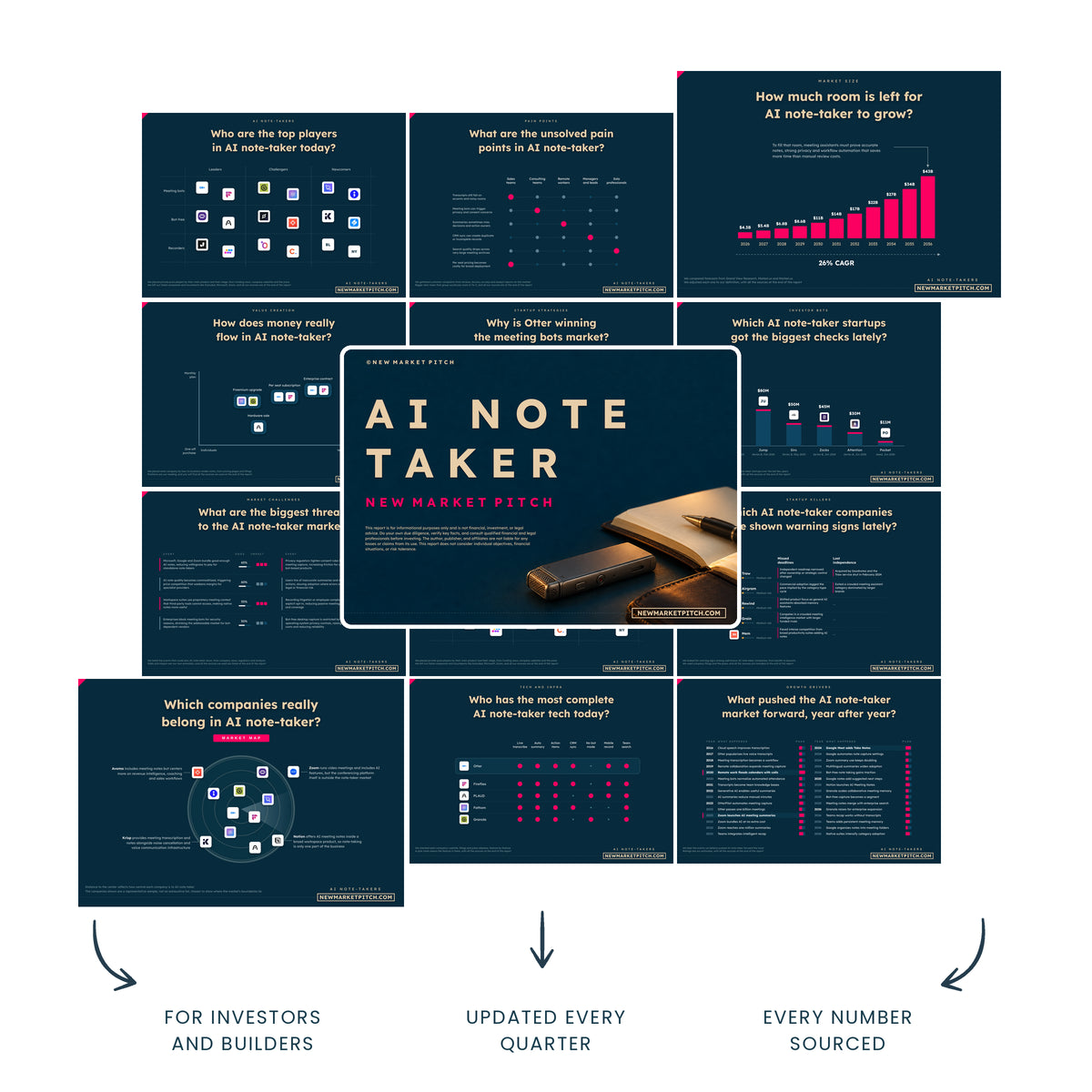
Whether you're building or investing in the AI note-taker market, our report covers everything you need to know: the players, the money, and what's coming next.
Summary
Since January 2024, AI note-taker startups have raised at least $584M in 32 deals involving 20 companies. Granola has attracted the most money, with $188M from 3 rounds. Granola's $125M Series C in March 2026 was also the largest single financing.
The headline makes this market look bigger than the experience of most founders. The median round is $11M, and just 2 deals above $50M brought in $205M. Strip those out and at least $379M remains.
Investors have been much more generous with products that do something useful after the meeting. Vertical meeting intelligence leads the categories by disclosed capital, with bot-free and local-first tools close behind. Basic meeting recaps attract far smaller checks.
Financial advisers show why the difference matters. Jump and Zocks use conversations to prepare client records, update other software and handle follow-ups. They are selling help with an adviser's working day, rather than another way to read a transcript.
That also explains the interest in meeting memory. Granola and Read AI want conversations to become useful information across a company, including outside the video call where the conversation happened.
Very few startups have made it far into later-stage financing. Seed accounts for 14 deals, versus 6 Series B deals and just 1 Series C. No qualifying Series D or growth round appears.
Repeat funding is hardly universal. Of the 20 companies, 12 have only 1 recorded deal. The 8 that returned for another round include several of the best-funded products.
The money is also overwhelmingly American. North America has 20 deals and $517M in disclosed funding, while startups in Asia-Pacific and Europe have recorded smaller checks. Their products still offer different approaches, especially to language and meeting capture.
AI recording devices are another small but active part of the market. Their appeal is obvious for conversations away from a laptop, but smartphones now handle more of the same recording and transcription work.
We see a real venture-backed market, though not a broad boom in interchangeable note-taking apps. The startups drawing the biggest checks make conversations useful in other tools or in specialist jobs. Google, Microsoft and Zoom have made the ordinary meeting summary much harder to sell on its own.

Written by the New Market Pitch teamWe track new markets so founders and investors can move faster. About us

In our report covering the AI note-taker market, you will always find fresh funding data, taken straight from our own verified funding database.
Our funding tracker covering the ai note taker market
Below is the table listing all the deals. You can find our methodology at the end of this page.
If you want a deeper understanding of the market and its current dynamics, get our ai note taker market report.
| Company | Category | Date | Stage | Deal size | What they do | Region | Lead investors | Country | Rank |
|---|---|---|---|---|---|---|---|---|---|
| Dedicated AI recording hardware | June 2026 | Seed | $11M | AI meeting notes and action tracking | North America | Accel | United States | ||
| Attention | Vertical meeting intelligence | June 2026 | Series B | $30M | AI agents executing revenue team workflows | North America | RTP Global | United States | |
| Future Intelligence | Dedicated AI recording hardware | May 2026 | Series A | $15M+ | Makes transcription earbuds for meetings and calls | Asia-Pacific | Not disclosed | China | |
| Granola | Bot-free and local-first | March 2026 | Series C | $125M | Creates AI-powered meeting notes | North America | Index Ventures | United States | |
| Quill Meetings | General-purpose meeting assistants | February 2026 | Seed | $6.5M | AI meeting notes and followups | North America | Basis Set Ventures | United States | |
| Jump | Vertical meeting intelligence | February 2026 | Series B | $80M | Conversational AI assistant for financial advisors | North America | Insight Partners | United States | |
| Zocks | Vertical meeting intelligence | January 2026 | Series B | $45M | Meeting assistant for financial advisory conversations | North America | Lightspeed Venture Partners, QED Investors | United States | |
| Notta | Multilingual and regional | December 2025 | Series B | $15M | Transcribes multilingual meetings and summarizes conversations | Asia-Pacific | Granite-Integral Capital | Japan | |
| Future Intelligence | Dedicated AI recording hardware | October 2025 | Series A | $14M+ | Makes transcription earbuds for meetings and calls | Asia-Pacific | Ant Group | China | |
| TwinMind | Bot-free and local-first | September 2025 | Seed | $5.7M | Ambient meeting transcription and memory assistant | North America | Not disclosed | United States | |
| MeetGeek | Team knowledge and workflow | September 2025 | Unknown | $1.9M | Records calls and automates meeting followups | Europe | Early Game Ventures | Romania | |
| Vinyl | Vertical meeting intelligence | August 2025 | Seed | $1.3M | AI meeting notes for accounting and bookkeeping firms | Asia-Pacific | Tidal Ventures | Australia | |
| Notta | Multilingual and regional | May 2025 | Series A | $6.9M | Transcribes multilingual meetings and summarizes conversations | Asia-Pacific | GL Ventures, Mizuho Leaguer Investments | Japan | |
| Noota | Multilingual and regional | May 2025 | Seed | $1.7M | Summarizes meetings and interviews across languages | Europe | Blast Club | France | |
| Granola | Bot-free and local-first | May 2025 | Series B | $43M | Creates AI-powered meeting notes | North America | NFDG | United States | |
| Zocks | Vertical meeting intelligence | March 2025 | Series A | $14M | Meeting assistant for financial advisory conversations | North America | Motive Ventures | United States | |
| The Plato | General-purpose meeting assistants | March 2025 | Seed | $543K | AI meeting notes and transcription | Asia-Pacific | Not disclosed | South Korea | |
| Jump | Vertical meeting intelligence | February 2025 | Series A | $20M | Conversational AI assistant for financial advisors | North America | Battery Ventures | United States | |
| Based Hardware | Dedicated AI recording hardware | January 2025 | Seed | $2M | Makes wearable open-source AI conversation memory device | North America | Tim Draper | United States | |
| Future Intelligence | Dedicated AI recording hardware | January 2025 | Seed | Undisclosed | Makes transcription earbuds for meetings and calls | Asia-Pacific | Wanwu Venture Capital | China | |
| Circleback | General-purpose meeting assistants | November 2024 | Seed | $2.5M | Automatically transcribes meetings and extracts action items | North America | Not disclosed | United States | |
| Read AI | Team knowledge and workflow | October 2024 | Series B | $50M | AI meeting summaries and workplace assistant | North America | Smash Capital | United States | |
| Granola | Bot-free and local-first | October 2024 | Series A | $20M | Creates AI-powered meeting notes | North America | Spark Capital | United States | |
| Attention | Vertical meeting intelligence | October 2024 | Series A | $14M | AI agents executing revenue team workflows | North America | Alven | United States | |
| Fathom | General-purpose meeting assistants | September 2024 | Series A | $17M | AI meeting recording and notes | North America | Telescope Partners | United States | |
| Based Hardware | Dedicated AI recording hardware | August 2024 | Seed | $700K | Makes wearable open-source AI conversation memory device | North America | Not disclosed | United States | |
| Tactiq | Bot-free and local-first | July 2024 | Series A | $7.3M | Captures live meeting captions and AI takeaways | Asia-Pacific | Flashpoint Ventures | Australia | |
| MeetRecord | Vertical meeting intelligence | June 2024 | Seed | $2.7M | Analyzes sales meetings and generates CRM summaries | Asia-Pacific | SWC Global | India | |
| Jump | Vertical meeting intelligence | June 2024 | Seed | $4.6M | Conversational AI assistant for financial advisors | North America | Sorenson Capital | United States | |
| Read AI | Team knowledge and workflow | April 2024 | Series A | $21M | AI meeting summaries and workplace assistant | North America | Goodwater Capital | United States | |
| Bluedot | Bot-free and local-first | April 2024 | Seed | $600K | Records browser meetings without a visible bot | Europe | Not disclosed | Ukraine | |
| Zocks | Vertical meeting intelligence | February 2024 | Seed | $5.5M | Meeting assistant for financial advisory conversations | North America | Lightspeed Venture Partners | United States |

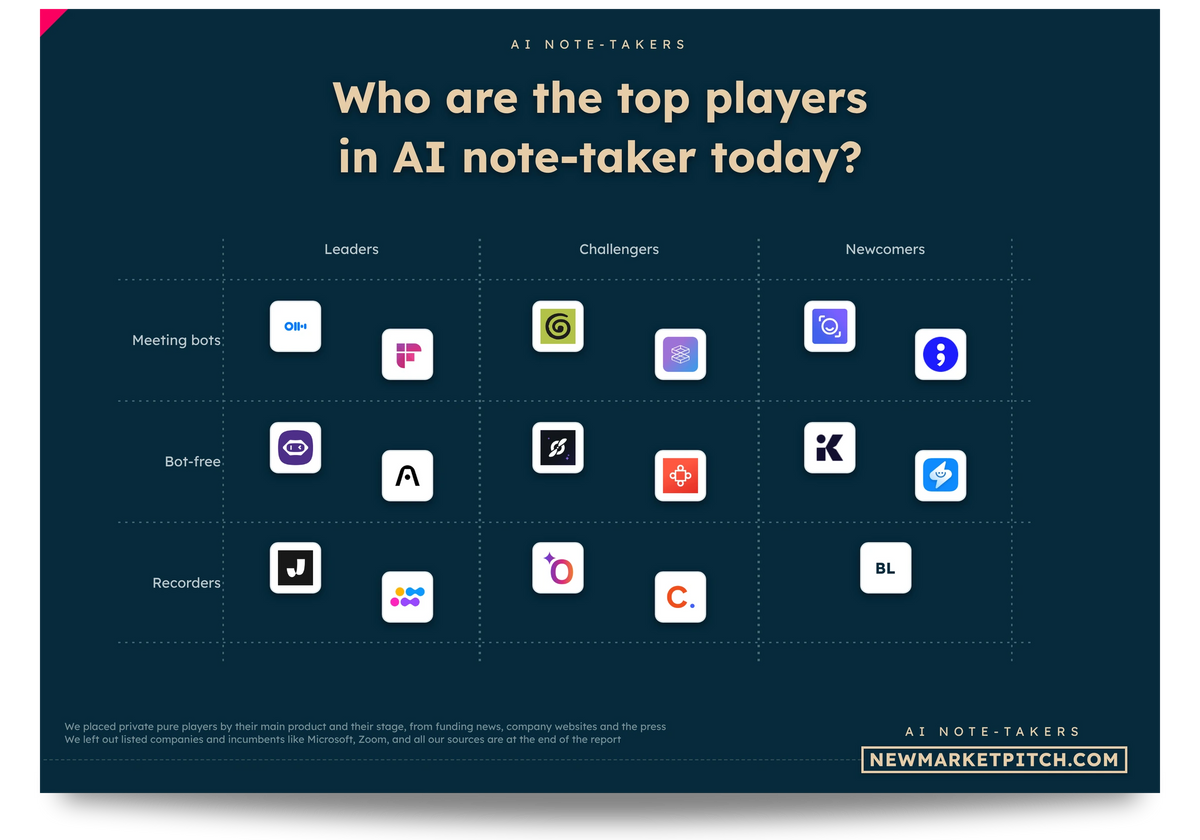
In our research about AI note-taker startups, we turn what is vague and complex into simple, useful visuals. Market maps like this one show you at a glance where every startup stands.
Is AI note-taker funding a big market yet?
AI note-taker startups have raised serious venture money, but the checks are concentrated in a small group of businesses.
AI note-taker startups have raised at least $584M in 32 deals, but those deals involve just 20 companies. Repeat rounds can make a market look crowded when the actual group of businesses is much smaller.
Look at what the larger funded companies sell. Granola connects discussions across a workplace, Jump handles client-meeting work for financial advisers, and Read AI brings meeting information into email and other tools. Their ambitions reach well beyond a transcript. Meanwhile, Google added AI meeting notes to Meet in August 2024, and Microsoft and Zoom offer similar features inside services companies already use.
That leaves a fairly clear test for a new startup. A great summary may get someone to try a product, but the company needs a reason for that person or their employer to keep paying. The money raised proves investors believe some businesses have found one; it says much less about a generic recording app.
How much does a typical AI note-taker raise?
The typical AI note-taker funding round is $11M, a long way from the giant checks that make headlines.
Among rounds with disclosed amounts, 10 were under $5M, another 12 were $5M to under $20M, and 6 were $20M to under $50M. The median company raised $6.9M during the period. A company's total and the size of one round answer different questions, especially when successful businesses come back to investors repeatedly.
The range is easy to see in individual deals. Circleback took in a $2.5M Seed in November 2024 for meeting notes and actions. Fathom raised a $17M Series A in September 2024 after building a more established meeting assistant. Attention's $30M Series B in June 2026 supported software that can carry out sales follow-ups instead of merely suggesting them. The bigger checks tend to come with more product and a clearer place in customers' work.
For a founder starting an AI meeting-notes company today, a nine-figure funding announcement is therefore a terrible comparison. The median gives a better idea of the money that actually changes hands, while the smaller rounds show investors are still willing to back focused early products.
Do most AI note-taker startups ever raise a second round?
No. Most funded AI note-taker startups have only 1 recorded deal in recent years.
Of the 20 companies, 12 have raised in 1 deal, 4 in 2 deals, and 4 in 3 or more deals. In all, 8 companies have repeat financings, or 40%. Those are financing records for this period, not a verdict on whether every company will eventually raise again.
Some of the exceptions progressed quickly. Granola went from a $20M Series A in October 2024 to a $43M Series B in May 2025. Jump raised a $4.6M Seed in June 2024 and a $20M Series A in February 2025. Zocks followed its $5.5M Seed in February 2024 with a $14M Series A in March 2025.
We should be careful about what this proves. A second round tells us a company attracted another investor commitment; it does not prove profitability. And a company with only one deal in this period may have raised before it began. Still, repeat checks clearly favor products that have found more to do with conversations than produce tidy notes.
Are $100M funding rounds becoming normal for AI note-takers?
Not yet. Nine-figure AI note-taker rounds are still exceptional, and only Granola has crossed that line in recent years.
Granola's $125M Series C in March 2026 is the single round of $100M or more, 3% of rounds with a disclosed amount. The 2 deals from $50M to under $100M, Read AI's $50M Series B and Jump's $80M Series B, brought in $130M, but most financings sit well below either band. Leave out Jump's and Granola's rounds, the only 2 above $50M, and funding falls to at least $379M.
The Granola announcement itself gives a clue about what investors were paying for. The company named Vanta, Gusto, Thumbtack and Asana among its customers and described a plan to make company conversations useful across other applications. That story is larger than replacing someone's handwritten meeting notes.
A huge round can be a sign that one business has broken away from its peers, not that investors have changed their expectations for every startup. For most founders, the question is whether the product saves enough work to become part of a regular company budget. A few giant checks cannot answer that for the rest of the market.

In our market report about AI note-taker startups, we always try to gather several sources and make estimates that make sense, so you can work with solid numbers.
Is Granola getting all the AI note-taker funding?
Granola has raised the most among AI note-taker startups, but several different kinds of products are attracting big checks.
Granola raised $188M across its 3 latest financings. Jump followed with $105M, Read AI with $71M from its 2 latest rounds and Zocks with $64M. Their products overlap on recording conversations, yet they sell to different needs. Granola wants teams to search and reuse meeting context. Jump and Zocks focus on financial-adviser workflows. Read AI brings meeting intelligence into the rest of a person's working day.
The progression at Granola helps explain why investors kept coming back. Granola's $20M Series A in October 2024 backed a simple meeting notepad. Shared team folders and search arrived with its May 2025 product push. The pitch increasingly treated conversation data as a resource for the wider company. Each step made the product useful in more situations.
There's room for more than one successful business because meeting conversations lead to very different jobs. A financial adviser needs client records and planning tasks; a company manager may want decisions preserved across projects. Funding has followed both directions. Granola is the biggest recipient, not proof that one general-purpose app has settled the whole market.
Are bot-free AI note-takers winning over investors?
Bot-free AI note-takers are attracting some of the biggest checks, especially when their notes become useful company memory.
Bot-free and local-first products have 6 deals, or 19% of the total, and $202M, representing 35% of the money with a public amount. The pitch starts with a familiar annoyance: people do not always want a recording bot to join their meeting as another participant. These products offer quieter ways to capture what was said.
Granola is the best-funded example, but the approaches vary. TwinMind's $5.7M Seed in September 2025 backed ambient speech capture and personal memory. Bluedot raised a $600K Seed in April 2024 for browser-based meeting recording without a visible bot. Tactiq, founded in Australia, works from live captions and supports several meeting services. That gives customers a different experience from inviting a separate meeting assistant to every call.
Bot-free should not be confused with private by default. Audio can still be uploaded, transcripts can still be stored, and participants may still need to consent. Granola and TwinMind describe different data-handling options in their published materials. Investors appear interested in a smoother way to capture conversations, but the lasting value comes from what users can safely do with those records afterward.
What kinds of AI note-takers are investors actually funding?
AI note-takers built for specialist work have received the most disclosed capital, ahead of ordinary meeting-summary apps.
Vertical meeting intelligence leads with 10 deals and $217M, or 37% of the money with a public amount. Bot-free and local-first products follow closely, while team knowledge and workflow products account for $73M. These categories solve different problems: some help financial advisers complete client paperwork, while others let teams search past conversations or share decisions.
Jump and Zocks show how a meeting assistant can become part of a regulated profession. Attention uses sales conversations to update other systems and prepare follow-ups. Granola puts meeting notes into a larger company record. Those are practical jobs a manager can budget for. They also give startups a better story than transcription accuracy alone, a feature that large meeting platforms keep improving.
The smallest funding categories should not be mistaken for products with no customers. A recording device can sell well without raising a huge venture round, and a multilingual tool can serve a useful niche. These figures tell us what investors financed, not which category people like best.
The table below shows AI note-taker categories ranked by disclosed capital.
| Category | Deals | Capital | Capital share |
|---|---|---|---|
| Vertical meeting intelligence | 10 | $217M | 37% |
| Bot-free and local-first | 6 | $202M | 35% |
| Team knowledge and workflow | 3 | $73M | 12% |
| Dedicated AI recording hardware | 6 | $43M+ | 7% |
| General-purpose meeting assistants | 4 | $27M | 5% |
| Multilingual and regional | 3 | $24M | 4% |
Capital shares refer to disclosed amounts; “+” means at least, because some amounts were not announced.

Our document detailing everything you need to know about AI note-taker gets updated several times a month, so you always get the latest view of where things stand.
Why are investors giving AI note-takers for financial advisers such big checks?
AI note-takers for financial advisers get big checks because they can handle client work that a normal meeting summary leaves unfinished.
Jump raised an $80M Series B in February 2026, and Zocks raised a $45M Series B in January 2026. Both companies work with advisers who need accurate client records, follow-up tasks and information passed into financial-planning systems. A useful transcript is only the starting point.
Jump said in its February 2026 announcement that its software was used by more than 27,000 advisers and was adding more than 2,000 each month. Its customers include registered investment advisers and larger financial institutions. Zocks connects conversations to planning, portfolio and CRM tools so advisers spend less time moving information between applications. Their software promises hours saved on real work, not simply better-written notes.
The specialist market also gives these startups a way to stand apart from Google Meet or Zoom. A broad meeting assistant cannot automatically know which client record should be updated or what an adviser needs to check before the next meeting. Those details are valuable, though they require careful data controls. We see a stronger reason to pay for software that understands the job than for one that merely remembers the conversation.
Can AI note-takers actually finish work after a meeting?
Yes. Some AI note-taker startups now update business tools and carry out follow-ups rather than stopping at a written recap.
Attention's $30M Series B in June 2026 backed software for sales teams that can update CRM records, prepare follow-ups and run parts of a sales process. In its funding announcement, Attention reported more than 20 million agent actions per month, more than 500 customers and annual recurring revenue growing 4x year over year. Those are its own operating claims, not estimates of the whole AI note-taker market.
Read AI had already taken steps beyond meetings when it connected its product to Gmail alongside its $50M Series B in October 2024. Granola brought shared folders and cross-meeting search into its product in May 2025. The companies differ, but they are moving in a similar direction: information from spoken conversations is getting linked to the work people perform afterward.
The distinction is easy to understand in a sales team. A recap says a customer wants a proposal; a connected assistant can draft the follow-up and prepare the CRM update for approval. Making that happen reliably, in the software a team already uses, gives customers a more concrete reason to pay.
Can a basic AI meeting-notes app still raise venture money?
A basic AI note-taker can still raise funding, but general-purpose assistants get far smaller checks than the best-funded specialists.
General-purpose meeting assistants account for 4 deals and $27M, or 5% of the money with a public amount. Fathom raised a $17M Series A in September 2024 for meeting recording, summaries and team features. Quill Meetings raised a $6.5M Seed in February 2026 for notes and follow-ups. Circleback's $2.5M Seed in November 2024 supported a product that also turns discussions into searchable information and tasks.
Those products offer more than a transcript, which is increasingly necessary. Google Meet can write notes and suggest next steps inside Workspace. Microsoft Teams supplies intelligent meeting recaps for eligible customers. Zoom has expanded the meeting summaries and AI assistance included in its paid offerings. For a buyer who already uses one of these platforms, trying a second service has a real cost in attention and administration.
A startup can still win by working across meeting platforms, giving teams more control or fitting a workflow the built-in tools handle badly. But if its entire pitch is an accurate summary, there are now plenty of ways to get one without buying another standalone app.

In our report covering the AI note-taker market, we look at what the winners do differently, so you can learn from the best instead of guessing.
Did Superhuman buying Fathom prove AI note-takers are valuable?
Superhuman's acquisition of Fathom shows that an AI note-taker's meeting records are valuable to larger software companies, even when the purchase price is private.
Superhuman announced the deal in September 2026. It said Fathom was trusted by hundreds of thousands of companies and planned to bring meeting context into its email, documents and AI agents. Fathom had previously raised a $17M Series A in September 2024. The acquisition itself does not count as another funding round, and the buyer did not announce its price.
The reason for the deal is more interesting than the absence of a valuation. A transcript records what happened, but information about decisions and commitments becomes more useful when an assistant can find it while drafting email, updating a document or preparing the next task. Superhuman already had products where that information could be used. Fathom supplied the missing meeting context.
The acquisition also shows a possible outcome for independent startups. A widely used note-taker may be valuable as part of someone else's suite rather than as a permanent standalone service. With the price undisclosed, nobody outside the deal can say what return Fathom's investors made.
Are AI recording gadgets getting as much funding as software?
No. Dedicated AI note-taking devices attract funding, but their disclosed rounds are smaller than the leading software deals.
Dedicated AI recording hardware has 6 deals from 3 companies and at least $43M, or 7% of the money with a public amount. Pocket raised an $11M Seed in June 2026 for a recorder that attaches to a phone and turns conversations into notes and tasks. Based Hardware raised a $700K Seed in August 2024 and a $2M Seed in January 2025 for a wearable conversation-memory product. China's Future Intelligence raised at least $29M across 3 rounds for transcription earbuds.
Customers have good reasons to want a device. Many important conversations happen in person, away from a browser-based meeting assistant. Pocket told TechCrunch in June 2026 that it had sold more than 130,000 devices. TechCrunch also described a $129 purchase price and paid software options, so hardware sales and recurring software revenue are separate questions.
The competition is already sitting in people's pockets. Apple announced recording, transcription and summaries for Phone and Notes in June 2024. A separate recorder therefore has to be easier to use, work in more situations or produce better results. And discreet hardware never removes the need to handle recording consent properly.
Are investors ignoring multilingual AI note-takers?
Multilingual AI note-takers are getting venture funding, but the disclosed checks are small beside the largest US deals.
The multilingual and regional category contains 3 deals from 2 companies, with $24M raised and 4% of the money with a public amount. Notta raised a $6.9M round in Japan in May 2025, then a $15M Series B in December 2025 led by Granite-Integral Capital. France's Noota raised a $1.7M Seed in May 2025 for meeting and interview summaries across languages.
The need is real for teams whose conversations do not happen entirely in English. International clients, regional sales calls and mixed-language meetings can be awkward for a product designed around a single language. Google Meet's published help pages list several supported languages for AI note-taking, while the relevant setting handles one spoken language at a time. That gives specialists a problem worth solving even as big platforms add languages.
We should not read the small funding total as a verdict on the size of customer demand. It tells us that these companies have yet to attract the large disclosed rounds seen in financial-adviser software or workplace meeting memory. A business can be useful in its home market without having the same fundraising story.
Will investors fund an AI note-taker just because it promises privacy?
Privacy can help an AI note-taker win users, but a privacy claim alone is unlikely to support a large venture round.
There are several ways to offer a less intrusive meeting experience, and they are not interchangeable. A bot-free recorder may keep a meeting participant list clean while still sending audio to a server. A local-first product can reduce cloud storage without solving every question about consent or sharing. We would judge the actual handling of recordings and transcripts rather than assume a product is private because its bot is invisible.
TwinMind raised a $5.7M Seed in September 2025 for an ambient memory assistant. Its privacy materials distinguish raw audio, transcripts and optional audio-saving settings. Granola publishes choices about audio processing and storage, while Quill Meetings has emphasized local transcription and ways to move notes into other apps. Those features make particular sense for interviews, sensitive customer calls and internal discussions.
Still, software buyers usually want more than a promise that their records are protected. They also need search, collaboration, useful integrations and predictable controls. Privacy makes a product easier to trust. Whether it becomes a business people pay for depends on what they can safely accomplish with the information afterward.

Learning from others' mistakes is the cheapest lesson there is. In our research about AI note-taker startups, we look at what broke startups before you, so you don't repeat it.
Why do US AI note-takers get so much more funding?
US-headquartered AI note-taker startups receive most of the disclosed venture money, helped by large rounds for workplace and financial-adviser software.
The United States accounts for 20 deals involving 11 companies and $517M, or 89% of the money with a public amount. Asia-Pacific has 9 deals and at least $63M, while Europe has 3 deals and $4.2M. The regional median rounds tell a similar story: North America's is $16M, compared with $7.1M in Asia-Pacific and $1.7M in Europe.
Jump and Zocks have attracted major checks by serving US financial advisers. Granola and Read AI raised money for tools that carry meeting information into wider workplace systems. Outside the US, Australia's Tactiq has focused on capturing captions without a bot, Japan's Notta works across languages, and Romania's MeetGeek automates meeting follow-ups. They are solving recognizable problems, but without matching the largest American financings.
These figures describe where companies are headquartered, not where their users live. They also cannot tell us whether a Japanese or European product has worse customer retention than an American one. The clearest difference is in the checks investors actually wrote. In this group of deals, the biggest ones went to US-based companies with a wider business workflow to sell.
How quickly can a new AI note-taker startup get funded?
AI note-taker startups can raise money early: the median funded company is 3 years old at the time of financing.
Among companies with under $5M raised during the period, the median age is 1.5 years. Across all funded AI note-takers, every company was founded in 2020 or later, and 55% were founded in 2022 or later. Those companies are young, though age says nothing on its own about how much product usage a founder has built.
Jump was founded in 2022 and raised a $4.6M Seed in June 2024 for an AI assistant aimed at financial advisers. TwinMind, founded in 2024, secured its $5.7M Seed in September 2025 after working on ambient conversation memory. Fathom, founded in 2020, raised its Series A in September 2024 with a more established meeting product and business integrations.
The investor case changes as these companies get older. Jump's February 2026 funding announcement pointed to adviser adoption, giving backers customer evidence rather than just a demo. That is the dividing line worth watching. AI makes a transcription prototype relatively easy to build; getting people to use the product in the same valuable workflow every day is much harder.
Can AI note-taker startups raise money after Series B?
AI note-taker startups rarely reach funding rounds beyond Series B, although Granola shows that Series C financing is possible.
There are 14 Seed deals, 10 Series A deals, 6 Series B deals and 1 Series C deal. No qualifying Series D or growth round appears. The median Seed is $2.5M, compared with $14M at Series A and $44M at Series B. Larger checks arrive as companies advance, but fewer companies make it to those financings.
Read AI raised a $21M Series A in April 2024 followed by a $50M Series B in October 2024. Attention moved from a $14M Series A in October 2024 to a $30M Series B in June 2026. Both examples show that investors will increase their commitments when a product grows into a broader workplace tool. Granola's later-stage financing is the exception, not proof that many mature AI note-taker companies are already raising huge checks.
Funding stage is only a label on a deal. A business might become profitable and choose not to raise again, or be acquired before reaching Series C, as Fathom was. What we can say from the financings is straightforward: the upper stages are still sparsely populated.
Is there an AI note-taker funding deal every month?
No. AI note-taker fundraising is patchy, with quiet months interrupted by bursts of larger deals.
Across 34 completed months, 13 had no qualifying deal. The median month contained 1 deal and $4M with a public amount, and only 9 months had deal counts above the median. This is a small funding market where a single announcement can change the monthly picture dramatically.
October 2024 and May 2025 tie for the most deals, with 3 each. October 2024's financings were worth $84M, including Read AI's $50M Series B and the Series A rounds of Granola and Attention, and May 2025 brought $52M, mostly from Granola's $43M Series B. March 2026 was the highest month by money raised, at $125M, driven by Granola alone. Some months bring several separate deals, while others are dominated by one unusually large check.
A quiet stretch does not tell us whether people have stopped using AI note-takers. Existing companies can add customers and products without announcing a new financing. Nor should one crowded month be taken as evidence that every startup suddenly has better access to money. The pattern is easier to see with both deal counts and funding amounts side by side.
The table below shows selected active months in chronological order.
| Month | Deals | Capital |
|---|---|---|
| April 2024 | 2 | $22M |
| June 2024 | 2 | $7.3M |
| October 2024 | 3 | $84M |
| January 2025 | 2 | $2M+ |
| March 2025 | 2 | $14M |
| May 2025 | 3 | $52M |
| September 2025 | 2 | $7.6M |
| February 2026 | 2 | $87M |
| June 2026 | 2 | $41M |
“+” means at least; monthly amounts exclude deals without a publicly disclosed value.

If you build or invest in the AI note-taker market, you need to know which business models pay off now and which ones are fading. That's why our report covering it has a whole section on it.
Do a few venture firms fund every AI note-taker startup?
Far from it, AI note-taker funding comes from a broad set of investors, even though the biggest checks go to a few companies.
We identify 61 unique investors, with only 3 appearing more than once. Among rounds with disclosed leads, 27 investors are named, and only 1 has led more than one deal. Lightspeed Venture Partners is that most active lead, with 2 rounds totaling $51M in combined deal size. That is the size of the rounds Lightspeed led, not the amount it personally invested.
Different firms have backed different ideas. Index Ventures backed Granola's company-memory product. Insight Partners led Jump's $80M Series B in February 2026, while QED Investors co-led Zocks' $45M Series B in January 2026. The firms are not all financing the same generic meeting recorder. Some see company memory as a big software category, while others want specialised tools for financial services.
Investors can also return to a company without leading its next round. Granola and Jump each named existing backers in later announcements. That distinction matters when people talk about a small circle controlling the industry. The data points more strongly to a few companies receiving large amounts than to a few firms repeatedly leading everything.
Can independent AI note-takers survive Google, Microsoft and Zoom?
Independent AI note-takers can survive Google, Microsoft and Zoom, but a basic meeting summary is now a weak reason to pay separately.
Google introduced AI notes in Meet in August 2024, added suggested next steps in February 2025, and began rolling out post-meeting routines in October 2026 that draft Gmail follow-ups or add items to Google Tasks. Microsoft offers intelligent recaps and tasks in Teams, and Zoom has expanded AI assistance in its meeting products. These platforms are already part of the calendars, calls and purchasing arrangements of many companies. A small startup cannot assume users will install another tool merely to get a decent summary.
The better-funded independents have moved into work the big platforms do not handle equally well. Jump and Zocks connect adviser meetings to client records and planning software. Attention can prepare sales follow-ups. Granola makes discussions easier to search and reuse across teams. Superhuman's acquisition of Fathom in September 2026 is another example of meeting information finding a home inside a wider productivity product.
That does not mean every specialist will beat an established platform. The larger companies can add features quickly and bundle them with tools customers already buy. But startups still have room when they work across services, understand a particular profession or carry a decision into the next part of someone's job. Those are reasons to keep using a product after the meeting ends.
So, what are AI note-taker funding deals really telling us today?
AI note-taker funding shows a real market led by a few specialists, not a rush of giant checks for every meeting app.
AI note-taker startups have raised at least $584M, but the money has gone unevenly across the market. Granola has raised the most, while its March 2026 Series C remains the largest deal. Lightspeed Venture Partners is the most active disclosed lead investor, with 2 led rounds. The biggest checks have gone toward specialist workflows and reusable company memory, while built-in meeting summaries have made simple recaps a tough product to sell on their own.
The table below shows what we found.
| Question | Answer |
|---|---|
| Is the funding boom reaching many businesses? | Only partly; a small set takes the biggest checks. There are 32 deals spread across just 20 companies. That is a real market, but hardly a universal windfall. |
| Can an ordinary founder expect a huge round? | No, most AI note-taker checks are far smaller. 10 of the disclosed rounds were under $5M. The biggest announcements badly distort what feels typical. |
| Are nine-figure AI note-taker checks now routine? | They remain rare, even for well-known meeting tools. Only 1 deal reached $100M or more. Granola's Series C shows how unusual that threshold remains. |
| Has Granola already taken every big opportunity? | Granola leads, but financial-adviser tools also attracted major money. Jump raised $105M from its recorded deals. Its customers need work completed after the meeting. |
| Do specialist products beat ordinary note apps? | They attract the larger funding totals in this market. Vertical meeting intelligence brought in $217M across 10 deals. Investors see value in the work that follows a conversation. |
| Is unobtrusive recording enough to get funded? | It helps when the notes become useful afterward. Bot-free and local-first products raised $202M in 6 deals. Capture alone is easier to copy than a working system. |
| Can general meeting assistants still find investors? | Yes, but they draw smaller sums overall. General-purpose assistants received $27M across 4 deals. Built-in summaries make a separate subscription harder to justify. |
| Are dedicated recorders winning the software funding race? | No, hardware has drawn smaller disclosed checks. Dedicated AI recording hardware raised at least $43M through 6 deals. Smartphones now compete on recording and transcription too. |
| Is the industry funded mostly in America? | Yes, US-headquartered companies dominate disclosed fundraising today. US companies secured $517M across 20 deals. Products elsewhere exist, but the largest checks are American. |
| Have AI note-takers reached the later funding stages? | Only a few have raised beyond early stages. Series B has 6 deals and Series C has 1. The market has yet to show many mature financings. |
| Are recurring lead investors controlling the field? | Not really; investors are more varied than headlines suggest. We count 61 unique investors and only 3 repeat participants. Concentration is clearer among companies than among investors. |

In our document detailing everything you need to know about AI note-taker, we like to show you the big picture. We know your time is precious, so we make every page quick to read and packed with as much learning as possible per minute.
Our methodology
Our data runs through November 19, 2026. We then reviewed this article and updated its answers on November 24, 2026, the date shown under the title. We cover financings announced from January 1, 2024 to November 19, 2026, and use this continuous period for the company totals, deal distribution, stage comparisons and geographic breakdowns in the article.
We count equity financings of qualifying private companies at or above $300K. We exclude debt, grants, loans, unconverted convertibles, SAFEs and public offerings. Each financing is counted once, and overlapping announcements about the same round are merged rather than counted as separate checks.
We define AI note-takers as standalone software or dedicated devices whose main purpose is to turn spoken work conversations into transcripts, structured notes, summaries, searchable meeting memory or follow-up actions. We include online and in-person meetings, bot-based and bot-free capture, local-first software, vertical applications, multilingual tools and dedicated recorders. We keep relevant borderline products rather than exclude them merely because they combine note-taking with other workflow functions. We exclude generic speech APIs, conferencing suites where note-taking is secondary, dictation tools, pure CRM analytics, generic assistants and clinical documentation where the medical chart is the main product.
Every company counted is a startup under our definition: independent, founded in 2007 or later, built around a new high-growth product or technology and financed by founders or external investors. Recently acquired businesses and companies that listed within the last five years remain eligible under our rules. Large established conferencing platforms can provide competitive context, but their financing is not added to startup totals.
We include deals without publicly disclosed amounts in deal counts, while excluding their unknown amounts from capital totals and amount-based medians. This is why some figures are minimums and carry a plus sign. Stages retain their announced labels and are grouped as Seed, Series A, Series B, Series C, later stages or Unknown. Regional groupings follow each company's headquarters country; product categories reflect our own segmentation of meeting assistants, local-first tools, team workflows, vertical intelligence, multilingual services and recording devices.
Rounds confirmed by a company announcement, a press article or a regulatory filing are counted in full. Where no article exists, a round is counted only when at least two recognised databases agree on its date (within one month) and amount (within 5%), and it is marked as low confidence; a round found in a single database stays in the company's history but is left out of totals. For companies that have raised more than $100M, every round counted is backed by an article.
We prioritize company announcements, regulatory filings, investor statements and reliable reporting for dates, amounts and lead investors; database-only observations must pass the independent agreement test above. A reported total can differ from another site's number because coverage dates, minimum deal sizes, excluded financing instruments or duplicate announcements differ. A month without a disclosed deal does not prove companies stopped growing, and an omitted well-known product may simply be a feature of a larger established company rather than an eligible startup.
Key sources include Granola's Series C announcement, enterprise customers and meeting-context strategy, Granola's May 2025 team folders, searchable meeting context and Series B, Jump's adviser adoption, product integrations and Series B announcement, Zocks' financial-adviser workflows, CRM integrations and Series B announcement, Attention's sales automation, customer metrics and Series B announcement, Read AI's Gmail integration, workplace assistant and Series B announcement, Fathom's September 2024 Series A and team-oriented product plans, Superhuman's September 2026 acquisition announcement and meeting-intelligence strategy, Pocket's recorder, sales claims and June 2026 financing, TwinMind's ambient meeting memory and seed financing, TwinMind's published audio handling, storage and consent-related controls, Tactiq's Australian founding story, product and business adoption, Notta's Japanese company announcement and multilingual transcription business, Circleback's seed announcement, customer use cases and automations, Google Meet AI note-taking launch in August 2024, Google Meet's suggested next steps feature, Google Meet's October 2026 rollout of follow-up email and Tasks routines, Google Meet's current language support and feature limitations, Microsoft Teams intelligent recap, notes and meeting tasks, Zoom's 2025 expansion of meeting summaries and agentic integrations, Apple's announcement of recording, transcription and summaries in Notes and Phone, Granola's explanation of bot-free capture, audio processing, consent and retention, and Quill Meetings' February 2026 seed funding and local-first assistant.

When you build or invest in the AI note-taker market, you need clarity, not confusion. In our report covering the AI note-taker market, we always try to put numbers on and quantify whatever is usually vague and confusing.
Written by the New Market Pitch teamWe track new markets so founders and investors can move faster. About us