What are the latest funding trends in AI note-taker?
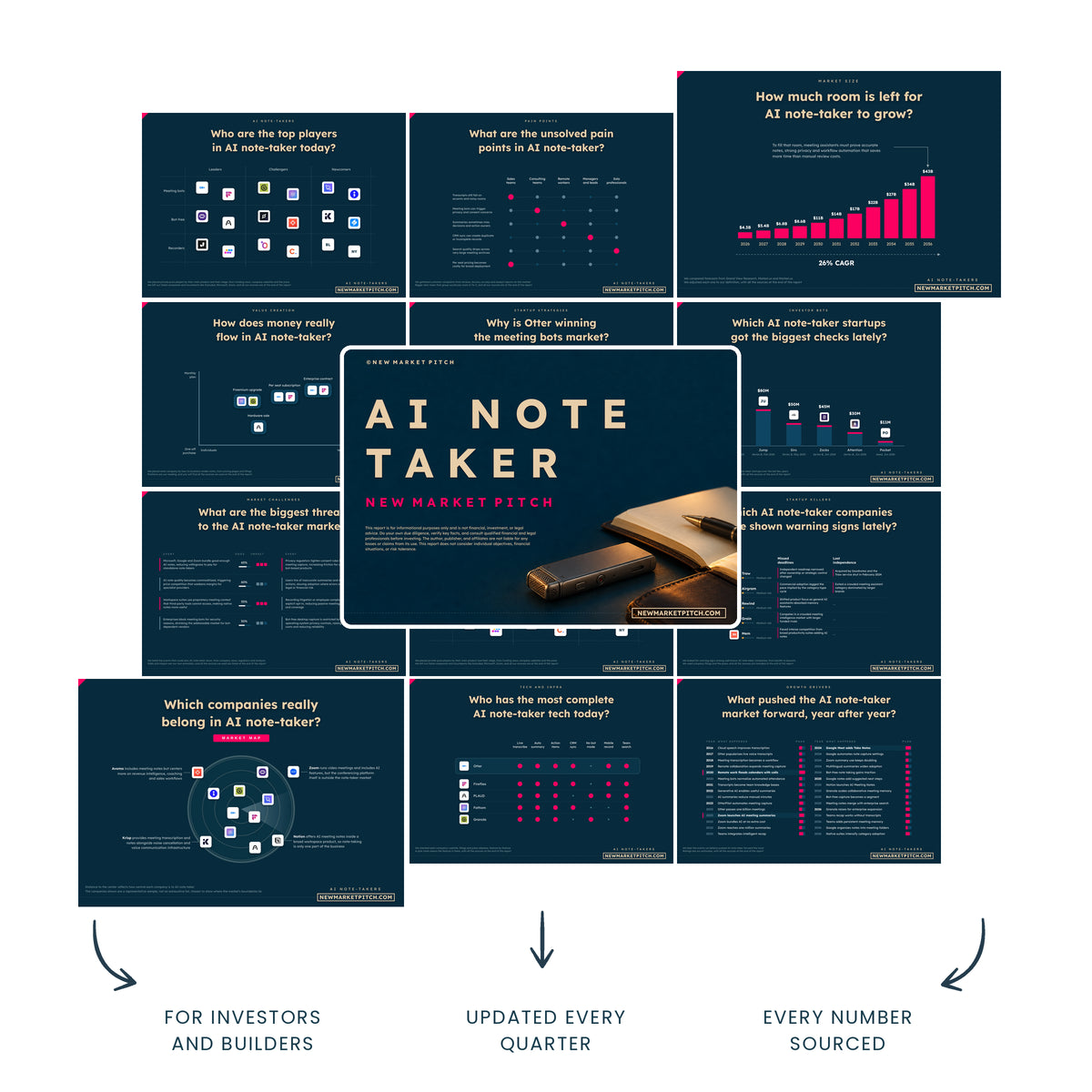
Whether you're building or investing in the AI note-taker market, our report covers everything you need to know: the players, the money, and what's coming next.
Summary
AI note-taker startups have raised at least $312M across 7 deals this year, even as fewer companies have secured funding. Granola leads with its $125M Series C in March 2026. Investors are spending far more on selected winners, while the market for new rounds has become smaller.
By the same point last year, there had been 12 deals and at least $111M. The comparable period of 2024 had 11 deals and $143M. Bigger checks explain why the total has climbed despite fewer transactions.
The largest rounds explain much of the jump. Just 2 financings above $50M raised $205M, leaving at least $107M outside that group. Founders should not mistake the total for a market where every note-taking app can raise easily.
The timing also tells a clear story. Q1 2026 brought 4 deals and $257M, followed by 3 deals and at least $56M in Q2 2026. Q3 2026 had no tracked deal, so the rush of money early in the year has not continued quarter after quarter.
Investors have moved further up the funding stages. Among deals with a named stage, later-stage financings make up 57% of this year's transactions, compared with 9% by this point last year. Companies with working products are getting the larger checks.
Financial-advisor software has become a major focus. Jump and Zocks turn client meetings into usable records and follow-up tasks, while Attention applies a similar approach to sales teams. Investors have found clearer uses for AI notes than a generic meeting recap.
Granola has another route: it keeps meeting history available to teams and other software without placing a visible bot in calls. Its push into shared company knowledge helps explain why independent tools still attract funding alongside built-in notes from Google, Microsoft and Zoom.
Dedicated devices have not disappeared. Pocket offers an offline recording tool, and Future Intelligence builds transcription earbuds. The at least $26M flowing into recording hardware remains modest compared with the biggest software rounds.
The United States currently dominates the disclosed funding figures, with 6 deals, while Europe has no tracked round this year. With so few transactions, that gap says more about where recent checks landed than about where the next useful products can be built.
We see a market where investors are backing stronger businesses, not more businesses. Specialized workflows, team knowledge, privacy and in-person capture offer reasons to pay for a separate AI note-taker, but the funding recovery is concentrated rather than widespread.

Written by the New Market Pitch teamWe track new markets so founders and investors can move faster. About us

In our report covering the AI note-taker market, you will always find fresh funding data, taken straight from our own verified funding database.
All funding deals in the ai note taker market over the last years
Below is the table listing all the deals. You can find our methodology at the end of this page.
If you want a deeper understanding of the market and its current dynamics, get our ai note taker market report.
| Company | Category | Date | Stage | Deal size | What they do | Region | Lead investors | Country | Rank |
|---|---|---|---|---|---|---|---|---|---|
| Dedicated AI recording hardware | June 2026 | Seed | $11M | AI meeting notes and action tracking | North America | Accel | United States | ||
| Attention | Vertical meeting intelligence | June 2026 | Series B | $30M | AI agents executing revenue team workflows | North America | RTP Global | United States | |
| Future Intelligence | Dedicated AI recording hardware | May 2026 | Series A | $15M+ | Makes transcription earbuds for meetings and calls | Asia-Pacific | Not disclosed | China | |
| Granola | Bot-free and local-first | March 2026 | Series C | $125M | Creates AI-powered meeting notes | North America | Index Ventures | United States | |
| Quill Meetings | General-purpose meeting assistants | February 2026 | Seed | $6.5M | AI meeting notes and followups | North America | Basis Set Ventures | United States | |
| Jump | Vertical meeting intelligence | February 2026 | Series B | $80M | Conversational AI assistant for financial advisors | North America | Insight Partners | United States | |
| Zocks | Vertical meeting intelligence | January 2026 | Series B | $45M | Meeting assistant for financial advisory conversations | North America | Lightspeed Venture Partners, QED Investors | United States | |
| Notta | Multilingual and regional | December 2025 | Series B | $15M | Transcribes multilingual meetings and summarizes conversations | Asia-Pacific | Granite-Integral Capital | Japan | |
| Future Intelligence | Dedicated AI recording hardware | October 2025 | Series A | $14M+ | Makes transcription earbuds for meetings and calls | Asia-Pacific | Ant Group | China | |
| TwinMind | Bot-free and local-first | September 2025 | Seed | $5.7M | Ambient meeting transcription and memory assistant | North America | Not disclosed | United States | |
| MeetGeek | Team knowledge and workflow | September 2025 | Unknown | $1.9M | Records calls and automates meeting followups | Europe | Early Game Ventures | Romania | |
| Vinyl | Vertical meeting intelligence | August 2025 | Seed | $1.3M | AI meeting notes for accounting and bookkeeping firms | Asia-Pacific | Tidal Ventures | Australia | |
| Notta | Multilingual and regional | May 2025 | Series A | $6.9M | Transcribes multilingual meetings and summarizes conversations | Asia-Pacific | GL Ventures, Mizuho Leaguer Investments | Japan | |
| Noota | Multilingual and regional | May 2025 | Seed | $1.7M | Summarizes meetings and interviews across languages | Europe | Blast Club | France | |
| Granola | Bot-free and local-first | May 2025 | Series B | $43M | Creates AI-powered meeting notes | North America | NFDG | United States | |
| Zocks | Vertical meeting intelligence | March 2025 | Series A | $14M | Meeting assistant for financial advisory conversations | North America | Motive Ventures | United States | |
| The Plato | General-purpose meeting assistants | March 2025 | Seed | $543K | AI meeting notes and transcription | Asia-Pacific | Not disclosed | South Korea | |
| Jump | Vertical meeting intelligence | February 2025 | Series A | $20M | Conversational AI assistant for financial advisors | North America | Battery Ventures | United States | |
| Based Hardware | Dedicated AI recording hardware | January 2025 | Seed | $2M | Makes wearable open-source AI conversation memory device | North America | Tim Draper | United States | |
| Future Intelligence | Dedicated AI recording hardware | January 2025 | Seed | Undisclosed | Makes transcription earbuds for meetings and calls | Asia-Pacific | Wanwu Venture Capital | China | |
| Circleback | General-purpose meeting assistants | November 2024 | Seed | $2.5M | Automatically transcribes meetings and extracts action items | North America | Not disclosed | United States | |
| Read AI | Team knowledge and workflow | October 2024 | Series B | $50M | AI meeting summaries and workplace assistant | North America | Smash Capital | United States | |
| Granola | Bot-free and local-first | October 2024 | Series A | $20M | Creates AI-powered meeting notes | North America | Spark Capital | United States | |
| Attention | Vertical meeting intelligence | October 2024 | Series A | $14M | AI agents executing revenue team workflows | North America | Alven | United States | |
| Fathom | General-purpose meeting assistants | September 2024 | Series A | $17M | AI meeting recording and notes | North America | Telescope Partners | United States | |
| Based Hardware | Dedicated AI recording hardware | August 2024 | Seed | $700K | Makes wearable open-source AI conversation memory device | North America | Not disclosed | United States | |
| Tactiq | Bot-free and local-first | July 2024 | Series A | $7.3M | Captures live meeting captions and AI takeaways | Asia-Pacific | Flashpoint Ventures | Australia | |
| MeetRecord | Vertical meeting intelligence | June 2024 | Seed | $2.7M | Analyzes sales meetings and generates CRM summaries | Asia-Pacific | SWC Global | India | |
| Jump | Vertical meeting intelligence | June 2024 | Seed | $4.6M | Conversational AI assistant for financial advisors | North America | Sorenson Capital | United States | |
| Read AI | Team knowledge and workflow | April 2024 | Series A | $21M | AI meeting summaries and workplace assistant | North America | Goodwater Capital | United States | |
| Bluedot | Bot-free and local-first | April 2024 | Seed | $600K | Records browser meetings without a visible bot | Europe | Not disclosed | Ukraine | |
| Zocks | Vertical meeting intelligence | February 2024 | Seed | $5.5M | Meeting assistant for financial advisory conversations | North America | Lightspeed Venture Partners | United States |

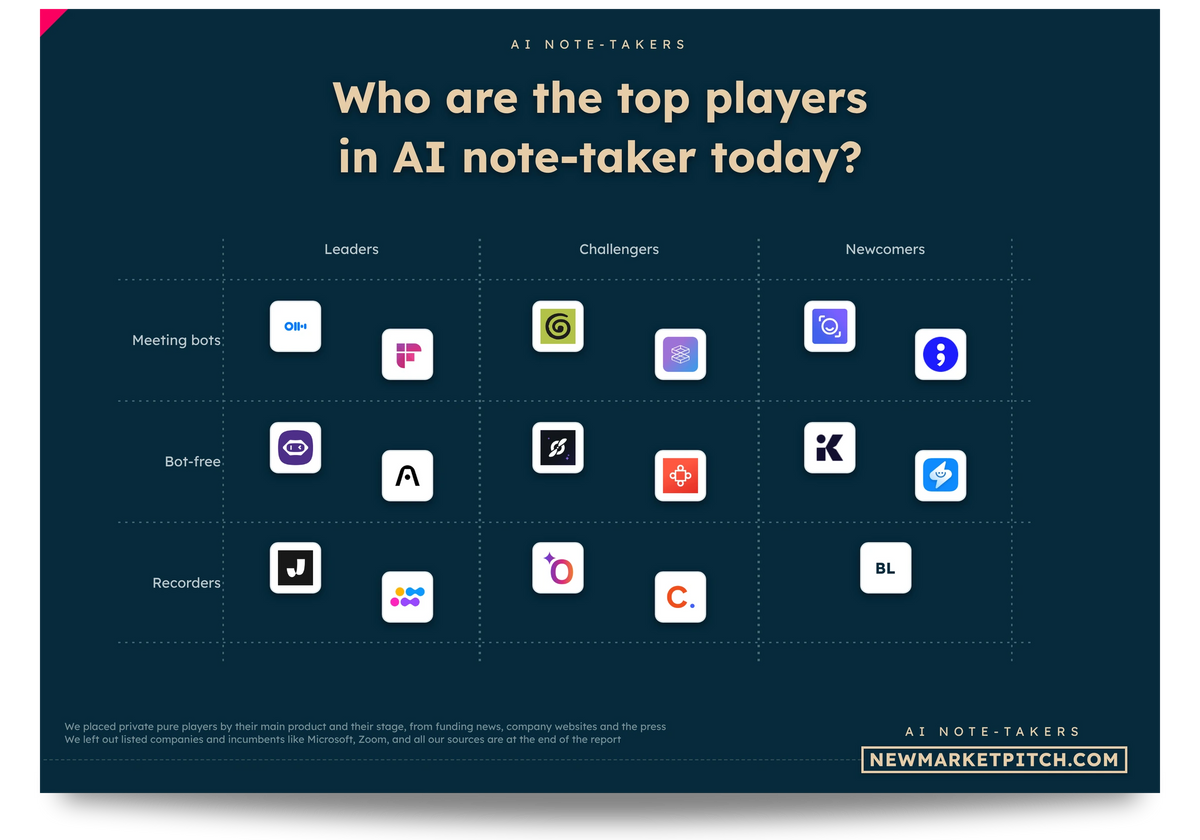
In our research about AI note-taker startups, we turn what is vague and complex into simple, useful visuals. Market maps like this one show you at a glance where every startup stands.
Is AI note-taker funding up this year?
AI note-taker startups are raising much more money this year, even though fewer companies are getting funded.
We tracked 7 deals raising at least $312M this year, against 12 deals and at least $111M over the same period of 2025. The matching period of 2024 had 11 deals raising $143M. Those comparisons use identical parts of each calendar year. The money has increased; the deal flow has slowed.
We also counted 7 funded companies this year, compared with 11 companies in the same period last year and 10 companies two years earlier. The median disclosed round reached $30.0M, up from $5.7M at the equivalent point last year. That makes it hard to describe the current rush as a broad recovery for young startups.
Look at the products receiving the larger checks. Granola sells meeting memory across teams, Jump works inside financial-advice firms, and Zocks turns sensitive client conversations into records and tasks. Investors see specific customers and jobs those customers need done. Far fewer small meeting assistants are sharing in that enthusiasm.
Has AI note-taker funding beaten last year's full-year total?
Yes, AI note-taker startups have already raised more capital than in either previous full calendar year.
The full year 2025 recorded 13 deals and at least $126M. The full year 2024 recorded 12 deals and $146M. This year's partial period has exceeded the amount raised in each of those complete years, although it still trails them in the number of deals. We should treat that as a comparison of actual totals, without pretending the current year is finished.
The difference is clear in the kinds of deals that closed. Noota's $1.7M Seed in May 2025 and Vinyl's $1.3M Seed in August 2025 were typical of the small rounds that filled the earlier market. This year has brought much larger expansion rounds for companies that had already launched products. Granola's March announcement, for example, described shared notes, enterprise controls and ways to make meeting context available to other tools.
So a startup can point to a much bigger total raised across the industry today. It cannot conclude that an early-stage meeting app will find fundraising easier than before.
Is AI note-taker funding only up because of a few giant rounds?
Only partly, because a few giant AI note-taker rounds account for most of this year's boom.
The 2 rounds above $50M raised $205M. Leaving out rounds above $100M still gives at least $187M this year, higher than either comparable earlier period. Once we exclude all rounds above $50M, however, the remaining capital is at least $107M, below the totals raised in the same parts of 2025 and 2024.
Granola's $125M Series C in March 2026 and Jump's $80M Series B in February 2026 are the two giant rounds doing most of the work. Zocks and Attention also received substantial checks, but for more narrowly defined customer problems. Their software is meant to maintain financial-advice records or carry out sales work after a conversation.
This is why a rising market total can be misleading. Investors will spend heavily where they believe a product can become part of a company's daily work. The much smaller amounts outside the giant rounds show that those bets have not lifted every AI note-taker startup with them.

In our market report about AI note-taker startups, we always try to gather several sources and make estimates that make sense, so you can work with solid numbers.
Did AI note-taker funding peak early in the year?
The AI note-taker funding rush peaked early in the year, and later quarters have been much quieter.
Q1 2026 recorded 4 deals raising $257M. Q2 2026 recorded 3 deals and at least $56M, while Q3 2026 had no deal. The current Q4 2026 is still partial, with no tracked financing so far. February 2026 and June 2026 each recorded 2 deals, and 5 completed months had none. With such a small market, one large announcement can dominate a whole quarter.
The financing sequence explains that stop-start pattern. Zocks raised in January, Jump and Quill Meetings in February, and Granola in March. Attention and Pocket followed in June. Earlier years also had bursts: Read AI's October 2024 financing helped lift Q4 2024, while Granola's May 2025 round was a large part of Q2 2025.
Fundraising can pause while products keep changing. Read AI continued adding meeting-search features and Zocks expanded its distribution through LPL Financial in October 2026. A quiet quarter therefore tells us about deal closings, not whether customers have stopped using these tools.
The table below shows the quarterly funding pattern, with incomplete periods identified.
| Period | Deals | Capital |
|---|---|---|
| Q1 2024 | 1 | $5.5M |
| Q2 2024 | 4 | $29M |
| Q3 2024 | 3 | $25M |
| Q4 2024 | 4 | $87M |
| Q1 2025 | 5 | $36M+ |
| Q2 2025 | 3 | $52M |
| Q3 2025 | 3 | $8.9M |
| Q4 2025 | 2 | $29M+ |
| Q1 2026 | 4 | $257M |
| Q2 2026 | 3 | $56M+ |
| Q3 2026 | No deal | $0 |
| Q4 2026 (partial) | No deal | $0 |
Can new AI note-taker startups still get seed funding?
Seed funding still reaches new AI note-taker products, but investors are backing fewer of them.
We recorded 2 Seed deals raising $18M this year. The same period of 2025 had 6 Seed deals raising at least $11M, and the comparable part of 2024 had 5 Seed deals raising $14M. Early-stage rounds account for 43% of this year's deals, compared with 91% by this point last year. A handful of large later rounds now draws much more attention.
Pocket's $11M Seed in June 2026 supported a device that attaches to a phone and records in-person conversations. TechCrunch reported that Pocket had already sold more than 130,000 devices, giving investors a specific product to judge. Quill Meetings' $6.5M Seed in February 2026 supported Quilliam, a tool designed to connect meeting history with other AI software.
Those startups took different routes: one built a physical way to capture conversations, while the other connected notes to everyday work. A newcomer offering only a transcript faces tougher competition from features already included in major workplace products.
Is Series B where the biggest AI note-taker checks go now?
Series B currently attracts the most disclosed AI note-taker funding, with investors backing tools already used for specific jobs.
This year we tracked 3 Series B deals raising $155M, which represents 50% of the money with a public amount and 43% of deals. At the same point last year, there was 1 Series B deal raising $43M. At the comparable point of 2024, there was 1 Series B deal raising $50M. These are small counts, but this year's concentration is hard to miss.
Jump's $80M Series B in February 2026 backed software for financial advisers. Zocks' $45M Series B in January 2026 also targeted financial advisers, with a strong focus on turning conversations into client data. Attention's $30M Series B in June 2026 focused on carrying out follow-up work for sales teams. All three sell outcomes that a basic meeting summary cannot deliver by itself.
The appeal is straightforward. Once a tool handles preparation, records, follow-ups and other daily tasks, a customer has more reasons to keep using it. That gives later-stage investors a clearer test than a download count or a clever transcription demo.
Are AI note-taker startups making it to Series C yet?
Granola has reached Series C, but very few other AI note-taker startups have made it that far.
We recorded 1 Series C deal this year, from Granola, and no Series D or later growth round. At the same point last year, the market had no Series C financing. Granola itself had closed a $43M Series B in May 2025, the largest deal of that comparable period. Its progression is impressive, although it remains a company-specific case.
The company has made its product useful to more people inside an organization. Its May 2025 release let colleagues share meeting intelligence. In March 2026, Granola added new ways to organize notes, share access and make conversation history available through APIs. It named Vanta, Gusto, Thumbtack and Asana among its customers. That is a more concrete selling point than generating a recap for one person.
There is still a considerable distance between launching an AI note-taking app and selling it across enterprises. Granola shows one way to cross that gap, while the absence of more late-stage rounds limits what we can conclude about the sector as a whole.

Our document detailing everything you need to know about AI note-taker gets updated several times a month, so you always get the latest view of where things stand.
Why are investors funding AI note-takers for financial advisors?
Financial-advisor AI note-takers are drawing large checks because they help firms deal with client records and follow-up work, not just meeting minutes.
The vertical meeting intelligence category recorded 3 deals and $155M this year, covering 43% of transactions and 50% of the money with a public amount. At the same point last year, it had 3 deals raising $35M, and the comparable 2024 period had 4 deals raising $27M. The amount has moved far more than the number of rounds.
Jump and Zocks help explain the interest in wealth management. Advisers repeatedly discuss goals, investments and life events with clients, then have to update records and planning systems. Jump handles preparation, notes and customer records. Zocks uses conversation details to build client profiles without storing recordings. Attention belongs in the same funded category but serves sales teams, so the investment trend extends beyond financial advice.
Recordkeeping also carries real costs in financial services. The SEC's January 2025 enforcement actions over firms' failures to preserve electronic communications show why documentation cannot be an afterthought. Those actions do not prove what motivated any particular investor, but they help explain why a tool that captures the right information can be useful.
Is Jump becoming a big business in AI meeting notes?
Jump has shown real adoption among financial advisers, making its AI note-taker one of the clearest commercial stories in this market.
In its February 2026 announcement, Jump said it had reached 27,000 advisers in less than two years and was adding more than 2,000 advisers each month. Those are company-reported usage figures, not independently audited revenue. They put real scale behind the company's new financing and distinguish it from products that have announced funding without sharing customer traction.
Jump covers meeting preparation, note-taking, summaries, follow-ups and CRM updates. It names customers or users across independent advisers, large advisory firms and financial institutions, including LPL Financial, Allianz Life and Manulife. The breadth of that customer list matters because selling to one profession does not require selling to only one size of business.
We still cannot infer profitability from adoption. Jump has to keep customers using its software and show that the work it saves is worth paying for. But its reported reach offers a much firmer explanation for investor confidence than a promise that AI will someday write better notes.
Can Zocks win financial advisors without saving recordings?
Zocks has made a recording-free AI note-taker attractive to financial advisers by turning conversations into usable client information.
Zocks says its product can capture meeting details and fill client profiles, planning documents and follow-up tasks without retaining audio or video files. That approach addresses an obvious concern for advisers discussing personal finances with clients. The company's January financing showed that investors were willing to support that particular design.
What followed is equally interesting. In April 2026, Zocks released a connector to share structured client information with other AI tools. In September 2026 it announced a connection to Claude for Financial Advisors. Then, in October 2026, Zocks said its software was available across the LPL Financial adviser network. Availability is a distribution opportunity; it is not the same as confirming that every eligible adviser pays for the product.
The bigger test is whether a privacy-minded product can also save advisers enough time to become part of their daily work. Zocks is building toward that test with client records and integrations. Recording-free capture helps open the door, but the follow-up work keeps the product useful.

In our report covering the AI note-taker market, we look at what the winners do differently, so you can learn from the best instead of guessing.
Can Granola turn AI meeting notes into company knowledge?
Granola is turning its AI note-taker into a searchable memory for whole teams, beyond personal recaps.
In May 2025, Granola introduced shared team meeting intelligence. Its March 2026 release added Spaces for organizing conversations, APIs for other software and more detailed enterprise controls. The company named customers such as Vanta, Gusto, Thumbtack and Asana. These are concrete signs of a product aimed at teams instead of a lone employee trying to remember a call.
Granola's approach also gives it room to compete with meeting platforms. Teams often talk on several services, and valuable discussions happen in person as well as online. A searchable history of decisions, requests and customer conversations can remain useful regardless of which platform hosted the call. Granola is trying to own that history rather than just the meeting transcript.
The risk is that teams already pay for Microsoft, Google or Zoom tools that can summarize meetings. Granola needs customers to keep finding its wider memory and sharing features worth a separate subscription. For now, the product direction gives a more convincing answer than simply promising more accurate notes.
Are investors backing AI note-takers that do the follow-up work?
Investors increasingly back AI note-takers that finish follow-up tasks after meetings instead of stopping at a summary.
Attention's $30M Series B in June 2026 is a good example. The company talks about drafting sales follow-ups, updating customer records and completing work that usually falls to a salesperson after a call. Zocks aims to turn client conversations into information financial advisers can use in planning. Jump connects meeting content to existing adviser workflows. Each product starts with a conversation but asks customers to judge the results afterward.
Quill Meetings approached the same problem from an earlier stage. Its February 2026 announcement presented Quilliam as a way to coordinate a user's meeting history with AI tools. These are different products with different buyers, and no common measure proves they save the same amount of work. Still, their announcements point in one direction.
Writing a recap is getting easier to copy. A tool that correctly updates a client record or makes the next task happen is more closely tied to work customers already need to finish. That is a stronger reason to pay every month.
Will Google Meet, Microsoft Teams and Zoom kill AI note-taker startups?
Google Meet, Microsoft Teams and Zoom are squeezing generic AI note-takers, but specialist startups still have room to compete.
At Google Cloud Next 2026, Google said more than 110 million meeting participants had used Take Notes For Me in the previous month, a count of participants rather than unique users. Microsoft offers intelligent meeting recaps in Teams, including options that do not retain a transcript, while Zoom includes AI meeting summaries in eligible workplace plans. That makes a simple meeting recap a difficult product to charge for on its own.
But those features do not replace every task that starts in a conversation. Granola makes notes usable across a company's history. Jump and Zocks work inside financial-advice systems. Pocket records discussions that happen away from video calls. Those products compete on the value of what happens after capture or on where they can capture in the first place.
Google also announced a way to use its note-taking feature across in-person meetings and other conferencing providers, so independent products cannot assume that cross-platform recording will remain theirs alone. Their strongest case today comes from specialized work and better handling of context, where a generic recap still falls short.

Learning from others' mistakes is the cheapest lesson there is. In our research about AI note-taker startups, we look at what broke startups before you, so you don't repeat it.
Are AI recording gadgets getting real venture funding?
Dedicated AI note-taking devices still get venture backing, though hardware attracts much less disclosed capital than software.
The dedicated AI recording hardware category recorded 2 deals and at least $26M this year, representing 29% of deals but 8% of the money with a public amount. At the equivalent point last year it had 3 deals and at least $16M, while the comparable 2024 period had 1 deal raising $700K. That is ongoing activity, but software remains where the largest disclosed checks landed.
Pocket's June 2026 round is the clearest example. TechCrunch described a small recorder that attaches to a phone and turns conversations into summaries, searchable information and tasks. The report also said Pocket had sold more than 130,000 units. Future Intelligence's round of at least $15M in May 2026 backed earbuds designed to transcribe meetings and calls.
A separate device makes sense for people who have conversations away from their desks. The challenge is convincing those people to carry and pay for another gadget when a phone can already record audio. Hardware has a real use case, but it draws far less money than software for now.
Does skipping the meeting bot still give AI note-takers an edge?
Bot-free AI note-taking can make meetings feel more natural, although removing the visible bot is unlikely to keep competitors away on its own.
The bot-free and local-first category recorded 1 deal raising $125M this year, representing 40% of the money with a public amount. The same period of 2025 recorded 2 deals raising $49M, while the comparable 2024 period recorded 3 deals raising $28M. The latest total reflects one exceptional company round, not a wave of new bot-free financings.
Granola captures meetings without adding another participant to the call. Zocks also emphasizes avoiding stored recordings, although its customers care as much about financial planning and client records. Meanwhile, Microsoft has developed meeting recap options that do not retain a transcript. Large software platforms can copy some of these privacy-oriented features.
There is also a legal limit to how invisible recording should become. The UK Information Commissioner's Office expects organizations to explain why personal information is being collected and how it is used. An easier recording experience helps, but customers still need trust, sensible data controls and useful work after the meeting.
Have investors lost interest in multilingual AI note-takers?
No multilingual AI note-taker has announced a funding round this year, but the gap is too small to prove investors have abandoned them.
At the same point in 2025, the multilingual and regional category recorded 2 deals raising $8.6M. Notta's $6.9M round and Noota's $1.7M Seed, both in May 2025, backed products for teams working across languages. Notta then raised a $15M Series B in December 2025, just before this year began, but no qualifying deal in that category appears in the current year. It is a noticeable gap in fundraising, even if a market with so few rounds can change quickly.
Competition has also changed. Google Meet supports translated captions and several languages for its note-taking features. A startup whose only selling point is transcription in another language now has to show why companies should use it instead of the meeting software they already buy.
Local integrations, region-specific support and data-handling needs can still give an independent company a reason to exist. We see no basis for calling multilingual demand dead. The funding evidence says that other types of note-taking products are currently winning the larger checks.
Is America taking most AI note-taker funding now?
US startups currently account for most AI note-taker deals and 95% of the money with a public amount.
The United States accounted for 6 deals, 86% of deal volume and $298M this year. In the same period of 2025, American startups had 5 deals raising $85M. The comparable period of 2024 had 8 deals raising $133M. America has been important throughout, but its share of deals has moved around rather than climbing every year.
The main current recipients include Granola, Jump, Zocks, Attention and Pocket. China is the other represented headquarters country, through Future Intelligence's round of at least $15M in May 2026. One Chinese deal is too few to say whether Asian funding is fading.
There are reasons US financial-advice and enterprise-software products appeal to investors, including accessible customers and established distribution channels. We should not push that explanation further than the deals allow. A small set of large American rounds can make the geography look more decisive than the wider product market really is.

If you build or invest in the AI note-taker market, you need to know which business models pay off now and which ones are fading. That's why our report covering it has a whole section on it.
Is Europe falling behind in AI note-taker funding?
Europe is falling behind in recorded AI note-taker financings this year, although that does not establish a permanent product disadvantage.
The region had no deal this year, compared with 2 deals raising $3.6M by this point in 2025 and 1 deal raising $600K by this point in 2024. Earlier examples included MeetGeek in Romania, Noota in France and Bluedot in Ukraine. Independent products exist, but European companies are absent from the current round announcements that meet our criteria.
Regional needs may still create openings. Companies can care about local languages, where information is stored and whether colleagues know they are being recorded. The UK's Information Commissioner's Office, for example, provides guidance on lawful handling of meeting information. That makes data practices important to customers, though it does not automatically make a product attractive to venture investors.
American companies are also building around privacy and user control. European startups therefore need a product reason to win, beyond being European. On the funding figures, Europe is currently behind; a claim that it has lost the market altogether would go much further than the evidence.
Are investors backing familiar AI note-taker startups instead of newcomers?
Established AI note-taker startups are getting the biggest checks, often after raising money before.
We classified 6 deals this year as follow-ons, raising at least $301M and accounting for 96% of the money with a public amount. The remaining round has an unknown first-versus-follow-on status. At the same point of 2025, 5 follow-on rounds raised at least $79M. At the corresponding point of 2024, 5 follow-on rounds raised $108M.
The well-known names make the direction clear. Granola advanced from earlier backing into a new stage, Jump went from its earlier Seed and Series A rounds to a larger Series B, and Zocks built on previous financings for a more specialized financial-advice product. Quill Meetings had also raised before its Seed. Pocket brought a new idea to the market, but its Seed check alone does not tell us whether it was a first-time fundraiser.
We should not confuse successful follow-on checks with a market that is equally welcoming to every new team. The recent financing activity says investors have growing confidence in certain products they can already judge.
So, what are the latest funding trends in AI note-takers?
AI note-taker funding is growing in dollars but shrinking in deal count, with investors favoring larger rounds for products that turn conversations into useful work.
Granola is the leading funded company this year. Jump and Zocks have shown why financial-advice software attracts large checks, while Attention is using meeting content to complete sales tasks. Pocket gives investors a separate way to back in-person conversations. These companies sell different things, but each promises customers more than a basic transcript.
There are important limits to the boom. Early-year financings drove much of the total, new deal announcements have slowed, and fewer companies have raised. US startups dominate the latest disclosed checks, while Europe has had none in the period. Google, Microsoft and Zoom continue making general-purpose meeting notes easier to get, which puts pressure on startups without a strong reason to exist separately.
Our conclusion is that funding is healthy for a selected group, not across the whole AI note-taker market.
The table below shows what we found.
| Question | Answer |
|---|---|
| Are more AI note-taker startups raising money? | No, fewer companies are securing rounds this year. We tracked 7 deals against 12 in last year's equivalent period. The bigger checks now reach a much narrower group of companies. |
| Has the market exceeded previous annual totals? | Yes, the current partial year has passed earlier totals. Full-year 2024 funding stood at $146M across the market. The money record does not mean more startups were financed. |
| Do giant rounds explain the sudden jump? | Largely, because the biggest checks make the total soar. Rounds above $50M brought in $205M this year. Ordinary rounds tell a much less dramatic story. |
| Did the initial rush keep going afterward? | No, the current funding burst came early in the year. Q1 2026 alone recorded 4 deals in the sector. Later quarters have been markedly quieter for new financings. |
| Are new meeting-note products still getting checks? | Yes, fresh products can still get seed backing. Seed deals raised $18M this year in our research. Investors favor products with a specific reason to exist. |
| Do investors prefer more established software teams? | Yes, they currently favor companies ready to expand. We tracked 3 Series B deals in the current period. Those companies can fund deeper customer workflows with larger checks. |
| Is financial advice the only hot application? | No, investors also back tools for sales teams. Attention raised $30M in its June 2026 Series B. Completing follow-up work is the bigger common theme. |
| Can standalone note-takers beat built-in meeting recaps? | Some can, provided they solve a tougher problem. Google reported more than 110 million recent note-taking attendees. A simple transcript alone is difficult to sell separately. |
| Are recording gadgets now taking over funding? | No, hardware remains smaller than the main software bets. Hardware drew just 8% of the money with a public amount this year. Offline recording still gives dedicated devices a useful niche. |
| Is the latest funding surge spread worldwide? | No, the visible checks are heavily concentrated in America. The United States accounted for 86% of this year's deals. Europe did not record a qualifying financing this year. |
| Do returning startups take most investor money? | Yes, known companies are receiving the largest checks. Follow-ons captured 96% of disclosed capital this year. First-time founders face a very different funding environment. |

In our document detailing everything you need to know about AI note-taker, we like to show you the big picture. We know your time is precious, so we make every page quick to read and packed with as much learning as possible per minute.
Our methodology
Our data runs through November 19, 2026. We then reviewed this article and updated its answers on November 24, 2026, the date shown under the title. We cover equity funding announced from January 1, 2024 through November 19, 2026, comparing January 1 through November 19 of 2026 with the same calendar periods of 2025 and 2024. We also show completed calendar years and dated quarters separately. The current year and quarter are incomplete, and we never annualize them.
We count equity financings of private companies at or above $300K. We exclude debt, grants, loans, unconverted convertibles, SAFEs and public offerings. Each financing is counted once, and overlapping reports of the same announcement are merged. We include independently built, growth-oriented startups founded in 2007 or later under our stated startup definition, including companies listed within the past 5 years and companies acquired within the past 3 years, rather than treating every established software vendor as a startup.
Our AI note-taker market includes standalone software and purpose-built devices that turn work conversations into transcripts, structured notes, summaries, searchable knowledge and follow-up actions. We include online and in-person capture, bot-free or local-first tools, multilingual products, vertical assistants and relevant recording hardware, including borderline cases rather than silently omitting them. We exclude generic speech APIs, conferencing suites whose notes are secondary, dictation-first tools, medical charting and general lecture summarizers not aimed at work conversations.
We group rounds by their announced stage, compare early and later financing only among deals with named stages, and assign geography from each company's headquarters country. Our market categories reflect what the product is primarily built to do. We distinguish first financings from follow-ons only when the company's financing history is sufficiently clear, leaving uncertain cases unclassified. One deal from 2024 is dated only by the year and is included in annual totals but in no quarter.
Our first choice for verifying rounds is a company or investor announcement, a regulatory filing or reliable reported coverage. Rounds without a published amount count toward deal totals but not the capital sum, so a total ending in a plus sign is a minimum. We do not substitute a database estimate for an undisclosed transaction amount, and we do not infer an unannounced funding stage.
Rounds confirmed by a company announcement, a press article or a regulatory filing are counted in full. Where no article exists, a round is counted only when at least two recognised databases agree on its date (within one month) and amount (within 5%), and it is marked as low confidence; a round found in a single database stays in the company's history but is left out of totals. For companies that have raised more than $100M, every round counted is backed by an article.
A reported market total can differ from ours because other reports may include speech infrastructure, medical documentation, larger conferencing platforms, debt, or financings below our threshold. Likewise, a quiet latest month is not evidence that the market has stopped operating: rounds are counted when they meet our announcement and verification rules. We preserve these boundaries consistently across each comparable period so the directional findings do not rest on changing definitions.
Key sources include Granola's March 2026 Series C announcement, enterprise customers and company-context strategy, Granola's May 2025 Series B and introduction of team meeting intelligence, Jump's February 2026 financing, adviser adoption, customers and product direction, Jump's 2026 financial-adviser integration announcements, Zocks' January 2026 financing and advisor workflow plans, Zocks' April 2026 client-context connector, Zocks' September 2026 Claude integration, Zocks' October 2026 LPL availability and connected planning workflows, Attention's June 2026 Series B and plans to execute follow-up sales work, Pocket investor's July 2026 account of its dedicated recording device and seed financing, Pocket's device design, distribution and product claims in June 2026, Quill's February 2026 first-party seed announcement and local-first agent, Read AI's October 2024 financing and expansion from meetings into workplace context, Read AI's October 2026 meeting-search product announcements, Google's 2026 note-taking adoption and cross-meeting expansion announcement, Microsoft Teams recap without saved transcription and licensing conditions, Zoom's 2026 explanation of included meeting summaries and workflow automation, SEC's January 2025 investment-adviser recordkeeping enforcement announcement, UK regulator's guidance on notice, lawful basis and retention for meeting recordings, and Google's documentation of AI meeting recap capabilities and supported languages.

When you build or invest in the AI note-taker market, you need clarity, not confusion. In our report covering the AI note-taker market, we always try to put numbers on and quantify whatever is usually vague and confusing.
Written by the New Market Pitch teamWe track new markets so founders and investors can move faster. About us