AI Personal Assistant Funding Tracker (70+ deals)
Whether you're building or investing in the AI personal assistant market, our report covers everything you need to know: the players, the money, and what's coming next.
Summary
AI personal assistant startups raised at least $5.6B through 75 deals involving 47 companies since January 2024. Perplexity led the companies by capital raised, with $1.7B across 7 rounds. The biggest individual deal was Instinct's $1.0B Series C in September 2026.
That headline makes the market look richer than the experience of most founders. The median round was $15M, and huge checks went to a small set of companies trying to build assistants for nearly every task.
Deals of $100M or more brought in $4.6B+ of disclosed capital. Most startups are chasing something narrower: a dependable way to handle calls, inboxes, calendars, web tasks or household plans.
Seed is still where most of the activity happens. Investors will back an early product, but far fewer companies have reached the stages where large follow-on checks are available.
The category attracting the most capital is general-purpose assistant platforms. Messaging and voice personal agents, meanwhile, account for the most individual deals. Lots of backers like the convenience of chat; the very biggest bets go toward products that can work across services.
Perplexity is building that future through its Comet browser. Instinct takes requests over text and phone, while Manus uses software to do work on a computer. Their funding supports different answers to the same consumer question: who will actually finish the job?
Specialists have a place too. Family coordinators, executive assistants and personal-memory tools solve problems people already recognize, even if their budgets are smaller than those of a general agent platform.
The geography is lopsided. The United States accounts for 75% of deals and 87% of disclosed capital. Some of the most practical messaging products, however, are built to reach people outside the US.
Funding also comes in bursts. 4 completed months passed without a qualifying deal, while major rounds can turn a single month into a big financing story.
We see a real market with two very different bets inside it: focused tools people can use today, and heavily funded platforms seeking permission to manage much more of their lives. Prosus Ventures led the most rounds, showing that repeat backers are interested in smaller assistants as well as headline deals.

Written by the New Market Pitch teamWe track new markets so founders and investors can move faster. About us

In our report covering the AI personal assistant market, you will always find fresh funding data, taken straight from our own verified funding database.
Our funding tracker covering the AI personal assistant market
Below is the table listing all the deals. You can find our methodology at the end of this page.
If you want a deeper understanding of the market and its current dynamics, get our AI personal assistant market report.
| Company | Category | Date | Stage | Deal size | What they do | Region | Lead investors | Country | Rank |
|---|---|---|---|---|---|---|---|---|---|
| Voyage Labs | Concierge and delegated errands | November 2026 | Seed | $12M | Builds Atlas, a personal travel agent that plans, books and monitors trips across a persistent workflow. | North America | Kleiner Perkins | United States | |
| Rhise AI | Personal memory and context | November 2026 | Seed | $2.9M | Builds Lucie, a proactive personal AI assistant connecting email, calendar, health and everyday context. | Europe | Not disclosed | Germany | |
| Wabi | General-purpose assistant platforms | October 2026 | Series A | $55M | Conversational personal assistance and mini apps | North America | IVP | United States | |
| Town | Executive and productivity assistants | October 2026 | Series B | $108M | Personal AI assistants for workplace tasks | North America | Forerunner Ventures, Menlo Ventures | United States | |
| Manus | Computer-use and web-task agents | October 2026 | Unknown | $500M+ | Autonomous general-purpose AI agents | Asia-Pacific | Boyu Capital, IDG Capital | Singapore | |
| Ghost | General-purpose assistant platforms | October 2026 | Seed | $11M | AI personal assistant for daily tasks | North America | Andreessen Horowitz | United States | |
| Eden AI Labs | Concierge and delegated errands | October 2026 | Seed | $1.5M | AI personal concierge assistant | North America | Gaea Ventures | United States | |
| Instinct | Messaging and voice personal agents | September 2026 | Series C | $1.0B | Personal AI assistant automating everyday tasks | North America | Sequoia Capital, Benchmark, Coatue | United States | |
| Hello Haven | Personal memory and context | September 2026 | Seed | $15M | Constructs personal memory for contextual assistants | North America | Mayfield | United States | |
| Orbits | Family and household coordination | September 2026 | Seed | ~$2M | Coordinates household appointments, errands and calendars | North America | a16z speedrun | Canada | |
| Catch | General-purpose assistant platforms | September 2026 | Seed | $5M | AI assistant for everyday tasks | Middle East | Entrée Capital, Pitango | Israel | |
| Fambot | Family and household coordination | September 2026 | Seed | $3.5M | Acts as an AI family chief-of-staff | North America | NextView Ventures, Baukunst | United States | |
| Passabot | Messaging and voice personal agents | August 2026 | Seed | $1.5M | Books flights by messaging the assistant | Latin America | Parceiro Ventures | Brazil | |
| Instinct | Messaging and voice personal agents | August 2026 | Series B | $250M | Personal AI assistant automating everyday tasks | North America | Index Ventures, Benchmark | United States | |
| Hark | General-purpose assistant platforms | August 2026 | Unknown | Undisclosed | Develops proprietary models for personal intelligence | North America | Not disclosed | United States | |
| Pally | Executive and productivity assistants | August 2026 | Seed | $5.2M | Remembers relationships and assists over messages | North America | Cyber Fund, Y Combinator | United States | |
| Instinct | Messaging and voice personal agents | August 2026 | Series A | $75M | Personal AI assistant automating everyday tasks | North America | Kleiner Perkins | United States | |
| NinjaTech AI | Executive and productivity assistants | August 2026 | Unknown | Undisclosed | AI assistant researches and schedules work | North America | Not disclosed | United States | |
| Tomo | Personal memory and context | June 2026 | Seed | $5M | Text coach follows up on goals habits | North America | Bain Capital Ventures | United States | |
| Jarvie AI | Messaging and voice personal agents | June 2026 | Seed | $8.3M | Coordinates tasks inside group text conversations | North America | Andreessen Horowitz, Base10 Partners, Lightspeed Venture Partners | United States | |
| Equal | Messaging and voice personal agents | June 2026 | Series B | $30M | Screens and responds to unwanted phone calls | Asia-Pacific | Prosus Ventures, Tomales Bay Capital | India | |
| Genspark | Computer-use and web-task agents | June 2026 | Series B | $100M | Autonomous AI workspace and research | North America | Not disclosed | United States | |
| Town | Executive and productivity assistants | June 2026 | Series A | $55M | Personal AI assistants for workplace tasks | North America | Andreessen Horowitz | United States | |
| Hark | General-purpose assistant platforms | May 2026 | Series A | $700M+ | Develops proprietary models for personal intelligence | North America | Parkway Venture Capital | United States | |
| Highlight AI | Personal memory and context | March 2026 | Series A | $40M | Screen-aware assistant recalls information from work | North America | Khosla Ventures | United States | |
| Littlebird | Personal memory and context | March 2026 | Seed | $11M | Remembers work context to answer later requests | North America | Lotus Studio | United States | |
| Sandbar | Ambient and wearable assistants | March 2026 | Series A | $23M | Smart ring capturing voice notes with AI memory and recall | North America | Adjacent, Kindred Ventures | United States | |
| Zapia | Messaging and voice personal agents | March 2026 | Seed | $7M | WhatsApp assistant for Latin American consumers | Latin America | Prosus Ventures | Uruguay | |
| Memorae AI | Messaging and voice personal agents | March 2026 | Seed | $2M | Saves reminders and schedules through WhatsApp | North America | Mucker Capital | United States | |
| Instinct | Messaging and voice personal agents | January 2026 | Seed | $25M | Personal AI assistant automating everyday tasks | North America | Conviction, Greenoaks | United States | |
| Pine | Concierge and delegated errands | December 2025 | Series A | $25M | Calls providers to negotiate consumer bills | North America | Not disclosed | United States | |
| Simular | Computer-use and web-task agents | December 2025 | Series A | $22M | Automates Mac applications for personal tasks | North America | Felicis | United States | |
| Genspark | Computer-use and web-task agents | November 2025 | Series B | $275M | Autonomous AI workspace and research | North America | Emergence Capital | United States | |
| The Librarian | Messaging and voice personal agents | November 2025 | Seed | $2M | Organizes reminders and information on WhatsApp | Asia-Pacific | Golden Gate Ventures | Singapore | |
| Wabi | General-purpose assistant platforms | November 2025 | Seed | $20M | Conversational personal assistance and mini apps | North America | Andreessen Horowitz | United States | |
| Strawberry | Computer-use and web-task agents | October 2025 | Seed | $6M | Agent browser carries out personal web workflows | Europe | General Catalyst, EQT Ventures | Sweden | |
| Howie | Executive and productivity assistants | September 2025 | Seed | $6M | Schedules meetings and follows up by email | North America | True Ventures | United States | |
| Perplexity | General-purpose assistant platforms | September 2025 | Series D+ | ~$200M | AI answer engine and Comet browser assistant | North America | Not disclosed | United States | |
| Fyxer AI | Executive and productivity assistants | September 2025 | Series B | $30M | AI executive assistant manages inbox and meetings | Europe | Madrona Venture Group, Lakestar | United Kingdom | |
| Poke | Messaging and voice personal agents | September 2025 | Seed | $15M | Handles everyday tasks through messaging conversations | North America | General Catalyst | United States | |
| Ohai.ai | Family and household coordination | August 2025 | Unknown | Undisclosed | Manages household calendars, lists and reminders | North America | Muse Capital | United States | |
| Perplexity | General-purpose assistant platforms | July 2025 | Unknown | $100M | AI answer engine and Comet browser assistant | North America | Not disclosed | United States | |
| Perplexity | General-purpose assistant platforms | June 2025 | Growth Equity | $500M | AI answer engine and Comet browser assistant | North America | Accel | United States | |
| Luzia | Messaging and voice personal agents | May 2025 | Unknown | $14M | WhatsApp assistant for everyday personal requests | Europe | Prosus Ventures | Spain | |
| Zapia | Messaging and voice personal agents | April 2025 | Seed | $7.3M | WhatsApp assistant for Latin American consumers | Latin America | Prosus Ventures | Uruguay | |
| Manus | Computer-use and web-task agents | April 2025 | Series B | $75M | Autonomous general-purpose AI agents | Asia-Pacific | Benchmark | Singapore | |
| Yutori | Computer-use and web-task agents | March 2025 | Seed | $15M | Runs browser tasks on users behalf | North America | Radical Ventures | United States | |
| Fyxer AI | Executive and productivity assistants | March 2025 | Series A | $10M | AI executive assistant manages inbox and meetings | Europe | 20VC | United Kingdom | |
| Town | Executive and productivity assistants | March 2025 | Seed | $18M | Personal AI assistants for workplace tasks | North America | First Round Capital | United States | |
| Genspark | Computer-use and web-task agents | February 2025 | Series A | $100M | Autonomous AI workspace and research | North America | Emergence Capital | United States | |
| Sandbar | Ambient and wearable assistants | February 2025 | Seed | $10M | Smart ring capturing voice notes with AI memory and recall | North America | True Ventures | United States | |
| Based Hardware | Ambient and wearable assistants | January 2025 | Seed | $2M | Wearable AI captures context and helps recall | North America | Tim Draper | United States | |
| Martin | Messaging and voice personal agents | January 2025 | Seed | $2M | Voice assistant organizing users daily lives | North America | Not disclosed | United States | |
| Boardy | Messaging and voice personal agents | January 2025 | Seed | $8M | Introduces people by telephone and messaging | North America | Creandum | Canada | |
| Vercept | Computer-use and web-task agents | January 2025 | Seed | $16M | Vy desktop agent automates computer applications | North America | Not disclosed | United States | |
| Ollie | Family and household coordination | 2025 | Unknown | $2M | Family operations assistant reachable through texts | North America | Not disclosed | United States | |
| Perplexity | General-purpose assistant platforms | December 2024 | Series D+ | $500M | AI answer engine and Comet browser assistant | North America | IVP | United States | |
| Equal | Messaging and voice personal agents | November 2024 | Series A | $10M | Screens and responds to unwanted phone calls | Asia-Pacific | Prosus Ventures, Tomales Bay Capital | India | |
| Boardy | Messaging and voice personal agents | October 2024 | Seed | $3M | Introduces people by telephone and messaging | North America | HF0 | Canada | |
| Highlight AI | Personal memory and context | October 2024 | Seed | $10M | Screen-aware assistant recalls information from work | North America | General Catalyst | United States | |
| Convergence | Computer-use and web-task agents | September 2024 | Seed | $12M | Proxy agent performs tasks inside browsers | Europe | Balderton Capital | United Kingdom | |
| Please | Computer-use and web-task agents | August 2024 | Series A | $20M | Automates web tasks across multiple sites | North America | General Catalyst | United States | |
| Based Hardware | Ambient and wearable assistants | August 2024 | Seed | $700K | Wearable AI captures context and helps recall | North America | Not disclosed | United States | |
| Bee | Ambient and wearable assistants | July 2024 | Seed | $5.5M | Wearable personal AI tracks daily context | North America | Exor | United States | |
| Perplexity | General-purpose assistant platforms | June 2024 | Growth Equity | $250M | AI answer engine and Comet browser assistant | North America | Not disclosed | United States | |
| Ario | Family and household coordination | June 2024 | Seed | $16M | Coordinates family schedules, emails and logistics | North America | Floodgate | United States | |
| Genspark | Computer-use and web-task agents | June 2024 | Seed | $60M | Autonomous AI workspace and research | North America | Lanchi Ventures | United States | |
| Luzia | Messaging and voice personal agents | May 2024 | Series B | $19M | WhatsApp assistant for everyday personal requests | Europe | Monashees | Spain | |
| rabbit | Ambient and wearable assistants | March 2024 | Unknown | $29M | Handheld AI device carries out user requests | North America | Not disclosed | United States | |
| Perplexity | General-purpose assistant platforms | March 2024 | Series C | $63M | AI answer engine and Comet browser assistant | North America | Daniel Gross | United States | |
| Mindy | Messaging and voice personal agents | February 2024 | Seed | $6M | Executes requests made through email messages | North America | Sequoia Capital | United States | |
| Sandbar | Ambient and wearable assistants | February 2024 | Seed | $3M | Smart ring capturing voice notes with AI memory and recall | North America | Upfront Ventures, Betaworks | United States | |
| Howie | Executive and productivity assistants | February 2024 | Seed | $1M | Schedules meetings and follows up by email | North America | Not disclosed | United States | |
| Ohai.ai | Family and household coordination | January 2024 | Seed | $6M | Manages household calendars, lists and reminders | North America | Eniac Ventures, LifeX Ventures | United States | |
| Perplexity | General-purpose assistant platforms | January 2024 | Series B | $74M | AI answer engine and Comet browser assistant | North America | IVP | United States |

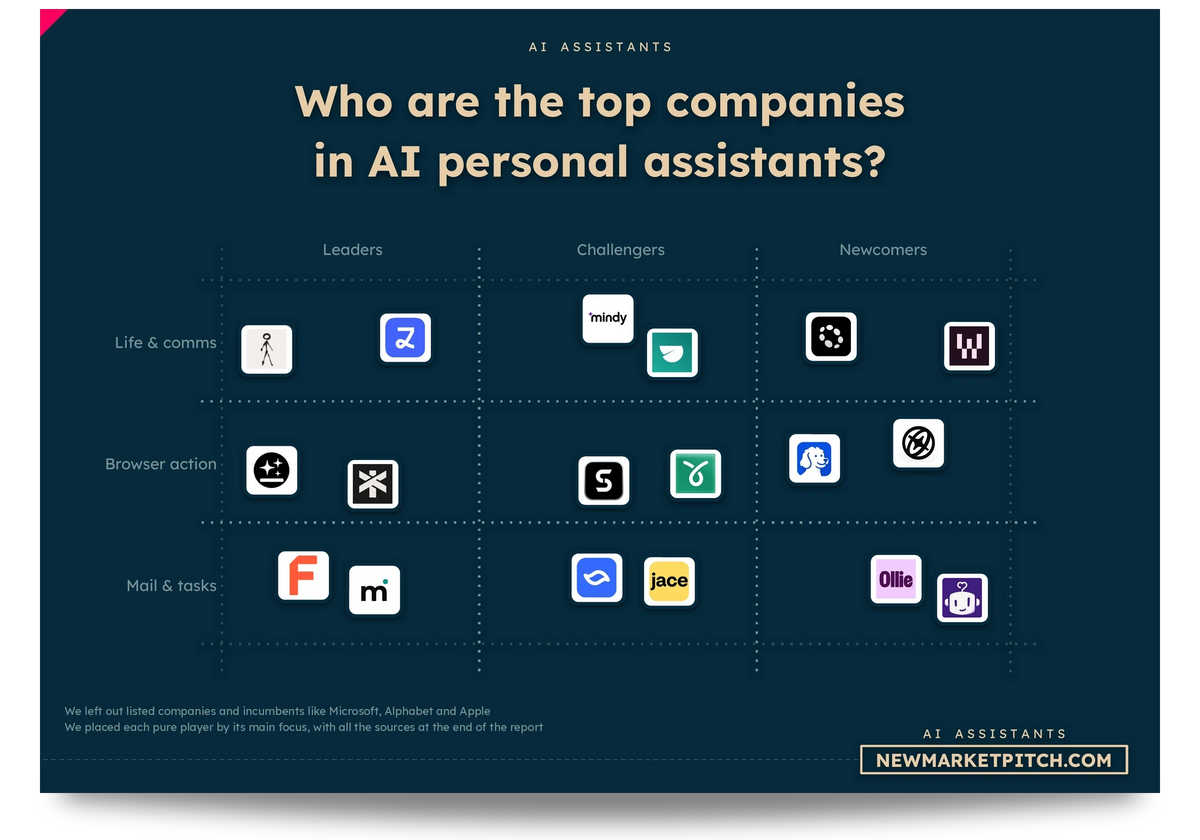
In our research about AI personal assistant startups, we turn what is vague and complex into simple, useful visuals. Market maps like this one show you at a glance where every startup stands.
Are AI personal assistants finally doing real tasks?
Yes. Investors now back AI personal assistants that make bookings, use websites and organize people's lives, rather than merely answer questions.
Instinct handles requests by text or phone and can contact businesses for users. Perplexity's Comet operates inside a browser, while Manus can work through software to finish research and other jobs. These are different approaches, but the promise is easy to understand: you ask for something and the assistant takes care of the steps.
Big technology companies are pursuing the same idea. OpenAI launched Operator in January 2025 and later folded browser actions into ChatGPT agent. Meta introduced Muse in September 2026, giving users a dedicated virtual computer for everyday tasks and asking permission before sensitive actions. Neither company belongs in our startup totals. Their products show why a standalone assistant must do more than hold a convincing conversation.
The smaller deals tell a similar story in a different setting. Voyage Labs raised a $12M Seed in November 2026 for Atlas, a travel agent meant to help with planning and booking. An assistant that stays involved when a reservation changes has a clearer job than a chatbot offering travel suggestions. That shift toward follow-through helps explain which businesses investors are willing to fund.
How much money has actually gone into AI personal assistant startups?
AI personal assistant startups have already raised at least $5.6B, across 75 deals involving 47 companies.
The total covers everything from household reminders to agents that use computers. That breadth is worth paying attention to. We found 30 companies with 1 qualifying round, 12 with 2 and 5 with 3 or more. The market has many independent teams, even though a handful of repeat fundraisers receive the biggest checks.
Perplexity shows why investors see a larger opportunity than simply charging people to ask questions. The company opened its Comet browser to everyone in October 2025, with background assistants that can pursue several tasks at once. A browser that carries out work reaches further into someone's day than a search box does.
There is a big difference between money raised and money earned, however. A venture round can pay for engineers, models, infrastructure and customers long before the product becomes a habit. The funding confirms that investors are taking personal assistants seriously. It does not tell us how many people will keep paying for one once the novelty fades.
How many AI personal assistant rounds reach $100M?
Only a few AI personal assistant rounds reach $100M, even though these giant checks account for most of the money raised.
We counted 13 deals of $100M or more, covering 6 companies. They make up 18% of financings with a disclosed amount and account for $4.6B+ of capital. By contrast, the $5M to under $20M bracket contains 28 deals, or 39% of those with disclosed amounts. Someone reading only the biggest funding stories would miss what most founders actually raise.
Look at the work behind those enormous checks. Hark raised a $700M+ Series A in May 2026 while building its own AI models and future hardware. Manus secured $500M+ in a round of undisclosed stage in October 2026 after returning to independent operation. Genspark raised a $275M Series B in November 2025 for an autonomous workspace. Each needs to make a system work across many kinds of tasks.
That is a costly promise, particularly when the assistant must run reliably through other companies' websites and applications. Those companies are fighting over a broad interface to everyday digital life. Most personal assistant startups can start with a much smaller, clearly defined job.
How much does a typical AI personal assistant startup raise?
The typical AI personal assistant round is $15M, far below the spectacular checks that make headlines.
The largest disclosed deal-size group was $5M to under $20M, with 28 deals involving 26 companies. Another 14 deals were under $5M, while 10 fell between $20M and under $50M. These figures describe a market in which plenty of investors still fund young teams tackling one useful problem.
The median amount raised per company was $12M. That measures something different from the median financing, because the same startup can raise several rounds. Howie received a $1M Seed in February 2024 to work on scheduling and follow-ups. Littlebird raised an $11M Seed in March 2026 for an assistant that remembers context from work happening across applications. In its announcement, Littlebird described a desktop tool that lets people retrieve earlier work without explaining the whole situation again.
A calendar helper can begin with a few integrations. An agent that operates unfamiliar websites needs to cope with changing pages, failed steps and the risk of taking the wrong action. Investors pay for those different ambitions at different scales. For most founders, a nine-figure round is a distraction from the more immediate question of whether people use the product repeatedly.

In our market report about AI personal assistant startups, we always try to gather several sources and make estimates that make sense, so you can work with solid numbers.
How small can a first AI personal assistant round be?
Very small: many AI personal assistant startups raise first checks under $5M, often for focused services with much smaller ambitions than the big agent platforms.
Rounds that their sources describe as a company's first financing accounted for 22 deals involving 22 companies and $254M in disclosed capital. The under-$5M group included 14 deals by 13 companies, with $29M invested. A startup does not have to build its own AI model or a whole new operating system to find backing.
Eden AI Labs raised a $1.5M Seed in October 2026 for a personal concierge. Orbits secured a ~$2M Seed in September 2026 for managing household appointments and errands. Rhise AI raised a $2.9M Seed in November 2026 for an assistant that keeps track of personal context. Rhise's announcement emphasized European hosting and GDPR as well as the product's everyday uses. Different jobs, different audiences, and much less money than the platform giants.
These early checks show that new ideas can still get funded. What comes next is tougher. Access to someone's messages, calendar or accounts has to be earned, and an assistant must work correctly often enough to become part of the user's routine. Plenty of money can build a first version; it cannot make people trust it.
Why are Series C rounds so rare for AI personal assistants?
Most AI personal assistant startups have yet to reach later fundraising stages: Seed dominates the deal count, while Series C is scarce.
Seed accounts for 40 deals involving 35 companies, with a $6M median round. Series A has 12 deals and Series B has 9. There are only 2 Series C deals, 2 Series D+ deals and 2 Growth Equity deals. That describes the stages at which companies have raised money, rather than a failure rate for startups founded recently.
Town is a useful example of what later funding is meant to support. It raised a $55M Series A in June 2026 and a $108M Series B in October 2026 while developing assistants that coordinate tasks across people at work. Its October announcement focused on what happens after one employee completes a task: someone else still needs context, an answer or permission to move the work along.
A young assistant can demonstrate that it schedules meetings or reads messages. A larger company must keep doing that as teams, users and connected applications grow. Investors have written sizable later checks for a few firms, but the number of companies at those stages is still small.
The table below shows the funding stages, sorted by disclosed capital.
| Stage | Deals | Disclosed capital | Deal share |
|---|---|---|---|
| Series A | 12 | $1.1B+ | 16% |
| Series C | 2 | $1.1B | 3% |
| Series B | 9 | $961M | 12% |
| Growth Equity | 2 | $750M | 3% |
| Series D+ | 2 | $700M | 3% |
| Unknown | 8 | $644M+ | 11% |
| Seed | 40 | $368M | 53% |
Are general AI assistants getting all the funding?
General-purpose AI assistants take the biggest share of the money, but messaging, computer-use and specialist assistants also attract serious checks.
General-purpose assistant platforms raised $2.5B+ in 13 deals, putting them ahead by disclosed capital. Messaging and voice personal agents had the most transactions, with 19 deals and $1.5B. Computer-use and web-task agents also drew substantial checks. The products investors fund most often are not necessarily the ones receiving the biggest checks.
Messaging gives people a familiar way to ask for help. Luzia and Zapia work through WhatsApp; Instinct handles text and phone requests while also trying to do the tasks behind them. General-purpose platforms such as Perplexity and Wabi want to handle a wider range of work. Wabi's October 2026 announcement described personalized mini-apps as part of its approach. A broader promise can lead to a bigger funding requirement, but the daily usefulness still has to show up in the product.
Other startups take a deliberately smaller route. Memory tools retrieve work context, executive assistants handle email, and family coordinators keep household plans together. The market makes room for them without assuming they all need to become a universal personal agent.
The table below shows all eight categories by disclosed funding.
| Assistant category | Deals | Disclosed capital | Capital share |
|---|---|---|---|
| General-purpose assistant platforms | 13 | $2.5B+ | 44% |
| Messaging and voice personal agents | 19 | $1.5B | 26% |
| Computer-use and web-task agents | 12 | $1.2B+ | 21% |
| Executive and productivity assistants | 9 | $233M+ | 4% |
| Personal memory and context | 6 | $84M | 1% |
| Ambient and wearable assistants | 7 | $73M | 1% |
| Concierge and delegated errands | 3 | $39M | 1% |
| Family and household coordination | 6 | $30M+ | 1% |

Our document detailing everything you need to know about AI personal assistant gets updated several times a month, so you always get the latest view of where things stand.
Can AI browser agents actually finish people's tasks?
AI browser agents can already attempt useful jobs across websites, but reliable completion is still the big test for the startups building them.
Computer-use and web-task agents attracted 12 deals across 8 companies and $1.2B+ of disclosed funding. Manus raised a $75M Series B in April 2025, while Genspark raised a $275M Series B in November 2025 and another $100M Series B in June 2026. Both want their software to carry out work that would otherwise require a person to open tabs, click through tools and check the result.
OpenAI's Operator launch in January 2025 showed how a model could use a browser through mouse-like actions. The announcement also described handing control back to a person for logins and payments. That detail is important. Websites change, buttons move, and a task can fail after several correct steps. Even a useful agent still needs boundaries and a way for users to catch mistakes.
A wrong search summary is annoying. A wrong booking or an email sent to the wrong person is worse. Investors have put substantial money behind computer-use agents because finishing real tasks would be valuable. The market still has to prove how often that works without constant supervision.
Is Perplexity turning into an AI personal assistant?
Yes. Perplexity is trying to turn its search audience into users of a browser assistant that completes tasks, rather than just finds answers.
Perplexity raised $1.7B across 7 deals, the largest capital total for a company in this market. It introduced the Comet browser in July 2025 and made it free for everyone in October 2025. Its October announcement also introduced background assistants that can work on several requests in parallel. Those features give users a reason to keep Comet open after a search ends.
This changes what Perplexity must be good at. A search engine can deliver an answer and wait for the next question. An assistant has to move between tabs, understand instructions and finish a task without overstepping. That means more access to accounts, more chances for errors and more competition from tools already installed on people's devices.
OpenAI now offers browser actions through ChatGPT agent, which wants to handle many of the same everyday jobs. Perplexity has a recognized brand and a large fundraising history, but a familiar name cannot guarantee that people will switch browsers. The question for Comet is how many people actually choose to do those jobs in its browser.
How did Instinct raise so much money so fast?
Instinct raised $1.4B across 4 deals in under a year because investors were ready to put enormous sums into a text-and-phone AI personal assistant built to run everyday errands.
Instinct's $1.0B Series C in September 2026 was the largest single round in the market. Before that, Instinct raised a $75M Series A and a $250M Series B, both in August 2026. Across 4 deals, the company raised $1.4B. Those checks came in quick succession for a product that promises to call businesses, book appointments and arrange things for users.
The attraction is obvious. An assistant that can phone a business when an online form fails could handle jobs that browser-only agents leave unfinished. Reuters reported that Instinct was expanding that concierge ability in September 2026. Yet every phone call, booking and purchase is also a chance to misunderstand what the user wanted. More access raises the cost of a mistake.
Instinct's privacy policy sets out ways users can direct and oversee third-party access. Its rivals can reach many of the same errands through the accounts people already use. The big fundraising has changed expectations for how far a personal agent might go. Instinct still needs to show that people will rely on it regularly.
Does a personal AI assistant really need its own hardware?
Not necessarily, but Hark is raising large rounds to build the AI models and the device behind its personal AI assistant, instead of relying entirely on other companies' technology.
Hark raised a $700M+ Series A in May 2026, led by Parkway Venture Capital. In its announcement, the company described a personal intelligence system with its own models, long-term memory and, eventually, purpose-built hardware. It also said it had secured an NVIDIA B200 data center to train those models. That makes Hark a bigger technical undertaking than an assistant that connects existing models to a calendar.
The approach has a cost. Hark needs model researchers, computing capacity, software that can handle real-world tasks and an attractive device. It may have to invest in all of those before it knows which daily uses people value most. Investors are backing the possibility that controlling the whole product could make the assistant faster or easier to use.
Sandbar is taking a narrower hardware route with a ring for capturing thoughts and recalling information. The r1, a handheld AI device from rabbit, received critical reviews at launch. Hark has to find a reason for users to want a new assistant, and possibly a new object, when their phones already do so much.

In our report covering the AI personal assistant market, we look at what the winners do differently, so you can learn from the best instead of guessing.
How young are AI personal assistant startups when investors back them?
AI personal assistant companies are getting funded very early: the median company was 1 year old when it raised a qualifying round.
For companies raising above $50M, the median age was 2 years. Among those raising under $5M, it was 1 year. And 96% of the funded companies were founded in 2022 or later. Most of these businesses arrived after generative AI made it easier to build conversational interfaces around existing software.
That youth makes the large checks striking. Hark was still developing its own models and product when it announced a $700M+ Series A in May 2026. Instinct, founded in 2025 according to Reuters, quickly moved from early backing to money for a broad personal agent. Voyage Labs went in a more focused direction with its $12M Seed in November 2026 for AI-assisted travel planning and booking.
A young company can move fast when model capabilities improve and software tools are readily available. But age also limits what its financing can prove. People need time to decide whether an assistant really saves effort, works through awkward cases and deserves ongoing access to their private accounts. Investors are financing that experiment before the long-term winners are clear.
Can AI executive assistants beat Microsoft and Google?
AI executive assistants can win over people who want their inbox and schedule handled better, but beating Microsoft and Google across the whole workday is much harder.
Executive and productivity assistants attracted 9 deals involving 5 companies and $233M+ in disclosed capital. Town raised a $108M Series B in October 2026 to help teams coordinate work, not just individual appointments. The company argued that faster personal output still leaves employees waiting for information and decisions from colleagues.
Fyxer AI focuses on a more familiar problem: email. Its $30M Series B in September 2025 backed an assistant that helps draft replies and handle recurring administrative work. Howie has also pursued scheduling and follow-ups. These companies offer something people can judge quickly: did the assistant actually clear work from their day?
Microsoft and Google already hold much of the email, calendar and document access a workplace assistant needs. A startup can still win a specific job when it works across services or saves more time than a built-in feature. Replacing an entire office suite would require far more than a good inbox assistant. The funded companies have a credible opening, especially where existing tools still make people chase one another for updates.
Are AI family assistants becoming a real business?
AI family assistants solve an obvious problem, but the funding is still limited and one recent shutdown shows how difficult it can be to keep households paying.
Family and household coordination recorded 6 deals involving 5 companies and $30M+ in disclosed capital. Ohai.ai raised a $6M Seed in January 2024 to combine AI and human help for household organization. Ario followed with a $16M Seed in June 2024 for family calendars, email and logistics. Parents have plenty of recurring tasks, so the need for help is easy to see.
Ollie tried to make coordination as simple as sending a text. After raising money in 2023 and 2025, it announced in October 2026 that it would close on November 6, and TechCrunch reported the decision on October 30. A product can solve a real irritation without persuading enough people to pay for a separate service over the long term.
Families also create messy permission problems. School messages, appointments and calendars often belong to different people, not one user with a single account. The assistant has to organize that information without sending the wrong details to the wrong person. Investors have backed several sensible products here. The test now is whether using them becomes easier than managing the family plans yourself.
Will people actually carry a separate AI assistant device?
AI assistant wearables have found some funding, but dedicated devices still need a convincing reason to compete with the phone people already carry.
Ambient and wearable assistants attracted 7 deals across 4 companies, with $73M in disclosed capital. Sandbar raised a $23M Series A in March 2026 for Stream, a ring that lets people capture thoughts with their voice and retrieve them later. Its deliberately activated microphone gives it a clear job without asking users to abandon their smartphones.
The harder pitch came from rabbit with the r1, a handheld AI device meant to carry out requests. The company's $29M round of undisclosed stage in March 2024 was followed by tough product reviews. Wired reported unreliable features and weak integrations. A dedicated device has to earn its extra place in someone's pocket, along with the need to charge and maintain it.
Investors still have reasons to explore new hardware, especially small devices that capture a thought, remember something or make a particular task easier. A second screen and another collection of apps would be a difficult sell when users already have those on a phone.

In our research about AI personal assistant startups, we don't want to repeat what boring consulting reports say. Instead, we show you the real and latest market signals that matter.
Is there room for a standalone AI memory assistant?
Yes, investors see a market for personal AI memory tools, but standalone startups will have to beat memory features built into much larger assistants.
Personal memory and context attracted 6 deals involving 5 companies and $84M in disclosed capital. Highlight AI raised a $40M Series A in March 2026 for a screen-aware work assistant. Littlebird raised an $11M Seed that same month for remembering what people have done across applications, while Hello Haven secured a $15M Seed in September 2026 for personal context. All are trying to spare users from explaining the same background repeatedly.
The usefulness is easy to picture. A memory assistant could bring back a document, find the last conversation about a project or remind someone what they promised to do. The problem comes when capturing everything feels intrusive or the remembered detail is wrong. Users need to decide what gets recorded and what can be forgotten.
The competition is getting tougher. Hark has made lasting memory part of its plan, and Meta's Muse already describes remembering details while letting users request deletion. Specialists can still do a better job at searching, organizing and controlling someone's personal history. They need a difference people will keep paying for, rather than a feature that larger assistants give away.
Can WhatsApp AI assistants take off outside the US?
WhatsApp-based AI personal assistants have a strong opening outside the United States because users can ask for help in a messaging app they already know.
Luzia, headquartered in Spain, raised a $19M Series B in May 2024 and a $14M round of undisclosed stage in May 2025. Uruguay-based Zapia raised a $7.3M Seed in April 2025 and a $7M Seed in March 2026. The companies use everyday conversations to handle requests without asking people to learn a new interface. Zapia's March 2026 announcement described plans to extend from messaging into websites and apps, with user approval.
The funding totals for their home regions remain much smaller than those for American companies. Latin America recorded 3 deals involving 2 companies and $16M in disclosed capital, and Europe had 7 deals and $93M. Those figures tell us where the funded startups are based, rather than how many consumers they can reach.
Messaging solves the first hurdle: getting someone to try an assistant. Doing the task remains harder. A reminder stays inside chat, but a reservation or bill negotiation may require calls, logins and follow-up. The best WhatsApp assistants will probably be the ones that let users keep the familiar conversation while handling the awkward work elsewhere.
Would you trust an AI assistant to send emails and spend your money?
Trust is the toughest everyday test for AI personal assistants that want to manage people's email, bookings and payments.
A useful agent needs access to sensitive accounts. Instinct's product is designed to make calls and arrange tasks across third-party services; its privacy policy explains user-directed access and oversight. Meta's September 2026 Muse announcement describes a dedicated secure computer and approval requests before a purchase or email. Meta also says people can review a record of the actions Muse takes.
OpenAI faced the same problem when it introduced Operator in January 2025. The browser agent was designed to hand control back for sensitive steps such as payment details and logins. These controls are important because an assistant can make a costly mistake after doing several earlier steps correctly. Sending a message to the wrong person or buying the wrong item carries consequences that a shaky search answer usually does not.
Today, personal assistant companies can show that their systems act across websites and applications. They still need to convince users that the agent knows when to stop and ask. The safeguard has to work during a difficult real task, not simply appear in a privacy page. Until then, there is a ceiling on how much work most people will hand over.

Learning from others' mistakes is the cheapest lesson there is. In our market report about AI personal assistant startups, we look at what broke startups before you, so you don't repeat it.
Why does the US get so much AI assistant funding?
The United States dominates AI personal assistant fundraising because many of the biggest agent platforms and their investors are based there.
American startups recorded 56 deals involving 34 companies and $4.9B+ in disclosed capital. They account for 75% of deals and 87% of the money with a public amount. North America as a whole recorded 59 deals involving 36 companies. These figures use the company's headquarters, not the location of the people who use its assistant.
Singapore shows how a few large checks can alter the country totals. It recorded 3 deals across 2 companies and $577M+ in disclosed capital. Manus's $500M+ round of undisclosed stage in October 2026 came after the company returned to independent operation following its separation from Meta, according to Reuters. One giant agent financing can outweigh a collection of smaller local assistants.
The concentration is unsurprising when so many companies seek top AI engineers, computing resources and large venture backers. Yet distribution follows another pattern. WhatsApp assistants in Latin America and Europe can build products around local habits while raising much less. The money is concentrated in the US; the opportunities to save people time are spread much more widely.
Do the same venture funds keep backing AI personal assistants?
Some venture funds keep returning to AI personal assistants, but a wide group of investors is still writing checks across the market.
We identified 129 unique investors, with 16 appearing more than once. Among rounds with a disclosed lead, 60 different investors took the lead, and 10 led more than once, accounting for 43% of those rounds. Repeat backers matter, but the market is far from depending on one firm.
Prosus Ventures led the most rounds, with 5 financings totaling $68M in combined round sizes. That figure describes the size of the rounds it led, not how much Prosus itself invested. The firm has repeatedly backed messaging assistants, including Zapia in Latin America. Andreessen Horowitz led 4 rounds with a combined size of $94M, while General Catalyst led 4 totaling $51M.
Big names can appear in enormous deals without leading the most transactions. Sequoia Capital, Benchmark and Coatue were named in Instinct's September 2026 financing, but a single large round and repeated leadership across startups tell different stories. The recurring funds show where investors have built familiarity; the much wider investor list suggests that personal assistance is no longer confined to one small circle of backers.
Why does AI personal assistant funding come in sudden waves?
AI personal assistant funding is uneven month to month, with a few major announcements making some periods look far busier than others.
Across 34 completed months, the median was 2 deals and $45M in disclosed capital each month. Four months had no qualifying deal, while 11 months exceeded the median deal count. August 2026 was the busiest month, with 6 deals. September 2026 also recorded the highest monthly disclosed funding, driven by Instinct.
Most seed checks for focused products happen independently of the very large platforms. A company building family scheduling software may raise when its product is ready; a major model or computer-use company can announce a deal that dominates the month's dollars. Hark's financing in May 2026 and Manus's in October 2026 are good examples of how the calendar can be shaped by an individual company.
A quiet month should not be mistaken for everyone losing interest, and a crowded one does not prove that every assistant startup suddenly has access to more money. The monthly pattern is simply lumpy. Across the whole period, smaller recurring financings continued alongside occasional giant ones. That is a more useful picture of the market than the latest funding headline.
So, where is AI personal assistant funding really going today?
AI personal assistant funding is going to a broad range of useful tools, but the biggest checks support a much smaller race to build the assistant that can handle almost everything.
People are funding products that schedule meetings, remember work, book trips, coordinate families, answer messages and operate a browser. Some solve one annoying job; others want access to whole sections of daily life. Perplexity raised the most capital among these startups, Instinct secured the largest individual deal, and Prosus Ventures led the most rounds. Those distinctions explain who gets the money without pretending we already know who will win the consumer market.
For now, the hardest part is turning a promising demonstration into a service people trust with recurring tasks. A clever chat interface gets attention. An assistant that finishes the job, checks before it takes a sensitive action and keeps working next week has a better chance of lasting.
The table below shows what we found.
| Question | Answer |
|---|---|
| Has personal assistant funding moved beyond an experiment? | Yes, AI personal assistant fundraising is already a major venture market. The 75 deals cover an unusually broad set of daily jobs. That variety creates opportunities, though it says little about lasting demand. |
| Are headline-sized checks what most founders can expect? | No, the enormous assistant rounds still stand well apart. Only 13 disclosed deals reached $100M or more. Most startups need a smaller plan they can actually deliver. |
| Do ordinary assistant startups still get meaningful checks? | Yes, investors continue funding products that solve focused daily problems. The median AI personal assistant financing was $15M. That leaves room for teams beyond the giant platforms. |
| Can a seed-stage assistant expect rapid follow-on funding? | Not automatically, since few assistant startups have reached later stages. Seed accounts for 40 deals in this market. Sustained usage matters more than a polished first demonstration. |
| Are universal agents taking all the investor money? | No, specialists still raise money for calls, calendars and memory. General-purpose assistant platforms attracted $2.5B+ in disclosed capital. Their larger plans help explain the size of their checks. |
| Is operating websites attracting serious agent investment? | Yes, investors want assistants that finish tasks across existing software. Computer-use and web-task agents raised $1.2B+ in disclosed capital. Reliable execution will decide which products keep their users. |
| Has Perplexity's browser push changed its funding profile? | Not really, Perplexity already led these startups in capital raised. Perplexity collected $1.7B across 7 rounds. Comet now has to turn search users into task users. |
| Did Instinct make text-first assistants look more ambitious? | Yes, Instinct is financing errands far beyond ordinary text replies. Instinct's September 2026 Series C brought in $1.0B. Users must still decide whether its actions are reliable enough. |
| Are family assistants finding an easy path to subscriptions? | No, useful household features have yet to guarantee paying customers. Family and household coordination raised $30M+ in disclosed capital. Ollie's shutdown shows that a promising product can still fail. |
| Is AI assistant funding spread evenly across countries? | No, American startups receive most of the disclosed investment money. The United States accounts for 87% of disclosed capital. Foreign messaging products can still reach users without matching that funding. |
| Does one investor effectively decide which assistants survive? | No, leadership in individual rounds remains spread across many investors. Prosus Ventures led 5 qualifying AI personal assistant rounds. Its repeat activity matters without giving it control of the market. |

If you build or invest in the AI personal assistant market, you need to know which business models pay off now and which ones are fading. That's why our report covering it has a whole section on it.
Our methodology
Our data runs through November 19, 2026. We then reviewed this article and updated its answers on November 24, 2026, the date shown under the title. We reviewed qualifying AI personal assistant financings from January 1, 2024 to November 19, 2026, keeping the market-wide deal history separate from all-time company funding or valuation rankings.
We counted private-company equity financings of $300K or more. We excluded debt, grants, loans, unconverted convertibles, SAFEs and public offerings. Each distinct financing counts once, even when several reports describe it or investors announce different parts of the same transaction.
We define the market around assistants that act for an identifiable person to organize, remember, coordinate or finish recurring personal and professional tasks. This covers messaging and voice agents, executive assistants, computer-use products, memory systems, family coordinators, delegated errands, ambient devices and broader personal platforms. We included defensible borderline cases rather than quietly deleting them; generic model suppliers, coding-only agents, transcription-only tools and companions without practical task execution do not qualify. Every company included meets our startup definition: independent, founded in 2007 or later, built for venture-style growth and either unlisted, listed within the last 5 years, or acquired within the last 3 years, in which case it is presented as now part of its acquirer.
We used eight product categories and assigned regions from company headquarters rather than customer location. Named stages are kept distinct; Seed and Series A are early stages, while Series B and later financing labels identify later funding. Unidentified stages remain Unknown rather than being inferred from round size. We report company counts separately from deals because repeat fundraisers should not be mistaken for new entrants.
Rounds confirmed by a company announcement, a press article or a regulatory filing are counted in full. Where no article exists, a round is counted only when at least two recognised databases agree on its date (within one month) and amount (within 5%), and it is marked as low confidence; a round found in a single database stays in the company's history but is left out of totals. For companies that have raised more than $100M, every round counted is backed by an article.
We prioritized company statements, regulatory filings and reliable reporting to establish the date, amount, stage and investors of each transaction. Unpublished amounts count toward deal totals but not capital totals, making some totals minimums. Percentages of capital refer to money whose amount is publicly disclosed, not an assumption about financing with undisclosed values.
A reader may find a larger funding figure in a company's profile or a different number of deals in a press roundup. Those sources may include financing before January 2024, transactions below our threshold, instruments we excluded, or companies outside this narrowly defined market. We kept the rules consistent across every company rather than changing the definition to match the most familiar headline. A quiet latest month likewise does not imply a complete quarter or a collapse in interest: it reflects the financings identified through November 19, 2026.
Key sources include Instinct's September 2026 Series C, consumer actions and competition, Reuters report on Instinct's financing and concierge expansion, Instinct's user control and account-access provisions, Hark's May 2026 financing, models, compute and hardware plan, Comet's public launch and background assistants, Perplexity's account of Comet's evolving task execution, Browser interaction, user handoff and Operator's 2025 launch, Integration of browser action into ChatGPT agent, Meta Muse launch, personal tasks, controls and virtual computer, Town's workplace coordination rationale and October 2026 Series B, Fyxer AI's September 2025 round and email-assistant proposition, Wabi's October 2026 funding and mini-app product, Sandbar's Series A and Stream wearable design, First-hand review of the rabbit r1's launch limitations, Ohai.ai's seed financing and household-coordination product, Ollie's announced shutdown, Zapia's messaging workflow, task expansion and funding, Genspark's Series B and autonomous workspace strategy, Reuters account of Manus's independence and October 2026 financing, Highlight AI's March 2026 financing and screen-aware work context, Voyage Labs's seed financing and specialized travel-agent workflow, Rhise AI's personal context product and European privacy positioning, and Littlebird's financing and on-screen context assistant.

In our report covering the AI personal assistant market, we like to show you the big picture. We know your time is precious, so we make every page quick to read and packed with as much learning as possible per minute.
Written by the New Market Pitch teamWe track new markets so founders and investors can move faster. About us