What are the latest funding trends in AI personal assistant?
Whether you're building or investing in the AI personal assistant market, our report covers everything you need to know: the players, the money, and what's coming next.
Summary
AI personal assistant startups are raising far more money this year. We tracked 30 deals worth at least $3.1B, and Instinct raised the most of any company, with $1.4B across its rounds.
The boom reaches beyond Instinct. Deal volume rose 36% from the same period last year, while funding climbed 164%. More companies found backers too, although the money grew much faster than the number of financings.
A founder raising an ordinary round would see a different picture. The median disclosed round fell 10%, to $13.5M from $15.0M. Investors are willing to write enormous checks, but that does not mean everyone gets one.
Take out rounds above $100M and funding is still up 9%. There is growth underneath the headline, just nowhere near as dramatic as the big total suggests.
The quarter-by-quarter record is uneven. Q3 2026 had the busiest stretch of deals and a much smaller median round than Q2 2026. A huge financing can change the total without changing what most startups raise.
Investors are also changing which products they favor. Messaging and voice personal agents now attract the most disclosed capital, while dedicated browser agents have fewer deals. Personal memory is drawing a wider set of backers.
New companies can still get a check. Seed is the most common named stage, and first financings are still happening. The difficult part comes later, when an assistant must turn an interesting demonstration into something people keep using.
Big later-stage rounds account for most disclosed capital. Hark is funding its own models and hardware, while Town and Wabi are building assistants around work and shared activities. These are different bets on what people will eventually delegate to AI.
The United States has the broadest funding base by far. Singapore's Manus and India's Equal show how much room remains for products outside America, but a handful of overseas deals cannot yet match the US pipeline.
Our conclusion is clear: personal AI assistant funding is growing fast, and investors are betting especially heavily on a few companies that could become a daily way to use software. Meta, Google and OpenAI now offer more of the same tasks themselves, so the money is flowing into a race that will be hard for startups to win.

Written by the New Market Pitch teamWe track new markets so founders and investors can move faster. About us

In our report covering the AI personal assistant market, you will always find fresh funding data, taken straight from our own verified funding database.
All funding deals in the AI personal assistant market over the last years
Below is the table listing all the deals. You can find our methodology at the end of this page.
If you want a deeper understanding of the market and its current dynamics, get our AI personal assistant market report.
| Company | Category | Date | Stage | Deal size | What they do | Region | Lead investors | Country | Rank |
|---|---|---|---|---|---|---|---|---|---|
| Voyage Labs | Concierge and delegated errands | November 2026 | Seed | $12M | Builds Atlas, a personal travel agent that plans, books and monitors trips across a persistent workflow. | North America | Kleiner Perkins | United States | |
| Rhise AI | Personal memory and context | November 2026 | Seed | $2.9M | Builds Lucie, a proactive personal AI assistant connecting email, calendar, health and everyday context. | Europe | Not disclosed | Germany | |
| Wabi | General-purpose assistant platforms | October 2026 | Series A | $55M | Conversational personal assistance and mini apps | North America | IVP | United States | |
| Town | Executive and productivity assistants | October 2026 | Series B | $108M | Personal AI assistants for workplace tasks | North America | Forerunner Ventures, Menlo Ventures | United States | |
| Manus | Computer-use and web-task agents | October 2026 | Unknown | $500M+ | Autonomous general-purpose AI agents | Asia-Pacific | Boyu Capital, IDG Capital | Singapore | |
| Ghost | General-purpose assistant platforms | October 2026 | Seed | $11M | AI personal assistant for daily tasks | North America | Andreessen Horowitz | United States | |
| Eden AI Labs | Concierge and delegated errands | October 2026 | Seed | $1.5M | AI personal concierge assistant | North America | Gaea Ventures | United States | |
| Instinct | Messaging and voice personal agents | September 2026 | Series C | $1.0B | Personal AI assistant automating everyday tasks | North America | Sequoia Capital, Benchmark, Coatue | United States | |
| Hello Haven | Personal memory and context | September 2026 | Seed | $15M | Constructs personal memory for contextual assistants | North America | Mayfield | United States | |
| Orbits | Family and household coordination | September 2026 | Seed | ~$2M | Coordinates household appointments, errands and calendars | North America | a16z speedrun | Canada | |
| Catch | General-purpose assistant platforms | September 2026 | Seed | $5M | AI assistant for everyday tasks | Middle East | Entrée Capital, Pitango | Israel | |
| Fambot | Family and household coordination | September 2026 | Seed | $3.5M | Acts as an AI family chief-of-staff | North America | NextView Ventures, Baukunst | United States | |
| Passabot | Messaging and voice personal agents | August 2026 | Seed | $1.5M | Books flights by messaging the assistant | Latin America | Parceiro Ventures | Brazil | |
| Instinct | Messaging and voice personal agents | August 2026 | Series B | $250M | Personal AI assistant automating everyday tasks | North America | Index Ventures, Benchmark | United States | |
| Hark | General-purpose assistant platforms | August 2026 | Unknown | Undisclosed | Develops proprietary models for personal intelligence | North America | Not disclosed | United States | |
| Pally | Executive and productivity assistants | August 2026 | Seed | $5.2M | Remembers relationships and assists over messages | North America | Cyber Fund, Y Combinator | United States | |
| Instinct | Messaging and voice personal agents | August 2026 | Series A | $75M | Personal AI assistant automating everyday tasks | North America | Kleiner Perkins | United States | |
| NinjaTech AI | Executive and productivity assistants | August 2026 | Unknown | Undisclosed | AI assistant researches and schedules work | North America | Not disclosed | United States | |
| Tomo | Personal memory and context | June 2026 | Seed | $5M | Text coach follows up on goals habits | North America | Bain Capital Ventures | United States | |
| Jarvie AI | Messaging and voice personal agents | June 2026 | Seed | $8.3M | Coordinates tasks inside group text conversations | North America | Andreessen Horowitz, Base10 Partners, Lightspeed Venture Partners | United States | |
| Equal | Messaging and voice personal agents | June 2026 | Series B | $30M | Screens and responds to unwanted phone calls | Asia-Pacific | Prosus Ventures, Tomales Bay Capital | India | |
| Genspark | Computer-use and web-task agents | June 2026 | Series B | $100M | Autonomous AI workspace and research | North America | Not disclosed | United States | |
| Town | Executive and productivity assistants | June 2026 | Series A | $55M | Personal AI assistants for workplace tasks | North America | Andreessen Horowitz | United States | |
| Hark | General-purpose assistant platforms | May 2026 | Series A | $700M+ | Develops proprietary models for personal intelligence | North America | Parkway Venture Capital | United States | |
| Highlight AI | Personal memory and context | March 2026 | Series A | $40M | Screen-aware assistant recalls information from work | North America | Khosla Ventures | United States | |
| Littlebird | Personal memory and context | March 2026 | Seed | $11M | Remembers work context to answer later requests | North America | Lotus Studio | United States | |
| Sandbar | Ambient and wearable assistants | March 2026 | Series A | $23M | Smart ring capturing voice notes with AI memory and recall | North America | Adjacent, Kindred Ventures | United States | |
| Zapia | Messaging and voice personal agents | March 2026 | Seed | $7M | WhatsApp assistant for Latin American consumers | Latin America | Prosus Ventures | Uruguay | |
| Memorae AI | Messaging and voice personal agents | March 2026 | Seed | $2M | Saves reminders and schedules through WhatsApp | North America | Mucker Capital | United States | |
| Instinct | Messaging and voice personal agents | January 2026 | Seed | $25M | Personal AI assistant automating everyday tasks | North America | Conviction, Greenoaks | United States | |
| Pine | Concierge and delegated errands | December 2025 | Series A | $25M | Calls providers to negotiate consumer bills | North America | Not disclosed | United States | |
| Simular | Computer-use and web-task agents | December 2025 | Series A | $22M | Automates Mac applications for personal tasks | North America | Felicis | United States | |
| Genspark | Computer-use and web-task agents | November 2025 | Series B | $275M | Autonomous AI workspace and research | North America | Emergence Capital | United States | |
| The Librarian | Messaging and voice personal agents | November 2025 | Seed | $2M | Organizes reminders and information on WhatsApp | Asia-Pacific | Golden Gate Ventures | Singapore | |
| Wabi | General-purpose assistant platforms | November 2025 | Seed | $20M | Conversational personal assistance and mini apps | North America | Andreessen Horowitz | United States | |
| Strawberry | Computer-use and web-task agents | October 2025 | Seed | $6M | Agent browser carries out personal web workflows | Europe | General Catalyst, EQT Ventures | Sweden | |
| Howie | Executive and productivity assistants | September 2025 | Seed | $6M | Schedules meetings and follows up by email | North America | True Ventures | United States | |
| Perplexity | General-purpose assistant platforms | September 2025 | Series D+ | ~$200M | AI answer engine and Comet browser assistant | North America | Not disclosed | United States | |
| Fyxer AI | Executive and productivity assistants | September 2025 | Series B | $30M | AI executive assistant manages inbox and meetings | Europe | Madrona Venture Group, Lakestar | United Kingdom | |
| Poke | Messaging and voice personal agents | September 2025 | Seed | $15M | Handles everyday tasks through messaging conversations | North America | General Catalyst | United States | |
| Ohai.ai | Family and household coordination | August 2025 | Unknown | Undisclosed | Manages household calendars, lists and reminders | North America | Muse Capital | United States | |
| Perplexity | General-purpose assistant platforms | July 2025 | Unknown | $100M | AI answer engine and Comet browser assistant | North America | Not disclosed | United States | |
| Perplexity | General-purpose assistant platforms | June 2025 | Growth Equity | $500M | AI answer engine and Comet browser assistant | North America | Accel | United States | |
| Luzia | Messaging and voice personal agents | May 2025 | Unknown | $14M | WhatsApp assistant for everyday personal requests | Europe | Prosus Ventures | Spain | |
| Zapia | Messaging and voice personal agents | April 2025 | Seed | $7.3M | WhatsApp assistant for Latin American consumers | Latin America | Prosus Ventures | Uruguay | |
| Manus | Computer-use and web-task agents | April 2025 | Series B | $75M | Autonomous general-purpose AI agents | Asia-Pacific | Benchmark | Singapore | |
| Yutori | Computer-use and web-task agents | March 2025 | Seed | $15M | Runs browser tasks on users behalf | North America | Radical Ventures | United States | |
| Fyxer AI | Executive and productivity assistants | March 2025 | Series A | $10M | AI executive assistant manages inbox and meetings | Europe | 20VC | United Kingdom | |
| Town | Executive and productivity assistants | March 2025 | Seed | $18M | Personal AI assistants for workplace tasks | North America | First Round Capital | United States | |
| Genspark | Computer-use and web-task agents | February 2025 | Series A | $100M | Autonomous AI workspace and research | North America | Emergence Capital | United States | |
| Sandbar | Ambient and wearable assistants | February 2025 | Seed | $10M | Smart ring capturing voice notes with AI memory and recall | North America | True Ventures | United States | |
| Based Hardware | Ambient and wearable assistants | January 2025 | Seed | $2M | Wearable AI captures context and helps recall | North America | Tim Draper | United States | |
| Martin | Messaging and voice personal agents | January 2025 | Seed | $2M | Voice assistant organizing users daily lives | North America | Not disclosed | United States | |
| Boardy | Messaging and voice personal agents | January 2025 | Seed | $8M | Introduces people by telephone and messaging | North America | Creandum | Canada | |
| Vercept | Computer-use and web-task agents | January 2025 | Seed | $16M | Vy desktop agent automates computer applications | North America | Not disclosed | United States | |
| Ollie | Family and household coordination | 2025 | Unknown | $2M | Family operations assistant reachable through texts | North America | Not disclosed | United States | |
| Perplexity | General-purpose assistant platforms | December 2024 | Series D+ | $500M | AI answer engine and Comet browser assistant | North America | IVP | United States | |
| Equal | Messaging and voice personal agents | November 2024 | Series A | $10M | Screens and responds to unwanted phone calls | Asia-Pacific | Prosus Ventures, Tomales Bay Capital | India | |
| Boardy | Messaging and voice personal agents | October 2024 | Seed | $3M | Introduces people by telephone and messaging | North America | HF0 | Canada | |
| Highlight AI | Personal memory and context | October 2024 | Seed | $10M | Screen-aware assistant recalls information from work | North America | General Catalyst | United States | |
| Convergence | Computer-use and web-task agents | September 2024 | Seed | $12M | Proxy agent performs tasks inside browsers | Europe | Balderton Capital | United Kingdom | |
| Please | Computer-use and web-task agents | August 2024 | Series A | $20M | Automates web tasks across multiple sites | North America | General Catalyst | United States | |
| Based Hardware | Ambient and wearable assistants | August 2024 | Seed | $700K | Wearable AI captures context and helps recall | North America | Not disclosed | United States | |
| Bee | Ambient and wearable assistants | July 2024 | Seed | $5.5M | Wearable personal AI tracks daily context | North America | Exor | United States | |
| Perplexity | General-purpose assistant platforms | June 2024 | Growth Equity | $250M | AI answer engine and Comet browser assistant | North America | Not disclosed | United States | |
| Ario | Family and household coordination | June 2024 | Seed | $16M | Coordinates family schedules, emails and logistics | North America | Floodgate | United States | |
| Genspark | Computer-use and web-task agents | June 2024 | Seed | $60M | Autonomous AI workspace and research | North America | Lanchi Ventures | United States | |
| Luzia | Messaging and voice personal agents | May 2024 | Series B | $19M | WhatsApp assistant for everyday personal requests | Europe | Monashees | Spain | |
| rabbit | Ambient and wearable assistants | March 2024 | Unknown | $29M | Handheld AI device carries out user requests | North America | Not disclosed | United States | |
| Perplexity | General-purpose assistant platforms | March 2024 | Series C | $63M | AI answer engine and Comet browser assistant | North America | Daniel Gross | United States | |
| Mindy | Messaging and voice personal agents | February 2024 | Seed | $6M | Executes requests made through email messages | North America | Sequoia Capital | United States | |
| Sandbar | Ambient and wearable assistants | February 2024 | Seed | $3M | Smart ring capturing voice notes with AI memory and recall | North America | Upfront Ventures, Betaworks | United States | |
| Howie | Executive and productivity assistants | February 2024 | Seed | $1M | Schedules meetings and follows up by email | North America | Not disclosed | United States | |
| Ohai.ai | Family and household coordination | January 2024 | Seed | $6M | Manages household calendars, lists and reminders | North America | Eniac Ventures, LifeX Ventures | United States | |
| Perplexity | General-purpose assistant platforms | January 2024 | Series B | $74M | AI answer engine and Comet browser assistant | North America | IVP | United States |

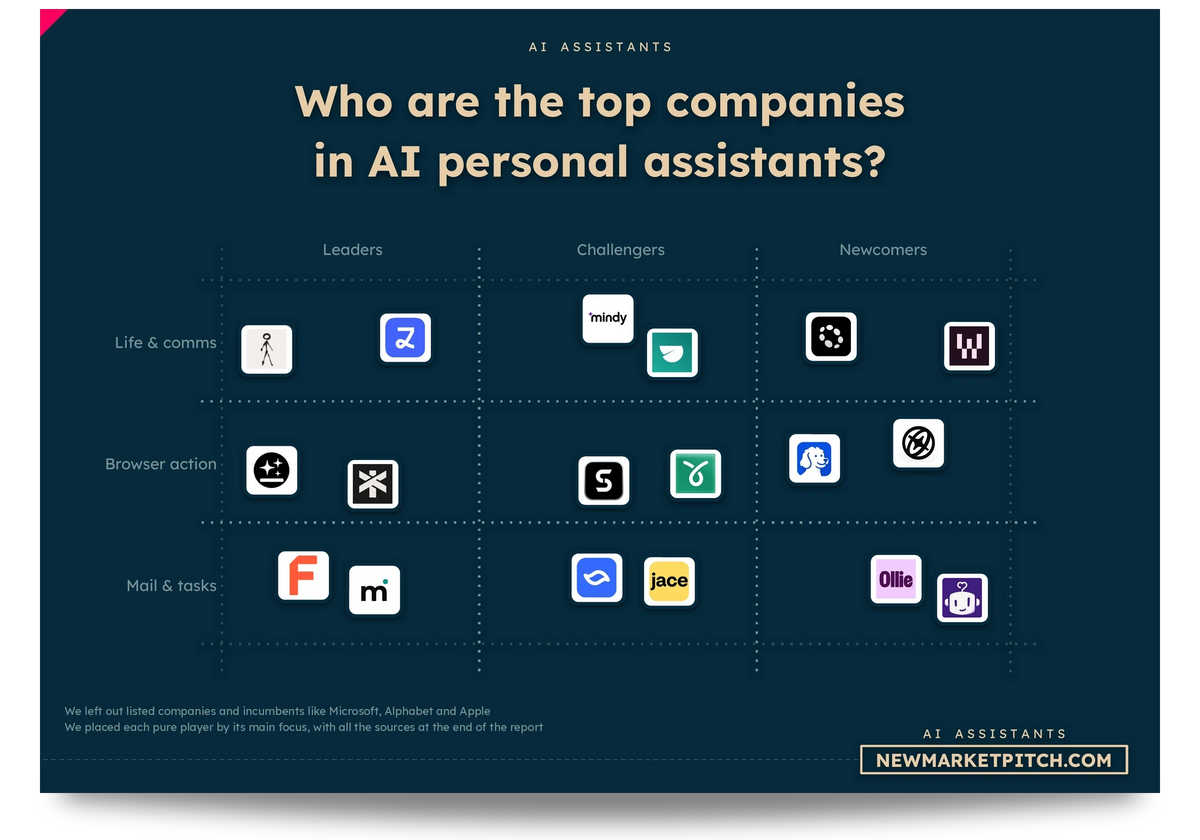
In our research about AI personal assistant startups, we turn what is vague and complex into simple, useful visuals. Market maps like this one show you at a glance where every startup stands.
Is AI personal assistant funding really booming this year?
Yes, AI personal assistant startups are raising much more money this year, and more companies are getting funded.
We counted 30 deals worth at least $3.1B, up from 22 deals and at least $1.2B in the same period of 2025. Funding rose 164%, compared with a 36% increase in deal count. The number of funded companies went from 19 to 25, up 32%. A bigger group of startups is finding money, even though a few very large rounds still drive most of the total.
Three different bets show where the enthusiasm comes from. Instinct's $1.0B Series C in September 2026 backs an agent that takes instructions through messages and calls. Hark's $700M+ Series A in May 2026 supports a plan to build personal AI models and dedicated hardware. Manus's $500M+ round of undisclosed stage in October 2026 funds software that carries out computer tasks. Investors are paying for different ways of getting AI to do work for individuals.
The starting point was much smaller: by the same point in 2024, there had been 18 deals worth $587M. That period has too few deals for a dependable percentage comparison, but the direction is clear across the three windows. The market has grown; the size of the biggest checks makes that growth look even more dramatic.
Has personal AI assistant funding already passed last year's full-year total?
It already has: AI personal assistant startups have raised more so far this year than in the whole of 2025.
This year's partial period has reached 206% of the disclosed capital recorded across the full year of 2025. The comparison is between at least $3.1B so far and at least $1.5B across the completed year. Deal count has also reached 115% of the previous full-year figure. We have not projected any future rounds or treated the current period as a completed year.
Look at the previous full years and the step up is clear. The 2024 calendar year had 19 deals worth $1.1B, followed by 26 deals worth at least $1.5B in 2025. The recent jump is larger in dollars than that earlier progression. Instinct, Hark and Manus explain why: each brought a size of check that earlier assistant companies rarely received.
The product opportunity has become harder to ignore, too. OpenAI announced its acquisition of Sky's developer in October 2025 to bring more computer control into ChatGPT. Meta introduced Muse in September 2026 with the ability to handle web tasks and bookings. Those corporate moves aren't part of our startup financing totals, but they show why investors are treating personal assistants as a major fight over how people use their devices.
Are most AI personal assistant startups raising bigger rounds now?
No, the typical AI personal assistant funding round has actually become smaller than it was by this point last year.
The disclosed median declined 10%, to $13.5M from $15.0M. That is easy to miss when the news is full of giant rounds. Littlebird's $11M Seed round in March 2026, Jarvie AI's $8.3M Seed round in June 2026 and Ghost's $11M Seed round in October 2026 are better illustrations of what many founders are raising.
These companies are solving different problems. Littlebird remembers a person's work context, Jarvie AI coordinates tasks inside group texts, and Ghost offers a general everyday assistant. None needs to fund a giant model-training effort just to launch its initial product. Investors can still finance useful, focused assistants without making a platform-sized commitment.
For perspective, the median in the same period of 2024 was $11.0M. So current rounds are bigger than that earlier midpoint but smaller than last year's. What has really changed is the gap between ordinary venture checks and the exceptional sums going into companies that want to own the whole personal AI experience.
Are $100M rounds becoming normal for AI personal assistants?
$100M rounds are still the exception in AI personal assistant funding, even though they now bring in most of the money.
There were 6 disclosed rounds of $100M or more this year, or 21% of deals with a public amount, and they brought in at least $2.7B. Five of them were above $100M and brought in at least $2.6B. The comparable period last year had 2 rounds above $100M totaling $700M.
The clearest check on the boom is the money outside these deals. Excluding rounds above $100M leaves at least $496M, up 9% from at least $456M in the comparable period. Excluding rounds above $50M leaves at least $211M, compared with at least $181M. That is a growing market for smaller checks, but the headline increase comes chiefly from the top end.
Instinct's September financing and Hark's $700M+ Series A in May 2026 created a new scale for the category. Manus then added another large bet on autonomous task execution. Those products have a much broader ambition than a specialized calendar assistant, but huge investment alone says little about retention or the cost of completing tasks reliably. Most personal AI startups still raise far less.

In our market report about AI personal assistant startups, we always try to gather several sources and make estimates that make sense, so you can work with solid numbers.
Is AI personal assistant funding growing every quarter?
No, AI personal assistant funding jumps around from quarter to quarter, with a particularly big burst in Q3 2026.
That quarter produced 11 deals worth at least $1.4B, yet its median disclosed round was $5.2M. Q2 2026 had 6 deals and at least $898M, with a $43M median. There were more checks in Q3 and a lot more money, but the middle-sized check was far smaller. Instinct's $1.0B Series C in September 2026 helps explain the gap.
This stop-start pattern predates the current boom. Q2 2025 brought $596M from 4 deals; Q3 2025 brought at least $351M from 6 deals. A founder trying to understand the market should look at the number of companies funded alongside the money, rather than treating every high-dollar quarter as a broad improvement.
Q4 2026 is still in progress, so its partial total can't be compared with a full quarter yet. The full quarterly series also makes it easier to see why a single company's announcement shouldn't decide whether the whole market is hot or cold.
The table below shows every quarter since the start of our coverage, with the current one marked as partial.
| Period | Deals | Capital |
|---|---|---|
| Q1 2024 | 7 | $181M |
| Q2 2024 | 4 | $345M |
| Q3 2024 | 4 | $38M |
| Q4 2024 | 4 | $523M |
| Q1 2025 | 9 | $181M |
| Q2 2025 | 4 | $596M |
| Q3 2025 | 6 | $351M+ |
| Q4 2025 | 6 | $350M |
| 2025, quarter not known | 1 | $2M |
| Q1 2026 | 6 | $108M |
| Q2 2026 | 6 | $898M+ |
| Q3 2026 | 11 | $1.4B+ |
| Q4 2026 (partial) | 7 | $690M+ |
Has Instinct changed how much investors will pay for a personal AI agent?
Yes, Instinct has pushed personal AI agent funding into a new range with a string of unusually large rounds.
Instinct raised $1.4B across 4 rounds this year, the most of any AI personal assistant startup in the period. It started with a $25M Seed round in January 2026, then announced a $75M Series A and $250M Series B in August 2026, followed by a $1.0B Series C in September 2026. That pace is extraordinary for an assistant built around familiar texting and calling.
The product gives users an agent with its own phone number and computer. It can contact businesses, book appointments and cancel subscriptions. TechCrunch reported in September 2026 that Instinct itself still had not published official user numbers or growth metrics alongside the financing news. Its earlier privacy policy had also attracted criticism, an important issue for a service that must access personal accounts to work well.
Investors clearly believe text-based agents could become a daily habit. Meta's Muse, launched the same month, can take on similar errands inside an ecosystem many people already use. Instinct has proved it can attract exceptional backing, but it still needs to show that people repeatedly trust the product with real tasks and that those tasks make commercial sense.
Why did Hark raise so much before its personal AI assistant took off?
Hark raised an unusually large sum because it wants to build the models, hardware and assistant experience together.
Hark's $700M+ Series A in May 2026 was a bet on a much more expensive route than putting an existing AI model behind a messaging interface. In its May announcement, Hark described its own multimodal foundation models, purpose-built devices and a universal interface for people and machines. The company also said it had a team of around 70 people and secured NVIDIA B200 computing infrastructure.
That ambition helps explain the scale of financing. Developing models, buying computing capacity, designing a device and getting it into people's hands all cost money before a broad customer base is established. Instinct has chosen a simpler entry point through text messages and calls. Wabi, meanwhile, is building personal assistance around shared mini-apps. These companies are taking quite different routes toward becoming part of users' everyday routines.
Hark's financing says investors think a dedicated personal AI product could eventually be important enough to justify those costs. It gives no answer yet about whether consumers will want another device when their phones, browsers and messaging apps are getting better assistants of their own.

Our document detailing everything you need to know about AI personal assistant gets updated several times a month, so you always get the latest view of where things stand.
Can a brand-new AI personal assistant startup still get seed funding?
Yes, new AI personal assistant startups are still getting their first checks, even as big follow-on rounds dominate the headlines.
We tracked 16 Seed rounds worth $118M this year. Seed accounts for 53% of all deals, while early-stage financings make up 81% among deals with a named stage. Voyage Labs raised a $12M Seed round in November 2026 for travel booking. Fambot raised a $3.5M Seed round in September 2026 for household planning, and Littlebird secured an $11M Seed round in March 2026 for remembering work context.
The first-financing figures tell a similar story. Counting only rounds that their sources describe as a company's first financing, we identified 9, representing 30% of deals, against 5 and 23% in the same period last year. Those first checks raised $68M, or 2% of disclosed capital.
Fambot's September launch offered a practical example of a focused pitch: it pulls school emails, calendars and other family messages into a daily plan. The company said it was already serving more than 1,000 families. Founders can still raise for narrow problems like that. The challenge is showing that people will keep delegating the job after the novelty wears off.
Do later-stage AI personal assistant startups get most of the money?
Yes, later-stage AI personal assistant startups take most of the disclosed funding, even though early rounds are far more common.
Later-stage deals account for 58% of disclosed capital this year, but just 19% of the count among deals with a named stage. Early-stage rounds represent 81% of that named-stage deal count and receive 42% of disclosed money. A small group of larger companies can therefore take most of the cash while new products continue to find seed and Series A backers.
Instinct's September Series C is the most striking case. Manus's October financing of at least $500M and Town's $108M Series B in October 2026 show how much investors will commit to products that aim to handle broad sets of tasks. Manus operates across computer workflows; Town wants assistants to help entire teams; Instinct starts in consumers' calls and messages.
The shift isn't entirely one-way. Early-stage deals received 23% of disclosed capital in the same period last year, so their share is higher now. Investors are making big bets on selected companies without abandoning new ones. The catch is that we have much more evidence of fundraising than we have of long-term profits or successful exits from this still-young market.
Why are some AI personal assistant Series A rounds so big?
Some AI personal assistant startups now get unusually large Series A checks because investors are financing much more ambitious products early.
There were 6 Series A deals worth at least $948M this year, with a $55M median for the stage. The comparable period last year recorded 2 Series A deals worth $110M. Hark's $700M+ Series A in May 2026 dominates the current figure, so the total shouldn't be mistaken for the size of an ordinary application startup's first major venture round.
Town raised a $55M Series A in June 2026 to build a personal assistant for inboxes, calendars, Slack and documents. Its company announcement described users delegating tasks rather than learning to configure complicated tools. Wabi raised a $55M Series A in October 2026 for personal AI and mini-apps people can use together. The checks match, but Town needs to become useful across a workday while Wabi needs users to return for social and personal activities.
Investors are clearly prepared to fund an ambitious product earlier than before. Still, Hark, Town and Wabi have different costs and routes to customers. It would be a mistake to read their rounds as a new entitlement for every founder asking for a Series A.
Are investors now putting their biggest checks into AI assistants that use texts and calls?
Yes, messaging and voice personal agents now attract the most disclosed funding in the AI personal assistant market.
We tracked 9 deals totaling $1.4B in this category, or 46% of disclosed capital. In the same period last year, there were 6 deals worth $48M, representing 4% of the money with a public amount. Instinct accounts for much of the leap, but smaller companies show why familiar communication channels interest investors.
Equal answers and screens phone calls in India; Prosus reported in June 2026 that it had passed 1 million monthly active users and 350,000 daily active users. Zapia handles reminders and bookings for Latin American consumers and is adding actions across websites and apps. Jarvie AI's $8.3M Seed round in June 2026 backed an agent that coordinates group-text tasks. These products meet users inside habits they already have.
There is a catch. Zapia said in March 2026 that restrictions affecting third-party AI assistants on WhatsApp had pushed it toward a distribution channel it controls. Meta has since introduced Muse in WhatsApp itself. Messaging makes an agent easy to reach today, while leaving the startup exposed to decisions made by the platform owner. Investors are backing the convenience of conversation, but a lasting business may need more independence.

In our report covering the AI personal assistant market, we look at what the winners do differently, so you can learn from the best instead of guessing.
Are investors suddenly funding AI assistants that remember everything?
Personal memory assistants are getting more funding deals, although they still receive a small share of AI personal assistant investment.
Personal memory and context companies recorded 5 deals worth $74M this year, or 17% of deals and 2% of disclosed capital. The category's share of deals rose 17 percentage points from the comparable period last year. It is a clear change in the number of startups attracting attention, even though the money is modest next to the huge messaging-agent rounds.
Hello Haven raised a $15M Seed round in September 2026 to build a digital twin that carries personal context across messages, email and apps. Highlight AI raised a $40M Series A in March 2026 for an assistant that uses the work visible on a person's screen. Littlebird's $11M Seed round that month took a similar aim at remembering information from computer work. Each is trying to solve a problem people encounter quickly: they have to explain themselves again every time they open another AI tool.
Memory also makes trust a bigger issue. Highlight's September privacy guidance says financial, medical and login pages are blocked from capture by default and that screen context can be turned off. Google, meanwhile, introduced optional personal-account connections for Gemini earlier this year. Independent memory products need to make stored context useful enough to justify asking for access that Google and other established platforms may already have.
Are investors losing interest in AI browser agents?
Investors are funding fewer dedicated AI browser-agent deals, but the companies that do raise can still get very large checks.
The computer-use and web-task agent category recorded 2 deals worth at least $600M this year. The comparable period last year had 5 deals and $212M. The deal count has fallen sharply, while announced funding has risen. Manus's $500M+ round of undisclosed stage in October 2026 and Genspark's $100M Series B in June 2026 account for the current activity.
Genspark's product can take a request, work on a cloud computer and return finished files. Anthropic made Claude in Chrome generally available to paid users in August 2026, while Perplexity added deeper multitab tasks to its Comet browser assistant. Those products now overlap with the workflows specialist browser-agent startups want to own. OpenAI is also pushing computer use into broader assistant products.
Browser automation remains useful, and investors clearly haven't stopped paying for it. But browsing, filling out forms and moving information between apps are increasingly features of general-purpose agents. That makes a new company selling only browser clicks harder to distinguish. The current numbers point to fewer separate browser-agent bets and much larger checks for selected survivors, not proof that the task itself is fading.
Have investors given up on wearable AI assistants?
No, wearable AI assistants are still getting funded, but there are very few recent deals in the category.
Ambient and wearable assistant startups recorded 1 financing worth $23M this year, compared with 2 financings worth $12M in the same period last year. These are small samples, so it would be reckless to declare a lasting retreat. The latest funding went to Sandbar's $23M Series A in March 2026 for its Stream ring.
The ring's microphone is off by default and activates when the wearer touches it. That lets someone capture a thought or ask an assistant for help without reaching for a phone. Sandbar told TechCrunch that its early preorders had sold out and that some users were using the device repeatedly throughout the day. Both details are encouraging, although neither establishes how much revenue the product will make after a wider release.
Wearable hardware has a hard comparison to beat: the phone and glasses customers already own. Amazon acquired the personal-memory wearable company Bee, and Meta plans to bring Muse to its AI glasses. A standalone ring can still win by making voice capture and recall unusually convenient. It must also turn those recordings into help people value, because simply collecting more notes leaves the owner with another inbox to sort through.
Are AI assistants for families finally getting serious funding?
Yes, investors are backing family AI assistants, but the checks are still modest next to the broader personal-agent market.
Family and household coordination startups secured 2 deals worth $5.5M this year. The same period last year had 1 deal with no disclosed amount. Fambot's $3.5M Seed round and Orbits' ~$2M Seed round in September 2026 went after calendars, errands and appointments. Ollie, a text-based family assistant that had raised money in 2023 and 2025, shows the risk: TechCrunch reported in October 2026 that it was shutting down.
These products have a clear daily job. A parent might need to find a changed pickup time, answer a school message and reschedule a medical appointment. Fambot said at its September launch that it was already serving more than 1,000 families, pulling information from school messages, calendars and activity updates into a daily plan. Google's latest Gemini update also shows how quickly the same idea can spread: its November announcement described turning school emails into calendar events and helping resolve a carpool conflict.
A family assistant has to get small details right. Shared calendars need permissions, and mistakes affect other people, sometimes children. That gives specialists room to earn trust by handling a particular household problem better than a general AI tool. For now, investors are paying for a chance to prove that families will use these services every week, not for evidence of a giant established market.

In our research about AI personal assistant startups, we don't want to repeat what boring consulting reports say. Instead, we show you the real and latest market signals that matter.
Are investors funding AI assistants that work for whole teams?
Workplace AI assistant funding is increasingly going toward products that help coworkers get things done together.
Executive and productivity assistants recorded 4 deals worth at least $168M this year, compared with 4 deals and $64M in the same period last year. The number of deals hasn't grown, but the disclosed money has. Town's $108M Series B in October 2026 is the clearest reason why the category looks bigger.
Town started with an assistant for one person's inbox, calendar and connected work tools. In its October 2026 announcement, the company described expanding that assistant to whole teams so people can share approved context and keep projects moving. Pally's $5.2M Seed round in August 2026 tackled a smaller part of the same daily routine: remembering relationships and following up in messages. Town is trying to coordinate work between people; Pally is helping an individual stay on top of contacts.
Microsoft and Google already sit inside many workplace calendars, documents and email accounts. Their assistants will be difficult to beat on simple drafting or scheduling. A startup has a stronger case when it can finish work across tools and colleagues, with the right permissions, and save enough time that a team wants to pay. That is the commercial question behind the bigger checks.
Is the United States pulling ahead in AI personal assistant funding?
Yes, American startups are attracting a larger share of AI personal assistant deals than they did by this point last year.
The United States recorded 23 deals worth at least $2.5B, accounting for 77% of deal count and 82% of disclosed capital this year. The comparable period of 2025 had 14 US deals, or 64% of the total. North America as a whole has 24 deals and at least $2.5B, compared with 15 deals and at least $1.0B by this point last year.
Instinct, Hark and Town show the advantage of a large domestic venture market: their backers can support consumer agents, original AI models and workplace software at very different stages. Wabi's $55M Series A in October 2026 added another bet on a personal assistant built around shared activities and mini-apps. The US has more financed approaches, as well as more very large rounds.
Those figures measure headquarters, not the countries where people actually use the products. Zapia serves Latin American consumers, while Equal built its call assistant for India. Local habits and language still matter. The US has a clear lead in attracting this kind of venture money, but American funding dominance does not settle which products people elsewhere will choose.
Is Asia catching up with the US in personal AI assistant funding?
Not in deal count: Asia-Pacific has attracted some large personal AI assistant investments without matching America's breadth.
Asia-Pacific startups recorded 2 deals and at least $530M this year, against 2 deals and $77M in the same period last year. The big change is largely Manus's $500M+ round of undisclosed stage in October 2026 in Singapore. India's Equal raised a $30M Series B in June 2026 for its AI call assistant. These are real businesses pursuing very different routes to users, but they aren't evidence of a wave of new regional fundraisings.
Manus takes actions through software and browsers for people who want to delegate complicated computer tasks. Equal began with a simpler, local need: screening unknown callers and responding when needed. Prosus reported in June 2026 that Equal had exceeded 350,000 daily active users and was expanding into other personal tasks. That is a more useful sign of customer demand than the round size alone.
Singapore gives agent companies a base for products aimed internationally; India offers a huge consumer market where voice and mixed-language calling are everyday habits. Those advantages may produce major companies. Today, though, the region's disclosed funding depends on very few deals, whereas US startups are getting funded across a wider range of products.

Learning from others' mistakes is the cheapest lesson there is. In our market report about AI personal assistant startups, we look at what broke startups before you, so you don't repeat it.
Is Europe falling behind in AI personal assistant funding?
Europe has far fewer recorded personal AI assistant deals this year, although the sample is too thin to call it a lasting decline.
We recorded 1 European financing worth $2.9M, compared with 4 financings worth $60M in the comparable period last year. The recent deal is Rhise AI's $2.9M Seed round in November 2026, backing a German assistant that connects personal information and everyday tasks. A single current deal gives us little basis for predicting Europe's next funding cycle.
There were more varied examples earlier. Fyxer AI raised a $10M Series A in March 2025 and a $30M Series B in September 2025 for executive-assistant work. Sweden's Strawberry raised $6M in a Seed round in October 2025 for a browser agent, while Spain's Luzia raised $14M in a round of undisclosed stage in May 2025 for a messaging assistant. Europe has produced different approaches; its current count is simply low.
The competitive pressure is real wherever a startup is based. Anthropic can perform tasks in Chrome, Perplexity's Comet works across web tabs, and Google is putting more personal information and actions into Gemini. European teams will need something customers can recognize and trust, such as an unusually good local service or specialist workflow. We can say that European fundraising has been quiet lately, but the evidence doesn't support a grand claim that European personal AI has failed.
Are big venture firms still backing independent AI personal assistants?
Yes, major venture firms are still leading AI personal assistant rounds, despite growing competition from giant technology companies.
Andreessen Horowitz is the most active lead investor in our current period, with 3 rounds led and $74M in combined round size. Benchmark led 2 rounds totaling $1.3B, while Kleiner Perkins led 2 rounds totaling $87M. Those sums describe the financings the firms led, not the amounts those firms personally invested. The difference in round size also shows how varied the bets are.
Andreessen Horowitz led Town's $55M Series A in June 2026 and also took part in Wabi's October 2026 round, which IVP led. Parkway Venture Capital led Hark's unusually large May 2026 round. The product choices range from work assistants and shared personal apps to hardware built for personal intelligence. These investors aren't all financing the same route to the customer.
The difficult part is competing for a habit rather than collecting a large investment. Equal has found demand by answering calls for people in India; Wabi wants friends to make and share useful mini-apps; Town is turning an individual work assistant into a team product. A famous lead investor can help a startup build and recruit. It cannot make customers keep using an assistant once Google or Meta offers a convenient alternative.
Do Meta, Google and OpenAI make personal AI startups too risky to fund?
No, but Meta, Google and OpenAI make life much harder for independent personal AI assistant startups.
Meta's Muse can act through WhatsApp, book appointments, fill forms and keep working on long-running tasks. Google's latest Gemini release introduced more task execution involving calls, bills and purchases, using accounts and payment tools people may already have connected. OpenAI acquired the developer of Sky in October 2025 to bring more computer control into ChatGPT, and Anthropic has made browser actions available through Claude in Chrome.
That competition is unusually direct. A new assistant must persuade people to hand over permissions to email, calendars, purchases or messages, while the biggest platforms already have customers, trusted accounts and familiar places to launch features. The more useful those platforms become, the harder it is to sell a generic assistant based on capabilities anyone can copy.
There are still reasons to fund startups. Equal knows Indian calling habits; Fambot focuses on messy family schedules; Sandbar offers a wearable input that a phone app cannot copy exactly. Each has to prove repeat usage, trust and a way to earn money. Investors are making those bets now because the opportunity is real, even though the number of companies that eventually win may be much smaller than the number being funded.
So, what are the latest funding trends in AI personal assistant?
AI personal assistant funding is booming, but most of the money is going to a small group of ambitious companies while other startups raise much more modest rounds.
We see a bigger funding market, more companies raising, and an ordinary round that has not kept pace with the largest checks. Instinct raised the most among startups in the current period; Hark is taking on the cost of original models and hardware; Manus and Genspark are building agents that operate software for users. At the same time, founders are still getting seed money for memory, family planning, phone calls and workplace coordination.
The biggest change is what investors hope an assistant can become. They're funding products that could eventually sit between a person and many of the apps that person uses each day. But Meta's Muse, Google's expanded Gemini tasks and OpenAI's push into computer use mean an independent product must do something especially well to earn a place in people's routine. Funding has grown much faster than we can yet measure long-term customer success. The opportunity is large, and so is the risk.
The table below shows what we found.
| Question | Answer |
|---|---|
| Is venture funding rising faster than deal activity? | Yes, disclosed funding increased 164% while deal count rose 36%. The median nevertheless declined to $13.5M from $15.0M. Bigger headlines conceal smaller typical checks for founders. |
| Has this year's market broken the old ceiling? | Yes, current financing has reached 206% of the full 2025 total. The present year remains incomplete, unlike that earlier calendar year. No year-end projection is needed to show the jump. |
| Do smaller rounds share the boom equally? | No, money excluding rounds above $100M rose just 9%. That group attracted at least $496M in the current period. Giant checks account for most of the headline surge. |
| Did one consumer agent change fundraising expectations? | Instinct led company fundraising through 4 rounds this year. Its financings followed each other at an unusually rapid pace. The money alone cannot prove people will keep using it. |
| Are funding quarters following a steady climb? | No, Q3 2026 recorded 11 deals and a $5.2M median. Large rounds lifted that quarter's headline capital figure. More deals didn't translate into a bigger typical check. |
| Are seed deals where most money goes? | No, seed deals represent 53% of financings this year. Seed rounds took just 4% of disclosed capital overall. Early access remains broad, while the biggest money goes elsewhere. |
| Are messaging agents attracting substantial new funding? | Yes, messaging and voice agents received 46% of disclosed funding. The category accounted for 9 financing deals this year. Reaching users through familiar conversations remains a major investor bet. |
| Has persistent personal memory become a big business? | Not yet, although memory assistants attracted 5 financing deals. The category received $74M during the current period. Investors still need proof that customers trust and reuse these tools. |
| Have AI browser agents lost their appeal? | Not entirely; dedicated browser agents raised at least $600M. Only 2 rounds produced that total this year. More general assistants can now handle many of those tasks. |
| Does America still have the broadest startup base? | Yes, US startups accounted for 23 funding deals. US disclosed rounds totaled at least $2.5B this year. Other regions have strong examples without comparable deal breadth. |
| Can independent assistants survive the technology giants? | Possibly, if they solve a recurring task better than platforms. Meta introduced Muse and Google expanded Gemini task execution. Startups need lasting habits and trust beyond a clever demonstration. |

If you build or invest in the AI personal assistant market, you need to know which business models pay off now and which ones are fading. That's why our report covering it has a whole section on it.
Our methodology
Our data runs through November 19, 2026. We then reviewed this article and updated its answers on November 24, 2026, the date shown under the title. We examine financings announced from January 1, 2024 through that date. This funding-trends article compares January 1 through November 19, 2026 with the corresponding January 1 through November 19 windows of 2025 and 2024; complete calendar years and quarters are identified separately. We do not annualize partial periods. One 2025 deal is dated only by its year, so it counts in the 2025 totals but in no quarter.
We count equity financings of private companies of at least $300K. Debt, grants, loans, unconverted convertible instruments, SAFEs and public offerings are excluded. We include a company's financing once, merge duplicate reports of the same round and retain the announced stage and amount. Undisclosed round sizes count toward the number of deals but not disclosed capital, so totals marked with a plus sign are minimums.
We define AI personal assistants as products acting for identifiable individuals to remember, organize, coordinate or complete everyday tasks across personal and professional contexts. That includes messaging and voice agents, executive assistants, computer-use agents, personal memory, household coordination, concierge products and ambient devices when assistance is their principal value. We include credible borderline cases rather than hiding them, while excluding generic model infrastructure, brand-facing customer support, coding-only agents, search-only products, pure transcription and purely conversational companions.
Every company counted meets our startup definition: an independent, growth-oriented business founded in 2007 or later, backed by venture capital, angels or its founders, and either private or listed within the past five years. An acquisition within the past three years does not automatically remove a company from the historical coverage. Incumbent technology giants may appear as competitive context, but their corporate activity is not included in our startup funding totals.
Rounds confirmed by a company announcement, a press article or a regulatory filing are counted in full. Where no article exists, a round is counted only when at least two recognised databases agree on its date (within one month) and amount (within 5%), and it is marked as low confidence; a round found in a single database stays in the company's history but is left out of totals. For companies that have raised more than $100M, every round counted is backed by an article.
We assign one primary category to each financing and a geographic region based on the company's headquarters country. Seed and Series A are early stages; Series B and later rounds and growth equity are later stages. Where stage or financing history cannot be established confidently, we label it unknown rather than inferring one. Percentages of capital refer only to amounts that were publicly disclosed, whereas percentages of deals include undisclosed-amount rounds.
Our first choice for each financing is the company's own announcement, a regulatory filing or reliable first-hand press reporting. We use the corroborated-database exception only under the rule above. Different reports may cover other definitions of an assistant, include earlier or smaller rounds, use an acquisition's announced value as financing, or stop on a different date. That explains why reputable totals can differ without making the comparison within this article inconsistent. The current quarter is unfinished, and its totals should not be mistaken for a forecast.
Key sources include Instinct's September Series C, product functions, privacy concerns and undisclosed usage metrics., Hark's May Series A, personal intelligence product plan, team and computing infrastructure., Town's June Series A and initial personal work-assistant proposition., Town's October Series B and expansion from personal to shared workplace tasks., Wabi's October round and collaborative mini-app assistant product., Reuters report confirming Manus's completed October financing., Genspark's computer-based agent and finished-task workflow., Perplexity's agent performing longer, multitab browser tasks., Anthropic's August release of autonomous browser actions and security precautions., OpenAI's acquisition of Sky's maker and ambitions for computer-using assistants., Meta's Muse launch, task execution, messaging interface and permissions., Google's opt-in connections between Gemini and personal accounts., Google's November expansion of Gemini task execution and consumer availability., Cognition's acquisition of Poke and evidence of demand for proactive messaging agents., Equal's Indian call-assistant product, adoption figures and financing., Zapia's product functions and response to messaging-platform restrictions., Fambot's family coordination product launch and early adoption., Hello Haven's persistent personal-memory product and September financing., Highlight AI's screen-context permissions and privacy safeguards., Sandbar's smart-ring capabilities and financing., Amazon's wearable-assistant acquisition and its relationship to Alexa., and Ollie's shutdown announcement..

In our report covering the AI personal assistant market, we like to show you the big picture. We know your time is precious, so we make every page quick to read and packed with as much learning as possible per minute.
Written by the New Market Pitch teamWe track new markets so founders and investors can move faster. About us