What are the most valuable ai-powered market research startups?
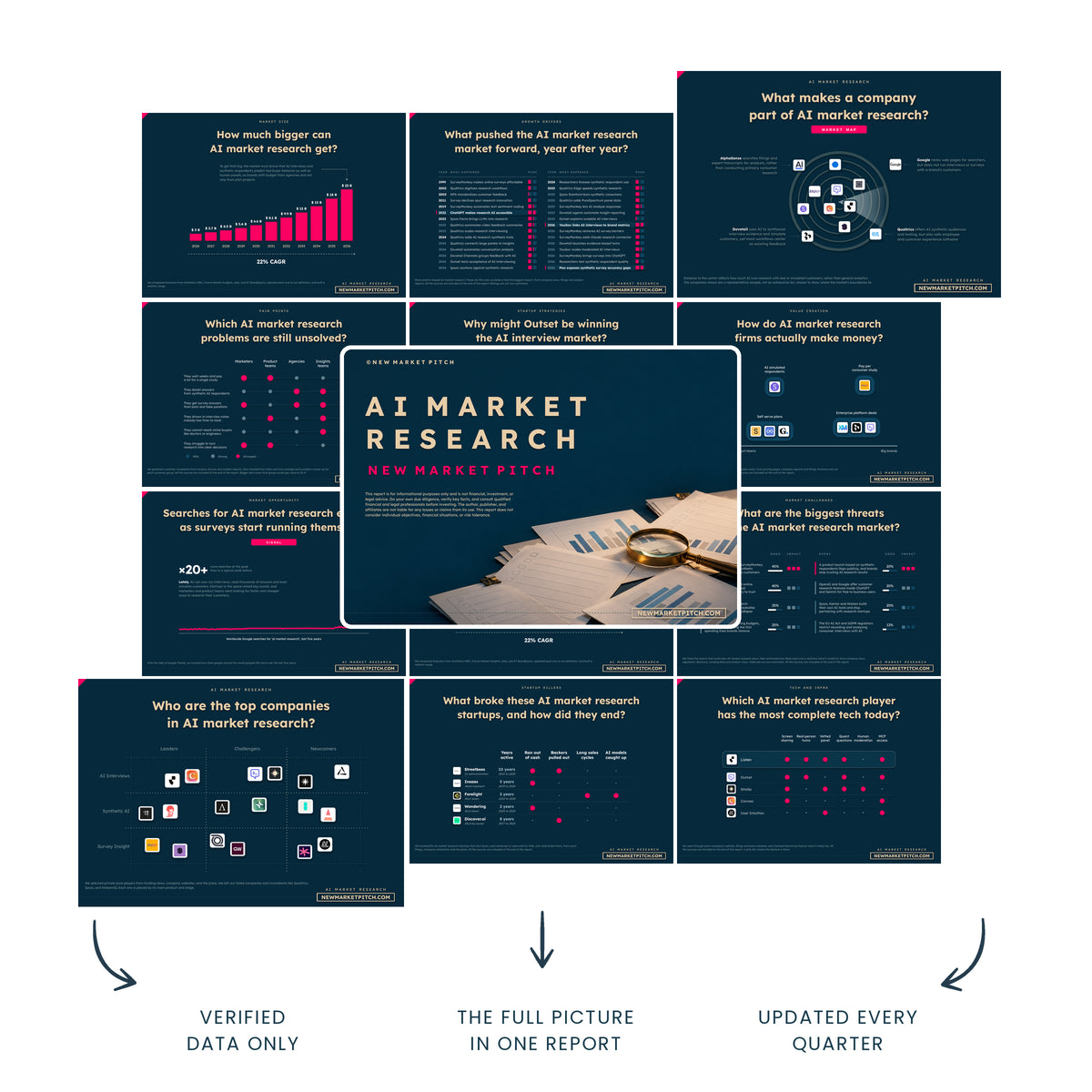
Whether you're building or investing in the ai-powered market research market, our report covers everything you need to know: the players, the money, and what's coming next.
Summary
Simile is the most valuable AI-powered market research startup, valued at $2.0B. Aaru follows with a reported $1.0B, and GWI ranks third with a valuation floor above $850M set in 2022. Those prices reflect very different bets on how companies will understand their customers.
Simile and Aaru promise to simulate human behavior before a company spends money on a new product, campaign or strategy. Simile's work with CVS Health and Itaú shows how businesses are already testing that idea, although the accuracy of any given prediction still needs checking.
The billion-dollar group is small. Only 2 of the 37 AI-powered market research startups we can value qualify as unicorns. The other 35, or 95%, sit below that threshold.
Older research software has hardly disappeared. GWI sells researched audience data, and Dovetail makes interviews and customer feedback easier to find. Their value comes partly from evidence they have collected or organized over years.
That history matters because synthetic respondents can give a convincing answer without predicting what a buyer will actually do. Stanford's research shows the potential of carefully grounded simulated people, while other studies have found clear limits when language models stand in for human decisions.
Meanwhile, AI interview companies are making research with real respondents much faster. Conveo, Outset and GetWhy use automated moderation and analysis, but the people on the other end of the interview are real.
Some companies focus on one decision. Happydemics measures advertising's effect on brand perception, Dragonfly AI predicts what people will notice in a design, and Unwrap sorts through customer complaints. All sell research, but they face different competitors.
The United States accounts for 18 of the startups we can value, against 6 in the United Kingdom. Strong contenders also come from Belgium, Denmark, Australia and New Zealand, so this is not simply a Silicon Valley business.
The prices need careful reading. Simile has an announced price and Aaru a price reported by the press, while most younger companies only have a range we estimate from their last round. A historic range and a freshly announced price do not prove exactly the same thing.
For now, Simile has the clearest claim to the top spot. The longer fight is between software that predicts consumer behavior, software that collects fresh human evidence, and platforms that make years of research useful again.

Written by the New Market Pitch teamWe track new markets so founders and investors can move faster. About us

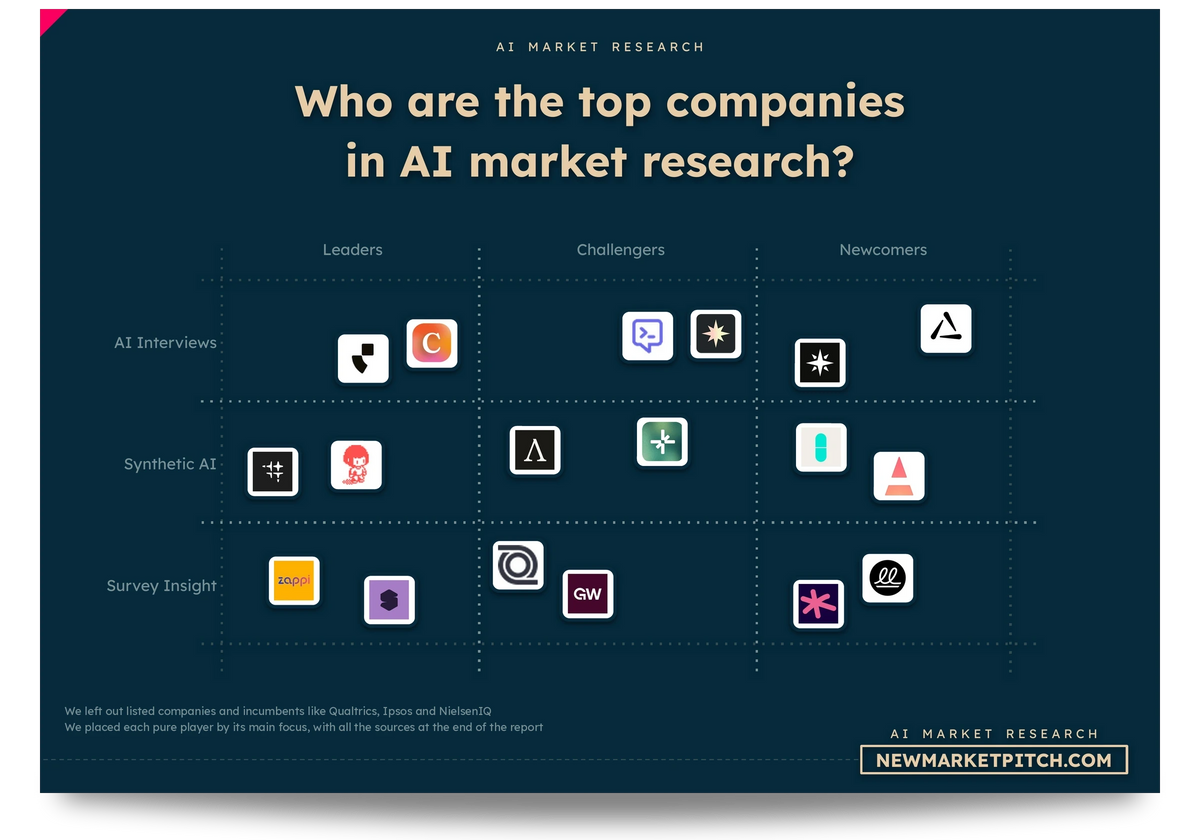
In our report covering the ai-powered market research market, we turn what is vague and complex into simple, useful visuals. Market maps like this one show you at a glance where every startup stands.
Top startups in the ai-powered market research industry ranked by valuation
Here is the current ranking of the most valuable ai-powered market research startups. For each one you will also find our confidence level and the valuation basis we used.
If you want to go deeper into the ai-powered market research startup landscape, check our report covering the ai-powered market research market.
| # | Startup | Valuation | Confidence | Valuation basis | Last round | Total funding |
|---|---|---|---|---|---|---|
| 1 | SimileFoundation models simulating human behavior | $2.0Bas of Jul 2026 | Full | Announced private round valuation | $200MSeries B · Jul 2026 | $300Mvalued at 6.7× this |
| 2 | AaruSimulates human behavior for market research | $1.0Bas of Dec 2025 | Strong | Reported private round valuation | $50M+Series A · Dec 2025 | $50M+valued at 20.0× this |
| 3 | GWIConsumer audience intelligence and AI data querying | >$850Mas of Feb 2022 | Full | Announced private round valuation | $180MSeries B · Feb 2022 | $220Mvalued at 3.9× this |
| 4 | DovetailAI repository and analysis for user interviews | >$700Mas of Jan 2022 | Strong | Reported private round valuation | $63MSeries A · Jan 2022 | $66M+valued at 10.6× this |
| 5 | GetWhyAI analysis of video-based consumer research | $272M–$454Mas of Jul 2025 | Low | Estimated from last round | $20MSeries A extension · Jul 2025 | $55Mvalued at 6.4× this |
| 6 | ConveoAutomated consumer interview and research agents | $250M–$417Mas of Sep 2026 | Low | Estimated from last round | $50MSeries A · Sep 2026 | $55Mvalued at 5.8× this |
| 7 | OutsetAI-moderated customer interviews and usability studies | $200M–$375Mas of Dec 2025 | Low | Estimated from last round | $30MSeries B · Dec 2025 | $51Mvalued at 5.4× this |
| 8 | HappydemicsAI-aided advertising measurement and brand surveys | $90M–$169Mas of Dec 2024 | Low | Estimated from last round | $14MSeries B · Dec 2024 | $27Mvalued at 4.6× this |
| 9 | Bridgetown ResearchAI market research and competitive intelligence | $95M–$158Mas of Feb 2025 | Low | Estimated from last round | $19MSeries A · Feb 2025 | $19Mvalued at 6.4× this |
| 10 | Newton ResearchAI research for advertising effectiveness decisions | $72M–$179Mas of Nov 2026 | Low | Estimated from last round | $18MNov 2026 | $27Mvalued at 4.2× this |
| 11 | KnitAI-powered consumer research and qualitative synthesis | $81M–$134Mas of Jul 2025 | Low | Estimated from last round | $16MSeries A · Jul 2025 | $29Mvalued at 3.6× this |
| 12 | StrellaAI-moderated customer interviews and focus groups for market research | $70M–$117Mas of Oct 2025 | Low | Estimated from last round | $14MSeries A · Oct 2025 | $18Mvalued at 5.0× this |
| 13 | UnwrapAI customer feedback analysis software | $60M–$100Mas of Jan 2025 | Low | Estimated from last round | $12MSeries A · Jan 2025 | $12Mvalued at 6.5× this |
| 14 | IdeallyAI-guided consumer survey testing and segmentation | $50M–$83Mas of Apr 2026 | Low | Estimated from last round | $10MSeries A · Apr 2026 | $10Mvalued at 6.5× this |
| 15 | Electric TwinSynthetic consumer audiences for research and prediction | $40M–$100Mas of Feb 2026 | Low | Estimated from last round | $10MFunding (stage not disclosed) · Feb 2026 | $14Mvalued at 4.5× this |
| 16 | Dragonfly AIPredictive attention analytics for creative effectiveness | $46M–$86Mas of Jan 2026 | Low | Estimated from last round | $6.9MGrowth equity · Jan 2026 | $11Mvalued at 5.9× this |
| 17 | Bolt InsightAI-moderated global consumer insight interviews | $47M–$79Mas of Dec 2025 | Low | Estimated from last round | $9.4MSeries A · Dec 2025 | $11Mvalued at 5.5× this |
| 18 | i-GenieAI consumer signals from digital behavior | $38M–$63Mas of Oct 2025 | Low | Estimated from last round | $7.5MSeries A · Oct 2025 | $7.5Mvalued at 6.5× this |
| 19 | QualSightsSmart sensors, a participant app and physical AI analytics measure actual consumer use of household products. | $20M–$50Mas of Nov 2026 | Low | Estimated from last round | $5MNov 2026 | $5Mvalued at 6.3× this |
| 20 | BluePillAI consumer twins for rapid concept testing | $24M–$40Mas of Nov 2025 | Low | Estimated from last round | $6MSeed · Nov 2025 | $6Mvalued at 5.2× this |
| 21 | Dialogue AIConversational customer interviews and automated insight analysis | $24M–$40Mas of Oct 2025 | Low | Estimated from last round | $6MSeed · Oct 2025 | $6Mvalued at 5.2× this |
| 22 | VersoAI-led consumer interviews and evolving personas | $24M–$40Mas of Oct 2026 | Low | Estimated from last round | $6MSeed · Oct 2026 | $6Mvalued at 5.2× this |
| 23 | Bounce InsightsAI-driven consumer survey research and insights | $18M–$45Mas of Dec 2024 | Low | Estimated from last round | $4.5MOther · Dec 2024 | $5.6Mvalued at 5.0× this |
| 24 | FairgenSynthetic respondent augmentation and audience twins | $22M–$37Mas of May 2024 | Low | Estimated from last round | $5.5MSeed · May 2024 | $8Mvalued at 3.6× this |
| 25 | CafeteriaAI-moderated feedback from youth consumers | $20M–$38Mas of Jul 2025 | Low | Estimated from last round | $3MGrowth equity · Jul 2025 | $6.1Mvalued at 4.5× this |
| 26 | Ai PaletteAI software for market research | $20M–$33Mas of Mar 2024 | Low | Estimated from last round | $4MSeries A · Mar 2024 | $4Mvalued at 6.5× this |
| 27 | CoLoopAI analysis and coding of qualitative research | $14M–$23Mas of Jan 2025 | Low | Estimated from last round | $3.5MSeed · Jan 2025 | $3.5M+valued at 5.2× this |
| 28 | KeplarVoice interviews for customer and market research | $14M–$23Mas of Sep 2025 | Low | Estimated from last round | $3.4MSeed · Sep 2025 | $3.4Mvalued at 5.2× this |
| 29 | Artificial SocietiesSimulated societies for public and consumer insight | $13M–$22Mas of May 2025 | Low | Estimated from last round | $3.4MSeed · May 2025 | $5.4Mvalued at 3.2× this |
| 30 | askpollyAI market research through synthetic consumers | $12M–$20Mas of Sep 2026 | Low | Estimated from last round | $3MSeed · Sep 2026 | $3Mvalued at 5.2× this |
| 31 | GetWhysAI interview analysis for market research | $11M–$18Mas of Feb 2025 | Low | Estimated from last round | $2.8MSeed · Feb 2025 | $2.8Mvalued at 5.2× this |
| 32 | IntelliciaSynthetic consumer research with AI personas | $10M–$17Mas of Sep 2026 | Low | Estimated from last round | $2.5MPre-Series A · Sep 2026 | $2.5Mvalued at 5.2× this |
| 33 | BehavixAI market research and consumer behavior analytics | $10M–$17Mas of Feb 2025 | Low | Estimated from last round | $2.5MSeed · Feb 2025 | $2.5Mvalued at 5.2× this |
| 34 | Autentic AIAI market research interviews platform | $6.7M–$11Mas of Oct 2026 | Low | Estimated from last round | $1.7MPre-Seed · Oct 2026 | $1.7Mvalued at 5.2× this |
| 35 | PropaneAI-powered customer intelligence and market insights | $5.4M–$9Mas of Sep 2025 | Low | Estimated from last round | $1.4MPre-Seed · Sep 2025 | $1.4Mvalued at 5.2× this |
| 36 | HootologyGenerative AI simulated qualitative research discussions | $4.4M–$7.3Mas of Jul 2025 | Low | Estimated from last round | $1.1MPre-Seed · Jul 2025 | $1.1Mvalued at 5.2× this |
| 37 | EchovaneAutonomous end-to-end market research agents | $4M–$6.7Mas of Aug 2026 | Low | Estimated from last round | $1MSeed · Aug 2026 | $1Mvalued at 5.2× this |
No startups match this search.

Our research about ai-powered market research startups gets updated several times a month, so you always get the latest view of where things stand.
Why is Simile already worth more than older market research startups?
Simile leads AI-powered market research because investors believe behavioral simulation could change how companies test big decisions.
Simile's announced valuation is $2.0B, with $300M raised in equity. Its July 2026 Series B priced a business founded in 2025 ahead of research vendors that spent years building customer relationships. The speed of that rise is unusual, but the product is also a bigger leap than faster survey analysis. Simile creates agents based on real people's characteristics and interviews, then uses them to explore how a population might respond.
The company has moved beyond a laboratory story. TechCrunch reported CVS Health among its customers and investors in July 2026. In a September 2026 case study, Simile described how Itaú Unibanco reduced one research cycle from five weeks to four business days, using simulation to screen ideas before human validation. Those are examples of a useful workflow, rather than independent proof that every simulated buying decision is correct.
Stanford's May 2025 research on interview-grounded agents gives the approach a scientific starting point. The hard part now is showing that accuracy survives unfamiliar products, different groups of buyers and changing behavior. That is what would turn Simile's price into a lasting advantage over GWI, Dovetail and other established research businesses.
Are billion-dollar AI market research startups actually common?
Only 2 AI-powered market research startups clearly qualify as unicorns: Simile and Aaru.
That is 5% of the 37 companies we can value. The other 35 sit below the billion-dollar line, even though AI tools have become common across interviews, consumer data and advertising tests. Investors have rewarded a small number of research businesses with very high prices rather than lifting the whole industry together.
The two leaders sell the same broad idea, simulated human behavior, but their prices rest on different evidence. Simile's $2.0B was announced with its July 2026 Series B. Aaru's $1.0B is a headline valuation reported by TechCrunch, with investors paying different prices per share in the same round, so the certainty behind those numbers is different.
GWI and Dovetail also belong in any serious discussion of valuable research software, but a historical valuation floor or a press-reported price does not automatically make a company a confirmed current unicorn. A two-company club is the right answer for this market, and calling every promising AI research vendor a potential billion-dollar business blurs a real gap in investor pricing.

In our market report about ai-powered market research startups, we look at what the winners do differently, so you can learn from the best instead of guessing.
Can Aaru catch Simile in synthetic market research?
Aaru is a genuine challenger to Simile in synthetic market research, although its disclosed valuation has not caught the leader.
Aaru's reported private-round valuation is a $1.0B headline figure, and it has raised at least $50M in equity. Founded in 2024, it builds simulated populations that clients can question about preferences, products and public opinion. TechCrunch reported in December 2025 that Redpoint Ventures backed its Series A and described work involving Accenture, EY and Interpublic Group. Those relationships put its software in front of strategy and advertising buyers, not just market research teams.
Simile has a different starting point: academic work on individual agents, followed by enterprise uses such as the CVS Health and Itaú projects. Aaru's promise is broader population-level forecasting. Both companies need to show how their predictions compare with real behavior when a client asks about something the models have never encountered.
We would call Aaru a serious competitor today, but a list of recognizable clients does not settle the accuracy question. Neither does a strong demo. The company that routinely shows its forecasts against later human evidence will have the better case for a premium valuation, regardless of which one arrived first.
Is Zappi still one of the most valuable AI research startups?
No, Zappi is no longer among the AI-powered market research startups we value, because Sumeru Equity Partners, a private equity firm, took control of it in December 2022.
Our ranking covers independent startups, and a company majority-owned by a private equity firm falls outside that definition. Zappi's December 2022 financing of $170M was led by Sumeru, and part of it was debt rather than equity. A deal that hands control of a company to its investor also cannot serve as the basis for our usual estimate, which assumes a round sold a minority stake of the kind startups usually give up.
The business remains a real competitor for the startups in our ranking. When it announced its 2022 investment, Zappi named PepsiCo, McDonald's, Heineken and Reckitt among more than 350 enterprise customers. Its platform helps teams test ads, concepts and packaging before spending heavily on a launch, and brands can compare new results with earlier research instead of accepting an isolated AI-generated opinion.
Without Zappi, Aaru ranks second behind Simile with a reported $1.0B, and GWI is third with a valuation floor above $850M from February 2022.
Is GWI still close to a $1B valuation?
GWI has a strong historical valuation in AI-powered audience research, but no newly disclosed price proves what the company is worth now.
The British company was valued at more than $850M in its February 2022 Series B. It has raised $220M in equity, so its valuation is 3.9x the money it raised. Those figures show how much investors valued a large, reusable audience dataset well before generative AI became a routine marketing tool.
When Permira announced the financing, it described consumer research across 48 countries and customers including Google, Spotify, EA, WPP and Omnicom. GWI also said license revenue had tripled since its earlier external investment. These businesses paid for comparisons based on surveyed audiences, an asset that an AI assistant cannot recreate just by writing a plausible answer.
Today, natural-language queries can make the data easier to use without changing where it came from. That could increase GWI's appeal to marketers who never learned complex research tools. It could also make generic summaries cheaper, so continued access to accurate, up-to-date research matters more than the interface. We see a durable business, but a valuation published in 2022 should not be passed off as a fresh deal.

In our document detailing everything you need to know about ai-powered market research, you will always find fresh funding data, taken straight from our own verified funding database.
Why is Dovetail worth so much without running surveys?
Dovetail is valuable in AI-powered market research because it helps companies use interviews they already paid to collect.
The Australian startup was reportedly valued at more than $700M, with its last recorded Series A in January 2022. That press-reported price is an older reference, not a new investor-announced valuation. Dovetail's own announcement from that month said more than 2,600 customers used its research repository.
Anyone who has worked on a large product team knows the problem. Interview recordings, support calls, usability studies and notes end up scattered across folders and tools. A researcher answers a question, then another team asks it again months later because nobody can find the original work. Dovetail lets employees search, tag and trace that evidence. AI can speed up the work, but the customer's own research history is what makes the system useful.
Simile and Aaru try to predict how people might respond. GetWhy, Outset and Strella help capture fresh answers from actual people. Dovetail can make those answers available to the next team making a decision. Its best argument for a substantial valuation is simple: once a company relies on a shared research library, replacing it becomes harder than swapping one summarization tool for another.
Are synthetic consumers taking over AI market research?
Synthetic-consumer companies lead some of the biggest AI market research valuations, but they have not taken over the industry.
Simile and Aaru sit near the top with platforms that simulate human behavior. Electric Twin pursues a related idea: we estimate its value at $40M–$100M from the size of its February 2026 round, whose stage was not published, dated to that round. BluePill and Artificial Societies also explore simulated consumers and communities. A client can test another scenario without recruiting a fresh group of people every time, which is the appeal.
Yet the other major businesses serve needs that simulations cannot simply erase. GWI maintains researched audience data, and Dovetail stores interviews a company has conducted. Those records let researchers compare a new claim with what someone actually said or did. Simulated responses still need to be checked against observations outside the model.
Most marketing and product teams will probably mix these methods. They can use simulations to narrow a long list of ideas, human interviews to understand unexpected reactions and established data to check whether a pattern is real. The highest startup prices show excitement about simulation. They do not show that businesses have stopped buying conventional evidence.

Learning from others' mistakes is the cheapest lesson there is. In our report covering the ai-powered market research market, we look at what broke startups before you, so you don't repeat it.
Can synthetic market research predict what people will buy?
Synthetic market research is useful for testing ideas, but it cannot yet be trusted on its own to predict purchases.
Researchers at Stanford showed in May 2025 that AI agents grounded in detailed interviews reproduced survey answers with 85% of the consistency people showed when answering again themselves. That is an encouraging result for one set of social-science questions. It does not tell a retailer how many shoppers will buy an unfamiliar product at a particular price.
Other experiments have exposed the gap. A study published in Proceedings of the National Academy of Sciences in June 2025 found that large language models could give inconsistent answers when used as substitutes for people making economic decisions. An AI customer may sound persuasive yet still choose differently from a real shopper who is spending actual money.
Simile has begun addressing the problem by testing simulations against withheld human evidence. Its September 2026 account of work with Itaú explains how bank researchers used confidence checks to decide which early concepts still needed direct human research. That is a more useful model for a paying customer than claiming synthetic buyers are always accurate. For a major product launch, we would use simulations to find questions worth investigating and real-world tests to make the final call.
Will AI replace real people in market research?
AI will replace some repetitive market research work, but real respondents will remain essential when companies need proof of human behavior.
Synthetic systems from Simile and Aaru let researchers explore reactions before they recruit a sample. Electric Twin builds simulated audiences, while Fairgen has described a narrower approach: supplementing actual survey results with modeled responses where a sample has gaps. Fairgen's own explanation of field augmentation treats collected human answers as the foundation, which is a more limited claim than fully replacing respondents.
The other side of the industry is making real interviews quicker. Conveo, Outset and Strella use AI moderators that can follow up on what participants say. GetWhy captures video from real consumers, giving teams something they can review when an AI summary sounds too certain. These companies use automation to get more value from people rather than inventing every answer.
The Stanford experiments also relied on extensive interviews to create the agents they tested. That is easy to forget when the resulting simulations look autonomous. Human evidence is still needed to build a useful model, check its predictions and spot changes that earlier data missed. We expect fewer low-value research tasks, not the end of human market research.

In our research about ai-powered market research startups, we always try to gather several sources and make estimates that make sense, so you can work with solid numbers.
Could Europe's AI interview startups become unicorns?
Europe's AI interview startups have serious enterprise customers, but their current valuation estimates remain below the established billion-dollar leaders.
Conveo is the most prominent example of this newer group. We estimate the Belgian company at $250M–$417M from the size of its September 2026 Series A, dated to that financing. It has raised $55M in equity.
Balderton's September announcement named Google, Unilever and Canva among Conveo's customers. An October 2026 case study then showed what usage can look like at a large company: Google described a continuous program of 20,000+ AI-moderated video conversations across seven countries. The material came from actual shoppers, and researchers could inspect the interviews behind the answers. That is a stronger commercial case than simply saying an AI interviewer can work at scale.
Denmark's GetWhy has also built around recorded consumer conversations, while the UK's Bolt Insight uses AI to conduct and synthesize interviews. These businesses may reach higher prices if customers keep using their evidence in day-to-day decisions. But a well-known client or a big library of interviews does not automatically mean recurring revenue, strong margins or a unicorn valuation.
Can Outset turn AI interviews into a major enterprise business?
Outset could build a much bigger AI research business if companies start using its interviews throughout the customer relationship.
The US startup is estimated at $200M–$375M from the size of its December 2025 Series B, with that range dated to the financing rather than announced as a company value. Our records show $51M in equity raised. In its Series B announcement, Outset said the business had grown more than eightfold over the preceding year. That is a company-reported growth measure, not a published revenue figure.
Outset began with AI-moderated research: a customer speaks to an automated interviewer, and the software helps researchers understand the responses. The company is now extending that approach into customer-experience management. A team might ask why users abandon a product, then investigate later whether changes fixed the problem. That creates more reasons to use the software than commissioning a one-off study every few months.
Conveo is developing continuous research too, while Dovetail already organizes existing customer evidence. Outset's advantage will depend on whether it can make fresh interviews part of regular product and support decisions. The expansion is credible, but a company announcement about new product plans still falls short of proving that the wider enterprise system has become indispensable.
Can GetWhy stand out when AI interviews are everywhere?
GetWhy can still stand out in AI-powered market research by giving clients real video evidence they can inspect themselves.
We estimate GetWhy at $272M–$454M from the size of its Series A, counting the June 2024 round and its July 2025 extension together, dated to the extension. That puts it fifth, just ahead of Conveo. The Danish company has raised $55M in equity. Its core promise is that AI makes interviewing and analysis faster without hiding the participants whose comments support a finding.
There is evidence that big research teams want that combination. GetWhy and eBay won Silver at the ESOMAR awards in September 2026 for a program that connected qualitative customer research more closely to business decisions. In June 2026, GetWhy also partnered with Market Logic Software so interview findings could appear inside the broader intelligence tools companies already use. That partnership could matter more commercially than another feature for automatically summarizing a recording.
Conveo and Outset are chasing similar customers, and neither relies on a secret language model that competitors can never reproduce. GetWhy's best defense is trust in the interview process, the ability to revisit the original video and a place in enterprise research workflows. When a product decision is disputed, an actual customer explaining a problem on camera can be more useful than a neat, unsupported summary.

If you build or invest in the ai-powered market research market, you need to know which business models pay off now and which ones are fading. That's why our report covering it has a whole section on it.
Are AI advertising research startups worth more than interview startups?
AI advertising research can produce valuable startups, but for now its specialists are valued below the leading customer-interview companies.
We estimate Happydemics at $90M–$169M from the size of its December 2024 Series B and Dragonfly AI at $46M–$86M from its January 2026 Growth Equity round. GetWhy, a specialist in real consumer interviews, is estimated much higher at $272M–$454M, and Conveo and Outset also sit above both advertising specialists.
The products solve different problems. Happydemics measures changes in brand awareness and campaign recall after audiences see advertising. Dragonfly AI predicts which parts of an image will attract attention before a campaign launches. In February 2026, Queen Mary University of London reported that Nestlé, Coca-Cola and L'Oréal had used Dragonfly's technology. An interview platform such as GetWhy can then ask people why an ad was confusing or memorable.
Zappi, now controlled by a private equity firm and outside our startup ranking, shows why advertising research can support a much larger company when it becomes part of repeated brand testing. But focused advertising tools need to prove that their predictions or measurements actually help clients make better creative choices. A brand-lift study, an attention prediction and a recorded interview are useful in different moments, and a valuation comparison should not pretend they sell the same result.
Are research archives worth more than AI interview software?
Research archives may have a stronger long-term advantage than AI interview tools, because customers cannot easily replace years of collected evidence.
GWI maintains audience data, and Dovetail organizes a company's own interviews. Each product becomes more useful as the evidence grows. An AI moderator can run a new interview, but it cannot instantly recreate a brand's research history, or the work its employees did to decide which findings to trust.
The two types of software are now moving toward each other. Outset wants interviews to power an ongoing customer-experience system. Conveo's work with Google shows how one continuously updated research program can answer questions that nobody thought to ask when the interviews began. GetWhy's integration with Market Logic brings new video research into a larger enterprise archive. Interview companies increasingly want to own what happens after the conversation ends.
There is a valuation contrast, but we should keep it narrow. Simile's source-backed value-to-equity-funding multiple is 6.7x, while GWI's is 3.9x. That compares investors' prices with capital raised, not with sales, profits or future retention. Our preference is for a business that can prove customers repeatedly consult its research. Whether it gets there through an archive or new interviews matters less than the habit it builds.

In our document detailing everything you need to know about ai-powered market research, we don't want to repeat what boring consulting reports say. Instead, we show you the real and latest market signals that matter.
Does the US dominate the most valuable AI research startups?
The United States has the biggest group of valuable AI market research startups, but the leading companies are not all American.
Among the 37 AI-powered market research startups we can value, 18 are American, compared with 6 in the United Kingdom. Simile and Aaru are based in the United States. Britain has GWI, Belgium has Conveo, Australia has Dovetail and Denmark has GetWhy. Those examples alone show why counting startup headquarters cannot tell us which country owns most of the market's value.
The smaller ecosystems are also building exportable products. New Zealand's Ideally sells consumer testing to international brands, while France's Happydemics focuses on advertising measurement. In April 2026, Ideally described further expansion beyond its home market. Such customer relationships matter more than the size of a startup's domestic market.
We include research-first companies, rather than every advertising or analytics platform that has added an AI assistant. This keeps the comparison focused on who sells consumer evidence as the main product. America has the broadest presence and the top confirmed valuation, while Europe and the Asia-Pacific region still have companies that global customers are willing to pay.
The table below shows the countries where the startups in this market are based.
| Country | Startups |
|---|---|
| United States | 18 |
| United Kingdom | 6 |
| Denmark | 2 |
| France | 2 |
| Australia | 1 |
| Belgium | 1 |
| Canada | 1 |
| Ireland | 1 |
| Israel | 1 |
| New Zealand | 1 |
| Singapore | 1 |
| South Korea | 1 |
| Spain | 1 |
Are British AI research startups worth as much as American ones?
Some are: GWI, a British AI-powered market research startup, ranks third, mostly because it owns trusted consumer data that brands keep buying.
GWI has proved that UK research software can reach major global buyers. GWI supplies audience information across markets, letting companies compare what consumers say and do. Those customer relationships give the business a starting point that a newly launched synthetic respondent tool cannot copy in a few weeks.
Newer British startups are pursuing different approaches. Electric Twin builds simulated consumer groups from research and behavioral information. Bolt Insight automates interviews with actual participants. Electric Twin's estimated range is tied to its February 2026 round, whose stage was not published. We estimate Bolt Insight at $47M–$79M from the size of its December 2025 Series A, dated to that round. Neither is an investor-announced valuation, and both still have a long way to go before matching the sector's highest disclosed prices.
British research startups can win individual customers without recreating Simile's entire simulation system. For some brands, reliable comparisons, easier access to existing studies or faster real interviews will be the better choice. That is a credible route to a valuable business, even if the biggest simulation valuations remain American.

In our report covering the ai-powered market research market, we like to show you the big picture. We know your time is precious, so we make every page quick to read and packed with as much learning as possible per minute.
Why haven't AI customer feedback startups reached $1B?
AI customer-feedback startups have not generally reached $1B valuations because analyzing complaints is useful but easier for large software companies to imitate.
Unwrap is a good example. We estimate it at $60M–$100M from the size of its January 2025 Series A, a range dated to that financing and not announced by investors. The company reads reviews, support tickets and product feedback to find recurring problems. Its Series A announcement named Lyft, JetBlue, GitHub, Oura and Microsoft among users. That is compelling evidence of demand, although recognizable customer names alone do not show how much each one spends.
The competition is close to where the data already lives. Customer-support, analytics and product platforms can add their own AI summaries, so a specialist must do more than label recurring complaints. It needs to show that teams act on the findings and return for the next decision.
Dovetail has gone further by making the underlying evidence searchable across teams. Knit also combines consumer research with automated synthesis, rather than relying only on existing support records. The most convincing path for feedback specialists is to become part of how products are improved. A clever dashboard may get purchased once, but a system that keeps exposing important problems is harder to replace.
Are older AI research valuations still believable?
Older AI market research valuations remain useful benchmarks, but they should not be read as prices investors would necessarily pay today.
GWI's announced valuation floor comes from February 2022 and Dovetail's reported price from January 2022. The companies still sell real products, and their older financing histories should not erase them from a discussion of the most valuable research startups. Yet these values have different levels of certainty, and all reflect conditions from earlier transactions.
GWI's historical figure was stated in connection with an investment. Dovetail's value was reported by the press. Even if both have gained customers since, growth cannot simply be converted into a new valuation without a current price or sound evidence about what buyers would pay.
Simile's more recent company-announced financing gives us firmer evidence of investor pricing, but it does not guarantee future success. New models may be growing quickly while older research companies hold more mature customer relationships. We keep both in the comparison and make the timing explicit, rather than treating an estimate from years ago as a current cash offer.
Could today's small AI research startups become unicorns?
Smaller AI-powered market research startups could become unicorns, but they need customers who return for decisions, not just a convincing demo.
Strella makes a case for AI-moderated interviews. In October 2025, the company said revenue had grown tenfold over the preceding year and named Amazon and Chobani in its customer work. We estimate Strella at $70M–$117M from the size of its October 2025 Series A, dated to that round rather than a published company price. Its case studies now describe practical product and pricing questions for brands including Ritual and MeUndies. These are stronger tests than showing that an AI moderator can ask fluent questions.
Other firms have more specialized routes. Fairgen tries to improve survey samples, Electric Twin builds synthetic audiences, and Ideally lets marketers test ideas with consumers quickly. Bridgetown Research uses AI to gather material for strategy and investment decisions, and Accel described that product in its February 2025 investment note. Our estimated $95M–$158M range for Bridgetown Research comes from the size of its February 2025 Series A, not a disclosed valuation.
Each has a plausible use case, but unicorn prices require a larger commercial story. We would look for repeated purchases, findings that clients can check, and evidence that the software saves time or changes a consequential decision. Those tests are harder to fake than an impressive output on a screen.

When you build or invest in the ai-powered market research market, you need clarity, not confusion. In our research about ai-powered market research startups, we always try to put numbers on and quantify whatever is usually vague and confusing.
Could synthetic consumer hype crash AI market research valuations?
AI market research valuations could fall sharply if synthetic consumers keep sounding plausible but fail to predict real decisions.
The risk is most obvious in products that promise to forecast purchases, pricing reactions or behavior in unfamiliar situations. Stanford's interview-based agents performed well on defined survey tests, but the June 2025 PNAS experiment showed that language models can behave inconsistently when asked to stand in for people making economic choices. A business that uses an untested prediction to launch the wrong product could lose more than it saved on research.
There is also a competitive risk. AI interview summaries, coding and search are becoming easier to add to existing products. A startup that sells only those features may struggle to explain why clients should keep paying a separate vendor. Simile and Aaru need reliable predictions, Conveo and Outset need recurring use of human interviews, and GWI and Dovetail need their existing evidence to remain worth buying.
That does not mean the sector depends on simulation succeeding everywhere. An unreliable synthetic buyer can coexist with valuable interview platforms, consumer data and advertising tests. Prices would be most vulnerable where investors have paid for a very broad promise and the vendor can only show a narrow, unverified use case. We would pay more attention to repeatable customer outcomes than to another dramatic AI demonstration.
So, which AI-powered market research startups are worth the most today?
Simile is the most valuable AI-powered market research startup today.
Its position rests on an announced private-round price and a product that is already being tested inside major organizations. Aaru follows with a $1.0B headline valuation reported by the press and competes directly in simulated consumer behavior, while GWI's price above $850M dates from 2022. These are different kinds of evidence, and we should not pretend all three numbers were established in the same way.
GWI and Dovetail show that companies will also pay for real audience data and searchable research archives. Conveo, Outset and GetWhy show how AI can make fresh interviews easier to run and reuse. If simulation gets much better, the leaders could move further ahead, and if validation proves difficult, trusted human evidence may become more valuable. Simile has the clearest top price for now, but no startup has proved it will own the whole market.
The table below shows what we found.
| Question | Answer |
|---|---|
| Can simulated buyers justify the biggest price? | Simile currently has the highest confirmed AI research startup valuation. Its investors announced a $2.0B value in July 2026. Real-world validation will determine how durable that lead becomes. |
| Can advertising measurement support a high valuation? | Happydemics measures how advertising changes brand perception. We estimate it at $90M–$169M from its December 2024 round. Interview companies currently carry higher estimates. |
| Is another synthetic research leader already emerging? | Aaru is already a major competitor in simulated consumer research. Its reported private-round valuation stands at $1.0B. Stronger evidence of accurate predictions could narrow the leadership gap. |
| Can established audience datasets still attract investors? | GWI shows that researched audiences remain valuable to big brands. Its historical disclosed valuation floor exceeds $850M in our research. That older price cannot establish what investors would pay now. |
| Do searchable interview archives justify high prices? | Dovetail gives product teams one place to revisit customer evidence. It was reportedly valued at more than $700M in 2022. Accumulated interviews may help the business retain its customers. |
| Could European interview companies reach unicorn status? | Conveo sells AI-moderated research to major international brands today. We estimate it at $250M–$417M from its September 2026 financing. Repeat enterprise usage would strengthen the case for higher prices. |
| Can AI interviews become everyday enterprise software? | Outset wants research interviews to support ongoing customer experience decisions. Our estimated valuation range is $200M–$375M from its funding round. Its expansion still needs proof of repeated enterprise adoption. |
| Does keeping real interviews create an advantage? | GetWhy allows researchers to return to the original consumer recordings. We estimate it at $272M–$454M from its Series A and July 2025 extension. Integrations could make those interviews useful to more teams. |
| Can simulated answers really predict customer behavior? | Stanford's interview-grounded agents replicated answers impressively in specific survey experiments. They matched people's answers 85% as well as people matched their own. That achievement does not establish reliable forecasts of actual purchases. |
| Are feedback tools likely to become unicorns? | Unwrap helps product teams find patterns across customer complaints. We estimate its value at $60M–$100M from its financing. Long-term adoption matters more than the speed of summaries. |
| Can research software grow beyond its home market? | New Zealand's Ideally already sells consumer testing to international brands. Our estimated range is $50M–$83M from its April 2026 round. Global customers give smaller research companies room to grow. |

A good product starts with a real problem. In our market report about ai-powered market research startups, we show you the ones customers still live with.
Our methodology
Our data runs through November 19, 2026. We then reviewed this article and updated its answers on November 24, 2026, the date shown under the title. We define AI-powered market research as independent research software that uses AI to collect, simulate or analyze evidence about consumers, audiences and markets for product, brand, pricing and strategic decisions. We include AI-moderated interviews, guided surveys, statistically calibrated synthetic respondents, qualitative synthesis, consumer intelligence and research-led creative testing, including companies at the edge of these categories. We exclude generic assistants, advertising activation, sales prospecting and research agencies without scalable proprietary software. Every company in the main ranking is an independent startup under our definition: founded in 2007 or later and built to grow through a new product or technology. Acquired companies and recent public listings are shown separately. This is a valuation ranking across each company's history, not a funding-flow study restricted to recent deals.
Every startup in this ranking has raised equity funding, and each valuation comes with a confidence level that shows how it was obtained. A Full rating means the company announced the valuation itself, or several independent sources report the same figure. A Strong rating means a credible press report gives the valuation, or it follows directly from the terms of a funding round, such as the amount raised and the stake sold.
When no valuation has been disclosed, it is estimated. A Partial rating means the startup was compared with similar companies at the same stage, using indicators such as revenue, deal terms or recent transactions in the sector. A Low rating means the only reliable data point is the last equity round: the valuation is then derived from the amount raised and the share of the company that startups usually give up at that stage, which is why it is shown as a range and dated to that round.
Several safeguards keep these figures honest. Valuations that appear only in commercial databases, with no article or company statement behind them, are not used, and sales of shares between existing shareholders never replace a recent funding round: a reported secondary price can stand in for a missing round price, and a sale above the last round only sets the top of a range. Rounds older than five years are not used to estimate a valuation, debt and grants never count as equity, and companies whose claims are disputed are left out of the ranking. Startups that have since been acquired or have gone public are listed separately, valued at their acquisition price or market capitalization rather than at a past private round.
We order companies with valuation ranges using the geometric mean of their low and high ends, so an optimistic ceiling does not pull a company artificially upward. Funding totals count equity only, excluding debt, grants and post-IPO offerings, and a plus sign means the disclosed total is a minimum. We count a round only when a company announcement, filing or press article confirms it, or when two recognized databases agree on both date and amount, with low confidence and never for companies above $100M raised. A round appearing in a single database stays out. Valuations require company statements, filings or reliable press, not an unsupported database entry.
The obvious objection is why Happydemics, at $90M–$169M, sits above Bridgetown Research at $95M–$158M, even though Bridgetown's low end is higher. We rank ranges by the geometric mean of their two ends, about $123M for Happydemics against about $122M for Bridgetown Research, so the wider range edges ahead. The same rule places Newton Research ($72M–$179M) above Knit ($81M–$134M) and Electric Twin ($40M–$100M) above Dragonfly AI ($46M–$86M). We show the confidence level so a reader can give a directly stated price more weight, and an estimated range is never a claim that a new transaction took place.
Key sources include Simile's financing, valuation and CVS Health relationship, Stanford's human-behavior simulation research and survey validation, Aaru's synthetic research product, investors and enterprise clients, Zappi's enterprise research product and customer relationships, GWI's historical financing and consumer data platform, Dovetail's research repository and reported customer base, Conveo's business model and September 2026 financing announcement, Outset's move toward customer-experience management and stated growth, GetWhy's enterprise intelligence integration, GetWhy and eBay research award, Strella's customer adoption and AI moderation business, Unwrap's customer-feedback analysis and customers, Electric Twin's synthetic audience technology and financing, Fairgen's approach to augmenting human surveys with synthetic responses, Bolt Insight's AI moderation products and research expansion, Ideally's platform and international expansion, Dragonfly AI's predictive visual attention technology and brand users, Happydemics' brand-lift measurement method and product, Peer-reviewed limits of LLMs as human surrogates, Bridgetown Research's strategy and diligence use cases, Knit's research product and Series A, Itaú case study and simulation validation in September 2026, and Google consumer interviewing program with Conveo in October 2026.
In our document detailing everything you need to know about ai-powered market research, we turn what is vague and complex into simple, useful visuals. Market maps like this one show you at a glance where every startup stands.
Written by the New Market Pitch teamWe track new markets so founders and investors can move faster. About us