
What’s the latest funding news in the AI protein design market? (October 2026)
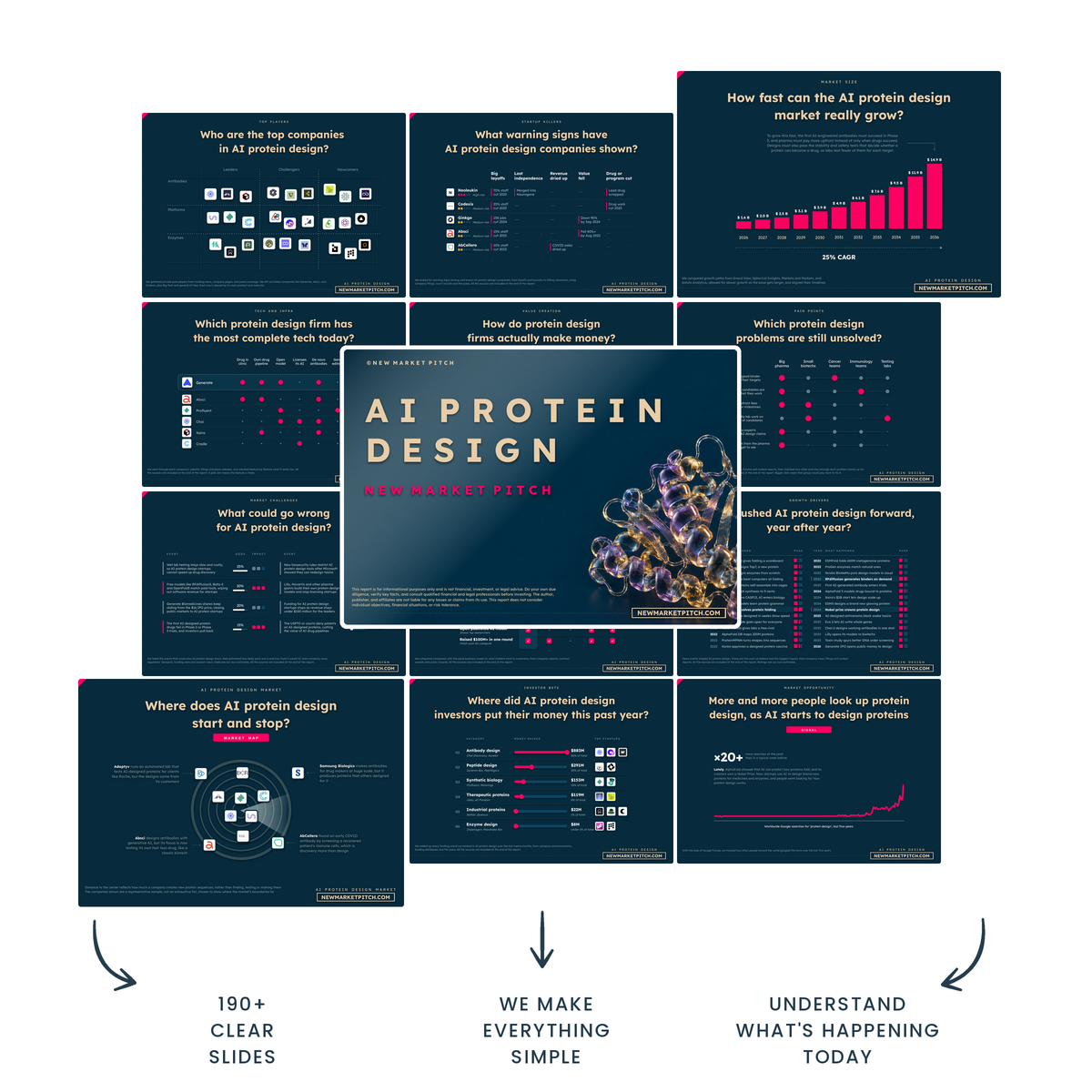
Whether you're building or investing in the AI protein design market, our report covers everything you need to know: the players, the money, and what's coming next.
AI protein design startups are attracting significant investment as generative models become increasingly capable of creating antibodies, enzymes and entirely new therapeutic proteins.
Our latest selection covers 12 funding announcements across six countries, with approximately $653.6 million in individually quantifiable rounds announced between February and September 2026.
As of October 16, 2026, the largest disclosed investments are concentrated in therapeutic protein design, while smaller companies are finding opportunities in industrial enzymes, agricultural biotechnology and commercial protein engineering software.
And if you want to better understand this new industry, you can download our pitch covering the AI protein design market.
Insights
- Chai Discovery's $400 million Series C represents approximately 61% of the $653.6 million in individually quantifiable financing across this selection. Investors are making particularly large commitments to generative models with established pharmaceutical partnerships.
- The three largest disclosed rounds, from Chai Discovery, Aureka Biotechnologies and BigHat Biosciences, total $575 million. That is nearly 88% of the measured capital, showing how concentrated AI protein design funding has become.
- Five pre-seed, seed and seed-extension financings account for approximately $33.6 million combined. This suggests that specialist protein engineering companies can still enter the market with relatively modest capital compared with established platform developers.
- Two Chinese protein design companies reported substantial financing without a separately verifiable exact USD amount for their latest transactions. Consequently, the $653.6 million subtotal understates the financing represented by these 12 announcements.
- Only Chai Discovery disclosed a specific company valuation in this selection, at $3.8 billion. Funding announcements are therefore much more transparent than valuation data, making reliable cross-company valuation comparisons difficult.
- AI protein design now serves customers beyond drug discovery. Quercus targets agricultural crop protection, Imperagen develops industrial enzymes, and Mandrake engineers gene-editing proteins for agricultural and therapeutic applications.
- Experimental validation is becoming part of the competitive advantage. BigHat, Aureka and Imperagen connect computational protein design with laboratory testing, generating practical performance data that can improve subsequent designs.
- Scala Biodesign illustrates a different commercial model from companies developing their own medicines. Its protein engineering software reportedly serves nine of the world's 20 largest pharmaceutical companies, supporting a platform-focused growth strategy.
- The selected financings span the United States, China, India, the United Kingdom, Israel and South Korea. However, the commercial ambitions of several companies extend well beyond their domestic markets, particularly through pharmaceutical collaborations.
- As of October 16, 2026, no October financing appears among these 12 identified qualifying deals. The most recent is BigHat's September round, highlighting the difference between a current funding review and deals announced during October itself.

Written by the New Market Pitch teamWe track new markets so founders and investors can move faster. About us

In our report covering the AI protein design market, you will always find fresh funding data, taken straight from our own verified funding database.
Summary table of the latest funding deals in the AI protein design market as of October 2026
We define the AI protein design market as AI tools and platforms that design or optimize protein sequences and structures.
We include generative protein models and platforms creating therapeutic, industrial or research proteins.
We exclude small-molecule discovery, routine protein manufacturing and structure analysis without a protein-design function.
| Name | When | Amount in $ | Round Type | Category |
|---|---|---|---|---|
| BigHat Biosciences | September 24, 2026 | $75M | Series C | AI Antibody Design & Therapeutic Proteins |
| Aureka Biotechnologies | August 10, 2026 | $100M | Series B | Generative Antibody Design & Biological Foundation Models |
| Accipiter Biosciences | July 31, 2026 | $10.5M | Seed Extension | De Novo Protein Design & Multispecific Therapeutics |
| Quercus Biosolutions | July 29, 2026 | $5M | Seed | Agricultural Protein Design & Crop Protection |
| Mandrake Bio | July 16, 2026 | Approx. $1.9M | Pre-Seed | Gene-Editing Enzymes & AI Protein Engineering |
| Chai Discovery | July 14, 2026 | $400M | Series C | Generative Protein Models & Antibody Design |
| MoleculeMind | June 17, 2026 | Undisclosed latest amount | Series A Financing Sequence | AI protein design & Industrial Protein Engineering |
| BioGeometry | June 9, 2026 | Undisclosed exact amount | Strategic Financing | Generative Biomolecular Models & Protein Design |
| Protuoso Biosciences | May 27, 2026 | $9.5M | Seed | Multifunctional Biologics & AI Protein Engineering |
| Imperagen | May 21, 2026 | Approx. $6.7M | Seed | Industrial Enzyme Design & Optimization |
| Scala Biodesign | March 31, 2026 | $16M | Series A | Protein Design Software & Therapeutic Optimization |
| Galux | February 10, 2026 | Approx. $29M | Series B | Generative Antibody Design & Therapeutic Proteins |
All the latest funding deals in the AI protein design market as of October 2026
BigHat Biosciences raised $75 million in September 2026 to advance its AI-designed protein therapeutics.
When was it?
BigHat Biosciences announced its latest financing on September 24, 2026.
Who are they?
BigHat Biosciences develops artificial intelligence models and automated laboratory systems to design antibodies with improved binding, stability and other properties needed for effective medicines.
Geographical focus?
Based in San Mateo, California, BigHat works with international pharmaceutical companies and develops therapeutics for global healthcare markets.
Why do we include them in the AI protein design market?
BigHat directly designs and optimizes therapeutic proteins through its Milliner platform, placing it in the AI antibody engineering and generative biologics category.
What is the company stage?
BigHat is a clinical-stage biotechnology company, with its AI-designed antibody-drug conjugate BHB810 undergoing Phase 1 human testing and additional therapeutic candidates in development.
How much did they raise?
BigHat secured $75 million in new financing, bringing its cumulative funding to approximately $223 million.
What round is it?
The financing was a Series C round co-led by DFJ Growth and Premji Invest, with participation from several financial and pharmaceutical investors.
Why did they raise?
BigHat raised capital to advance its clinical pipeline, including BHB810 and BHB299, while expanding the automated experiments and biological data generation supporting its protein-design models.
Aureka Biotechnologies secured $100 million in August 2026 to develop its next generation of biological AI models.
When was it?
Aureka Biotechnologies announced the completion of its financing on August 10, 2026.
Who are they?
Aureka Biotechnologies develops generative AI models and laboratory technologies that create therapeutic antibodies, with a particular focus on cardiometabolic and inflammatory diseases.
Geographical focus?
Aureka operates across the United States and China, with research capabilities and pharmaceutical relationships supporting an international drug-discovery business.
Why do we include them in the AI protein design market?
Aureka uses biological foundation models to generate and optimize new antibody molecules, making therapeutic protein design a central part of its technology platform.
What is the company stage?
Aureka is a growth-stage biotechnology platform with an internal therapeutic pipeline, established experimental infrastructure and pharmaceutical collaborations.
How much did they raise?
Aureka raised $100 million in this financing, bringing its total reported funding to nearly $200 million.
What round is it?
The financing was a Series B completed in multiple tranches, initially funded by Granite Asia and subsequently supported by a strategic investor and other existing and new backers.
Why did they raise?
Aureka plans to train more advanced biological foundation models and expand its Lab-in-the-Loop system, connecting AI-generated molecular designs with experimental testing and functional feedback.

In our research about AI protein design, we turn what is vague and complex into simple, useful visuals. Market maps like this one show you at a glance where every startup stands.
Accipiter Biosciences added $10.5 million in July 2026 to accelerate its multifunctional protein therapeutics.
When was it?
Accipiter Biosciences' additional financing was publicly reported on July 31, 2026.
Who are they?
Accipiter Biosciences designs new therapeutic proteins capable of activating multiple biological pathways within a single molecule, targeting complex diseases such as cancer and autoimmune disorders.
Geographical focus?
Headquartered in Seattle, Accipiter develops medicines from the United States while pursuing partnerships and potential clinical applications in international pharmaceutical markets.
Why do we include them in the AI protein design market?
Accipiter uses computational protein design to create entirely new multifunctional proteins, making de novo therapeutic protein engineering its core product category.
What is the company stage?
Accipiter is a preclinical biotechnology company developing proprietary therapeutic candidates, with its research supported by pharmaceutical partnerships involving Pfizer and Kite Pharma.
How much did they raise?
Accipiter raised an additional $10.5 million, increasing its total reported financing to approximately $23.2 million.
What round is it?
The investment was an extension of Accipiter's original seed financing, provided by existing investors rather than a newly announced Series A.
Why did they raise?
Accipiter secured the additional funding to expand its research team, advance promising therapeutic candidates and prepare a broader portfolio of protein medicines for clinical development.
Quercus Biosolutions raised $5 million in July 2026 to develop AI-designed proteins for crop protection.
When was it?
Quercus Biosolutions announced its seed financing on July 29, 2026.
Who are they?
Quercus Biosolutions uses generative AI to create small proteins that can protect crops against weeds and potentially other agricultural threats.
Geographical focus?
Based in the United States, with operations associated with Wisconsin and Missouri, Quercus initially targets agricultural markets facing herbicide resistance.
Why do we include them in the AI protein design market?
Quercus designs functional mini-proteins using generative AI, placing the company in agricultural protein engineering rather than conventional chemical pesticide development.
What is the company stage?
Quercus is a seed-stage agricultural biotechnology company developing its first crop-protection products and building a portfolio of proprietary protein designs.
How much did they raise?
Quercus secured $5 million in seed funding, with the round described as oversubscribed.
What round is it?
The financing was a seed round led by Serra Ventures, with additional participation from agricultural, technology and sustainability-focused investors.
Why did they raise?
Quercus is using the funding to advance its protein-based herbicides, strengthen intellectual-property protection and explore future applications against fungi and insects.

Your time is limited. In our market report about AI protein design, we put numbers on each part of the market, so you can see where it makes sense to focus.
Mandrake Bio raised approximately $1.9 million in July 2026 to develop AI-designed gene-editing enzymes.
When was it?
Mandrake Bio announced its pre-seed funding on July 16, 2026.
Who are they?
Mandrake Bio combines generative AI and biophysical modeling to create compact, programmable gene-editing enzymes designed for specific biological applications.
Geographical focus?
Based in Bengaluru, India, Mandrake develops technology intended for agricultural biotechnology and genetic medicine applications beyond its domestic market.
Why do we include them in the AI protein design market?
Mandrake uses AI to design the protein structures and sequences of gene-editing enzymes, placing it directly in computational enzyme engineering and functional protein design.
What is the company stage?
Mandrake is an early research and development company validating its engineered enzymes and building the laboratory capabilities needed to test its designs.
How much did they raise?
Mandrake secured INR 160 million, equivalent to approximately $1.9 million at the reported conversion, in its latest financing.
What round is it?
The financing was a pre-seed round co-led by Activate and Antler, alongside Spectrum Impact, DeVC and several angel investors.
Why did they raise?
Mandrake plans to expand its AI and biophysics research teams, improve its protein-design platform and validate new gene-editing enzymes through laboratory experiments.
Chai Discovery secured $400 million in July 2026 to expand its generative molecular design platform.
When was it?
Chai Discovery announced its latest fundraising round on July 14, 2026.
Who are they?
Chai Discovery builds generative AI models that design antibodies and other biological molecules from scratch, helping pharmaceutical researchers develop medicines against difficult targets.
Geographical focus?
Headquartered in San Francisco, Chai serves an international pharmaceutical market through relationships with companies including Eli Lilly, Pfizer and Novartis.
Why do we include them in the AI protein design market?
Chai's technology generates new protein and antibody designs rather than only predicting existing structures, placing it among the core developers of generative protein foundation models.
What is the company stage?
Chai is a rapidly expanding commercial AI research company with established pharmaceutical partnerships and multiple generations of molecular design models.
How much did they raise?
Chai raised $400 million in new capital, bringing its cumulative reported financing to approximately $630 million and establishing a disclosed company valuation of $3.8 billion.
What round is it?
The investment was a Series C led by Index Ventures, with Kleiner Perkins, Sequoia Capital, Dimension and several other venture investors participating.
Why did they raise?
Chai plans to develop more capable molecular design models, expand its research operations and accelerate pharmaceutical programs involving biological targets that traditional methods struggle to address.

In our document detailing everything you need to know about AI protein design, we always try to gather several sources and make estimates that make sense, so you can work with solid numbers.
MoleculeMind reported a Series A financing sequence exceeding $100 million cumulatively in June 2026.
When was it?
MoleculeMind publicly reported the completion of its Series A financing sequence on June 17, 2026.
Who are they?
MoleculeMind develops AI models and software that design antibodies, enzymes and other proteins for pharmaceutical research, synthetic biology and industrial biotechnology.
Geographical focus?
Based in China, with operations in Shanghai and Beijing, MoleculeMind targets pharmaceutical and industrial customers in domestic and international markets.
Why do we include them in the AI protein design market?
MoleculeMind develops generative protein engineering systems, including MMDesign and MoleculeOS, that help researchers create and optimize functional protein sequences.
What is the company stage?
MoleculeMind is a growth-stage protein technology platform with reported commercial collaborations across pharmaceuticals, industrial enzymes and other biological manufacturing applications.
How much did they raise?
MoleculeMind reported more than $100 million raised cumulatively across its Series A financing sequence, but the amount attributable to the latest transaction was not separately disclosed in USD millions.
What round is it?
The announcement concerned a Series A financing sequence involving Blue Bridge Capital, Pudong Venture Capital, COFCO Emerging Industry Fund and several other investors.
Why did they raise?
MoleculeMind plans to improve its generative protein models, expand industrial validation and commercialize its protein engineering technology through platform access and research partnerships.
BioGeometry secured strategic financing worth hundreds of millions of RMB in June 2026.
When was it?
BioGeometry's strategic financing was publicly reported by 36Kr on June 9, 2026, before the company's later announcement dated June 26.
Who are they?
BioGeometry develops generative AI models capable of designing proteins, antibodies and enzymes by modeling biological structures and interactions at the atomic level.
Geographical focus?
Based in China, BioGeometry serves pharmaceutical and biotechnology customers while developing protein engineering technology for domestic and international applications.
Why do we include them in the AI protein design market?
BioGeometry's GeoFlow models generate and optimize new protein structures and sequences, with applications in therapeutic antibodies, industrial enzymes and other biological molecules.
What is the company stage?
BioGeometry is a growth-stage biotechnology platform with reported pharmaceutical collaborations, automated laboratory capabilities and proprietary drug-development programs.
How much did they raise?
BioGeometry reported financing of several hundred million RMB, but an exact transaction value in USD millions was not publicly disclosed.
What round is it?
The transaction was described as strategic financing co-led by the Shanghai Biomedical Innovation and Translation Fund, CAS Investment, Fortune Capital and Link-X Capital.
Why did they raise?
BioGeometry intends to develop its next-generation GeoFlow model, increase automated laboratory capacity and advance proprietary therapeutic programs based on generative biomolecular design.

Our report covering the AI protein design market gets updated several times a month, so you always get the latest view of where things stand.
Protuoso Biosciences raised $9.5 million in May 2026 to develop multifunctional therapeutic proteins.
When was it?
Protuoso Biosciences officially announced its financing on May 27, 2026, following an earlier media preview.
Who are they?
Protuoso Biosciences develops engineered proteins that combine antibodies, cytokines, peptides and other biological components into medicines capable of affecting multiple disease mechanisms.
Geographical focus?
Headquartered in San Carlos, California, Protuoso is developing therapeutics for major disease areas with potential applications across international pharmaceutical markets.
Why do we include them in the AI protein design market?
Protuoso combines AI-assisted protein engineering and computational design to create multifunctional biologics through its proprietary MUXBODY platform.
What is the company stage?
Protuoso is an early-stage biotechnology company developing preclinical programs in cardiometabolic diseases, oncology and autoimmune conditions.
How much did they raise?
Protuoso secured $9.5 million in new seed financing to support its protein engineering technology and early therapeutic portfolio.
What round is it?
The investment was a seed round co-led by Taya Venture and Darwin Ventures, with additional support from NSG Ventures, SEEDS and other investors.
Why did they raise?
Protuoso plans to develop its modular protein platform and advance multiple therapeutic programs through a hub-and-spoke structure that allows separate assets to progress in parallel.
Imperagen secured approximately $6.7 million in May 2026 to expand its AI-powered enzyme engineering platform.
When was it?
Imperagen's financing was formally announced on May 21, 2026, with TechCrunch publishing its coverage on May 20 in US time.
Who are they?
Imperagen combines AI models, quantum-physics-based simulations and automated laboratory testing to engineer enzymes with improved performance for industrial and pharmaceutical processes.
Geographical focus?
Based in Manchester, United Kingdom, Imperagen serves industrial customers across international pharmaceutical manufacturing, life sciences, personal care and sustainable chemicals markets.
Why do we include them in the AI protein design market?
Imperagen directly optimizes enzyme sequences and functions through computational models, placing the company in industrial protein engineering and AI-guided enzyme design.
What is the company stage?
Imperagen is an early commercial-stage technology company with an operational enzyme engineering platform and industrial customer projects.
How much did they raise?
Imperagen secured £5 million, equivalent to approximately $6.7 million, in new seed financing.
What round is it?
The financing was a seed round led by PXN Ventures, with participation from existing investors IQ Capital and Northern Gritstone.
Why did they raise?
Imperagen plans to expand its AI research team, improve laboratory automation, strengthen its enzyme design models and convert industrial demand into additional commercial contracts.

In our research about AI protein design, we look at what the winners do differently, so you can learn from the best instead of guessing.
Scala Biodesign raised $16 million in March 2026 to expand its commercial protein engineering software.
When was it?
Scala Biodesign announced its Series A financing on March 31, 2026.
Who are they?
Scala Biodesign develops software combining AI, physical modeling and evolutionary biology to improve the stability, activity and performance of therapeutic and industrial proteins.
Geographical focus?
Headquartered in Israel, Scala targets an international pharmaceutical and biotechnology customer base, including several major global drug developers.
Why do we include them in the AI protein design market?
Scala's ScalaOS platform helps researchers redesign and optimize protein sequences for antibodies, enzymes and other biologics, making protein engineering software its central commercial offering.
What is the company stage?
Scala is a commercial growth-stage software company with reported adoption among nine of the world's 20 largest pharmaceutical companies.
How much did they raise?
Scala secured $16 million in its latest financing, bringing the company's total reported funding to approximately $21.5 million.
What round is it?
The financing was a Series A led by Grove Ventures, with participation from TLV Partners, Deep Insight and other supporters.
Why did they raise?
Scala plans to improve its protein design software, expand research and development operations and increase adoption among pharmaceutical and biotechnology customers worldwide.
Galux raised approximately $29 million in February 2026 to advance generative AI protein therapeutics.
When was it?
Galux announced the completion of its Series B financing on February 10, 2026.
Who are they?
Galux develops generative AI models that design new antibodies and therapeutic proteins from scratch, with the goal of improving how medicines recognize biological targets.
Geographical focus?
Based in South Korea, Galux develops its technology domestically while pursuing pharmaceutical research collaborations and international drug-discovery opportunities.
Why do we include them in the AI protein design market?
Galux specializes in de novo protein generation and antibody engineering, placing its core technology directly within generative therapeutic protein design.
What is the company stage?
Galux is a growth-stage AI drug-design platform with pharmaceutical collaborations and therapeutic candidates in research and preclinical development.
How much did they raise?
Galux secured KRW 42 billion, approximately $29 million, bringing its total reported fundraising to around $47 million.
What round is it?
The financing was a Series B involving Yuanta Investment, Korea Development Bank, InterVest and several other Korean financial institutions and venture investors.
Why did they raise?
Galux plans to improve its generative protein models, advance new therapeutic candidates and expand its pharmaceutical collaborations outside South Korea.
Written by the New Market Pitch teamWe track new markets so founders and investors can move faster. About us