
AI protein design funding: a quarter-by-quarter analysis
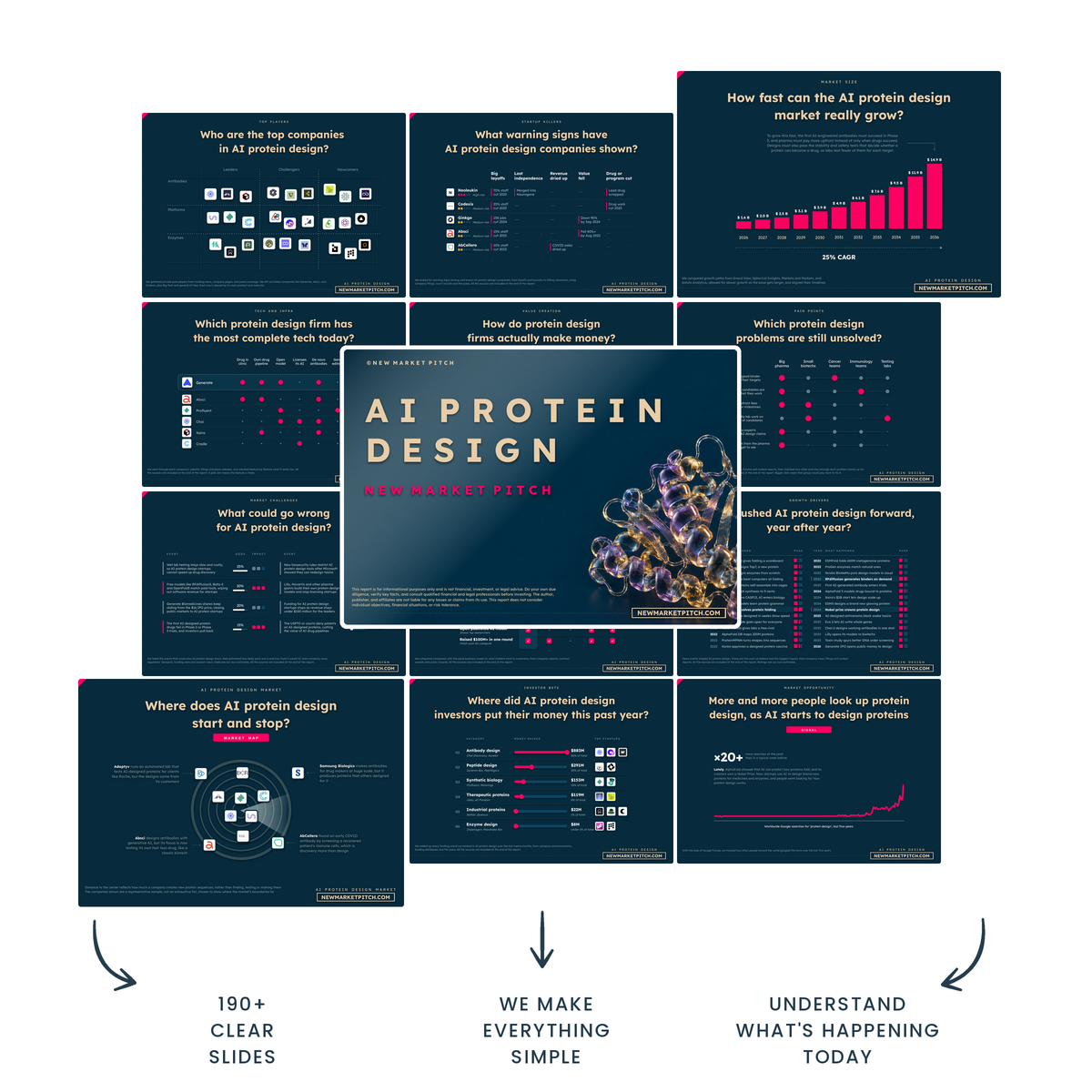
Whether you're building or investing in the AI protein design market, our report covers everything you need to know: the players, the money, and what's coming next.
Summary
AI protein design funding has reached record levels, but the boom is concentrated in a handful of companies rather than spreading across the startup market. Quarterly investment climbed from $104.9 million in Q3 2025 to $667.2 million in Q3 2026, yet only eight startups raised money in the latest quarter, and four transactions accounted for $650 million of that total.
The latest funding record is particularly misleading. Excluding rounds above $50 million, Q3 2026 investment falls to just $17.2 million, the weakest result across all five quarters. The market's largest financings are growing while smaller funding activity is shrinking.
Q4 2025 was the clearest period of broad expansion. Deals rose from six to eleven, disclosed investment nearly quadrupled to $414.4 million, and funding below the $50 million threshold almost tripled. Unlike the latest record quarter, that increase reached beyond the biggest transactions.
Q1 2026 revealed the opposite problem with headline figures. Total funding fell 18%, but investment excluding rounds above $50 million increased 91% to $191.3 million. Q2 then brought a much sharper slowdown, although two Chinese transactions without confirmed amounts make its reported $53.9 million total an incomplete measure.
Chai Discovery has become the market's dominant fundraiser, securing $600 million across three rounds in less than a year. That represents approximately 38% of all disclosed funding during the five quarters studied. Its $400 million July 2026 round alone accounted for 60% of the latest quarter's investment.
Antibody and binder design is the strongest sustained category trend. Its share of transactions increased from 17% to 50%, with BigHat Biosciences, Infinimmune and Aureka joining Chai among the companies attracting major investments. Pharmaceutical partnerships and clinical progress are becoming more visible alongside the fundraising.
Other categories look much less established. Peptide design briefly captured 62% of Q1 2026 investment, largely through Syneron Bio's $150 million Series B, before recording no deals in the next two quarters. Industrial protein and enzyme developers continue to attract much smaller rounds than pharmaceutical-focused companies.
New-company formation is a weak point in the financing data. Only five of forty transactions were identified as first financings, accounting for 12.5% of deals and just 2.4% of disclosed capital. Follow-on rounds dominate, meaning investors are mostly financing companies with established funding histories.
North America captures most disclosed capital, but its apparent advantage is amplified by incomplete reporting of Asian rounds. Strategic pharmaceutical investors are active, particularly in antibody and therapeutic development, although their participation fluctuates rather than increasing consistently each quarter.
The next convincing sign of market-wide growth would be more first financings, a recovery in $20 million to $50 million rounds, and more startups reaching growth stages. Another $400 million investment would reinforce the strength of an established leader, but wouldn't demonstrate that the wider AI protein design market is expanding.

Written by the New Market Pitch teamWe track new markets so founders and investors can move faster. About us

In our report covering the AI protein design market, you will always find fresh funding data, taken straight from our own verified funding database.
All funding deals in the AI protein design market over the last years
Below is the table listing all the deals. You can find our methodology at the end of this page.
If you want a deeper understanding of the market and its current dynamics, get our report covering the AI protein design market.
| Company | Category | Date | Stage | Deal size | What they do | Region | Lead investors | Country |
|---|---|---|---|---|---|---|---|---|
| BigHat Biosciences | Antibody & Binder Design | September 2026 | Series C | $75M | Uses AI-guided protein engineering and automated experimentation to design therapeutic antibodies. | North America | DFJ Growth; Premji Invest | United States |
| Anew Labs | Antibody & Binder Design | September 2026 | Unknown | $290M | ByteDance spin-off building AI models for protein structure prediction and antibody design | Asia-Pacific | HSG; IDG Capital; Hillhouse Investment | China |
| Infinimmune | Antibody & Binder Design | August 2026 | Series A | $75M | Combines human antibody discovery and protein language models to optimize therapeutic antibodies. | North America | Regeneron Ventures; Playground Global | United States |
| Aureka Biotechnologies | Antibody & Binder Design | August 2026 | Series B | $100M | Develops biological foundation models for generative therapeutic antibody design. | North America | Not disclosed | United States |
| Accipiter Biosciences | Therapeutic Protein Design | July 2026 | Seed | $10.5M | Computationally designs multifunctional therapeutic proteins targeting multiple biological pathways. | North America | Not disclosed | United States |
| Quercus Biosolutions | Industrial Protein Design | July 2026 | Seed | $5M | Uses generative AI to design protein-based crop-protection compounds. | North America | Serra Ventures | United States |
| Mandrake Bio | Enzyme Design | July 2026 | Seed | ≈$1.8M | Uses generative AI to design gene-editing enzymes for agriculture and therapeutics. | Asia-Pacific | Activate; Antler | India |
| Chai Discovery | Antibody & Binder Design | July 2026 | Series C | $400M | Builds generative AI models to design therapeutic antibodies and protein binders. | North America | Index Ventures | United States |
| Matwings Technology | Research & Synthetic Biology Proteins | July 2026 | Series A | Not Disclosed | Develops protein foundation models and AI agents to generate and optimize functional proteins. | Asia-Pacific | Shanghai SDIC Pioneer; SDIC Innovation | China |
| LivingFilters | Antibody & Binder Design | June 2026 | Seed | ≈$470K | Uses computational protein design and generative AI to create selective protein binders for detecting and removing water contaminants. | Europe | Turbine Capital | Sweden |
| MoleculeMind | Research & Synthetic Biology Proteins | June 2026 | Series A | Not Disclosed | Provides MoleculeOS generative AI models for designing and optimizing antibodies, therapeutic proteins, peptides and industrial enzymes. | Asia-Pacific | Pudong Venture Capital; Zhangjiang Science and Technology Investment | China |
| BioGeometry (百奥几何) | Antibody & Binder Design | June 2026 | Unknown | Not Disclosed | Develops GeoFlow generative AI models for de novo antibody design, protein optimization and other biomolecular engineering applications. | Asia-Pacific | Shanghai Biomedical Innovation and Translation Fund; CAS Investment; Fortune Capital; Link-X Capital | China |
| Protuoso Biosciences | Therapeutic Protein Design | May 2026 | Seed | $9.5M | Uses AI-guided protein engineering to design multifunctional recombinant therapeutics combining antibody, cytokine and peptide components. | North America | Taya Venture; Darwin Ventures | United States |
| Imperagen Limited | Enzyme Design | May 2026 | Seed | ≈$6.7M | Combines quantum-physics simulation, AI models and automated experimentation to design improved enzymes for industrial applications. | Europe | PXN Ventures | United Kingdom |
| Resurrect Bio Ltd | Research & Synthetic Biology Proteins | May 2026 | Series A | $2.2M | Uses AI-guided protein-interaction analysis and engineering of plant immune receptors to design disease-resistance traits for crops. | Europe | Corteva Agriscience | United Kingdom |
| Aureka Biotechnologies | Antibody & Binder Design | April 2026 | Series A | $35M | Develops generative AI and automated experimental platforms for de novo design and optimization of therapeutic antibodies. | North America | HongShan (Sequoia China) | United States |
| Scala Biodesign | Research & Synthetic Biology Proteins | March 2026 | Series A | $16M | Provides ScalaOS, a computational and AI-based platform for optimizing protein sequences and properties across therapeutic and industrial applications. | Middle East | Grove Ventures | Israel |
| Syneron Bio (元思生肽) | Peptide Design | March 2026 | Series B | $150M | Uses an AI-driven discovery and optimization platform to design macrocyclic peptide therapeutics for difficult drug targets. | Asia-Pacific | Decheng Capital; CDH VGC | China |
| Matwings Technology | Research & Synthetic Biology Proteins | March 2026 | Series A | >$29M | Provides a generative protein foundation model and integrated R&D platform for designing functional proteins across biological applications. | Asia-Pacific | CNPC Kunlun Capital; Yonghua Capital; Shanghai Future Industries Fund | China |
| Unnatural Products | Peptide Design | March 2026 | Series B | $45M | Combines machine learning, computational design and experimental testing to engineer synthetic macrocyclic peptide therapeutics. | North America | The Venture Collective | United States |
| Antiverse | Antibody & Binder Design | March 2026 | Series A | $9.3M | Uses generative AI and laboratory validation to design therapeutic antibodies against difficult membrane-protein targets, including GPCRs and ion channels. | Europe | Soulmates Ventures | United Kingdom |
| Starget Pharma | Peptide Design | February 2026 | Series A | $18M | Uses AI-driven peptide backbone modeling and optimization to design targeted peptide radioligands for cancer therapy. | Middle East | Ilex Medical | Israel |
| Galux | Antibody & Binder Design | February 2026 | Series B | $29M | Develops AI models that generate and optimize therapeutic protein and antibody sequences, particularly de novo antibodies against challenging targets. | Asia-Pacific | Yuanta Investment | South Korea |
| Ukko | Therapeutic Protein Design | January 2026 | Series C | $45M | Uses computational protein design to re-engineer allergenic proteins into safer, immune-modulating therapeutic candidates. | North America | Israel Biotech Fund | United States |
| Syneron Bio (元思生肽) | Peptide Design | December 2025 | Series A | ≈$100M | Uses intelligent high-throughput discovery and computation to design and optimize macrocyclic peptide therapeutics. | Asia-Pacific | Not disclosed | China |
| Chai Discovery | Antibody & Binder Design | December 2025 | Series B | $130M | Develops generative AI models for de novo design and optimization of therapeutic antibodies and other protein binders. | North America | General Catalyst; Oak HC/FT | United States |
| Levinthal Biotech (杭州力文所生物科技有限公司) | Research & Synthetic Biology Proteins | December 2025 | Seed | Not Disclosed | Develops generative protein-design models to engineer enzymes, functional proteins, and therapeutic peptides. | Asia-Pacific | Jinyu Maowu (金雨茂物) | China |
| Aether Biomachines | Industrial Protein Design | December 2025 | Unknown | $15M | Uses AI to design functional proteins for advanced materials, industrial processing, and environmental applications. | North America | Tribe Capital | United States |
| immunitoAI Private Limited | Antibody & Binder Design | November 2025 | Series A | $6.1M | Uses generative AI to design novel therapeutic antibody sequences against specified biological targets. | Asia-Pacific | Ashish Kacholia | India |
| AI Proteins | Therapeutic Protein Design | November 2025 | Series A | $41.5M | Uses AI and high-throughput experimentation to create de novo miniprotein medicines for therapeutic applications. | North America | Mission BioCapital; Santé Ventures | United States |
| Profluent | Research & Synthetic Biology Proteins | November 2025 | Series B | $106M | Builds generative protein foundation models that design genome-editing enzymes, antibodies, and other functional proteins. | North America | Altimeter Capital; Bezos Expeditions | United States |
| Aureka Biotechnologies | Antibody & Binder Design | November 2025 | Series A | $23.2M | Combines generative AI and experimental screening to design and optimize therapeutic antibodies. | North America | 5Y Capital; Qiming Venture Partners | United States |
| Accipiter Biosciences | Therapeutic Protein Design | November 2025 | Seed | $12.7M | Designs de novo multifunctional protein therapeutics using computational protein engineering and high-throughput experiments. | North America | Takeda; Flying Fish Partners | United States |
| Beijing Zhiyuan Shenlan Technology Co., Ltd. (北京智源深澜科技有限公司) | Research & Synthetic Biology Proteins | November 2025 | Seed | Not Disclosed | Develops a generative-AI and automated experimental platform for designing and optimizing proteins, peptides, enzymes, and other biological macromolecules. | Asia-Pacific | Woyan Capital | China |
| Caravel Bio | Industrial Protein Design | October 2025 | Seed | $1.9M | Uses machine learning and high-throughput protein evolution to engineer functional proteins for industrial and synthetic biology applications. | North America | Not disclosed | United States |
| Peptilogics | Peptide Design | October 2025 | Series B | $78M | Uses computational and generative-AI methods to design engineered peptide therapeutics, including antimicrobials. | North America | Presight Capital; Thiel Bio; Founders Fund | United States |
| Scindo | Enzyme Design | September 2025 | Seed | ≈$5.4M | Develops an AI-driven enzyme-design platform to create biocatalysts for sustainable chemicals and bio-based ingredients. | Europe | Kadmos Capital; Clay Capital | United Kingdom |
| Arzeda | Industrial Protein Design | September 2025 | Unknown | $4.5M | Uses computational protein design and generative AI to engineer enzymes and proteins for industrial applications. | North America | Not disclosed | United States |
| Ridge Biotechnologies, Inc. | Enzyme Design | September 2025 | Seed | $25M | Uses machine learning and cell-free experimental data to design precision enzymes for therapeutic applications. | North America | Sutter Hill Ventures | United States |
| Toursynbio (途深智合) | Research & Synthetic Biology Proteins | September 2025 | Seed | Not Disclosed | Develops generative AI platforms for de novo protein design and optimization, including antibodies and enzymes. | Asia-Pacific | Not disclosed | China |
| Chai Discovery | Antibody & Binder Design | August 2025 | Series A | $70M | Develops generative AI foundation models for designing therapeutic antibodies and other protein molecules. | North America | Menlo Ventures | United States |
| Foundry BioSciences | Therapeutic Protein Design | July 2025 | Seed | Not Disclosed | Develops generative AI models to design novel proteins for longevity-related therapeutic and health applications. | North America | XtalPi | United States |

In our research about AI protein design, we turn what is vague and complex into simple, useful visuals. Market maps like this one show you at a glance where every startup stands.
Is AI protein design funding actually growing?
AI protein design funding has reached record levels, but the number of startups raising money has barely changed. The growth is coming from a handful of much larger investments.
We tracked 40 funding deals between Q3 2025 and Q3 2026. Quarterly investment rose from $104.9 million to $414.4 million, slipped to $341.3 million, collapsed to $53.9 million, and then reached $667.2 million. Yet deal counts stayed between six and eleven throughout the period.
The strongest evidence is what happens when we remove rounds above $50 million. In Q3 2026, the supposed record quarter, funding falls from $667.2 million to just $17.2 million. That is the lowest figure across all five quarters. Meanwhile, Q1 2026, which looked weaker than Q4 2025, actually had 91% more capital below that threshold.
Investors are willing to put enormous sums into selected AI protein design companies. We still haven't seen sustained growth in the number of startups benefiting from that money.
| Quarter | Deals | Total funding | Median disclosed round | Funding excluding rounds above $50M |
|---|---|---|---|---|
| Q3 2025 | 6 | $104.9M | $15.2M | $34.9M |
| Q4 2025 | 11 | $414.4M | $23.2M | $100.4M |
| Q1 2026 | 8 | $341.3M | $29.0M | $191.3M |
| Q2 2026 | 7 | $53.9M | $6.7M | $53.9M |
| Q3 2026 | 8 | $667.2M | $75.0M | $17.2M |
Why did AI protein design funding suddenly jump in Q4 2025?
AI protein design funding nearly quadrupled in Q4 2025 because more startups raised money and several companies secured unusually large growth rounds.
Deal activity increased from six to eleven transactions, while disclosed capital reached $414.4 million, up from $104.9 million. Even without rounds above $50 million, funding almost tripled to $100.4 million. There was a genuine expansion beneath the headline increase.
Chai Discovery raised $130 million in December, just months after its $70 million Series A. Profluent secured $106 million, while Peptilogics raised $78 million. Together, these three companies accounted for approximately 76% of quarterly funding.
The financing mix was changing as well. Later-stage companies represented 27% of deals, compared with 17% in Q3, and follow-on financings increased from four to ten transactions.
Q4 stands out because investors supported more companies while also making much larger commitments to a few established developers.

Your time is limited. In our market report about AI protein design, we put numbers on each part of the market, so you can see where it makes sense to focus.
Why did AI protein design funding fall in Q1 2026 when round sizes were increasing?
AI protein design funding fell 18% in Q1 2026, but the underlying market was stronger across smaller and mid-sized rounds.
Capital declined from $414.4 million to $341.3 million, and deal activity dropped from eleven to eight transactions. However, the median disclosed round increased from $23.2 million to $29 million.
The biggest difference was the number of exceptionally large investments. Q4 had three rounds above $50 million, whereas Q1 had only one: Syneron Bio's $150 million Series B. Excluding these transactions, funding increased from $100.4 million to $191.3 million.
The composition also shifted. Peptide design went from one deal to three, strategic-investor participation climbed from 18% to 62.5%, and half of the quarter's transactions were Series B or later.
Syneron's financing is a useful example. The company was expanding its Synova macrocyclic peptide discovery platform and advancing drug candidates toward clinical development, with investors including Decheng Capital, CDH VGC and existing backer AstraZeneca.
So Q1's headline decline obscured a substantial increase in funding outside the largest deals.
Did AI protein design funding really collapse in Q2 2026?
AI protein design funding suffered a sharp slowdown in Q2 2026, although missing Chinese deal amounts make the reported 84% decline look worse than the full picture may have been.
Disclosed funding fell from $341.3 million to $53.9 million, while the median reported round dropped from $29 million to $6.7 million. No Series B or later deal was recorded, and investment excluding rounds above $50 million declined 72%.
The largest disclosed transaction was Aureka's $35 million Series A+, accounting for 65% of quarterly funding. Without that financing, the remaining disclosed total was only $18.9 million.
However, BioGeometry and MoleculeMind both announced financings whose exact amounts could not be reliably established. BioGeometry's round was described as hundreds of millions of renminbi, while MoleculeMind's available information referred to cumulative funding above $100 million without identifying the June transaction's size.
The drop in recorded investment was severe. Its precise magnitude remains uncertain, particularly given those two undisclosed Chinese rounds.

In our document detailing everything you need to know about AI protein design, we always try to gather several sources and make estimates that make sense, so you can work with solid numbers.
Is Q3 2026's record AI protein design funding a real recovery?
The record $667.2 million raised by AI protein design startups in Q3 2026 is mainly the result of four enormous deals. Funding across the rest of the market was exceptionally weak.
Chai Discovery raised $400 million, Aureka secured $100 million, and BigHat Biosciences and Infinimmune each raised $75 million. Those four transactions contributed $650 million, accounting for 97% of all disclosed funding.
Although capital reached 12.4 times its Q2 level, the number of deals rose only from seven to eight. Once we remove transactions above $50 million, funding actually fell 68%, from $53.9 million to $17.2 million.
There was also a striking gap in round sizes. Four deals exceeded $50 million, but none fell between $20 million and $50 million.
The biggest companies are attracting record commitments, while smaller and intermediate-sized financing activity has become much thinner.
Is Chai Discovery driving the entire AI protein design funding boom?
Chai Discovery has become the single biggest driver of AI protein design funding, raising $600 million across three rounds during the period we studied.
Its $70 million Series A in August 2025 was followed by a $130 million Series B in December and a $400 million Series C in July 2026. Together, those rounds accounted for approximately 38% of all disclosed investment across five quarters.
The July financing valued Chai at $3.8 billion and was led by Index Ventures, alongside investors including Kleiner Perkins, Sequoia Capital and Dimension.
There's a commercial story behind the fundraising. Chai has signed collaborations with Eli Lilly, Pfizer, Novartis, argenx and Bristol Myers Squibb. Its models are being applied to antibody and molecular design problems for major pharmaceutical companies, giving investors more to assess than laboratory performance alone.
The company also reported improvements in de novo antibody design through Chai-2 and continued developing its molecular design capabilities.
Chai's extraordinary pace of financing makes the broader market appear much stronger than most startups' fundraising activity suggests. And its pharmaceutical relationships help explain why investors are willing to commit such large amounts.

Our report covering the AI protein design market gets updated several times a month, so you always get the latest view of where things stand.
Are more AI protein design startups getting funded each quarter?
The number of AI protein design startups raising money has remained surprisingly flat despite the dramatic growth in headline investment.
We counted six funded companies in Q3 2025, eleven in Q4, eight in Q1 2026, seven in Q2, and eight in Q3. No quarter contained multiple transactions from the same company.
This means the $667.2 million raised in Q3 2026 was distributed across only eight companies, compared with eleven companies sharing $414.4 million in Q4 2025.
The typical disclosed round also varied sharply. Median financing increased from $15.2 million in Q3 2025 to $29 million in Q1 2026, fell to $6.7 million in Q2, and rebounded to $75 million in Q3. That latest median reflects the disclosed financing sample, where a few very large rounds carry considerable weight.
There is still no steady increase in the number of startups accessing venture capital. What has changed is how much money a few companies can raise when investors decide to back them.
Is antibody design becoming the hottest part of AI protein funding?
Antibody and binder design is the strongest part of AI protein design fundraising, and its momentum extends beyond a few headline transactions.
Its share of quarterly deals rose from 17% in Q3 2025 to 27% in Q4, 25% in Q1 2026, 43% in Q2, and 50% in Q3.
Chai Discovery leads the category financially, but other companies are progressing commercially. BigHat Biosciences raised $75 million in September after dosing its first patient in a Phase 1 trial of BHB810, an AI-designed antibody-drug conjugate targeting CDH17.
Infinimmune raised another $75 million in August to advance human-derived antibodies for inflammatory diseases. Its earlier collaboration with Merck provides another example of pharmaceutical interest in antibody-discovery technology.
Aureka also secured $100 million to expand its biological foundation models and experimental validation platform.
These companies have different technical and commercial approaches, but antibody design is becoming the clearest area where major fundraising, pharmaceutical partnerships and drug-development progress overlap.
| Category | Q3 2025 | Q4 2025 | Q1 2026 | Q2 2026 | Q3 2026 |
|---|---|---|---|---|---|
| Antibody & Binder | 1 | 3 | 2 | 3 | 4 |
| Research & Synthetic Bio | 1 | 3 | 2 | 2 | 1 |
| Therapeutic Protein | 1 | 2 | 1 | 1 | 1 |
| Peptide Design | 0 | 1 | 3 | 0 | 0 |
| Industrial Protein | 1 | 2 | 0 | 0 | 1 |
| Enzyme Design | 2 | 0 | 0 | 1 | 1 |

In our research about AI protein design, we look at what the winners do differently, so you can learn from the best instead of guessing.
Why did peptide design funding suddenly spike and then disappear?
Peptide design funding experienced a short-lived surge in Q1 2026, driven by three transactions worth $213 million, including Syneron Bio's $150 million Series B.
The category represented 62% of the quarter's disclosed investment, up from 19% in Q4 2025. But it recorded no transactions in either Q2 or Q3 2026.
Syneron was responsible for most of the spike. Its financing followed an earlier substantial round and supported the development of macrocyclic peptide therapeutics. Existing strategic backing from AstraZeneca helped distinguish it from a purely speculative AI platform investment.
Unnatural and Starget also contributed to Q1 activity, although their businesses sit near the boundary between peptide development and the broader protein design market.
Three deals in one quarter, followed by none in the next two, is a thin basis for claiming a lasting boom. The spike looks more like a cluster of company-specific financings.
Are industrial protein and enzyme startups being left behind?
Industrial protein and enzyme design startups are attracting much smaller financing rounds than pharmaceutical-focused AI protein developers.
Across five quarters, these two categories accounted for eight of forty transactions. Their funding has remained modest compared with the largest therapeutic protein rounds.
Industrial Protein recorded $4.5 million in Q3 2025, $16.9 million across two transactions in Q4, and $5 million in Q3 2026. Enzyme Design raised $30.4 million across two deals in Q3 2025, followed by $6.7 million in Q2 2026 and $1.7 million in Q3.
The contrast with Chai's $400 million financing or BigHat's $75 million Series C is enormous.
Industrial applications may offer attractive commercial opportunities, but the biggest venture commitments are going toward technologies connected to therapeutic discovery and drug development.

In our market report about AI protein design, we don't want to repeat what boring consulting reports say. Instead, we show you the real and latest market signals that matter.
Are investors giving up on early-stage AI protein design startups?
Early-stage AI protein design startups are still raising money, but their share of total capital has become extremely sensitive to the largest growth rounds.
Seed and Series A deals represented 83% of transactions in Q3 2025, 64% in Q4, and 50% in Q1 2026. Their share then increased to 86% in Q2 before falling to 62.5% in Q3.
In terms of funding amounts, the picture looks very different. Early-stage companies received 100% of disclosed capital in Q2 2026, but only 14% in Q3, when two Series C rounds dominated the market.
The opposite happened to later-stage funding, whose share of disclosed capital moved from 0% to 86% between those quarters.
We also looked at company age. Median age at financing increased from 1.5 years in Q3 2025 to six years in Q1 2026, before returning to approximately three years in Q3.
There is no consistent retreat from younger businesses. Selected mature companies periodically raise so much money that early-stage financing becomes almost invisible in the capital totals.
Why are so few new AI protein design startups raising their first round?
First-time funding is unusually scarce in AI protein design, with just five identified first financings among forty transactions.
Those five deals represented only 12.5% of the market's financing activity and 2.4% of disclosed capital.
The quarterly figures are revealing. We found two first financings in Q3 2025, one in Q4, none in Q1 2026, and one in each of the next two quarters.
Follow-on financing accounted for at least 86% of transactions in every quarter after Q3 2025. Even among fourteen seed rounds, only five were identified as first financings.
Our first-financing classification relies on publicly established funding histories, which can be incomplete. Still, the dominance of follow-on rounds is hard to miss.
Venture activity depends heavily on companies already established within the funding ecosystem. The open question is whether enough new developers can raise initial capital to replenish that group.

Learning from others' mistakes is the cheapest lesson there is. In our document detailing everything you need to know about AI protein design, we look at what broke startups before you, so you don't repeat it.
Is AI protein design funding becoming too concentrated?
AI protein design investment has been heavily concentrated throughout the entire period, and the latest quarter shows just how extreme the imbalance can become.
In every quarter, the three largest transactions accounted for at least 70% of disclosed funding. Their share reached 96% in Q3 2025, 95% in Q2 2026, and 86% in Q3.
Chai Discovery alone raised $600 million over the five quarters, approximately 38% of the $1.58 billion in total disclosed investment. Its July 2026 financing represented 60% of that quarter's funding.
What changed most dramatically in Q3 2026 was the distribution of round sizes. Four financings exceeded $50 million, two reached at least $100 million, and the remaining disclosed rounds were much smaller.
The $20 million to $50 million segment, which had four transactions in Q1, recorded none in Q3.
That's the missing middle. A few startups can raise hundreds of millions, but the latest numbers show little activity in the intermediate funding range that could support the next group of growing companies.
| Quarter | Largest deal share | Top 3 share | Rounds above $50M | Capital from rounds above $50M |
|---|---|---|---|---|
| Q3 2025 | 67% | 96% | 1 | 67% |
| Q4 2025 | 31% | 76% | 3 | 76% |
| Q1 2026 | 44% | 70% | 1 | 44% |
| Q2 2026 | 65% | 95% | 0 | 0% |
| Q3 2026 | 60% | 86% | 4 | 97% |
Is North America taking all the AI protein design funding?
North America dominates disclosed AI protein design investment, although the size of several Chinese rounds remains unknown.
North American startups captured at least 83% of reported capital in four of the five quarters. Q1 2026 was the exception, when the region's share dropped to 26% and Asia-Pacific reached 61%, helped by Syneron's $150 million financing.
By Q3 2026, six of eight funded companies were based in North America, and the region accounted for virtually all disclosed capital.
Asia-Pacific nevertheless maintained a meaningful share of deal activity, generally between 17% and 38%. The problem is disclosure: six of the seven transactions without confirmed amounts involved Chinese or other Asia-Pacific companies.
European activity was much smaller and less consistent, with one, zero, one, three and zero deals across the five quarters.
North America's leadership is particularly clear among companies securing the largest publicly documented financings. The gap in total capital could be narrower than reported because several Asian deals lack comparable amounts.

If you build or invest in the AI protein design market, you need to know which business models pay off now and which ones are fading. That's why our report covering it has a whole section on it.
Are the same investors repeatedly backing AI protein design startups?
AI protein design funding involves a diverse group of lead investors, even though most of the capital goes to a relatively small number of companies.
We identified between five and seventeen unique disclosed leads per quarter. Across the five-quarter period, no investor appeared as the named lead in more than one transaction.
Q4 2025 had the broadest identified group, with seventeen unique leads, alongside the highest quarterly deal count.
Individual large transactions also show different investor groups taking positions. Chai's December Series B was co-led by General Catalyst and Oak HC/FT, while its July Series C was led by Index Ventures. BigHat's September Series C was co-led by DFJ Growth and Premji Invest.
Capital is concentrating around companies, but the same pattern isn't apparent among named lead investors.
That doesn't mean these firms are newcomers to protein design. Participation in earlier or non-leading investments may not appear in our quarterly counts.
Why are pharmaceutical companies investing in AI protein design now?
Major pharmaceutical companies are taking a growing practical interest in AI protein design, particularly through partnerships and selected investments in antibody and therapeutic developers.
Strategic-investor participation was especially high in Q1 2026, appearing in 62.5% of deals, compared with 18% in Q4 2025. The figure then fell to 29% in Q2 and recovered to 38% in Q3.
Bayer, AstraZeneca, Pfizer, argenx and Merck were among the pharma-linked investors associated with Q1 activity. In Q3, antibody-design companies attracted participation from investors connected to Lilly, Amgen, Regeneron and Merck.
Commercial partnerships provide useful context. BigHat completed three project collaborations with Merck, triggering an undisclosed milestone payment announced in August 2026. It also advanced its own antibody-drug conjugate BHB810 into human trials in September.
Chai, meanwhile, expanded its pharmaceutical relationships through agreements involving Lilly, Pfizer, Novartis and other major developers.
Large drugmakers are finding specific uses for AI-designed proteins in research and therapeutic development. The interest has a commercial basis, even if it isn't translating into steadily increasing quarterly investment.
Strategic funding remains uneven. The median financing involving strategic investors, $23.5 million, is almost identical to the $23.2 million median for other rounds.

In our research about AI protein design, we like to show you the big picture. We know your time is precious, so we make every page quick to read and packed with as much learning as possible per minute.
What is the biggest problem facing AI protein design funding now?
The biggest problem in AI protein design fundraising is the weak pipeline of smaller financings beneath a few exceptionally well-funded companies.
Three developments stand out. First-time financings account for only five of forty deals. Funding outside rounds above $50 million fell to $17.2 million in Q3 2026. And the $20 million to $50 million segment completely disappeared in that quarter.
Established companies can raise massive sums, but broad access to growth capital remains limited.
BigHat's $75 million Series C came as the company advanced a clinical-stage pipeline. Chai's $400 million round followed the development of multiple pharmaceutical relationships. Aureka's $100 million Series B is supporting larger biological foundation models and experimental validation.
These companies have increasingly substantial technical and commercial achievements for investors to evaluate.
The tougher question is whether enough younger companies can reach the same position. Our quarterly data does not follow complete startup cohorts, so it cannot establish how many companies fail to progress from one financing stage to another. But the shortage of first rounds and intermediate-sized financings is difficult to ignore.
What is AI protein design funding actually telling us?
AI protein design is becoming a market where a small group of companies can raise extraordinary amounts of capital, while funding across the wider startup population remains relatively limited.
The clearest sustained category trend is the rise of antibody and binder design. Its share of deals increased from 17% to 50%, supported by companies developing AI-powered discovery platforms, pharmaceutical partnerships and clinical-stage therapeutics.
First-time funding remains scarce, and follow-on transactions dominate. Investors are largely financing companies with established funding histories rather than rapidly expanding the number of new entrants.
The market has also developed an uneven maturity profile. Large Series B and C financings periodically dominate capital, but early-stage deals still represent a substantial share of transactions. There is no consistent quarter-by-quarter shift toward older or later-stage companies.
Lead-investor participation remains fragmented, while pharmaceutical strategic activity is concentrated around specific technologies and development programs. Corporate interest has clear commercial foundations, but it hasn't increased steadily every quarter.
The most misleading statistic is the latest $667.2 million funding record. Almost all that money came from four transactions, and funding below $50 million was weaker than in any other quarter studied.
The next convincing sign of market-wide growth would be more companies raising capital, more first financings and stronger activity in the middle funding tiers. Another enormous round for an established company would reinforce the success of the sector's leaders, but wouldn't by itself show that the wider market is getting healthier.

When you build or invest in the AI protein design market, you need clarity, not confusion. In our market report about AI protein design, we always try to put numbers on and quantify whatever is usually vague and confusing.
Our methodology
We analyzed AI protein design fundraising from July 1, 2025, through September 30, 2026, covering five complete quarters. The dataset contains 40 financing transactions and tracks disclosed capital, round sizes, financing stages, company age, categories, geography, previous funding histories, and lead and strategic-investor participation. Our quarterly market statistics are calculated from these financing records rather than taken from published industry estimates.
We classified startups according to their principal protein design activity: antibody and binder design, peptide design, therapeutic proteins, research and synthetic biology, industrial proteins, and enzyme design. Companies operating across several areas were categorized according to their primary technology and business activities. Each distinct financing was counted separately, while repeated coverage of the same round was not treated as another transaction.
Seven of the forty deals lacked sufficiently established individual funding amounts. They are included in deal counts and category comparisons but excluded from disclosed capital totals, median round calculations and financing-size distributions. Approximate amounts and reported lower bounds were retained at their stated values. We also examined funding after removing individual rounds above $50 million to distinguish changes in broad financing activity from the effects of exceptionally large transactions.
For financing-stage analysis, Seed and Series A were treated as early-stage rounds, while Series B and later were classified as later-stage. Unknown stages remained separate. First financings were identified through available company funding histories rather than assuming every seed round was a company's first investment. Lead-investor and strategic-investor participation were assessed from disclosed transaction information.
Quarterly assignment followed the documented financing timing. Syneron Bio's $150 million Series B, completed on March 31, 2026 and announced in early April, was assigned to Q1 2026. Ukko's $45 million financing, which closed in 2025 but was disclosed in January 2026, was assigned according to its recorded announcement timing. Undisclosed financing amounts, particularly for Asian companies, and incomplete historical funding information are the principal limitations when comparing capital distribution and new-company participation.
We also examined company announcements, investor publications and industry reporting to understand the commercial developments accompanying major financings. These included pharmaceutical partnerships, advances in AI-powered molecular design, experimental validation and progress toward clinical development. Commercial milestones were used to contextualize fundraising activity, not treated as proof of why investors made particular decisions.
Key sources include Chai Discovery's $400 million Series C announcement, General Catalyst's investment announcement, Chai Discovery's pharmaceutical collaboration updates, Syneron Bio's $150 million Series B announcement, Aureka Biotechnologies' $100 million Series B announcement, BigHat Biosciences' Series C announcement, BigHat's clinical development update, BigHat's Merck collaboration announcement, Infinimmune's company announcements, and Fierce Biotech's coverage of Syneron's financing and peptide strategy.

A good product starts with a real problem. In our document detailing everything you need to know about AI protein design, we show you the ones customers still live with.
Written by the New Market Pitch teamWe track new markets so founders and investors can move faster. About us