
AI protein design funding tracker (84 deals)
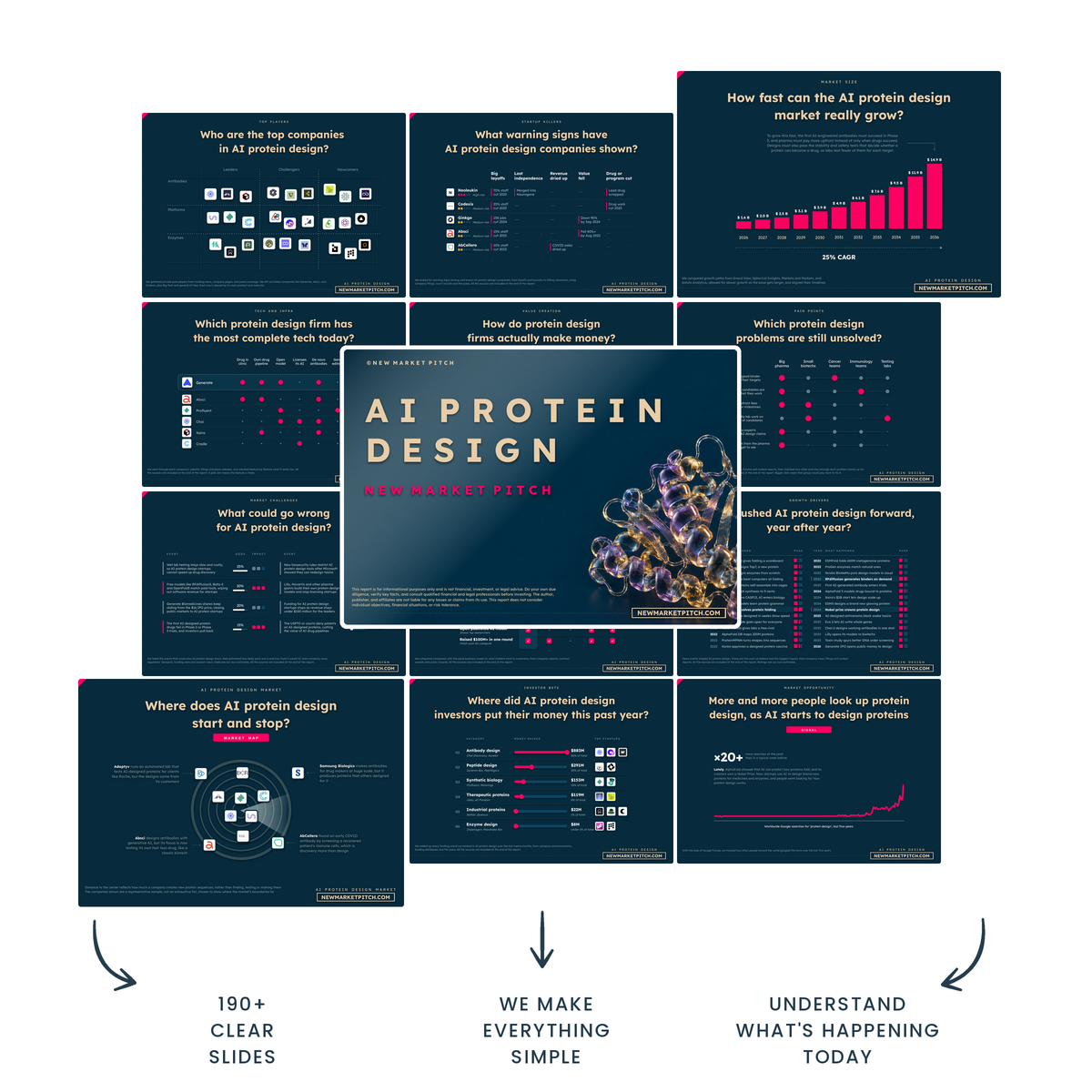
Whether you're building or investing in the AI protein design market, our report covers everything you need to know: the players, the money, and what's coming next.
Summary
The AI protein design funding tracker (84 deals) shows a genuine $2.75 billion venture market, but the headline is heavily inflated by a small number of exceptionally large rounds. The typical disclosed financing is $15 million, less than half the $36.73 million average.
Between January 2024 and September 2026, 67 companies completed 84 recorded financings. Nine transactions have no usable disclosed amount, so the $2.75 billion represents a lower bound rather than the market's complete investment total.
Capital is highly concentrated. The ten largest recipients captured 63% of disclosed funding, and Chai Discovery alone raised $600 million across three rounds, representing 21.8% of the market. Even excluding Chai, approximately $2.15 billion remains.
The funding distribution is much less generous than the largest announcements suggest. Forty-one transactions were below $20 million, while just eight rounds of at least $100 million contributed $1.3 billion, nearly half of recorded capital.
Antibody and binder design dominates investment, attracting $1.28 billion across 23 transactions. Pharmaceutical applications receive the largest commitments, while enzyme and industrial protein engineering together attracted only about $162 million across 16 deals.
Investors are willing to finance major research platforms unusually early. EvolutionaryScale raised more than $142 million at Seed, showing how foundational biological AI models can attract substantial capital before conventional commercial maturity.
The funding ladder narrows sharply after Series A. We recorded 32 Seed rounds, 31 Series A financings, 14 Series B transactions and only four Series C deals. Median financing nevertheless increases from $6 million at Seed to $66.5 million at Series B.
Existing companies are capturing most of the capital. Follow-on financings represent 81% of deals and approximately 87% of disclosed funding, while strategic investors participated in one-third of transactions, including investments associated with major pharmaceutical and technology groups.
North America accounts for approximately $2.12 billion, or 77.1% of disclosed funding, across half of the transactions. Europe and Asia-Pacific have meaningful startup populations but far fewer publicly recorded nine-figure financings, with some Asian transactions also disclosed through imprecise currency ranges.
Monthly funding is volatile rather than steadily increasing. July 2026 reached $417.16 million largely because of Chai Discovery's $400 million Series C, demonstrating how individual announcements can dominate the apparent direction of the market.
The next meaningful test is commercial execution. Funding proves that investors are willing to support AI-designed proteins, but the evidence remains much thinner on widespread pharmaceutical revenue, successful clinical development and profitable industrial production. The gap between exceptionally financed platforms and the rest of the sector is already substantial.

Written by the New Market Pitch teamWe track new markets so founders and investors can move faster. About us

In our report covering the AI protein design market, you will always find fresh funding data, taken straight from our own verified funding database.
Our funding tracker covering the AI protein design market
Below is the table listing all the deals. You may find our methodology at the end of this page.
And, if you want to gain a deeper understanding of the market and its current dynamics, get our report covering the AI protein design market.
| Company | Category | Date | Stage | Deal size | What they do | Region | Lead investors | Country |
|---|---|---|---|---|---|---|---|---|
| BigHat Biosciences | Antibody & Binder Design | September 2026 | Series C | $75M | Uses AI-guided protein engineering and automated experimentation to design therapeutic antibodies. | North America | DFJ Growth; Premji Invest | United States |
| Anew Labs | Antibody & Binder Design | September 2026 | Unknown | $290M | ByteDance spin-off building AI models for protein structure prediction and antibody design | Asia-Pacific | HSG; IDG Capital; Hillhouse Investment | China |
| Infinimmune | Antibody & Binder Design | August 2026 | Series A | $75M | Combines human antibody discovery and protein language models to optimize therapeutic antibodies. | North America | Regeneron Ventures; Playground Global | United States |
| Aureka Biotechnologies | Antibody & Binder Design | August 2026 | Series B | $100M | Develops biological foundation models for generative therapeutic antibody design. | North America | Not disclosed | United States |
| Accipiter Biosciences | Therapeutic Protein Design | July 2026 | Seed | $10.5M | Computationally designs multifunctional therapeutic proteins targeting multiple biological pathways. | North America | Not disclosed | United States |
| Quercus Biosolutions | Industrial Protein Design | July 2026 | Seed | $5M | Uses generative AI to design protein-based crop-protection compounds. | North America | Serra Ventures | United States |
| Mandrake Bio | Enzyme Design | July 2026 | Seed | ≈$1.8M | Uses generative AI to design gene-editing enzymes for agriculture and therapeutics. | Asia-Pacific | Activate; Antler | India |
| Chai Discovery | Antibody & Binder Design | July 2026 | Series C | $400M | Builds generative AI models to design therapeutic antibodies and protein binders. | North America | Index Ventures | United States |
| Matwings Technology | Research & Synthetic Biology Proteins | July 2026 | Series A | Not Disclosed | Develops protein foundation models and AI agents to generate and optimize functional proteins. | Asia-Pacific | Shanghai SDIC Pioneer; SDIC Innovation | China |
| LivingFilters | Antibody & Binder Design | June 2026 | Seed | ≈$470K | Uses computational protein design and generative AI to create selective protein binders for detecting and removing water contaminants. | Europe | Turbine Capital | Sweden |
| MoleculeMind | Research & Synthetic Biology Proteins | June 2026 | Series A | Not Disclosed | Provides MoleculeOS generative AI models for designing and optimizing antibodies, therapeutic proteins, peptides and industrial enzymes. | Asia-Pacific | Pudong Venture Capital; Zhangjiang Science and Technology Investment | China |
| BioGeometry (百奥几何) | Antibody & Binder Design | June 2026 | Unknown | Not Disclosed | Develops GeoFlow generative AI models for de novo antibody design, protein optimization and other biomolecular engineering applications. | Asia-Pacific | Shanghai Biomedical Innovation and Translation Fund; CAS Investment; Fortune Capital; Link-X Capital | China |
| Protuoso Biosciences | Therapeutic Protein Design | May 2026 | Seed | $9.5M | Uses AI-guided protein engineering to design multifunctional recombinant therapeutics combining antibody, cytokine and peptide components. | North America | Taya Venture; Darwin Ventures | United States |
| Imperagen Limited | Enzyme Design | May 2026 | Seed | ≈$6.7M | Combines quantum-physics simulation, AI models and automated experimentation to design improved enzymes for industrial applications. | Europe | PXN Ventures | United Kingdom |
| Resurrect Bio Ltd | Research & Synthetic Biology Proteins | May 2026 | Series A | $2.2M | Uses AI-guided protein-interaction analysis and engineering of plant immune receptors to design disease-resistance traits for crops. | Europe | Corteva Agriscience | United Kingdom |
| Aureka Biotechnologies | Antibody & Binder Design | April 2026 | Series A | $35M | Develops generative AI and automated experimental platforms for de novo design and optimization of therapeutic antibodies. | North America | HongShan (Sequoia China) | United States |
| Scala Biodesign | Research & Synthetic Biology Proteins | March 2026 | Series A | $16M | Provides ScalaOS, a computational and AI-based platform for optimizing protein sequences and properties across therapeutic and industrial applications. | Middle East | Grove Ventures | Israel |
| Syneron Bio (元思生肽) | Peptide Design | March 2026 | Series B | $150M | Uses an AI-driven discovery and optimization platform to design macrocyclic peptide therapeutics for difficult drug targets. | Asia-Pacific | Decheng Capital; CDH VGC | China |
| Matwings Technology | Research & Synthetic Biology Proteins | March 2026 | Series A | >$29M | Provides a generative protein foundation model and integrated R&D platform for designing functional proteins across biological applications. | Asia-Pacific | CNPC Kunlun Capital; Yonghua Capital; Shanghai Future Industries Fund | China |
| Unnatural Products | Peptide Design | March 2026 | Series B | $45M | Combines machine learning, computational design and experimental testing to engineer synthetic macrocyclic peptide therapeutics. | North America | The Venture Collective | United States |
| Antiverse | Antibody & Binder Design | March 2026 | Series A | $9.3M | Uses generative AI and laboratory validation to design therapeutic antibodies against difficult membrane-protein targets, including GPCRs and ion channels. | Europe | Soulmates Ventures | United Kingdom |
| Starget Pharma | Peptide Design | February 2026 | Series A | $18M | Uses AI-driven peptide backbone modeling and optimization to design targeted peptide radioligands for cancer therapy. | Middle East | Ilex Medical | Israel |
| Galux | Antibody & Binder Design | February 2026 | Series B | $29M | Develops AI models that generate and optimize therapeutic protein and antibody sequences, particularly de novo antibodies against challenging targets. | Asia-Pacific | Yuanta Investment | South Korea |
| Ukko | Therapeutic Protein Design | January 2026 | Series C | $45M | Uses computational protein design to re-engineer allergenic proteins into safer, immune-modulating therapeutic candidates. | North America | Israel Biotech Fund | United States |
| Syneron Bio (元思生肽) | Peptide Design | December 2025 | Series A | ≈$100M | Uses intelligent high-throughput discovery and computation to design and optimize macrocyclic peptide therapeutics. | Asia-Pacific | Not disclosed | China |
| Chai Discovery | Antibody & Binder Design | December 2025 | Series B | $130M | Develops generative AI models for de novo design and optimization of therapeutic antibodies and other protein binders. | North America | General Catalyst; Oak HC/FT | United States |
| Levinthal Biotech (杭州力文所生物科技有限公司) | Research & Synthetic Biology Proteins | December 2025 | Seed | Not Disclosed | Develops generative protein-design models to engineer enzymes, functional proteins, and therapeutic peptides. | Asia-Pacific | Jinyu Maowu (金雨茂物) | China |
| Aether Biomachines | Industrial Protein Design | December 2025 | Unknown | $15M | Uses AI to design functional proteins for advanced materials, industrial processing, and environmental applications. | North America | Tribe Capital | United States |
| immunitoAI Private Limited | Antibody & Binder Design | November 2025 | Series A | $6.1M | Uses generative AI to design novel therapeutic antibody sequences against specified biological targets. | Asia-Pacific | Ashish Kacholia | India |
| AI Proteins | Therapeutic Protein Design | November 2025 | Series A | $41.5M | Uses AI and high-throughput experimentation to create de novo miniprotein medicines for therapeutic applications. | North America | Mission BioCapital; Santé Ventures | United States |
| Profluent | Research & Synthetic Biology Proteins | November 2025 | Series B | $106M | Builds generative protein foundation models that design genome-editing enzymes, antibodies, and other functional proteins. | North America | Altimeter Capital; Bezos Expeditions | United States |
| Aureka Biotechnologies | Antibody & Binder Design | November 2025 | Series A | $23.2M | Combines generative AI and experimental screening to design and optimize therapeutic antibodies. | North America | 5Y Capital; Qiming Venture Partners | United States |
| Accipiter Biosciences | Therapeutic Protein Design | November 2025 | Seed | $12.7M | Designs de novo multifunctional protein therapeutics using computational protein engineering and high-throughput experiments. | North America | Takeda; Flying Fish Partners | United States |
| Beijing Zhiyuan Shenlan Technology Co., Ltd. (北京智源深澜科技有限公司) | Research & Synthetic Biology Proteins | November 2025 | Seed | Not Disclosed | Develops a generative-AI and automated experimental platform for designing and optimizing proteins, peptides, enzymes, and other biological macromolecules. | Asia-Pacific | Woyan Capital | China |
| Caravel Bio | Industrial Protein Design | October 2025 | Seed | $1.9M | Uses machine learning and high-throughput protein evolution to engineer functional proteins for industrial and synthetic biology applications. | North America | Not disclosed | United States |
| Peptilogics | Peptide Design | October 2025 | Series B | $78M | Uses computational and generative-AI methods to design engineered peptide therapeutics, including antimicrobials. | North America | Presight Capital; Thiel Bio; Founders Fund | United States |
| Scindo | Enzyme Design | September 2025 | Seed | ≈$5.4M | Develops an AI-driven enzyme-design platform to create biocatalysts for sustainable chemicals and bio-based ingredients. | Europe | Kadmos Capital; Clay Capital | United Kingdom |
| Arzeda | Industrial Protein Design | September 2025 | Unknown | $4.5M | Uses computational protein design and generative AI to engineer enzymes and proteins for industrial applications. | North America | Not disclosed | United States |
| Ridge Biotechnologies, Inc. | Enzyme Design | September 2025 | Seed | $25M | Uses machine learning and cell-free experimental data to design precision enzymes for therapeutic applications. | North America | Sutter Hill Ventures | United States |
| Toursynbio (途深智合) | Research & Synthetic Biology Proteins | September 2025 | Seed | Not Disclosed | Develops generative AI platforms for de novo protein design and optimization, including antibodies and enzymes. | Asia-Pacific | Not disclosed | China |
| Chai Discovery | Antibody & Binder Design | August 2025 | Series A | $70M | Develops generative AI foundation models for designing therapeutic antibodies and other protein molecules. | North America | Menlo Ventures | United States |
| Foundry BioSciences | Therapeutic Protein Design | July 2025 | Seed | Not Disclosed | Develops generative AI models to design novel proteins for longevity-related therapeutic and health applications. | North America | XtalPi | United States |
| ProteinQure Inc. | Peptide Design | May 2025 | Series A | $11M | Uses machine learning and molecular simulations to design therapeutic peptides and peptide-drug conjugates. | North America | Tom Williams (Heron Rock Fund) | Canada |
| RevolKa | Therapeutic Protein Design | May 2025 | Series A | $1.4M | Develops an AI-powered protein engineering platform that generates and optimizes protein sequences for therapeutic and industrial applications. | Asia-Pacific | D3 LLC; TOHOKU University Venture Partners Co., Ltd. | Japan |
| Solena Materials | Industrial Protein Design | May 2025 | Seed | $6.7M | Uses AI to design novel protein sequences that form biodegradable, high-performance fibres for textile applications. | Europe | Sir David Harding; SynBioVen; Insempra | United Kingdom |
| Meddenovo Drug Design | Peptide Design | May 2025 | Seed | $450K | Develops AI- and physics-based computational tools to design and optimize cyclic peptide drug candidates. | Europe | Not disclosed | France |
| BigHat Biosciences | Antibody & Binder Design | April 2025 | Series B | $44M | Uses machine learning and automated experimentation to design and optimize therapeutic antibodies and other protein biologics. | North America | Not disclosed | United States |
| Brink Therapeutics | Enzyme Design | April 2025 | Seed | ≈$4M | Uses generative AI and directed evolution to design programmable integrase and recombinase enzymes for gene-editing therapies. | Europe | Kurma Partners; Breega | France |
| GigaCrop | Enzyme Design | March 2025 | Seed | $4.5M | Uses machine learning and enzyme engineering to design improved photosynthetic pathways that increase crop productivity. | North America | Playground Global | United States |
| Epoch Biodesign | Enzyme Design | March 2025 | Series A | $18.3M | Uses AI-powered protein engineering to design enzymes that degrade plastics and synthetic textiles for industrial recycling. | Europe | Extantia Capital | United Kingdom |
| ZYMVOL Biomodeling, S.L. | Enzyme Design | February 2025 | Seed | $3.1M | Develops computational and AI-assisted enzyme discovery and engineering technology to design proteins with improved catalytic and industrial properties. | Europe | Faber Ventures | Spain |
| Latent Labs | Therapeutic Protein Design | February 2025 | Seed | $10M | Develops generative protein foundation models that enable pharmaceutical and biotechnology companies to design and optimize therapeutic proteins. | Europe | Pillar VC; Kindred Capital | United Kingdom |
| Latent Labs | Therapeutic Protein Design | February 2025 | Series A | $40M | Develops generative protein foundation models that enable pharmaceutical and biotechnology companies to design and optimize therapeutic proteins. | Europe | Radical Ventures; Sofinnova Partners | United Kingdom |
| Pepticom Ltd. | Peptide Design | January 2025 | Series A | $6.6M | Uses generative AI and computational modeling to design and optimize therapeutic peptides, including cyclic peptidomimetics. | Middle East | Japan Israel High Tech Ventures 2 LP | Israel |
| Cradle Bio | Research & Synthetic Biology Proteins | November 2024 | Series B | $73M | Provides a generative-AI platform for designing and optimizing protein sequences, including enzymes, antibodies and research proteins. | Europe | IVP | Netherlands |
| Aizen Therapeutics | Peptide Design | November 2024 | Seed | $13M | Uses generative AI to design de novo mirror-image D-peptide therapeutics with engineered binding and stability properties. | North America | Madrona | United States |
| Matwings Technology | Research & Synthetic Biology Proteins | November 2024 | Series A | >$13.8M | Develops AI models that predict protein function and optimize protein sequences for pharmaceutical, diagnostic and synthetic-biology applications. | Asia-Pacific | Qiming Venture Partners | China |
| Archon Biosciences | Antibody & Binder Design | October 2024 | Seed | $20M | Uses AI-driven computational protein design to create novel protein scaffolds that assemble antibodies into therapeutic antibody cages. | North America | Madrona Ventures | United States |
| Fable Therapeutics | Antibody & Binder Design | October 2024 | Seed | $10M | Applies generative AI and protein-engineering models to design therapeutic antibodies and peptides for metabolic diseases. | North America | Versant Ventures; DCVC Bio | United States |
| Fable Therapeutics | Antibody & Binder Design | October 2024 | Series A | $43.5M | Applies generative AI and protein-engineering models to design therapeutic antibodies and peptides for metabolic diseases. | North America | Versant Ventures; DCVC Bio | United States |
| Avenue Biosciences Oy | Peptide Design | October 2024 | Seed | $2.5M | Uses machine learning to screen and optimize signal-peptide sequences that improve the cellular secretion of therapeutic proteins. | Europe | Voima Ventures | Finland |
| Antiverse | Antibody & Binder Design | October 2024 | Seed | $4.6M | Uses generative AI and experimental screening to design therapeutic antibodies against difficult targets including GPCRs and ion channels. | Europe | i&i Biotech Fund I; Kadmos Capital | United Kingdom |
| Basecamp Research | Research & Synthetic Biology Proteins | October 2024 | Series B | $60M | Develops biological AI models trained on biodiversity data to design novel protein sequences, enzymes and biological systems. | Europe | Singular | United Kingdom |
| Generate:Biomedicines, Inc. | Therapeutic Protein Design | September 2024 | Unknown | $15M | Operates a generative-AI protein-design platform to create and optimize therapeutic antibodies, enzymes, cytokines and other protein medicines. | North America | Not disclosed | United States |
| Arzeda | Industrial Protein Design | September 2024 | Unknown | $38M | Uses generative AI and computational protein design to create and optimize enzymes and industrial proteins for food, materials, agriculture and consumer products. | North America | Sofinnova Partners | United States |
| MoleculeMind | Research & Synthetic Biology Proteins | September 2024 | Series A | Not Disclosed | Develops AI foundation models and the MoleculeOS platform for de novo protein generation and optimization across enzymes, antibodies, peptides and other proteins. | Asia-Pacific | Xienuo Investment; Shenzhen Capital Group | China |
| ZipBio | Therapeutic Protein Design | September 2024 | Seed | $4M | Uses generative AI to design compact de novo therapeutic proteins and genes intended to improve drug delivery and biological activity. | North America | NFX | United States |
| RevolKa | Therapeutic Protein Design | August 2024 | Series A | $700K | Uses its aiProtein platform to combine AI with directed protein evolution to design and optimize functional proteins for therapeutics and industrial applications. | Asia-Pacific | D3 LLC; DEEPCORE Inc. | Japan |
| Biomatter | Enzyme Design | August 2024 | Seed | ≈$7.1M | Develops generative-AI models that design new enzymes and optimize protein functionality for industrial and life-science applications. | Europe | Inventure; UVC Partners | Lithuania |
| Outpace Bio | Therapeutic Protein Design | August 2024 | Series B | $144M | Uses AI-powered de novo protein design to create molecular control systems that enhance engineered immune-cell therapies. | North America | RA Capital Management | United States |
| Micropep Technologies | Peptide Design | July 2024 | Series B | $29M | Uses generative AI and proprietary sequence-design algorithms to develop micropeptide-based crop-protection products. | Europe | Zebra Impact Ventures; BPI Green Tech Investment | France |
| Abiologics, Inc. | Therapeutic Protein Design | July 2024 | Series A | $50M | Uses generative AI and automated chemical protein synthesis to design novel programmable therapeutic proteins from artificial amino-acid building blocks. | North America | Not disclosed | United States |
| EvolutionaryScale | Research & Synthetic Biology Proteins | June 2024 | Seed | >$142M | Develops generative protein foundation models, including ESM3, that design new protein sequences, structures and functions for research and industrial applications. | North America | Nat Friedman; Daniel Gross; Lux Capital | United States |
| Ability Biologics | Antibody & Binder Design | June 2024 | Seed | $6M | Uses its generative-AI AbiLeap platform to design selective, logic-gated multispecific therapeutic antibodies. | North America | Amplitude Ventures | Canada |
| Vilya, Inc. | Peptide Design | June 2024 | Series A | $21M | Applies AI-driven computational molecular design to generate and optimize novel therapeutic macrocyclic peptides. | North America | ARCH Venture Partners | United States |
| LabGenius | Antibody & Binder Design | May 2024 | Series B | ≈$44.5M | Uses a closed-loop machine-learning and automated laboratory platform to design and optimize multispecific therapeutic antibodies. | Europe | M Ventures | United Kingdom |
| Nabla Bio | Antibody & Binder Design | May 2024 | Series A | $26M | Develops generative protein-design models integrated with laboratory validation to engineer antibodies against challenging membrane-protein targets. | North America | Radical Ventures | United States |
| Prologue Medicines | Therapeutic Protein Design | May 2024 | Series A | $50M | Uses machine learning and viral-protein evolution data to identify, design and optimize programmable therapeutic proteins. | North America | Not disclosed | United States |
| Allozymes | Enzyme Design | May 2024 | Series A | $15M | Engineers and optimizes industrial enzymes using ultra-high-throughput variant screening and developing AI-guided enzyme-design models. | Asia-Pacific | Seventure Partners; Xora Innovation | Singapore |
| Xaira Therapeutics | Research & Synthetic Biology Proteins | April 2024 | Growth Equity | ≈$1B | Integrates protein-design generative foundation models, biological data and therapeutic development for AI-enabled drug discovery, including designed proteins and biomolecules. | North America | ARCH Venture Partners; Foresite Capital | United States |
| Diagonal Therapeutics | Antibody & Binder Design | April 2024 | Series A | $128M | Uses AI, computational modeling and experimental engineering to discover and optimize multispecific agonist antibodies that activate disease-relevant receptor complexes. | North America | BVF Partners; Atlas Venture | United States |
| Matwings Technology | Research & Synthetic Biology Proteins | April 2024 | Seed | Not Disclosed | Provides AI protein-sequence design and optimization services through its AccelProtein large language model across therapeutic, industrial and research applications. | Asia-Pacific | GSR United Capital | China |
| Profluent | Research & Synthetic Biology Proteins | March 2024 | Series A | $35M | Develops generative AI foundation models to design and experimentally validate novel functional proteins, initially focusing on CRISPR gene-editing systems. | North America | Spark Capital | United States |
| Baseimmune | Vaccine & Antigen Design | February 2024 | Series A | $11.3M | Uses AI to predict pathogen evolution and design synthetic antigenic protein sequences for broadly protective vaccines. | Europe | MSD Global Health Innovation Fund; IQ Capital | United Kingdom |
| Insamo | Peptide Design | February 2024 | Seed | $12M | Combines machine-learning-driven peptide design, high-throughput screening and synthesis to develop orally available therapeutic cyclic peptides. | North America | Playground Global | United States |
| DenovAI Biotech | Antibody & Binder Design | February 2024 | Seed | $3M | Develops AI-powered computational protein-design platforms for generating therapeutic antibodies and high-affinity protein binders from scratch. | Middle East | Not disclosed | Israel |
| RevolKa | Therapeutic Protein Design | February 2024 | Series A | $1M | Uses its aiProtein AI-assisted directed-evolution platform to design and optimize functional proteins for therapeutic and industrial applications. | Asia-Pacific | D3 LLC; DEEPCORE Inc.; Tohoku University Venture Partners Co., Ltd. | Japan |

In our research about AI protein design, we turn what is vague and complex into simple, useful visuals. Market maps like this one show you at a glance where every startup stands.
Is AI protein design really a multibillion-dollar market now?
AI protein design has attracted at least $2.75 billion in venture funding, but most startups in the sector are raising far less money than that headline might suggest.
Between January 2024 and September 2026, we identified 84 financing transactions involving 67 companies. The average disclosed round was $36.73 million, while the median was only $15 million. A handful of very large investments explain much of that gap.
Chai Discovery raised $400 million in a single financing, Syneron Bio secured $150 million, and Outpace Bio completed a $144 million Series B. Those deals demonstrate how much investors are willing to commit to promising protein-design technologies, particularly when they have pharmaceutical applications.
But the wider market looks rather different. Nearly half of all recorded transactions were below $20 million, and only eight reached $100 million or more.
The $2.75 billion total is also a minimum because nine transactions have no usable disclosed amount. Several other deals were reported as lower bounds, while some included capital commitments that may not have been fully drawn.
For now, AI protein design looks like a market with a fairly broad group of funded startups and a much smaller set of companies attracting exceptionally large checks.
How many AI protein design startups are actually getting funded?
We found 67 funded AI protein design companies, and 55 of them raised money only once during the period we studied.
That means 82.1% of companies have a single recorded transaction. Another eight businesses completed two financings, while four appeared in three or more deals.
This is worth separating from the total number of transactions. Chai Discovery and Aureka Biotechnologies each recorded three rounds, while Profluent and BigHat Biosciences also appeared more than once.
A company with only one financing in our research may already have raised money before January 2024. It might also have secured enough capital to finance several years of research.
Outpace Bio, for instance, received $144 million in one transaction. EvolutionaryScale raised more than $142 million at Seed. Neither company would necessarily need another round shortly afterward.
Looking at the 67 distinct companies gives us a better idea of how many businesses investors are actually supporting, while the repeated financings show where additional capital is accumulating.

Your time is limited. In our market report about AI protein design, we put numbers on each part of the market, so you can see where it makes sense to focus.
Are a few AI protein design startups taking most of the money?
Funding in AI protein design is extremely concentrated, with the ten largest recipients collecting 63% of all recorded capital.
Chai Discovery leads by a considerable margin. Its three financings total $600 million, almost four times the $158.2 million raised by second-place Aureka Biotechnologies.
Syneron Bio follows with $150 million, ahead of Outpace Bio at $144 million and EvolutionaryScale at more than $142 million.
The top five companies together received 43.4% of the market's disclosed funding.
Meanwhile, 19 companies have no more than $5 million in observable cumulative capital. That group includes businesses whose actual totals may be higher because some financing amounts were undisclosed.
What's striking is how quickly the scale changes. A company can be among the ten largest funding recipients with $75 million, yet Chai alone has raised eight times that amount during the same period.
Which AI protein design companies raised the most money?
| Company | Recorded deals | Capital raised |
|---|---|---|
| Chai Discovery | 3 | $600.0M |
| Aureka Biotechnologies | 3 | $158.2M |
| Syneron Bio | 1 | $150.0M |
| Outpace Bio | 1 | $144.0M |
| EvolutionaryScale | 1 | ≥$142.0M |
| Profluent | 2 | $141.0M |
| Diagonal Therapeutics | 1 | $128.0M |
| BigHat Biosciences | 2 | $119.0M |
| Peptilogics | 1 | $78.0M |
| Infinimmune | 1 | $75.0M |

In our document detailing everything you need to know about AI protein design, we always try to gather several sources and make estimates that make sense, so you can work with solid numbers.
Is Chai Discovery making the AI protein design market look bigger than it really is?
Chai Discovery accounts for 21.8% of all recorded AI protein design funding, making it by far the biggest influence on the market's headline numbers.
Its largest financing came on July 14, 2026, when the company announced a $400 million Series C at a $3.8 billion valuation. That round alone represents 14.5% of the sector's disclosed capital.
The funding followed Chai's development of AI models for molecular design and a series of relationships with major pharmaceutical companies.
Its commercial activity is increasingly relevant to the investment case. In June 2026, Chai announced a license agreement with Pfizer involving its Chai-3 model. The company also expanded its work with Eli Lilly and announced collaborations involving Novartis, argenx and Bristol Myers Squibb during the summer.
Investors are effectively backing a company that wants its molecular-design software used across numerous drug-discovery programs.
But we should also look beyond Chai. Removing its entire $600 million leaves roughly $2.15 billion in disclosed funding across the remaining businesses.
There is serious financing activity elsewhere, even if Chai has become the standout fundraising success.
What does a normal AI protein design startup actually raise?
The typical disclosed AI protein design round is $15 million, although the amount a startup can realistically target depends heavily on its development stage and business model.
Sixteen financings were below $5 million, while 25 fell between $5 million and $20 million. Those smaller transactions account for 41 of the 84 deals we recorded.
At the other extreme, eight financings reached $100 million or more and together contributed $1.3 billion. That's nearly half of all calculable capital from fewer than one in ten transactions.
An early enzyme-design company looking for several million dollars is operating within a fairly common funding range. A startup seeking $100 million for an AI protein platform is approaching a much narrower group of investors and competing with companies that have already convinced backers to finance ambitious scientific programs.
The stage of development makes the difference more obvious. Median Seed financing stands at $6 million, compared with $19.65 million at Series A and $66.5 million at Series B.
We would use those stage-specific figures before treating the overall market average as a realistic fundraising target.

Our report covering the AI protein design market gets updated several times a month, so you always get the latest view of where things stand.
How much money do AI protein design companies raise per round?
| Round size | Deals | Share of deals | Recorded capital |
|---|---|---|---|
| Under $5M | 16 | 19.0% | $40.02M |
| $5M–under $20M | 25 | 29.8% | $270.00M |
| $20M–under $50M | 18 | 21.4% | $613.70M |
| $50M–under $100M | 8 | 9.5% | $531.00M |
| $100M+ | 8 | 9.5% | $1,300.00M |
| Undisclosed | 9 | 10.7% | Unknown |
Which part of AI protein design is getting the most funding?
Antibody and binder design is currently the biggest destination for AI protein design funding, attracting approximately $1.28 billion across 23 transactions.
That category accounts for 46.6% of disclosed capital, despite representing only 27.4% of deals. The difference is considerable.
Research and synthetic-biology protein design comes next with at least $477 million, followed by therapeutic proteins at $435.3 million and peptides at $386.55 million.
The order changes when we compare round sizes. Research and synthetic biology has a median disclosed financing of $35 million, slightly above the $32 million median in antibody and binder design. Both stand well above enzyme and industrial protein engineering.
Several different businesses sit behind these figures. Chai Discovery develops molecular-design models for pharmaceutical partners. Latent Labs builds generative protein-design technology that researchers can use to create and optimize biological molecules. Outpace Bio uses designed proteins in engineered immune-cell therapies.
Investors are financing everything from research tools to drug candidates, but pharmaceutical applications are where the biggest checks are most visible.

In our research about AI protein design, we look at what the winners do differently, so you can learn from the best instead of guessing.
Where is the money going within AI protein design?
| Category | Deals | Companies | Recorded capital | Median deal |
|---|---|---|---|---|
| Antibody & Binder | 23 | 16 | $1,282.7M | $32.0M |
| Research & Synthetic Biology | 16 | 11 | ≥$477.0M | $35.0M |
| Therapeutic Protein | 16 | 12 | $435.3M | $12.7M |
| Peptide | 12 | 12 | $386.55M | $15.5M |
| Enzyme | 10 | 10 | $90.79M | $6.05M |
| Industrial Protein | 6 | 5 | $71.11M | $5.85M |
| Vaccine & Antigen | 1 | 1 | $11.3M | $11.3M |
Why are investors spending so much on AI-designed antibodies?
Investors are making especially large bets on AI antibody design because successful platforms could help pharmaceutical companies discover and improve drugs across many different programs.
Chai Discovery gives us a good example. The company develops computational tools that help researchers design molecules and predict how they interact with biological targets.
Its agreements with Pfizer, Eli Lilly and Novartis show the kind of customers these platforms can attract. Instead of developing every drug itself, a molecular-design company can potentially work across several pharmaceutical pipelines.
Diagonal Therapeutics illustrates another approach. In April 2024, the company launched with $128 million to develop agonist antibodies, using computational and experimental techniques to target diseases involving disrupted biological signaling.
BigHat Biosciences combines machine learning and laboratory automation to design therapeutic antibodies. Its Milliner platform integrates computational work with experimental testing, connecting molecular design to drug development.
Better antibody design could save pharmaceutical companies time, improve candidates and make difficult biological targets more accessible.
Of course, the financing figures don't prove that every platform will deliver those results. But the large rounds, growing commercial relationships and investment from established drugmakers give us concrete reasons for the category's popularity.

In our market report about AI protein design, we don't want to repeat what boring consulting reports say. Instead, we show you the real and latest market signals that matter.
Why would investors put more than $100 million into an AI protein design seed round?
Some AI protein design startups can raise enormous seed rounds because investors are financing the development of foundational biological AI models, which can require substantial resources from the beginning.
EvolutionaryScale is the clearest example. In June 2024, it announced seed funding exceeding $142 million while introducing ESM3, a generative model capable of designing proteins.
The round was led by investors including Nat Friedman, Daniel Gross and Lux Capital, with participation from Amazon and NVentures, Nvidia's venture investment arm.
ESM3 was developed to work with protein sequences, structures and functions. The potential applications extend from pharmaceutical research to new materials and other biological technologies.
Building this kind of technology requires specialized AI researchers, significant computing resources and experimental work to determine whether generated proteins behave as intended.
EvolutionaryScale was therefore raising money for a broad scientific research platform with ambitions extending across several industries.
In ordinary startup terminology, a seed round suggests a relatively small investment in an early business. EvolutionaryScale shows why that assumption can be misleading in scientific AI.
Are AI protein design startups building software or developing actual drugs?
AI protein design funding covers both software-like research platforms and companies developing physical therapies, with very different costs attached to each business.
EvolutionaryScale is focused on foundational models that scientists can use to generate and study proteins. Latent Labs takes a related approach, building tools that let researchers design molecules such as antibodies and enzymes.
Latent Labs launched publicly in February 2025 with $50 million in total funding, including a $40 million Series A. Its platform aims to make generative protein design accessible to pharmaceutical and biotechnology researchers.
Outpace Bio sits much closer to clinical development. Its August 2024 Series B raised $144 million to advance programmed T-cell therapies toward early clinical proof-of-concept in solid tumors.
Diagonal Therapeutics is another example of capital supporting a specific therapeutic pipeline. Its $128 million financing was intended partly to advance treatments for hereditary hemorrhagic telangiectasia, a rare bleeding disorder.
Clinical programs need manufacturing, testing, regulatory preparation and human trials. Those activities can absorb substantial amounts of money long after the underlying protein-design work has produced a promising candidate.
That's why we need to be careful with the market's aggregate funding figure. A dollar raised for training molecular models and a dollar raised for developing a treatment can support very different activities.

Learning from others' mistakes is the cheapest lesson there is. In our document detailing everything you need to know about AI protein design, we look at what broke startups before you, so you don't repeat it.
Why are industrial protein and enzyme startups raising smaller rounds?
Industrial protein and enzyme-design companies are raising much smaller venture rounds than their pharmaceutical counterparts, with no financing above $50 million recorded in either category.
The combined capital for both segments is approximately $162 million, spread across 16 transactions.
Epoch Biodesign offers a useful example of the industrial approach. The company uses AI and enzyme engineering to break down difficult-to-recycle materials, including plastics and textiles, into reusable chemical building blocks.
Its technology has to work in industrial processes where cost, material recovery and production efficiency determine whether customers will adopt it.
Resurrect Bio applies computational protein engineering to agricultural disease resistance. Its 2026 Series A reached $10.3 million after an initial close of $8.1 million, with strategic involvement from Corteva Agriscience.
These are practical biological-engineering businesses, but their commercialization paths differ from those of antibody drug developers.
They may grow through corporate partnerships, licensing, manufacturing relationships or strategic funding arrangements that are less visible in a database of venture financings.
What we can establish is that investors are writing smaller observable equity checks for these applications. Whether industrial protein design ultimately becomes a larger commercial market is a separate question.
How far have AI protein design startups actually progressed?
AI protein design remains heavily concentrated at Seed and Series A, although the companies reaching Series B are already raising much larger amounts of money.
We counted 32 Seed financings, 31 Series A rounds, 14 Series B transactions and four Series C deals. Three additional financings had no reliable stage classification.
The typical round grows considerably as companies advance. Median financing increases from $6 million at Seed to $19.65 million at Series A, before reaching $66.5 million at Series B.
A company raising Series B in this market is generally seeking several times more capital than a typical Series A business.
The founding dates suggest the market is still young. Forty-three of the 67 funded companies were established in 2021 or later.
Even so, the largest financings are already supporting companies with substantial research operations, pharmaceutical programs and more demanding development plans.
We see plenty of early-stage activity and a smaller population receiving major follow-on investment. The challenge is how many of those businesses will progress to the next level.

If you build or invest in the AI protein design market, you need to know which business models pay off now and which ones are fading. That's why our report covering it has a whole section on it.
How does AI protein design funding change by stage?
| Stage | Deals | Recorded capital | Median deal |
|---|---|---|---|
| Seed | 32 | $331.81M | $6.0M |
| Series A | 31 | $797.90M | $19.65M |
| Series B | 14 | $1,037.01M | $66.5M |
| Series C | 4 | $535.00M | $60.0M |
| Unknown | 3 | $53.00M | $26.5M |
Why are so few AI protein design companies reaching Series C?
Series C funding is still rare in AI protein design, with only four recorded transactions compared with 31 Series A financings.
There is a noticeable narrowing earlier in the funding ladder. Series B appears 14 times, less than half the Series A count.
The four Series C deals together represent $535 million, with Chai Discovery responsible for $400 million. That leaves only $135 million in recorded Series C financing across the other three transactions.
These numbers don't prove that startups are failing between stages. The companies raising Series A during this period haven't necessarily had enough time to reach Series B or C, while others may have raised earlier rounds before our observation window began.
Still, the shortage of later-stage transactions deserves attention.
Protein-design businesses often need years to validate their technology, build commercial relationships or demonstrate therapeutic progress. Investors considering a large Series C may also want stronger evidence of revenue, pharmaceutical partnerships or clinical results than was required during earlier rounds.
For now, the market has produced several companies capable of raising nine-figure Series B financings, but relatively few have reached a similarly well-funded Series C stage.

In our research about AI protein design, we like to show you the big picture. We know your time is precious, so we make every page quick to read and packed with as much learning as possible per minute.
How old are AI protein design startups when they raise big money?
AI protein design startups are receiving large investments surprisingly early, with a median company age of just three years among rounds above $50 million.
Across the full financing population, the median age at fundraising is also three years.
There is a fairly normal progression by stage. Companies raising Seed are typically around two years old, compared with four years at Series A, 5.5 years at Series B and 6.5 years at Series C.
But some companies move much faster.
EvolutionaryScale raised more than $142 million shortly after its formation. Chai Discovery also reached a very large Series C financing within a relatively short corporate history.
Those examples suggest that investors are prepared to back exceptional AI and biological research teams without waiting for a decade of operating history.
The distinction is particularly relevant for foundational-model companies. Their value can depend heavily on technical capability, model performance, intellectual property and access to commercially important biological applications.
Young companies are not automatically receiving small checks in this sector.
Are investors backing new AI protein design startups or mostly funding companies they already know?
Most AI protein design funding is going to businesses that have raised external capital before, with follow-on financings accounting for 81% of recorded deals.
We classified 68 transactions as follow-ons and 16 as first financings. Those follow-on rounds represent approximately $2.40 billion, or 87% of disclosed funding.
The market continues to fund new entrants, but established startups are receiving most of the money.
There is also a distinction between historical follow-on financing and repeated fundraising during our observation window. A company may appear only once between 2024 and 2026 while still having several earlier rounds behind it.
BigHat Biosciences and Outpace Bio, for example, had already secured financing before the period we analyzed. Their later transactions build on existing company histories.
The large follow-on share suggests investors are increasingly financing continued research, therapeutic development and expansion rather than simply paying for the initial creation of new businesses.

When you build or invest in the AI protein design market, you need clarity, not confusion. In our market report about AI protein design, we always try to put numbers on and quantify whatever is usually vague and confusing.
Which investors are most active in AI protein design?
AI protein design has no single venture firm dominating the lead-investor market, although a small group of specialist investors appears repeatedly.
We identified 102 distinct lead or co-lead names across the available financing records. Only nine appeared on more than one transaction.
Playground Global led or co-led three rounds with a combined financing value of $91.5 million. Sofinnova Partners appeared twice across rounds totaling $78 million, while Radical Ventures participated as a lead in two transactions totaling $66 million.
Versant Ventures and DCVC Bio also recur, including through Fable Therapeutics' financing history.
But the number of appearances needs some interpretation. D3 LLC and DEEPCORE recur through successive financings involving RevolKa, rather than investments across several unrelated businesses.
At the upper end of the market, large generalist venture investors can become important. Chai Discovery's $400 million Series C brought together Index Ventures, Kleiner Perkins, Sequoia Capital and Dimension.
Specialist biotechnology funds, established venture firms and technology-oriented investors all participate, often depending on whether the company is developing drug candidates, biological foundation models or industrial applications.
Are pharmaceutical giants investing in AI protein design themselves?
Pharmaceutical and technology companies are already involved in a substantial share of AI protein design financings, with strategic investors identified in one-third of recorded transactions.
Across the 84 deals, 28 involved strategic participation. Those transactions had a median round size of $21 million, compared with $13 million for deals without a disclosed strategic investor.
Among the recognizable corporate participants are investment entities associated with AstraZeneca, Pfizer, Merck, Eli Lilly, Regeneron and Bayer.
Their interests are commercially understandable. Better protein-design technology could help drugmakers discover antibodies, improve therapeutic candidates, pursue difficult targets and reduce some of the experimental work involved in early discovery.
Technology companies have a different reason to pay attention. Amazon and NVentures backed EvolutionaryScale, whose protein foundation models require the type of AI computing infrastructure these businesses already support.
Corporate involvement also reaches agriculture. Corteva's participation in Resurrect Bio reflects interest in engineered biological traits that could protect crops against disease.
The presence of strategic investors doesn't guarantee future commercial success, and the total amount contributed by those investors is not always disclosed. Still, their participation shows that established companies are willing to commit capital to protein-design technologies with potential uses in existing industries.

A good product starts with a real problem. In our document detailing everything you need to know about AI protein design, we show you the ones customers still live with.
Is the United States taking most of the AI protein design investment?
The United States is comfortably ahead in observable AI protein design funding, accounting for roughly $2.11 billion across 40 recorded deals.
North America as a whole contributes 42 transactions and approximately $2.12 billion. That's 77.1% of all disclosed capital, despite representing only half the deal count.
Europe follows with 20 transactions and $338.65 million. The United Kingdom is its largest identifiable contributor, with 12 deals totaling approximately $219 million.
Asia-Pacific records 18 transactions and at least $247.66 million. China accounts for 11 of those deals, with at least $192.8 million in numerically reported funding.
But China's position is less precisely measured. Several Chinese financings were disclosed through broad RMB ranges rather than exact amounts, making the region's reported dollar total less reliable.
There is also an enormous difference in typical financing size. North America's median disclosed round is $35 million, compared with $6.9 million in Europe and $9.95 million in Asia-Pacific.
The United States clearly leads when it comes to the large, publicly disclosed financings that dominate the sector's capital totals. Other regions have meaningful startup activity, but far fewer recorded nine-figure rounds.
Is AI protein design funding growing steadily, or does it come in waves?
AI protein design funding arrives in bursts, with a handful of large transactions causing much bigger swings in monthly capital than changes in the number of deals.
Across the 32 completed months from January 2024 through August 2026, the market averaged roughly 2.6 transactions per month. The busiest months were October 2024 and November 2025, with six deals each.
Yet July 2026 attracted far more money than either month, reaching $417.16 million across five financings.
Almost all of that amount came from Chai Discovery's $400 million Series C.
March 2026 was another particularly large month, recording $249.3 million across five transactions. November 2025 brought $189.5 million across six deals, including Profluent's $106 million financing.
The difference between an ordinary month and an exceptional one can come down to a single company announcing a major financing.
We also found cases where announcement dates differed from closing dates. Ukko's $45 million financing, for example, closed in 2025 but became public in January 2026.
The market has demonstrated an ability to attract very large rounds, although the timing is irregular and individual announcements can dominate the statistics.

In our report covering the AI protein design market, we try to remove everything that could confuse you, especially if you're investing or building in this market.
What's still missing from the AI protein design market?
AI protein design has plenty of early funding and several spectacular rounds, but we still have limited evidence of a broad population of companies reaching commercial scale.
The later-stage gap is the first concern. Only four Series C transactions appear in the period, and one company accounts for most of their capital.
Industrial applications also remain relatively small in the available equity data. Enzyme and industrial protein companies have 16 financings between them, but neither category records a round above $50 million.
Vaccine and antigen design is even less represented, with only one qualifying financing. That gives us too little evidence to judge investor demand for the category as a whole.
The bigger question concerns what happens after funding.
AI protein-design companies are pursuing very different outcomes. Some want pharmaceutical partners to use their models. Others aim to develop approved therapeutics, while industrial businesses must prove they can manufacture products at an economically competitive cost.
The financing data gives us evidence of investor interest, but it doesn't establish whether those companies are generating substantial revenue, producing successful clinical results or operating profitable industrial processes.
That is where the next meaningful separation between the strongest companies and the rest of the market is likely to appear.
What should we actually take away from the funding data?
AI protein design has become a serious venture-backed biotechnology market, but investors are clearly much more selective with their largest checks than the headline funding total suggests.
The first conclusion concerns concentration. Sixty-seven companies received investment, yet a small group accounts for most of the money. Chai Discovery is the standout, although several other companies have secured nine-figure financings.
The second is that ordinary fundraising remains much smaller than the biggest announcements imply. The typical disclosed deal is $15 million, and almost half of all recorded transactions fall below $20 million.
Third, pharmaceutical applications are receiving the strongest financial backing. Antibody design leads the market, while therapeutic proteins, peptides and broader biological research platforms also attract substantial amounts. Industrial protein and enzyme engineering remain considerably smaller in the venture data.
Fourth, the market is still relatively young. Most deals are at Seed or Series A, and the number of financings drops sharply at Series B and C. Companies that reach those later stages can raise substantial capital, but relatively few have done so.
Fifth, established investors and corporate backers are playing a meaningful role. Follow-on rounds dominate financing activity, and strategic investors participate in one-third of transactions. Drugmakers and technology companies clearly see potential commercial value in the field.
Finally, AI protein design's biggest unanswered question is whether its best-funded companies can turn advanced computational biology into durable businesses. The sector has demonstrated that investors are willing to spend billions supporting the technology. We still need to see how widely that investment translates into valuable medicines, scalable industrial products and sustainable commercial revenue.
In our research about AI protein design, you will always find fresh funding data, taken straight from our own verified funding database.
Our methodology
This analysis examines observable venture fundraising in the AI protein design market from January 1, 2024, through September 24, 2026. We analyzed 84 qualifying financing transactions involving 67 distinct companies, using a deal-level funding database supported by company announcements, investor communications and publicly available financing information.
Our market definition includes companies where computational protein design, protein engineering or closely related AI-driven biological design is central to the business. This covers antibody and binder design, therapeutic proteins, peptides, enzymes, industrial proteins, biological research platforms and vaccine or antigen applications. Businesses operating across several areas were classified according to the role protein design plays in their technology.
Each qualifying financing was treated as a separate transaction, with additional closes and financing extensions reviewed to avoid double-counting cumulative announcements. We distinguished companies from transactions and classified deals by financing stage, application, geography, investor participation and first-financing versus follow-on status.
Numerical financing amounts were available for 75 of the 84 transactions. The nine transactions without usable disclosed amounts remain included in deal counts but are excluded from calculations requiring a numerical funding value. The approximately $2.75 billion total is therefore a disclosed lower bound. Reported amounts may also include approximate currency conversions, minimum disclosed commitments or financing structures where not all capital was immediately drawn.
We calculated median and average round sizes, funding concentration, company-level cumulative financing, stage distributions, geographic comparisons, investor participation and monthly funding patterns from the same financing cohort. The statistics describe funding recorded during the study period, rather than lifetime company funding or the total economic size of the protein-design industry.
We used external announcements to validate important transactions and understand how companies intend to deploy their financing. Particular attention was given to large rounds, scientific platforms, pharmaceutical partnerships, therapeutic pipelines and industrial applications. We also reviewed company-name consistency, stage classifications, overlapping financing announcements and differences between closing dates and publication dates.
Key sources include Chai Discovery's financing and pharmaceutical collaboration announcements, TechCrunch's reporting on EvolutionaryScale's $142 million-plus seed financing and ESM3 launch, Outpace Bio's $144 million Series B announcement, and Diagonal Therapeutics' $128 million launch financing.
Additional sources include Latent Labs' funding and platform launch, BigHat Biosciences' Series B and Milliner platform announcement, Epoch Biodesign's industrial enzyme platform, Resurrect Bio's completed Series A, Fable Therapeutics' investor information, and Antiverse's antibody-discovery technology and company information.
The resulting figures measure disclosed private-market fundraising and investor activity. They should not be interpreted as total industry investment, scientific research expenditure, pharmaceutical partnership value, company revenue or evidence of commercial success.
In our market report about AI protein design, we turn what is vague and complex into simple, useful visuals. Market maps like this one show you at a glance where every startup stands.
Written by the New Market Pitch teamWe track new markets so founders and investors can move faster. About us