
What are the top AI protein design startups by total funding raised?
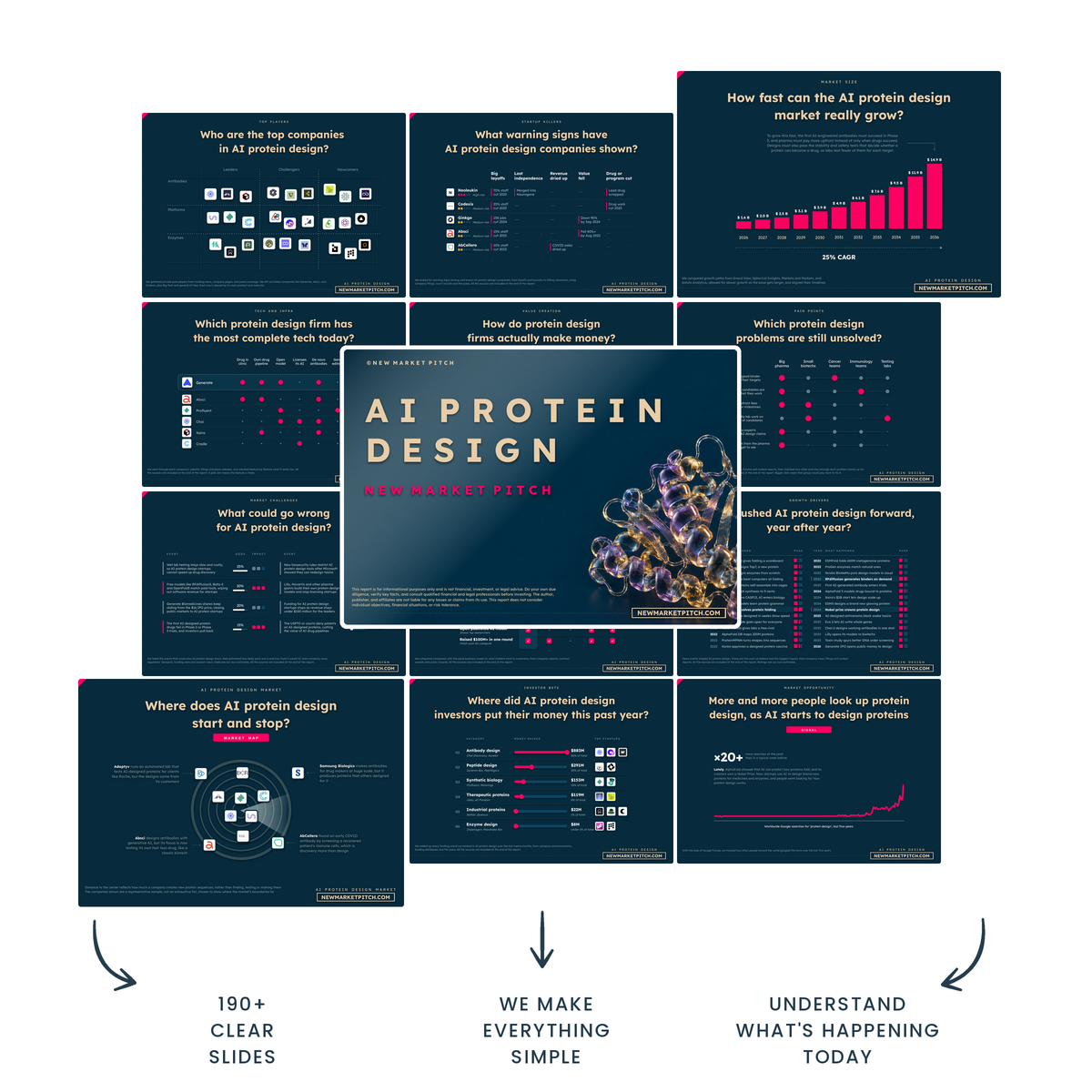
Whether you're building or investing in the AI protein design market, our report covers everything you need to know: the players, the money, and what's coming next.
Summary
Generate Biomedicines leads the AI protein design funding ranking with approximately $1.1 billion raised, followed by Xaira Therapeutics at $1 billion and AbCellera at $841 million. Chai Discovery and Absci complete the top five.
The 20 companies analyzed have raised approximately $5.67 billion in cumulative reported equity financing. The five largest account for roughly $4.16 billion, or 73% of the sample, showing how heavily investment is concentrated among a handful of businesses.
The ranking mixes private startups with publicly traded biotechnology companies. Generate's $400 million IPO, AbCellera's $200 million public offering and Absci's $100 million offering all contributed to their cumulative totals, making direct comparisons with younger private companies less straightforward.
Xaira remains an exceptional case. It assembled approximately $1 billion in financing commitments when it launched in 2024, immediately placing it among the best-funded AI biotechnology companies despite having no lengthy operating history.
Chai Discovery has delivered the fastest recent fundraising acceleration among the leading private companies. Its $400 million Series C in July 2026 brought cumulative funding to $630 million and valued the company at $3.8 billion, nearly three times its previous reported valuation.
Recent investment has been substantial across different company types. Five major financings involving Chai, AbCellera, Absci, Basecamp Research and BigHat Biosciences totaled $915 million between June and September 2026.
The most heavily funded businesses are not all selling the same product. Generate and Absci finance proprietary therapeutic development, Chai builds molecular design models for pharmaceutical researchers, while companies such as Cradle and Latent Labs offer protein engineering tools without independently funding entire drug pipelines.
Antibody-focused companies have attracted considerably more capital than industrial enzyme specialists in the selected sample. Six antibody developers represent approximately $1.86 billion in funding, compared with around $242 million across three enzyme engineering companies.
Pharmaceutical partnerships are becoming increasingly important. Eli Lilly invested $40 million directly into Absci, while Generate signed a Zealand Pharma agreement with $30 million upfront and potential milestone payments of up to $1.2 billion. Those commercial payments are separate from equity funding.
AI-designed therapeutics are already entering human testing, including Generate's Phase 3 asthma program and Absci's early clinical study of ABS-201. Generate leads in cumulative financing, Xaira stands out for its launch funding, and Chai is advancing quickly in private fundraising. Clinical results and commercial adoption will ultimately matter more than the fundraising rankings.

Written by the New Market Pitch teamWe track new markets so founders and investors can move faster. About us

In our report covering the AI protein design market, you will always find fresh funding data, taken straight from our own verified funding database.
Top startups in the AI protein design market ranked by total funding raised
Here is an updated table that ranks the top startups in the AI protein design market based on the total amount of funding they have raised to date.
The table also includes the total number of funding rounds, the date and size of the latest round, the financing type (e.g. Series A, equity financing), key investors, the startup's current status (active, IPO, acquired, or shut down), and a confidence score based on the data collected (we excluded startups with very low data confidence, to make sure everything is reliable).
If you need to dig deeper and get more detailed data, please check our report covering the AI protein design market.
The ranking focuses on cumulative equity capital raised, including IPO proceeds and subsequent public equity offerings. Debt, grants, commercial partnerships, and licensing payments are excluded. Figures marked † represent provisional or partially reconstructed funding totals. The data reflects research conducted through October 13, 2026.
| # | Startup | What They Do | Total Raised ($) | Total Rounds | Last Round Date | Last Round Amount ($) | Last Round Type | Key Investors | Current Stage | Confidence |
|---|---|---|---|---|---|---|---|---|---|---|
| 1 | Generate Biomedicines | Generative AI protein therapeutics | $1.1B† | 5 (4 quantified) | March 2026 | $400M | IPO | Flagship Pioneering, Fidelity, Amgen | IPO | Partial |
| 2 | Xaira Therapeutics | AI-driven therapeutic drug discovery | $1.0B† | 1 consolidated | April 2024 | ~$1.0B | Launch / Series A | ARCH Venture Partners, Foresite Capital, Sequoia Capital | Active | Partial |
| 3 | AbCellera | AI-powered antibody discovery and development | $841M | 4 | August 2026 | $200M | Public Equity Offering | DCVC Bio, OrbiMed, Viking Global Investors | IPO | Strong |
| 4 | Chai Discovery | AI molecular and antibody design | $630M | 4 | July 2026 | $400M | Series C | Index Ventures, Kleiner Perkins, Sequoia Capital | Active | Full |
| 5 | Absci | Generative AI biologic drug discovery | $598M† | 11 identified | June 2026 | $100M | Public Equity Offering | Eli Lilly, Adage, BVF Partners | IPO | Partial |
| 6 | Basecamp Research | Biodiversity-powered AI protein design | $220M† | 3 quantified, extensions | September 2026 | $140M | Series C | S32, NVentures, Menlo Ventures | Active | Partial |
| 7 | BigHat Biosciences | AI-designed therapeutic antibodies | $218M† | 5 | September 2026 | $75M | Series C | DFJ Growth, Premji Invest, Catalio Capital Management | Active | Partial |
| 8 | Profluent | AI-designed proteins and gene editors | $150M | 3 | November 2025 | $106M | Series B | Altimeter Capital, Bezos Expeditions, Spark Capital | Active | Strong |
| 9 | Evozyne | Generative AI protein engineering | $144M† | 3 principal | September 2023 | $81M | Series B | Fidelity, OrbiMed, NVentures | Active | Partial |
| 10 | EvolutionaryScale | Generative protein foundation models | $142M | 1 | June 2024 | $142M | Seed | Lux Capital, Nat Friedman, Daniel Gross | Acquired | Strong |
| 11 | Dyno Therapeutics | AI-engineered gene therapy delivery vectors | $109M | 2 | May 2021 | $100M | Series A | Andreessen Horowitz, Casdin Capital, GV | Active | Full |
| 12 | Nabla Bio | AI-powered antibody design | $107M† | 4 consolidated | May 2026 | $70M | Series B | Radical Ventures, Khosla Ventures, Fifty Years | Active | Partial |
| 13 | Cradle | AI-powered protein engineering software | $102M† | 3 | November 2024 | $73M | Series B | IVP, Index Ventures, Kindred Capital | Active | Partial |
| 14 | Arzeda | Computational enzyme and protein design | $91M† | 4 identified | September 2025 | $5M | Equity Offering / Series B Extension | Sofinnova Partners, 1955 Capital, Stage 1 Ventures | Active | Partial |
| 15 | LabGenius | AI-guided therapeutic antibody discovery | $73M | 4 | May 2024 | $44M | Series B | M Ventures, Octopus Ventures, LG Corp | Active | Strong |
| 16 | Latent Labs | Generative AI protein design | $50M | 2 | January 2025 | $40M | Series A | Radical Ventures, Sofinnova Partners, Flying Fish Ventures | Active | Strong |
| 17 | A-Alpha Bio | AI protein interaction engineering | $45M | 3 | July 2023 | $22M | Series A2 | Perceptive Xontogeny Ventures, Madrona, Breakout Ventures | Active | Full |
| 18 | Antiverse | AI-powered therapeutic antibody discovery | $17M† | 3 quantified | March 2026 | $9M | Series A | Soulmates Ventures, Development Bank of Wales, DOMiNO Ventures | Active | Partial |
| 19 | Biomatter | Generative AI enzyme design | $7M† | 2 | August 2024 | ~$6M fresh equity | Seed | Inventure, UVC Partners, Practica Capital | Active | Partial |

In our research about AI protein design, we turn what is vague and complex into simple, useful visuals. Market maps like this one show you at a glance where every startup stands.
Which AI protein design startups have raised the most funding?
Generate Biomedicines currently leads the AI protein design funding ranking with approximately $1.1 billion raised, followed by Xaira Therapeutics at $1 billion and AbCellera at $841 million.
Our research covers 20 companies with approximately $5.67 billion in combined reported equity financing. The five largest account for roughly $4.16 billion, or 73% of the sample. Generate and Xaira have each attracted around a billion dollars, while the tenth-ranked company, EvolutionaryScale, has raised $142 million.
The ranking also brings together different kinds of businesses. Generate develops its own medicines, Xaira combines AI research with drug development, AbCellera specializes in antibody discovery and development, and Chai Discovery builds molecular design models for pharmaceutical researchers. The companies compete for some of the same investors and scientific talent, but their funding needs vary considerably.
We updated BigHat Biosciences' total from the provisional $218 million in the original dataset to $223 million, using its September 2026 company announcement. Other figures marked with a dagger remain provisional.
| Rank | AI protein design company | Total equity raised | Status |
|---|---|---|---|
| 1 | Generate Biomedicines | ~$1.1B† | Public |
| 2 | Xaira Therapeutics | ~$1.0B† | Private |
| 3 | AbCellera | $841M | Public |
| 4 | Chai Discovery | $630M | Private |
| 5 | Absci | ~$598M† | Public |
| 6 | BigHat Biosciences | $223M | Private |
| 7 | Basecamp Research | ~$220M† | Private |
| 8 | Profluent | $150M | Private |
| 9 | Evozyne | ~$144M† | Private |
| 10 | EvolutionaryScale | $142M | Reported acquired |
Why are investors putting so much money into AI protein design now?
Investors are putting hundreds of millions into AI protein design because companies are starting to connect their models to actual drug development, and pharmaceutical companies are willing to work with them.
The technology has moved well beyond predicting the structure of an existing protein. Companies such as Chai, Generate and BigHat are using AI to design new molecules with specific properties, including how strongly they bind to biological targets, how stable they are and whether they could become useful medicines.
The funding figures show how much investors are willing to spend on that opportunity. Chai raised $400 million in July 2026, Basecamp Research secured $140 million in September, and BigHat raised $75 million the following day. Those three rounds alone represent $615 million in fresh financing.
The companies also have different ways of making money. Chai works with pharmaceutical groups that want better molecular design tools. Generate has clinical drug programs and licensing partnerships. BigHat develops its own antibodies while using automated experiments to improve its models.
An important recent example is Generate's collaboration with Zealand Pharma, announced on October 13, 2026. The agreement includes $30 million upfront and potential milestone payments of up to $1.2 billion for its initial programs, plus royalties. The milestone figure depends on future achievements, and it is commercial deal value rather than equity funding.
Investors now have clinical trials, pharmaceutical customers and large commercial agreements to examine. That is a much stronger foundation for fundraising than promising laboratory results alone, although successful investment returns are far from guaranteed.

Your time is limited. In our market report about AI protein design, we put numbers on each part of the market, so you can see where it makes sense to focus.
How much money have AI protein design startups raised altogether?
The 20 AI protein design companies in our dataset have raised approximately $5.67 billion in cumulative reported equity financing.
We calculated that amount by adding the individual company totals, including the updated $223 million figure for BigHat. The aggregate covers private funding rounds, IPO proceeds and subsequent primary public equity offerings.
The distribution is striking. The first three companies account for approximately $2.93 billion, which is nearly 52% of the sample. The next two, Chai and Absci, add another $1.23 billion. That leaves approximately $1.50 billion spread across the remaining 15 businesses.
Put differently, Generate, Xaira and AbCellera have collectively attracted nearly twice as much funding as the bottom 15 companies combined.
The $5.67 billion figure is a cumulative total across multiple years, rather than the money invested in one year. It also covers a selected group of AI protein design specialists, so we would not present it as the entire global industry's lifetime investment.
Several historical amounts are provisional, particularly where older rounds were undisclosed or financing records could not be fully reconciled. The exact total may change with further disclosures, but the concentration near the top is unmistakable.
Has Xaira Therapeutics raised more funding than Generate Biomedicines?
Generate Biomedicines has raised slightly more reported equity capital than Xaira Therapeutics, although Xaira still stands out for attracting approximately $1 billion when it launched.
Generate's cumulative financing is around $1.1 billion. The company accumulated funding over several years before completing its $400 million IPO in March 2026, following pricing in February. Its business has also progressed toward later-stage clinical development, including Phase 3 trials of GB-0895 for severe asthma.
Xaira took a very different route. The company launched in April 2024 with approximately $1 billion in committed financing from investors including ARCH Venture Partners, Foresite Capital and Sequoia Capital.
That gave Xaira a financial position comparable to much older biotechnology companies almost immediately. Its scientific ambitions drew heavily on advances in generative protein design, including research associated with the University of Washington's Institute for Protein Design.
The approximate $100 million difference between the two companies is relatively small, considering their financing histories. Generate's lead reflects years of fundraising and a public listing, while Xaira's headline figure largely comes from its unusually large launch.
We also have stronger transactional visibility into Generate's IPO than into every component of Xaira's original financing commitments. Generate leads the available ranking, but the rounded figures do not establish a precise $100 million difference in fully received capital.

In our document detailing everything you need to know about AI protein design, we always try to gather several sources and make estimates that make sense, so you can work with solid numbers.
Did Generate Biomedicines' $400 million IPO change its funding position?
Generate Biomedicines' $400 million IPO put it at the top of our AI protein design fundraising ranking and gave the company another major source of financing for its clinical programs.
According to its SEC prospectus, Generate sold 25 million shares at $16 each. The offering generated $400 million in gross proceeds and approximately $374 million before expenses after underwriting discounts.
The transaction represented roughly 36% of Generate's reported $1.1 billion cumulative equity funding. It was a major addition to the company's financing history.
Generate entered the public market with an established drug development pipeline. Its lead candidate, GB-0895, is being evaluated in two global Phase 3 studies for severe asthma, while the company is also working on other inflammatory diseases and engineered therapeutics.
The IPO also separates Generate from companies such as Chai and Xaira, which remain privately held. Generate can raise additional primary equity through the public market, although share issuance can dilute existing shareholders.
The $400 million offering establishes that Generate could attract considerable public-market capital. Its future value will depend much more heavily on clinical results and the progress of its drug programs than on the amount it raised at listing.
How did Chai Discovery raise $630 million in just two years?
Chai Discovery has become one of the fastest-funded AI protein design startups, raising approximately $630 million between its 2024 founding and July 2026.
The company started with a $30 million seed round, followed by a $70 million Series A in August 2025 and a $130 million Series B in December 2025. Its $400 million Series C in July 2026 took cumulative funding to $630 million.
That final round accounted for approximately 63% of all the capital Chai had raised. It also valued the company at $3.8 billion, compared with about $1.3 billion at its previous Series B. Its reported valuation nearly tripled in seven months.
Index Ventures led the Series C alongside Kleiner Perkins, Sequoia Capital and Dimension. Chai has also announced collaborations involving major pharmaceutical companies, including Eli Lilly, Pfizer, Novartis, argenx and Bristol Myers Squibb.
Those partnerships help explain why the financing accelerated. Chai is developing molecular design models that pharmaceutical researchers can use across different discovery programs, giving investors a business opportunity that extends beyond one drug candidate.
Among the private companies in our dataset, Chai's fundraising speed is exceptional. Xaira raised more money at launch, but Chai's progression through four financing rounds shows how quickly investors increased their commitment after the company began building its technology and pharmaceutical relationships.

Our report covering the AI protein design market gets updated several times a month, so you always get the latest view of where things stand.
Are AbCellera and Absci still attracting investors after their IPOs?
AbCellera and Absci are still raising substantial equity funding as public companies, with a combined $300 million in announced offerings during 2026.
AbCellera priced a $200 million public offering in August. According to its SEC filing, the transaction involved approximately 17.4 million common shares and pre-funded warrants covering another 3.1 million shares.
Absci completed a $100 million offering in June. Its second-quarter financial report later confirmed that Eli Lilly contributed $40 million, representing 40% of the announced financing.
The Absci transaction is particularly interesting because it combined specialist financial investors with a major pharmaceutical company making a direct equity investment. The money also arrived as Absci advanced its AI-designed ABS-201 antibody through human clinical testing.
There is a useful financial distinction in the companies' reported totals. AbCellera's $841 million and Absci's provisional $598 million include eligible primary public equity financing, whereas private companies generally accumulate funding through venture rounds.
For Absci, the extra capital was also important to its operating runway. Its second-quarter report showed approximately $201 million in cash, cash equivalents and marketable securities and a quarterly net loss of $33.2 million.
Both companies can still attract investors, but their financing needs remain substantial. Developing AI-designed medicines through clinical trials is expensive.
Which AI protein design startups raised funding most recently?
BigHat Biosciences and Basecamp Research are among the most recent major AI protein design fundraising announcements, with a combined $215 million raised in September 2026.
Basecamp secured $140 million in a Series C led by S32. Other participants included NVIDIA, Menlo Ventures' Anthology Fund, Catalio Capital Management and the NATO Innovation Fund.
A day later, BigHat announced a $75 million Series C co-led by DFJ Growth and Premji Invest. The company also confirmed that its cumulative funding had reached $223 million.
Both companies are using the new money to move closer to therapeutic development. Basecamp is advancing AI-designed medicines, including work involving cell reprogramming. BigHat is financing its clinical-stage protein therapeutics and expanding its automated biological data generation platform.
The recent financing picture is broader than these two transactions. Chai raised $400 million in July, AbCellera announced $200 million in August, and Absci completed $100 million in June.
Across these five financing events, the announced amount reaches $915 million. That calculation spans private Series C rounds and public equity offerings, so it captures major capital commitments rather than a single type of venture investment.
| Company | Financing date | Amount | Type |
|---|---|---|---|
| BigHat Biosciences | Sep 2026 | $75M | Series C |
| Basecamp Research | Sep 2026 | $140M | Series C |
| AbCellera | Aug 2026 | $200M | Public offering |
| Chai Discovery | Jul 2026 | $400M | Series C |
| Absci | Jun 2026 | $100M | Public offering |
| Nabla Bio | May 2026 | ~$70M | Series B |
| Antiverse | Mar 2026 | ~$9M | Series A |

In our research about AI protein design, we look at what the winners do differently, so you can learn from the best instead of guessing.
What are the biggest funding rounds in AI protein design history?
Xaira Therapeutics' approximately $1 billion launch financing is the largest headline financing commitment in our AI protein design dataset, followed by the $400 million transactions involving Chai Discovery and Generate Biomedicines.
Xaira's funding was announced when the company launched in April 2024. The figure is unusually large for a new biotechnology company, although the original commitment structure makes it less directly comparable with a conventional completed venture round.
Chai's $400 million Series C in July 2026 was the largest identified private growth round among the other companies in our sample. Generate's $400 million IPO had the same headline size but came from a public share offering.
Below those transactions, AbCellera raised $200 million through a public offering, EvolutionaryScale secured $142 million in seed financing, and Basecamp raised $140 million in its Series C. Profluent's $106 million Series B and Dyno Therapeutics' $100 million Series A also stand out.
The size of EvolutionaryScale's seed round deserves attention. The company raised more at that early stage than the lifetime funding recorded for businesses such as Dyno, Nabla Bio and Cradle.
There is no standard round size across AI protein design. Investors have financed some companies with tens of millions while giving others several hundred million to pursue much broader scientific or therapeutic ambitions.
Is AI protein design funding concentrated in a few startups?
AI protein design funding is heavily concentrated, with five companies attracting nearly three-quarters of the cumulative equity capital recorded in our 20-company sample.
Generate, Xaira, AbCellera, Chai and Absci together represent approximately $4.16 billion of the $5.67 billion total. Their average reported funding is about $833 million.
The remaining 15 companies have an average of roughly $100 million each. That makes the top-five average more than eight times larger than the average for everyone else.
Looking at the extremes, Generate has raised more than 160 times as much as Biomatter, while Xaira's original financing commitment is more than six times Profluent's total recorded funding.
Part of this comes from company age and business model. Publicly traded drug developers have had more opportunities to raise capital, while newer software and enzyme engineering companies often work with smaller budgets.
However, Xaira and Chai show that investors sometimes commit enormous amounts before a company has spent a decade building its business.
A small group now operates with research budgets far beyond those available to most AI protein engineering specialists. Whether they use that advantage effectively is another question.

In our market report about AI protein design, we don't want to repeat what boring consulting reports say. Instead, we show you the real and latest market signals that matter.
Who are the biggest investors in AI protein design startups?
Flagship Pioneering, ARCH Venture Partners, Foresite Capital, Index Ventures and Sequoia Capital are among the most prominent investors behind the largest AI protein design companies.
Flagship is closely associated with Generate Biomedicines, while ARCH and Foresite helped establish Xaira. Index Ventures has backed Chai Discovery and Cradle, and Sequoia appears among the investors in both Xaira and Chai.
There are also investors connecting the newer model-building companies. Radical Ventures participated in financing for Nabla Bio and Latent Labs. NVentures has backed Basecamp Research and Evozyne. Andreessen Horowitz has supported businesses including Dyno Therapeutics and BigHat.
The investor base spans traditional biotechnology funds backing drug pipelines and technology-focused firms financing molecular models, automated laboratories and software platforms.
Pharmaceutical companies are also participating directly. Eli Lilly's $40 million investment in Absci is a particularly concrete example because the company disclosed the amount in its financial reporting.
We cannot reliably rank every investor by dollars committed. The public announcements usually identify syndicate participants and lead investors, without disclosing how much each participant contributed.
What we can establish is that AI protein design now attracts investors from venture technology, specialist life sciences and large pharmaceutical companies.
Are pharmaceutical companies investing in AI protein design startups?
Pharmaceutical companies are increasingly involved in AI protein design through direct investments and commercial partnerships, with Eli Lilly providing some of the clearest examples.
Lilly invested $40 million in Absci's June 2026 public offering, according to Absci's quarterly financial report. It has also worked with BigHat Biosciences on machine-learning-enabled antibody discovery and is among the pharmaceutical groups collaborating with Chai Discovery.
Other partnerships show how widely the technology is being tested. Chai has announced collaborations with Novartis, argenx and Bristol Myers Squibb, while Dyno Therapeutics has worked with companies including Roche, Novartis and Astellas on gene delivery.
Generate's recent agreement with Zealand Pharma adds another application: AI-engineered protein therapeutics for metabolic diseases. The deal carries a $30 million upfront payment and potentially much larger milestone and royalty payments.
These agreements demonstrate genuine interest from pharmaceutical companies that already develop and sell medicines.
However, the commercial amounts should remain separate from equity financing. A $1 billion potential licensing deal can include payments that will only become due after years of technical, clinical or commercial progress.
For investors, pharmaceutical partnerships provide useful evidence of demand. The harder test will be how much money is actually paid, what research succeeds, and which medicines eventually reach patients.

Learning from others' mistakes is the cheapest lesson there is. In our document detailing everything you need to know about AI protein design, we look at what broke startups before you, so you don't repeat it.
Are AI-designed proteins actually making it into clinical trials?
AI-designed protein therapeutics have already reached human clinical trials, with Generate Biomedicines and Absci providing two of the clearest examples.
Generate's GB-0895 is being evaluated in two global Phase 3 trials for severe asthma. The antibody targets TSLP and has been engineered for an extended half-life, with twice-yearly subcutaneous dosing under investigation.
Absci began dosing participants in its Phase 1/2a HEADLINE study of ABS-201 in December 2025. In June 2026, the company reported interim safety and pharmacokinetic data from the first 32 healthy volunteers across four single-ascending-dose cohorts.
The reported findings suggested that ABS-201 was generally well tolerated in the blinded early cohorts, with an estimated half-life of at least 65 days. Those results support continued investigation, although clinical effectiveness in pattern hair loss still needs to be demonstrated.
BigHat is also advancing AI-designed therapeutics into clinical development, supported by its latest $75 million financing.
The distinction between laboratory success and clinical success remains important here. A protein can look excellent in computational tests and still fail because of safety, efficacy or manufacturing problems.
Even so, the presence of Phase 1 and Phase 3 programs shows that AI protein design is already contributing to real human drug development. The next meaningful evidence will come from larger controlled trials and regulatory decisions.
Why are AI protein foundation models attracting so much funding?
AI protein foundation models are attracting large investments because a single model could help scientists design many different molecules, potentially serving numerous pharmaceutical and biotechnology customers.
Chai Discovery is a leading example. Its $630 million total funding supports AI models intended to design molecular structures and interactions, including antibodies against difficult drug targets.
EvolutionaryScale raised $142 million in seed financing in June 2024 to develop large-scale protein models. Its work builds on the ESM research direction, which uses patterns learned from protein sequences to understand and generate biological structures.
Profluent has raised approximately $150 million to design proteins and gene-editing tools, while Basecamp uses biological sequence data gathered from nature to train models for therapeutic design.
The attraction is that these systems may become useful across many research projects. A model that consistently helps create better proteins could be used repeatedly instead of requiring researchers to develop a completely new discovery method for every target.
But biology puts unusually demanding requirements on these models. Generating a promising protein sequence is only the beginning. Researchers still need to confirm its behavior experimentally and establish whether the resulting molecule can be developed safely and economically.
The big unanswered commercial question is which models deliver repeatable improvements that customers will pay for. Comparable revenue, adoption and experimental success data remain limited.

If you build or invest in the AI protein design market, you need to know which business models pay off now and which ones are fading. That's why our report covering it has a whole section on it.
Are AI antibody design startups attracting more money than enzyme design companies?
AI antibody design companies have attracted far more reported equity funding than enzyme engineering specialists in our sample, largely because some antibody developers are also building their own drug pipelines.
AbCellera, Absci and BigHat together have approximately $1.66 billion in recorded funding. Adding Nabla Bio, LabGenius and Antiverse takes this selected antibody-focused group to roughly $1.86 billion.
For comparison, Evozyne, Arzeda and Biomatter collectively represent approximately $242 million. The antibody-focused group has therefore raised about 7.7 times as much as these three enzyme engineering companies.
The comparison is not perfectly exclusive. AbCellera and Absci run broader biologics discovery operations, and some other businesses in the dataset work across several protein types.
Still, there is a recognizable funding difference. Therapeutic antibodies benefit from established pharmaceutical development pathways and can potentially generate large returns if a proprietary medicine reaches the market.
Industrial enzymes have applications in manufacturing, chemicals, diagnostics, agriculture and sustainability. Businesses such as Arzeda and Biomatter may earn money from engineering services, partnerships or commercially useful enzymes rather than pursuing expensive late-stage drug trials.
That changes how much equity capital a company needs. Antibody developers financing clinical trials may require hundreds of millions, while an industrial enzyme company can pursue a different scale of business with substantially less investment.
How much funding have AI gene-editing startups like Profluent and Dyno raised?
Profluent has raised approximately $150 million and Dyno Therapeutics about $109 million, making both important funded specialists in AI-enabled gene editing and gene delivery.
Profluent's latest major round was a $106 million Series B in November 2025, involving investors including Altimeter Capital, Bezos Expeditions and Spark Capital. The financing represented more than 70% of its recorded cumulative funding.
Profluent uses AI to design proteins, including systems that can edit genetic material. Its research could contribute to the development of new tools for genetic medicine.
Dyno focuses on delivery. In May 2021, the company raised a $100 million Series A led by Andreessen Horowitz, with participants including Casdin Capital, GV and Lux Capital.
Dyno's technology uses AI to engineer adeno-associated virus capsids, which can influence how gene therapies are delivered to particular tissues.
These businesses address different stages of genetic medicine. A gene-editing tool needs to perform the intended molecular operation, while a delivery system needs to bring therapeutic material to the right cells.
The combined $259 million in reported funding reflects investor support for both problems. Their future commercial performance will depend on whether these technologies improve the safety, efficiency and practicality of actual treatments.

In our research about AI protein design, we like to show you the big picture. We know your time is precious, so we make every page quick to read and packed with as much learning as possible per minute.
Can AI protein design software startups compete with billion-dollar biotech companies?
AI protein design software companies such as Cradle and Latent Labs can compete commercially without raising anything close to a billion dollars, because they sell tools rather than financing every stage of drug development themselves.
Cradle raised a $73 million Series B in November 2024, taking its cumulative funding above $100 million. The company offers software that helps researchers design and improve proteins using machine learning and experimental feedback.
Its approach allows biotechnology and industrial customers to retain ownership of the proteins they develop. That differs from companies that finance proprietary therapeutic programs and hope to earn revenue from successful medicines.
Latent Labs has raised $50 million and is building protein design models and tools for pharmaceutical and biotechnology users. Its investors include Radical Ventures and Sofinnova Partners, alongside technology leaders such as Jeff Dean and Dario Amodei.
The financial gap is substantial. Generate has raised approximately eleven times Cradle's reported funding and 22 times Latent Labs' total.
Yet the software companies have different operating requirements. They can focus on model development, customer adoption and recurring commercial relationships without independently paying for every clinical trial associated with molecules designed using their products.
The question is whether customers will continue paying for these tools as competing models improve. Cradle and Latent Labs have promising business models, but publicly available revenue and retention data are not yet sufficient to say which one is winning.
Which countries have the best-funded AI protein design startups?
The United States dominates the top of our AI protein design funding ranking, while Canada and the United Kingdom also have companies that have attracted substantial investment.
Generate, Xaira, Chai, Absci, BigHat, Profluent and Dyno are headquartered in the United States. These businesses cover therapeutic development, antibody engineering, foundation models and gene delivery.
Canada is represented by AbCellera, headquartered in Vancouver, with $841 million in recorded equity funding. That makes AbCellera one of the largest companies in the entire sample, regardless of geography.
The United Kingdom has a strong cluster of younger specialists. Basecamp Research has approximately $220 million, LabGenius $73 million and Latent Labs $50 million. Antiverse also operates in the UK, focusing on antibody discovery.
Continental Europe includes Cradle, based in the Netherlands, and Biomatter, headquartered in Lithuania.
The geographical pattern resembles the broader biotechnology industry in one important respect: American investment networks and pharmaceutical research ecosystems remain very influential. However, European companies are also raising meaningful amounts, particularly for protein engineering software and specialized discovery technologies.
Our dataset cannot establish the total funding raised in every country. It does show that the largest individual fundraising totals are heavily concentrated in North America.

When you build or invest in the AI protein design market, you need clarity, not confusion. In our market report about AI protein design, we always try to put numbers on and quantify whatever is usually vague and confusing.
Does raising more money make an AI protein design startup more valuable?
An AI protein design startup's funding total tells us how much capital investors have supplied, while its valuation reflects what they are willing to pay for ownership. Chai Discovery is a particularly useful example of the difference.
Chai raised $400 million in July 2026 at a reported valuation of $3.8 billion. Its cumulative funding reached approximately $630 million, meaning its valuation was around six times its total capital raised.
The financing also marked a sharp increase from its previous $1.3 billion valuation in December 2025. Chai's reported value grew approximately 192% in seven months.
Xaira presents another example. The company launched with around $1 billion in committed funding, but that amount alone does not tell us the value investors assigned to the whole business. Financing commitments, post-money valuations and the amount actually received need to be distinguished.
Generate's IPO provides a public-market example. Its shares were initially sold at $16, but its valuation after listing changes with its share price and outstanding share count.
For AI protein design businesses, investors ultimately need to assess the potential returns from drug candidates, intellectual property, research partnerships and technology platforms.
Chai's rapid valuation increase shows how strongly investors can reprice a promising company. It does not establish that Chai is more commercially successful than every competitor with a lower valuation or more cumulative funding.
Are AI protein design startups making money yet?
Some AI protein design companies already earn revenue from research partnerships, software and licensing, but the leading therapeutic developers are still spending heavily on research and clinical trials.
Absci offers a useful public example. Its second-quarter 2026 report showed approximately $0.3 million in quarterly revenue, compared with a $33.2 million net loss. Research and development expenses alone reached $22.6 million.
The company is therefore still primarily financed by equity capital rather than by revenue from approved therapeutic products. Its $100 million public offering helped extend the resources available to develop ABS-201.
Other companies have different revenue opportunities. Cradle sells protein engineering software, Dyno works with pharmaceutical partners on gene delivery, and Chai develops molecular design collaborations with established drugmakers.
Generate's Zealand Pharma agreement also shows the potential scale of licensing economics. However, its $30 million upfront payment and possible future milestones should not be confused with recurring product sales or realized lifetime revenue.
We cannot calculate a meaningful industry-wide profitability rate because comparable financial statements are unavailable for most privately held companies in the sample.
Fundraising remains crucial for the drug development side of AI protein design. Even companies with valuable discovery technologies may need years of investment before their proprietary medicines generate commercial sales.

A good product starts with a real problem. In our document detailing everything you need to know about AI protein design, we show you the ones customers still live with.
Who is actually winning the AI protein design funding race right now?
Generate Biomedicines currently leads AI protein design by cumulative reported equity funding, but Chai Discovery has shown the fastest recent private fundraising acceleration among the companies we analyzed.
Generate's approximately $1.1 billion total puts it ahead of Xaira and AbCellera. Its public listing and Phase 3 clinical programs also make it one of the more mature therapeutic developers in the group.
Xaira remains extraordinary for assembling approximately $1 billion in launch financing. No other company in the sample has matched that scale of headline initial commitment.
Chai stands out for a different reason. It progressed from its $30 million seed round to $630 million in cumulative funding within roughly two years, while reaching a $3.8 billion reported valuation and announcing collaborations with major pharmaceutical companies.
AbCellera and Absci deserve attention for continuing to secure public equity capital, while Basecamp and BigHat have recently added large private rounds to finance their next stages of development.
Across our 20-company sample, around 73% of reported capital sits with the five most-funded businesses. That concentration gives the leaders far greater financial resources than most of their competitors.
Our judgment is that Generate wins the cumulative funding ranking, Xaira holds the most remarkable launch financing, and Chai is the clearest example of rapid private-market fundraising growth.
The wider AI protein design market is well funded, with clinical-stage programs and major pharmaceutical partnerships supporting the investment case. But the ultimate winners will be determined by validated drugs, useful technology, repeat customers and financial returns. Fundraising has established the leading contenders, not settled the competition.
Our methodology
This analysis reconstructs cumulative equity funding across 20 companies in the AI protein design market, using financing information available through October 13, 2026. The selected businesses focus substantially on AI-driven protein design, protein engineering, antibody discovery, molecular foundation models or closely related therapeutic applications.
We reviewed financing histories round by round, starting with recent company announcements and tracing earlier investments. For each business, we examined funding dates, amounts, round classifications, investor participation and corporate status. We then aggregated identifiable transactions to calculate cumulative funding and rank companies using the underlying amounts before rounding.
Our equity totals include private venture rounds, IPO proceeds and subsequent primary public share offerings. We exclude debt, grants, acquisition consideration, secondary share sales, licensing revenue and commercial partnership payments. We also distinguish announced financing packages from independently identifiable equity proceeds and check round extensions against earlier transactions to avoid double counting.
We used four confidence categories for individual company histories: Full, Strong, Partial and Low. Full and Strong indicate relatively complete or well-reconciled financing records, while Partial and Low identify greater uncertainty around historical amounts, round classifications or transaction completeness. Provisional totals are marked with a dagger where appropriate. Publicly listed companies remain in the ranking because their cumulative primary equity financing is directly relevant to the comparison.
We compared company-reported cumulative funding with our reconstructed figures wherever possible. For example, BigHat Biosciences reported $223 million in total financing in September 2026, compared with approximately $218.3 million identifiable across its principal rounds. We use the company's updated cumulative disclosure in the article while preserving the distinction in the underlying analysis. Xaira's launch commitment and Absci's convertible financing were also reviewed separately to avoid treating fundamentally different financing structures as interchangeable.
Our source hierarchy prioritizes regulatory filings, official company disclosures, investor announcements and first-hand financing documentation, supplemented by reputable financial reporting and specialist funding databases. Key references include Generate Biomedicines' SEC IPO prospectus, Generate's IPO announcement, Xaira's launch financing disclosure, Chai Discovery's company announcements, AbCellera's SEC offering disclosure, Absci's second-quarter 2026 financial results, BigHat's Series C announcement, Basecamp Research's Series C announcement, and Generate's Zealand Pharma collaboration disclosure.
The resulting figures measure historical primary equity financing across the selected companies, rather than annual investment activity, market valuation or the total capital deployed across the global AI protein design industry. Our comparison emphasizes traceable funding transactions and consistent financing definitions, while retaining the context needed to interpret differences between private platform developers, clinical biotechnology companies and publicly traded businesses.

In our report covering the AI protein design market, we try to remove everything that could confuse you, especially if you're investing or building in this market.
Written by the New Market Pitch teamWe track new markets so founders and investors can move faster. About us