Is the AI recruiting market big in a hiring slowdown?
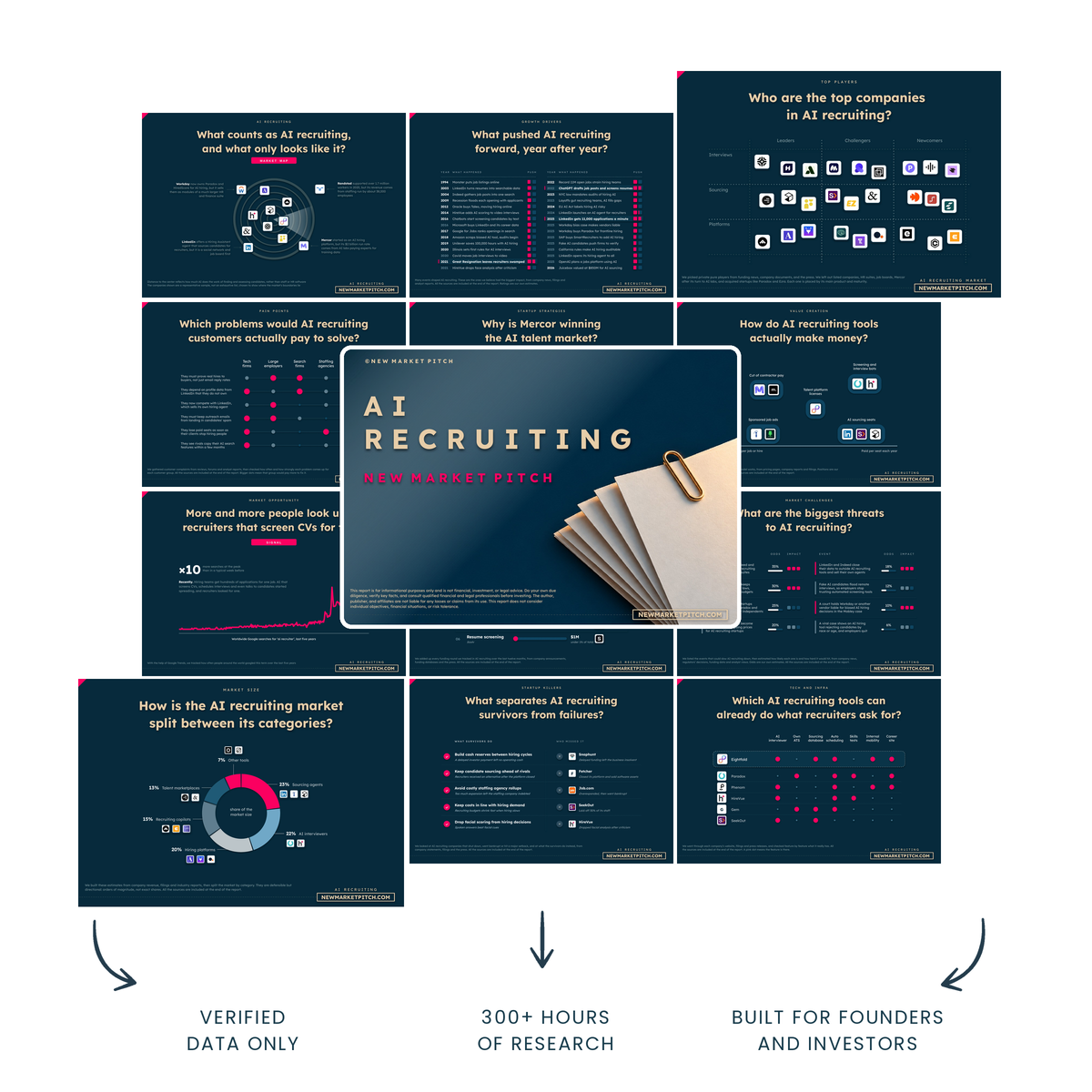
Whether you're building or investing in the AI recruiting market, our report covers everything you need to know: the players, the money, and what's coming next.
Summary
Yes, the AI recruiting market is already a substantial business despite the hiring slowdown, with more than $450 million in annualized revenue from LinkedIn's agentic hiring products alone. The broader market is larger, although AI-specific revenue remains difficult to isolate from established recruiting platforms.
Weak hiring is changing what employers want from recruiting software. Companies are less willing to pay for additional candidates, but increasingly interested in tools that help smaller recruiting teams manage the applications they already receive.
The workload has changed dramatically. Greenhouse found that applications per vacancy rose from 116 in 2022 to 244 in 2025, while average recruiter headcount per organization fell 56%. Fewer recruiters are handling much larger candidate pools.
AI adoption is accelerating even as hiring stagnates. SHRM found that 43% of organizations used AI in HR in 2025, up from 26% a year earlier, with recruiting the most common application. But much of that activity involves general-purpose or bundled tools rather than separately purchased AI recruiting software.
The financial benefits are real but uneven. Among HR professionals using AI for recruiting, 89% reported efficiency improvements, while only 36% reported lower hiring costs. Vendors that can demonstrate actual budget savings have a stronger proposition than those selling theoretical productivity gains.
Indeed illustrates how recruitment technology can grow without a hiring recovery. Recruit Holdings generated $9.67 billion in FY2025 HR Technology revenue, with Indeed's average revenue per job posting increasing 17%. Better monetization can compensate for weak hiring volumes.
Enterprise software companies are paying heavily for recruiting capabilities. Workday acquired Paradox for approximately $1.1 billion, while SAP paid €753 million for SmartRecruiters. Together, these transactions represent roughly $2 billion in strategic acquisition spending.
LinkedIn, Workday and SAP are becoming increasingly difficult competitors for independent AI recruiting startups. They already own candidate networks, enterprise customer relationships or recruiting workflows, making basic AI features much harder to sell as standalone subscriptions.
Recruiting automation is improving individual productivity without necessarily shortening recruitment cycles. Greenhouse reported a 122% increase in monthly hires per recruiter between 2022 and 2025, even as average time to fill a position increased approximately 37%. Faster administration does not automatically mean faster hiring decisions.
The clearest opportunities are in frontline hiring, candidate communication, scheduling, internal mobility and specialized assessment. AI recruiting can support more valuable companies, but the winners will need to own difficult workflows, prove measurable savings and survive competition from increasingly capable incumbent platforms.

Written by the New Market Pitch teamWe track new markets so founders and investors can move faster. About us
Is the hiring slowdown actually hurting the AI recruiting market?
The hiring slowdown is hurting recruitment advertising and staffing businesses, but demand for AI recruiting software is holding up much better because employers still have a lot of candidates to process.
The US Bureau of Labor Statistics reported 7.1 million job openings and 5.2 million hires in August 2026. September brought just 29,000 additional payroll jobs, with unemployment at 4.2%. Employers are still hiring, but the pace is weak.
LinkedIn's 2026 Future of Talent report puts the global slowdown into perspective. Hiring remained approximately 30% below pre-pandemic levels, while applications per applicant were 30% higher. Companies have fewer openings, yet jobseekers are applying more frequently.
That creates very different conditions for recruiting businesses. Indeed and LinkedIn still depend partly on employers paying to advertise or fill vacancies. AI tools that screen applications, schedule interviews and answer candidate questions depend more on how much administrative work recruiters have to handle.
Employers may cut spending on attracting candidates while increasing spending on managing those already applying. That's why recruiting technology can continue growing during a hiring slump.
How big is the AI recruiting market today?
The AI recruiting market already generates hundreds of millions of dollars in identifiable annualized product revenue, but there is still no reliable public figure for the entire industry's AI-specific sales.
LinkedIn provided one of the clearest commercial disclosures in April 2026, when it announced that its agentic hiring products had surpassed a $450 million annual revenue run rate. That is a substantial amount for AI-enabled recruiting products, although an annualized run rate should not be confused with revenue already earned over a full year.
The broader recruitment technology industry is much larger. Recruit Holdings, which owns Indeed and Glassdoor, reported $9.67 billion in HR Technology revenue for the fiscal year ending March 2026. But most of that business belongs to the wider employment marketplace, including job advertising, matching and recruitment services.
Workday, SAP, Greenhouse and other established vendors also sell recruiting software with AI functionality. Their AI-related revenue generally isn't disclosed separately.
We therefore have a confirmed commercial floor in the hundreds of millions from LinkedIn alone, alongside a much larger pool of recruitment technology spending that AI is gradually changing. The true total is higher than that identifiable floor, but the available disclosures do not support a precise global market estimate.
Counting all AI-enabled recruitment software as a separate AI market would produce a misleadingly large number.
| Company or product | Public commercial evidence | What the figure tells us |
|---|---|---|
| LinkedIn agentic hiring | Over $450M annual revenue run rate | Direct evidence of AI product monetization |
| Recruit Holdings HR Technology | $9.67B FY2025 revenue | Broader recruitment marketplace revenue |
| SmartRecruiters | €26M reported contribution to SAP in 2025, plus €61M additional pro forma revenue | Revenue reference for an acquired recruiting platform |
| Workday Paradox | Approximately $1.1B acquisition consideration | Strategic acquisition value |
| SAP SmartRecruiters | €753M acquisition consideration | Strategic acquisition value |
| Workday Recruiting | AI revenue undisclosed | Established enterprise recruiting software |
| Greenhouse | AI revenue undisclosed | Recruiting platform with AI capabilities |
| HireVue | AI revenue undisclosed | Interview and assessment technology |
If you want more recent data on this point, please see our latest AI recruiting market report.

Your time is limited. In our report covering the AI recruiting market, we put numbers on each part of the market, so you can see where it makes sense to focus.
Are companies really using more AI while cutting recruiting teams?
Yes. Recruiting teams have become much smaller while AI adoption in HR has increased sharply, although the evidence doesn't show how much of the headcount reduction AI directly caused.
Greenhouse's March 2026 benchmark report analyzed more than 640 million applications across over 6,000 companies. Average recruiter headcount per organization fell from 10.43 in 2022 to 4.62 in 2025, a reduction of approximately 56%.
Meanwhile, SHRM's 2025 Talent Trends survey found that 43% of organizations used AI for HR activities, compared with 26% in 2024. Recruiting was the most common area for AI adoption.
Companies were reducing recruiting teams during the same period that AI tools became easier to access and more widely used.
However, layoffs, hiring freezes and changes in recruitment demand also contributed to smaller teams. We cannot conclude that AI replaced 56% of recruiters.
What we can establish is that recruiters are expected to handle substantially more work individually, and companies increasingly have tools available to help them do it. For AI vendors, that's a stronger commercial argument than promising employers they can hire even more people.
Has AI made the application overload much worse?
AI-assisted job applications are adding pressure to an already overloaded recruitment process, although the increase in applications began before today's wave of recruiting agents.
Greenhouse found that average applications per vacancy rose from 116 in 2022 to 244 in 2025, an increase of 111%. Annual applications handled per recruiter climbed even faster, from 1,610 to 4,890.
The year-by-year pattern is worth examining. Applications per vacancy increased by 63% between 2022 and 2023, then 18% in 2024 and 9% in 2025. The problem has kept growing, but the rate of increase has slowed considerably.
Application overload was already a serious recruiting problem before autonomous job application agents became widely available.
AI has nevertheless made it easier for candidates to generate tailored resumes, prepare applications and apply repeatedly. Employers then need more effective ways to identify relevant candidates, detect suspicious information and prioritize whom to interview.
An illustrative employer receiving 244 applications for each of 100 vacancies would process 24,400 submissions. At Greenhouse's 2022 benchmark, the same number of positions would have attracted 11,600 applications.
That's more than twice as many submissions for the same number of jobs. No wonder automated screening and candidate management remain attractive even when companies are filling fewer positions.

In our research about AI recruiting tools, we always try to gather several sources and make estimates that make sense, so you can work with solid numbers.
Does AI recruiting actually save companies enough money?
AI recruiting can justify meaningful software budgets through labor savings, but vendors have a stronger case when they can show costs avoided rather than just hours theoretically saved.
SHRM's 2025 research found that 89% of HR professionals using AI for recruiting reported time savings or increased efficiency. Only 36% reported lower recruitment, interviewing or hiring costs.
That's quite a gap. Employers frequently see productivity gains, but those gains do not always become measurable financial savings.
We can illustrate the economics using a recruiting team that processes 24,400 applications annually. Saving three minutes of manual work per application would release 1,220 hours. At an illustrative fully loaded labor cost of $50 per hour, that represents $61,000 in labor capacity.
If the company spends $30,000 annually on recruiting automation, the purchase can make economic sense. But the benefit depends on whether saved time replaces paid labor, avoids additional hiring or improves valuable work elsewhere.
The most attractive vendors can demonstrate these effects through actual customer results. Reducing scheduling workloads, shortening application handling time and eliminating repeated administrative tasks offers a more measurable proposition than promising generally better recruiting decisions.
If you want more recent data on this point, please see our latest AI recruiting market report.
Which AI recruiting tools are worth buying during a hiring freeze?
AI recruiting tools that reduce repetitive work have the clearest value during a hiring freeze, while products focused on generating more candidates face a tougher market.
An employer receiving hundreds of applications per vacancy may have little reason to purchase software that attracts even more applicants. The same employer could benefit immediately from automating interview scheduling, answering candidate questions or searching its existing applicant database.
Paradox built its business around conversational recruiting and high-volume hiring workflows, particularly for frontline workers. HiredScore developed AI-powered candidate matching and talent management capabilities. LinkedIn's Hiring Assistant focuses on identifying candidates and supporting recruiter workflows.
These products tackle different problems, but employers can use all three to improve the efficiency of hiring operations.
The exposure varies across recruiting categories. Job advertising is closely connected to vacancies, while screening and communication costs depend on application volume. Internal talent rediscovery can even become more attractive when companies prefer filling vacancies with existing employees.
| AI recruiting category | Why employers pay | Exposure to hiring slowdown |
|---|---|---|
| Interview scheduling | Reduce coordination work | Low to medium |
| Candidate communication | Handle questions and follow-ups | Low to medium |
| Resume screening assistance | Process application backlogs | Medium |
| Talent rediscovery | Reuse existing candidate databases | Low to medium |
| Internal mobility matching | Fill roles with existing employees | Low |
| Skills assessment | Evaluate candidates more consistently | Medium |
| Candidate sourcing | Find people for open positions | Medium to high |
| Job advertising optimization | Improve paid recruitment campaigns | High |
| Frontline hiring agents | Process large numbers of applicants | Medium to high |
These exposure levels are our assessment of the underlying business models rather than measured historical revenue sensitivities.

In our market report about AI recruiting tools, we don't want to repeat what boring consulting reports say. Instead, we show you the real and latest market signals that matter.
Is AI recruiting adoption growing faster than hiring?
AI recruiting adoption is growing much faster than hiring activity, but using AI and paying for specialized AI recruiting software are two different things.
SHRM's 2025 survey of 2,040 US HR professionals found that AI adoption across HR increased by 17 percentage points in one year, reaching 43%. Among organizations using AI for recruitment, 66% used it to write job descriptions, 44% to screen resumes, 32% to automate candidate searches and 29% to communicate with applicants.
LinkedIn's January 2026 research also found that 93% of surveyed recruiters planned to increase AI usage, with 66% intending to expand AI use in prescreening interviews.
The difference between these activities is important for market sizing.
A recruiter using ChatGPT to rewrite a job description may contribute to an AI adoption statistic without generating any revenue for a specialized recruiting company. An employer paying for an automated hiring agent creates identifiable software spending.
That leaves AI recruiting vendors with a substantial conversion opportunity. Many organizations have already tried the technology, but the challenge is persuading them to buy dedicated products instead of relying on functionality included in their existing systems.
Broad adoption is well established. How much additional software spending those users will generate remains much less certain.
Are Indeed and LinkedIn still growing despite weak hiring?
Indeed and LinkedIn show that recruitment technology companies can increase revenue during weak hiring conditions, particularly when they capture more value from each customer.
Recruit Holdings reported that its HR Technology revenue grew 7.6% in US dollars during FY2025, reaching $9.67 billion.
The US business grew 8.8% despite stagnant hiring demand. A particularly revealing figure was Indeed's 17% increase in average revenue per job posting.
Indeed earned more money per posting even though employers were not broadly increasing hiring activity. Improved monetization helped compensate for the weak market.
LinkedIn reported 12% year-over-year revenue growth in Microsoft's third fiscal quarter of 2026. Its AI hiring products were already generating a substantial annualized revenue run rate.
Neither company's total growth can be attributed entirely to AI. Indeed's pricing and marketplace monetization changes are important in their own right, while LinkedIn operates several revenue-generating businesses.
Still, the financial results challenge the idea that recruitment software revenue must decline whenever hiring slows. Companies can grow by improving matching, adding valuable products and charging more for existing recruitment services.
Recruit has also projected 11% growth in HR Technology revenue for FY2026, with expected segment revenue of $10.74 billion. Management expects continued monetization gains before a major rebound in employment demand.
If you want more recent data on this point, please see our latest AI recruiting market report.

In our document detailing everything you need to know about AI recruiting, we like to show you the big picture. We know your time is precious, so we make every page quick to read and packed with as much learning as possible per minute.
Are AI recruiting startups attracting real money?
AI recruiting startups have attracted substantial acquisition spending from enterprise software companies, and the two largest recent disclosed transactions alone add up to roughly $2 billion.
Workday completed its acquisition of Paradox in October 2025, with approximately $1.1 billion in acquisition consideration disclosed in its regulatory filing. Paradox specializes in conversational AI for candidate engagement and high-volume recruiting.
SAP acquired SmartRecruiters in September 2025 for €753 million, or approximately $878 million. SAP's financial statements reported €26 million in revenue contribution after consolidation and estimated a further €61 million in pro forma revenue had the acquisition been consolidated from the start of 2025.
Those figures are particularly useful because they provide a revenue reference alongside a large transaction value.
The two acquisitions followed Workday's purchase of HiredScore in 2024. Taken together, they show a repeated preference among major HR software vendors for buying established recruiting technology rather than building every capability internally.
However, buyers were acquiring complete recruitment products, customer relationships and workflow integrations, rather than isolated language-model features.
We should distinguish the commercial success of established recruiting platforms from the prospects of newly created AI wrappers. Both may describe themselves as AI recruiting companies, but their customer relationships and revenue potential can be very different.
The acquisition market demonstrates that recruitment technology remains strategically valuable. It doesn't establish that AI-specific startups collectively generate billions in annual recurring revenue.
Is LinkedIn already taking over AI recruiting?
LinkedIn is one of the strongest commercial players in AI recruiting today, especially for professional hiring, and its latest product expansion makes that position harder for startups to challenge.
In September 2026, LinkedIn introduced Hiring Assistant 2, an upgraded recruiting agent with stronger reasoning, memory and personalization. The product is designed to identify qualified candidates, provide richer hiring context and manage talent pools within LinkedIn's existing recruitment environment.
This follows the earlier commercial success of its agentic hiring products and gives LinkedIn a considerable distribution advantage.
The company's professional network exceeds 1.3 billion members. Recruiters already using LinkedIn can access AI functionality alongside candidate profiles, sourcing tools and established workflows. Competing startups must often persuade employers to introduce another vendor into the process.
However, LinkedIn's position is strongest where its professional data and recruiting relationships matter most.
Indeed has a different advantage in active job search and employer job postings. Paradox has developed capabilities around frontline recruiting, while applicant tracking platforms such as Greenhouse control later stages of candidate evaluation and interview management.
LinkedIn is therefore well positioned to become a leading AI recruiting platform, especially in professional sourcing. Its position is less decisive in specialized assessments, internal enterprise workflows and high-volume frontline hiring.
The competitive question is increasingly whether independent AI recruiting products can offer enough additional value to justify another subscription alongside LinkedIn's expanding capabilities.

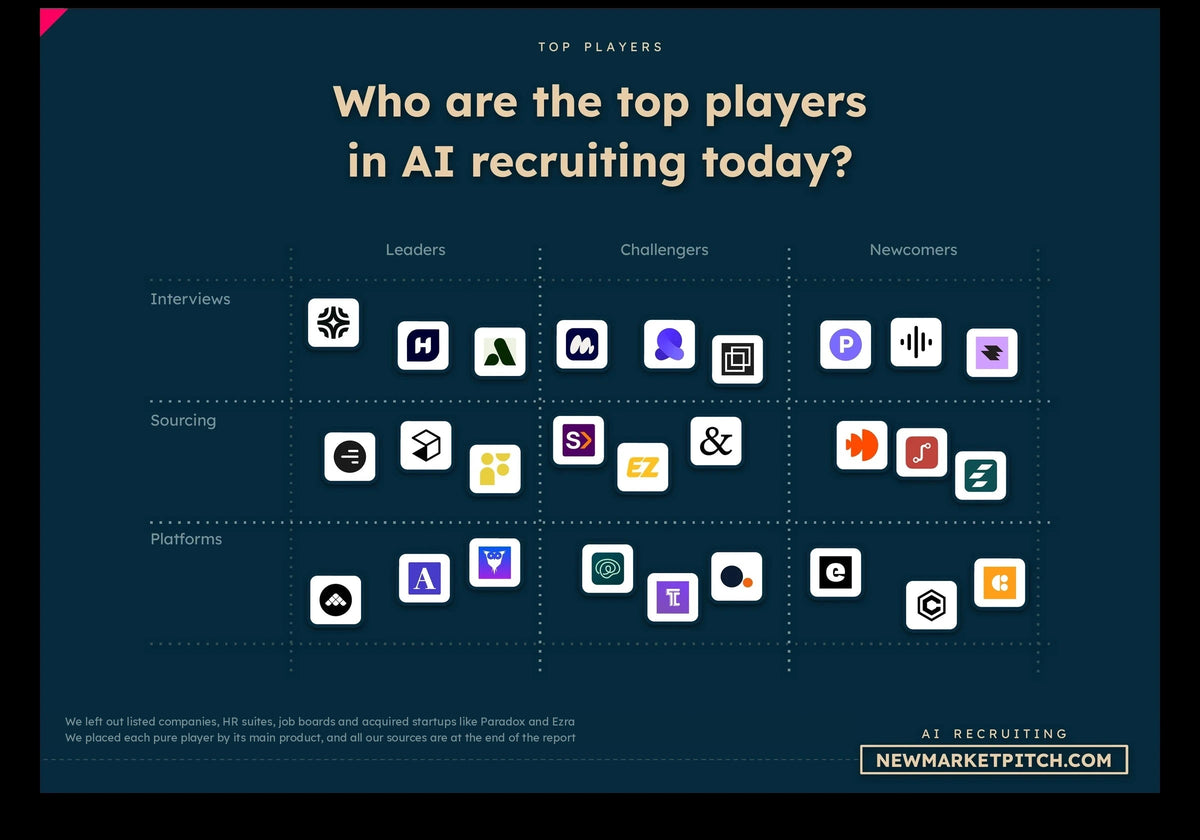
In our report covering the AI recruiting market, we turn what is vague and complex into simple, useful visuals. Market maps like this one show you at a glance where every startup stands.
Will Workday and SAP make AI recruiting startups irrelevant?
Workday and SAP are making life harder for generic AI recruiting startups because they can integrate similar features into enterprise systems that customers already use.
Workday now combines its established Recruiting product with capabilities acquired through HiredScore and Paradox. SAP is incorporating SmartRecruiters into the SuccessFactors ecosystem.
For enterprise customers, the appeal is straightforward. A company already running Workday or SAP may prefer adding a recruiting feature inside the same environment rather than introducing a separate tool that needs new integrations, approvals and data-management arrangements.
This creates particular pressure on startups selling basic resume summaries, job-description generation and routine candidate messages. Those functions are relatively easy for large platforms to incorporate.
More specialized software has a better chance.
Frontline recruiting across hundreds of restaurants, warehouses or retail locations has different requirements from professional candidate sourcing. Complex scheduling, location-specific workflows and integrations with existing HR systems can create meaningful barriers to replacement.
Assessment products also face different technical and regulatory requirements from simple text-generation tools.
We expect many basic AI recruiting features to become standard parts of broader HR software. Independent vendors will need deeper expertise in specific recruiting problems, stronger customer relationships or demonstrably better results.
If you want more recent data on this point, please see our latest AI recruiting market report.
Is AI recruiting actually making hiring faster?
AI recruiting is helping recruiters work more efficiently, but hiring processes are not necessarily becoming faster overall.
The Greenhouse benchmark gives us an interesting contradiction.
Monthly hires per recruiter increased from 2.2 in 2022 to 4.9 in 2025, a gain of 122%. Yet average time to fill a vacancy increased from 43.64 to 59.67 days, or approximately 37%.
Recruiters were filling more jobs individually while employers were taking longer to complete each hiring process.
Several factors can explain the difference. Organizations may take more time to approve positions, interview candidates or make final decisions. Recruiters can also process applications faster without eliminating delays elsewhere.
We cannot isolate AI's contribution to either trend from these figures alone.
Automating individual recruiting tasks doesn't guarantee that an organization will fill vacancies faster.
The commercial evidence is stronger for administrative productivity than for better hiring outcomes. A product demonstrating hundreds of hours saved has an understandable economic case. A product claiming to improve hiring quality needs stronger evidence, ideally comparing employee performance, retention and recruitment outcomes over time.

Our research about AI recruiting tools gets updated several times a month, so you always get the latest view of where things stand.
Can AI recruiting agents actually replace human recruiters?
AI recruiting agents can already handle substantial portions of administrative recruitment work, but replacing human recruiters across the entire hiring process remains unproven.
Products such as LinkedIn Hiring Assistant and Paradox's conversational agents can support candidate discovery, communication, scheduling and other repetitive activities.
Those capabilities can reduce the time recruiters spend on routine work, particularly at organizations dealing with large numbers of applicants.
However, deciding whom to hire involves more than evaluating documents. Employers need to understand a candidate's actual experience, assess role-specific judgment, negotiate employment terms and make decisions that comply with relevant employment laws.
The regulatory environment reflects those responsibilities. New York City's Local Law 144 requires qualifying automated employment decision tools to undergo bias audits and meet notification requirements. The European Union's AI Act also places recruitment and employment-related AI systems within its high-risk framework, subject to applicable implementation rules and timelines.
This creates a practical limit to fully autonomous recruitment, especially where automated recommendations materially influence hiring decisions.
We expect AI to take over more of the work around recruiting, with human involvement remaining important in consequential selection decisions.
That still creates a substantial software opportunity. A system doesn't need to eliminate the recruiter to produce meaningful economic value for the employer.
Can AI recruiting become a global market?
AI recruiting already addresses a global problem, and the established recruitment software industry shows that employers outside the US spend billions of dollars on hiring technology.
Recruit Holdings provides a useful geographical breakdown. Its FY2025 HR Technology revenue included $5.31 billion from the United States, $2.04 billion from Europe and other international markets, and $2.31 billion from Japan.
Approximately 45% of the segment's revenue therefore came from outside the US.
That revenue includes conventional recruitment services, so it should not be interpreted as international AI recruiting sales. It establishes that digital recruitment has large paying customer bases across several regions.
AI can also help companies manage internal mobility and workforce skills when external hiring is weak.
LinkedIn's 2026 Future of Talent report discusses the growing importance of managing internal skills and employee capabilities. This creates opportunities for software that helps employers identify existing employees who could fill open positions.
But the market becomes harder to measure as products expand from recruitment into internal mobility, skills management and workforce planning.
Regulation adds another layer of complexity. Privacy requirements, employment practices and rules governing automated candidate evaluation differ between jurisdictions. A US recruiting agent may need significant changes before deployment across Europe or Asia.
The global opportunity is substantial, particularly for vendors able to support multiple languages and local employment requirements. The main constraint is how much of that opportunity can be served through repeatable software instead of expensive country-specific customization.

In our market report about AI recruiting tools, you will always find fresh funding data, taken straight from our own verified funding database.
Can AI recruiting support more billion-dollar startups?
AI recruiting can support additional billion-dollar companies, but the strongest candidates will own valuable recruiting workflows rather than sell easily copied AI features.
LinkedIn's disclosed AI hiring revenue demonstrates the commercial potential of these products at scale. Recent acquisitions also show that large enterprise vendors are willing to pay substantial sums for established recruiting platforms.
For an independent startup, the economics depend heavily on contract sizes and customer retention.
A company charging $50,000 annually needs 2,000 customers to reach $100 million in annual recurring revenue. At $100,000 per customer, it needs 1,000. At $10,000 annually, it needs 10,000.
These are illustrative calculations, not observed industry averages.
The challenge is winning those customers while employers are scrutinizing HR budgets and incumbent platforms are adding similar functionality.
A startup that automates a difficult, expensive workflow may sustain premium pricing. A tool that summarizes resumes or writes recruiting emails will struggle if customers can get comparable features through existing subscriptions.
Companies focused on frontline hiring, specialized assessments and industry-specific recruiting processes have more opportunities to build independent businesses.
We also expect consolidation to continue. Workday and SAP have already demonstrated that acquiring recruitment technology can be faster than developing all the required products themselves.
For investors, the category offers credible paths to significant revenue and strategic acquisitions. The evidence for a large number of independent billion-dollar outcomes remains much thinner.
If you want more recent data on this point, please see our latest AI recruiting market report.
Is the AI recruiting market big in a hiring slowdown?
Yes. The AI recruiting market is already a substantial commercial opportunity, and the hiring slowdown is strengthening demand for some of its most useful products.
The biggest change is the amount of recruitment work employers must handle with smaller teams. Candidate applications have risen sharply, recruiters are processing far more submissions individually, and companies are increasingly using AI to automate routine tasks.
We also have convincing commercial evidence. LinkedIn's agentic hiring products have surpassed a $450 million annual revenue run rate. Recruit Holdings continues growing despite weak hiring demand, and Workday and SAP have spent roughly $2 billion acquiring Paradox and SmartRecruiters.
However, the size of the independent AI recruiting market remains much harder to establish than the size of the broader recruitment technology industry. Many AI capabilities are now bundled into applicant tracking systems, professional networks and enterprise HR platforms. Those features create economic value without always generating separate AI software revenue.
The strongest opportunity lies in reducing the cost of recruiting, managing growing application volumes and automating difficult hiring workflows. Products that simply bring more applicants into an already crowded process face a less attractive market.
AI recruiting is a real and growing category with substantial revenue potential, even if hiring stays weak. The companies most likely to win will be those that can prove they save employers money and solve recurring recruiting problems.
The hiring slowdown has made buyers more selective. It has also made good recruiting automation considerably more valuable.

In our document detailing everything you need to know about AI recruiting, we look at what the winners do differently, so you can learn from the best instead of guessing.
Our methodology
This analysis examines whether AI recruiting is becoming a substantial commercial market despite weaker hiring demand. We compare labor-market conditions, recruitment workloads, enterprise AI adoption, disclosed product revenue, acquisition activity, employer economics and the competitive position of established recruiting platforms.
We started with recent labor-market evidence from the US Bureau of Labor Statistics and LinkedIn, then examined how hiring activity, application volumes and recruiter workloads have changed. Greenhouse's benchmark covering more than 640 million applications across over 6,000 companies provided the main operational comparison between 2022 and 2025. SHRM's 2025 Talent Trends research provided evidence on AI adoption, efficiency improvements and reported cost reductions.
For market sizing, we prioritized identifiable commercial revenue over broad industry forecasts. Microsoft's disclosure of a $450 million annualized revenue run rate for LinkedIn's agentic Talent Solutions products provides the clearest AI-related revenue anchor. We compare it with Recruit Holdings' $9.67 billion FY2025 HR Technology revenue to distinguish directly monetized AI products from the much larger recruitment technology industry. Annualized revenue run rates are treated separately from recognized fiscal-year revenue.
We examined market consolidation through Workday's acquisition of Paradox and SAP's acquisition of SmartRecruiters, using corporate announcements and financial filings to establish transaction values. For SmartRecruiters, SAP disclosed €753 million in acquisition consideration, €26 million of recognized 2025 revenue contribution and €61 million in additional pro forma revenue assuming consolidation from the beginning of the year. Acquisition prices are treated as evidence of strategic demand, not recurring software revenue or proof of AI-specific market size.
For employer economics, we combined observed recruitment workloads with illustrative assumptions about time saved and labor costs. The 24,400-application example, three minutes saved per submission and $50 hourly labor cost are calculations intended to show how an automation purchase might be evaluated. They are not industry-average savings or verified customer results. We also distinguish productivity improvements from actual reductions in hiring expenditure.
We assessed the competitive landscape by comparing the workflows and distribution advantages of LinkedIn, Indeed, Workday, SAP, Greenhouse and specialist providers such as Paradox. The hiring-slowdown exposure assigned to recruiting categories is our assessment based on how their products generate value, rather than a statistical estimate of historical revenue sensitivity. We also considered employment-related AI obligations under New York City's Local Law 144 and the European Union's AI Act.
Across these dimensions, we identified recent evidence, compared it with historical benchmarks and alternative indicators, and aggregated the results to assess the market's size and resilience. We gave greater weight to directly disclosed revenue, financial filings, large original research datasets and official statistics. This approach keeps AI adoption, operational savings, software revenue and transaction valuations separate while showing how they collectively shape the commercial opportunity.
Key sources used for this analysis include: the US Bureau of Labor Statistics' Job Openings and Labor Turnover Survey, the September 2026 Employment Situation report, LinkedIn's Future of Talent report, Greenhouse's recruiting benchmarks, SHRM's 2025 AI in HR research, SHRM's Talent Trends survey, and LinkedIn's January 2026 recruiting research.
For commercial performance and acquisitions, we used Microsoft's FY2026 third-quarter earnings call, Microsoft's FY2026 third-quarter business performance report, Recruit Holdings' FY2025 financial results, Workday's FY2026 Form 10-K, Workday's Paradox acquisition announcement, Workday's HiredScore announcement, SAP's SmartRecruiters acquisition announcement, and SAP's 2025 financial-statement acquisition note.
Additional product and regulatory references include LinkedIn's Hiring Assistant 2 announcement, Workday's Talent Acquisition AI Agent documentation, Greenhouse's AI recruiting platform, New York City's automated employment decision tools requirements, and the European Commission's AI Act employment guidance.

If you build or invest in the AI recruiting market, you need to know which business models pay off now and which ones are fading. That's why our report covering it has a whole section on it.
Written by the New Market Pitch teamWe track new markets so founders and investors can move faster. About us