Who are the top AI recruiting startups beyond LinkedIn?
Whether you're building or investing in the AI recruiting market, our report covers everything you need to know: the players, the money, and what's coming next.
Summary
Ashby, Juicebox, Gem, Findem, hireEZ, Eightfold AI, Humanly, and ConverzAI are the top AI recruiting startups beyond LinkedIn. Ashby leads in integrated recruiting software, Juicebox is one of the strongest direct challengers to LinkedIn Recruiter, and Humanly and ConverzAI stand out for automating high-volume recruitment.
The strongest competitors are attacking different parts of hiring. Juicebox and hireEZ focus on finding candidates, Ashby and Gem manage the recruiting process, Eightfold specializes in enterprise talent intelligence, and Humanly and ConverzAI automate conversations and screening.
Ashby has some of the clearest commercial evidence. Its customer base exceeded 4,400 in May 2026, up from 2,400 a year earlier, while revenue more than doubled. That combination puts it ahead of many competitors whose growth claims rely mainly on activity metrics.
Juicebox reached more than 5,000 recruiting teams and an $850 million valuation in March 2026. Its natural-language sourcing engine is a credible alternative to LinkedIn's search tools, although there is little evidence yet that employers are cancelling LinkedIn subscriptions at scale.
Gem is becoming Ashby's most interesting independent challenger. Its ATS revenue grew elevenfold over 18 months, and its integrated sourcing, applicant tracking, and AI agents could make separate recruiting tools increasingly unnecessary.
Profile coverage is a weaker competitive advantage than it first appears. hireEZ reports more than one billion open-web profiles, while Findem combines detailed talent intelligence with professional network access. Neither has publicly demonstrated that a larger database consistently produces better hires than LinkedIn.
The clearest financial returns often come from staffing and high-volume hiring. ConverzAI customer TalentBurst reported 40% more placements and $4.6 million in additional revenue, while Humanly reported handling more than 250,000 new candidates monthly. These are substantial operational results, though largely drawn from selected customer deployments.
LinkedIn is fighting back. Its Hiring Assistant has demonstrated meaningful recruiter productivity gains, and the September 2026 introduction of Hiring Assistant 2 raises the bar for independent sourcing startups. Better search alone may become a difficult advantage to defend.
Consolidation is accelerating as established HR vendors buy AI capabilities. Workday acquired Paradox, Humanly purchased three specialist companies, and Phenom acquired Plum. Independent startups increasingly need either a complete recruiting platform or capabilities that are difficult for larger vendors to reproduce.
Mercor illustrates why AI talent marketplaces need a separate category. Despite extraordinary gross revenue growth and a $10 billion valuation, approximately 91% of its first-half 2026 revenue reportedly came from AI foundation-model developers, making it more exposed to AI training demand than traditional recruiting software budgets.
No independent startup has demonstrated that it can replace LinkedIn's professional network or broadly displace its recruiting revenue. The more immediate competitive battle is over which companies become indispensable to recruiters after candidates have been discovered, and which can turn automation into durable, measurable financial value.

Written by the New Market Pitch teamWe track new markets so founders and investors can move faster. About us

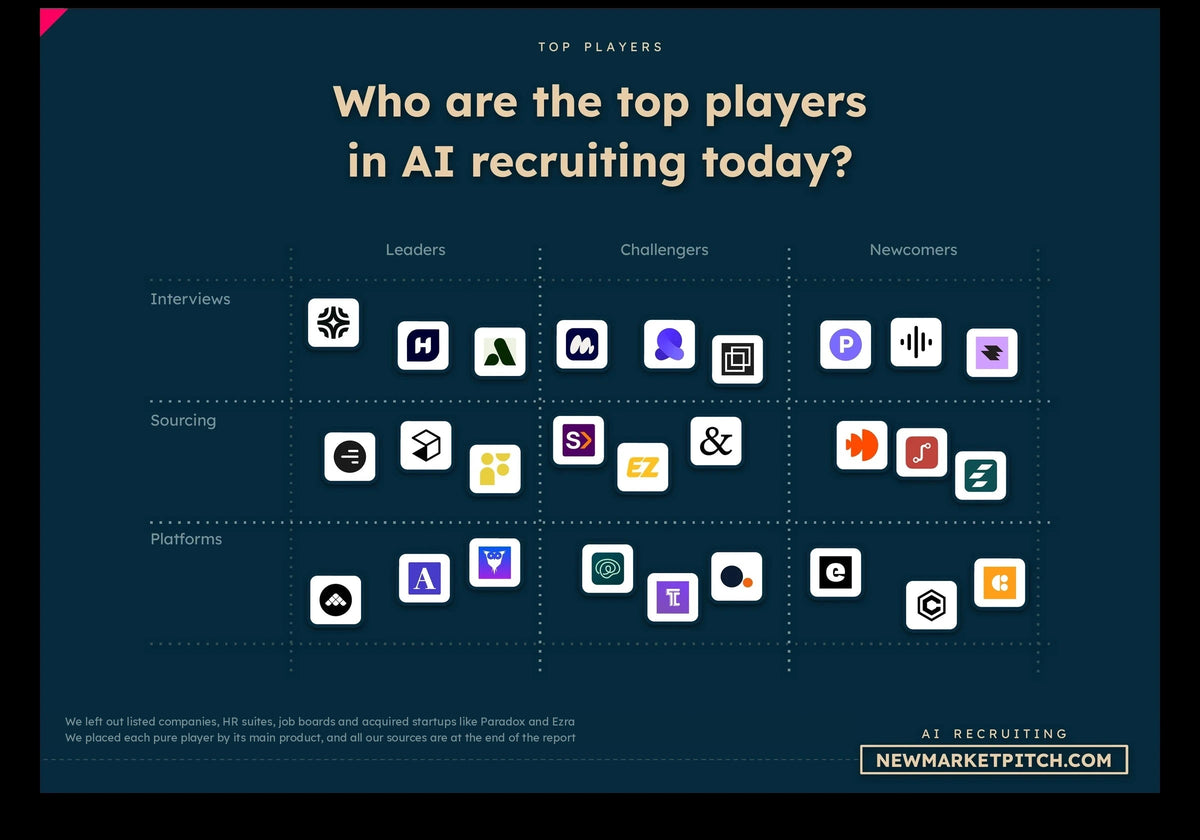
In our report covering the AI recruiting market, we turn what is vague and complex into simple, useful visuals. Market maps like this one show you at a glance where every startup stands.
Are AI recruiting startups finally giving LinkedIn serious competition?
AI recruiting startups are now serious competitors to LinkedIn Recruiter, especially when it comes to finding candidates, managing hiring, and automating interviews. Juicebox, Ashby, Gem, Findem, hireEZ, and Eightfold AI are among the strongest companies, although they compete in different parts of recruitment.
LinkedIn still has a huge advantage: its professional network, established recruiter relationships, and access to career information. Most AI recruiting startups cannot match that reach. Instead, they are building tools that search across different sources, contact candidates, screen applicants, and manage interviews with much less manual work.
The growth is becoming difficult to ignore. In March 2026, Juicebox announced an $80 million Series B at an $850 million valuation and reported more than 5,000 recruiting teams using its platform. In May, Ashby reported more than 4,400 customers, compared with 2,400 a year earlier. Findem announced $51 million in new financing in October 2025 after reporting more than threefold year-over-year growth.
These three companies are approaching recruitment differently. Juicebox specializes in finding candidates, Ashby runs the hiring process, and Findem uses AI to identify and match talent.
LinkedIn remains central to how companies discover professionals, but employers increasingly have alternatives for the work that happens before and after that search.
Which AI recruiting startups are growing the fastest right now?
Ashby and Juicebox have some of the strongest publicly disclosed customer numbers among AI recruiting startups, while Gem and Findem are reporting particularly rapid growth in specific products and enterprise accounts.
Ashby's May 2026 figures are especially useful because they include a direct comparison with the previous year. Its customer base grew from 2,400 to more than 4,400, an increase of at least 83%. Revenue more than doubled over the same period.
That means Ashby's revenue grew faster than its customer count. Larger contracts, existing customers buying more products, and changes in pricing or customer mix could explain the difference, although the company has not published enough information to separate those effects.
Juicebox reported more than 5,000 recruiting teams using its platform in March 2026. That makes it one of the most widely adopted AI-native sourcing products based on disclosed usage. However, a recruiting team is not necessarily equivalent to one paying company, so we cannot directly compare its figure with Ashby's customer count.
Gem offers another interesting comparison. The company reported nearly 500 customers for its newer applicant tracking system, with revenue from that product increasing elevenfold over 18 months. Findem, meanwhile, reported more than threefold year-over-year growth when announcing its October 2025 financing.
Humanly and ConverzAI are harder to compare because their public figures focus more on recruiting activity and customer outcomes than software revenue.
| Startup | Reported commercial evidence | What we can conclude |
|---|---|---|
| Ashby | 4,400+ customers; revenue more than doubled annually | Strong customer growth and recurring software demand |
| Juicebox | 5,000+ recruiting teams; $850M valuation | Widespread adoption of AI sourcing |
| Gem | Nearly 500 ATS customers; ATS revenue up 11x in 18 months | Fast growth in integrated recruiting software |
| Findem | More than 3x annual growth; $105M total funding | Rapid expansion in talent intelligence |
| Humanly | 250,000+ candidates engaged monthly | Large-scale automated recruiting activity |
| hireEZ | 1B+ profiles across 45+ sourcing platforms | Extensive candidate discovery infrastructure |
| ConverzAI | Staffing customers reporting higher placements and revenue | Evidence of commercial value from automated recruiters |
| Eightfold AI | Enterprise deployments including STMicroelectronics and Forvia | Established presence among large employers |
We would put Ashby first for the quality of its disclosed growth evidence. Juicebox has impressive sourcing adoption, while Gem's rapid expansion makes it a company worth watching closely.

Our research about AI recruiting tools gets updated several times a month, so you always get the latest view of where things stand.
Is Juicebox the best AI alternative to LinkedIn Recruiter?
Juicebox is currently one of the strongest alternatives to LinkedIn Recruiter for finding candidates, thanks to its PeopleGPT search engine and growing adoption among recruiting teams.
Founded in 2022, Juicebox allows recruiters to describe the candidates they want in ordinary language. Instead of building long Boolean searches using job titles and keywords, they can ask for people with particular skills, experience, and professional backgrounds.
The company's March 2026 funding round was led by DST Global, with participation from Sequoia Capital, Coatue, and Y Combinator. That $80 million investment came after several years of product development and customer expansion.
More interestingly, Juicebox has published examples showing how customers actually use its technology. At Lovable, its case study reported 8,200 searches, an 18.8% interested reply rate, and more than 385,000 network overlaps surfaced. Fleetio reported a 67% improvement in go-to-market sourcing efficiency.
Those numbers show that Juicebox can help recruiters search more efficiently and identify relationships that might otherwise go unnoticed. Still, these are selected customer results. We do not have independent figures showing the average improvement across its entire customer base.
And there is one important gap in the evidence: Juicebox has not demonstrated that thousands of employers are cancelling LinkedIn Recruiter to use PeopleGPT instead.
Juicebox has built a very credible competitor to LinkedIn's search experience. Whether it can take a substantial share of LinkedIn's recruiting revenue remains an open question.
If you want more recent data on this point, please see our latest AI recruiting market report.
Is Ashby becoming the default recruiting software for startups?
Ashby is becoming one of the leading recruiting platforms for fast-growing companies, and its customer numbers suggest that the business is already well beyond the early startup stage.
In July 2025, Ashby announced a $50 million Series D and reported that its customer base had increased from approximately 1,300 to more than 2,700 in just over a year. Revenue was growing 135% year over year, while interviews scheduled through the platform had increased 170%.
Its following disclosures showed that growth continuing rather than disappearing after a particularly strong year.
Ashby more than tripled its reported customer base from the earlier 1,300-customer benchmark while maintaining annual revenue growth above 100% in its latest disclosed period. That's a pretty strong combination.
The product covers applicant tracking, interview scheduling, candidate relationship management, recruiting analytics, and AI-assisted workflows. A company can therefore use Ashby to manage much of its recruitment without assembling several separate applications.
This explains why Ashby is increasingly competing with established applicant tracking systems such as Greenhouse and Lever, as well as newer platforms such as Gem.
There are limits to its position. Ashby is particularly visible among technology startups and high-growth businesses, while global employers with complicated HR requirements may prefer Workday, SAP SuccessFactors, or other established enterprise systems.
We would still rank Ashby among the strongest AI recruiting software startups overall. Few independent competitors have published such consistent evidence of customer and revenue growth.

In our market report about AI recruiting tools, we look at what the winners do differently, so you can learn from the best instead of guessing.
Can Gem take recruiting customers away from Ashby?
Gem has become a serious Ashby competitor by expanding from candidate sourcing and relationship management into a complete applicant tracking system, with its newer recruiting products growing quickly.
The company's recent figures are impressive. Over 18 months, Gem reported an elevenfold increase in revenue from ATS customers, a twenty-eightfold increase in monthly interviews scheduled through the ATS, and an elevenfold increase in monthly hires.
It also reported fifteenfold growth in adoption of its AI agents for sourcing and application review.
Those growth rates need some context. An elevenfold increase sounds extraordinary, but the ATS product started from a relatively small base. Nearly 500 ATS customers represent meaningful adoption without yet putting Gem at the same disclosed overall customer scale as Ashby.
The difference between interview and hiring growth is also worth examining. Monthly interviews rose much faster than completed hires, although changes in customer activity and interview processes could explain part of that gap. We cannot conclude that Gem's technology increased hiring conversion by the same amount.
Gem's customer list includes Anthropic, Robinhood, Figma, DoorDash, and Reddit. Amazon One Medical also reported consolidating three recruiting tools and saving $15,000 in technology costs using Gem.
Companies can use Gem to bring sourcing, candidate management, and hiring into one platform while reducing the number of tools their recruiters need.
Ashby currently has stronger evidence of broad customer adoption. Gem, however, is closing the product gap and has demonstrated fast growth in ATS usage. It is one of Ashby's most credible independent challengers.
If you want more recent data on this point, please see our latest AI recruiting market report.
Can Findem and hireEZ find better candidates than LinkedIn?
Findem and hireEZ can help recruiters discover candidates beyond their usual LinkedIn searches, but neither company has publicly proved that its platform consistently finds more qualified people than LinkedIn Recruiter.
hireEZ has built a particularly large sourcing infrastructure. In July 2026, it announced partnerships with Nexxt and Talroo, connecting its database of more than one billion open-web profiles with additional pools of candidates.
The combination brings together information from publicly available professional sources, recruiting networks, and job seekers actively searching for work.
Findem has taken a somewhat different route. Its platform uses detailed talent attributes and contextual information to help recruiters evaluate candidates beyond their job titles.
Findem also acquired Getro in December 2025, gaining access to a network ecosystem serving more than 800 professional and investment networks associated with approximately 3.5 million job openings.
That acquisition gave Findem another way to connect recruitment with professional communities and existing hiring relationships.
The difference between the two companies is becoming clearer. hireEZ emphasizes broad candidate discovery and automated sourcing across many platforms. Findem puts more weight on interpreting candidate information and connecting that intelligence to recruiting workflows.
Both approaches make sense, but profile coverage alone cannot prove better hiring performance. The same professional can appear in several databases, and some profiles will contain outdated information.
For companies recruiting highly specialized employees, both products deserve serious consideration. We would be much more cautious about claims that either has already built a superior professional network to LinkedIn.

In our document detailing everything you need to know about AI recruiting, you will always find fresh funding data, taken straight from our own verified funding database.
Is Eightfold AI the strongest AI recruiting startup for large companies?
Eightfold AI is one of the most established enterprise AI talent platforms, particularly for large companies that want to manage employee skills, internal mobility, and external recruitment together.
Eightfold serves a broader HR need than startups focused mainly on sourcing candidates. Its technology helps employers understand which skills they already have, what skills they need, and whether existing employees could move into new roles.
That is particularly relevant for international companies with thousands of workers.
Eightfold has publicly identified enterprise customers including STMicroelectronics, Forvia, and Softtek. These organizations face complicated workforce requirements involving multiple roles, locations, and skill sets.
Forvia's use of talent intelligence, for example, relates partly to the automotive industry's growing need for software and technology expertise. Finding external candidates is only one part of that challenge. Employers also need to identify people already inside the company who could take on different work.
Eightfold is therefore competing for a broader portion of corporate HR spending than companies such as Juicebox.
This gives it a strong position in large enterprises, but recent public growth figures are less detailed than those available for Ashby. We cannot establish that Eightfold is currently winning more customers or growing faster than newer rivals.
Eightfold belongs near the top of the enterprise AI recruiting category, especially when internal talent management matters as much as hiring from outside.
Are Humanly and ConverzAI actually replacing human recruiters?
Humanly and ConverzAI are already automating large volumes of candidate screening and communication, making them two of the clearest examples of AI handling work that recruiters previously performed themselves.
Humanly reported in May 2025 that it was screening and scheduling more than 250,000 new candidates per month and had conducted over five million interviews cumulatively.
The company also described customer implementations where hiring time fell from 44 days to five days, an improvement of nearly 89%. Its reported candidate experience scores averaged 4.8 out of five.
These are substantial results, although the hiring-time improvement comes from selected deployments rather than a controlled comparison across all customers.
Humanly strengthened its position by acquiring Sprockets, Qualifi, and HourWork in October 2025. Those acquisitions expanded its capabilities in candidate assessment, interviewing, and frontline workforce retention.
ConverzAI is addressing a similar problem in staffing agencies, where recruiters often contact large numbers of candidates to fill temporary or permanent positions. Its virtual recruiters interact with people over phone calls, text messages, and email.
Some customer results have been particularly strong. TalentBurst reported a 40% increase in placements and $4.6 million in additional revenue. The Advance Group reported $2.6 million in new revenue within four months.
Those figures suggest that AI recruiters can generate measurable commercial benefits, especially where employers need to contact candidates quickly and repeatedly.
There are still important limits to automation. Screening candidates, asking structured questions, and booking interviews are much easier to standardize than judging complex professional experience or predicting long-term job performance.
Regulation is also becoming relevant. New York City's Local Law 144 requires bias audits and candidate notices for covered automated employment decision tools. A December 2025 audit by the New York State Comptroller found potential compliance problems in at least 17 of 32 websites and bias audits examined.
That finding concerns compliance rather than proof that those algorithms discriminated against candidates. Still, it shows why companies automating hiring decisions need stronger controls than those simply helping recruiters find people.
Humanly and ConverzAI are among the most compelling AI recruiting startups because they can point to actual work completed by their systems. Their success will increasingly depend on keeping those automated decisions reliable, fair, and acceptable to employers.
If you want more recent data on this point, please see our latest AI recruiting market report.

Learning from others' mistakes is the cheapest lesson there is. In our report covering the AI recruiting market, we look at what broke startups before you, so you don't repeat it.
Which AI recruiting startups actually save employers money?
ConverzAI, Humanly, hireEZ, and Gem have published some of the clearest examples of AI recruiting software improving hiring costs, placement revenue, or recruiter productivity.
We looked for customer results connected to measurable outcomes rather than simply the number of AI searches or automated messages.
Staffing agencies provide some of the strongest examples because their financial results depend directly on how many positions they fill.
ConverzAI's TalentBurst case reported higher placements alongside millions of dollars in additional revenue. hireEZ customer DIVERSANT reported 35% less sourcing time and a 7% increase in placement revenue.
Corporate recruiting teams measure value differently. At Apptio, hireEZ reported a 75% reduction in sourcing time and doubled response rates. Gem customer Daxko reported saving eight to ten hours per role while reducing fraud-checking costs by 89%.
These improvements are not directly comparable, but together they show where employers are finding value.
| AI recruiting provider | Customer | Reported improvement |
|---|---|---|
| ConverzAI | TalentBurst | 40% more placements; $4.6M additional revenue |
| ConverzAI | The Advance Group | $2.6M new revenue in four months |
| ConverzAI | TalentBridge | 80% reduction in time-to-fill |
| hireEZ | DIVERSANT | 35% less sourcing time; 7% more placement revenue |
| hireEZ | Apptio | 75% less sourcing time; 2x response rates |
| hireEZ | ZD Jasper Realty | 75% reduction in time-to-fill |
| Gem | Amazon One Medical | Three recruiting tools removed; $15K saved |
| Gem | Daxko | 8–10 hours saved per role; fraud-check costs down 89% |
| Juicebox | Fleetio | 67% improvement in GTM sourcing efficiency |
The qualification is important: these figures come from vendor-published customer studies, often without independent control groups. They establish that meaningful improvements have occurred in named deployments but cannot support a reliable industry-wide average.
Still, the results cover enough different employers and recruitment tasks to show that AI recruiting software has moved well beyond a productivity experiment.
Is LinkedIn's own AI already catching up with recruiting startups?
LinkedIn is catching up quickly in AI-powered recruiting, and its Hiring Assistant has already demonstrated productivity improvements that compete directly with the promises made by independent sourcing startups.
LinkedIn introduced Hiring Assistant to selected customers in 2024 before expanding English-language availability globally in September 2025.
According to its early customer results, recruiters using the system saved more than four hours per role, reviewed 62% fewer profiles, and achieved a 69% improvement in InMail acceptance rates.
Those improvements directly challenge products built around faster candidate discovery and outreach.
LinkedIn then announced Hiring Assistant 2 in September 2026, adding improved reasoning, memory, personalization, and talent-pool management.
The company is clearly moving toward software that can handle more of the recruiting process on behalf of human users.
That creates a serious competitive problem for specialists such as Juicebox, Findem, and hireEZ. Better AI search is attractive, but LinkedIn already has a professional network, established recruiter contracts, and extensive data about employment histories.
Ashby and Gem are somewhat less exposed because their platforms also run applicant tracking, scheduling, recruiting analytics, and other hiring operations.
The wider hiring environment adds pressure. LinkedIn reported in September 2026 that global hiring was approximately 30% below pre-pandemic levels while applications per applicant were around 30% higher.
Recruiters therefore face more applicants competing for fewer openings. Automation can help them handle that workload, but weaker hiring demand may also make employers more cautious about purchasing additional software.
LinkedIn's productivity figures cannot be compared directly with startup case studies as if they came from the same experiment. The customer samples and measurement methods differ.
LinkedIn's response nevertheless looks serious. Independent AI recruiting startups now need to deliver measurable advantages that employers cannot obtain simply by switching on the latest LinkedIn features.
If you want more recent data on this point, please see our latest AI recruiting market report.

Your time is limited. In our research about AI recruiting tools, we put numbers on each part of the market, so you can see where it makes sense to focus.
Are Workday and other HR giants buying AI recruiting startups?
Large HR software companies are already buying AI recruiting startups, with Workday's acquisition of Paradox providing one of the clearest examples of the industry consolidating.
Workday completed the Paradox acquisition on October 1, 2025, after announcing the agreement in August.
Paradox had built conversational AI tools for candidate engagement and high-volume recruitment, particularly among employers hiring frontline workers.
By adding Paradox to HiredScore and its existing Workday Recruiting software, Workday expanded its capabilities across sourcing, matching, communication, and hiring workflows.
There have been similar moves elsewhere.
Humanly acquired three specialized recruiting businesses in October 2025, while Phenom acquired Plum in April 2026 to strengthen its talent assessment products.
Rather than leaving sourcing, screening, interviews, and candidate assessment spread across separate vendors, recruiting software companies increasingly want to manage several of those activities within one product.
That is especially attractive to large employers already dealing with complicated HR systems.
For startups, acquisitions create a potential exit route but also increase competitive pressure. A smaller specialist may offer an excellent AI product, only to find that Workday, Phenom, or another established provider has added similar capabilities to software the customer already pays for.
The independent businesses best positioned to survive are likely to be those with strong customer relationships, extensive recruiting data, or a product advantage that is difficult for a larger platform to reproduce.
Is Mercor the biggest AI recruiting startup, or has it become an AI training company?
Mercor has become one of the fastest-growing AI-powered talent businesses, but its revenue now comes overwhelmingly from supplying specialist labor to AI developers rather than selling conventional recruiting software.
Founded in 2023, Mercor started with automated candidate matching and recruitment. Its business subsequently shifted toward connecting highly skilled contractors with AI companies that need experts for model training and evaluation.
The financial growth has been extraordinary.
In October 2025, Mercor raised $350 million at a $10 billion valuation, compared with the $2 billion valuation attached to its February 2025 financing.
According to The Information, Mercor generated $614 million in gross revenue during the first half of 2026, approximately 70% more than it generated throughout 2025. Sacra estimated that annualized gross revenue had reached approximately $2 billion by June 2026.
But gross revenue needs careful interpretation in this business.
Mercor pays contractors who perform work for its customers, and Sacra estimated that approximately 60–70% of gross revenue goes to those workers. The amount retained by Mercor is therefore substantially smaller.
Its customer mix also tells us what kind of company Mercor has become. The Information reported that AI foundation-model developers accounted for approximately 91% of its first-half 2026 revenue.
That is very different from Ashby, Juicebox, or Gem selling recruiting tools to thousands of employers.
Mercor's success demonstrates the enormous demand for AI-powered matching of specialized professionals. However, it tells us more about the economics of AI training labor than the adoption of recruiting software by ordinary employers.
We would rank Mercor among the most successful AI talent marketplaces, while keeping it separate from the leading independent recruiting software startups.
The same distinction matters when discussing Micro1 and other companies supplying specialists for AI training projects.

In our market report about AI recruiting tools, we always try to gather several sources and make estimates that make sense, so you can work with solid numbers.
Which AI recruiting startups are best for different types of employers?
The best AI recruiting startup depends heavily on the type of hiring a company does. Ashby, Juicebox, Gem, Findem, Eightfold AI, Humanly, and ConverzAI have established strengths in different recruiting workflows.
For technology startups and growing software companies, Ashby has a strong combination of applicant tracking, scheduling, and recruiting analytics. Gem is an increasingly credible alternative, especially for teams wanting sourcing and candidate management integrated with their ATS.
Juicebox is particularly attractive to recruiters looking for specialized professionals and wanting to search beyond their existing LinkedIn workflow.
Findem and hireEZ are worth examining when companies need broad sourcing, detailed candidate intelligence, or ways to rediscover candidates already known to the business.
Eightfold AI is better suited to large employers managing complicated workforce requirements, including internal mobility and skills planning.
Humanly and ConverzAI are especially relevant for high-volume recruitment and staffing operations, where faster candidate communication can translate into significant operational improvements.
| Recruiting need | Leading AI startups | Evidence supporting their position |
|---|---|---|
| AI-native candidate sourcing | Juicebox | 5,000+ recruiting teams |
| Complete startup recruiting platform | Ashby | Rapid customer expansion and revenue growth |
| ATS with integrated AI agents | Gem | ATS revenue increased 11x in 18 months |
| Enterprise talent intelligence | Findem | More than 3x annual growth |
| Open-web sourcing | hireEZ | Database covering 1B+ profiles |
| Internal mobility and enterprise hiring | Eightfold AI | Deployments at major multinational employers |
| Automated high-volume screening | Humanly | 250,000+ monthly candidate interactions |
| Staffing agency recruiting automation | ConverzAI | Customer-reported placement and revenue growth |
| Enterprise talent assessment | Phenom | Expanded capabilities through acquisitions |
There is no reliable public revenue ranking covering all these businesses. Most remain private, and even the companies publishing growth figures use different definitions of customers, users, and recruiting activity.
We can nevertheless identify fairly clear leaders within individual categories. What is much less clear is whether any of them will eventually become the dominant platform across the entire recruiting process.
Who are the top AI recruiting startups beyond LinkedIn?
Ashby, Juicebox, Gem, Findem, hireEZ, Eightfold AI, Humanly, and ConverzAI are currently among the strongest independent AI recruiting startups beyond LinkedIn. Of those companies, we would place Ashby first for overall recruiting software, Juicebox first for AI-native sourcing, and Humanly among the leaders in automated high-volume recruitment.
Ashby's sustained customer and revenue growth gives it a particularly strong position. The company is becoming an important recruiting system for high-growth businesses and has demonstrated that customers are willing to spend more on integrated hiring software.
Juicebox is one of the clearest threats to LinkedIn Recruiter's traditional candidate-search experience. Its natural-language search product has reached substantial adoption, although we still lack evidence that it is replacing LinkedIn at a comparable scale.
Gem deserves close attention because its ATS is growing quickly and its wider product offering increasingly overlaps with Ashby's.
For larger employers, Findem and Eightfold AI offer more extensive talent intelligence capabilities, while hireEZ remains a serious candidate-sourcing specialist. Humanly and ConverzAI have shown that AI can take over significant portions of candidate communication and screening while producing measurable improvements for customers.
Mercor is a major success story in AI-powered talent matching, but its concentration in AI training work makes it a different type of business.
LinkedIn faces several credible competitors, each attacking a different part of recruitment. None has yet shown that it can replace LinkedIn's professional network or displace its recruiting business on a broad scale.
For now, Ashby looks particularly strong as a recruiting software company, while Juicebox is among the most interesting direct alternatives to LinkedIn Recruiter. The next major competitive shift will depend on which of these startups can turn AI-powered hiring efficiency into lasting customer relationships, rather than simply offering features that LinkedIn and established HR vendors can eventually copy.
If you want more recent data on this point, please see our latest AI recruiting market report.

If you build or invest in the AI recruiting market, you need to know which business models pay off now and which ones are fading. That's why our report covering it has a whole section on it.
Sources and methodology
This analysis identifies the leading AI recruiting startups beyond LinkedIn using recent evidence of commercial adoption, revenue growth, product capabilities, customer outcomes, enterprise deployments, and competitive positioning. We examined sourcing engines, applicant tracking systems, autonomous recruiting tools, talent intelligence platforms, and adjacent AI talent marketplaces, with particular attention to developments in 2025 and 2026.
We assessed leadership separately across these recruiting categories because the companies operate different business models and address different hiring needs. For each dimension, we gathered recent, attributable evidence, compared individual developments, and combined the results to identify companies with the strongest commercial and operational positions. The assessment gives greater weight to consistent evidence across multiple dimensions than to isolated growth announcements or financing headlines.
We distinguished commercial scale from growth momentum by comparing absolute adoption figures, reported growth rates, and their underlying measurement periods. Customer counts, recruiting teams, candidate profiles, automated interviews, software revenue, and enterprise deployments were evaluated as different metrics. This distinction is particularly important when comparing Ashby's reported customers, Juicebox's recruiting teams, Gem's ATS customers, and Humanly's recruiting activity.
To evaluate practical results, we examined named customer deployments and reported changes in sourcing time, recruiter productivity, hiring speed, placements, and financial performance. Vendor-published case studies were treated as evidence from specific implementations rather than industry-wide benchmarks. Where companies disclosed unusually high percentage growth, we also considered the starting base, product maturity, and whether the results covered an entire company or a newer product line.
Competitive positioning was assessed against the relevant incumbent rather than LinkedIn alone. We examined Juicebox, Findem, and hireEZ against LinkedIn Recruiter's candidate discovery capabilities; Ashby and Gem against established recruiting software; Eightfold against enterprise talent management platforms; and Humanly and ConverzAI against manual screening and staffing processes. LinkedIn's own AI developments and acquisitions by Workday and other HR vendors were incorporated into the competitive assessment.
We also separated conventional recruiting software from AI-powered labor marketplaces. Mercor was analyzed as an adjacent talent business because its reported gross revenue largely reflects specialist work supplied to AI developers. Gross transaction revenue and subscription software revenue were therefore not treated as equivalent indicators of recruiting software market share or commercial performance.
We prioritized first-hand company announcements, financing disclosures, customer studies, acquisition statements, and official regulatory materials, supplementing them with reported financial information where appropriate. The analysis focuses on observable adoption, growth, and employer results rather than funding totals or product claims alone. New York City's automated employment decision tool requirements were considered when assessing the operational and regulatory implications of AI-driven screening.
Key sources for commercial adoption and growth include Ashby's May 2026 customer and revenue update, Ashby's Series D announcement, Juicebox's $80 million Series B announcement, Gem's ATS growth disclosure, and Findem's financing and growth announcement.
For product differentiation and recruiting operations, we examined Findem's Getro acquisition, hireEZ's sourcing partnerships, Humanly's recruiting activity and customer results, Humanly's acquisition announcement, Gem's Daxko case study, and Ashby's 2026 product keynote.
For incumbent competition, consolidation, and regulation, sources include LinkedIn's Hiring Assistant introduction, LinkedIn's September 2026 Hiring Assistant 2 announcement, Workday's Paradox acquisition announcement, and New York City's official automated employment decision tools guidance. Mercor's Series C announcement provided an additional reference for distinguishing AI talent marketplaces from conventional recruiting software.
The final selections reflect the aggregation of these findings. We ranked companies within the recruiting functions where the evidence supported a clear competitive advantage, while keeping different revenue models and commercial metrics separate. This produces a comparative assessment of the strongest independent competitors without imposing a single revenue or market-share ranking on businesses that disclose fundamentally different operating data.

In our report covering the AI recruiting market, we don't want to repeat what boring consulting reports say. Instead, we show you the real and latest market signals that matter.
Written by the New Market Pitch teamWe track new markets so founders and investors can move faster. About us