What are the top AI recruiting startups by revenue today?
Whether you're building or investing in the AI recruiting market, our report covers everything you need to know: the players, the money, and what's coming next.
Summary
Job&Talent is the highest-revenue AI recruiting startup today, with €1.8B in 2024 revenue, followed by ZipRecruiter ($449M), iCIMS (~$400M ARR), Turing (~$350M annualized run-rate) and Andela (~$264M).
The biggest recruiting businesses aren't necessarily the most advanced AI companies. Job&Talent earns most of its revenue through workforce services, while ZipRecruiter operates a hiring marketplace and iCIMS sells enterprise software. Their financial scale reflects much more than AI adoption.
Revenue quality varies considerably across the ranking. Job&Talent's €1.8B turnover comes with an underlying EBITDA margin of roughly 3.4%, while subscription software companies can have very different economics. Comparing revenue alone obscures these differences.
Established recruiting platforms still have a substantial commercial advantage. Greenhouse, Phenom, HackerRank and CEIPAL each have revenue indicators above $100M, while younger AI-native specialists such as Juicebox and Contrario are operating at much smaller scales.
Recruitment AI adoption has expanded sharply but isn't accelerating every year. In iHire's 2026 survey, 24.2% of employers used AI in recruitment, down from 25.9% in 2025, although adoption remains almost five times its 2023 level.
Most employers are using AI for writing job advertisements and candidate messages. Only 29.9% of AI-using employers apply it to screening applications, and 9.1% use it for interviews. Fully automated hiring remains a relatively small part of the market.
AI recruiting companies can grow even when hiring slows, but business models matter. ZipRecruiter's revenue fell approximately 30.5% between 2023 and 2025, while Ashby reported revenue growth above 100% in the year preceding May 2026.
Automated interviewing has reached serious volume without proving that AI makes better hiring decisions. Humanly reported more than five million cumulative interviews, and Sapia.ai reached 8.3 million, but employer trust and candidate acceptance remain significant obstacles.
Newer AI-native startups are beginning to demonstrate real monetization. Juicebox reported $10M ARR in September 2025, Contrario exceeded a $6M revenue run-rate in May 2026, and Dex reported approximately $1.8M annualized revenue in April 2026.
Acquisitions are reshaping the competitive landscape. SAP bought SmartRecruiters, Zoom acquired BrightHire and Workday acquired HiredScore, bringing specialized recruiting technology into larger enterprise platforms.
The next competitive battle is likely to center on who controls the recruiting workflow. Established applicant tracking systems retain customer relationships and integrations, while AI-native companies are expanding from individual tasks toward sourcing, screening, interviewing and recruitment management. The gap in revenue remains large, but the product boundaries are getting blurry.

Written by the New Market Pitch teamWe track new markets so founders and investors can move faster. About us

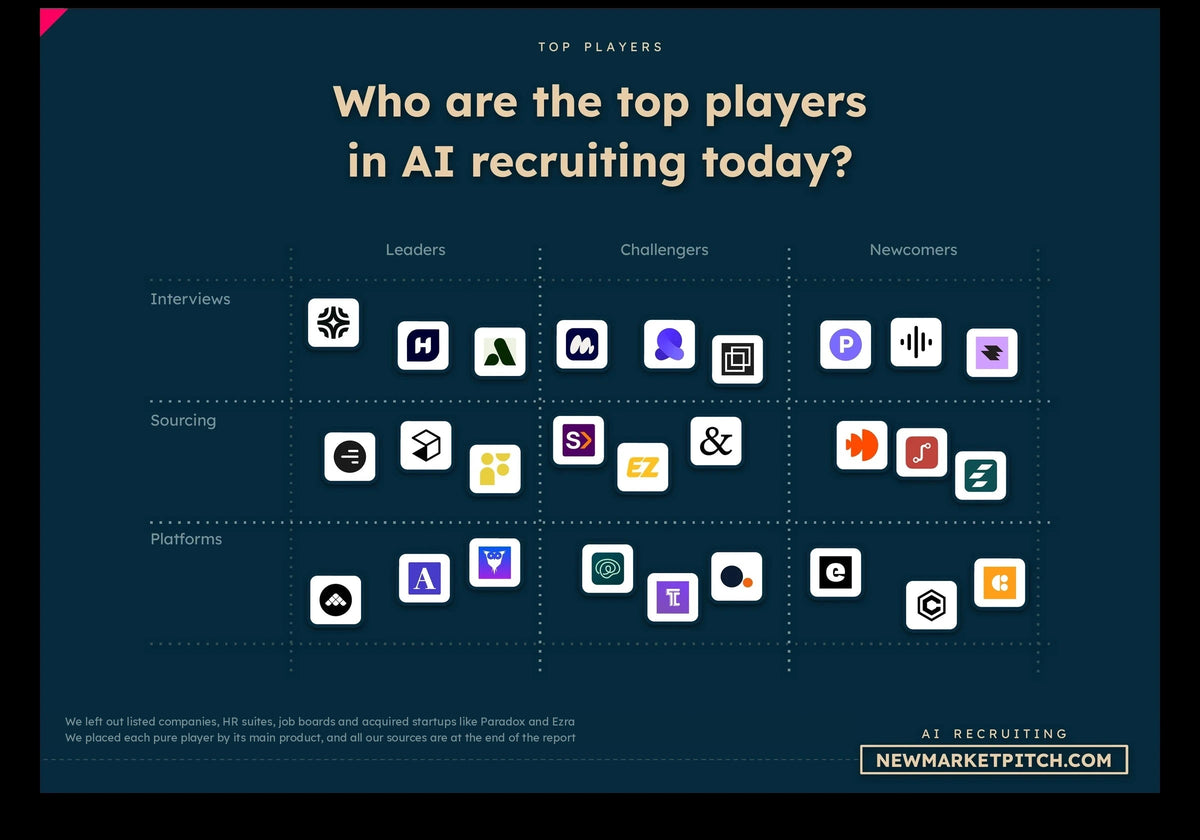
In our report covering the AI recruiting market, we turn what is vague and complex into simple, useful visuals. Market maps like this one show you at a glance where every startup stands.
The ranking of top startups in the AI recruiting market by revenue
Below is a table ranking the startups of this market by their current revenue scale. You can find our methodology at the end of this page.
If you want a deeper understanding of the market and its current dynamics, get our report on the AI recruiting market.
| Ranking | Company | Latest Metric | Metric Type | Freshness | Disclosed When | Source Quality | Confidence | Segment | Why This Ranking | Local Metric | Country |
|---|---|---|---|---|---|---|---|---|---|---|---|
| 1 | Job&Talent | ~$1.95B | Annual Revenue | Aging · 22mo | Sep 24, 2025 | Company Disclosed | Medium | AI Staffing & Matching | Large verified staffing revenue places it above software vendors; it includes labor-service activity and cannot be equated with AI recruiting software revenue. | €1.8B | es |
| 2 | ZipRecruiter | $449M | Fiscal-Year Revenue | Fresh · 10mo | Feb 25, 2026 | Filed / Audited | High | AI Sourcing & Matching | Recent audited total ranks above older ARR and estimates; significant revenue also comes from standard job advertising rather than only AI matching. | us | |
| 3 | iCIMS | ~$400M | ARR | Historical · 53mo | May 5, 2022 | Company Disclosed | Medium | AI Recruiting Platforms | The sizeable CEO-confirmed ARR outranks smaller estimates, but its 2022 measurement is historical and is not recognized annual revenue. | us | |
| 4 | Turing | ~$350M | Revenue Run-Rate | Fresh · 10mo | Third-Party Estimate | Low | AI Staffing & Matching | Materially larger recent annualized turnover than most vendors, but much of the platform has shifted to AI data work rather than recruitment; not recognized revenue. | us | ||
| 5 | Andela | ~$264M | Annual Revenue | Aging · 22mo | Third-Party Estimate | Low | AI Staffing & Matching | Large reported talent-platform sales are ahead of mid-sized software firms, but underlying source is not recorded and service fees may dominate. | us | ||
| 6 | Greenhouse | $237M | Annual Revenue | Historical · 35mo | 2023 | Company Disclosed | Medium | AI Recruiting Platforms | Company-submitted revenue is stronger than newer third-party estimates of comparable size, though this older figure may understate or overstate present operations. | us | |
| 7 | Phenom | ~$232M | Annual Revenue | Aging · 24mo | Third-Party Estimate | Low | AI Recruiting Platforms | Estimated scale is close to Greenhouse but ranks lower due to its lack of a company-reported revenue disclosure. | us | ||
| 8 | HackerRank | ~$221M | Annual Revenue | Aging · 28mo | Third-Party Estimate | Low | AI Assessments | High modeled revenue suggests significant enterprise scale, but the estimate is uncorroborated and materially less dependable than filed accounts. | us | ||
| 9 | CEIPAL | ~$172M | Annual Revenue | Aging · 24mo | Third-Party Estimate | Low | AI Recruiting Platforms | Substantial modeled recruiting-platform scale places it below larger specialized vendors; revenue also includes broader workforce software. | us | ||
| 10 | Eightfold AI | ~$96.6M | Annual Revenue | Aging · 23mo | Third-Party Estimate | Low | AI Sourcing & Matching | Model-based revenue ranks below larger disclosed and estimated platforms; this is a broader talent-intelligence product spanning internal mobility. | us | ||
| 11 | HireVue | ~$89M | Annual Revenue | Aging · 28mo | Third-Party Estimate | Low | AI Interviewing | A specialist interviewing and assessment business, but a model-based 2024 figure is less reliable than reported revenue from adjacent suppliers. | us | ||
| 12 | Avature | ~$170M | Annual Revenue | Historical · 82mo | Third-Party Estimate | Low | AI Recruiting Platforms | The reported historical amount exceeds nearby newer estimates, but the seven-year-old uncorroborated observation receives a large freshness penalty. | us | ||
| 13 | Loxo | $76.1M | Annual Revenue | Historical · 34mo | 2023 | Company Disclosed | Medium | AI Sourcing & Matching | Older company-submitted revenue receives more weight than nearby unverified modeled sales, despite a less recent operating period. | us | |
| 14 | Sense | ~$75M | Annual Revenue | Aging · 23mo | Third-Party Estimate | Low | AI Candidate Engagement | Similar magnitude to Loxo but lower because it relies on a third-party model instead of a company submission. | us | ||
| 15 | HeyJobs | ~$75M | Annual Revenue | Aging · 24mo | Third-Party Estimate | Low | AI Sourcing & Matching | A substantial modeled recruitment-platform business, although estimates differ between providers and not all sales represent AI features. | de | ||
| 16 | Karat | ~$73.6M | Annual Revenue | Aging · 22mo | Third-Party Estimate | Low | AI Interviewing | A sizable interview and technical-assessment provider, but outside estimates are less comparable than directly stated revenue. | us | ||
| 17 | Workable | ~$69.5M | Annual Revenue | Aging · 24mo | Third-Party Estimate | Low | AI Recruiting Platforms | Its recruiting ATS includes AI features, while the entire product suite and modeled revenue limit comparisons with AI-only vendors. | us | ||
| 18 | Criteria | ~$62.8M | Annual Revenue | Aging · 28mo | Third-Party Estimate | Low | AI Assessments | Screening and assessment products provide clear market fit, but annual revenue is an unverified estimate. | us | ||
| 19 | CodeSignal | ~$53.8M | Annual Revenue | Aging · 22mo | Third-Party Estimate | Low | AI Assessments | Technical hiring assessment sales place it above smaller screening platforms, though the revenue is not directly disclosed. | us | ||
| 20 | Findem | ~$50.8M | Annual Revenue | Aging · 22mo | Third-Party Estimate | Low | AI Sourcing & Matching | A specialized AI talent search vendor with modeled 2024 sales; limited company confirmation keeps confidence low. | us | ||
| 21 | Teamtailor | ~$47.2M | Annual Revenue | Aging · 22mo | 2025 | Filed / Audited | High | AI Recruiting Platforms | Consolidated accounts are stronger evidence than nearby modeled dollar figures, even though the reporting period is older and AI is one part of the ATS offering. | SEK 496M | se |
| 22 | Beamery | ~$44.7M | Fiscal-Year Revenue | Aging · 21mo | Oct 27, 2025 | Filed / Audited | High | AI Sourcing & Matching | Audited turnover narrowly follows Teamtailor and outranks similarly sized software estimates on evidence quality. | £34.9M | gb |
| 23 | hireEZ | ~$42.6M | Annual Revenue | Aging · 24mo | Third-Party Estimate | Low | AI Sourcing & Matching | Focused sourcing automation is highly relevant, but this number is modeled rather than recognized audited sales. | us | ||
| 24 | TestGorilla | ~$36.2M | Annual Revenue | Fresh · 15mo | Third-Party Estimate | Low | AI Assessments | More recent modeled revenue supports a position above less current smaller estimates, but does not justify high confidence. | nl | ||
| 25 | iMocha | ~$33.7M | Annual Revenue | Fresh · 13mo | Third-Party Estimate | Low | AI Assessments | Recent modeled scale is relevant to AI skill assessments; international operations and unverified model inputs reduce comparability. | us | ||
| 26 | Gem | ~$31M | Annual Revenue | Aging · 22mo | Third-Party Estimate | Low | AI Sourcing & Matching | Talent CRM and sourcing company is plausibly close to nearby assessment firms, but lacks a stronger current company-wide figure. | us | ||
| 27 | SmartRecruiters | ~$30M | Segment Revenue | Fresh · 10mo | Jan 2026 | Filed / Audited | Medium | AI Recruiting Platforms | Audited contribution covers only the September to December period after SAP acquired it, so ranking at this amount understates a normal full year. | ~€26M | us |
| 28 | Ashby | ~$28.2M | Annual Revenue | Aging · 22mo | Third-Party Estimate | Low | AI Recruiting Platforms | The older revenue model is weak relative to its directly disclosed 4,400-plus customers in May 2026; no current revenue is confirmed. | us | ||
| 29 | Talview | ~$26.1M | Annual Revenue | Fresh · 10mo | Third-Party Estimate | Low | AI Interviewing | Recruitment interviewing and proctoring revenue is modeled and includes adjacent examination products; ranks below comparable ATS vendors. | us | ||
| 30 | JobDiva | ~$26M | Annual Revenue | Aging · 28mo | Third-Party Estimate | Low | AI Recruiting Platforms | Staffing and recruitment ATS offers AI-powered candidate matching, but the $26M figure is modeled and unverified. | us | ||
| 31 | SeekOut | ~$25.2M | Annual Revenue | Aging · 23mo | Third-Party Estimate | Low | AI Sourcing & Matching | Relevant AI sourcing specialization, though the published number is estimated and older than those of nearby companies. | us | ||
| 32 | Hireology | $29.8M | Annual Revenue | Historical · 82mo | 2019 | Credible Reported | Low | AI Recruiting Platforms | Historical recruiting-platform revenue is useful context but more than six years old; modern AI-assisted functionality may have changed its scale. | us | |
| 33 | Harver | ~$20M | Annual Revenue | Fresh · 10mo | Third-Party Estimate | Low | AI Assessments | Hiring assessment business has relevant offerings, but third-party revenue models differ sharply and this estimate requires caution. | us | ||
| 34 | Codility | ~$13.8M | Annual Revenue | Historical · 70mo | Third-Party Estimate | Low | AI Assessments | Older recorded revenue is kept rather than replaced by customer-count proxies, but six years of aging make current scale uncertain. | us | ||
| 35 | SourceWhale | ~$11.9M | Annual Revenue | Fresh · 13mo | Third-Party Estimate | Low | AI Sourcing & Matching | Recruiter-oriented sourcing software fits the market directly, with an estimated rather than disclosed financial figure. | gb | ||
| 36 | Glider AI | ~$11.6M | Annual Revenue | Fresh · 10mo | Third-Party Estimate | Low | AI Assessments | Skills screening technology fits the market, but unconfirmed 2025 estimates provide only directional scale. | us | ||
| 37 | ConverzAI | ~$10.9M | Annual Revenue | Fresh · 10mo | Third-Party Estimate | Low | AI Interviewing | AI voice-based screening fits narrowly, although modeled revenue remains unverified. | us | ||
| 38 | Recruit CRM | >$10M | Other Scale Signal | Very Fresh · 6mo | Apr 2026 | Company Disclosed | Low | AI Recruiting Platforms | Direct founder revenue claim is more credible than similar-sized estimates, but the statement does not identify the accounting period and cannot establish recognized FY revenue. | us | |
| 39 | Plum | ~$10.5M | Annual Revenue | Aging · 22mo | Third-Party Estimate | Low | AI Assessments | Talent assessment provider ranks near similarly modeled specialists; revenue likely includes broader workforce development offerings. | ca | ||
| 40 | Juicebox | $10M | ARR | Fresh · 13mo | Sep 25, 2025 | Company Disclosed | Medium | AI Sourcing & Matching | Directly reported ARR merits a position near larger but much weaker estimates; it is recurring contract value, not recognized annual revenue. | us | |
| 41 | Fountain | ~$10.2M | Annual Revenue | Historical · 58mo | Third-Party Estimate | Low | AI Recruiting Platforms | High-volume hiring technology is relevant, but the older number is not a reliable guide to current revenue. | us | ||
| 42 | Crelate | ~$9.5M | Annual Revenue | Aging · 22mo | Third-Party Estimate | Low | AI Recruiting Platforms | Recruitment CRM and modern automation fit the market; modeled sales are smaller than most enterprise suites. | us | ||
| 43 | JobAdder | ~$9.8M | Annual Revenue | Aging · 22mo | Third-Party Estimate | Low | AI Recruiting Platforms | A recruitment ATS with AI-assisted workflows, but the published figure is an indirect third-party estimate. | au | ||
| 44 | Firefish Software | ~$9.5M | Annual Revenue | Aging · 22mo | Third-Party Estimate | Low | AI Recruiting Platforms | Recruitment CRM and automation platform has an indicative estimate only; direct filed turnover would be more reliable. | gb | ||
| 45 | Screenloop | $6.6M | Annual Revenue | Aging · 22mo | Jan 3, 2025 | Company Disclosed | Medium | AI Interviewing | Interview intelligence revenue is company-reported and therefore more dependable than similarly sized platform estimates, albeit older. | gb | |
| 46 | Contrario | >$6M | Revenue Run-Rate | Very Fresh · 5mo | May 20, 2026 | Company Disclosed | Medium | AI Recruitment Marketplace | Very recent company-disclosed run-rate carries more weight than similar-sized older estimates, but marketplace recruiter fees may affect margins. | us | |
| 47 | Manatal | ~$6M | Annual Revenue | Aging · 22mo | Third-Party Estimate | Low | AI Recruiting Platforms | AI-enhanced ATS has international customers, but disclosed revenue is absent and the number is a third-party model. | th | ||
| 48 | Willo | $5.4M | Annual Revenue | Aging · 22mo | Company Disclosed | Medium | AI Interviewing | Company-attributed video interviewing revenue provides better evidence than smaller model-based screening estimates. | gb | ||
| 49 | Recruiterflow | >$5.3M | ARR | Fresh · 7mo | Mar 2026 | Credible Reported | Medium | AI Recruiting Platforms | Fresh ARR is preferable to similarly sized older estimated sales but is not recognized annual revenue. | in | |
| 50 | Bryq | ~$3.5M | Annual Revenue | Aging · 22mo | Third-Party Estimate | Low | AI Assessments | Assessment and candidate-fit tools fit the market, while modeled sales remain weaker than directly announced ARR. | us | ||
| 51 | Arctic Shores | ~$3.4M | Annual Revenue | Aging · 22mo | Third-Party Estimate | Low | AI Assessments | AI-powered psychometric screening fits the market; small estimated revenue has not been independently corroborated. | gb | ||
| 52 | Vervoe | ~$3M | Annual Revenue | Aging · 22mo | Third-Party Estimate | Low | AI Assessments | Skills-based candidate screening is relevant, but estimated company-wide revenue is weak evidence of current scale. | au | ||
| 53 | Dex | ~$1.8M | Revenue Run-Rate | Very Fresh · 6mo | Apr 28, 2026 | Company Disclosed | Medium | AI Recruitment Marketplace | Newer verified annualized revenue provides a stronger basis than customer-count-only startups, but is a run-rate since monetization began recently. | gb | |
| 54 | Expertia AI | >$280K | Fiscal-Year Revenue | Aging · 19mo | Filed / Audited | Medium | AI Recruiting Platforms | Local filed revenue is far below the much larger third-party dollar estimate for this company; the statutory figure takes precedence because its perimeter is defined. | >INR 24M | in | |
| 55 | Employ | >23K customers | Other Scale Signal | Aging · 22mo | Jan 2026 | Credible Reported | Low | AI Recruiting Platforms | Large consolidated employer adoption suggests considerable scale, but the figure spans the Jobvite, Lever and JazzHR brands without disclosed revenue. | us | |
| 56 | Metaview | >7K companies | Other Scale Signal | Very Fresh · 1mo | Sep 30, 2026 | Company Disclosed | Low | AI Interviewing | Recent adoption is unusually broad, but customers may include non-paying users and there is no published revenue to compare with ARR. | gb | |
| 57 | Humanly | >5M interviews | Other Scale Signal | Very Fresh · 6mo | Apr 2026 | Company Disclosed | Low | AI Interviewing | High interview throughput demonstrates operational adoption, not realized revenue or paying customer count. | us | |
| 58 | Alex | >1M interviews | Other Scale Signal | Very Fresh · 1mo | Company Disclosed | Low | AI Interviewing | A meaningful number of automated interviews indicates product traction, but cumulative volume cannot establish annual software revenue. | us | ||
| 59 | Sapia.ai | 8.3M interviews | Other Scale Signal | Fresh · 10mo | 2025 | Company Disclosed | Low | AI Interviewing | Large cumulative screening volume signals adoption, but no revenue or annual volume is separately disclosed. | au | |
| NR | BrightHire | Not disclosed | Other Scale Signal | Undated | Dec 2025 | Filed / Audited | Low | AI Interviewing | Acquired interview-intelligence vendor has no defensible public revenue or count. | us | |
| NR | HiredScore | Not disclosed | Other Scale Signal | Undated | Mar 2024 | Filed / Audited | Low | AI Sourcing & Matching | Strong evidence that the product operates at enterprise scale but standalone monetary size was not disclosed; acquired in 2024. | us |

Our research about AI recruiting tools gets updated several times a month, so you always get the latest view of where things stand.
Which AI recruiting startups make the most money today?
Job&Talent currently ranks first among AI recruiting startups by revenue, followed by ZipRecruiter, iCIMS, Turing and Andela.
Job&Talent generated €1.8B in annual revenue in 2024, putting it well ahead of the other companies in our ranking. ZipRecruiter comes second with $449M in FY2025 revenue, while iCIMS ranks third with approximately $400M in annual recurring revenue (ARR) as of May 2022. Turing follows with an estimated $350M annualized revenue run-rate in December 2025, and Andela ranks fifth with approximately $264M in reported 2024 revenue.
These companies make money in quite different ways. Job&Talent supplies workers to employers, ZipRecruiter operates a recruitment marketplace, and iCIMS sells enterprise recruiting software. Turing and Andela combine technology-driven matching with technical talent services.
The next five positions belong to Greenhouse ($237M), Phenom (~$232M), HackerRank (~$221M), CEIPAL (~$172M) and Eightfold AI (~$96.6M). These companies mainly sell recruiting platforms, assessments and talent intelligence technology.
We identified 59 ranked startups, including 54 with financial indicators and five whose positions rely on other measurable evidence of commercial scale. Two recently acquired companies remain unranked because their standalone revenue is unavailable.
The companies with the largest revenue bases are generally broader staffing, recruitment marketplace or enterprise software businesses. Younger AI-native recruiting companies are growing, but their disclosed financial figures remain much smaller.
The figures below preserve each company's reported metric and period. ARR, annualized run-rates and third-party revenue estimates should not be read as identical to recognized annual revenue.
| Rank | AI recruiting startup | Revenue indicator | Period |
|---|---|---|---|
| 1 | Job&Talent | €1.8B annual revenue | 2024 |
| 2 | ZipRecruiter | $449M fiscal-year revenue | FY2025 |
| 3 | iCIMS | ~$400M ARR | May 2022 |
| 4 | Turing | ~$350M revenue run-rate | Dec 2025 |
| 5 | Andela | ~$264M annual revenue | 2024 |
| 6 | Greenhouse | $237M annual revenue | Nov 2023 |
| 7 | Phenom | ~$232M annual revenue | Oct 2024 |
| 8 | HackerRank | ~$221M annual revenue | Jun 2024 |
| 9 | CEIPAL | ~$172M annual revenue | Oct 2024 |
| 10 | Eightfold AI | ~$96.6M annual revenue | Nov 2024 |
Why are companies spending money on AI recruiting software now?
Companies are investing in AI recruiting software because recruiters are dealing with more applications while employers remain reluctant to expand their hiring teams.
LinkedIn's 2026 Future of Talent report found that global hiring was approximately 30% below pre-pandemic levels, while applications per applicant had increased by 30%.
According to iHire's 2026 State of Online Recruiting report, 24.2% of surveyed employers were using AI in recruitment, compared with 25.9% in 2025, 14.7% in 2024 and 4.9% in 2023.
AI adoption grew almost fivefold between 2023 and 2026, but the latest survey actually shows a small decline from the previous year.
Among employers using AI, 66.2% use it to write job advertisements, 62.3% to compose candidate messages and 29.9% to screen applications or resumes. Only 9.1% use it to interview candidates.
Most employers are still using AI for relatively straightforward tasks, far from the fully autonomous recruitment promised by many vendors.

In our market report about AI recruiting tools, we look at what the winners do differently, so you can learn from the best instead of guessing.
How much revenue does Job&Talent generate?
Job&Talent is the highest-revenue AI recruiting startup in our ranking, with €1.8B in annual revenue for 2024.
The Spanish-founded company confirmed the figure in September 2025, alongside financial results showing that it had maintained revenue despite a 9.5% contraction in the broader staffing market.
Job&Talent also reported €61.3M in underlying EBITDA, up 23%, and a contribution margin of 27.3%, an improvement of 6.2 percentage points. In the United States, revenue grew 5.7% while the comparable staffing market contracted 9.4%.
The company's reported underlying EBITDA equaled approximately 3.4% of annual revenue. That relatively narrow margin reflects the economics of a workforce business, where labor services account for much of the money flowing through the company.
Job&Talent has increasingly positioned itself as an AI-powered workforce management platform. It reports client productivity gains of up to 30% and a 3.3-times cost-to-serve advantage over incumbents. These are company-reported claims, rather than independently measured industry averages.
Job&Talent earns revenue by supplying and managing workers, with AI supporting matching and operations. Its €1.8B turnover therefore cannot be directly equated with sales of AI recruiting software.
Is ZipRecruiter still making money as AI changes recruitment?
ZipRecruiter remains one of the largest AI recruiting startups, with $449M in FY2025 revenue, although its business has shrunk considerably over the past two years.
The company's SEC filings show revenue falling from $646M in 2023 to $474M in 2024 and $449M in 2025.
That amounts to an approximately 30.5% decline over two years. The company also reported a $33M net loss in 2025, compared with a $12.9M loss in 2024, while adjusted EBITDA fell from $78M to $40.8M.
ZipRecruiter continues to operate a substantial marketplace. Its fourth-quarter 2025 results showed 59,104 quarterly paid employers, compared with 57,833 one year earlier, an increase of approximately 2.2%.
Revenue per paid employer, however, decreased from $1,920 to $1,889 over the same period.
The company has managed to increase its number of paying employers slightly, but spending per employer remains under pressure. Its AI-powered matching technology has not been enough to reverse the broader revenue decline.

In our document detailing everything you need to know about AI recruiting, you will always find fresh funding data, taken straight from our own verified funding database.
How big is iCIMS compared with newer AI recruiting startups?
iCIMS remains one of the biggest enterprise recruiting software companies in our ranking, with approximately $400M ARR reported in May 2022.
The figure came from a Reuters interview with the company's CEO. Although it is an older measurement, it establishes that iCIMS had already reached hundreds of millions in recurring software revenue before the generative AI boom.
iCIMS sells recruiting technology to employers, including applicant tracking, candidate management, hiring workflows and automation.
The scale becomes clearer when we consider younger specialists. Eightfold AI ranks tenth with approximately $96.6M in modeled 2024 annual revenue. SeekOut ranks thirty-first with approximately $25.2M in modeled revenue from 2024, while Juicebox ranks fortieth with $10M ARR as of September 2025.
These figures come from different periods and sources, so the comparison is indicative rather than a precise measurement of their relative revenue today.
Still, iCIMS's historical ARR shows how valuable an established enterprise customer base can be. New AI recruiting startups must convince employers to buy their products, while companies such as iCIMS can introduce AI features to organizations already paying for recruitment software.
Are Turing and Andela still mainly recruiting companies?
Turing and Andela remain major AI-enabled talent businesses, but both have expanded beyond the conventional business of helping companies recruit employees.
Turing ranks fourth with approximately $350M in estimated annualized revenue run-rate as of December 2025, according to Sacra. The company initially became known for matching employers with remote software developers.
Its activities have since expanded toward AI data work and technical services supporting the development of artificial intelligence systems.
Andela, ranked fifth with approximately $264M in reported 2024 revenue, also emerged from the market for technical talent. Its platform helps organizations find and work with skilled professionals internationally.
Greenhouse, Phenom and Eightfold AI primarily sell software products to organizations managing employees or candidates. Turing and Andela also monetize services associated with supplying technical talent, which can produce much larger turnover without implying an equally large software subscription business.

Learning from others' mistakes is the cheapest lesson there is. In our report covering the AI recruiting market, we look at what broke startups before you, so you don't repeat it.
Which AI recruiting software companies have the highest revenue?
Greenhouse ranks first among dedicated recruiting software platforms in our startup ranking, followed by Phenom and CEIPAL.
Greenhouse occupies sixth place overall with $237M in reported annual revenue as of November 2023. Phenom ranks seventh at approximately $232M in estimated annual revenue as of October 2024, while CEIPAL comes ninth with approximately $172M in estimated annual revenue from the same year.
These companies cover different parts of recruitment. Greenhouse is known for applicant tracking and hiring workflows. Phenom sells talent experience and recruiting automation technology. CEIPAL combines recruitment software with staffing and workforce management tools.
Avature ranks twelfth with approximately $170M in reported 2019 annual revenue, although the age of that figure makes current comparisons uncertain. Workable ranks seventeenth with approximately $69.5M in estimated annual revenue as of October 2024.
Teamtailor ranks twenty-first with SEK 496M in 2024 consolidated turnover, supported by Swedish financial accounts. Beamery follows at twenty-second with £34.9M in FY2025 turnover from UK filed accounts.
We count nine startups in the ranking's financial top tier, where recorded indicators exceed $100M. Those figures mix realized revenue, ARR, run-rates and estimates. Greenhouse's company-attributed revenue and Teamtailor's statutory accounts are also stronger financial references than third-party modeling estimates.
Which AI sourcing and candidate-matching startups make the most revenue?
ZipRecruiter leads the AI sourcing and candidate-matching category in our ranking, followed by Eightfold AI, Loxo, HeyJobs and Findem.
ZipRecruiter operates a recruitment marketplace. Eightfold AI sells talent intelligence technology to enterprises. Loxo provides recruiting software and sourcing tools, while HeyJobs focuses on recruitment marketing and matching. Findem specializes in AI-driven talent search.
Below this group are Beamery, hireEZ, Gem, SeekOut, SourceWhale and Juicebox.
Beamery's £34.9M FY2025 turnover is supported by UK financial accounts, whereas hireEZ, Gem, SeekOut and SourceWhale rely on third-party revenue estimates in the ranking.
Juicebox reported $10M ARR in September 2025, giving us a direct financial indicator for its AI sourcing business. The older providers still have larger documented revenue bases, while newer specialists are trying to automate more of the candidate discovery process.

Your time is limited. In our research about AI recruiting tools, we put numbers on each part of the market, so you can see where it makes sense to focus.
Which AI interviewing startups earn the most money?
HireVue ranks first among dedicated AI interviewing startups in our ranking, followed by Karat, Talview and ConverzAI.
HireVue ranks eleventh overall with approximately $89M in estimated annual revenue as of June 2024. Karat follows in sixteenth position with approximately $73.6M in reported 2024 revenue.
Talview ranks twenty-ninth with approximately $26.1M in estimated 2025 revenue, while ConverzAI ranks thirty-seventh with approximately $10.9M in estimated annual revenue for the same year.
The products cover different types of interviewing. HireVue provides enterprise interviewing and assessment technology. Karat focuses on technical interviews. Talview offers interviewing and testing products, while ConverzAI uses AI voice technology for recruitment screening.
Screenloop and Willo provide further examples of monetization in this category, reporting $6.6M and $5.4M in 2024 annual revenue, respectively.
More recent AI interviewing specialists are gaining attention, particularly Metaview, Humanly, Alex and Sapia.ai. Their available figures, however, primarily measure customer adoption or interview volume rather than revenue.
Can AI interviewers replace human recruiters and actually improve hiring?
AI interviewers can now handle millions of screening conversations and save recruiters time, but there is little evidence that they can replace human recruiters or consistently make better hiring decisions.
Humanly reported more than five million cumulative interviews and said its platform was engaging more than 250,000 candidates each month.
Sapia.ai reported 8.3M cumulative chat interviews in its 2025 review, while Alex reported more than one million AI interviews in its Y Combinator company profile.
These volumes demonstrate that automated interviews have moved beyond small pilots, although cumulative interview counts cannot establish how many human recruiters have been replaced.
LinkedIn's 2025 Future of Recruiting report found that recruiting professionals experimenting with or integrating generative AI reported saving approximately 20% of their working week on average, equivalent to roughly one working day in a standard five-day week.
Yet HireVue's 2026 Global AI in Hiring Report found that while 77% of surveyed HR teams used AI regularly, only 41% of hiring teams fully trusted it.
Candidates are skeptical too. iHire's 2026 survey found that 44.3% of jobseekers viewed employers' increasing use of AI negatively, compared with 21.8% who viewed it positively.
Automated screening, scheduling and routine candidate communications are already delivering measurable efficiency gains. Proving that AI consistently selects better employees would require reliable evidence about subsequent job performance, retention, hiring mistakes and fairness across candidate groups.

In our market report about AI recruiting tools, we always try to gather several sources and make estimates that make sense, so you can work with solid numbers.
Which AI assessment startups generate the most revenue?
HackerRank ranks first among AI assessment startups in our ranking, followed by Criteria, CodeSignal, TestGorilla and iMocha.
HackerRank occupies eighth position overall with approximately $221M in modeled annual revenue as of June 2024. Criteria ranks eighteenth at approximately $62.8M in modeled 2024 revenue, followed by CodeSignal at approximately $53.8M.
TestGorilla ranks twenty-fourth with approximately $36.2M in estimated annual revenue as of July 2025, and iMocha ranks twenty-fifth at approximately $33.7M as of September 2025.
Further down the ranking are Harver, Codility, Glider AI, Plum, Bryq, Arctic Shores and Vervoe. Their recorded revenue indicators range from approximately $20M to $3M, although several figures are historical or modeled.
These companies are addressing an increasingly important recruiting problem: employers need ways to verify candidate skills when resumes and applications can easily be written or improved with generative AI.
HireVue's 2026 Global AI in Hiring Report, based on responses from more than 3,100 hiring managers, found that 71% of candidates use AI for resumes.
That makes practical tests, structured assessments and skills verification potentially more valuable as employers try to distinguish candidates' actual abilities from AI-assisted applications.
What other AI recruiting startups have meaningful revenue?
Beyond the ten largest companies, our AI recruiting ranking contains dozens of startups with revenue indicators ranging from tens of millions of dollars to relatively small early-stage businesses.
Sense ranks fourteenth with approximately $75M in modeled annual revenue as of November 2024. It focuses on candidate engagement and recruitment communications.
Gem ranks twenty-sixth with approximately $31M in estimated 2024 revenue, while SmartRecruiters ranks twenty-seventh with approximately €26M in revenue recorded for September–December 2025.
SmartRecruiters was acquired by SAP in September 2025. The recorded figure covers only its post-acquisition contribution during part of the year, so it should not be mistaken for a normal twelve-month revenue total.
Ashby ranks twenty-eighth at approximately $28.2M in modeled annual revenue as of December 2024, although its more recent operating performance suggests that the historical estimate does not capture its latest growth.
Further down, Recruit CRM has a founder-reported revenue claim exceeding $10M as of April 2026, without a clearly stated accounting period. Recruiterflow reported more than $5.3M ARR as of March 2026.
Smaller companies such as Manatal, Bryq, Arctic Shores and Vervoe show that recruitment automation and assessments can also support businesses with revenue indicators in the low single-digit millions.
Many figures in this part of the ranking come from external company-data providers rather than financial statements, so small differences between modeled estimates should not be treated as precise financial comparisons.
| Rank | AI recruiting startup | Revenue indicator | Period |
|---|---|---|---|
| 11 | HireVue | ~$89M annual revenue | Jun 2024 |
| 12 | Avature | ~$170M annual revenue | 2019 |
| 13 | Loxo | $76.1M annual revenue | Dec 2023 |
| 14 | Sense | ~$75M annual revenue | Nov 2024 |
| 15 | HeyJobs | ~$75M annual revenue | Oct 2024 |
| 16 | Karat | ~$73.6M annual revenue | 2024 |
| 17 | Workable | ~$69.5M annual revenue | Oct 2024 |
| 18 | Criteria | ~$62.8M annual revenue | Jun 2024 |
| 19 | CodeSignal | ~$53.8M annual revenue | 2024 |
| 20 | Findem | ~$50.8M annual revenue | 2024 |
| 21 | Teamtailor | SEK 496M annual revenue | 2024 |
| 22 | Beamery | £34.9M fiscal-year revenue | FY2025 |
| 23 | hireEZ | ~$42.6M annual revenue | Oct 2024 |
| 24 | TestGorilla | ~$36.2M annual revenue | Jul 2025 |
| 25 | iMocha | ~$33.7M annual revenue | Sep 2025 |
| 26 | Gem | ~$31M annual revenue | 2024 |
| 27 | SmartRecruiters | ~€26M segment revenue | Sep–Dec 2025 |
| 28 | Ashby | ~$28.2M annual revenue | Dec 2024 |
| 29 | Talview | ~$26.1M annual revenue | 2025 |
| 30 | JobDiva | ~$26M annual revenue | Jun 2024 |
| 31 | SeekOut | ~$25.2M annual revenue | Nov 2024 |
| 32 | Hireology | $29.8M annual revenue | 2019 |
| 33 | Harver | ~$20M annual revenue | 2025 |
| 34 | Codility | ~$13.8M annual revenue | 2020 |
| 35 | SourceWhale | ~$11.9M annual revenue | Sep 2025 |
| 36 | Glider AI | ~$11.6M annual revenue | 2025 |
| 37 | ConverzAI | ~$10.9M annual revenue | 2025 |

If you build or invest in the AI recruiting market, you need to know which business models pay off now and which ones are fading. That's why our report covering it has a whole section on it.
Are newer AI recruiting startups making real money or just attracting users?
Several younger AI recruiting startups are already earning millions of dollars, while others have reached thousands of companies or millions of interviews without disclosing comparable revenue.
Juicebox ranks fortieth with $10M ARR as of September 2025. Contrario ranks forty-sixth with a revenue run-rate exceeding $6M in May 2026, while Dex ranks fifty-third with approximately $1.8M in annualized revenue reported in April 2026.
Juicebox focuses on AI-powered candidate sourcing. Contrario operates an AI recruitment marketplace, while Dex combines recruitment technology with a newer marketplace approach.
Investors are backing these businesses at very different stages. Juicebox announced $36M in funding in September 2025, including a $30M Series A led by Sequoia Capital. Humanly later announced a $25M Series B to expand its AI hiring technology.
Metaview raised an additional $60M in September 2026, bringing its total funding to $110M, while reporting that more than 7,000 companies used its products.
Some companies have much larger adoption figures than their disclosed financial evidence suggests.
Employ ranks fifty-fifth using a scale indicator of more than 23,000 customers as of 2024 across its recruiting software brands, including Jobvite, Lever and JazzHR. Metaview follows at fifty-sixth with more than 7,000 companies using its products.
Humanly ranks fifty-seventh with more than five million cumulative interviews. Alex follows at fifty-eighth with more than one million interviews, while Sapia.ai ranks fifty-ninth with 8.3M cumulative interviews.
These indicators measure different things. Employ reports adoption across several recruitment software brands, Metaview focuses on interview intelligence and automation, while Humanly, Alex and Sapia.ai emphasize automated candidate interactions.
We cannot establish which of these companies earns the most revenue from their customer or interview counts. The strongest direct evidence of monetization among younger AI-native specialists comes from the ARR and run-rate disclosures of companies such as Juicebox, Contrario and Dex.
The following table completes our ranking. Positions 55–59 are based on quantified commercial adoption rather than financial revenue.
| Rank | AI recruiting startup | Revenue or scale indicator | Period |
|---|---|---|---|
| 38 | Recruit CRM | >$10M revenue claim; period unspecified | Apr 2026 |
| 39 | Plum | ~$10.5M annual revenue | 2024 |
| 40 | Juicebox | $10M ARR | Sep 2025 |
| 41 | Fountain | ~$10.2M annual revenue | 2021 |
| 42 | Crelate | ~$9.5M annual revenue | 2024 |
| 43 | JobAdder | ~$9.8M annual revenue | 2024 |
| 44 | Firefish Software | ~$9.5M annual revenue | 2024 |
| 45 | Screenloop | $6.6M annual revenue | 2024 |
| 46 | Contrario | >$6M revenue run-rate | May 2026 |
| 47 | Manatal | ~$6M annual revenue | 2024 |
| 48 | Willo | $5.4M annual revenue | 2024 |
| 49 | Recruiterflow | >$5.3M ARR | Mar 2026 |
| 50 | Bryq | ~$3.5M annual revenue | 2024 |
| 51 | Arctic Shores | ~$3.4M annual revenue | 2024 |
| 52 | Vervoe | ~$3M annual revenue | 2024 |
| 53 | Dex | ~$1.8M revenue run-rate | Apr 2026 |
| 54 | Expertia AI | >INR 24M fiscal-year revenue | FY2025 |
| 55 | Employ | >23K customers | 2024 |
| 56 | Metaview | >7K companies | Sep 2026 |
| 57 | Humanly | >5M cumulative interviews | Through Apr 2026 |
| 58 | Alex | >1M cumulative interviews | Through 2026 |
| 59 | Sapia.ai | 8.3M cumulative interviews | Through 2025 |
Are big software companies buying AI recruiting startups?
Yes. Acquisitions involving SmartRecruiters, BrightHire and HiredScore show that major software companies increasingly want to own AI recruiting technology.
SAP completed its acquisition of SmartRecruiters on September 11, 2025, adding recruiting technology to its SuccessFactors human capital management business.
SmartRecruiters remains twenty-seventh in our startup ranking, with approximately €26M in post-acquisition segment revenue for September–December 2025.
Zoom acquired BrightHire in December 2025, bringing interview intelligence technology into its broader communications and productivity ecosystem.
Workday acquired HiredScore in 2024, adding AI-powered candidate matching and talent intelligence technology to its HR software offering.
BrightHire and HiredScore remain unranked because comparable standalone revenue figures have not been disclosed.
All three acquisitions concern technology that can be integrated into existing employee records, recruitment workflows and business communications. They also show that acquisition is becoming an important route for recruiting startups to reach large enterprise customers.

In our report covering the AI recruiting market, we don't want to repeat what boring consulting reports say. Instead, we show you the real and latest market signals that matter.
Can AI recruiting startups grow when employers are hiring less?
AI recruiting startups can grow even when companies are hiring fewer people, but the results depend heavily on how they make money.
Job&Talent maintained its 2024 revenue despite a contracting staffing market and improved underlying EBITDA by 23%.
ZipRecruiter, meanwhile, experienced a substantial two-year revenue decline as employer hiring demand remained weak.
Ashby reported revenue growth exceeding 100% over the year preceding May 2026, despite the broader recruiting environment.
Staffing and recruitment marketplace revenue tends to follow job openings, hiring activity and employer spending. Recruiting software can also grow by replacing older systems or helping companies reduce administrative work.
An employer might cut job advertising while paying more for software that allows a smaller recruiting team to handle applications efficiently.
Are AI recruiting agents replacing traditional applicant tracking systems?
AI recruiting agents are becoming more common, but traditional applicant tracking systems remain central to how most employers manage hiring.
The latest evidence from Bullhorn's 2026 Recruitment Industry Trends report shows how far the market has progressed.
Only 10% of surveyed staffing firms reported having agentic AI embedded throughout their workflows. Meanwhile, 54% had automation in place for candidate search.
Search automation is already relatively common, but fully integrated AI recruiting workflows are still rare.
Traditional ATS platforms manage candidate records, applications, hiring decisions and collaboration between recruiters and managers. AI agents can perform specific tasks within those processes, such as sourcing candidates, sending messages or conducting preliminary interviews.
Greenhouse, Phenom, CEIPAL, Workable, Teamtailor and Ashby all operate in broader recruiting software categories where AI can be added to existing workflows.
Newer specialists such as Juicebox and Metaview are approaching recruitment from the automation side, then expanding the tasks their products handle.
The more immediate competitive threat is that AI-native products could capture valuable parts of recruiting workflows, rather than employers suddenly abandoning every established ATS.

In our research about AI recruiting tools, we like to show you the big picture. We know your time is precious, so we make every page quick to read and packed with as much learning as possible per minute.
Could AI hiring regulations slow recruiting startups?
Regulation could make AI recruiting more expensive to develop and sell, especially for startups building systems that evaluate candidates or influence employment decisions.
The European Union's AI Act treats certain employment-related AI applications as high-risk. Under the current timetable, the relevant obligations for these systems are scheduled to apply from December 2027.
Those obligations cover areas including risk management, documentation, data governance, transparency and human oversight.
New York City already regulates qualifying automated employment decision tools under Local Law 144. Enforcement began in July 2023, with requirements involving bias audits and notices to affected candidates or employees.
Software that helps write a job advertisement generally presents fewer regulatory concerns than technology that scores applicants or substantially influences hiring decisions.
Larger enterprise software providers may be better equipped to support compliance teams, audit procedures and customer documentation. Smaller companies may have to spend more of their resources demonstrating that their systems meet the relevant requirements.
The burden could therefore fall more heavily on startups building automated candidate evaluation systems than on those focused on administrative tasks.
Can AI-native recruiting startups catch Greenhouse, iCIMS and ZipRecruiter?
AI-native recruiting startups can become serious competitors, but the available financial evidence does not yet show them catching the largest established recruiting platforms.
ZipRecruiter ranks second with $449M in FY2025 revenue, iCIMS ranks third with approximately $400M ARR as of May 2022, and Greenhouse ranks sixth with $237M in reported annual revenue as of November 2023.
Juicebox, a younger AI sourcing specialist, reported $10M ARR in September 2025. Contrario and Dex disclosed smaller annualized revenue run-rates during 2026.
Ashby offers a more encouraging example of how newer recruiting platforms can gain ground. At its Ashby One event in May 2026, the company announced that its customer base had grown from 2,400 to more than 4,400 over the previous year, an increase exceeding 83%. Revenue also grew by more than 100% during that period.
Ashby combines applicant tracking, analytics, scheduling, candidate management and AI-assisted workflows, allowing it to compete across several activities that employers previously handled through separate tools.
It remains twenty-eighth in our revenue ranking, based on approximately $28.2M in modeled annual revenue as of December 2024. The newer growth disclosure does not provide an updated revenue total, but it shows that employers are willing to switch to newer recruiting platforms.
The most promising route for AI-native startups is to expand beyond one narrow recruiting task. A company that starts by finding candidates could eventually offer outreach, screening, scheduling and broader recruitment management.
Enterprise recruiting remains difficult to take over quickly, however. Employers need reliable candidate records, workflow integrations, permissions, reporting and compliance support. Newer companies will need to provide those capabilities while maintaining their technological advantage.

When you build or invest in the AI recruiting market, you need clarity, not confusion. In our market report about AI recruiting tools, we always try to put numbers on and quantify whatever is usually vague and confusing.
What are the top AI recruiting startups by revenue today?
Job&Talent is currently the top AI recruiting startup by revenue, followed by ZipRecruiter, iCIMS, Turing and Andela.
Job&Talent's €1.8B in 2024 revenue puts it first in our ranking, while ZipRecruiter's $449M FY2025 revenue makes it the second-largest. iCIMS, Turing and Andela complete the top five using their respective ARR, run-rate and reported annual revenue indicators.
Nine startups occupy positions associated with financial indicators above $100M, although the figures include different periods and accounting definitions.
Younger AI-native specialists such as Juicebox, Contrario and Dex have demonstrated genuine monetization, but their financial scale remains much smaller than that of the leading recruitment platforms.
For now, Job&Talent leads the revenue ranking. The most interesting competitive changes are happening further down, where AI-native companies are trying to turn sourcing, interviewing and assessment automation into much larger recruiting businesses.
Our methodology
This analysis ranks AI recruiting startups by their strongest available financial indicators, while distinguishing recognized revenue from annual recurring revenue, annualized run-rates, estimates and commercial adoption. We cover staffing platforms, recruitment marketplaces, applicant tracking software, AI sourcing, interviewing, assessments and talent intelligence.
We apply a consistent startup definition: companies founded in 2000 or later that have never been publicly listed or first went public within the previous five years, and that are independent rather than longstanding divisions of larger operating groups. Companies acquired within the previous three years remain eligible, with their acquisition status identified.
We examined company announcements, annual reports, regulatory filings, executive statements, statutory accounts, financial reporting and third-party estimates. We prioritized metric relevance, source quality and freshness, retaining older figures when they remained more credible than newer estimates.
The ranking uses one main indicator per company. Financial figures receive priority over nonfinancial commercial indicators, and direct company disclosures or audited accounts carry more weight than modeled estimates. When only adoption figures are available, we report the relevant customer, interview or transaction volumes without translating them into assumed revenue.
We also distinguish company-wide revenue from individual business segments, staffing turnover, partial-year contributions and subscription software income. Job&Talent's workforce revenue, iCIMS's ARR, Turing's annualized run-rate and SAP's partial-year SmartRecruiters contribution describe different financial activities and should not be compared as identical accounting measures.
Where several sources describe a company's scale, we selected the most defensible indicator rather than automatically choosing the largest number. This explains why some historical figures remain in the ranking and why the positions should be understood as an evidence-weighted comparison rather than a perfectly synchronized revenue league table.
The final ranking contains 59 startups. The first 54 have monetary indicators of varying quality and comparability; the remaining five have quantified commercial-adoption indicators. BrightHire and HiredScore are discussed separately following their acquisitions because comparable standalone revenue figures are unavailable.
For the largest companies, key financial sources include Job&Talent's official financial results, ZipRecruiter's FY2025 SEC filing, and Reuters reporting on iCIMS's ARR. We also used Teamtailor's Swedish company accounts and Beamery's UK financial information.
To assess market demand and adoption, we used LinkedIn's 2026 Future of Talent report, LinkedIn's 2025 Future of Recruiting report, iHire's 2026 State of Online Recruiting report, HireVue's 2026 Global AI in Hiring Report and Bullhorn's 2026 Recruitment Industry Trends report.
For emerging companies and acquisitions, key sources include Ashby's May 2026 growth announcement, Juicebox's funding announcement, Humanly's Series B announcement, Metaview's Series C announcement, SAP's SmartRecruiters acquisition confirmation and SAP's filed financial information.
Regulatory analysis draws on the European Commission's AI Act framework, its enforcement timetable and New York City's guidance on automated employment decision tools. These sources help distinguish the commercial opportunities in AI recruiting from the compliance obligations facing companies that automate candidate evaluation and hiring decisions.

A good product starts with a real problem. In our document detailing everything you need to know about AI recruiting, we show you the ones customers still live with.
Written by the New Market Pitch teamWe track new markets so founders and investors can move faster. About us