What’s the latest funding news in the AI security operations (AI SOC) market? (October 2026)
Whether you're building or investing in the AI SOC market, our report covers everything you need to know: the players, the money, and what's coming next.
AI security operations (AI SOC) funding is moving beyond tools that simply classify security alerts, with investors increasingly backing systems that investigate threats and take action.
Recent financing rounds cover autonomous security analysts, threat hunting platforms, AI-native detection infrastructure and automated incident response.
Our October 2026 review examines 12 announced financings, distinguishing individual rounds from combined funding disclosures and core AI SOC vendors from adjacent security automation businesses.
And if you want to better understand this new industry, you can download our pitch covering the AI SOC market.
Insights
- The 10 announcements with identifiable individual financing amounts represent more than $529 million in disclosed funding. This is a minimum, since Reach Security reported a Series B exceeding $50 million without specifying the final figure.
- Torq's $140 million Series D and Exaforce's $125 million Series B were the two largest individually identified rounds in this selection, suggesting investors are willing to finance AI SOC platforms that already serve substantial enterprise demand.
- Five companies announced identifiable Series A rounds, ranging from Discern Security's $13 million to Artemis Security's $55 million. That spread reflects how differently investors value early commercial traction and the scope of autonomous security products.
- The AI SOC market now attracts two distinct kinds of investment: automating security analysts' investigations and improving protective controls. Qevlar AI and Mate Security represent the former, while Reach Security and Discern Security lean toward the latter.
- Abstract Security and Nebulock each raised $25 million, but target different operational problems. Abstract processes security data as it arrives, while Nebulock searches for malicious behavior that conventional alerting systems might otherwise miss.
- Surf AI's $57 million and Kai Security's $125 million were disclosed across multiple financing rounds. Their individual latest-round amounts remain unidentified, making them unsuitable for direct comparisons of investment ticket sizes.
- RADICL's $31 million Series A highlights another commercialization model for AI SOC technology: combining automated investigation and response with managed cybersecurity services for smaller companies in regulated industries.
- Only Torq and Exaforce have specific reported valuations in this selection, at $1.2 billion and approximately $725 million respectively. The other financing announcements do not provide enough evidence for reliable valuation comparisons.
- The three July announcements illustrate how the market is expanding beyond alert triage. Mate concentrates on organizational context, Abstract on security data architecture, and Discern on continuously improving deployed security controls.
- The newest featured financing, Reach Security's October Series B, also illustrates an important market boundary: automated remediation is attracting capital, even when the product does not directly replace a traditional SOC analyst.

Written by the New Market Pitch teamWe track new markets so founders and investors can move faster. About us

In our report covering the AI SOC market, you will always find fresh funding data, taken straight from our own verified funding database.
Summary table of the latest funding deals in the AI SOC market as of October 2026
We define the AI SOC market as AI systems that automate work performed by security operations centers.
We include AI security analysts and platforms for alert investigation, threat triage, response and security-workflow automation.
We exclude general cybersecurity products without an operational investigation or response role and human-only security services.
The table ranks the featured announcements from newest to oldest, using their public announcement dates rather than later database updates. Combined financing disclosures are identified separately, and several companies have a broader security operations focus than conventional AI SOC analysts.
| Name | When | Amount in $ | Round Type | Category |
|---|---|---|---|---|
| Reach Security | Oct 13, 2026 | >$50M | Series B | Security Control Optimization & Automated Remediation |
| Discern Security | Jul 30, 2026 | $13M | Series A | Proactive Security Operations & Control Remediation |
| Mate Security | Jul 29, 2026 | $35M | Series A | Agentic SOC & Incident Response |
| Abstract Security | Jul 22, 2026 | $25M | Growth Financing | AI-Native SIEM & Security Operations |
| Nebulock | Jun 25, 2026 | $25M | Series A | Autonomous Threat Hunting & Investigation |
| Exaforce | May 12, 2026 | $125M | Series B | Agentic SOC & Threat Detection and Response |
| Artemis Security | Apr 15, 2026 | $55M | Series A | AI-Native Detection & Incident Investigation |
| Surf AI | Mar 17, 2026 | $57M combined | Seed & Series A | Security Workflow & Risk Remediation Automation |
| Kai Security | Mar 10, 2026 | $125M combined | Seed & Series A | Autonomous IT & OT Security Operations |
| Qevlar AI | Mar 10, 2026 | $30M | Venture Round | Autonomous SOC Investigation & Threat Triage |
| RADICL | Feb 3, 2026 | $31M | Series A | Autonomous Virtual SOC & Managed Cyber Defense |
| Torq | Jan 12, 2026 | $140M | Series D | Agentic SOC & Security Hyperautomation |
The combined amounts reported by Surf AI and Kai Security should not be interpreted as the size of their most recent individual rounds. Reach Security and Discern Security are included under a broader interpretation of operational security automation, while RADICL combines software with managed services.
All the latest funding deals in the AI SOC market as of October 2026
Reach Security raised more than $50 million in a Series B round in October 2026.
When was it?
Reach Security announced the financing on October 13, 2026, making it the most recent qualifying announcement in this selection.
Who are they?
Reach Security develops AI software that examines existing cybersecurity tools, identifies gaps in their configurations and automatically adjusts defenses to reduce exposure to attacks.
Geographical focus?
Reach Security operates from the United States and serves enterprise customers, with plans to expand internationally and deepen its presence in the U.S. federal market.
Why do we include them in the AI SOC market?
Reach belongs to the broader security operations automation category because its platform can execute defensive remediation, although it focuses on optimizing security controls rather than investigating conventional SOC alerts.
What is the company stage?
Reach is in commercial growth, having reported that its customer base doubled over the preceding 12 months and having secured enterprise customers including Autodesk.
How much did they raise?
Reach secured more than $50 million in new financing, but the company did not disclose an exact final amount.
What round is it?
The investment was a Series B led by Top Tier Capital Partners, with participation from Ballistic Ventures, In-Q-Tel, M12 and existing investors.
Why did they raise?
Reach intends to expand its integrations, improve automated security control management and enter additional markets as enterprises seek to strengthen defenses without manually configuring multiple security products.
Discern Security secured $13 million in Series A financing in July 2026.
When was it?
Discern Security announced its Series A funding on July 30, 2026.
Who are they?
Discern Security develops AI agents that analyze an organization's existing security tools, find protection gaps and coordinate the work needed to improve those defenses.
Geographical focus?
Discern is based in California and primarily targets enterprise security teams in the United States, with a platform applicable to organizations operating across multiple regions.
Why do we include them in the AI SOC market?
Discern fits the adjacent security workflow automation category because it investigates gaps and coordinates remediation, although its main product is not designed to replace an alert-triage analyst.
What is the company stage?
Discern is in early commercial growth, with an existing platform and an investment focused on expanding product capabilities and customer adoption.
How much did they raise?
Discern raised $13 million in the new round, bringing its reported total financing to $16 million.
What round is it?
The financing was a Series A led by Forgepoint Capital, with First Rays Ventures, Growth Enjin Partners, Vela Ventures and angel investors participating.
Why did they raise?
Discern plans to hire more product and engineering staff and expand the AI capabilities that help security teams identify, prioritize and correct weaknesses in their existing tools.

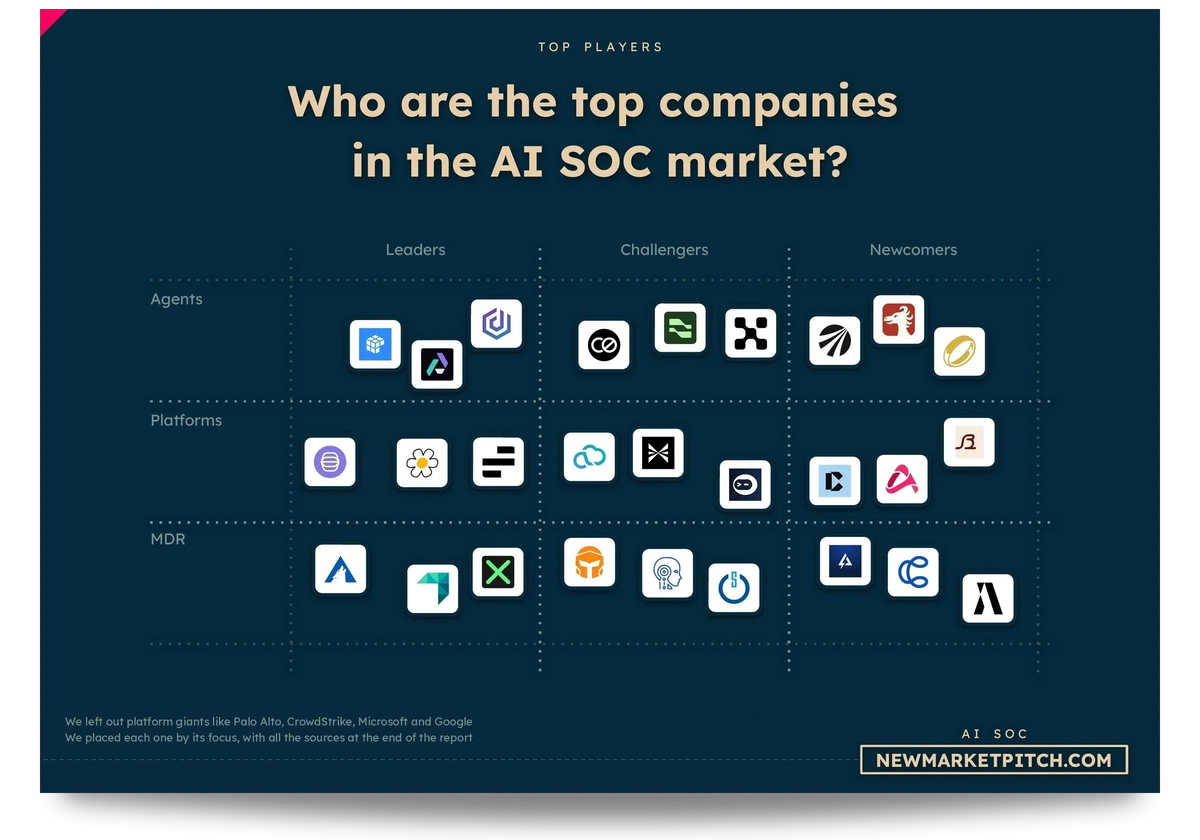
In our research about AI security operations, we turn what is vague and complex into simple, useful visuals. Market maps like this one show you at a glance where every startup stands.
Mate Security raised $35 million in a Series A round in July 2026 to expand its agentic SOC platform.
When was it?
Mate Security publicly announced the financing on July 29, 2026, following earlier reporting about the transaction.
Who are they?
Mate Security builds AI agents that learn an organization's systems and business context before investigating alerts, developing detections, hunting for threats and supporting incident response.
Geographical focus?
Mate is based in Tel Aviv, Israel, and targets large enterprise security teams and security service providers in international markets.
Why do we include them in the AI SOC market?
Mate is a direct AI SOC provider because its agents automate detection engineering, threat triage, investigations and response using a continuously updated organizational context graph.
What is the company stage?
Mate is in early commercial growth, having emerged from stealth in late 2025 and subsequently raised additional capital to expand its customer-facing and technical teams.
How much did they raise?
Mate secured $35 million in the Series A, bringing its total reported funding to more than $50 million.
What round is it?
The investment was a Series A led by Canaan Partners, with participation from Insight Partners, Microsoft's M12 and Team8.
Why did they raise?
Mate plans to expand research, sales and customer support while building an AI SOC that improves its understanding of enterprise environments as it processes more investigations.
Abstract Security secured $25 million in growth financing in July 2026 for its AI-native security operations platform.
When was it?
Abstract Security published its financing announcement on July 22, 2026, with independent industry reporting following on July 23.
Who are they?
Abstract Security develops a composable security operations platform that processes incoming security data, runs detections and supports AI-assisted investigations and incident response.
Geographical focus?
Abstract is based in the United States and focuses on enterprise customers managing complex security data and monitoring requirements.
Why do we include them in the AI SOC market?
Abstract belongs to the AI-native SOC infrastructure category because it embeds AI into detection, triage, investigation and response rather than treating automation as a separate feature.
What is the company stage?
Abstract is in commercial growth, reporting 380% annual recurring revenue growth, 264% net revenue retention and a tripling of its customer base before the financing.
How much did they raise?
Abstract received $25 million in new investment, bringing its total disclosed funding to nearly $50 million.
What round is it?
The transaction was announced as strategic growth financing, co-led by Cheyenne Ventures and AVP, with participation from Olive Hill Ventures, Crosslink Capital and Rally Ventures.
Why did they raise?
Abstract intends to extend real-time detection capabilities, integrate AI more deeply across security operations and strengthen its commercial team as customers reconsider traditional SIEM platforms.

Your time is limited. In our market report about AI security operations, we put numbers on each part of the market, so you can see where it makes sense to focus.
Nebulock raised $25 million in Series A financing in June 2026 for autonomous threat hunting.
When was it?
Nebulock announced the investment on June 25, 2026.
Who are they?
Nebulock develops AI security agents that continuously search enterprise systems for suspicious activity and investigate possible threats before conventional alerts necessarily appear.
Geographical focus?
Nebulock is based in the United States and targets enterprise customers across financial services, healthcare and technology, including large multinational organizations.
Why do we include them in the AI SOC market?
Nebulock is a direct match for autonomous threat hunting and SOC investigation because its software actively identifies and examines suspicious behavior instead of relying exclusively on existing alert queues.
What is the company stage?
Nebulock is in early commercial growth, reporting Fortune 500 adoption and more than 300 million AI-driven investigations roughly nine months after emerging from stealth.
How much did they raise?
Nebulock secured $25 million in new Series A funding.
What round is it?
The Series A was led by FirstMark, alongside Bain Capital Ventures, Decibel, Zetta Venture Partners and Step Function Ventures.
Why did they raise?
Nebulock plans to extend autonomous hunting into more investigation and response workflows, helping security teams identify meaningful threats that might otherwise remain unnoticed.
Exaforce secured $125 million in a Series B round in May 2026, reaching a reported $725 million valuation.
When was it?
Exaforce announced the financing on May 12, 2026.
Who are they?
Exaforce develops an AI security operations platform that combines real-time security data, a knowledge graph and autonomous agents to detect, investigate and respond to cyber threats.
Geographical focus?
Exaforce is headquartered in the United States and serves enterprise customers, with international expansion included in its growth strategy.
Why do we include them in the AI SOC market?
Exaforce is a core agentic SOC provider because its platform automates alert analysis, contextual investigation, threat prioritization and incident response through connected AI workflows.
What is the company stage?
Exaforce is in the scaling stage, having grown to more than 130 employees and reported processing millions of security investigations by the time of its Series B.
How much did they raise?
Exaforce raised $125 million in new capital, bringing cumulative funding to $200 million and reaching an approximately $725 million valuation reported by TechCrunch.
What round is it?
The financing was a Series B backed by HarbourVest, Peak XV, Mayfield, Khosla Ventures and Seligman Ventures, among other investors.
Why did they raise?
Exaforce plans to strengthen its real-time AI reasoning, automate more complex investigation tasks and expand internationally as enterprise demand for AI-driven security operations grows.

In our document detailing everything you need to know about AI SOC, we always try to gather several sources and make estimates that make sense, so you can work with solid numbers.
Artemis Security disclosed a $55 million Series A in April 2026 as part of a $70 million combined financing announcement.
When was it?
Artemis Security announced its financing and public launch on April 15, 2026.
Who are they?
Artemis Security builds AI-native cybersecurity software that learns how an organization operates, connects suspicious activity across systems and helps security teams detect and respond to attacks.
Geographical focus?
Artemis is based in the United States, was founded by Israeli entrepreneurs and targets large enterprises operating complex cloud and identity environments.
Why do we include them in the AI SOC market?
Artemis belongs to the AI-native threat detection and investigation category because its platform connects security signals into contextual investigations and supports automated defensive responses.
What is the company stage?
Artemis was at an early commercial stage when it emerged from stealth, with an initial enterprise product, approximately 30 employees and plans to expand its workforce.
How much did they raise?
Artemis disclosed $70 million across its seed and Series A rounds, implying a $55 million Series A after subtracting the separately reported $15 million seed financing.
What round is it?
The latest identified financing was a Series A led by Felicis, following a seed round co-led by First Round Capital and Brightmind.
Why did they raise?
Artemis intends to develop security software that understands each customer's business environment, allowing its agents to investigate connected threats without requiring analysts to reconstruct organizational context manually.
Surf AI announced $57 million in combined seed and Series A funding in March 2026.
When was it?
Surf AI publicly announced its launch and accumulated financing on March 17, 2026.
Who are they?
Surf AI builds security automation agents that connect information from cloud, identity, IT and business systems to identify risks and coordinate remediation across teams.
Geographical focus?
Surf is based in New York, has Israeli founding roots and targets multinational enterprises managing complex security operations.
Why do we include them in the AI SOC market?
Surf fits the broader security operations automation category because its agents coordinate remediation work, although its product emphasizes proactive exposure reduction rather than conventional alert investigation.
What is the company stage?
Surf was in early commercial growth when it emerged publicly, with an operating platform and reported relationships with large international organizations.
How much did they raise?
Surf disclosed $57 million across seed and Series A financing, but the individual amount attributable to the latest round was not established in the announcement.
What round is it?
The reported financing covered seed and Series A investments backed by Accel, Cyberstarts and Boldstart Ventures, with Accel leading the financing disclosed at launch.
Why did they raise?
Surf plans to expand its product and engineering teams and develop AI agents that manage risk remediation without requiring repeated handoffs between security, IT and other departments.

Our report covering the AI SOC market gets updated several times a month, so you always get the latest view of where things stand.
Kai Security disclosed $125 million across seed and Series A financing in March 2026.
When was it?
Kai Security announced its emergence from stealth and combined financing on March 10, 2026.
Who are they?
Kai Security develops an autonomous cybersecurity platform that analyzes threats, evaluates risks and coordinates defensive tasks across enterprise IT and operational technology environments.
Geographical focus?
Kai is based in San Jose, California, and targets large organizations in industries including energy, pharmaceuticals, automotive and other industrial sectors.
Why do we include them in the AI SOC market?
Kai fits the autonomous security operations category because its AI platform performs detection, analysis and defensive actions, although its wider capabilities also include vulnerability management and security risk assessment.
What is the company stage?
Kai was in early commercial growth when it launched publicly, reporting initial customers and significant bookings during its first year of operations.
How much did they raise?
Kai disclosed $125 million raised across its seed and Series A rounds, without specifying the size of each individual financing.
What round is it?
The announcement covered seed and Series A funding led by Evolution Equity Partners, with participation from N47 and other investors.
Why did they raise?
Kai plans to expand AI research, product development and commercial operations while connecting security workflows that traditionally remain separated between enterprise IT and industrial environments.
Qevlar AI raised $30 million in March 2026 to expand its autonomous SOC investigation platform.
When was it?
Qevlar AI publicly announced the financing on March 10, 2026, following an Axios report published the previous day.
Who are they?
Qevlar AI develops autonomous security investigation agents that examine alerts, correlate evidence across security tools and identify attack patterns that help teams prioritize real threats.
Geographical focus?
Qevlar operates across France and the United States and serves international enterprises and managed security service providers, including customers such as Mercedes-Benz and Sodexo.
Why do we include them in the AI SOC market?
Qevlar is a direct AI SOC provider because its core product automates security alert investigation, evidence correlation, threat triage and the identification of recurring incident patterns.
What is the company stage?
Qevlar is in commercial growth, with an established enterprise customer base and distribution through major managed security service providers, including Orange Cyberdefense.
How much did they raise?
Qevlar secured $30 million in new financing, bringing its cumulative disclosed funding to approximately $45 million.
What round is it?
The company announced a venture funding round jointly led by Partech and Forgepoint Capital International, with participation from EQT Ventures, without specifying a Series label in its public release.
Why did they raise?
Qevlar plans to expand its team and international presence while extending its product from individual alert investigations toward identifying the underlying weaknesses that cause repeated security incidents.

In our research about AI security operations, we look at what the winners do differently, so you can learn from the best instead of guessing.
RADICL raised $31 million in Series A financing in February 2026 to expand its autonomous virtual SOC.
When was it?
RADICL announced the Series A funding on February 3, 2026.
Who are they?
RADICL provides an AI-enabled virtual security operations center that combines automated monitoring, threat investigation and incident response with managed cybersecurity services.
Geographical focus?
RADICL focuses on the United States, particularly smaller defense contractors, critical infrastructure suppliers and businesses operating in regulated sectors.
Why do we include them in the AI SOC market?
RADICL belongs to the autonomous virtual SOC category because AI agents support security detection, investigation and response, although the commercial offering also relies on human-managed security services.
What is the company stage?
RADICL is in commercial growth, expanding an established virtual SOC offering for smaller organizations that need continuous cybersecurity coverage.
How much did they raise?
RADICL secured $31 million in new funding, bringing its cumulative disclosed financing to $42 million.
What round is it?
The financing was a Series A led by Paladin Capital Group, with participation from Access Venture Partners, Denver Ventures and Cervin Ventures.
Why did they raise?
RADICL plans to improve autonomous monitoring and response capabilities while making continuous security operations more accessible to smaller businesses that cannot maintain large internal cybersecurity teams.
Torq secured $140 million in a Series D round in January 2026, reaching a $1.2 billion valuation.
When was it?
Torq's financing was reported on January 11 and formally announced by the company on January 12, 2026.
Who are they?
Torq develops an AI security operations platform that automates alert investigations, coordinates actions across cybersecurity tools and helps enterprises respond to incidents faster.
Geographical focus?
Torq operates internationally from its Israeli and U.S. business presence, serving large enterprises and expanding into the U.S. federal government market.
Why do we include them in the AI SOC market?
Torq is a core AI SOC platform because its agents automate security investigations, alert triage, incident response and the operational workflows traditionally handled by SOC analysts and automation teams.
What is the company stage?
Torq is in advanced commercial growth, with enterprise customers, expanding public-sector ambitions and a reported valuation above $1 billion.
How much did they raise?
Torq raised $140 million in new funding, bringing its cumulative financing to $332 million at a disclosed $1.2 billion valuation.
What round is it?
The financing was a Series D led by Merlin Ventures, with participation from Evolution Equity Partners, Notable Capital, Bessemer Venture Partners, Insight Partners and Greenfield Partners.
Why did they raise?
Torq intends to scale its AI SOC platform, expand enterprise distribution and enter government security environments where high alert volumes and manual investigation workflows create substantial operational demands.
Written by the New Market Pitch teamWe track new markets so founders and investors can move faster. About us