AI SOC funding tracker (100+ deals)
Whether you're building or investing in the AI SOC market, our report covers everything you need to know: the players, the money, and what's coming next.
Summary
AI SOC has become a substantial venture-backed market: we count 109 deals across 74 companies and at least $3.3B in financing so far. ReliaQuest accounts for the largest single financing, a $500M+ Growth Equity round in March 2025.
Most AI SOC checks are much smaller than the biggest announcements. A typical round is nowhere near a giant growth investment.
Large checks nevertheless matter disproportionately. Just 9 deals of $100M or more account for $1.7B of disclosed capital, while funding without those nine checks still reaches at least $1.6B.
Investors also back young security teams. Seed financings account for 58 deals, alongside 24 Series A rounds, creating a large early-stage cohort.
The companies receiving funding are also young. The median company age at financing is 2 years, and 76% of funded companies were founded since 2022.
Fundraising repeats, but not for everyone. Some 31 companies raised in multiple rounds during the covered window, while 43 companies completed one tracked round.
Capital also goes to different parts of the security workflow. Autonomous investigation and triage lead on both deal activity and disclosed capital, with incident response automation second on each.
The deals are heavily concentrated geographically. The United States accounts for 83 deals, while Israel has become an important second hub for operational security AI products.
Plenty of investors are active, but few repeatedly lead rounds. Our records contain 147 distinct investors and 99 distinct disclosed lead investors.
AI SOC is a real funding market, with new companies getting checks and a few outsized rounds setting the headline.

Written by the New Market Pitch teamWe track new markets so founders and investors can move faster. About us

In our report covering the AI SOC market, you will always find fresh funding data, taken straight from our own verified funding database.
Our funding tracker covering the AI SOC market
Below is the table listing all the deals. You can find our methodology at the end of this page.
If you want a deeper understanding of the market and its current dynamics, get our AI SOC market report.
| Company | Category | Date | Stage | Deal size | What they do | Region | Lead investors | Country | Rank |
|---|---|---|---|---|---|---|---|---|---|
| Daylight Security | AI-First Managed SOC | November 2026 | Series B | $80M | Hybrid AI and human cyber defense | North America | Goldman Sachs Alternatives | United States | |
| Brava Security | Detection Engineering | November 2026 | Seed | $15M | Multi-agent security operations platform that generates attack telemetry, validates detection coverage, and rewrites SIEM detections. | Middle East | F2 Venture Capital, Pitango | Israel | |
| CyberKord | Incident Response Automation | November 2026 | Seed | ~$3.1M | AI platform that investigates security alerts, simulates remediation in a digital twin, and autonomously contains or resolves incidents across existing security tools. | Europe | 360 Capital | Italy | |
| Mave | SOC Copilots | October 2026 | Series A | $28M | Agentic enterprise security operations platform | Middle East | Red Dot Capital Partners | Israel | |
| Mave | SOC Copilots | October 2026 | Seed | $6M | Agentic enterprise security operations platform | Middle East | Dell Technologies Capital, Emerge Ventures | Israel | |
| StrikeReady | SOC Copilots | September 2026 | Unknown | Undisclosed | AI-powered SOC command and assistance | North America | Not disclosed | United States | |
| Corma | SOC Copilots | August 2026 | Seed | $60M | Defensive cybersecurity foundation models | Middle East | Sequoia Capital | Israel | |
| Mate Security | Autonomous Investigation & Triage | July 2026 | Series A | $35M | Autonomous AI SOC investigation agents | Middle East | Canaan Partners | Israel | |
| Beelzebub | Incident Response Automation | July 2026 | Seed | ~$3.4M | AI-native deception and autonomous defense platform that detects intrusions, investigates attacker activity and isolates compromised systems automatically. | Europe | United Ventures | Italy | |
| Abstract Security | Autonomous Investigation & Triage | July 2026 | Series A | $25M | Security analytics and SIEM platform | North America | Cheyenne Ventures, AVP | United States | |
| Beacon Security | Autonomous Investigation & Triage | July 2026 | Seed | $13M | AI security operations investigation platform | North America | Notable Capital | United States | |
| Nebulock | Threat Hunting | June 2026 | Series A | $25M | Autonomous threat hunting and response | North America | FirstMark | United States | |
| Strand Intelligence | Autonomous Investigation & Triage | June 2026 | Seed | $1.3M | AI security operations investigation platform | Europe | Osney Capital | United Kingdom | |
| Imperum | SOC Copilots | June 2026 | Seed | Undisclosed | Autonomous security operations center software | Europe | Curiosity VC | Netherlands | |
| Exaforce | Autonomous Investigation & Triage | May 2026 | Series B | $125M | Autonomous AI-powered security operations | North America | HarbourVest Partners | United States | |
| Copperhelm | Incident Response Automation | April 2026 | Seed | $7M | AI security operations platform | Middle East | TLV Partners | Israel | |
| Rilian | Case Management & Orchestration | April 2026 | Seed | Undisclosed | Agentic security investigation and orchestration | North America | 8VC, First In, Tamarack Global | United States | |
| Spectrum Security | Detection Engineering | April 2026 | Seed | $19M | Autonomous security operations and threat detection | North America | TechOperators | United States | |
| Artemis Security | Incident Response Automation | April 2026 | Series A | $55M | AI-native threat detection and response | North America | Felicis | United States | |
| Artemis Security | Incident Response Automation | April 2026 | Seed | $15M | AI-native threat detection and response | North America | First Round Capital, Brightmind Partners | United States | |
| Mallory | Autonomous Investigation & Triage | April 2026 | Seed | Undisclosed | AI security operations investigation agents | North America | Decibel | United States | |
| TENEX.AI | AI-First Managed SOC | March 2026 | Series B | $250M | AI-native managed detection and response | North America | Crosspoint Capital Partners | United States | |
| Kai Security | Autonomous Investigation & Triage | March 2026 | Unknown | $125M | Autonomous cybersecurity investigation and response | North America | Evolution Equity Partners | United States | |
| Qevlar AI | Autonomous Investigation & Triage | March 2026 | Series A | $30M | Autonomous security alert investigation agents | Europe | Partech, Forgepoint Capital International | France | |
| Cotool | Case Management & Orchestration | March 2026 | Seed | $7.4M | Agent operating system for cybersecurity | North America | Andreessen Horowitz | United States | |
| Fig Security | Detection Engineering | March 2026 | Series A | $30M | Security operations resilience software | Middle East | Ten Eleven Ventures | Israel | |
| Prophet Security | Autonomous Investigation & Triage | February 2026 | Unknown | Undisclosed | Agentic AI security operations platform | North America | Not disclosed | United States | |
| Cydelphi | Incident Response Automation | February 2026 | Seed | $3M | AI digital forensics and incident response | North America | Glasswing Ventures | United States | |
| CounterShadow | Autonomous Investigation & Triage | February 2026 | Seed | Undisclosed | Autonomous AI security operations platform | Europe | Tachles VC | United Kingdom | |
| Vega Security | Detection Engineering | February 2026 | Series B | $120M | Distributed AI-native threat detection platform | North America | Accel | United States | |
| RADICL | AI-First Managed SOC | February 2026 | Series A | $31M | Managed cybersecurity and compliance platform | North America | Paladin Capital Group | United States | |
| Sevii | Autonomous Investigation & Triage | February 2026 | Seed | Undisclosed | Autonomous cyber defense and incident response | North America | Not disclosed | United States | |
| AiStrike | Autonomous Investigation & Triage | January 2026 | Seed | $7M | AI-native preemptive cyber defense | North America | Blumberg Capital | United States | |
| Asymmetric Security | Autonomous Investigation & Triage | January 2026 | Seed | $4.2M | AI-driven cyber forensics and incident response | North America | Susa Ventures | United States | |
| Torq | Case Management & Orchestration | January 2026 | Series D+ | $140M | Agentic AI security operations automation | North America | Merlin Ventures | United States | |
| 7AI | Autonomous Investigation & Triage | December 2025 | Series A | $130M | Autonomous AI security operations agents | North America | Index Ventures | United States | |
| Cognna | Incident Response Automation | December 2025 | Series A | $9.2M | Agentic AI security operations platform | Middle East | Impact46, BNVT Capital | Saudi Arabia | |
| PRE Security | Detection Engineering | December 2025 | Seed | Undisclosed | AI-native security automation platform | North America | Not disclosed | United States | |
| Method Security | SOC Copilots | November 2025 | Seed | $26M | AI-driven synthetic security engineers | North America | Andreessen Horowitz, General Catalyst | United States | |
| Mate Security | Autonomous Investigation & Triage | November 2025 | Seed | $16M | Autonomous AI SOC investigation agents | Middle East | Team8, Insight Partners | Israel | |
| Secure.com | SOC Copilots | November 2025 | Seed | $4.5M | AI-powered digital security teammates | North America | Disrupt.com | United States | |
| Daylight Security | AI-First Managed SOC | November 2025 | Series A | $33M | Hybrid AI and human cyber defense | North America | Craft Ventures | United States | |
| AiStrike | Autonomous Investigation & Triage | November 2025 | Unknown | $5.1M | AI-native preemptive cyber defense | North America | Not disclosed | United States | |
| Rilevera | Incident Response Automation | November 2025 | Seed | $3M | Automated security operations and threat response | North America | DataTribe | United States | |
| RedCarbon | Autonomous Investigation & Triage | October 2025 | Series A | $3.3M | AI security operations and threat triage | Europe | Azimut Venture Capital Digitech Europe | Italy | |
| Bricklayer AI | Autonomous Investigation & Triage | October 2025 | Seed | $5M | Autonomous AI security analysts | North America | Tech Square Ventures | United States | |
| Conifers | Autonomous Investigation & Triage | October 2025 | Growth Equity | Undisclosed | Agentic AI security operations platform | North America | Washington Harbour Partners | United States | |
| TENEX.AI | AI-First Managed SOC | September 2025 | Series A | $27M | AI-native managed detection and response | North America | Crosspoint Capital Partners | United States | |
| Simbian | Autonomous Investigation & Triage | September 2025 | Unknown | Undisclosed | AI-powered autonomous security operations | North America | Not disclosed | United States | |
| Miru Labs | Autonomous Investigation & Triage | September 2025 | Seed | $2.7M | AI-native cybersecurity investigation graph platform | North America | Seedcamp, Dreamcraft, Cadenza | United States | |
| WiseBee | Autonomous Investigation & Triage | August 2025 | Seed | $2.5M | AI-driven autonomous security operations | North America | Frontline Ventures, BrightCap Ventures | United States | |
| Command Zero | Autonomous Investigation & Triage | July 2025 | Unknown | $10M | AI-powered autonomous cyber investigations | North America | Not disclosed | United States | |
| Legion Security | Autonomous Investigation & Triage | July 2025 | Series A | $30M | Browser-native autonomous AI SOC analyst | North America | Coatue | United States | |
| Prophet Security | Autonomous Investigation & Triage | July 2025 | Series A | $30M | Agentic AI security operations platform | North America | Accel | United States | |
| Nebulock | Threat Hunting | July 2025 | Seed | $6M | Autonomous threat hunting and response | North America | Bain Capital Ventures | United States | |
| BlinkOps | Case Management & Orchestration | July 2025 | Series B | $50M | AI-powered security automation platform | North America | O.G. Venture Partners | United States | |
| Daylight Security | AI-First Managed SOC | July 2025 | Seed | $7M | Hybrid AI and human cyber defense | North America | Bain Capital Ventures | United States | |
| Dropzone AI | Autonomous Investigation & Triage | July 2025 | Series B | $37M | Autonomous AI security alert investigations | North America | Theory Ventures | United States | |
| AirMDR | AI-First Managed SOC | July 2025 | Seed | $11M | AI-native managed detection and response | North America | Race Capital | United States | |
| RunReveal | Detection Engineering | July 2025 | Seed | $7M | AI-native security data analytics platform | North America | Not disclosed | United States | |
| Circumvent | Incident Response Automation | June 2025 | Seed | $6M | AI-driven cloud security and remediation | North America | Paladin Capital Group | United States | |
| Swimlane | Case Management & Orchestration | June 2025 | Growth Equity | $45M | Agentic AI security automation platform | North America | Activate Capital, Energy Impact Partners | United States | |
| BreachRx | Incident Response Automation | May 2025 | Series A | $15M | Incident response coordination and automated response plans | North America | Ballistic Ventures | United States | |
| Sevii | Autonomous Investigation & Triage | April 2025 | Seed | Undisclosed | Autonomous cyber defense and incident response | North America | Overline | United States | |
| Kenzo Security | Autonomous Investigation & Triage | April 2025 | Seed | $4.5M | AI-driven security operations automation | North America | The General Partnership | United States | |
| Exaforce | Autonomous Investigation & Triage | April 2025 | Series A | $75M | Autonomous AI-powered security operations | North America | Khosla Ventures, Mayfield, Thomvest Ventures | United States | |
| Sekoia | Incident Response Automation | April 2025 | Series B | $29M | AI-native cyber detection and response | Europe | Revaia | France | |
| Qevlar AI | Autonomous Investigation & Triage | April 2025 | Seed | $10M | Autonomous security alert investigation agents | Europe | EQT Ventures, Forgepoint Capital International | France | |
| ReliaQuest | Incident Response Automation | March 2025 | Growth Equity | $500M+ | AI-powered security operations automation | North America | EQT | United States | |
| RAD Security | Detection Engineering | March 2025 | Series A | $14M | AI-driven cloud threat detection platform | North America | Cheyenne Ventures | United States | |
| Crogl | Autonomous Investigation & Triage | March 2025 | Series A | $25M | Autonomous AI cybersecurity investigation agents | North America | Menlo Ventures | United States | |
| Crogl | Autonomous Investigation & Triage | March 2025 | Seed | $5M | Autonomous AI cybersecurity investigation agents | North America | Tola Capital, Firestreak Ventures | United States | |
| Zaun | SOC Copilots | March 2025 | Seed | $1.5M | AI agents for security operations centers | North America | Not disclosed | United States | |
| Andesite | SOC Copilots | February 2025 | Seed | $23M | AI-powered security operations platform | North America | General Catalyst, Red Cell Partners | United States | |
| 7AI | Autonomous Investigation & Triage | February 2025 | Seed | $36M | Autonomous AI security operations agents | North America | Not disclosed | United States | |
| Backline | Incident Response Automation | January 2025 | Seed | $9M | AI agents automate security remediation | North America | StageOne Ventures | United States | |
| Conifers | Autonomous Investigation & Triage | January 2025 | Seed | $25M | Agentic AI security operations platform | North America | SYN Ventures | United States | |
| Mitiga | Incident Response Automation | January 2025 | Series B | $30M | Cloud and AI agent security | Middle East | SYN Ventures | Israel | |
| CounterShadow | Autonomous Investigation & Triage | January 2025 | Seed | Undisclosed | Autonomous AI security operations platform | Europe | Not disclosed | United Kingdom | |
| Fig Security | Detection Engineering | 2025 | Seed | $8M | Security operations resilience software | Middle East | Team8 | Israel | |
| System Two Security | Detection Engineering | December 2024 | Seed | $7M | AI threat hunting and detection engineering | North America | Costanoa Ventures | United States | |
| Tuskira | Detection Engineering | December 2024 | Unknown | $29M | AI-powered unified threat defense platform | North America | Intel Capital, SYN Ventures | United States | |
| Cognna | Incident Response Automation | November 2024 | Unknown | Undisclosed | Agentic AI security operations platform | Middle East | Saudi Telecom Company (stc) | Saudi Arabia | |
| Embed Security | Autonomous Investigation & Triage | November 2024 | Seed | $6M | AI-powered security alert triage | North America | Paladin Capital Group | United States | |
| ContraForce | Incident Response Automation | October 2024 | Seed | $3.3M | AI security operations and incident response software | North America | Gallos Technologies, DataTribe | United States | |
| Abstract Security | Autonomous Investigation & Triage | October 2024 | Series A | $15M | Security analytics and SIEM platform | North America | Munich Re Ventures | United States | |
| Torq | Case Management & Orchestration | September 2024 | Series C | $70M | Agentic AI security operations automation | North America | Evolution Equity Partners | United States | |
| Intezer | Autonomous Investigation & Triage | September 2024 | Series C | $33M | AI-driven security investigation and triage | North America | Norwest | United States | |
| BlinkOps | Case Management & Orchestration | September 2024 | Growth Equity | $24M | AI-powered security automation platform | North America | Not disclosed | United States | |
| Command Zero | Autonomous Investigation & Triage | July 2024 | Seed | $21M | AI-powered autonomous cyber investigations | North America | Andreessen Horowitz | United States | |
| Legion Security | Autonomous Investigation & Triage | July 2024 | Seed | $8M | Browser-native autonomous AI SOC analyst | North America | Accel, Picture Capital | United States | |
| Huntress | Incident Response Automation | June 2024 | Series D+ | $150M | Managed cybersecurity detection and response | North America | Kleiner Perkins, Meritech Capital, Sapphire Ventures | United States | |
| AirMDR | AI-First Managed SOC | June 2024 | Seed | $5M | AI-native managed detection and response | North America | Foundation Capital | United States | |
| Bricklayer AI | Autonomous Investigation & Triage | May 2024 | Seed | $2.5M | Autonomous AI security analysts | North America | Not disclosed | United States | |
| RunReveal | Detection Engineering | May 2024 | Seed | $2.5M | AI-native security data analytics platform | North America | Costanoa Ventures | United States | |
| Corelight | Detection Engineering | April 2024 | Series D+ | $150M | Network detection and threat response | North America | Accel | United States | |
| Dropzone AI | Autonomous Investigation & Triage | April 2024 | Series A | $17M | Autonomous AI security alert investigations | North America | Theory Ventures | United States | |
| Prophet Security | Autonomous Investigation & Triage | April 2024 | Seed | $11M | Agentic AI security operations platform | North America | Bain Capital Ventures | United States | |
| Anvilogic | Detection Engineering | April 2024 | Series C | $45M | AI-driven security detection engineering platform | North America | Evolution Equity Partners | United States | |
| BreachRx | Incident Response Automation | April 2024 | Seed | $6.5M | Incident response coordination and automated response plans | North America | Not disclosed | United States | |
| Andesite | SOC Copilots | April 2024 | Seed | $15M | AI-powered security operations platform | North America | Red Cell Partners, General Catalyst | United States | |
| Simbian | Autonomous Investigation & Triage | April 2024 | Seed | $10M | AI-powered autonomous security operations | North America | Cota Capital, Icon Ventures, Firebolt, Secure Octane, Rain Capital | United States | |
| StrikeReady | SOC Copilots | April 2024 | Series A | $12M | AI-powered SOC command and assistance | North America | 33N Ventures | United States | |
| Surge | Autonomous Investigation & Triage | March 2024 | Seed | $5.8M | AI-driven security operations | Europe | Eurazeo | France | |
| LimaCharlie | Case Management & Orchestration | February 2024 | Series A | $10M | API-first security operations infrastructure platform | North America | Sands Capital | United States | |
| Torq | Case Management & Orchestration | January 2024 | Series B | $42M | Agentic AI security operations automation | North America | Not disclosed | United States | |
| Nebulock | Threat Hunting | 2024 | Seed | $2.5M | Autonomous threat hunting and response | North America | Not disclosed | United States | |
| PRE Security | Detection Engineering | January 2024 | Seed | Undisclosed | AI-native security automation platform | North America | strategic channel partners | United States |

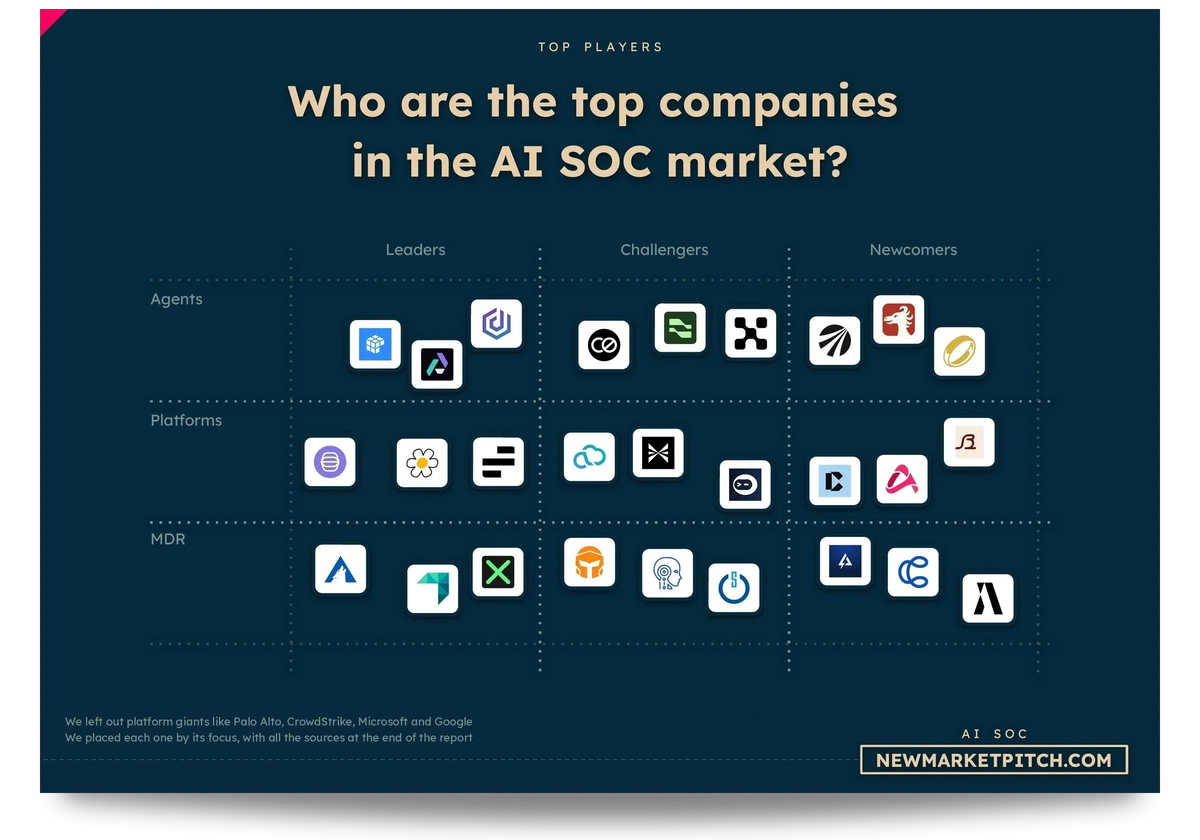
In our research about AI security operations, we turn what is vague and complex into simple, useful visuals. Market maps like this one show you at a glance where every startup stands.
How much money have AI SOC startups actually raised?
AI SOC startups have already raised at least $3.3B across 109 deals, spread over the 74 companies we track.
That total includes companies whose primary product operates the security operations center: autonomous alert investigation, threat hunting, detection engineering, response orchestration and AI-led managed defense. General cybersecurity companies do not qualify merely because they advertise AI. Exaforce's $125M Series B in May 2026, 7AI's $130M Series A in December 2025 and Dropzone AI's $37M Series B in July 2025 show how investors fund different parts of the SOC workflow. Each amount refers to an individual round.
Does one giant AI SOC round explain the whole market?
No single AI SOC financing explains the market, even though ReliaQuest accounts for its largest round.
ReliaQuest's March 2025 Growth Equity announcement was for $500M+, with EQT, KKR and FTV Capital involved. The company says its GreyMatter platform connects hundreds of security tools and automates investigations and response. By contrast, Torq raised a $140M Series D+ in January 2026 to expand agentic workflow orchestration, while 7AI raised a $130M Series A in December 2025 for autonomous security agents. The large checks span several business models. ReliaQuest is the largest single deal, not the entire funding story.

Your time is limited. In our market report about AI security operations, we put numbers on each part of the market, so you can see where it makes sense to focus.
Are nine-figure AI SOC funding rounds becoming normal?
Nine-figure AI SOC rounds remain unusual, with only 9 deals of $100M or more, or 8% of all financings.
Those rounds represent $1.7B of disclosed capital, which explains why a market with a much smaller typical check can still post a multibillion-dollar headline. TENEX.AI's $250M Series B in March 2026, Vega Security's $120M Series B in February 2026 and Exaforce's $125M Series B in May 2026 are examples of substantial commitments to distinct operating models. The typical AI SOC startup raises much less.
Would AI SOC funding still matter without the megadeals?
Even without rounds above $50M, AI SOC startups still raised at least $1.3B.
The market still has a large pool of smaller investments once those huge rounds are removed. The 14 outsized financings account for 13% of deals and $2.0B of disclosed capital. Those smaller checks support new products, specialist security tools and expansion into enterprise accounts.
How big is a typical AI SOC funding round?
A typical AI SOC funding round is $15M, the median of all rounds with a public amount.
Most rounds with a public amount sit well below $50M: 16 are under $5M, 38 are from $5M to under $20M and 26 are from $20M to under $50M. Seed-stage companies often fund a product and first sales motion, while a company such as Dropzone AI used its $37M Series B in July 2025 to expand AI SOC analysts and customer integrations. Not every startup will follow Dropzone AI into larger rounds.

In our document detailing everything you need to know about AI SOC, we always try to gather several sources and make estimates that make sense, so you can work with solid numbers.
Is AI SOC creating new funded startups or recycling the same winners?
AI SOC investors are funding new startups as well as backing companies that have raised before.
We classify 40 deals as first financings and 56 as follow-ons; 13 have unknown financing history. The first-financing cohort represents 37% of deals but 18% of disclosed capital, whereas follow-ons account for 51% of deals and 79% of disclosed capital. New teams still get funded, but investors commit much more money to companies they know. Examples range from small early rounds to successive raises by Torq, Exaforce and TENEX.AI.
Why did investors put so much money into TENEX.AI?
TENEX.AI attracted a major AI SOC investment by combining AI automation with a managed security service staffed by people.
TENEX.AI raised $277M in 2 tracked rounds, including a $250M Series B in March 2026 led by Crosspoint Capital Partners. In its announcement, the company said the money would fund additional analysts, engineers, international expansion and AI development. That is a very different use of capital from a lightweight alert-analysis tool: the business combines automation with humans who remain accountable for security decisions. It is a bigger operational bet than selling a standalone triage tool.

Our report covering the AI SOC market gets updated several times a month, so you always get the latest view of where things stand.
Is Torq still raising big money for security automation?
Torq is still drawing large checks for AI SOC automation, with $252M raised across its last 3 rounds.
Torq's $70M Series C in September 2024 backed the expansion of its automation platform, and its $140M Series D+ in January 2026 extended that effort into agentic security operations. Torq's stated product focus is orchestration across tools and workflows rather than replacing every component of a security stack. Torq has reached later-stage funding while many AI analyst startups are still at seed or Series A.
Is autonomous alert investigation getting the most AI SOC deals?
Autonomous investigation and triage gets the most AI SOC deals, with 35 rounds across 23 companies.
Autonomous investigation and triage makes up 32% of deals but only 20% of disclosed capital: lots of rounds, but not the most money. Companies such as Dropzone AI, Prophet Security and Qevlar AI target the repetitive work of interpreting alerts, assembling context and preparing cases for analysts. Dropzone's enterprise deployment claims, Prophet's agentic SOC launch and Qevlar's emphasis on turning investigations into broader security insights all point to the same buyer problem. Investors clearly want the problem solved, but no single product approach has won.
Which parts of AI SOC actually attract the most money?
Autonomous investigation and triage gets the most disclosed AI SOC funding and also sees the most deals, ahead of incident response automation on both.
Autonomous investigation and triage accounts for at least $946M and 29% of disclosed capital, compared with at least $847M for incident response automation. Case management and orchestration is also substantial, partly because enterprise workflows require integrations, approvals, auditability and coordination across existing tools. Investigating an alert and safely containing an attack demand different levels of trust from buyers.
The table below shows how the seven AI SOC categories compare, ordered by disclosed capital.
| Category | Deals | Capital | Capital share |
|---|---|---|---|
| Incident Response Automation | 22 | $1.0B+ | 30% |
| Autonomous Investigation & Triage | 35 | $651M+ | 20% |
| Case Management & Orchestration | 11 | $589M+ | 18% |
| Detection Engineering | 15 | $449M+ | 14% |
| AI-First Managed SOC | 4 | $292M | 9% |
| SOC Copilots | 19 | $272M+ | 8% |
| Threat Hunting | 3 | $34M | 1% |
“+” means at least; financing amounts are not public for every deal.

In our research about AI security operations, we look at what the winners do differently, so you can learn from the best instead of guessing.
Are AI SOC investors still mostly funding seed-stage companies?
Seed is still the most common AI SOC funding stage, with 58 deals involving 50 companies.
Series A adds 24 deals, and after that the number of rounds drops fast. Early-stage financings represent 81% of deals with a named stage, yet only 41% of disclosed capital; later-stage financings attract 59% of the money with a public amount. Many startups are getting early checks, while a small group takes the expensive later rounds.
The table below shows the financing stages in the AI SOC market, ordered by disclosed capital rather than by stage sequence.
| Stage | Deals | Capital | Median round |
|---|---|---|---|
| Series A | 24 | $830M | $28M |
| Series B | 9 | $763M | $50M |
| Growth Equity | 4 | $569M+ | $45M |
| Seed | 58 | $488M+ | $7M |
| Series D+ | 3 | $440M | $150M |
| Series C | 3 | $148M | $45M |
| Unknown | 8 | $52M+ | $9M |
“+” indicates a minimum; some financings have undisclosed amounts.
Can AI SOC startups raise money after Series B?
AI SOC startups can raise beyond Series B, but only a small group has made it that far.
Across the full window we identify 3 Series C deals, 3 Series D+ deals and 4 Growth Equity financings. ReliaQuest's $500M+ Growth Equity raise in March 2025, Huntress's $150M Series D+ in June 2024 and Torq's $140M Series D+ in January 2026 show that established operational security providers can draw institutional checks. Most AI SOC startups are still far from reaching those stages.

In our market report about AI security operations, we don't want to repeat what boring consulting reports say. Instead, we show you the real and latest market signals that matter.
Are AI SOC startups getting large rounds unusually young?
Young AI SOC startups are attracting large investments, and the median funded-company age is just 2 years.
Most of these companies are very recent: 85% of funded companies were founded since 2020. A visible example is Artemis Security, which announced $15M in seed capital and a $55M Series A in April 2026 after emerging from stealth. TENEX.AI and 7AI likewise raised large rounds with relatively new AI-native operating models. These rounds show investors will take big bets on young companies.
How quickly can an AI SOC startup raise again?
AI SOC startups that raise again wait a median of 13.5 months between two rounds.
Among observed round-to-round gaps, 30% are shorter than 12 months, 66% shorter than 18 months and 80% shorter than 24 months. Exaforce's $75M Series A in April 2025 followed by its $125M Series B in May 2026 and Torq's progression through institutional rounds give concrete examples of companies returning to investors. Raising again quickly says little on its own about revenue or customer retention.
Does the United States dominate AI SOC funding?
The United States dominates AI SOC startup funding, accounting for 83 deals across 56 companies.
American-headquartered companies account for 76% of tracked deals and 86% of disclosed capital, or at least $2.8B. The American group includes ReliaQuest, TENEX.AI, Torq, Exaforce and Dropzone AI. These figures describe headquarters, not where companies hire or sell.

Learning from others' mistakes is the cheapest lesson there is. In our document detailing everything you need to know about AI SOC, we look at what broke startups before you, so you don't repeat it.
Has Israel become a serious AI SOC funding hub?
Israel is a serious AI SOC funding hub, with 13 deals across 8 companies.
Israeli-headquartered startups have raised $354M in disclosed capital over the window. Daylight Security raised an $80M Series B in November 2026 for human-supervised response. Mate Security's $35M Series A in July 2026 focused on automated investigation, while Corma raised a $60M seed round in August 2026 around security-specific AI models. Israel has a genuine cluster of funded AI SOC businesses, albeit a much smaller one than the US.
Is Europe missing the AI SOC investment wave?
European AI SOC startups are getting funded, but their rounds remain much smaller than those of American companies.
We track 11 deals across 9 European companies and at least $86M. France accounts for 4 deals and $74M, including Qevlar AI's $30M Series A in March 2026. Italy and the United Kingdom also have funded AI SOC startups, generally with smaller checks. Europe has active security AI teams but far fewer large rounds than the US.

If you build or invest in the AI SOC market, you need to know which business models pay off now and which ones are fading. That's why our report covering it has a whole section on it.
Are Andreessen Horowitz and Accel leading AI SOC rounds?
Andreessen Horowitz and Accel are active AI SOC lead investors, although repeat leads remain uncommon across the market.
We identify 99 distinct lead investors, with 15 that led more than one round. Together, repeat leads account for 37% of rounds with a disclosed lead. No firm clearly leads the pack: Evolution Equity Partners, Accel, SYN Ventures, General Catalyst and Andreessen Horowitz have each led 3 rounds. Those names appear across different stages and product categories. A lead investor may be joined by several other firms; leading a round does not mean funding all of it.
Do AI SOC funding deals arrive steadily throughout the year?
AI SOC funding arrives in bursts, with individual big rounds pushing monthly investment totals sharply higher.
Across 34 completed months, the median month contains 2 deals and $55M of disclosed funding. July 2025 has the most deals, with 9, whereas March 2025 leads by money with $546M+, dominated by ReliaQuest's Growth Equity financing. A busy month can mean many smaller rounds, or one enormous check. We also recorded a month without a deal.
Does AI SOC funding mean companies are already replacing human analysts?
AI SOC funding is not proof that security teams can already replace human analysts with software.
Dropzone AI described customer deployments of autonomous alert investigation when it announced its July 2025 Series B. TENEX.AI explicitly said its March 2026 Series B would finance hiring analysts and engineers as well as platform development. Daylight Security likewise describes a hybrid model combining agents with expert defenders. These models help security teams do more with the same people, but humans still own the judgment calls and the customer's trust. Actual deployments matter more than calling a product autonomous.

In our research about AI security operations, we like to show you the big picture. We know your time is precious, so we make every page quick to read and packed with as much learning as possible per minute.
Will CrowdStrike and Google make independent AI SOC startups irrelevant?
Independent AI SOC startups still attract funding even as CrowdStrike, Google and other major vendors launch competing tools.
CrowdStrike announced coordinated multi-agent SOC investigations in September 2026, and Google described autonomous Security Operations agents in June 2026. Fortinet also launched its agentic FortiSOC platform in June 2026, combining detection, orchestration and response. Those vendors have distribution and existing telemetry advantages; startups argue that they can work across mixed environments or move faster on a narrower operational task. The funding shows demand for alternatives, although incumbent platforms still have large distribution advantages.
So, what does AI SOC funding really look like today?
AI SOC funding is now substantial but uneven, with many young companies raising smaller checks and a few platforms drawing huge rounds.
Autonomous investigation is a common starting point for new businesses. Response, orchestration and managed SOC platforms can attract much bigger rounds because they take responsibility for more of the security work. Companies can raise beyond seed, especially in the US and Israel, but they face growing competition from major security vendors. A startup still needs to show customers that it can handle a real security task reliably.
The table below shows what we found.
| Question | Answer |
|---|---|
| Is this still a niche funding category? | No, it has become a substantial venture-backed security market. We count 109 deals so far. Those deals span multiple operational workflows rather than one product type. |
| Does a giant announcement define everything? | No, smaller AI SOC financings still add up to serious money. Funding outside the largest deals reaches at least $1.3B. That leaves meaningful capital for companies beyond the headlines. |
| Can founders expect nine-figure venture checks? | No, nine-figure checks remain exceptional in this AI SOC market. Only 9 deals have reached nine figures so far. Most startups still need to plan around smaller fundraising rounds. |
| Is a routine SOC funding round enormous? | No, most AI SOC funding rounds are far less spectacular. The median round with a public amount is $15M. Seed-stage founders typically start below the biggest growth-stage checks. |
| Are investors still backing new entrants? | Yes, there is still room for new companies. First financings make up 37% of tracked deals. But follow-on businesses capture substantially more of the money. |
| Have autonomous investigations become mainstream investments? | Autonomous investigation has become the busiest funded AI SOC workflow. Investigation and triage has attracted 35 deals so far. Response automation still draws a larger share of disclosed capital. |
| Is every SOC technology funded equally? | AI SOC investment varies sharply between different security operations workflows. Incident response automation accounts for 30% of disclosed capital. Investors put bigger sums behind platforms trusted with active defense. |
| Are established providers the only winners? | No, recently founded AI SOC startups are also attracting major investments. The median company is just 2 years old when it raises. Youth has not stopped businesses from securing sizeable venture checks. |
| Is AI SOC financing mostly American? | Yes, US-headquartered companies dominate where AI SOC fundraising happens. US companies account for 76% of all AI SOC deals. Israel has become a serious alternative, although much smaller financially. |
| Have companies stopped relying on people? | No, investors still fund SOC services that employ human analysts. TENEX.AI plans to add security staff as its platform expands. Human judgment still matters when customers need a defensible response. |
| Are big incumbents absent from the contest? | No, established cybersecurity platforms have entered agentic operations. CrowdStrike announced multi-agent SOC investigations in September 2026. Startups must show cross-tool value or superior specialized performance. |

When you build or invest in the AI SOC market, you need clarity, not confusion. In our market report about AI security operations, we always try to put numbers on and quantify whatever is usually vague and confusing.
Our methodology
Our data runs through November 12, 2026. We cover the complete window from January 1, 2024 to November 12, 2026, counting equity financings of private companies at or above $300K. We exclude debt, grants, loans, unconverted convertibles, SAFEs and public offerings.
We define AI SOC as the primary business of automating or substantially augmenting security operations: alert triage, investigation, detection engineering, threat hunting, orchestration, incident containment, response and SOC-specific copilots. AI-native managed detection and response is included when technology is the core operational product, not merely a staffing claim. We retain genuinely overlapping, borderline security operations platforms rather than silently excluding them, but exclude generic cybersecurity, posture-only products and horizontal AI infrastructure lacking a primary SOC workflow.
Every company in this analysis is a startup under our definition: founded in 2000 or later, independently built for fast growth around a new product or technology, financed privately, and not publicly listed except for companies listed within the previous five years. Recently acquired companies remain eligible for three years under the acquiring business. We assign each deal to our own categories and a region based on headquarters country, not employee location.
We count each qualifying financing once, merging duplicate announcements and reports of the same raise. Disclosed and undisclosed financings both contribute to deal counts; only public monetary amounts contribute to capital totals. This is why some totals are explicitly minimums and why capital shares refer to disclosed capital. Named stages are retained, and the early-versus-later comparison uses only deals with a known stage.
We favor company announcements, investor statements, official filings and reliable contemporaneous journalism when recording round dates, stages, lead investors and amounts. Our finance-history check distinguishes a first recorded financing from a follow-on without suggesting that private financing histories can be perfectly exhaustive. We report financing velocity only where consecutive dated rounds allow it to be measured.
Rounds confirmed by a company announcement, a press article or a regulatory filing are counted in full. Where no article exists, a round is counted only when at least two recognised databases agree on its date (within one month) and amount (within 5%), and it is marked as low confidence; a round found in a single database stays in the company's history but is left out of totals. For companies that have raised more than $100M, every round counted is backed by an article.
A broad cybersecurity funding total will differ from this result because it includes other products and often uses different date, company and deal-size rules. Conversely, a financing announced by a company that operates outside our primary AI SOC definition is not silently imported into this market. Months with limited activity are reported as observed, not filled in with inferred rounds or annualized amounts.
Key sources include ReliaQuest March 2025 growth financing and GreyMatter platform, TENEX.AI March 2026 Series B and managed SOC expansion, TENEX.AI stated hiring and operational use of funds, Torq January 2026 Series D and agentic orchestration, Torq September 2024 Series C and earlier platform strategy, Exaforce May 2026 Series B and investigation platform, 7AI December 2025 Series A and agent model, Prophet Security agentic AI SOC investment, Dropzone AI July 2025 Series B and customer deployment, Qevlar AI March 2026 financing and investigation workflow, Kai Security funding announcement and autonomous defense product, Daylight Security November 2026 financing and hybrid response model, Artemis Security April 2026 seed and Series A announcement, Swimlane June 2025 investment and operations automation, Huntress June 2024 Series D financing, Corelight April 2024 financing and SOC use cases, Google June 2026 security operations agents, CrowdStrike September 2026 multi-agent SOC investigations, Fortinet June 2026 agentic FortiSOC launch, and Corma August 2026 security AI seed financing.

A good product starts with a real problem. In our document detailing everything you need to know about AI SOC, we show you the ones customers still live with.
Written by the New Market Pitch teamWe track new markets so founders and investors can move faster. About us