Is the AI security operations market big or just a SIEM feature?
Whether you're building or investing in the AI SOC market, our report covers everything you need to know: the players, the money, and what's coming next.
Summary
The AI security operations (AI SOC) market is a real emerging cybersecurity market with the potential to generate several billion dollars in annual software revenue. But much of its basic functionality will become standard inside SIEM and existing security platforms, leaving independent vendors to compete for more complex investigations and automation.
There is no reliable standalone AI SOC revenue estimate yet. The broader cybersecurity market is worth hundreds of billions of dollars, but adding together SIEM, SOAR, XDR, and managed security spending would substantially exaggerate the money available to independent AI SOC vendors.
A $5 billion market is plausible, although it would require considerable adoption. At an average annual contract value of $175,000, approximately 30,000 paying organizations would be needed. That is a scenario, not an estimate of current spending.
The underlying workload problem is substantial. Prophet Security's 2026 survey found that organizations left roughly 28% of security alerts uninvestigated on average, while 39% of respondents said their organizations ignored at least 30%. AI SOC vendors are selling investigative capacity that many security teams simply do not have.
The productivity gains are becoming measurable. Controlled research published by the Cloud Security Alliance found that analysts using Dropzone AI completed simulated investigations 45–61% faster while achieving 22–29% higher accuracy. Those results are promising, although they do not establish that agents can handle complex incidents without human oversight.
Adoption is further along than many early AI software categories. In Prophet's survey, 40% of organizations were already using AI in their SOC, with another 56% evaluating or piloting it. Still, using AI security features is not the same as purchasing a dedicated autonomous SOC platform.
Startup traction shows genuine commercial demand without yet proving a large standalone market. Dropzone AI reported 11-fold ARR growth in 2025 and production usage at more than 300 enterprises. Torq reached a $1.2 billion valuation, while Simbian reported 15-fold customer growth. Absolute revenue and sustainable margins remain largely undisclosed.
Cross-platform investigations are the strongest competitive opportunity for independent vendors. An enterprise using Splunk, CrowdStrike, Okta, and AWS may benefit from an agent that coordinates work across all four. Customers relying on one integrated security ecosystem have much less reason to buy another platform.
The economics can support meaningful contracts. A company conducting 20,000 investigations annually could recover approximately 3,333 analyst hours by halving investigation time, equivalent to about $250,000 in annual labor capacity at $75 per hour. However, freed capacity does not automatically translate into payroll savings.
Microsoft, CrowdStrike, Palo Alto Networks, and Cisco are rapidly incorporating AI agents into existing products. Basic alert summaries, triage, and evidence gathering will be increasingly difficult to monetize independently. The likely winners are vendors capable of owning full investigative workflows, delivering reliable cross-platform results, and expanding into threat hunting, detection engineering, and response.

Written by the New Market Pitch teamWe track new markets so founders and investors can move faster. About us
Why is AI SOC suddenly becoming a big cybersecurity market?
The AI SOC market is attracting serious investment because security teams are struggling to investigate the alerts their existing software generates, and AI agents can now handle part of that work.
The problem has become difficult to ignore. Prophet Security's 2026 State of AI in the SOC survey, conducted with ViB among 250 security professionals, found that 74% of organizations received at least 50 security alerts daily, while 27% received 500 or more. The average organization left roughly 28% of alerts uninvestigated.
Cyberattacks are also getting faster. CrowdStrike's 2026 Global Threat Report found that average eCrime breakout time fell to 29 minutes in 2025, 65% faster than the previous year. The report also recorded an 89% increase in operations involving AI-enabled adversaries.
Investors have responded. Torq raised $140 million at a $1.2 billion valuation in January 2026. Dropzone AI reported 11-fold annual recurring revenue growth during 2025, while Simbian announced 15-fold customer growth over the preceding 12 months.
The appeal is straightforward. Traditional security information and event management systems, or SIEMs, collect information, detect suspicious activity, and generate alerts. Security operations center teams, or SOCs, investigate those alerts and decide how to respond. AI SOC companies want to automate much of that investigative work.
The question is whether customers will keep paying independent companies for it when Microsoft, CrowdStrike, and Palo Alto Networks are already building similar capabilities into their existing security products.
Is AI SOC actually different from SIEM?
AI SOC is becoming a separate type of security software because it can investigate threats and recommend actions across several tools, while traditional SIEM products mainly collect and analyze security data.
A SIEM such as Splunk Enterprise Security or Microsoft Sentinel centralizes security logs, searches for suspicious patterns, and helps analysts understand what happened. Security orchestration, automation, and response software, known as SOAR, automates predefined investigation and response workflows.
AI SOC systems go further by using agents to decide which investigative steps to take. An agent might receive a suspicious-login alert, examine the user's recent activity, compare device information, search cloud access logs, and determine whether the event looks malicious.
That flexibility is the main technical difference. Traditional automation generally follows predefined rules. AI agents can adapt their investigations to the evidence they uncover, although their conclusions still need to be checked against reliable security data.
The commercial distinction becomes clearer when an AI SOC product works across several existing platforms. A company using CrowdStrike for endpoints, Okta for identities, and Splunk for analytics may find value in an independent agent that connects investigations across all three.
However, AI-generated incident summaries, natural-language searches, and basic alert classification are already becoming standard SIEM capabilities.
Autonomous investigation software has a much stronger case for becoming an independent market than AI-assisted SIEM features.

Your time is limited. In our report covering the AI SOC market, we put numbers on each part of the market, so you can see where it makes sense to focus.
How big is the AI SOC market today?
The standalone AI SOC market is still small compared with the broader cybersecurity industry, and public financial disclosures do not yet support a reliable worldwide revenue estimate.
Gartner projected approximately $240 billion in global information security spending for 2026, including $121.2 billion in security software and $92.8 billion in security services. Those figures establish the size of the broader industry, but AI SOC represents only a fraction of that spending.
The difficulty is that autonomous investigation appears in several existing categories. Microsoft sells security analytics and AI capabilities through Sentinel, Defender, and Security Copilot. CrowdStrike includes investigation and response features within Falcon. Palo Alto Networks combines AI agents with Cortex automation.
Counting the full revenue of these products as AI SOC spending would greatly exaggerate the market. The same problem occurs when analysts add together SIEM, SOAR, XDR, and managed detection revenue, because those categories overlap.
Independent startups offer a cleaner indication of new spending. Dropzone AI, Prophet Security, Simbian, and other specialists sell products specifically designed to automate security operations. Unfortunately, most do not disclose audited annual revenue.
Enterprises are paying for AI SOC software, and some suppliers are growing quickly. But the available numbers do not yet establish that standalone AI SOC has become a multibillion-dollar revenue category.
Could AI SOC become a $5 billion software market?
AI SOC could realistically become a $5 billion annual software market, but reaching that scale would require tens of thousands of organizations to maintain dedicated subscriptions rather than rely entirely on existing security platforms.
We can estimate the scale using customer numbers and annual spending rather than applying an arbitrary percentage to global cybersecurity expenditure.
At $100,000 per customer, 10,000 organizations generate $1 billion in annual revenue. At $150,000, 20,000 customers produce $3 billion. A market with 30,000 customers paying $175,000 reaches $5.25 billion.
These scenarios are plausible for large organizations with complex security environments. An enterprise running a substantial SOC may spend far more on analysts, external services, and security tooling than on one additional automation platform.
Smaller companies are less likely to pay six figures for a separate AI SOC system, especially when their existing security provider includes similar capabilities.
The biggest uncertainty is how many organizations will have a compelling reason to pay for independent automation. Installed SIEM products already have access to much of the relevant security data, and incumbent vendors can bundle new features into broader subscriptions.
| Paying organizations | Average annual contract | Annual AI SOC revenue |
|---|---|---|
| 2,500 | $40,000 | $100M |
| 5,000 | $60,000 | $300M |
| 7,500 | $80,000 | $600M |
| 10,000 | $100,000 | $1.0B |
| 15,000 | $120,000 | $1.8B |
| 20,000 | $150,000 | $3.0B |
| 30,000 | $175,000 | $5.25B |
| 40,000 | $200,000 | $8.0B |
These are hypothetical adoption scenarios, not forecasts or estimates of current revenue. The $5 billion outcome requires broad enterprise adoption and pricing that survives competition from bundled AI features.
If you want more recent data on this point, please see our latest AI SOC market report.

In our research about AI security operations, we always try to gather several sources and make estimates that make sense, so you can work with solid numbers.
Are security teams overwhelmed enough to pay for AI SOC?
Many security teams have enough repetitive investigative work to justify AI SOC software, and the latest workload data suggests that a substantial share of alerts already receives insufficient attention.
Prophet Security's 2026 survey found that the median organization received roughly 100 alerts daily, while the mean approached 1,000 because some large organizations received far more. The median investigation lasted approximately 45 minutes, and the average was about 75 minutes.
The staffing figures help explain the problem. Some 18% of surveyed SOCs operated with fewer than five full-time analysts, while another 17% had between five and nine.
More concerning, 39% of respondents said their organization left at least 30% of alerts uninvestigated. Sixty percent reported that an ignored or uninvestigated alert had subsequently proved important.
We should be careful with these figures because the survey covers 250 professionals rather than a representative sample of every enterprise. Still, the relationship between alert volume, investigation time, and staffing exposes a real operational bottleneck.
A security team receiving 100 alerts daily cannot spend 45 minutes on every alert without consuming 75 analyst hours each day. Even if many alerts are filtered automatically, the remaining workload can overwhelm a small team.
That is what AI SOC vendors can sell: the ability to investigate more suspicious activity with the same people, while allowing analysts to concentrate on serious incidents.
Can AI SOC agents actually investigate threats faster than humans?
AI SOC agents have already demonstrated major improvements in investigation speed, with controlled research showing that AI-assisted analysts can finish certain security investigations almost twice as fast.
In October 2025, the Cloud Security Alliance published research comparing analysts working with and without Dropzone AI. In the simulated scenarios, AI-assisted analysts completed investigations 45–61% faster and achieved 22–29% higher accuracy.
That is a substantial improvement. An investigation that normally takes 30 minutes could potentially be completed in roughly 12–17 minutes if the measured percentage reduction applies.
Commercial users report similar results. Dropzone AI has described customer investigations falling from approximately 25 minutes to 3–10 minutes in selected deployments. Prophet Security's 2026 survey found that 72% of respondents already using AI in their SOC reported reducing investigation time by at least 25%.
The figures come from different types of evidence. The Cloud Security Alliance benchmark used controlled scenarios, Dropzone's examples describe selected customer deployments, and Prophet's results are self-reported.
Even with those limitations, the evidence shows that AI can save meaningful time on routine security investigations.
The harder question concerns complex incidents. An experienced analyst investigating an advanced intrusion may need to interpret ambiguous evidence, understand business systems, and make decisions with major operational consequences. Current benchmarks do not establish that AI agents can handle those situations independently with consistently acceptable accuracy.

In our market report about AI security operations, we don't want to repeat what boring consulting reports say. Instead, we show you the real and latest market signals that matter.
Are companies actually using AI SOC, or mostly testing it?
AI SOC has clearly moved beyond demonstrations, although most organizations in the available survey evidence are still evaluating the technology rather than running it in production.
Prophet Security's 2026 survey found that 40% of respondents' organizations were already using AI in their SOC. Another 56% were evaluating or piloting it, while just 4% had ruled it out.
The numbers suggest that interest is widespread, but the distinction between AI in the SOC and a dedicated AI SOC product matters. A company using Microsoft's AI-assisted security tools might count as an AI adopter without purchasing anything from an independent startup.
We can compare those survey results with actual vendor deployments.
Dropzone AI reported processing security alerts in production at more than 300 enterprises by the end of 2025. Simbian reported processing more than one million security incidents over the preceding 12 months.
These are meaningful operating volumes, although vendor-reported incidents do not necessarily represent unique, fully resolved attacks.
One overlooked finding in Prophet's survey is that 46% of respondents who had developed their own AI SOC tooling had scrapped or replaced it. Building a prototype appears relatively easy compared with maintaining reliable investigations across changing security systems.
This may favor specialist vendors that can demonstrate stable production performance. For now, actual paid deployments are a more useful measure of market maturity than the percentage of organizations experimenting with AI.
Which AI SOC startups are actually growing?
Dropzone AI, Torq, Simbian, and Prophet Security have some of the clearest publicly disclosed evidence of commercial activity, but their different products and limited revenue disclosures make a definitive market ranking impossible.
Dropzone AI provides particularly useful figures. The company reported 11-fold ARR growth in 2025, more than 370% net revenue retention, and production usage at over 300 enterprises.
Net revenue retention above 370% is striking because it means reported recurring revenue from an existing customer cohort more than tripled, including expansion and contraction. However, such a figure can also reflect very rapid expansion from small initial deployments. It should not be extrapolated indefinitely.
Torq provides a different commercial benchmark. Its $140 million Series D in January 2026 brought total funding to $332 million and valued the company at $1.2 billion. Its product covers agentic investigation and broader security orchestration, meaning Torq competes for more than alert-triage budgets.
Simbian's 15-fold customer growth suggests another fast-expanding supplier, although the company did not disclose the absolute customer count alongside that growth claim.
Prophet Security raised $30 million in July 2025 and subsequently attracted strategic investments from Amex Ventures and Citi Ventures. Its focus on autonomous investigations places it closer to the dedicated AI SOC category.
The companies differ enough that adding their financing rounds or valuations would reveal little about total market revenue.
| Company | Main focus | Public evidence | What remains unclear |
|---|---|---|---|
| Dropzone AI | Autonomous alert investigation | 300+ enterprises; 11x ARR growth in 2025 | Absolute ARR and long-term margin profile |
| Torq | Agentic security orchestration | $1.2B valuation; $332M total funding | Revenue attributable specifically to AI SOC |
| Simbian | Autonomous security operations | 15x customer growth; 1M+ incidents processed | Customer count and absolute ARR |
| Prophet Security | AI SOC investigation agents | $30M Series A and strategic investments | Revenue scale and retention |
| Radiant Security | AI investigation and triage | Commercial AI SOC platform | Comparable public revenue figures |
| 7AI | Autonomous security investigation | Dedicated agentic security platform | Large-scale revenue and retention figures |
| Tines | Security workflow automation | Established enterprise automation business | Share of revenue from AI SOC capabilities |
The most persuasive early growth figure is Dropzone's net revenue retention because it suggests that at least some customers are expanding usage after initial adoption. We still need longer operating histories to judge how durable that expansion will be.

In our document detailing everything you need to know about AI SOC, we like to show you the big picture. We know your time is precious, so we make every page quick to read and packed with as much learning as possible per minute.
Is Microsoft turning AI SOC into a free SIEM feature?
Microsoft could capture a large part of the AI SOC opportunity by adding automated investigations to security products that many enterprises already buy, although those AI capabilities are not necessarily free.
Microsoft has several advantages. Sentinel handles security analytics, Defender XDR brings together detection and response information, and Security Copilot provides AI-assisted workflows.
Microsoft's security agents now cover tasks including phishing triage, threat intelligence, investigation support, and other repetitive security operations.
For a customer already using Microsoft identity, endpoint, cloud, and security products, automated investigation is a natural extension of existing software. Microsoft can connect information across systems it already controls and sell additional capabilities through established enterprise agreements.
That makes the purchasing decision difficult for a startup. A security leader may appreciate an independent AI analyst but hesitate to approve another vendor when Microsoft promises comparable functionality.
There are limitations to Microsoft's advantage. Many large organizations use security products from multiple companies, and native Microsoft automation may be less useful when investigating events across specialized third-party systems.
Security Copilot and related agents can also involve additional licensing, usage charges, or entitlement restrictions, so bundled functionality does not automatically eliminate separate spending.
Still, Microsoft's distribution gives it a powerful position. Standalone AI SOC companies will struggle if their main selling point is simply providing faster summaries of alerts already visible in Sentinel or Defender.
If you want more recent data on this point, please see our latest AI SOC market report.
Can CrowdStrike, Palo Alto Networks, and Splunk copy AI SOC startups?
CrowdStrike, Palo Alto Networks, and Cisco's Splunk business already offer enough AI-assisted investigation capabilities to make basic AI SOC functionality difficult for startups to defend.
CrowdStrike expanded Charlotte AI with agentic workflows in April 2025, building on the Falcon platform's endpoint, identity, and cloud security data.
Palo Alto Networks has moved in the same direction through Cortex. In February 2026, the company expanded Cortex AgentiX with agents designed for incident investigations and workflow development. Its existing automation ecosystem includes more than 1,300 playbooks and 1,100 integrations.
Cisco is also developing AI-powered investigation capabilities within Splunk Enterprise Security. In February 2026, it announced a security-focused foundation model supporting functions such as investigation summaries, search-query generation, and recommended actions.
Established security vendors are placing AI agents directly into the workflows where analysts already spend their time.
They also have advantages that startups cannot quickly reproduce: years of security telemetry, established customer relationships, large integration ecosystems, and direct control over response actions.
However, an incumbent's agent may naturally favor its own platform and data structure. Independent suppliers can still win customers that need investigations spanning several competing security products.
Simple alert classification and summarization already look like weak foundations for a standalone business. The competitive pressure is only going to increase.

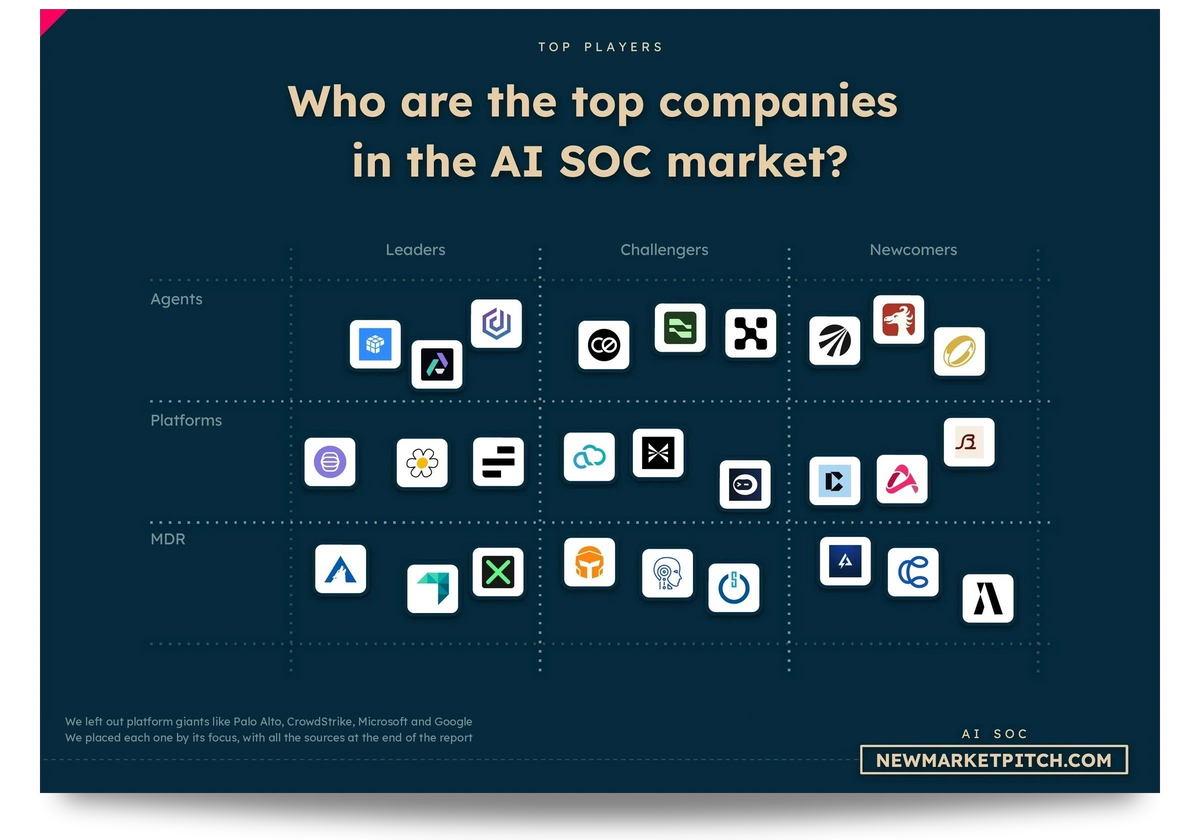
In our report covering the AI SOC market, we turn what is vague and complex into simple, useful visuals. Market maps like this one show you at a glance where every startup stands.
Why would companies pay for AI SOC if they already have Splunk or Sentinel?
Companies have a strong reason to buy independent AI SOC software when their security investigations involve several disconnected products and their existing SIEM cannot handle the complete workflow efficiently.
Consider an enterprise using Splunk to centralize logs, CrowdStrike to monitor endpoints, Okta to manage identities, and AWS to run cloud infrastructure.
An analyst investigating suspicious access may need to examine information from all four environments. Depending on how the tools are configured, the investigation can involve several searches, manual checks, and decisions about which system to query next.
An independent AI SOC agent can potentially coordinate that work without forcing the customer to replace its existing security stack.
This explains why companies such as Dropzone AI and Torq emphasize integrations and cross-platform automation. Their opportunity is particularly attractive in enterprises built through acquisitions, where different business units may have adopted different security products.
Managed security providers are another relevant customer group. These companies investigate threats across multiple clients and can potentially use AI agents to handle repetitive cases more efficiently. Dropzone has reported partnerships with providers including ECS and CBTS.
The commercial picture changes for businesses that already use one integrated security platform. Those customers may find native AI capabilities sufficient, especially when the incremental cost is low.
Fragmented enterprise security environments and managed security providers are likely to be especially important customers for independent AI SOC vendors. That is where cross-platform automation can be worth paying for.
If you want more recent data on this point, please see our latest AI SOC market report.
How much money can AI SOC actually save a company?
AI SOC can justify a six-figure annual subscription when it removes thousands of hours of repetitive investigation work, but the savings depend heavily on alert volumes and how much automation the security team can use.
We can model the economics using an enterprise that performs 20,000 investigations annually.
If each investigation requires 20 minutes, the workload represents approximately 6,667 analyst hours. Cutting the time in half would recover around 3,333 hours per year.
At an illustrative fully loaded analyst cost of $75 per hour, that equals approximately $250,000 in annual labor capacity.
The company could potentially justify a $100,000 AI SOC subscription if those savings are sustained and the product does not require excessive integration, oversight, or infrastructure spending.
But recovered time does not necessarily mean reduced payroll. Analysts may use the additional capacity to investigate previously ignored alerts, improve detections, or respond faster.
There is also a potential benefit from reducing security incidents. IBM's 2026 Cost of a Data Breach report found that organizations making extensive use of security AI and automation had average breach costs $1.93 million lower than organizations using none. The study covered broad security automation practices, so that difference cannot be attributed specifically to independent AI SOC software.
Our calculation shows why the economics can work for larger SOCs. Companies with only a few hundred meaningful investigations per year face a much harder case for buying a dedicated product.

Our research about AI security operations gets updated several times a month, so you always get the latest view of where things stand.
Will AI SOC replace security analysts?
AI SOC will probably reduce the number of routine investigations performed manually, but replacing entire security analyst teams remains unrealistic with today's demonstrated capabilities.
The biggest improvements are currently concentrated in tasks such as retrieving evidence, classifying alerts, reconstructing timelines, and preparing investigation summaries.
Those activities consume substantial analyst time, particularly in teams handling hundreds of repetitive cases.
High-impact security incidents are more complicated. A ransomware investigation may require decisions about isolating production systems, restoring operations, notifying customers, and coordinating legal or regulatory responses.
An AI agent can assist with those decisions, but a mistaken containment action could interrupt critical infrastructure or disrupt an entire business.
The employment effect may therefore appear first in hiring plans rather than mass layoffs. A team that previously needed additional analysts to handle growing workloads may be able to maintain coverage with its existing staff.
That limits how much of the human SOC labor budget becomes available to software companies. Some productivity gains will be reinvested in better security coverage, and some will allow organizations to avoid future hiring or outsourcing.
For AI SOC vendors, the most credible promise is currently more investigative capacity per analyst rather than operating a sophisticated security program without human expertise.
What could stop AI SOC startups from becoming billion-dollar businesses?
The biggest threat to AI SOC startups is that their products become features customers expect to receive inside existing security subscriptions, leaving too little pricing power for independent vendors.
The incumbent product announcements already discussed show how quickly this can happen. AI-generated investigation summaries, alert classification, and automated evidence gathering are moving into established security platforms.
A startup selling only these capabilities could find itself competing against functionality that customers perceive as already paid for.
There are also technical barriers. Autonomous investigations require dependable access to security data, accurate reasoning, appropriate permissions, and strong controls over automated actions. A system that occasionally misclassifies low-risk alerts may be manageable. One that incorrectly suppresses serious incidents can lose customer trust very quickly.
The rapid pace of AI model improvements creates another complication. A startup may build a useful product around a capability that larger platforms can reproduce after a model upgrade.
Commercial evidence remains incomplete as well. High growth rates from early deployments can make a company look much more mature than its revenue base actually supports. Financing rounds reveal investor expectations, while long-term customer retention and sustainable gross margins reveal whether the product has lasting value.
The best-positioned startups will need to own complex investigations across several security environments, maintain consistently strong results, and become difficult to replace operationally. Everything else faces serious pressure from the platforms customers already own.
If you want more recent data on this point, please see our latest AI SOC market report.

In our market report about AI security operations, you will always find fresh funding data, taken straight from our own verified funding database.
Could AI SOC eventually become bigger than SIEM?
AI SOC could eventually generate more revenue than traditional SIEM software if vendors expand from alert investigation into broader security operations, but current evidence does not establish that this will happen.
SIEM software historically monetizes collecting, storing, searching, and analyzing security data. AI SOC products increasingly focus on the work performed after that information becomes available.
The potential scope is much broader than investigating alerts. Security teams also spend time developing detection rules, hunting for threats, analyzing malware, preparing incident reports, and coordinating responses across systems.
Dropzone AI's roadmap toward specialized threat-hunting, detection-engineering, forensics, and intelligence agents reflects this expansion. Torq's acquisition of Jit in May 2026 also pointed toward deeper contextual security investigations rather than isolated automated tasks.
If AI SOC vendors eventually handle a substantial share of these activities, their products could capture spending that currently goes to multiple software platforms and external service providers.
However, traditional SIEM vendors are pursuing exactly the same opportunity. A market shift toward autonomous investigations does not guarantee that independent AI SOC suppliers capture the resulting revenue.
There is also a measurement problem. As AI capabilities become embedded in larger security subscriptions, separating AI SOC revenue from SIEM revenue may become increasingly difficult.
AI SOC has room to become a major part of security operations spending. Whether it ever exceeds SIEM as a separately measured market remains an open question.
Is the AI security operations market big or just a SIEM feature?
The AI SOC market is real and could support several billion dollars in annual software revenue, but a large share of basic AI investigation functionality will become standard inside SIEM and other security platforms. A meaningful standalone market should survive, although the number of independent winners may be limited.
The strongest evidence comes from actual operating results. Controlled research has shown 45–61% faster security investigations with AI assistance. Production deployments now span hundreds of enterprises at individual vendors, and the available survey data shows that many organizations are already using AI in their security operations.
Those results establish that AI SOC solves a problem companies genuinely face.
Commercial evidence is encouraging but still incomplete. Dropzone AI's 11-fold ARR growth, Torq's $1.2 billion valuation, and Simbian's rapid customer expansion show growing interest. None provides enough information to calculate the revenue of the entire standalone market.
The $5 billion scenario illustrates what larger adoption could look like: approximately 30,000 paying organizations spending an average of $175,000 annually. That is feasible in an enterprise cybersecurity industry worth hundreds of billions of dollars, but it requires independent vendors to maintain meaningful pricing power.
Microsoft, CrowdStrike, Palo Alto Networks, and Cisco are the main reasons we cannot assume that outcome. Their existing products already handle much of the information and many of the workflows that AI SOC agents need.
Simple AI alert summaries and basic triage are likely to become bundled features. More complex cross-platform investigations, autonomous orchestration, and specialized security workflows have a better chance of supporting independent subscriptions.
AI SOC is therefore more than a SIEM feature, but the standalone market will be smaller than the total economic value created by AI in security operations. The companies that become major businesses will be those that take responsibility for entire investigative workflows and consistently perform them better than the tools customers already own.
If you want more recent data on this point, please see our latest AI SOC market report.

In our document detailing everything you need to know about AI SOC, we look at what the winners do differently, so you can learn from the best instead of guessing.
Our methodology
This analysis examines whether AI SOC can become a substantial independent cybersecurity software market or whether its capabilities will largely be absorbed into existing SIEM and security platforms. We evaluated customer demand, operational performance, commercial adoption, startup traction, competitive differentiation, and the economics of autonomous security investigations.
We built the assessment through a structured aggregation of recent evidence. For each dimension, we identified fresh developments, gathered comparable observations, assessed their significance, and used the combined findings to reach stronger conclusions. This approach allowed us to distinguish the expansion of AI capabilities across cybersecurity from the formation of a separately monetizable AI SOC market.
To evaluate underlying demand, we examined alert volumes, investigation times, staffing constraints, and the proportion of security alerts left uninvestigated. The main operational references were Prophet Security's 2026 State of AI in the SOC survey, based on responses from 250 security professionals, and CrowdStrike's 2026 Global Threat Report. Survey findings were interpreted as evidence of workload and adoption patterns rather than population-wide measurements of all security operations centers.
We assessed technical effectiveness using the Cloud Security Alliance's benchmark study of AI agents in the SOC, alongside reported customer deployments and operational findings from vendors. Controlled investigation benchmarks, customer case studies, and self-reported productivity gains were assessed separately because they provide different levels of evidence about real-world performance. We also distinguished faster routine investigations from the ability to execute complex incident responses autonomously.
For commercial traction, we examined customer adoption, recurring-revenue growth, net revenue retention, production workloads, financing, and company valuations. Sources included Dropzone AI's 2025 operating disclosures, Torq's Series D announcement, Simbian's commercial growth announcement, and Prophet Security's financing disclosure. We gave greater weight to production deployments and recurring customer expansion than to funding totals or valuations, which measure investor expectations rather than market revenue.
We defined standalone AI SOC spending as revenue attributable to products primarily sold for autonomous security investigation and related operations. AI features embedded in SIEM, XDR, SOAR, and managed security platforms were assessed as competitive offerings without counting the full revenue of their parent products as AI SOC spending. Gartner's worldwide information security spending forecast provided broader industry context, not a direct market-size estimate for AI SOC.
Because reliable consolidated revenue disclosures are unavailable, we modeled potential market size from paying-organization counts multiplied by annual contract values. The $5 billion scenario is therefore an adoption-and-pricing calculation, not a measured market value or a formal forecast. We also modeled customer economics using investigation volumes, time savings, and illustrative analyst labor costs, treating recovered working hours as potential operating capacity rather than guaranteed payroll reductions. IBM's Cost of a Data Breach report provided additional context on security automation economics without attributing broad breach-cost differences specifically to AI SOC vendors.
To evaluate competitive pressure, we examined product announcements and technical capabilities from established security vendors. Key sources included Microsoft's Security Copilot agent announcement, Microsoft's licensing documentation, CrowdStrike's agentic AI product update, Palo Alto Networks' Cortex developments, and Cisco's security-tuned AI model announcement. We compared these capabilities with specialist offerings, particularly their ability to conduct investigations across multiple security environments.
Finally, we evaluated whether independent AI SOC suppliers could expand beyond alert triage into broader security operations. This included Torq's acquisition of Jit and emerging specialist capabilities in threat hunting, detection engineering, forensics, and orchestration. Our conclusions combine observed customer needs, measured investigation improvements, reported commercial traction, bottom-up market scenarios, and the competitive reach of existing security platforms. This distinction is central to the analysis: the economic value created by autonomous security operations may be substantially larger than the revenue independent AI SOC vendors can ultimately capture.

If you build or invest in the AI SOC market, you need to know which business models pay off now and which ones are fading. That's why our report covering it has a whole section on it.
Written by the New Market Pitch teamWe track new markets so founders and investors can move faster. About us