Who are the top investors in AI security operations?
Whether you're building or investing in the AI SOC market, our report covers everything you need to know: the players, the money, and what's coming next.
Summary
Accel and SYN Ventures are tied as the most active investors in AI security operations, having joined 4 equity rounds each. Both led 3 of those rounds, but their recent activity and the companies they favor tell different stories.
Accel has backed Corelight, Vega Security, Legion Security and Prophet Security, spanning established detection technology and newer AI-driven security operations. Its latest recorded participation was with Vega Security, whereas SYN Ventures has not joined a recorded AI SOC round this year.
SYN Ventures has concentrated on Tuskira, Conifers and Mitiga. Its Conifers investment backs agents for enterprise security teams and managed providers. That is a specific bet on SOC work, not on every startup with AI in its pitch.
The next tier is crowded rather than dominated by a single challenger. Evolution Equity Partners, Andreessen Horowitz, Paladin Capital Group, General Catalyst, Bain Capital Ventures, Costanoa Ventures and Okta Ventures are tied with 3 rounds each.
Some investors lead deals. Others prefer to join. Evolution Equity Partners, Andreessen Horowitz, Paladin Capital Group, General Catalyst and Bain Capital Ventures each led 3 recorded rounds, while Okta Ventures joined 3 without leading one.
We identified 147 named investors in 109 AI SOC equity rounds involving 73 startups. At least one investor was named in 102 rounds, so the apparent concentration at the top should not be confused with control of the entire market.
Much of the activity starts early: 53 of the 96 rounds with a known stage were seed rounds. Yet no single seed investor leads by participation, leaving early AI SOC investment fragmented among funds pursuing different technical approaches.
Later-stage decisions look more specialized. Evolution Equity Partners joined 2 Series C rounds, while Cheyenne Ventures joined 2 Series A rounds; their positions describe stage preferences, not the size of their individual checks.
The larger financings tell a different story. Crosspoint Capital Partners led TENEX.AI's $250M Series B, while Goldman Sachs Alternatives led Daylight Security's $80M Series B, showing that mature security-operations models can attract substantial rounds without their backers topping the participation ranking.
No fund controls the AI SOC investor market. Accel and SYN Ventures lead on recorded participation, but who actually matters to a founder depends on whether they need a seed lead, a repeat backer, a strategic participant or a growth investor.

Written by the New Market Pitch teamWe track new markets so founders and investors can move faster. About us

In our report covering the AI SOC market, you will always find fresh funding data, taken straight from our own verified funding database.
Which VCs invest the most in AI SOC right now?
Accel and SYN Ventures are tied for the most active AI SOC investors, with 4 rounds joined and 3 led each. They sit ahead of 7 investors tied on 3 rounds, so neither firm is the sole leader of this market.
Look at what they backed and the tie becomes less meaningful. Accel's AI SOC companies include Corelight, Vega Security, Legion Security and Prophet Security. Corelight's announcement described how detection engineering and network evidence feed SOC workflows; Vega Security is building detection around security data where that data already resides. SYN Ventures instead appears with Tuskira, Conifers and Mitiga, reflecting its interest in operational security platforms that can connect existing tools and improve investigations.
The next group has very different priorities. Andreessen Horowitz and General Catalyst have backed early cyber-autonomy teams; Evolution Equity Partners has supported both Torq and Kai Security; and Okta Ventures has participated alongside traditional funds. Repeated participation is visible, but the amounts individual funds invested are not.
The table below ranks the 20 most active AI SOC investors by the number of equity rounds they joined, with the rounds they led, their main stages, the startups they backed and the biggest round they joined.
If you want to go more into detail and get more data to understand what investors are betting on now, please check our AI SOC report.
| # | Investor | Rounds | Led | Main stages | AI SOC startups backed | Biggest round joined | Latest round |
|---|---|---|---|---|---|---|---|
| 1 | Accel | 4 | 3Named as lead in every round found (lead known for 3 of 4 rounds) |
Seed 1Series A 1 | Corelight, Vega Security, Legion Security, Prophet Security | $150MCorelight · 2024 | Feb 2026 |
| 2 | SYN Ventures ▼ | 4 | 3Usually leads (75% of its rounds) |
Seed 1Series B 1 | Tuskira, Conifers, Mitiga | $30MMitiga · 2025 | Oct 2025 |
| 3 | Evolution Equity Partners | 3 | 3Named as lead in every round found | Series C 2Series A 1 | Torq, Anvilogic, Kai Security | $125MKai Security · 2026 | Mar 2026 |
| 4 | Andreessen Horowitz | 3 | 3Named as lead in every round found | Seed 3 | Method Security, Command Zero, Cotool | $26MMethod Security · 2025 | Mar 2026 |
| 5 | Paladin Capital Group | 3 | 3Named as lead in every round found | Seed 2Series A 1 | Circumvent, Embed Security, RADICL | $31MRADICL · 2026 | Feb 2026 |
| 6 | General Catalyst | 3 | 3Named as lead in every round found | Seed 3 | Andesite, Method Security | $26MMethod Security · 2025 | Nov 2025 |
| 7 | Bain Capital Ventures | 3 | 3Named as lead in every round found | Seed 3 | Daylight Security, Prophet Security, Nebulock | $11MProphet Security · 2024 | Jul 2025 |
| 8 | Costanoa Ventures | 3 | 2Named as lead in every round found (lead known for 2 of 3 rounds) |
Seed 3 | RunReveal, System Two Security | $7MRunReveal · 2025 | Jul 2025 |
| 9 | Okta Ventures ▼ | 3 | 0Never led (lead known for 1 of 3 rounds) |
Seed 1Series B 1 | Daylight Security, Command Zero, RunReveal | $80MDaylight Security · 2026 | Nov 2026 |
| 10 | Cheyenne Ventures | 2 | 2Named as lead in every round found | Series A 2 | RAD Security, Abstract Security | $25MAbstract Security · 2026 | Jul 2026 |
| 11 | Crosspoint Capital Partners | 2 | 2Named as lead in every round found | Series A 1Series B 1 | TENEX.AI | $250MTENEX.AI · 2026 | Mar 2026 |
| 12 | Forgepoint Capital International | 2 | 2Named as lead in every round found | Seed 1Series A 1 | Qevlar AI | $30MQevlar AI · 2026 | Mar 2026 |
| 13 | Team8 | 2 | 2Named as lead in every round found | Seed 2 | Mate Security, Fig Security | $16MMate Security · 2025 | Nov 2025 |
| 14 | DataTribe | 2 | 2Named as lead in every round found | Seed 2 | ContraForce, Rilevera | $3.2MContraForce · 2024 | Nov 2025 |
| 15 | Theory Ventures | 2 | 2Named as lead in every round found | Series A 1Series B 1 | Dropzone AI | $37MDropzone AI · 2025 | Jul 2025 |
| 16 | Red Cell Partners | 2 | 2Named as lead in every round found | Seed 2 | Andesite | $23MAndesite · 2025 | Feb 2025 |
| 17 | Craft Ventures | 2 | 1Leads half its rounds | Series A 1Series B 1 | Daylight Security | $80MDaylight Security · 2026 | Nov 2026 |
| 18 | Insight Partners | 2 | 1Named as lead in every round found (lead known for 1 of 2 rounds) |
Seed 1Series B 1 | Torq, Mate Security | $42MTorq · 2024 | Nov 2025 |
| 19 | Wipro Ventures | 2 | 0Never led (lead known for 1 of 2 rounds) |
— | Tuskira, Simbian | $28MTuskira · 2024 | Sep 2025 |
| 20 | Goldman Sachs Alternatives | 1 | 1Named as lead in its only round found | Series B 1 | Daylight Security | $80MDaylight Security · 2026 | Nov 2026 |
No investors match this search.
Data from January 2024 through 12 November 2026, which is enough to show who is active today and who has been for years. Rounds: equity rounds in which the investor is named. Led: rounds it led or co-led. ▲ more rounds in 2026 so far than its 2025 pace, ▼ fewer.

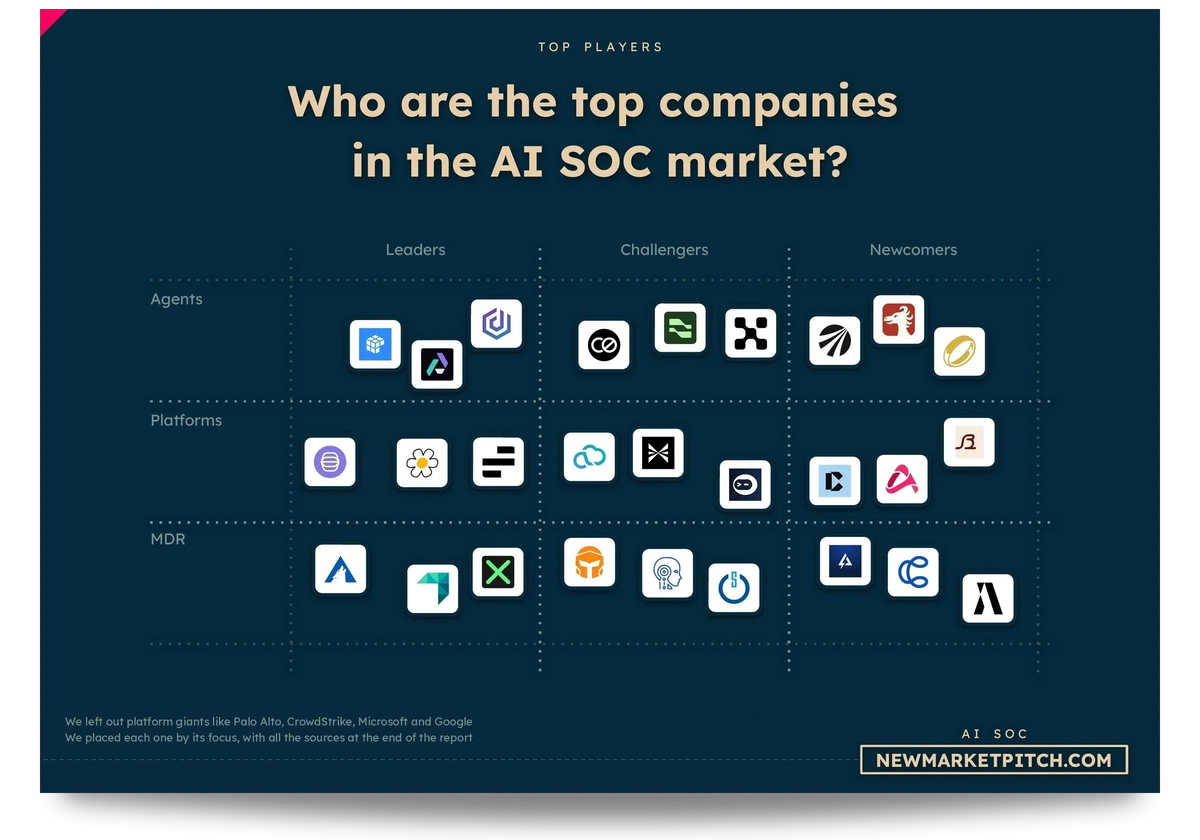
In our research about AI security operations, we turn what is vague and complex into simple, useful visuals. Market maps like this one show you at a glance where every startup stands.
Does Accel really lead AI SOC investing, or just appear in big rounds?
Accel really does lead AI SOC fundraisings: it led 3 rounds where the lead was published, across several types of security-operations software.
Its position is shared with SYN Ventures on participation and on the number of rounds led.
The portfolio illustrates why both measures matter. Accel backed Corelight's $150M later-stage financing in 2024, supporting an established detection-and-response vendor; it also backed Prophet Security and Legion Security, then appeared in Vega Security's latest round in February 2026. Accel's public account of Corelight emphasizes the open-source Zeek and Suricata foundations and the role of usable network evidence in investigations. Its subsequent Vega Security involvement points toward distributed detection and AI-native workflows.
These investments cover several ways to improve daily security work. The $150M is what Corelight raised in total, not what Accel put in.
Is SYN Ventures still as active in AI SOC as Accel?
No, SYN Ventures matches Accel in total AI SOC rounds, but it has not joined a recorded round this year, while Accel has joined 1.
SYN Ventures joined 3 rounds last year, so its lead comes mostly from earlier activity.
The firm's record is concentrated in clear security-operations bets. SYN Ventures helped back Tuskira's AI-powered threat defense platform, appeared with Conifers and joined Mitiga. Conifers launched CognitiveSOC to support enterprise and managed service provider analysts, while Tuskira's approach links security controls and attack context across an existing stack. Those are different architectures, but each aims to make a security team's operational decisions faster and more coherent.
SYN Ventures may still be working closely with its portfolio companies, even without announcing a new round. For founders raising today, that difference in recent deal activity is worth checking.

Your time is limited. In our market report about AI security operations, we put numbers on each part of the market, so you can see where it makes sense to focus.
Are Andreessen Horowitz and General Catalyst really backing AI SOC startups?
Yes, Andreessen Horowitz and General Catalyst are recurring AI SOC investors, with 3 rounds joined and 3 led each, although their investments do not make either the category's most frequent participant.
Andreessen Horowitz has backed Method Security, Command Zero and Cotool. Cotool says it builds agents around security teams' own investigation processes, keeping permissions and review in the workflow. Method Security approaches automation from the critical-infrastructure end, combining defensive visibility with controlled offensive testing. In its discussion of security priorities, Andreessen Horowitz describes a shift toward agent-assisted investigation while acknowledging that customers remain cautious about allowing autonomous response.
General Catalyst backed Andesite and Method Security. Andesite stresses human oversight of AI-generated security findings, a different emphasis from a fully delegated investigation model. Both funds are trying to turn security expertise into software. Andesite's emphasis on human approval shows why that does not always mean handing every decision to an agent.
Are specialist cybersecurity investors beating generalist VCs in AI SOC?
Neither group is winning outright in AI SOC investing: Accel and cybersecurity specialist SYN Ventures share the top spot by rounds joined.
SYN Ventures and Paladin Capital Group explicitly work across cybersecurity, while Bain Capital Ventures and Andreessen Horowitz approach the field from wider enterprise-technology portfolios. Paladin has led financing for RADICL, whose virtual SOC serves defense-industrial and critical-infrastructure suppliers. Bain Capital Ventures backed Prophet Security and Nebulock, products addressing alert investigation and threat hunting rather than selling a broad security suite. Accel's Corelight relationship stretches from network detection fundamentals into AI-enabled SOC workflows.
A cybersecurity specialist may introduce buyers. A generalist VC may help with senior hires or a later financing. Both groups are prominent among the most frequent AI SOC backers.

In our document detailing everything you need to know about AI SOC, we always try to gather several sources and make estimates that make sense, so you can work with solid numbers.
Is leading an AI SOC funding round more important than joining it?
Leading an AI SOC round usually matters more for setting up the financing, while joining can still bring useful contacts.
Accel and SYN Ventures each led 3 recorded rounds, but investors with fewer participations have also repeatedly taken lead roles.
Evolution Equity Partners, Andreessen Horowitz, Paladin Capital Group, General Catalyst and Bain Capital Ventures led every one of their recorded rounds. These funds have repeatedly agreed to organize financings, not just join someone else's deal. Okta Ventures, by contrast, joined rounds without leading, as a strategic participant often does. RunReveal's $7M seed round, for example, brought in Okta Ventures alongside Costanoa Ventures, an earlier backer, so a financial investor and a company-linked investor sat side by side.
The lead has not necessarily written the largest check. A disclosed round size is what the startup raised in total, not what the lead put in. For a founder, the investor who will price and organize the financing is often more consequential than a participant's logo on the announcement.
Is Okta Ventures a serious AI SOC investor?
Yes, Okta Ventures has joined 3 AI SOC rounds, at Daylight Security, Command Zero and RunReveal, though it has not led any of them.
The companies share a practical dependency on existing enterprise security systems. Command Zero automates investigative steps across security tools; RunReveal combines security telemetry with detection-and-response workflows; Daylight Security pairs AI agents with human responders. All of them can use identity and access data, which explains why an investor tied to an identity-security company keeps a close eye on them.
Daylight Security's later-stage funding illustrates the difference. Goldman Sachs Alternatives led it, while Okta Ventures joined alongside other backers. Founders looking for a first lead should remember that Okta Ventures brings links to identity security, not a habit of leading rounds.

Our report covering the AI SOC market gets updated several times a month, so you always get the latest view of where things stand.
Is Goldman Sachs Alternatives becoming a major AI SOC backer?
Goldman Sachs Alternatives has backed a major AI SOC growth round, but it is not among the most frequent investors.
It led a single recorded AI SOC round, at Daylight Security, unlike the repeated activity of Accel and SYN Ventures.
Daylight's financing shows what later-stage investors will back. Daylight Security combines an AI-native platform with security engineers and offers managed, co-managed and embedded delivery. Its November 2026 funding announcement names customers including Lovable, LastPass, Rogo, dLocal and Miro. AI handles more of the investigation work, while people still make the high-stakes calls.
Craft Ventures and Okta Ventures also joined the Daylight financing, so the new lead stepped into a group of investors that was already there. Goldman Sachs Alternatives was willing to lead a growth round for this hybrid model. One round doesn't make Goldman Sachs Alternatives a regular AI SOC investor yet.
Which AI SOC investors are still investing this year?
No single AI SOC investor leads this year: 10 investors are tied with 1 recorded round each. Among the 20 most active AI SOC investors, 10 have joined a round this year and 10 have not; Accel has joined 1, while SYN Ventures has joined none.
An all-time leader may no longer be the busiest fund right now. Accel's latest recorded participation is Vega Security, while the newer names around Daylight Security's financing include Goldman Sachs Alternatives and Okta Ventures. Evolution Equity Partners also appeared with Kai Security, and Forgepoint Capital International participated in Qevlar AI's expansion. Their recent deals span detection, autonomous investigations and managed defense rather than a single product template.
The AI SOC market has seen 35 rounds this year, against 41 last year. Those are deal counts for the whole market, and the year isn't over yet. A fund with no recorded participation may be evaluating opportunities or helping existing companies privately. Recent public deals are useful for a founder choosing whom to contact now. Silence alone does not prove a fund has stopped investing.
The table below shows, year by year, how many rounds 12 of the most active AI SOC investors joined, so it is easy to see who is still investing and who has slowed down.
If you want to go more into detail and see which investors are still writing checks and which have slowed down, please check our AI SOC report.
| Investor | 2024 | 2025 | 2026* | Total |
|---|---|---|---|---|
| Accel | 2 | 1 | 1 | 4 |
| Evolution Equity Partners | 2 | 1 | 3 | |
| Andreessen Horowitz | 1 | 1 | 1 | 3 |
| Paladin Capital Group | 1 | 1 | 1 | 3 |
| Okta Ventures | 2 | 1 | 3 | |
| Cheyenne Ventures | 1 | 1 | 2 | |
| Crosspoint Capital Partners | 1 | 1 | 2 | |
| Forgepoint Capital International | 1 | 1 | 2 | |
| Craft Ventures | 1 | 1 | 2 | |
| Goldman Sachs Alternatives | 1 | 1 | ||
| SYN Ventures | 1 | 3 | 4 | |
| General Catalyst | 1 | 2 | 3 |
* 2026: January to 12 November. Darker cells mean more rounds that year. Data from January 2024 through 12 November 2026.

In our research about AI security operations, we look at what the winners do differently, so you can learn from the best instead of guessing.
Why are some AI SOC investors backing human-led security services?
Some AI SOC investors favor security services where AI does the routine work and people still make the tough calls.
TENEX.AI, Daylight Security and RADICL show how this works for different customers.
TENEX.AI describes an AI-native managed detection-and-response platform with human analysts governing consequential actions. Daylight Security lets enterprises choose managed, co-managed or forward-deployed service delivery. RADICL targets smaller defense-industrial businesses that must meet demanding security requirements but cannot staff a large internal SOC. Each uses AI to help security staff cover more work, but each makes different promises about human support.
This helps explain why Crosspoint Capital Partners, Goldman Sachs Alternatives and Paladin Capital Group can be involved in a market sometimes portrayed as pure agent software. For buyers, a vendor's ability to take responsibility for an incident may matter as much as its automation rate. For investors, the business also brings recurring services, integration work and customer trust.
Which AI SOC investors back seed rounds, and which back growth rounds?
Seed is the busiest AI SOC stage, accounting for 53 of the 96 rounds with a known stage, but it has no single leading investor. Later-stage participation is more differentiated: Evolution Equity Partners leads at Series C with 2 rounds, within a market that has 10 rounds at Series C or later.
Andreessen Horowitz, General Catalyst and Bain Capital Ventures have all backed seed-stage security automation, but their preferences diverge. Cotool is building an AI operating layer for investigations; Andesite emphasizes decision support and analyst control; Prophet Security automates repetitive alert investigation. At Series A, Cheyenne Ventures is the unique participation leader with 2 rounds, including Abstract Security, whose streaming-first product aims to reshape security operations data handling.
At later stages, investors want to know whether the product works reliably across big customers. Evolution Equity Partners backed Torq as it expanded AI-driven security orchestration and later supported Kai Security. Many firms are willing to try an early SOC idea. Far fewer financings reach Series C.
The table below shows, for 12 of the most active AI SOC investors, how many rounds they joined at each stage, from seed to growth.
If you want to go more into detail and see where each investor places its bets, from seed to growth, please check our AI SOC report.
| Investor | Seed | Series A | Series B | Series C | Series D+ | Growth |
|---|---|---|---|---|---|---|
| Accel | 1 | 1 | 1 | · | 1 | · |
| SYN Ventures | 1 | · | 1 | · | · | 1 |
| Evolution Equity Partners | · | 1 | · | 2 | · | · |
| Andreessen Horowitz | 3 | · | · | · | · | · |
| Paladin Capital Group | 2 | 1 | · | · | · | · |
| General Catalyst | 3 | · | · | · | · | · |
| Bain Capital Ventures | 3 | · | · | · | · | · |
| Costanoa Ventures | 3 | · | · | · | · | · |
| Okta Ventures | 1 | · | 1 | · | · | · |
| Cheyenne Ventures | · | 2 | · | · | · | · |
| Crosspoint Capital Partners | · | 1 | 1 | · | · | · |
| Forgepoint Capital International | 1 | 1 | · | · | · | · |
Most active at each stage, among all AI SOC investors: Seed, 4 investors tied with 3 rounds · Series A, Cheyenne Ventures · Series B, no investor joined more than one round · Series C, Evolution Equity Partners · Series D+, no investor joined more than one round · Growth, no investor joined more than one round. Bigger dots mean more rounds. Data from January 2024 through 12 November 2026.

In our market report about AI security operations, we don't want to repeat what boring consulting reports say. Instead, we show you the real and latest market signals that matter.
Who backs AI SOC startups before they've made much money?
No single fund dominates early AI SOC investing: both cybersecurity specialists and large VCs back young teams.
For founders, the useful question is who understands the product before sales have taken off.
Bain Capital Ventures led Prophet Security's $11M seed round, arguing that SOC teams were overwhelmed by repetitive alert investigations. Andreessen Horowitz led Cotool's earliest reported financing; Cotool's design starts with practitioners specifying tasks and authorization boundaries. General Catalyst helped back Andesite, whose core claim is that autonomous analysis must still present evidence to the people responsible for decisions. Team8 has participated in Mate Security and Fig Security, while DataTribe backed ContraForce and Rilevera.
Those early bets focus on a problem security teams already face, the founding team's experience and how the product fits existing tools. A fund with few seed deals may still be interested: seed is a wide-open stage, and no single investor leads it. Founders should prioritize the fit between a product's delivery model and a fund's actual early-stage investments rather than chase the overall participation ranking.
Who leads big AI SOC rounds after Series B?
Evolution Equity Partners is the most active AI SOC Series C investor, with 2 rounds joined, although it does not lead across all stages.
It led every recorded round it joined, including deals involving Torq, Anvilogic and Kai Security.
Torq is the obvious example. Its security orchestration platform grew beyond rigid playbooks toward AI-assisted workflows, and Evolution Equity Partners led the company's Series C. Kai Security represents another direction: autonomous cyber defense that reasons across fragmented systems. Evolution Equity Partners also appears with Anvilogic, which focuses on detection engineering and the logic needed to identify threats across tools.
Each company helps a security team make better use of its existing tools. But leading many later rounds is not the same as writing the biggest checks. Kai Security's $125M round, a Series A, is the size of the startup's financing, not Evolution Equity Partners' contribution. Other investors can lead a substantial growth transaction without joining as many rounds. Evolution's Series C record shows it keeps coming back to the same kind of bet, not that it puts in the most money.

Learning from others' mistakes is the cheapest lesson there is. In our document detailing everything you need to know about AI SOC, we look at what broke startups before you, so you don't repeat it.
Which AI SOC investors keep funding the same startup?
Crosspoint Capital Partners, Forgepoint Capital International and Theory Ventures are good examples of AI SOC investors that keep funding the same startup as it grows.
Crosspoint Capital Partners is recorded in 2 TENEX.AI rounds and led both. TENEX.AI progressed from its early managed-security proposition into a larger platform-and-service expansion, with the company emphasizing alert coverage and human oversight. Forgepoint Capital International also joined 2 Qevlar AI rounds, helping a company move from alert investigations toward broader security insight and response workflows. Theory Ventures appears twice with Dropzone AI, whose products have expanded from an AI SOC analyst to more proactive threat-hunting capabilities.
Backing one startup again is different from backing several new ones. Accel spread its participation across different startups; Crosspoint and Forgepoint returned to companies they already knew. The first shows a wide reach for new deals, the second a willingness to keep funding a company as it grows. A founder evaluating investors should look at both, especially when future support during a difficult financing cycle may be as valuable as the original introduction.
Are AI SOC investors picking AI agents over older security tools?
AI SOC investors are backing both AI agents and older orchestration tools that now use AI.
The products increasingly cover the path from an alert to a response.
Andreessen Horowitz's Cotool investment targets reusable agents that work inside established security teams. Bain Capital Ventures' Prophet Security bet starts with alert triage; Costanoa Ventures' RunReveal bet starts with security data and AI-native detection. Evolution Equity Partners' Torq investment addresses orchestration, while Qevlar AI's backers are funding investigation that can generate broader operational insights. The companies attack different parts of the same labor-intensive process.
The boundaries between these products are already blurring. A vendor sold as an AI analyst may eventually add response execution, while a SOAR provider may add agent-based reasoning. The common bet is on software that handles useful security work and connects to tools customers already have. Nobody can say yet which kind of product will earn the most, but investors are clearly backing far more than chatbot-style analysts.

If you build or invest in the AI SOC market, you need to know which business models pay off now and which ones are fading. That's why our report covering it has a whole section on it.
Which AI SOC investors most often invest together?
General Catalyst and Red Cell Partners have invested together in AI SOC more often than any other recorded pair, joining 2 Andesite rounds. No other pair of AI SOC investors has backed the same startup together more than once.
Andesite sells AI security analysis that keeps people in charge of high-stakes decisions. Red Cell Partners presents Andesite as a company it incubated, while General Catalyst's participation connects that company-building model with a larger venture platform. So the two firms share a clear idea of how security automation should work.
Investing together twice doesn't say much about a fund's whole network. The market has 147 named investors, and many rounds bring together funds without producing a recurring partnership. Nor does co-investment prove that the investors contributed equally or made every decision jointly. For founders, a strong group of investors often starts with funds that see the product the same way, and investing together twice doesn't mean they control the company.
The table below lists the pairs of AI SOC investors named together in at least two equity rounds, with the startups they backed together.
If you want to go more into detail and see which investor networks back the same startups, please check our AI SOC report.
| Investor pair | Rounds together | Startups backed together |
|---|---|---|
| General Catalyst + Red Cell PartnersAndesite | 2 | Andesite |
Pairs of investors named in the same equity round. Data from January 2024 through 12 November 2026.
Why does Okta Ventures invest alongside AI SOC venture funds?
Okta Ventures often joins AI SOC financings led by traditional venture funds, giving startups an investor with links to identity security.
That pattern appears with RunReveal, Daylight Security and Command Zero.
Costanoa Ventures led RunReveal's first round and came back for the $7M seed round that Okta Ventures joined, putting an early software investor next to a company close to identity security. Daylight Security's later financing brought Goldman Sachs Alternatives together with Okta Ventures and Craft Ventures. Command Zero also reported support from Okta Ventures alongside financial backers. A strategic investor can bring ecosystem knowledge or access, although its participation is not proof of a commercial distribution agreement.
AI SOC vendors must work with the identity, endpoint and security tools customers already use. Investors have reasons to look for products that are interoperable rather than isolated. But a strategic investor is no guarantee of sales: enterprise buyers still assess product quality, governance and pricing. These investments suggest strong interest in tools that connect easily. They do not establish which vendor will win.

In our research about AI security operations, we like to show you the big picture. We know your time is precious, so we make every page quick to read and packed with as much learning as possible per minute.
So, who are the biggest investors in AI SOC startups today?
Accel and SYN Ventures are tied as the biggest AI SOC investors by the number of equity rounds joined, with 4 each and 3 led apiece.
Accel combines established detection infrastructure such as Corelight with newer AI operations companies such as Vega Security and Prophet Security. SYN Ventures has maintained a focused portfolio including Conifers and Mitiga, but no recorded participation this year. Evolution Equity Partners and Andreessen Horowitz demonstrate repeat leadership, while Crosspoint Capital Partners and Goldman Sachs Alternatives show how fewer transactions can still be consequential for companies preparing to scale.
For founders, the distinction is useful. Participation tells us which firms repeatedly appear, lead status tells us who organizes deals, stages reveal what a firm is likely to finance, and co-investment shows existing relationships. That is a better starting point for a fundraising shortlist than the investor's name alone.
The table below shows what we found.
| Question | Answer |
|---|---|
| Is there a single busiest AI SOC investor? | No, Accel and SYN Ventures share the participation lead. Each led 3 recorded rounds. Founders should check who has backed a company recently. |
| Has Accel stopped backing operational security? | No, Accel remains visible in AI SOC financing. Its 1 recorded round this year involved Vega Security. The investment extends a portfolio spanning different detection workflows. |
| Is SYN Ventures still matching Accel's pace? | Not on the current year's announced AI SOC rounds. SYN Ventures has no recorded participations this year. Its cumulative standing reflects stronger activity in prior periods. |
| Do big-name generalists always lead these rounds? | No, specialists also repeatedly organize AI SOC financings. Paladin Capital Group led 3 recorded rounds. Its RADICL investment targets security operations for demanding smaller organizations. |
| Does a strategic investor have to lead? | No, a strategic backer may prefer to join another fund. Okta Ventures participated without taking the lead. Its identity-security links can help integration-heavy startups. |
| Can fewer deals still signal serious influence? | Yes, a single lead round can be consequential. Goldman Sachs Alternatives led Daylight Security's $80M Series B. That role does not make it the busiest investor. |
| Are seed investors concentrated around one fund? | No, AI SOC seed funding remains dispersed. Seed accounts for 53 of the 96 stage-classified rounds. No investor has a unique participation lead there. |
| Is there a recognizable Series A leader? | Yes, Cheyenne Ventures leads by Series A participation. It joined 2 recorded rounds at that stage. Its backing of Abstract Security illustrates the specialization involved. |
| Who stands out in later AI SOC rounds? | Evolution Equity Partners leads the Series C category. Its 2 recorded rounds make it the stage leader. That does not establish the largest individual capital commitment. |
| Are recurring investor partnerships common? | Not really, repeat pairings are rare in AI SOC. General Catalyst and Red Cell Partners shared 2 Andesite rounds. Their partnership reflects a specific human-guided AI SOC approach. |
| Does the largest financing identify the biggest backer? | No, a round's size belongs to the company. Crosspoint Capital Partners led TENEX.AI's $250M Series B. Its own contribution is not disclosed by that headline. |

When you build or invest in the AI SOC market, you need clarity, not confusion. In our market report about AI security operations, we always try to put numbers on and quantify whatever is usually vague and confusing.
Our methodology
Our data runs through November 12, 2026. We track AI SOC equity rounds systematically, deal by deal, from January 2024, a period long enough to reveal recurring investors rather than isolated announcements. We define AI SOC as technology whose primary job is to automate or substantially augment security operations center detection, triage, investigation, threat hunting, orchestration or response. Every company counted meets our startup definition, and borderline companies with a genuine security-operations core remain included.
We count the private equity rounds each named investor joined and the rounds it led, not the amount it invested, which is rarely disclosed. IPOs and post-listing offerings are excluded. We reconcile investors named in company announcements and credible reporting, merge aliases of the same firm and duplicate coverage of a single round, and exclude unspecified groups such as “existing investors.” The current-year comparison first appears in March, when enough months have elapsed for meaningful comparison.
Rounds confirmed by a company announcement, a press article or a regulatory filing are counted in full. Where no article exists, a round is counted only when at least two recognised databases agree on its date (within one month) and amount (within 5%), and it is marked as low confidence; a round found in a single database stays in the company's history but is left out of totals. For companies that have raised more than $100M, every round counted is backed by an article.
We do not accept the investor roster of a commercial company database on its own. Such rosters can add investors who never participated in a given round or conflate equity with debt and grants. We identified investors for 102 of 109 rounds, representing 94%; rounds without a named participant count toward market activity but not toward any investor's activity total, making the recorded investor counts a floor.
A financing round appears once in the market's deal tracker but once for each named investor participating in it here. Co-investors therefore do not imply extra financings. We keep leads separate from other participants and preserve stage distinctions, because frequency, underwriting responsibility and ability to support later growth answer different questions.
The main objection is that a well-known specialist can rank below a generalist despite having deeper knowledge or larger investments. That is entirely compatible with our definition: we measure verified participation in a bounded period, not reputation, fund size, equity ownership or all-time cybersecurity investing. This narrow measure provides a comparable answer to who has recently and repeatedly backed AI SOC companies, while leadership and stage evidence supply the needed context.
Key sources include Corelight financing and Accel leadership, Accel's security detection investment thesis, Accel and Vega Security's operational approach, SYN Ventures and Conifers' CognitiveSOC, SYN Ventures and Tuskira, Evolution Equity Partners and Kai Security, Evolution Equity Partners and Torq's security automation, Andreessen Horowitz and Cotool, Investor perspective on autonomy in the SOC, Method Security's operating model and backers, Andesite's human-in-the-loop security model, Prophet Security's AI analyst and Bain financing, Paladin Capital Group and RADICL, Costanoa Ventures and Okta Ventures at RunReveal, Command Zero strategic participation, Crosspoint Capital Partners and TENEX.AI, Forgepoint Capital International and Qevlar AI, Theory Ventures and Dropzone AI, Goldman Sachs Alternatives and Daylight syndicate, Cheyenne Ventures and Abstract Security, and DataTribe's early detection engineering thesis.

A good product starts with a real problem. In our document detailing everything you need to know about AI SOC, we show you the ones customers still live with.
Written by the New Market Pitch teamWe track new markets so founders and investors can move faster. About us