Who are the top investors in AI training data?
Whether you're building or investing in the AI training data market, our report covers everything you need to know: the players, the money, and what's coming next.
Summary
Meta is the biggest strategic investor in AI training data, while Felicis has the strongest current case among venture capital firms. Accel remains one of the sector's most important long-term investors through its early backing of Scale AI.
Meta's approximately $14.3 billion investment in Scale AI in June 2025 dwarfs conventional training-data financing. But the transaction also brought Scale founder Alexandr Wang into Meta, making it a strategic bet on AI talent and infrastructure as much as on the data business itself.
Felicis stands out for backing two different approaches to the same market. It led $450 million in combined Mercor financing across two rounds and separately led DatologyAI's $46 million Series A, gaining exposure to expert-generated data and automated data curation.
Accel's investment history shows how dramatically the market has changed. Scale AI moved from labeling autonomous-vehicle data to supplying frontier AI laboratories, with its valuation rising from $7.3 billion in 2021 to more than $29 billion in Meta's 2025 transaction.
General Catalyst and Benchmark made unusually well-timed investments in Mercor. Its valuation climbed from $250 million in September 2024 to $10 billion in October 2025, while the company evolved from an AI recruiting platform into a major supplier of expert training data.
The most aggressive valuations are increasingly going to companies that organize specialist knowledge rather than routine labeling. Mercor, micro1, and AfterQuery have attracted enormous investor interest by helping AI models learn complicated professional tasks, from coding to legal reasoning.
Training-data software is attracting a different group of investors. Insight Partners and S32 co-led Snorkel AI's $350 million Series E, while Wellington Management backed Encord and Radical Ventures invested in DatologyAI and Prime Intellect.
NVIDIA is building exposure across the training-data ecosystem. Its investments in Scale and Prime Intellect, together with its acquisition of Gretel, cover traditional data services, reinforcement learning infrastructure, and synthetic-data generation.
Valuation growth alone is a poor way to judge investment success. AfterQuery's reported valuation increased more than tenfold in roughly five months, but private ownership stakes, secondary sales, profitability, and realized investor returns remain largely undisclosed.
The biggest commercial risk is customer concentration. Frontier AI laboratories account for substantial training-data demand, and changes in their procurement decisions, internal capabilities, or training methods could quickly affect suppliers valued at billions of dollars.
Our overall choice is Felicis among conventional venture firms, Meta by strategic transaction size, and Accel for its long-term Scale AI record. The next generation of winners may depend less on who produces the most training data and more on who can consistently make advanced models better at difficult, real-world tasks.

Written by the New Market Pitch teamWe track new markets so founders and investors can move faster. About us
Why are investors pouring so much money into AI training data?
AI training data companies are attracting billion-dollar investments because the leading AI labs now need far more than labeled images and text to improve their models.
The biggest turning point came in June 2025, when Meta invested approximately $14.3 billion in Scale AI, acquiring a reported 49% stake at a valuation above $29 billion. Scale had previously raised $1 billion at a $13.8 billion valuation in May 2024. Meta's investment went well beyond a normal funding round: Scale founder Alexandr Wang joined Meta to lead its superintelligence efforts.
Other companies have since attracted similarly serious interest, although at smaller amounts. Mercor raised $350 million at a $10 billion valuation in October 2025, Snorkel AI secured $350 million at a $3.5 billion valuation in September 2026, and micro1 reached a reported $4 billion valuation that same month.
These companies are increasingly selling expert knowledge, specialized datasets, and realistic environments where AI models can practice complex tasks. Mercor connects AI laboratories with doctors, lawyers, engineers, and researchers. Snorkel combines automation with expert contributions to produce training datasets. micro1 has expanded from recruiting specialists into acquiring enterprise operational data.
For investors, the opportunity has changed considerably. A company that can help a frontier model become better at coding, legal analysis, or using enterprise software may now attract much higher spending than a traditional annotation provider.
Who actually counts as an AI training data investor?
AI training data investors include venture capital firms, growth funds, and technology companies that buy equity in businesses supplying the data used to train and improve AI models.
We include companies involved in labeling, expert-generated datasets, data curation, synthetic data, and reinforcement learning environments. That covers established suppliers such as Scale AI, newer expert-data businesses such as Mercor and AfterQuery, and software-focused companies such as Snorkel AI and DatologyAI.
There is an important distinction between funding these businesses and purchasing their services. Meta's investment in Scale AI belongs in an investor ranking. OpenAI paying an external company to produce training data would count as customer spending unless OpenAI also acquired equity in that supplier.
Acquisitions need separate treatment as well. NVIDIA's purchase of synthetic-data company Gretel in 2025 demonstrates strategic interest in the sector, but an acquisition is different from participating in a venture financing round.
When Felicis leads Mercor's $350 million Series C, the $350 million represents the entire round, including other investors. Felicis's individual contribution has not been publicly disclosed.
We therefore rank investors using confirmed investments, leadership roles, repeated participation, and the commercial progress of the companies they backed.

In our report covering the AI training data market, you will always find fresh funding data, taken straight from our own verified funding database.
Is Meta the biggest investor in AI training data today?
Meta is currently the biggest identifiable strategic investor in AI training data by disclosed transaction value, following its approximately $14.3 billion investment in Scale AI.
According to Reuters, the June 2025 transaction gave Meta a reported 49% stake in Scale, valuing the company above $29 billion. The investment was approximately 14 times larger than Scale's previous $1 billion financing in 2024.
The comparison with newer training-data companies is even more striking. Meta's single transaction was about 41 times the size of Mercor's $350 million Series C or Snorkel AI's $350 million Series E.
Much of the economic significance came from the nature of the transaction. Meta secured a major ownership position in an established supplier while bringing Scale founder Alexandr Wang into its AI organization. A strategic share purchase of this kind may also involve existing shareholders selling stock, so the full announced amount should not be treated as new money available for Scale's operations.
The investment also created a commercial complication. Scale had built its business supplying AI companies that sometimes compete directly with Meta. A supplier partly owned by one major customer has to convince the others that their data, projects, and commercial relationships remain protected.
Meta made the biggest financial commitment we can identify, but it also bought something conventional venture investors rarely get: a direct connection between a major data supplier and its own frontier AI strategy.
If you want more recent data on this point, please see our latest AI training data market report.
Which venture capital firms invest the most in AI training data?
Felicis, Accel, General Catalyst, Benchmark, and Insight Partners have some of the strongest documented AI training data investment records, although no public dataset establishes which has invested the most money individually.
Accel has long-standing exposure to Scale AI and led its $1 billion financing in 2024. Felicis led Mercor's $100 million Series B and $350 million Series C, while separately leading DatologyAI's $46 million Series A.
General Catalyst and Benchmark also have important positions in Mercor, having invested before the company reached its $10 billion valuation. Insight Partners and S32 co-led Snorkel AI's $350 million Series E in September 2026.
Several other firms are becoming more relevant. Wellington Management led Encord's $60 million Series C in February 2026. Radical Ventures led Prime Intellect's $130 million Series A in July 2026, adding to its earlier exposure to DatologyAI. Altos Ventures led AfterQuery's $30 million Series A, before the company's reported valuation jumped above $3 billion.
The table below compares documented activity rather than attributing an entire funding round to its lead investor.
| Investor | Main investment | Evidence of commitment |
|---|---|---|
| Meta | Scale AI | Approximately $14.3B strategic transaction |
| Accel | Scale AI | Led $1B financing in 2024 |
| Felicis | Mercor, DatologyAI | Led Mercor B and C; DatologyAI A |
| General Catalyst | Mercor | Participated across four financing stages |
| Benchmark | Mercor | Participated in Series A, B and C |
| Insight Partners | Snorkel AI | Co-led $350M Series E |
| S32 | Snorkel AI | Co-led $350M Series E |
| Radical Ventures | DatologyAI, Prime Intellect | Backed both; led Prime Intellect A |
| Wellington Management | Scale AI, Encord | Scale investor; led Encord C |
| Khazanah Nasional | Turing | Led $111M Series E |
| Vanara Capital | Invisible Technologies | Led $100M financing |
| Altos Ventures | AfterQuery | Led $30M Series A |
| Dream Ventures | micro1 | Led financing at $4B valuation |

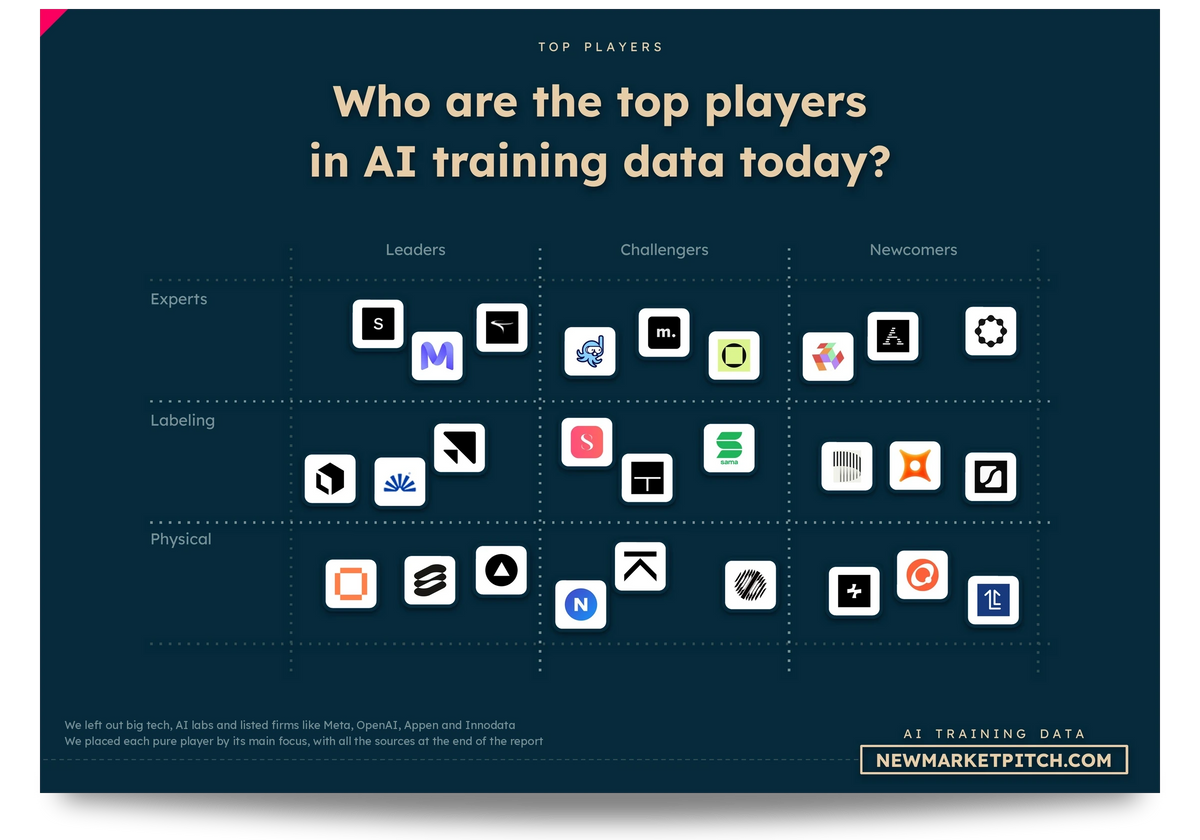
In our research about AI training data, we turn what is vague and complex into simple, useful visuals. Market maps like this one show you at a glance where every startup stands.
Did Accel make the best early investment in AI training data?
Accel has one of the strongest claims to the defining early venture investment in AI training data, having backed Scale AI well before its $29 billion strategic valuation.
Scale was founded in 2016, initially supplying labeled data to autonomous-vehicle developers and other machine-learning companies. Its original opportunity existed long before the current boom in frontier AI models.
In April 2021, Scale raised $325 million at a $7.3 billion valuation. Three years later, Accel led a $1 billion financing at $13.8 billion, alongside investors including NVIDIA, Coatue, Index Ventures, Founders Fund, Thrive Capital, Tiger Global, and Greenoaks.
Scale's valuation increased approximately 89% between those two financings, then more than doubled again during the Meta transaction in June 2025.
Scale managed to move from supplying data for autonomous vehicles into supporting frontier-model development, allowing its investors to benefit from two successive AI markets.
We cannot calculate Accel's actual investment return from valuation figures alone. Its ownership percentage, secondary sales, and cash distributions are not fully disclosed. The Meta transaction also changed Scale's ownership structure considerably.
Is Felicis the strongest AI training data venture investor right now?
Felicis currently has the strongest documented case among venture firms combining repeated large-round leadership with investments in different types of AI training data companies.
Its most important position is Mercor. Felicis led the company's $100 million Series B in February 2025 at a $2 billion valuation. Eight months later, it led the $350 million Series C at $10 billion, according to Mercor's announcement and TechCrunch.
That represents $450 million raised across two Felicis-led rounds, with Mercor's valuation increasing fivefold between them. Felicis's own investment amounts remain undisclosed, but its decision to lead both rounds shows unusual conviction.
Felicis also led DatologyAI's $46 million Series A in May 2024. DatologyAI develops systems that automatically select and organize training data, working on a different problem from Mercor's network of expert contributors.
This gives Felicis exposure to two business models that could both become important as training methods evolve. Mercor generates valuable information through specialists, while DatologyAI focuses on making existing training information more useful.
That's a stronger portfolio argument than simply participating in one huge round. Felicis has backed both the creation of new expert data and the software used to improve data quality.
If you want more recent data on this point, please see our latest AI training data market report.

In our market report about AI training data, we always try to gather several sources and make estimates that make sense, so you can work with solid numbers.
Why did General Catalyst and Benchmark keep investing in Mercor?
General Catalyst and Benchmark repeatedly backed Mercor as the company moved from AI recruiting into supplying expert-generated training data to frontier AI laboratories.
General Catalyst participated in Mercor's $3.6 million financing in January 2024. Benchmark joined the $30 million Series A in September 2024, which valued Mercor at approximately $250 million.
Both firms subsequently participated in the $100 million Series B in February 2025 and the $350 million Series C in October 2025. That gives General Catalyst four documented funding stages and Benchmark three.
Mercor's valuation increased fortyfold, from $250 million to $10 billion, over approximately thirteen months.
Mercor began as an AI-powered hiring platform, but its expert network became valuable to AI labs seeking scientists, doctors, lawyers, engineers, and other professionals to produce specialized training material.
By July 2026, Mercor reported a gross annualized revenue run rate above $2 billion, roughly double its reported run rate four months earlier. Those figures are company-reported annualized measures rather than audited full-year revenue, but they show a much larger business than its original recruiting proposition suggested.
Benchmark entered before Mercor's first billion-dollar valuation. General Catalyst invested even earlier and continued supporting the company through successive rounds.
Why are investors backing Mercor, micro1, and AfterQuery instead of traditional data-labeling companies?
Investors are paying especially high valuations for Mercor, micro1, and AfterQuery because these companies supply the specialist knowledge that frontier AI labs need to teach models how to perform difficult work.
Mercor's October 2025 financing valued it at $10 billion. micro1 reached a reported $4 billion valuation in September 2026. AfterQuery reportedly reached $3.2 billion around the same period, just months after raising $30 million at a $300 million valuation.
These businesses are connected by their use of skilled contributors, although their products are not identical.
Mercor organizes a large network of experts who help models learn and improve. micro1 recruits specialists and has expanded into acquiring enterprise operational data. AfterQuery focuses on training datasets and environments that capture how professionals make decisions and carry out tasks.
Their customers are trying to improve model performance in areas such as software engineering, financial analysis, legal reasoning, and scientific work. That can require carefully constructed examples of complex decisions, realistic workflows, and expert evaluations.
Traditional annotation remains useful for autonomous vehicles, computer vision, document processing, and many enterprise applications. But the newer companies are targeting problems that may be harder to solve through inexpensive, standardized labeling alone.
The valuation differences are striking. AfterQuery's reported increase from $300 million to $3.2 billion represents a 10.7-fold jump in roughly five months. Mercor's increase from $250 million to $10 billion took about thirteen months.
Investors clearly believe that specialized human expertise will remain expensive and valuable as models improve. The harder question is how long that advantage lasts once AI systems become capable of generating and checking more of their own training material.
If you want more recent data on this point, please see our latest AI training data market report.

Our document detailing everything you need to know about AI training data gets updated several times a month, so you always get the latest view of where things stand.
Are Insight Partners and S32 becoming major AI training data investors?
Insight Partners and S32 have become major growth investors in AI training data through their leadership of Snorkel AI's $350 million Series E in September 2026.
The round valued Snorkel at $3.5 billion, compared with $1.3 billion when it raised $100 million in May 2025. Its valuation therefore increased approximately 2.7 times in sixteen months.
Snorkel originally focused heavily on automating data labeling. The company has since expanded into producing complete datasets, synthetic training material, evaluations, and environments for advanced AI systems.
According to Snorkel's September 2026 announcement, its newer data-as-a-service offering had grown more than eighteenfold in approximately a year and reached a $375 million annualized revenue run rate.
The latest round also brought together a broad investor group. Addition participated alongside Insight Partners and S32, while other investors included Third Point Ventures, March Capital, Blumberg Capital, Greylock, Lightspeed, and GV.
Insight Partners and S32 are especially relevant because they co-led the largest publicly announced Snorkel financing. Earlier backers such as Greylock, Lightspeed, and Addition also deserve recognition for supporting the company through its development.
Which investors are backing AI training data software and automation?
Felicis, Amplify Partners, Radical Ventures, and Wellington Management are among the strongest investors backing companies that use software to improve AI training data quality and production.
DatologyAI is a good example. Amplify Partners led its $11.65 million seed financing, announced in February 2024. Felicis subsequently led its $46 million Series A in May 2024, with participation from Radical Ventures, Amplify, Microsoft's M12, and Amazon's Alexa Fund.
DatologyAI focuses on selecting and organizing training datasets. The goal is to improve how models learn from available information without relying exclusively on producing ever-larger quantities of new material.
Encord represents another approach. Wellington Management led its $60 million Series C in February 2026, bringing the company's total reported financing to $110 million. Existing investors including Y Combinator, CRV, N47, and Crane Venture Partners also participated.
Encord supplies tools for organizing, annotating, and evaluating complex datasets, particularly as AI development expands into video, robotics, and other multimodal applications.
Snorkel's $350 million Series E, DatologyAI's $46 million Series A, and Encord's $60 million Series C add up to $456 million across three distinct transactions. They also show how much investment is going toward software that helps produce or improve training data, rather than relying entirely on large networks of human annotators.

In our report covering the AI training data market, we look at what the winners do differently, so you can learn from the best instead of guessing.
Is NVIDIA becoming a serious AI training data investor?
NVIDIA is becoming one of the most strategically important technology investors in AI training data, with activity spanning traditional suppliers, synthetic data, and reinforcement learning infrastructure.
The company participated in Scale AI's $1 billion financing in May 2024, alongside major financial and corporate investors.
In March 2025, TechCrunch reported that NVIDIA had acquired Gretel, a startup developing synthetic-data technology. Although the acquisition price was not officially disclosed, the transaction gave NVIDIA direct ownership of technology used to generate training datasets.
In July 2026, NVIDIA Ventures participated in Prime Intellect's $130 million Series A, led by Radical Ventures. Prime Intellect builds infrastructure for open AI training and reinforcement learning.
NVIDIA was also linked to Mercor financing discussions around a reported $20 billion valuation in August 2026, according to The Information. The precise financial terms and individual investor commitments were not publicly established to the same standard as Mercor's earlier announced rounds.
These investments cover different parts of model development. Scale provides established data services, Gretel specializes in synthetic data, and Prime Intellect builds training infrastructure.
Are newer AI training data startups growing faster than Scale AI?
AfterQuery, Mercor, and micro1 have recorded extraordinarily fast valuation increases, but we cannot conclude that they are all growing faster than Scale AI commercially.
AfterQuery offers one of the clearest examples. In April 2026, the company announced a $30 million Series A led by Altos Ventures at a $300 million valuation. By September, TechCrunch reported that another financing valued it at $3.2 billion.
That represented a more than tenfold increase in roughly five months. AfterQuery also reported exceeding a $100 million annualized revenue run rate around the time of its Series A announcement.
micro1 followed a similarly rapid path. Its reported valuation increased from approximately $500 million in 2025 to $4 billion in September 2026, an eightfold jump in roughly a year.
Mercor went from a $250 million Series A valuation in September 2024 to $10 billion in October 2025. That fortyfold increase was accompanied by rapid growth in reported revenue activity.
Scale's history looks different. Founded in 2016, it took years to build its position in autonomous-vehicle data before expanding into frontier AI. Its valuation increased from $7.3 billion in 2021 to $13.8 billion in 2024, and then exceeded $29 billion in the Meta transaction.
The newer companies have achieved much faster valuation increases over short periods. Yet these comparisons span different stages of development and do not reveal equivalent changes in actual revenue, profitability, or cash generation.
A tenfold valuation jump makes a great headline. It doesn't establish a tenfold improvement in the underlying business, especially when the valuation comes from a private financing with terms that are not fully public.
If you want more recent data on this point, please see our latest AI training data market report.

In our research about AI training data, we don't want to repeat what boring consulting reports say. Instead, we show you the real and latest market signals that matter.
Are the biggest AI training data companies also the most heavily funded?
Surge AI shows that an AI training data company can build a very large business without raising the kind of venture capital associated with Scale AI, Mercor, or Snorkel.
Surge was founded in 2020 and operated for years without conventional external venture funding. Sacra estimated its 2024 annualized revenue at approximately $1.2 billion, while Bloomberg reported in July 2025 that the company was exploring its first major external financing.
That makes Surge a useful counterexample to the idea that funding totals determine commercial leadership.
Mercor has reported a gross annualized revenue run rate above $2 billion. Snorkel reported $375 million in September 2026. AfterQuery reported surpassing $100 million earlier that year.
These figures were published at different times and do not necessarily follow identical revenue-recognition methods. They also reveal little about how much each company retains after paying specialists, operating its infrastructure, and delivering customer projects.
Are investors now betting more on reinforcement learning data?
Investors are increasingly financing reinforcement learning environments and expert evaluations because advanced AI models need realistic practice completing complex tasks.
Snorkel's September 2026 financing is one example. Its latest products include training environments and detailed evaluations for advanced AI systems.
Labelbox has also expanded into this market through Horizon, a product designed to build realistic reinforcement learning environments. In October 2026, the company announced more than $100 million in financing commitments, combining equity and credit. The distinction matters because the entire amount cannot be counted as venture equity.
Prime Intellect raised $130 million in July 2026 to support AI training infrastructure, including reinforcement learning systems. Radical Ventures led the financing, with participation from NVIDIA Ventures, Intel Capital, and Dell Technologies Capital.
AfterQuery also works on environments designed to teach models how professionals complete tasks. Its customers can use these datasets to train AI agents on workflows extending beyond simple question answering.
A realistic software-development environment, for instance, can expose a model to multiple decisions, intermediate failures, and feedback across an entire task. That offers a different training experience from receiving a dataset of isolated questions and correct answers.
We do not have enough consistent industry-wide spending data to claim that reinforcement learning environments already attract more capital than every other form of training data.

Learning from others' mistakes is the cheapest lesson there is. In our market report about AI training data, we look at what broke startups before you, so you don't repeat it.
Could AI training data investors lose money despite all these billion-dollar valuations?
AI training data investors face a serious risk of paying valuations that assume rapid revenue growth will continue, even though customer concentration, labor costs, and changing training methods could weaken future returns.
Mercor's valuation increased fivefold between February and October 2025. AfterQuery's reported valuation increased more than tenfold in approximately five months during 2026. These are exceptional increases, even for fast-growing AI companies.
But the training-data market has an unusual customer structure. Some of the largest contracts come from a relatively small group of frontier AI laboratories. If one laboratory changes supplier, cuts spending, or develops more training capabilities internally, the effect on an individual supplier could be substantial.
The operating models also differ. Mercor and micro1 coordinate large numbers of highly skilled professionals. Snorkel combines expert contributions with automation. DatologyAI develops software for improving datasets.
Companies that pay specialists to complete projects may have different gross margins from software providers. Without comparable financial statements, we cannot reliably rank their profitability.
Strategic ownership creates another risk. Meta's substantial stake in Scale raised questions about whether competing AI laboratories would remain comfortable sharing sensitive projects with the company.
There is also the possibility that synthetic data and automated evaluation will replace some services currently performed by humans. NVIDIA's acquisition of Gretel shows how seriously a major technology company takes synthetic-data generation.
Who are the top AI training data investors right now?
Meta leads AI training data investing by disclosed strategic transaction value, while Felicis, Accel, General Catalyst, and Benchmark have the strongest claims among traditional venture capital firms.
These investors reached their positions in different ways.
Meta committed approximately $14.3 billion to Scale AI in one enormous strategic transaction. Accel backed Scale over a much longer period and led its major 2024 financing before Meta entered.
Felicis has the strongest current case for venture leadership across different training-data businesses. It led Mercor's Series B and C, totaling $450 million in combined financing, and also led DatologyAI's $46 million Series A.
General Catalyst and Benchmark benefited from backing Mercor before its valuation reached $10 billion. Insight Partners and S32 became major investors in training-data technology through Snorkel's $350 million financing. Radical Ventures is another important name because of its investments in DatologyAI and Prime Intellect.
The rankings below reflect our assessment of documented investor activity, breadth, and the development of portfolio companies. They are not a calculation of individual invested capital or realized returns.
| Investor | Main strength | Current judgment |
|---|---|---|
| Meta | $14.3B Scale transaction | Largest strategic investor |
| Felicis | Mercor and DatologyAI | Strongest multi-company VC case |
| Accel | Early Scale exposure | Defining established VC investor |
| General Catalyst | Mercor across multiple rounds | Leading recurring backer |
| Benchmark | Early and repeated Mercor exposure | Strong early-growth investor |
| Insight Partners | Snorkel AI Series E | Leading data-technology growth investor |
| S32 | Snorkel AI Series E | Major growth-stage backer |
| Radical Ventures | DatologyAI and Prime Intellect | Strong technical training exposure |
| Wellington Management | Scale and Encord | Broad data-infrastructure investor |
| NVIDIA | Scale, Gretel, Prime Intellect | Major strategic technology investor |
| Altos Ventures | AfterQuery Series A | Notable early investor in expert data |
| Dream Ventures | micro1 financing | Emerging expert-data investor |

If you build or invest in the AI training data market, you need to know which business models pay off now and which ones are fading. That's why our report covering it has a whole section on it.
So who are the best investors in AI training data overall?
Felicis is our strongest choice among conventional venture capital firms currently investing in AI training data, while Meta is the clear leader in strategic transaction size and Accel has one of the sector's most important long-term investment records.
Felicis stands out because it led two major Mercor rounds as the company moved from a $2 billion to a $10 billion valuation, while separately backing DatologyAI's software-driven approach to improving training datasets.
Accel has the longer history through Scale AI, whose valuation rose from $7.3 billion in 2021 to more than $29 billion in Meta's 2025 transaction. General Catalyst and Benchmark also deserve top-tier consideration for their repeated investments in Mercor before its enormous valuation increase.
For training-data software and reinforcement learning infrastructure, Insight Partners, S32, and Radical Ventures are particularly relevant. Their investments reflect growing demand for better datasets, realistic training environments, and automated evaluation.
We cannot identify a definitive winner by actual financial return without access to private ownership and distribution data. On the evidence available today, Felicis has built the most convincing multi-company venture portfolio among the leading names examined.
If you want more recent data on this point, please see our latest AI training data market report.
Our methodology
This analysis identifies the leading investors in AI training data using documented financing activity and commercial evidence available as of October 28, 2026. We compare transaction size, investment timing, leadership roles, repeated participation, portfolio breadth, and the subsequent development of the companies backed.
We include venture capital firms, growth investors, and strategic corporate investors financing companies involved in data annotation, expert-generated datasets, data curation, synthetic data, and reinforcement learning environments. Customer contracts are excluded from investment comparisons. Acquisitions are considered separately from venture financing, and equity-plus-credit commitments are not treated entirely as equity.
Investor rankings reflect documented commitment and portfolio development rather than assumed financial returns. When an investor leads a funding round, the announced financing amount represents the entire round, not necessarily that investor's individual contribution. Valuations are treated as financing or transaction benchmarks, while annualized revenue figures are distinguished from audited full-year revenue. Strategic investors and conventional venture firms are assessed separately.
We prioritize first-hand company financing announcements, investor disclosures, and established financial and technology reporting. The assessment gives particular weight to Scale AI's financing history and Meta transaction, Mercor's funding progression, Snorkel AI's growth financing, and investments in DatologyAI, Encord, AfterQuery, and Prime Intellect. Reported valuations and commercial figures are attributed to their original disclosures or reporting rather than treated as independently audited results.
Key sources include Scale AI's announcement of its Meta transaction, Reuters on Meta's reported $14.3 billion investment, Scale AI's Series F announcement, Accel's Scale AI investment history, Scale AI's Series E announcement, Mercor's Series C announcement, Mercor's Series B announcement, Mercor's initial financing announcement, and TechCrunch on Mercor's reported revenue run rate and financing discussions.
Additional sources include DatologyAI's Series A announcement, DatologyAI's seed financing, Snorkel AI's Series E and commercial update, Snorkel AI's earlier financing announcement, Encord's Series C announcement, Prime Intellect's Series A announcement, AfterQuery's Series A announcement, TechCrunch on AfterQuery's reported $3.2 billion valuation, TechCrunch on micro1's commercial growth, Labelbox's financing announcement, and TechCrunch on NVIDIA's reported Gretel acquisition.

In our report covering the AI training data market, we like to show you the big picture. We know your time is precious, so we make every page quick to read and packed with as much learning as possible per minute.
Written by the New Market Pitch teamWe track new markets so founders and investors can move faster. About us