Is AI trust, risk and security a real business model or just a feature?
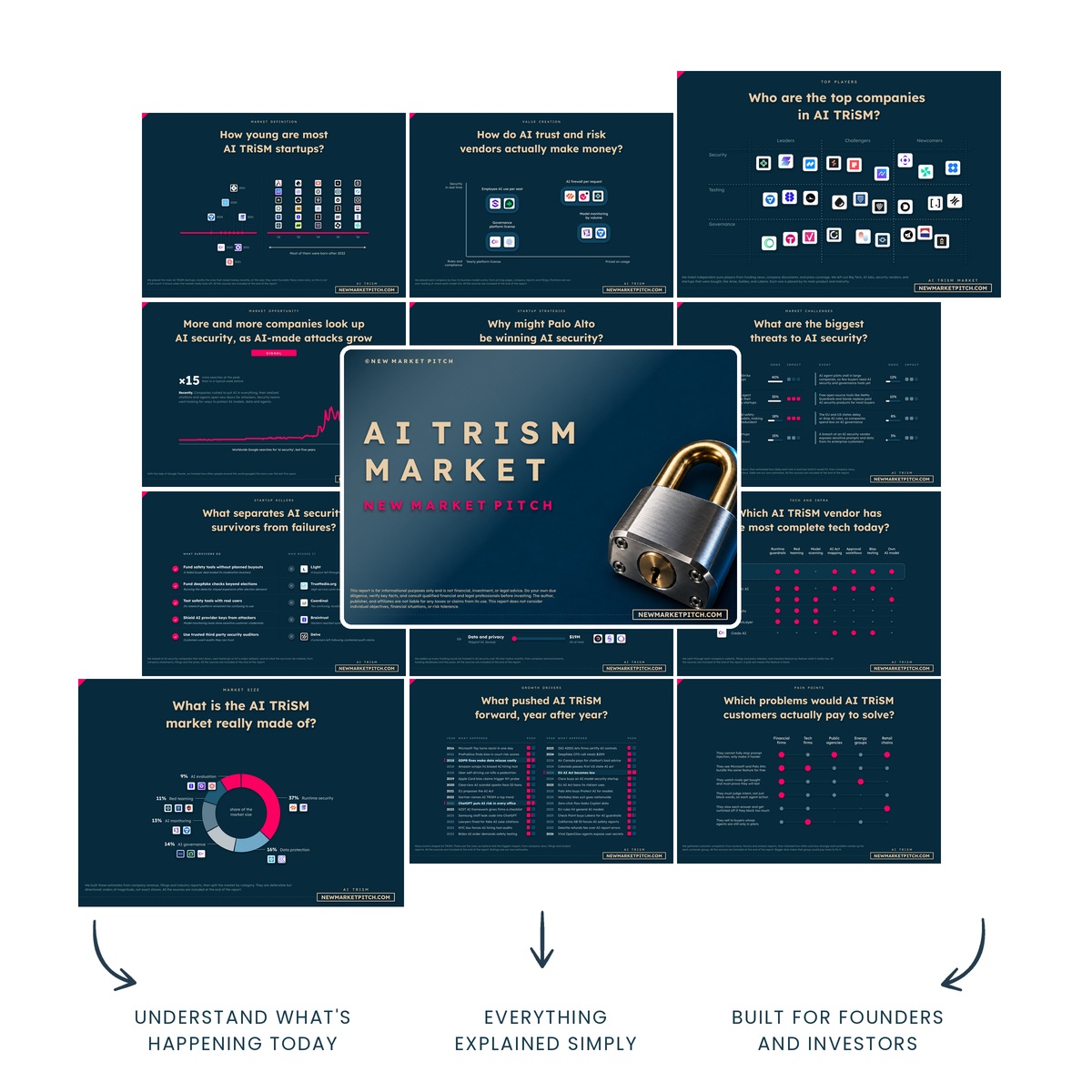
Whether you're building or investing in the AI TRiSM market, our report covers everything you need to know: the players, the money, and what's coming next.
Summary
AI trust, risk and security management (AI TRiSM) is a real business opportunity, but much of it is becoming a feature inside cybersecurity, cloud and enterprise software platforms. Independent companies can still build substantial businesses around runtime security, cross-platform governance and continuous AI risk management, while basic safeguards are increasingly being commoditized.
The acquisition market reveals where the strategic value lies. Palo Alto Networks, Check Point and F5 spent approximately $982 million acquiring Protect AI, Lakera and CalypsoAI in 2025. These deals validate demand for specialist technology, but also show how quickly independent products can become components of larger security platforms.
The pricing gap is striking. IBM advertises AI governance subscriptions starting at $42,000 annually, while AWS sells certain AI safeguards for a few cents per thousand text units. Enterprises will pay serious money for governance and oversight, but isolated technical controls face a much tougher pricing environment.
AI TRiSM is not really one software market. Runtime protection, model evaluation, governance, compliance automation and privacy safeguards have different buyers, competitors and economics. Combining them into one market-size estimate risks overstating how much revenue independent vendors can capture.
Independent governance software has an advantage when enterprises use multiple cloud providers, models and AI applications. A central system tracking approvals, risk assessments and compliance evidence can become difficult to replace, although established governance platforms are competing for that role.
Regulation supports demand without guaranteeing software sales. The EU AI Act creates ongoing compliance obligations, but some high-risk requirements have been delayed until December 2027 and August 2028. Companies can also use existing compliance platforms, consultants or internal systems rather than buy a dedicated AI TRiSM product.
Autonomous agents are expanding the security problem beyond filtering chatbot responses. Businesses increasingly need controls over what agents can access, which tools they can execute and what actions they can take. That creates more room for sophisticated protection than a standalone prompt-filtering API offers.
Product defensibility increasingly comes from operational dependence. A security platform enforcing policies across several models, or a governance system maintaining years of audit evidence, has greater pricing power than a tool providing occasional tests, isolated scores or basic dashboards.
The revenue mathematics are plausible but demanding. At an illustrative $42,000 annual contract, a specialist needs approximately 2,381 customers to reach $100 million in recurring revenue. Larger contracts and additional modules can improve the equation, but sales costs, integrations and customer retention remain critical.
Acquisitions may be a more natural outcome for many specialist vendors than building independent public companies. Established cybersecurity businesses can distribute acquired AI protection technology through existing enterprise relationships, making some capabilities more valuable inside a larger platform.
Our conclusion is that AI TRiSM has genuine commercial value but an exaggerated identity as a single standalone industry. The winners will be the vendors that remain essential even after Microsoft, AWS and established security companies have added the obvious safeguards to products customers already buy.

Written by the New Market Pitch teamWe track new markets so founders and investors can move faster. About us
Why is AI TRiSM becoming such a big business question?
AI TRiSM is attracting serious money, but the companies buying AI security technology are increasingly turning it into features of their existing products.
Gartner placed AI trust, risk and security management (AI TRiSM) at the Peak of Inflated Expectations in its 2025 AI Hype Cycle. The category covers technologies used to keep AI systems secure, reliable, compliant and under human control.
The business landscape has changed quickly. During 2025, Palo Alto Networks acquired Protect AI, Check Point acquired Lakera, and F5 acquired CalypsoAI. All three purchases involved specialized AI security companies whose technology could strengthen much larger cybersecurity platforms.
The consolidation has continued. In June 2026, F5 acquired SurePath AI for $50.1 million, adding technology for discovering unauthorized AI use and monitoring how employees interact with AI applications.
At the same time, AWS, Microsoft, IBM and Cisco have been developing their own AI safeguards. Companies that previously needed an independent supplier for certain AI security functions can increasingly obtain those capabilities from vendors they already use.
This creates an unusual market. Demand for AI protection is growing, acquisitions are happening, and new products keep appearing. Yet these developments could leave independent AI TRiSM startups with a smaller opportunity than the industry's growth suggests.
What are AI TRiSM companies actually selling?
AI TRiSM covers several different software businesses, and the differences between them determine whether a startup can make money independently.
Gartner describes AI TRiSM as a group of technical capabilities supporting AI governance, trustworthiness, fairness, safety, reliability, security, privacy and data protection. Its framework identifies four layers of capabilities rather than one standardized product.
In practice, companies have taken different approaches.
Credo AI helps enterprises keep track of AI systems, assess risks and document compliance decisions. HiddenLayer protects AI models and applications against attacks. Arthur provides model evaluation, monitoring and governance. Lakera developed defenses against threats such as prompt injection and data leakage.
These products can have entirely different buyers. A security team protecting an AI-powered customer service application may purchase runtime protection. A bank's model risk team may need governance and evaluation software to oversee hundreds of models.
Some companies sell annual enterprise subscriptions. Others charge for usage, protected applications or monitoring activity.
The broad AI TRiSM label therefore combines several markets that already overlap with cybersecurity, compliance software and AI development tools. Their commercial potential needs to be judged separately, particularly when customers can replace certain products with software they already own.

A good product starts with a real problem. In our report covering the AI TRiSM market, we show you the ones customers still live with.
Are companies actually paying for AI TRiSM software?
AI TRiSM already has paying enterprise customers and published software prices, although financial disclosures remain too limited to establish how profitable the specialist vendors have become.
IBM provides one of the clearest examples. Its watsonx.governance Risk & Compliance Basic plan starts at $3,500 per month, equivalent to $42,000 annually. The Advanced plan starts at $6,450 per month, or $77,400 annually.
IBM also offers a watsonx.governance contract through AWS Marketplace for $42,000 over 12 months. That configuration includes five AI use cases, 12,000 evaluations and 25 concurrent users.
A larger deployment can cost considerably more, depending on the number of users, modules, evaluations and systems being governed.
At the other end of the market, Amazon Bedrock Guardrails charges just $0.07 per 1,000 text units for content filtering and $0.08 for prompt-attack filtering through its dedicated guardrail checks API.
The two pricing approaches reveal an important distinction. Businesses will pay substantial annual fees for managing AI governance processes, while basic technical safeguards are increasingly available at low usage-based prices.
Independent vendors such as Credo AI, Arthur and HiddenLayer also sell enterprise products, but their publicly available materials do not consistently disclose customer counts, annual recurring revenue, gross margins or renewal rates.
We can establish that AI TRiSM software is commercially viable. Whether the average specialist vendor has attractive economics is another question.
| AI TRiSM product | Published pricing | Commercial model |
|---|---|---|
| IBM governance free trial | Free | Evaluation |
| IBM Model Management | From $0.64, usage-based | Consumption |
| IBM Risk & Compliance Basic | $3,500/month | Enterprise subscription |
| IBM Risk & Compliance Advanced | $6,450/month | Enterprise subscription |
| IBM governance on AWS | $42,000/year | Annual contract |
| AWS content filtering | $0.07/1,000 text units | Consumption |
| AWS prompt-attack filtering | $0.08/1,000 text units | Consumption |
| AWS sensitive-information filtering | $0.10/1,000 text units | Consumption |
| AWS contextual grounding checks | $0.10/1,000 text units | Consumption |
Published starting prices and API rates are not directly comparable measures of value. Actual enterprise contract costs depend on configuration and usage.
Do the biggest AI TRiSM acquisitions prove there's real money in this market?
Major AI security acquisitions prove that specialized technology has become valuable to cybersecurity companies, although the prices paid reveal more about strategic demand than startup profitability.
Palo Alto Networks completed its acquisition of Protect AI in July 2025. According to its SEC filings, the purchase consideration totaled $635 million, comprising $608 million in cash and $27 million in replacement equity awards.
Check Point completed its acquisition of Lakera in October 2025 for approximately $201.8 million, while F5 paid $145.2 million for CalypsoAI in September of that year.
Together, those three transactions totaled approximately $982 million.
Their timing is revealing. Three established cybersecurity companies spent nearly $1 billion on AI-native security acquisitions during a period when generative AI applications were moving into enterprise production.
The buyers also had similar intentions. Palo Alto wanted to strengthen Prisma AIRS, Check Point aimed to expand protection for generative and agentic AI, and F5 wanted runtime protection and testing capabilities for AI inference.
F5's subsequent SurePath acquisition added another dimension: discovering AI applications already being used inside organizations.
These purchases suggest that enterprise security platforms want coverage across the AI lifecycle, from discovering applications to testing them and protecting their activity.
Still, the buyers' SEC filings provide acquisition values rather than meaningful standalone revenue histories for the acquired startups. We cannot turn approximately $1 billion in acquisition spending into a conclusion about the size of the AI TRiSM software market.
The more interesting finding is that buyers repeatedly preferred acquiring specialized technology and distributing it through established security platforms.

If you build or invest in the AI TRiSM market, you need to know which business models pay off now and which ones are fading. That's why our report covering it has a whole section on it.
Can independent AI TRiSM startups survive against Microsoft and AWS?
Independent AI TRiSM startups face a difficult pricing battle against cloud providers, especially when selling basic safeguards that already come with existing AI infrastructure.
Amazon Bedrock Guardrails offers content filtering, prompt-attack detection, sensitive-information filtering, contextual grounding checks and automated reasoning checks.
Microsoft Azure AI Content Safety offers related capabilities, including harmful-content detection and prompt-related security tools. Both platforms allow developers to add safeguards directly to applications without separately negotiating with a specialist AI security company.
The economics become particularly uncomfortable for narrowly focused startups.
At AWS's published rate of $0.08 per 1,000 text units, processing one million billable text units for prompt-attack detection would cost $80, excluding other services and charges.
A vendor charging thousands of dollars annually for essentially the same protection must demonstrate a substantial additional benefit.
That benefit could involve better detection, consistent security policies across several cloud providers, specialized attack coverage or integration with existing corporate security systems.
The situation resembles earlier cybersecurity markets, where standalone capabilities gradually became standard functions of cloud platforms, endpoint security suites and network protection products.
Startups still have opportunities, but the easiest functionality to reproduce is under the greatest pricing pressure. A company offering little beyond a prompt filter will struggle to defend premium pricing against its customer's existing cloud provider.
If you want more recent data on this point, please see our latest AI TRiSM market report.
Why would a company pay for independent AI governance software?
Companies have a good reason to buy independent AI governance software when their AI systems are spread across different platforms, departments and external suppliers.
Imagine a financial institution using Microsoft Azure for internal applications, AWS for model development, third-party AI assistants for employees and several specialized models for financial risk analysis.
Individual providers can report activity within their own systems. The institution still needs to know which AI applications exist, who approved them, which regulations apply and whether the required checks have been completed.
Credo AI addresses that problem with AI inventories, risk assessments and governance workflows. IBM offers related capabilities through watsonx.governance, while ServiceNow has been extending its AI governance offerings inside enterprise workflows.
The business case becomes more compelling when AI oversight involves multiple departments. Security teams need technical controls, compliance teams need documentation, and business owners need approval processes.
Keeping those records accurate across a changing collection of AI applications is recurring work.
An independent platform also has a neutrality advantage. A company using several model providers may prefer a governance system that can assess them all rather than relying on one supplier's own reporting.
That advantage has limits. Existing governance, risk and compliance software can also add AI-specific functions.
Independent AI governance vendors therefore have the strongest position when customers use their platform as a central record of AI systems and decisions. A basic inventory or compliance questionnaire offers much less protection against competitors.

Learning from others' mistakes is the cheapest lesson there is. In our market report about AI trust and risk tools, we look at what broke startups before you, so you don't repeat it.
Will the EU AI Act force companies to buy AI TRiSM software?
The EU AI Act will push more companies to improve AI governance, but the latest regulatory changes have made the case for immediate compliance-driven software spending less straightforward.
The AI Act entered into force in August 2024. Rules concerning prohibited AI practices began applying in February 2025, followed by general-purpose AI provisions in August 2025.
Many of the law's remaining provisions began applying in August 2026, but the EU subsequently delayed certain high-risk AI requirements.
Following the EU's simplification package, the application dates for the affected high-risk rules moved to December 2027 for standalone high-risk AI systems and August 2028 for high-risk AI systems embedded in regulated products.
That delay matters for vendors whose sales arguments rely heavily on approaching regulatory deadlines.
Companies still have responsibilities under provisions already in force, and organizations operating across several jurisdictions must handle overlapping requirements. The voluntary NIST AI Risk Management Framework also provides an established reference for documenting and managing AI risks.
However, the legislation does not require companies to purchase a specific AI TRiSM product.
A large enterprise might extend its existing compliance platform. Another may hire consultants or build internal workflows. Smaller organizations may initially manage their obligations through documents and conventional risk-management systems.
Regulation should generate recurring work around inventories, assessments, documentation and monitoring. The companies best positioned to monetize that work are those that can automate it and keep the evidence up to date.
Simply selling AI Act compliance checklists is unlikely to support a large independent business for long.
Is AI security a better business than AI governance?
AI runtime security currently has stronger evidence of strategic demand than standalone AI governance, although we still lack enough financial data to prove that it generates better software margins or retention.
The difference comes from what customers need the products to do.
Runtime security monitors or controls AI applications while they operate. It can detect malicious prompts, data leakage and suspicious interactions before those events cause damage.
AI governance focuses more heavily on documenting risks, managing approvals and proving that an organization follows its own policies and applicable regulations.
For security vendors, runtime protection connects naturally to products that customers already buy. Cybersecurity teams are accustomed to paying for controls that continuously monitor production systems.
Governance can also become essential infrastructure, especially in regulated industries. But its purchasing process may involve several departments, and the work can overlap with existing compliance software.
The investment market provides another useful comparison.
HiddenLayer announced a $100 million Series B in September 2026, led by Delta-v Capital, with participation from Ten Eleven Ventures, Morgan Stanley, Microsoft's M12 and Booz Allen Ventures.
The company said it would use the financing to expand its AI security platform, including protection for autonomous coding agents.
That is a substantial financing round for a specialist company in a market where several peers have already been acquired.
Our preference is for runtime security as the clearer independent startup opportunity. Governance can still produce durable revenue, but the evidence for specialist security demand is more visible, particularly among major enterprise technology buyers.
If you want more recent data on this point, please see our latest AI TRiSM market report.

When you build or invest in the AI TRiSM market, you need clarity, not confusion. In our document detailing everything you need to know about AI TRiSM, we always try to put numbers on and quantify whatever is usually vague and confusing.
Will autonomous AI agents create a bigger market for AI security?
AI agents are making specialized security more important because businesses increasingly need to control the actions AI systems can take, rather than just the answers they generate.
Traditional chatbot safeguards focus heavily on harmful content, confidential information and unreliable responses.
Autonomous agents introduce additional risks. They can read documents, execute code, call external services, update records and potentially initiate financial or operational transactions.
The OWASP Top 10 for Large Language Model Applications identifies prompt injection and excessive agency among the relevant risks. A malicious instruction becomes more dangerous when a compromised system can access business tools.
We are beginning to see commercial products respond to that change.
HiddenLayer's Agent Harness Security focuses on protecting AI coding agents during operation. Cisco's AI Defense, launched in January 2025, addresses vulnerabilities and runtime threats in enterprise AI applications. Established identity and security systems are also increasingly relevant because agents need controlled access to corporate resources.
The business opportunity extends beyond inspecting prompts. Security software may need to identify which agent performed an action, which permissions were available, what data was accessed and whether an action violated company policy.
Those requirements are harder to satisfy with a basic content-filtering API.
Demand for agent protection, however, does not automatically mean demand for a separate AI TRiSM supplier. Identity providers, application security companies and cloud platforms can all compete for the same spending.
Autonomous agents make the security problem more serious. Independent startups will benefit most when their tools work across the applications, models and identity systems customers already use.
Can AI TRiSM startups build technology that competitors cannot easily copy?
The defensible part of AI TRiSM increasingly lies in how deeply a product is connected to enterprise operations, because individual safeguards are becoming easier for competitors to reproduce.
A startup can develop an effective prompt classifier, but AWS, Microsoft and other established providers can improve their own detection tools and offer them directly to customers.
Basic AI inventories and compliance dashboards face similar competition from enterprise governance platforms.
A more defensible product becomes difficult to replace because it manages information and workflows across many systems.
For runtime security, that could mean enforcing consistent policies across several model providers while feeding incidents into an existing security operations center.
For governance, it could mean maintaining years of AI approval decisions, assessment histories, regulatory mappings and evidence needed by auditors.
Evaluation software faces a related challenge. Running an occasional model test is becoming commonplace. Managing a trusted history of evaluations across model versions, applications and deployment environments creates more lasting value.
Arthur's evaluation and monitoring products address this kind of ongoing oversight, while Credo AI focuses on the governance processes surrounding AI systems.
Still, deep integration does not guarantee that an independent vendor survives. A large software provider could acquire similar technology or add competing functions to an established platform.
The better test is whether removing the specialist would disrupt important business processes. If customers could switch it off without changing how they operate, the product probably has limited pricing power.
If you want more recent data on this point, please see our latest AI TRiSM market report.

In our report covering the AI TRiSM market, we look at what the winners do differently, so you can learn from the best instead of guessing.
Can AI model testing become a standalone business?
AI model evaluation can support recurring software revenue, but standalone testing vendors will struggle if their products produce only scores that development teams can generate elsewhere.
Enterprises need to know whether their AI systems remain accurate, secure and reliable after updates.
NIST's Generative AI Profile, published in July 2024, addresses testing, evaluation, verification and validation throughout the AI lifecycle.
That creates recurring demand because models, prompts, data sources and application behavior can change.
However, model testing is increasingly built into AI development tools and cloud environments. Developers can already evaluate outputs using frameworks and services integrated with their existing workflows.
The commercial opportunity becomes stronger when evaluations support consequential decisions.
A financial institution may need documented testing before releasing an AI application. A healthcare software provider may need to track failures across successive model versions. A customer service company may need continuous checks for policy violations as its AI agent changes.
In each case, the valuable product includes evaluation history, repeatability, reporting and integration with release decisions.
That also suggests why many independent evaluation vendors may expand into monitoring, governance or security rather than remain narrowly focused.
Basic model testing is becoming a feature. A broader platform that controls how enterprises approve and monitor AI systems has a better chance of sustaining meaningful subscription revenue.
How big is the AI TRiSM market really?
AI TRiSM is too broad to support a reliable standalone market-size estimate from the public evidence currently available, and many headline figures risk counting existing cybersecurity and compliance spending as new AI software revenue.
The category combines AI runtime protection, model monitoring, governance, privacy safeguards, evaluation and compliance automation.
All of those functions have genuine demand, but they overlap with established markets.
Runtime protection competes for application security budgets. Model evaluation overlaps with AI development infrastructure. Governance overlaps with enterprise risk management, while sensitive-data controls overlap with existing data security products.
The same corporate expenditure can therefore appear in several adjacent market estimates.
There is also a difference between software revenue and the strategic value of the technology. A company acquired for hundreds of millions of dollars does not necessarily contribute anything close to that amount in annual market spending.
Similarly, Gartner's worldwide AI spending forecast of $2.59 trillion for 2026 describes a much larger industry that includes infrastructure, devices and other AI-related products.
Assigning a small percentage of that figure to AI TRiSM would produce an attractive market estimate, but the calculation would be arbitrary.
We would need a much more detailed picture of independent vendor revenue, spending already included in enterprise software contracts and usage charges paid for cloud safeguards.
For now, the available evidence supports a commercially important collection of markets, with runtime security and cross-platform governance among the most interesting segments.
The total opportunity for independent startups is smaller than the sum of every software budget associated with trustworthy AI.
If you want more recent data on this point, please see our latest AI TRiSM market report.

Your time is limited. In our research about AI trust and risk tools, we put numbers on each part of the market, so you can see where it makes sense to focus.
How much revenue could an AI TRiSM startup realistically make?
An independent AI TRiSM startup could build a meaningful recurring-revenue business at enterprise software prices, but reaching $100 million annually would require thousands of customers or substantially larger contracts than the published entry-level benchmarks.
We can illustrate the economics using IBM's advertised $42,000 annual governance configuration as a reference point.
At that price, 100 customers would generate $4.2 million in annual recurring revenue. Five hundred would generate $21 million, while 1,000 would generate $42 million.
Reaching approximately $100 million would require around 2,381 equivalent annual contracts.
Those are substantial customer counts for a specialist enterprise product, particularly one requiring security reviews, internal approvals and integration with existing systems.
Larger companies could pay considerably more. A bank deploying governance software across hundreds of AI use cases would have different needs from a business overseeing five internal applications.
A startup could also increase revenue by selling monitoring, automated evaluation and compliance modules to existing customers.
But annual contract value alone does not determine whether the model works. Sales costs, deployment work, cloud expenses, retention and the amount of human support required all affect profitability.
Public disclosures from specialist AI TRiSM vendors are still too limited to establish representative gross margins, customer-acquisition costs or net revenue retention.
The calculation shows that enterprise pricing can support substantial revenue. It also explains why selling a narrowly differentiated feature, rather than a deeply integrated platform, may become difficult as customer counts grow.
| Illustrative customers | Annual price/customer | Annual recurring revenue |
|---|---|---|
| 25 | $42,000 | $1.05M |
| 50 | $42,000 | $2.10M |
| 100 | $42,000 | $4.20M |
| 250 | $42,000 | $10.50M |
| 500 | $42,000 | $21.00M |
| 1,000 | $42,000 | $42.00M |
| 2,000 | $42,000 | $84.00M |
| 2,381 | $42,000 | ~$100.00M |
These calculations use an illustrative contract price and should not be interpreted as actual customer counts or revenue forecasts for a particular AI TRiSM company.
Will most AI TRiSM startups end up being acquired?
Acquisition looks like one of the most credible outcomes for specialist AI TRiSM companies, although there is not enough evidence to conclude that most startups will be acquired.
The recent transaction pattern explains why.
Large cybersecurity vendors already sell products to enterprise security teams. They have distribution networks, existing contracts and established ways to deploy protective software.
A specialist startup may have developed effective AI security technology but still need years to build comparable sales relationships and infrastructure integrations.
An established vendor can incorporate the technology into a broader offering and reach customers much faster.
As seen above, major acquisitions have already concentrated several AI-native capabilities inside larger platforms. The newer SurePath transaction reinforces that trend, showing that buyers are adding different pieces of the AI security workflow rather than purchasing identical products repeatedly.
The alternative is for specialists to remain independent and become major security or governance platforms themselves.
That path requires more than developing good detection technology. Vendors need enough product breadth to survive bundled competition, sufficient distribution to win enterprise accounts and customer relationships that continue producing revenue after the initial deployment.
The market currently offers clear evidence that buyers want specialist technology. It offers much less financial evidence about how many independent startups can grow into large, profitable companies.
We expect acquisitions to remain common because the strategic value of these capabilities can be greater inside established software platforms than when sold independently.

In our market report about AI trust and risk tools, we always try to gather several sources and make estimates that make sense, so you can work with solid numbers.
Is AI trust, risk and security a real business model or just a feature?
AI TRiSM is partly a real standalone software business, but the broad category is increasingly becoming a collection of features inside cybersecurity, cloud and enterprise software platforms.
The strongest independent opportunities currently appear in runtime AI security, cross-platform governance and products that manage continuous oversight of AI systems.
We have concrete evidence that these capabilities command spending. Enterprise governance software carries annual prices in the tens of thousands of dollars. Specialist AI security companies have attracted major investments. Established technology vendors have paid substantial amounts to acquire products they want to integrate into their platforms.
The difficulty comes from how that spending will be distributed.
Cloud providers are already selling basic safeguards at low usage-based prices. Cybersecurity companies are integrating AI protection into existing platforms. Governance providers are adding AI oversight to broader enterprise workflows.
A startup offering one narrow safeguard will increasingly compete against a bundled feature that the customer may already be paying for.
Specialists have a better chance when their products work across multiple vendors, control sensitive operations or become essential to an organization's risk-management processes.
The growth of autonomous AI agents should make those capabilities more valuable. The additional complexity creates real security problems that conventional content filters do not fully address.
Still, we have more evidence of technology investment and acquisition demand than of large, profitable independent AI TRiSM businesses.
Our judgment is that AI TRiSM is a real commercial opportunity with an exaggerated identity as a single software market. Most basic trust and safety functions are likely to become standard features, while a smaller number of independent vendors can build substantial businesses around security enforcement, governance and continuous risk management.
The companies that win will be those that enterprises keep paying even after Microsoft, AWS and their existing cybersecurity providers have added the obvious AI safeguards.
If you want more recent data on this point, please see our latest AI TRiSM market report.
Our methodology
This analysis examines whether AI TRiSM can sustain independent software businesses or whether its capabilities are increasingly being absorbed into established technology platforms. We addressed the question through several commercial dimensions, including observable customer spending, product pricing, strategic acquisitions, startup financing, competitive distribution, regulatory demand, technological differentiation and revenue scalability.
For each dimension, we examined recent developments, prioritized the most relevant evidence and assessed what it revealed about the underlying business economics. We then combined these findings to identify conclusions supported by multiple developments rather than relying on isolated company announcements or broad industry expectations.
We treated AI TRiSM as a collection of overlapping software activities rather than a uniform market. Runtime security, governance, model evaluation, privacy protection and compliance automation were assessed against their respective buyers, competitors and established software alternatives. This distinction helps separate growing demand for trustworthy AI from the revenue that independent specialists can realistically capture.
Our commercial assessment distinguishes three forms of evidence: published software prices demonstrate available monetization models; disclosed acquisition consideration establishes what strategic buyers have paid for specialist technology; and equity financing demonstrates investor willingness to fund future growth. We do not treat those measures as interchangeable or use acquisition values as proxies for annual software revenue.
To assess competitive durability, we compared specialist products with safeguards and governance capabilities distributed through major cloud, cybersecurity and enterprise platforms. We examined whether independent products offer advantages through cross-platform coverage, enforcement capabilities, ongoing monitoring, enterprise workflow integration and accumulated risk-management records. Greater weight was placed on functions that become difficult for customers to replace.
Our regulatory analysis uses the EU AI Act as amended by Regulation (EU) 2026/1744, alongside the NIST AI Risk Management Framework and technical security guidance from OWASP. We distinguished obligations already in force from future application dates, while assessing compliance-related software demand separately from the legal requirements themselves.
We also tested revenue scalability using published enterprise subscription benchmarks. The customer-count scenarios are arithmetic illustrations of potential annual recurring revenue, rather than forecasts for any particular vendor. The broader commercial assessment considers acquisition costs, integration requirements, recurring usage, customer retention and competition from bundled products, where publicly available evidence permits.
Key sources for market definitions and pricing include Gartner's 2025 AI Hype Cycle, IBM's watsonx.governance pricing, Amazon Bedrock pricing, Amazon Bedrock Guardrails, and Microsoft Azure AI Content Safety.
For acquisition activity and specialist company positioning, we used Palo Alto Networks' Protect AI acquisition announcement, its FY2025 Form 10-K, Check Point investor disclosures, F5 investor disclosures, HiddenLayer's September 2026 financing announcement, and official product information from Credo AI, Arthur, Cisco AI Defense and ServiceNow AI Control Tower.
Regulatory and technical references include the original EU AI Act, Regulation (EU) 2026/1744, the European Commission's AI regulatory framework, NIST's AI Risk Management Framework, NIST's Generative AI Profile, and OWASP's guidance on excessive agency.
Our final judgment comes from aggregating the evidence across these dimensions: where enterprises demonstrably spend money, where established platforms are reducing the value of standalone features, and where specialist vendors can retain sufficient operational importance to support recurring revenue. The central test is whether the value of AI trust, risk and security technology can translate into durable economics for independent companies.

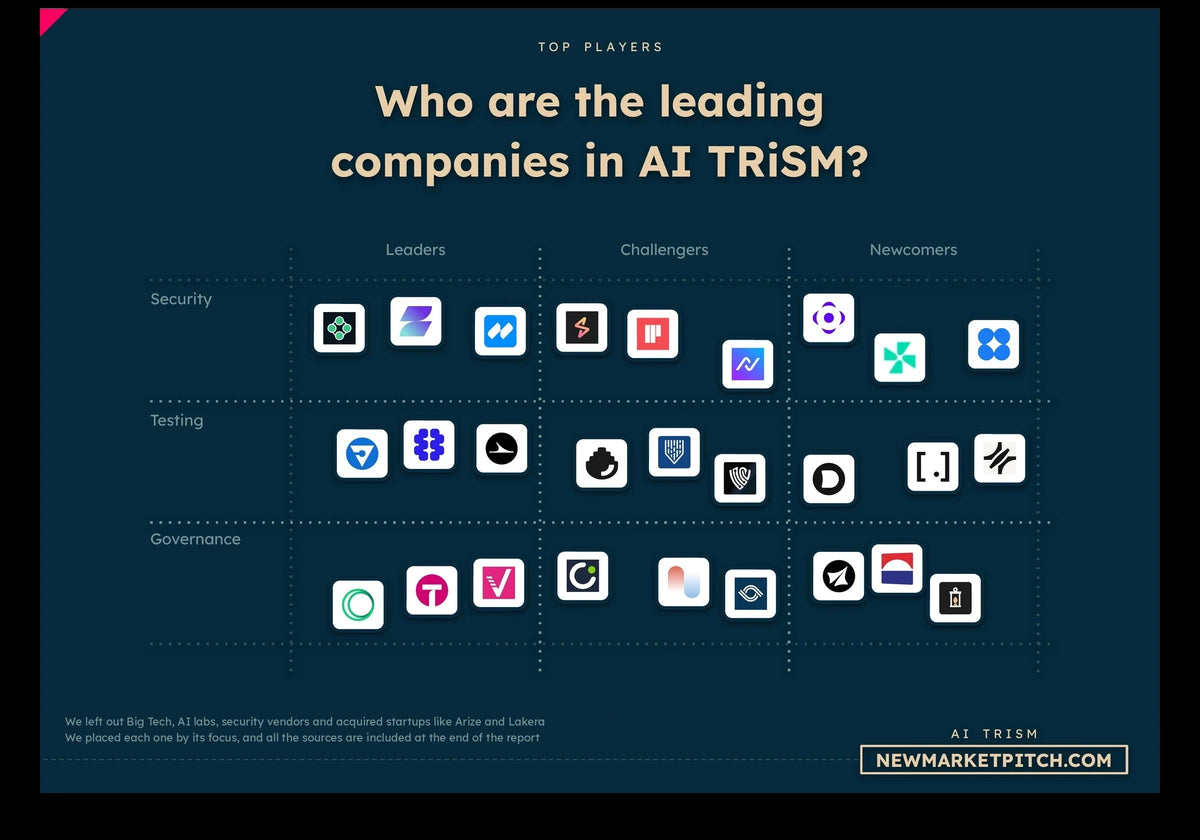
In our document detailing everything you need to know about AI TRiSM, we turn what is vague and complex into simple, useful visuals. Market maps like this one show you at a glance where every startup stands.
Written by the New Market Pitch teamWe track new markets so founders and investors can move faster. About us