Who are the top AI trust, risk and security startups still independent?
Whether you're building or investing in the AI TRiSM market, our report covers everything you need to know: the players, the money, and what's coming next.
Summary
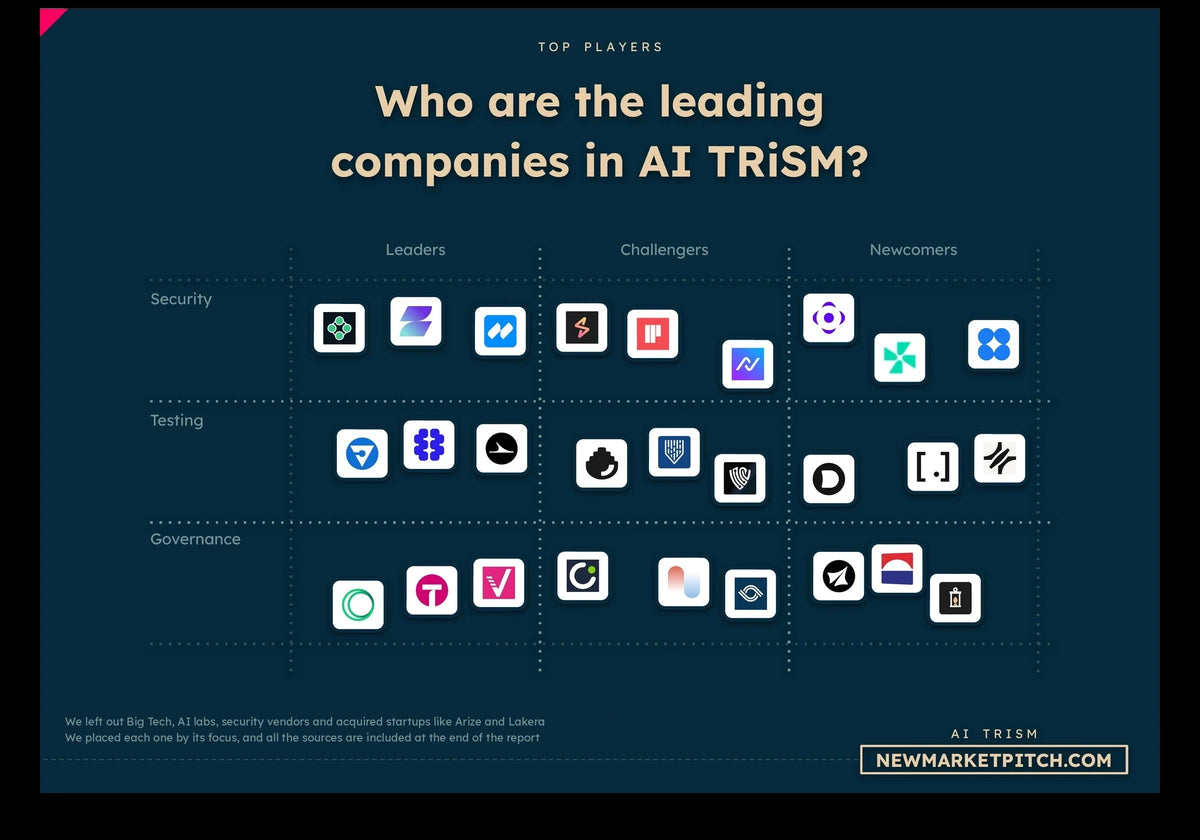
Credo AI and HiddenLayer are the top independent AI trust, risk and security management (AI TRiSM) startups in our assessment, leading enterprise AI governance and AI security respectively. Noma Security, ModelOp, Fiddler AI and Holistic AI form the next group of strong contenders, followed by WitnessAI and Arthur.
The independent market has been reshaped by acquisitions. Cisco, Palo Alto Networks, Check Point, F5 and other cybersecurity companies have bought AI security specialists, removing several recognizable names from the independent competitive landscape.
There is no single leader across every AI TRiSM category. Governance platforms, technical assurance tools, model observability systems and runtime security products solve different problems, and their competitive positions need to be judged separately.
HiddenLayer has the strongest recently disclosed commercial case among the independent security specialists reviewed. Its September 2026 $100 million Series B followed more than tenfold ARR growth, reaching the tens of millions of dollars, with more than 50 new platform customers.
Noma Security is a serious challenger, having reported ARR growth above 1,300% and raised $100 million in July 2025. Its broader approach to discovering and securing enterprise AI applications could be attractive, although its absolute revenue remains undisclosed.
Credo AI leads our independent governance shortlist because of its enterprise-wide risk management capabilities and recognition as a Leader in Forrester's 2025 AI Governance evaluation. ModelOp competes particularly well in regulated operations, with documented customer outcomes including major reductions in model-risk review times.
Holistic AI brings technical testing into governance, with enterprise references including Unilever, Siemens and GSK. Fiddler AI is expanding beyond model observability into evaluation, agent monitoring and policy enforcement, narrowing the gap between monitoring and security.
Customer evidence is uneven. HiddenLayer discloses recurring revenue, Noma publishes growth percentages, ModelOp reports operational improvements, and other vendors emphasize enterprise references or analyst recognition. Those figures cannot honestly be turned into a revenue league table.
Capital is still flowing to independent specialists. Four disclosed rounds from HiddenLayer, Noma Security, WitnessAI and Fiddler AI total $288 million, showing that consolidation has not ended investors' appetite for standalone AI trust and security companies.
The next competitive battle is likely to center on autonomous-agent security and controls that work across multiple AI providers. Large software vendors can bundle narrow features, but independent companies have an opening wherever customers need consistent governance, monitoring and protection across different models, clouds and applications. Sustained revenue, retention and production deployment breadth will ultimately separate the durable winners from acquisition candidates.

Written by the New Market Pitch teamWe track new markets so founders and investors can move faster. About us

In our report covering the AI TRiSM market, we turn what is vague and complex into simple, useful visuals. Market maps like this one show you at a glance where every startup stands.
Why are so many AI TRiSM startups getting acquired?
The independent AI TRiSM market has lost several of its best-known startups to acquisitions by major cybersecurity companies, leaving a smaller group of specialists competing for enterprise customers.
Cisco acquired Robust Intelligence in 2024, bringing automated AI model testing and protection into its security portfolio. Palo Alto Networks completed its acquisition of Protect AI in July 2025. Check Point announced its acquisition of Lakera in September 2025, while F5 bought CalypsoAI that same month. CrowdStrike acquired Pangea, SentinelOne bought Prompt Security, and Cato Networks acquired Aim Security.
The buying continued in 2026. F5 acquired SurePath AI for $50.1 million in June, following its $145.2 million CalypsoAI acquisition. Palo Alto Networks completed its purchase of Koi in April, adding protection for AI coding tools and agentic endpoints.
Across these nine acquisitions, we identified seven different buyers. That's a striking level of consolidation, with several competing cybersecurity companies acquiring similar capabilities within roughly two years.
OpenAI also announced an agreement to acquire Promptfoo in March 2026. Promptfoo had already reached teams at more than 25% of Fortune 500 companies, making the transaction particularly revealing: even AI model providers want to own independent testing and security technology.
We distinguish completed purchases from announced transactions whose closing status has not been independently confirmed. Either way, the acquisition wave has changed the competitive landscape. Companies that once appeared near the top of independent AI security rankings now belong to larger technology groups.
What makes an AI TRiSM startup truly independent?
An independent AI TRiSM startup is a company that controls its own business and primarily helps organizations govern, test, monitor or secure artificial intelligence systems.
Gartner's AI TRiSM category stands for AI trust, risk and security management. It covers several problems that enterprises increasingly face: keeping track of AI applications, evaluating risks, preventing attacks, monitoring model behavior and proving compliance with internal policies or regulations.
These products can look very different. Credo AI helps companies manage AI governance and accountability. HiddenLayer protects AI models and applications against security threats. Fiddler AI monitors AI behavior and helps teams evaluate model reliability.
All three qualify because their products directly address AI-specific trust or security problems.
Ownership also matters. HiddenLayer has received backing from Microsoft's M12, but Microsoft does not own HiddenLayer. WitnessAI has investors including Qualcomm Ventures and Samsung Ventures, yet remains independently operated.
By contrast, Protect AI no longer qualifies after its acquisition by Palo Alto Networks, regardless of whether its technology and brand remain visible.
For our comparison, we include independent specialists with meaningful products in AI governance, model assurance, observability or AI security. We exclude acquired businesses, traditional cybersecurity startups that merely use AI internally, and generic compliance software with no substantial AI-specific capabilities.

Our research about AI trust and risk tools gets updated several times a month, so you always get the latest view of where things stand.
Who are the top independent AI TRiSM startups right now?
Credo AI, HiddenLayer, Noma Security, ModelOp, Fiddler AI, Holistic AI, WitnessAI and Arthur are the strongest independent AI TRiSM startups in our assessment, although they lead different parts of the market.
Credo AI has one of the clearest positions in enterprise AI governance. ModelOp is particularly strong in managing AI systems already running inside large organizations. HiddenLayer and Noma Security stand out in AI application and agent security, while Fiddler AI and Arthur have substantial experience monitoring model behavior.
The strongest recent commercial evidence comes from HiddenLayer. Its September 2026 financing announcement followed reported annual recurring revenue growth of more than tenfold, with ARR reaching the tens of millions of dollars. Noma Security also reported exceptional growth, with ARR increasing by more than 1,300% over the year preceding its July 2025 Series B.
Those figures tell us something useful about adoption, but they cannot establish a complete revenue ranking. Credo AI, ModelOp and several other competitors have not disclosed comparable figures.
We therefore separate companies with proven enterprise governance capabilities from those showing unusually fast commercial growth. That distinction produces a more useful comparison than ranking startups purely by fundraising.
| Startup | Main specialty | Evidence of its position |
|---|---|---|
| Credo AI | Enterprise AI governance | Forrester AI Governance Leader in 2025 |
| HiddenLayer | AI model and agent security | $100M Series B in 2026 |
| Noma Security | AI application and agent security | $100M Series B in 2025 |
| ModelOp | AI lifecycle governance | Deployments involving Prudential and other financial institutions |
| Fiddler AI | AI monitoring and evaluation | $30M Series C in 2026 |
| Holistic AI | AI governance and technical assurance | Gartner AI Governance Challenger in 2026 |
| WitnessAI | Enterprise AI usage security | $58M strategic financing in 2026 |
| Arthur | Model monitoring and agent security | Enterprise monitoring products and integrations |
| Enkrypt AI | LLM safety testing and protection | Dedicated AI evaluation and security platform |
If you want more recent data on this point, please see our latest AI TRiSM market report.
Is HiddenLayer the strongest independent AI security startup today?
HiddenLayer currently has one of the strongest cases for independent AI security leadership because its recent growth comes with unusually concrete revenue and customer figures.
In September 2026, HiddenLayer raised a $100 million Series B led by Delta-v Capital. Investors included Ten Eleven Ventures, Morgan Stanley, Microsoft's M12 and Booz Allen Ventures. Combined with its $50 million Series A in 2023, these two rounds alone represent $150 million in financing.
The more interesting development was its commercial growth. CEO Chris Sestito told TechCrunch that annual recurring revenue had increased more than tenfold over the preceding year, reaching the tens of millions of dollars. More than 90% of the growth reportedly came from newly signed customers, and the company added over 50 platform customers during that period.
The combination is unusual. A tenfold growth rate is relatively easy to achieve when revenue starts close to zero. Reaching eight-figure recurring revenue while adding dozens of enterprise customers suggests a business that has moved well beyond early testing contracts.
HiddenLayer now sells protection for AI models, applications and autonomous agents. Its customer base spans financial services, pharmaceuticals, technology, government and defense.
The company has also expanded into agentic runtime security and coding-agent protection, allowing it to address threats that were much less prominent when it initially focused on machine-learning model security.
We still cannot prove HiddenLayer has the highest ARR in the entire independent AI TRiSM market. But among the specialists that have recently published meaningful commercial numbers, it has one of the clearest claims to leadership.

In our market report about AI trust and risk tools, we look at what the winners do differently, so you can learn from the best instead of guessing.
Can Noma Security overtake HiddenLayer?
Noma Security is one of HiddenLayer's closest independent challengers, and its rapid growth suggests that enterprises are willing to buy broader AI security platforms rather than separate tools for each threat.
Noma emerged from stealth in November 2024 and announced a $100 million Series B led by Evolution Equity Partners in July 2025.
The company reported ARR growth of more than 1,300% over the preceding year, together with dozens of production customers across financial services, life sciences, retail and technology.
A 1,300% increase means revenue grew to more than fourteen times its previous level. That's exceptional, but the starting figure matters. Without absolute ARR, we cannot establish whether Noma has overtaken HiddenLayer commercially.
The companies also approach AI security differently. HiddenLayer built its reputation around protecting models against attacks and has expanded into applications and agents. Noma emphasizes discovering AI systems across an organization, identifying their vulnerabilities and protecting them through a unified platform.
Its July 2026 integration with Anthropic's Claude compliance API reinforces that approach. Noma wants to connect security controls directly to the AI environments enterprises already use.
That could become a powerful advantage for customers running many models and agents across different departments.
HiddenLayer currently has the better disclosed evidence of commercial scale. Noma looks like a credible alternative for companies seeking a broad AI security management platform, but a stronger ranking would require comparable revenue, retention and deployment figures.
If you want more recent data on this point, please see our latest AI TRiSM market report.
Is Credo AI still the leader in independent AI governance?
Credo AI remains our leading independent AI governance specialist because its platform addresses the organizational problems that appear when companies deploy AI across many teams and applications.
Founded by Navrina Singh, Credo AI helps businesses maintain AI inventories, document risks, manage policies, collect evidence and track accountability for systems developed internally or purchased from external vendors.
Credo AI was named a Leader in the Forrester Wave for AI Governance Solutions in the third quarter of 2025. That gives its product position some external support, although analyst recognition does not establish revenue leadership.
The commercial opportunity is becoming clearer as companies move from experimenting with a few AI tools to operating large collections of applications and autonomous agents.
A financial institution might use AI for fraud detection, customer service, internal research and credit analysis. Different teams own these systems, their risks vary, and several may rely on third-party models. Keeping approvals, testing results and responsibilities consistent becomes difficult without dedicated governance software.
Credo AI is built around that cross-company problem.
Its main competitors include ModelOp and Holistic AI, alongside governance capabilities from larger software providers. Credo AI's advantage is its focused enterprise governance offering, while its competitors bring strengths in operational lifecycle management or technical testing.
We put Credo AI first among independent governance specialists based on its established positioning and external evaluations. There is not enough public financial information to claim it is the category's largest company by revenue.

In our document detailing everything you need to know about AI TRiSM, you will always find fresh funding data, taken straight from our own verified funding database.
Does ModelOp have better enterprise customers than Credo AI?
ModelOp has some of the strongest publicly documented enterprise deployments in AI governance, particularly in financial services, where controlling model risk has been a serious business requirement for years.
The company has worked with organizations including Prudential Financial and Fidelity Investments. Its published Royal Bank of Canada Capital Markets case study reports a 50% reduction in time to market for AI-related operational processes.
Prudential's reported experience is even more concrete: a model-risk rating process that previously took around two weeks was reduced to less than one day.
These are customer-reported outcomes rather than independently audited benchmarks, but they show exactly what buyers are paying for. Faster reviews can reduce the time needed to bring AI systems into production without eliminating governance checks.
ModelOp also has an important technical distinction. Its platform manages the lifecycle of AI systems, linking inventories, validation, approvals, monitoring and operational controls.
Its 2026 partnership with Kong extended that approach toward runtime enforcement, allowing governance policies to affect systems after deployment.
Gartner named ModelOp a Visionary in its 2026 Magic Quadrant for AI Governance Platforms.
Credo AI may be better positioned as a broad enterprise governance platform, but ModelOp has a particularly convincing record in operational use cases. For a bank or insurer with established model-risk processes, we would put both companies on the shortlist.
Is Holistic AI a serious competitor to Credo AI and ModelOp?
Holistic AI deserves a place among the top independent AI governance startups because it combines policy management with technical testing, supported by a substantial list of enterprise references.
The company publicly associates its products with organizations including Unilever, Siemens, GSK, eBay, GE HealthCare and Aon.
Its platform covers AI system inventories, third-party risk, bias testing, robustness assessments, security evaluation and compliance evidence.
This combination is particularly useful for companies operating AI systems that can materially affect people. An insurer may need to assess whether a model treats customer groups unfairly, while a healthcare organization may need technical evidence that an application behaves reliably under different conditions.
Governance records alone cannot answer those questions. Buyers also need test results that they can review and repeat.
Holistic AI has built its position around linking those two types of work. It was recognized as a Challenger in Gartner's 2026 Magic Quadrant for AI Governance Platforms, providing another outside assessment of its product capabilities.
Compared with Credo AI and ModelOp, Holistic AI has a strong technical assurance angle and a broad set of named enterprise references.
We would rank all three among the leading independent governance companies, with the preferred vendor depending heavily on whether the customer prioritizes enterprise-wide policy management, operational lifecycle controls or direct technical assessment.
If you want more recent data on this point, please see our latest AI TRiSM market report.

Learning from others' mistakes is the cheapest lesson there is. In our report covering the AI TRiSM market, we look at what broke startups before you, so you don't repeat it.
Is Fiddler AI becoming more than a model monitoring startup?
Fiddler AI has expanded well beyond traditional model monitoring and is now trying to become a central control platform for enterprise AI applications and agents.
In January 2026, Fiddler raised a $30 million Series C led by RPS Ventures, with participation from Lightspeed Venture Partners, Lux Capital, Insight Partners, Capgemini Ventures and other investors.
Its Fiddler Control Plane brings together evaluation, telemetry, continuous monitoring, policy enforcement and governance records.
That expansion follows a real change in enterprise AI systems. Traditional machine-learning models generally take inputs and produce predictions. Their performance can often be monitored through accuracy, data drift and other measurable outputs.
Autonomous agents behave differently. They may retrieve documents, choose tools, call external services and perform several actions before producing a result.
An agent that produces a plausible final response could still have accessed unauthorized data along the way. Enterprises consequently need visibility into the sequence of actions, not only the quality of the final answer.
Fiddler's newer products target that problem while building on its earlier experience in model explainability and monitoring.
The company now competes more directly with Arthur and some AI security specialists. Its technical positioning is credible, although we lack sufficiently recent ARR figures to rank Fiddler alongside HiddenLayer on commercial scale.
For enterprises that need to observe AI behavior across multiple applications, Fiddler remains one of the stronger independent options.
Which AI TRiSM startups have the best proof that customers actually use them?
HiddenLayer, ModelOp, Holistic AI, Credo AI and Noma Security have some of the strongest publicly available evidence of enterprise adoption, although they disclose very different information.
HiddenLayer has reported actual recurring revenue scale and customer growth. ModelOp has published operational outcomes involving named financial institutions. Holistic AI has a broad collection of enterprise references, while Credo AI has built an established position in governance and received strong external evaluations.
Noma's reported customer growth is promising, but limited disclosure of named accounts and absolute contract values makes its commercial footprint harder to measure.
Promptfoo provides an interesting benchmark for technical adoption, even though its announced OpenAI acquisition removes it from a clean independent ranking. Before the agreement, Promptfoo reported more than 350,000 developers using its tools, roughly 130,000 monthly active developers and adoption among teams at over 25% of Fortune 500 companies.
Those figures demonstrate how far an AI security product can spread through developer teams. They do not reveal how much companies pay.
The same caution applies to customer logos. A global bank using a product in one pilot is very different from deploying it across hundreds of applications.
The table below separates the evidence available for each company rather than pretending the numbers measure the same thing.
| Startup | Public commercial evidence | What we can conclude |
|---|---|---|
| HiddenLayer | Eight-figure ARR and over 50 new platform customers in a year | Strong evidence of commercial scale |
| Noma Security | ARR growth exceeding 1,300% and dozens of customers | Fast adoption, undisclosed absolute scale |
| ModelOp | Prudential, Fidelity and RBC Capital Markets references | Established enterprise usage |
| Holistic AI | References including Unilever, Siemens and GSK | Broad named enterprise relationships |
| Credo AI | Forrester Leader recognition and enterprise governance platform | Product maturity; revenue scale undisclosed |
| Fiddler AI | $30M Series C and expanded platform | Strong investor support; limited revenue disclosure |
| WitnessAI | $58M strategic financing and enterprise AI protection products | Commercial backing; scale difficult to compare |
| Arthur | Enterprise monitoring references and products | Established technical capability; limited fresh growth data |

Your time is limited. In our research about AI trust and risk tools, we put numbers on each part of the market, so you can see where it makes sense to focus.
Can WitnessAI become a major independent AI security company?
WitnessAI has a credible opportunity in enterprise AI security because it focuses on a problem that many organizations already face: employees and AI agents accessing sensitive company information through increasingly complicated applications.
In January 2026, WitnessAI raised $58 million in strategic funding led by Sound Ventures. Investors included Fin Capital, Qualcomm Ventures, Samsung Ventures and Forgepoint Capital Partners.
The company helps enterprises understand how AI applications are being used, detect risky interactions and enforce security policies.
Consider an employee uploading confidential material into a public AI tool, an internal copilot retrieving documents from the wrong department, or an autonomous agent sending information to an external service. Each situation creates risks that traditional software security products may struggle to interpret fully.
WitnessAI aims to provide visibility into these interactions and help security teams prevent data exposure.
Its approach also gives it a different starting point from vendors focused mainly on testing proprietary models. Many enterprises use third-party AI products and need security controls even when they cannot inspect the underlying models.
The $58 million financing gives WitnessAI resources to expand, and its investors bring connections across several technology industries. However, the company has not disclosed enough recent revenue or customer information to support a top-three commercial ranking.
We see WitnessAI as a strong challenger in enterprise AI usage security, particularly for organizations deploying third-party copilots and agents.
Can Arthur keep up with newer AI security startups?
Arthur remains a serious AI monitoring and security specialist, but its current commercial position is harder to judge than that of newer competitors reporting rapid growth.
Arthur raised a $42 million Series B in September 2022. At the time, the company reported 445% annual growth and average quarterly growth of 58%.
Those figures established early traction, although they are too old to tell us much about the company's current size.
Arthur initially developed tools for monitoring model performance, reliability, bias and explainability. It has since expanded toward agent behavioral analytics, anomaly detection and security monitoring.
The company also supports integrations with security platforms including CrowdStrike Falcon, Splunk and Elastic.
These capabilities address problems that traditional observability tools were never designed to handle. An autonomous AI agent can generate correct-looking responses while making unexpected tool calls or crossing security boundaries during execution.
Arthur's experience monitoring machine-learning systems gives it a foundation for identifying unusual behavior. Still, established technology does not guarantee that customers will choose Arthur over HiddenLayer, Noma or Fiddler.
We include Arthur among the leading independent AI TRiSM specialists because of its technical scope and enterprise monitoring experience. Its ranking would become more convincing with fresh ARR, retention and customer expansion data.

In our market report about AI trust and risk tools, we always try to gather several sources and make estimates that make sense, so you can work with solid numbers.
Are investors still putting serious money into independent AI TRiSM startups?
Investors are still committing substantial capital to independent AI TRiSM startups, especially those building protection for AI applications and autonomous agents.
Four major disclosed transactions illustrate the scale. HiddenLayer raised $100 million in 2026, Noma Security raised $100 million in 2025, WitnessAI secured $58 million in 2026, and Fiddler AI raised $30 million in 2026.
Together, these rounds represent $288 million of announced financing, including $188 million across the three named 2026 rounds.
These are significant investments for specialized enterprise software companies. Unlike foundation-model developers, AI TRiSM vendors generally do not need enormous GPU clusters to train proprietary frontier models.
Their main expenses are more likely to involve product engineering, security research, integrations, enterprise sales and customer support.
The financing also suggests where investors see commercial opportunities. HiddenLayer, Noma and WitnessAI all have substantial exposure to AI security, while Fiddler is expanding monitoring into policy enforcement and agent control.
We should not treat these four rounds as a complete picture of sector funding. A proper market-wide comparison would require an exhaustive database covering the same periods and separating primary equity from debt and other financing.
Still, multiple large rounds show that independent startups can attract the capital needed to compete with established cybersecurity vendors.
Acquisition remains a possible outcome for many of them, but funding alone does not force that decision.
Will Microsoft, IBM and cybersecurity giants eventually replace independent AI TRiSM startups?
Microsoft, IBM and major cybersecurity vendors will probably absorb more AI TRiSM functions, but independent specialists still have room to win customers that use several AI providers and want consistent controls across them.
Large technology companies already have a powerful advantage: enterprises buy their security, cloud and governance products.
Microsoft can integrate AI protection into its existing security and compliance environment. IBM can connect governance to established enterprise AI infrastructure. Palo Alto Networks and Check Point can distribute AI-specific protection through products their security customers already use.
Recent acquisitions show how quickly these vendors can add capabilities. Palo Alto Networks acquired Protect AI and Koi, while F5 bought CalypsoAI and SurePath AI.
The immediate threat is strongest for narrow products offering functionality that a larger platform can reproduce or bundle at a lower price.
Independent companies have a stronger opportunity when customers operate many different models, cloud environments and AI applications.
A multinational business may use Microsoft's ecosystem for productivity, AWS for infrastructure, Anthropic for some language-model workloads and specialized models for regulated applications. It may want a single governance or monitoring layer across all of them.
Credo AI, ModelOp and Fiddler have built important parts of their positioning around such cross-platform needs. HiddenLayer and Noma are also expanding toward broader protection across models and agents.
We expect further consolidation, particularly among single-purpose security products. The independent winners will likely be those that become deeply integrated into everyday enterprise AI operations and are difficult to replace with a bundled feature.
If you want more recent data on this point, please see our latest AI TRiSM market report.

If you build or invest in the AI TRiSM market, you need to know which business models pay off now and which ones are fading. That's why our report covering it has a whole section on it.
Is AI agent security becoming more important than AI governance?
AI agent security is becoming one of the fastest-growing parts of AI TRiSM, but enterprise governance remains essential for companies managing regulated or high-risk AI systems.
The difference comes from the problems these products solve.
Governance tools help organizations record which AI systems exist, who owns them, which risks have been assessed and what controls are required. Credo AI, ModelOp and Holistic AI focus heavily on these needs.
Security tools address threats during actual operation. An autonomous agent may retrieve confidential data, execute code, access business systems or communicate with external services. Security teams need ways to detect and stop harmful actions as they happen.
The financial evidence points to rapid growth in this second category. According to Gartner figures reported by TechCrunch in September 2026, spending on products securing AI tools was expected to reach $2.83 billion in 2026, up 83% from 2025.
That implies approximately $1.55 billion in 2025, with Gartner projecting spending close to $4.78 billion in 2027.
The forecast therefore implies that AI security spending could roughly triple over two years. These figures cover AI security products rather than the entire AI TRiSM market, so we should not use them as a governance-market estimate.
Regulation reinforces the governance side. The EU AI Act introduces requirements around documentation, risk management, transparency and oversight, with obligations applying under a phased timetable and some high-risk requirements extending into 2027 and 2028.
For heavily regulated companies, governance will continue to drive purchases. For organizations rapidly deploying autonomous agents, runtime protection may become the more urgent budget item.
The strongest long-term competitors may be those that connect both requirements. ModelOp is linking governance to runtime controls, Fiddler is combining observability with enforcement, and Noma is expanding the security layer around enterprise AI applications.
Who are the top AI trust, risk and security startups still independent?
Credo AI and HiddenLayer are our two strongest overall independent AI TRiSM candidates today, leading enterprise AI governance and AI security respectively. Noma Security, ModelOp, Fiddler AI and Holistic AI form the next group of major contenders, followed by WitnessAI and Arthur.
Credo AI has one of the most established independent positions in enterprise governance, backed by external product evaluations and a platform built for managing AI risk across organizations.
HiddenLayer has the clearest recent public evidence of significant commercial growth among the security specialists we reviewed. Its combination of recurring revenue, customer acquisition and technical expansion makes it particularly compelling.
Noma Security could challenge that position as more enterprises buy unified AI application and agent protection. ModelOp has a strong record of solving operational problems for large financial institutions. Holistic AI brings technical evaluation into governance, while Fiddler connects monitoring and AI control.
WitnessAI is worth watching in enterprise AI usage security. Arthur remains relevant through its experience in model and agent monitoring, although fresher commercial figures would strengthen its standing.
The acquisitions of Robust Intelligence, Protect AI, Lakera and other specialists have also made independence more meaningful. Several companies that helped establish AI security are now owned by larger vendors.
Our conclusion is clear: Credo AI leads our independent governance shortlist, while HiddenLayer currently has the strongest disclosed commercial case in independent AI security. Noma Security is among the most credible challengers, and ModelOp, Holistic AI and Fiddler deserve serious consideration for enterprise deployments.
The next ranking changes will depend on who can convert rapid AI adoption into lasting enterprise contracts. Revenue growth, customer retention and the number of AI applications protected in production will tell us much more than another large funding announcement.
If you want more recent data on this point, please see our latest AI TRiSM market report.

In our report covering the AI TRiSM market, we don't want to repeat what boring consulting reports say. Instead, we show you the real and latest market signals that matter.
Our methodology
This analysis identifies the leading independent AI Trust, Risk and Security Management (TRiSM) startups using evidence available through October 12, 2026. We examine ownership, product specialization, enterprise adoption, commercial growth, technical capabilities, financing and competitive consolidation. The assessment covers AI governance, model assurance, observability, application security and agent runtime protection.
We begin by establishing which companies remain independent. Completed acquisitions remove companies from the independent shortlist, while announced transactions are distinguished from confirmed ownership changes. We also exclude traditional cybersecurity providers that primarily use AI inside their own products and generic compliance platforms without substantial AI-specific capabilities.
For each dimension, we collect recent, attributable developments and aggregate them to assess competitive standing. Financing announcements are compared with customer acquisition and product expansion. Enterprise customer references are examined alongside documented deployment outcomes. Technical capabilities are evaluated in relation to the specific governance or security problems they address. We then combine the findings across dimensions to identify companies demonstrating the strongest and most consistent evidence of leadership.
We distinguish absolute revenue figures from percentage growth, customer counts from developer adoption, and production deployments from customer references. An eight-figure ARR disclosure provides different evidence from a 1,300% growth announcement without a disclosed starting point. Similarly, analyst recognition establishes competitive positioning within a defined product category rather than overall revenue leadership. These distinctions shape the comparisons throughout the article.
We assess governance and security specialists within their respective segments before drawing overall conclusions. Credo AI, ModelOp and Holistic AI are evaluated primarily on enterprise governance, operational controls and technical assurance. HiddenLayer, Noma Security and WitnessAI are assessed on AI-specific security capabilities and commercial adoption. Fiddler AI and Arthur are examined through their monitoring, evaluation and agent-security offerings. The final shortlist reflects comparative evidence and enterprise relevance rather than a mechanical score or funding-based ranking.
For market consolidation, key sources include Cisco's Robust Intelligence announcement, Palo Alto Networks' Protect AI acquisition confirmation, Check Point's Lakera announcement, Palo Alto Networks' Koi acquisition confirmation, F5's CalypsoAI transaction announcement, and OpenAI's Promptfoo acquisition announcement.
For financing and commercial positioning, we use HiddenLayer's $100 million Series B announcement, Noma Security's Series B and growth disclosure, Fiddler AI's Series C announcement, WitnessAI's strategic financing announcement, and Arthur's historical financing and growth disclosure. HiddenLayer's recurring revenue figures are drawn from the executive interview reported by TechCrunch, rather than inferred from its financing amount.
For governance positioning and enterprise adoption, key references include Credo AI's Forrester recognition, Gartner's 2026 Magic Quadrant for AI Governance Platforms, ModelOp's financial-services customer evidence, ModelOp's enterprise platform and customer references, and Holistic AI's governance capabilities and enterprise references. Named deployments and customer-reported operational improvements are assessed separately from analyst evaluations and vendor product descriptions.
Market definitions and regulatory context are grounded in the NIST AI Risk Management Framework and the European Union Artificial Intelligence Act. Together with the corporate, customer and industry research above, these sources support a structured comparison of current market leaders, the changing competitive landscape and the requirements most likely to influence enterprise purchasing decisions.

In our research about AI trust and risk tools, we like to show you the big picture. We know your time is precious, so we make every page quick to read and packed with as much learning as possible per minute.
Written by the New Market Pitch teamWe track new markets so founders and investors can move faster. About us