Which AI trust, risk and security startups earn the most?
Whether you're building or investing in the AI TRiSM market, our report covers everything you need to know: the players, the money, and what's coming next.
Summary
OneTrust earns the most among AI trust, risk and security startups, with more than $505 million in annual recurring revenue (ARR), followed by Dataiku, Cato Networks, Vanta, and Optro. All five have reached at least $300 million ARR, although most of their revenue comes from broader enterprise software rather than dedicated AI security.
The biggest winners so far are companies that already sold privacy, compliance, data governance, or cybersecurity software before generative AI took off. They can add AI controls to existing products and sell them through established enterprise relationships.
The ranking also reveals how misleading headline revenue comparisons can be. DataRobot's estimated $225 million ARR dates back to 2023, while Cyera's more recent $150 million-plus ARR disclosure carries stronger evidence of its current commercial scale.
AI-native security specialists are reaching meaningful revenue levels, but remain much smaller than diversified platforms. Zenity and HiddenLayer have both reached eight-figure annual revenue or ARR, while HiddenLayer reported more than tenfold ARR growth over one year.
Alice is an exception among specialists, approaching $100 million ARR in August 2026. Its advantage comes from combining an established digital trust-and-safety business with AI security products whose revenue reportedly grew more than 500% over two years.
AI agent security is emerging as a particularly promising market. As autonomous systems gain access to corporate applications, sensitive records, and transaction tools, security buyers need controls over what agents can access and do, not just what they say.
Independent AI monitoring and governance vendors are generating millions, but their reported financial scale is generally modest. Fiddler AI, Holistic AI, Cranium AI, and Credo AI rely largely on third-party revenue estimates rather than verified financial disclosures.
Acquisitions are happening well before many specialists reach significant revenue. Cisco, Check Point, F5, Dynatrace, and other larger software companies have purchased AI security capabilities, sometimes from businesses generating less than $5 million annually.
The market's size also needs careful interpretation. Gartner forecast $492 million in worldwide spending on dedicated AI governance platforms in 2026, less than OneTrust's total ARR alone, because the company's revenue covers a much wider range of software products.
Our ranking covers 53 startups with financial or quantified commercial-scale evidence, including a long tail of businesses estimated to generate less than $10 million annually. The financial leaders are clear, but AI-specific revenue remains largely undisclosed, leaving substantial room for younger specialists to grow.

Written by the New Market Pitch teamWe track new markets so founders and investors can move faster. About us

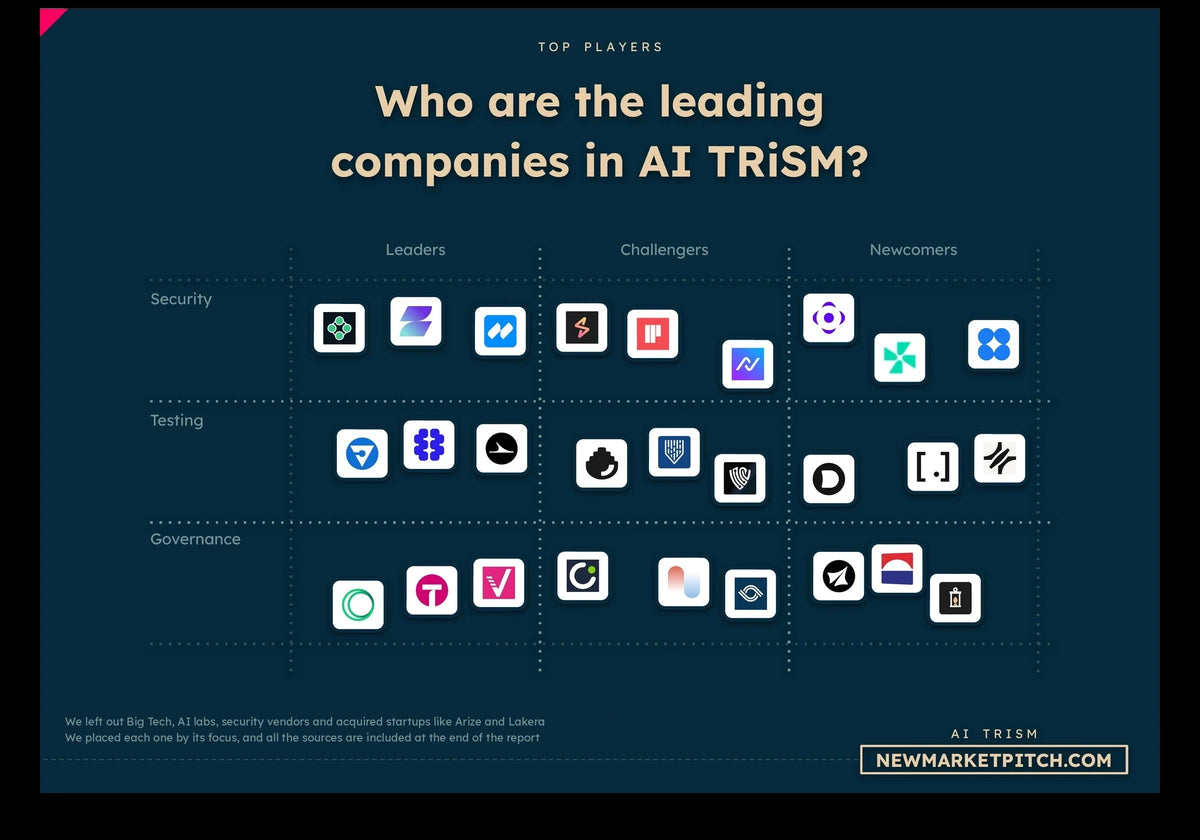
In our report covering the AI TRiSM market, we turn what is vague and complex into simple, useful visuals. Market maps like this one show you at a glance where every startup stands.
The ranking of top startups in the AI trust, risk and security management (AI TRiSM) market by revenue
Below is a table ranking the startups of this market by their current revenue scale. You can find our methodology at the end of this page.
If you want a deeper understanding of the market and its current dynamics, get our report on the AI trust, risk and security management (AI TRiSM) market.
| Ranking | Company | Latest Metric | Metric Type | Freshness | Disclosed When | Source Quality | Confidence | Segment | Why This Ranking | Local Metric | Country |
|---|---|---|---|---|---|---|---|---|---|---|---|
| 1 | OneTrust | >$505M | ARR | Fresh · 15mo | Nov 13, 2025 | Credible Reported | Medium | AI Governance | Largest independently founded specialist with a reported ARR amount, although privacy and compliance sales extend beyond AI governance. | us | |
| 2 | Dataiku | >$350M | ARR | Fresh · 12mo | Oct 17, 2025 | Company Disclosed | Medium | AI Governance | Its governed-AI controls qualify, but ARR covers a broader enterprise AI platform; ties in nominal threshold with Cato. | us | |
| 3 | Cato Networks | >$350M | ARR | Fresh · 10mo | Feb 24, 2026 | Company Disclosed | Medium | AI Security | AI security is a real offering after acquiring Aim Security, but most ARR comes from broader SASE products; the end-2025 period is fresher than Dataiku. | il | |
| 4 | Vanta | >$300M | ARR | Very Fresh · 6mo | Apr 29, 2026 | Company Disclosed | Medium | AI Governance | Recent directly disclosed ARR is strong, but includes SOC 2 and general compliance alongside AI inventory and ISO 42001 controls. | us | |
| 5 | Optro | >$300M | ARR | Fresh · 12mo | Oct 14, 2025 | Company Disclosed | Medium | AI Governance | Substantial company-reported ARR places Optro among the largest private firms, although most subscriptions predate its AI governance expansion via FairNow. | us | |
| 6 | Collibra | ~$162M | Annual Revenue | Fresh · 10mo | Third-Party Estimate | Low | AI Governance | Broader data governance sales support the scale estimate, but the figure is unfiled and AI governance is not separately identified. | be | ||
| 7 | Cyera | >$150M | ARR | Very Fresh · 5mo | Jun 2, 2026 | Credible Reported | Medium | AI Security | Newer ARR evidence outweighs weaker estimates nearby; only a portion of the data-security business serves AI risk controls. | us | |
| 8 | DataRobot | ~$225M | ARR | Historical · 34mo | Third-Party Estimate | Low | AI Governance | The older ARR estimate indicates substantial scale, but the period is Historical and the broader enterprise AI platform extends beyond governance; current ARR is unverified. | us | ||
| 9 | BigID | >$100M | ARR | Aging · 26mo | Aug 2024 | Company Disclosed | Medium | AI Security | Older company-sourced recurring revenue is preferred to unverified newer estimates; much of the business remains broader data privacy and security. | us | |
| 10 | Drata | >$100M | ARR | Aging · 20mo | Feb 19, 2025 | Company Disclosed | Medium | AI Governance | Its ISO 42001 and NIST AI risk control tools qualify, but the reported ARR spans all compliance automation and is older than Alice. | us | |
| 11 | Alice | ~$100M | ARR | Very Fresh · 2mo | Aug 25, 2026 | Company Disclosed | Medium | AI Security | Recent direct ARR is the strongest specialist-scale figure near $100M, but includes older trust-and-safety services as well as AI security. | us | |
| 12 | Zenity | >$10M | Annual Revenue | Very Fresh · 2mo | Aug 3, 2026 | Company Disclosed | Medium | AI Agent Security | A conservative lower bound preserves the CEO wording; actual annual revenue could exceed estimate-only firms placed below. | il | |
| 13 | HiddenLayer | >$10M | ARR | Very Fresh · 1mo | Sep 2, 2026 | Company Disclosed | Medium | AI Security | Recent CEO-sourced ARR strongly supports eight-figure scale, but the disclosed lower bound does not establish its exact position against Fiddler. | us | |
| 14 | LogicGate | ~$58.9M | Annual Revenue | Undated | Third-Party Estimate | Low | AI Governance | Governance and risk software includes an AI governance product, but the undated company-wide estimated revenue is weaker than direct company ARR evidence. | us | ||
| 15 | Hyperproof | ~$44.3M | Annual Revenue | Undated | Third-Party Estimate | Low | AI Governance | AI compliance frameworks and guardrails qualify, but most estimated company revenue is general compliance automation and no operating period is verified. | us | ||
| 16 | Fiddler AI | ~$30.7M | Annual Revenue | Undated | Third-Party Estimate | Low | AI Monitoring & Risk | Possible larger revenue than HiddenLayer, but an undated headcount-based estimate is materially weaker than current executive ARR evidence. | us | ||
| 17 | Astrix Security | ~$25.1M | Annual Revenue | Fresh · 10mo | Third-Party Estimate | Low | AI Agent Security | Estimated pre-acquisition sales include wider non-human-identity security, and Cisco acquired the business in 2026; AI agent revenue is unreported. | il | ||
| 18 | Nightfall AI | ~$25.3M | Annual Revenue | Undated | Third-Party Estimate | Low | AI Security | Modelled company-wide revenue includes DLP beyond AI agents; no dated, independently verified sales amount is available. | us | ||
| 19 | Airia | ~$21.8M | Annual Revenue | Fresh · 10mo | Sep 10, 2026 | Third-Party Estimate | Low | AI Governance | Dated 2025 estimate is more comparable than undated private-company proxies, but covers its broader AI orchestration and security platform. | us | |
| 20 | Arthur AI | ~$15.4M | Annual Revenue | Undated | Third-Party Estimate | Low | AI Monitoring & Risk | Estimated company-wide model-monitoring revenue is not audited; strong AI-risk fit but no dated current sales disclosure. | us | ||
| 21 | Holistic AI | ~$13M | Annual Revenue | Undated | Third-Party Estimate | Low | AI Governance | Dedicated AI risk governance gives a cleaner market perimeter than broad security platforms, but the amount is an undated model estimate. | gb | ||
| 22 | Arize AI | ~$12.4M | Annual Revenue | Historical · 34mo | Third-Party Estimate | Low | AI Monitoring & Risk | Historical third-party estimate predates Dynatrace acquisition in October 2026; later commercial scale is unknown. | us | ||
| 23 | Cranium AI | ~$10.4M | Annual Revenue | Undated | Third-Party Estimate | Low | AI Governance | A direct specialist in AI security and risk, but the estimate is modelled from company information rather than reported sales. | us | ||
| 24 | Robust Intelligence | ~$9M | Revenue Run-Rate | Aging · 26mo | Jul 8, 2025 | Credible Reported | Low | AI Testing & Assurance | Better sourced than many estimates nearby, but an aged pre-Cisco run-rate is not evidence of current standalone sales. | us | |
| 25 | RagaAI | ~$8.9M | Annual Revenue | Undated | Third-Party Estimate | Low | AI Testing & Assurance | Nominally higher than Monitaur, but entity-level reporting and unverified estimation reduce confidence in the total. | us | ||
| 26 | Monitaur | ~$8.1M | Annual Revenue | Undated | Third-Party Estimate | Low | AI Governance | Strong direct governance-product fit, but the figure is a non-dated external estimate and the next cluster is very close. | us | ||
| 27 | Credo AI | ~$7.9M | Annual Revenue | Undated | Third-Party Estimate | Low | AI Governance | Dedicated AI-policy inventory and risk management, with estimated sales nearly tied to WitnessAI; differences at this precision are weak. | us | ||
| 28 | WitnessAI | ~$7.8M | Annual Revenue | Undated | Third-Party Estimate | Low | AI Security | Recent company-reported 500% ARR growth may make this undated estimate stale; the dollar base itself is not verified. | us | ||
| 29 | Aurascape AI | ~$6.4M | Annual Revenue | Fresh · 10mo | Third-Party Estimate | Low | AI Security | A specialist AI security estimate without direct confirmation; its date and methodology are less transparent than annual-report revenue. | us | ||
| 30 | Knostic | ~$6.2M | Annual Revenue | Fresh · 10mo | Third-Party Estimate | Low | AI Security | Protects AI access and data permissions; the unverified 2025 estimate is modestly below Aurascape and overlaps its uncertainty. | us | ||
| 31 | Patronus AI | ~$5.8M | Annual Revenue | Undated | Third-Party Estimate | Low | AI Testing & Assurance | Modelled revenue is weak but direct safety-evaluation product fit and 2026 growth support inclusion above smaller estimated players. | us | ||
| 32 | ModelOp | ~$5.1M | Annual Revenue | Undated | Third-Party Estimate | Low | AI Governance | Gartner-recognized AI governance technology; dollar estimate is undated and not independently confirmed. | us | ||
| 33 | Lakera | <$5M | Annual Revenue | Fresh · 15mo | Jul 8, 2025 | Credible Reported | Low | AI Security | A credible upper bound rather than a usable point estimate; predates acquisition by Check Point and cannot prove relative scale. | ch | |
| 34 | CalypsoAI | <$5M | Annual Revenue | Fresh · 15mo | Jul 8, 2025 | Credible Reported | Low | AI Security | Similar upper-bound evidence to Lakera; former standalone revenue is further obscured by its F5 acquisition. | ie | |
| 35 | Openlayer | ~$4.8M | Annual Revenue | Aging · 22mo | Aug 2026 | Third-Party Estimate | Low | AI Monitoring & Risk | Nominal amount slightly exceeds ValidMind but reflects older AI-monitoring sales with limited company confirmation. | us | |
| 36 | ValidMind | ~$4.2M | Annual Revenue | Fresh · 10mo | Sep 10, 2026 | Third-Party Estimate | Low | AI Governance | A more recent annual estimate than Openlayer, but remains externally modelled rather than reported. | us | |
| 37 | SPLX AI | ~$4M | Annual Revenue | Undated | Third-Party Estimate | Low | AI Testing & Assurance | Agent red-teaming technology is directly relevant; the headline dollar figure is an undated external estimate. | us | ||
| 38 | Noma Security | ~$3.9M | Annual Revenue | Undated | Third-Party Estimate | Low | AI Security | One independent estimate is lower than competing estimates; exceptional reported ARR growth lacks a comparable dollar baseline. | il | ||
| 39 | Enkrypt AI | ~$3.4M | Annual Revenue | Undated | Third-Party Estimate | Low | AI Testing & Assurance | Product directly tests and guards models, but sales are estimated and business was acquired by Anaconda in 2026. | us | ||
| 40 | Deepchecks | ~$3.1M | Annual Revenue | Fresh · 10mo | Sep 18, 2025 | Third-Party Estimate | Low | AI Testing & Assurance | Revenue estimate supports inclusion but covers reliability testing in addition to risk and safety monitoring. | il | |
| 41 | Gray Swan AI | ~$2.48M | Annual Revenue | Undated | Third-Party Estimate | Low | AI Testing & Assurance | Nominally similar to Acuvity and Vijil, but all three rely on estimates; precision should not be overinterpreted. | us | ||
| 42 | Acuvity | ~$2.5M | Annual Revenue | Undated | Third-Party Estimate | Low | AI Security | Explicit enterprise GenAI monitoring and policy controls; an undated headcount-based estimate limits rank precision. | us | ||
| 43 | Vijil | ~$2.5M | Annual Revenue | Undated | Third-Party Estimate | Low | AI Testing & Assurance | Strong AI trust testing fit and estimated sales comparable to Acuvity; neither figure is directly reported. | us | ||
| 44 | Saidot | ~$2.5M | Annual Revenue | Fresh · 15mo | Sep 2, 2026 | Third-Party Estimate | Low | AI Governance | A clear governance specialist, but this 2025 estimate is older than the undated current figures beside it. | fi | |
| 45 | Mindgard | ~$2.4M | Annual Revenue | Aging · 22mo | Aug 2026 | Third-Party Estimate | Low | AI Testing & Assurance | Older estimate and evolving red-team platform weaken the comparison against newer governance-software estimates. | gb | |
| 46 | Guardrails AI | ~$1.1M | Annual Revenue | Fresh · 10mo | Sep 2026 | Third-Party Estimate | Low | AI Security | 2025 revenue estimate predates the September 2026 acquisition by Harvey, and is not company-confirmed. | us | |
| 47 | FairNow | ~$1.03M | Annual Revenue | Undated | Third-Party Estimate | Low | AI Governance | Undated third-party estimate pertains to the stand-alone AI governance business acquired in 2025 by Optro. | us | ||
| 48 | Armilla AI | ~$800K | Annual Revenue | Aging · 22mo | Aug 2026 | Third-Party Estimate | Low | AI Testing & Assurance | Historical estimate for AI assurance and risk tooling; dollar precision is weaker than the companies above. | ca | |
| 49 | Fairly AI | ~$442K | Annual Revenue | Undated | Third-Party Estimate | Low | AI Governance | Small current third-party estimate and no formal annual disclosures. | ca | ||
| 50 | Modulos | >200 organizations | Other Scale Signal | Undated | Company Disclosed | Low | AI Governance | Actual deployment reach is more defensible than a conflicting low-million revenue estimate, but organizations are not necessarily paid subscriptions. | ch | ||
| 51 | Promptfoo | 130K monthly active users | Users | Fresh · 7mo | Mar 9, 2026 | Company Disclosed | Low | AI Testing & Assurance | Large developer usage and real enterprise adoption, but no disclosed revenue and user counts cannot be converted into sales. | us | |
| 52 | Runlayer | >12 enterprise customers | Other Scale Signal | Very Fresh · 4mo | Jun 24, 2026 | Credible Reported | Low | AI Agent Security | Named customer type supports early product traction, not payment size; cannot outrank companies with actual dollar evidence. | us | |
| 53 | AIR Security | >20 customers | Other Scale Signal | Very Fresh · 1mo | Sep 1, 2026 | Company Disclosed | Low | AI Security | A recent founder-reported customer count proves some enterprise sales, but does not reveal recognized revenue. | il | |
| NR | Lasso Security | Not disclosed | Other Scale Signal | Undated | Sep 1, 2026 | Credible Reported | Low | AI Security | Revenue growth is reported, but no absolute revenue or ARR figure is public. | il | |
| NR | Securiti AI | Not disclosed | Other Scale Signal | Undated | Dec 11, 2025 | Company Disclosed | Low | AI Governance | Substantial enterprise presence but acquisition consideration is not revenue; Securiti no longer reports separately from Veeam. | us | |
| NR | Aim Security | Not disclosed | Other Scale Signal | Undated | Sep 3, 2025 | Company Disclosed | Low | AI Security | Standalone revenue cannot be inferred from Cato Networks group ARR, even though the AI-security product is now in a much larger group. | il | |
| NR | Protect AI | Not disclosed | Other Scale Signal | Undated | Jul 22, 2025 | Company Disclosed | Low | AI Security | AI model and agent protection is a strong fit; acquisition price and financing are not defensible proxies for recurring sales. | us | |
| NR | Prompt Security | Not disclosed | Other Scale Signal | Undated | Aug 2025 | Company Disclosed | Low | AI Security | Large deployments were publicized, but no standalone recognized revenue or annual run-rate is published. | il | |
| NR | Relyance AI | Not disclosed | Other Scale Signal | Undated | Oct 2024 | Company Disclosed | Low | AI Governance | Established product and enterprise customers without a disclosed absolute revenue, customer count or ARR figure. | us |

Our research about AI trust and risk tools gets updated several times a month, so you always get the latest view of where things stand.
Which AI trust, risk and security startups make the most revenue?
OneTrust currently tops the AI trust, risk and security startup ranking with more than $505 million in annual recurring revenue (ARR), followed by Dataiku, Cato Networks, Vanta, and Optro.
OneTrust passed $505 million ARR in July 2025, according to reporting by The Information. Dataiku exceeded $350 million ARR in October 2025, followed by Cato Networks, which finished 2025 above the same threshold. Vanta crossed $300 million in April 2026, while Optro, previously known as AuditBoard, reached that level in October 2025.
These five companies have something important in common: they were selling privacy, compliance, enterprise AI, or cybersecurity software before dedicated AI trust and security became a major market. Their revenues include those established businesses, so we cannot treat the figures as spending exclusively on AI governance or AI security.
The next group includes Collibra, Cyera, DataRobot, BigID, Drata, and Alice. Their figures range from recent ARR disclosures to older estimates, with Alice approaching $100 million ARR in August 2026.
We found 53 ranked startups with usable revenue or commercial-scale figures. Five have directly reported ARR thresholds above $300 million, while the more specialized companies protecting models, testing AI systems, and securing autonomous agents generally operate at a much smaller documented scale.
Here are the highest-ranked companies, preserving the original reporting periods and revenue measures.
| Rank | Startup | Revenue scale | Metric and period |
|---|---|---|---|
| 1 | OneTrust | >$505M | ARR, July 2025 |
| 2 | Dataiku | >$350M | ARR, October 2025 |
| 3 | Cato Networks | >$350M | ARR, 2025 |
| 4 | Vanta | >$300M | ARR, April 2026 |
| 5 | Optro | >$300M | ARR, October 2025 |
| 6 | Collibra | ~$162M | Estimated annual revenue, FY2025 |
| 7 | Cyera | >$150M | ARR, May 2026 |
| 8 | DataRobot | ~$225M | Estimated ARR, December 2023 |
| 9 | BigID | >$100M | ARR, August 2024 |
| 10 | Drata | >$100M | ARR, February 2025 |
| 11 | Alice | ~$100M | Approaching $100M ARR, August 2026 |
| 12 | Zenity | >$10M | Annual revenue, August 2026 |
| 13 | HiddenLayer | >$10M | ARR, September 2026 |
| 14 | LogicGate | ~$58.9M | Estimated annual revenue, period undisclosed |
| 15 | Hyperproof | ~$44.3M | Estimated annual revenue, period undisclosed |
Why is AI trust and security becoming such a big business?
AI trust and security is becoming a serious software business because companies are giving AI systems access to sensitive information, internal applications, and tasks that previously required human approval.
Companies are deploying AI applications that read documents, write code, query databases, and increasingly use tools to complete work. Each additional permission creates another opportunity for data leaks, manipulated instructions, or unauthorized actions.
Gartner estimated in February 2026 that worldwide spending on dedicated AI governance platforms would reach $492 million in 2026 and exceed $1 billion by 2030. That forecast covers governance platforms specifically, rather than the much broader cybersecurity market.
The products already being sold show how many problems enterprises need to address. OneTrust helps companies document and manage their AI-related risks. HiddenLayer protects models and applications against attacks. Fiddler AI monitors model behavior and outputs. Zenity focuses on the permissions and actions of AI agents.
AI security has moved well beyond checking whether a model produces harmful answers. Companies increasingly need controls that operate continuously, especially when AI applications interact with confidential data or take actions inside business systems.

In our market report about AI trust and risk tools, we look at what the winners do differently, so you can learn from the best instead of guessing.
How much revenue does OneTrust make today?
OneTrust remains the largest startup in our AI trust and security revenue ranking, with ARR exceeding $505 million as of July 2025.
The Information reported the figure in November 2025, citing a person with direct knowledge of the company's finances. OneTrust was also growing approximately 17% year over year and exploring a potential private-equity transaction, according to that reporting.
A 17% increase on a $505 million ARR base represents roughly $86 million in additional annualized recurring revenue over a year, using the reported percentage as a simple calculation.
OneTrust built its business around privacy management, consent, data governance, and compliance software. Its AI governance offering adds another set of controls to workflows that enterprise customers already use.
This gives OneTrust an advantage over younger companies selling only AI governance. It can approach existing customers with additional products rather than establish a completely new relationship every time.
OneTrust does not disclose how much of its $505 million-plus ARR comes specifically from AI governance. Its leading position reflects the scale of the entire company, including products that existed well before the generative AI boom.
Is Dataiku bigger than Cato Networks in AI governance and security?
Dataiku ranks second in our AI trust and security startup ranking, ahead of Cato Networks in third place, although both companies have reported ARR above $350 million.
Dataiku crossed $300 million ARR in January 2025 and exceeded $350 million by October. It also reported serving more than 750 organizations, including one-quarter of the top 500 companies in the Forbes Global 2000.
Its software helps businesses build, deploy, monitor, and govern AI applications. The governance tools sit inside a broader enterprise AI platform, which means Dataiku can sell security and oversight capabilities alongside the technology customers use to develop their AI systems.
Cato Networks followed a different path. It exceeded $350 million ARR in 2025, with reported year-over-year growth of 43%. The company's main business combines networking and cybersecurity through its secure access service edge platform.
Cato acquired Aim Security in 2025 to expand into AI security. That acquisition brought dedicated capabilities for protecting enterprise use of generative AI.
The two companies entered the market from different directions. Dataiku approaches AI trust through development and governance, while Cato approaches it through cybersecurity infrastructure.
Their reported ARR amounts are remarkably close, but neither has disclosed enough AI-specific revenue to establish which generates more sales from governance or security controls alone.

In our document detailing everything you need to know about AI TRiSM, you will always find fresh funding data, taken straight from our own verified funding database.
Is Vanta becoming one of the biggest AI governance companies?
Vanta has already become one of the largest startups offering AI governance capabilities, passing $300 million ARR in April 2026 after an unusually fast period of growth.
Founder Christina Cacioppo disclosed that the company needed approximately two years to grow from $10 million to $100 million ARR, another 15 months to reach $200 million, and only nine more months to exceed $300 million.
Each of the last two milestones required adding another $100 million in ARR. Vanta reached the most recent milestone 40% faster than the previous one.
The company also reported approximately 16,000 customers. Most originally bought Vanta to automate compliance work involving standards such as SOC 2 and ISO 27001, security evidence, and vendor risk assessments.
AI governance fits into that existing business. Companies adopting ISO 42001 or documenting AI risks already need inventories, policies, controls, and evidence that their systems are being managed properly.
Vanta can sell those capabilities to an established customer base. A smaller AI governance startup often has to convince the same buyer to purchase another platform.
We cannot isolate Vanta's AI governance revenue from its total ARR. Still, the speed at which its business has grown makes it one of the clearest examples of compliance software expanding successfully into AI-related controls.
How big is Optro's AI risk management business?
Optro has more than $300 million ARR, making the former AuditBoard one of the largest startups selling enterprise risk management and AI governance software.
The company reached that milestone in October 2025, after building a substantial business in internal audit, compliance, and enterprise risk management. At the time, it reported serving more than half of the Fortune 500.
Optro expanded into dedicated AI governance through its acquisition of FairNow in October 2025. FairNow developed technology for managing AI policies, risk assessments, and compliance with frameworks including NIST AI RMF and ISO 42001.
FairNow also appears separately in our ranking at number 47, using an estimated standalone annual revenue figure of approximately $1.03 million. The acquisition places that specialist technology inside a company with a much larger enterprise customer base.
Optro had already crossed $300 million ARR, while the acquired business was estimated to generate only a small fraction of that amount independently. Optro's AI governance revenue is not disclosed separately.

Learning from others' mistakes is the cheapest lesson there is. In our report covering the AI TRiSM market, we look at what broke startups before you, so you don't repeat it.
Which AI security startups have more than $100 million in revenue?
Ten ranked AI trust and security startups have reported or estimated revenue measures above $100 million, while Alice is approaching that mark.
The first five have ARR thresholds above $300 million. Collibra follows with approximately $162 million in estimated FY2025 annual revenue, and Cyera reported more than $150 million ARR as of May 2026.
DataRobot occupies eighth place using an older estimate of approximately $225 million ARR from December 2023. That figure is numerically higher than several companies above it, but its age and weaker source quality make it less useful for understanding current scale.
BigID reported more than $100 million in recurring revenue in August 2024. Drata crossed $100 million ARR in February 2025, when it also reported more than 7,000 customers. Alice subsequently announced that it was approaching $100 million ARR.
Several companies sell AI governance alongside mature products for privacy, compliance, data security, or enterprise AI development. Dedicated model protection and AI testing businesses are much less visible among the companies with nine-figure financial disclosures.
The commercial market is already substantial, but the biggest revenue pools currently sit inside broader enterprise software businesses.
Is Cyera growing faster than other AI data security startups?
Cyera has become one of the largest younger data security startups, with ARR exceeding $150 million as of May 2026, only about five years after the company was founded.
TechCrunch reported the milestone in June 2026 while discussing Cyera's potential fundraising at a valuation of approximately $12 billion.
At that valuation, the company's reported ARR would imply a multiple of roughly 80 times annual recurring revenue.
Cyera specializes in finding, classifying, and protecting sensitive information across enterprise environments. The rise of AI agents makes that work more important because agents can retrieve or expose data through permissions granted to applications and employees.
BigID also operates in data security and governance, with a reported ARR threshold above $100 million from August 2024. Nightfall AI, whose business includes data loss prevention, has estimated annual revenue of approximately $25.3 million.
Those figures cannot establish a reliable three-company growth ranking because their periods and source quality differ. Cyera's achievement is the scale reached in a relatively short operating history, although only part of its business is directly tied to AI security.

Your time is limited. In our research about AI trust and risk tools, we put numbers on each part of the market, so you can see where it makes sense to focus.
How much money does Alice, formerly ActiveFence, make?
Alice is approaching $100 million ARR, making the former ActiveFence one of the most commercially successful startups specializing in digital trust, safety, and AI security.
The company announced the milestone in August 2026 alongside a $140 million financing round led by Apax Digital. Total funding reached $280 million.
Alice began in 2018 as ActiveFence, focusing on detecting harmful content and online threats. Its business later expanded into protecting AI models and applications, identifying adversarial behavior, and evaluating safety risks.
The company reported working with eight of the ten leading AI model laboratories and protecting more than three billion people through the digital platforms using its technology.
Alice also said its AI business grew more than 500% over the preceding two years.
That's a striking increase, but it does not tell us the absolute revenue generated by AI products. The approximately $100 million ARR figure covers the wider business, which includes longstanding trust-and-safety services.
Alice has an advantage that many newly founded AI security startups lack: years of experience identifying malicious behavior at scale. Its expansion into AI protection builds on that operational history rather than starting from scratch.
Which AI agent security startups are making real money?
Zenity is currently the highest-ranked dedicated AI agent security startup, with annual revenue in the tens of millions of dollars as of August 2026.
Its CEO disclosed that revenue scale in an interview with CTech. Because the statement did not establish an exact amount, our ranking conservatively records annual revenue above $10 million.
Zenity focuses on protecting AI agents and enterprise AI applications, particularly when autonomous systems can access sensitive information, use tools, or perform actions on behalf of employees.
Astrix Security ranks seventeenth overall with estimated 2025 annual revenue of approximately $25.1 million. Cisco acquired Astrix in 2026, adding security technology for non-human identities and AI agents.
Runlayer, ranked fifty-second, reported more than 12 enterprise customers as of June 2026. Its customers included unicorn companies, although the disclosure did not specify how much they paid.
These three examples show how uneven the commercial evidence remains. Zenity has a recent executive-confirmed revenue threshold, Astrix has an estimated pre-acquisition figure, and Runlayer has customer traction without disclosed revenue.
An AI chatbot that gives a wrong answer creates one kind of problem. An AI agent with permission to access customer records, execute code, or send information to external services can do considerably more damage.
Zenity's eight-figure revenue disclosure shows that enterprises are already paying meaningful amounts for software designed around these risks.

In our market report about AI trust and risk tools, we always try to gather several sources and make estimates that make sense, so you can work with solid numbers.
Is HiddenLayer one of the fastest-growing AI security startups?
HiddenLayer is one of the fastest-growing AI-native security startups with publicly reported financial evidence, having increased ARR more than tenfold in the year preceding September 2026.
CEO Chris Sestito disclosed the growth in a TechCrunch interview following the company's $100 million Series B financing.
HiddenLayer's ARR had reached the tens of millions of dollars, and more than 90% of its growth reportedly came from new customers acquired during the previous year.
Most of the increase therefore came from additional customers rather than simply selling larger contracts to the same organizations.
HiddenLayer develops technology for protecting AI models, applications, and agents against attacks. Its customers include businesses in financial services, technology, and government.
A tenfold increase is an exceptionally strong growth rate, although the starting revenue figure remains undisclosed. We cannot tell whether ARR increased from $2 million to $20 million or from $5 million to $50 million.
Cato Networks and Vanta provide useful comparisons at a much larger scale. Cato reported 43% ARR growth in 2025, reaching more than $350 million, while Vanta added over $100 million ARR in nine months as it passed $300 million. Both are adding substantial recurring revenue despite having far larger starting businesses.
Alice reported more than 500% growth in its AI business over two years. WitnessAI also disclosed 500% ARR growth, although its absolute starting revenue was not verified. A company growing from $1 million to $6 million ARR has increased 500%, just as one growing from $20 million to $120 million has.
HiddenLayer stands out because it combines an executive-confirmed eight-figure revenue scale with an unusually strong increase driven mainly by new enterprise customers. We cannot produce a reliable fastest-growing ranking across all these companies, but HiddenLayer is clearly among the strongest recent cases.
Which AI monitoring startups earn the most?
Fiddler AI is the highest-ranked specialist in AI monitoring and risk, with estimated annual revenue of approximately $30.7 million, followed by Arthur AI and Arize AI.
These companies help businesses understand how deployed models behave, whether their outputs remain reliable, and when AI applications introduce unexpected risks.
Fiddler ranks sixteenth overall. Arthur AI follows at number twenty with estimated annual revenue of approximately $15.4 million, while Arize AI ranks twenty-second using an estimated $12.4 million in 2023 revenue.
Dynatrace acquired Arize in October 2026 after announcing a transaction valued at approximately $915 million in August.
That purchase price indicates strategic interest in AI observability, but the financial figure available in our ranking remains Arize's older 2023 revenue estimate.
Openlayer also operates in AI monitoring and risk, ranking thirty-fifth with estimated annual revenue of approximately $4.8 million in 2024.
Independent monitoring tools can appeal to enterprises using several AI models and cloud providers. Those customers may prefer one system that evaluates models across different environments rather than relying on tools bundled into each AI platform.

If you build or invest in the AI TRiSM market, you need to know which business models pay off now and which ones are fading. That's why our report covering it has a whole section on it.
Are dedicated AI governance startups making millions yet?
Dedicated AI governance startups are already generating or are estimated to generate millions of dollars annually, led in our specialist group by Holistic AI, Cranium AI, and Monitaur.
Holistic AI ranks twenty-first overall with estimated annual revenue of approximately $13 million. Cranium AI ranks twenty-third at approximately $10.4 million, followed by Monitaur at number twenty-six with approximately $8.1 million.
Credo AI follows at number twenty-seven with an estimate of approximately $7.9 million. ModelOp ranks thirty-second at approximately $5.1 million, while ValidMind ranks thirty-sixth with estimated 2025 annual revenue of approximately $4.2 million.
These companies help enterprises maintain AI inventories, document risks, enforce policies, validate models, and prepare for regulatory or internal audits.
Their revenue figures mostly come from third-party estimates rather than published financial statements, so small differences between them should not be treated as precise evidence of which business is commercially stronger.
Several independent governance specialists appear to have reached multimillion-dollar scale, but none has a verified revenue base approaching the leading diversified governance platforms.
Are AI red-teaming startups making serious money?
AI red-teaming startups are making money, but most specialists in adversarial testing and model evaluation remain much smaller than the largest governance and cybersecurity platforms.
Robust Intelligence ranks twenty-fourth overall using an approximately $9 million annualized revenue run-rate reported around its acquisition by Cisco in August 2024.
RagaAI follows at number twenty-five with estimated annual revenue of approximately $8.9 million. Patronus AI ranks thirty-first at approximately $5.8 million, while SPLX AI ranks thirty-seventh at approximately $4 million.
Other specialists include Enkrypt AI, Deepchecks, Gray Swan AI, Vijil, Mindgard, and Armilla AI. Their estimated annual revenue ranges from approximately $3.4 million to $800,000.
Promptfoo is particularly interesting because its commercial reach is much easier to see through product adoption than revenue.
When OpenAI announced its agreement to acquire Promptfoo in March 2026, the startup reported 130,000 monthly active users. Its technology was also used by teams at more than 25% of Fortune 500 companies.
Those figures show substantial developer adoption, but Promptfoo did not disclose a revenue amount.
The big question for red-teaming startups is whether enterprises will keep paying separate vendors for testing as cloud platforms, model providers, and cybersecurity companies add similar capabilities.

In our report covering the AI TRiSM market, we don't want to repeat what boring consulting reports say. Instead, we show you the real and latest market signals that matter.
Is AI security making more money than AI governance?
AI governance and broader enterprise security companies currently dominate the top of the revenue ranking, while dedicated AI security specialists have generally disclosed much smaller revenue bases.
Much of the difference comes from how these businesses developed.
Governance companies often began with existing enterprise requirements: managing compliance, protecting sensitive data, documenting risks, and preparing audit evidence. Generative AI created more work for those same systems.
AI security specialists have had to build products for newer threats, including prompt injection, model manipulation, unauthorized agent actions, and malicious use of AI tools.
Those risks are real, but enterprise purchasing processes for dedicated AI security software are still developing.
A company might already spend millions annually on compliance software while purchasing its first dedicated AI agent security product. The two categories are at different stages of commercial maturity.
However, the available figures do not support a clean calculation of total AI governance revenue versus total AI security revenue.
The largest companies operate across several categories, and most do not disclose product-level sales.
Broader governance and security platforms have the larger documented revenue bases today. The split between money spent specifically on AI governance and AI security remains much harder to measure.
Are big cybersecurity companies buying up AI security startups?
Acquisitions have become a major part of the AI security market, with larger software companies buying specialist technology for model protection, agent security, governance, and AI monitoring.
Cisco acquired Robust Intelligence in 2024 and Astrix Security in 2026. The two deals brought different capabilities: protection and evaluation for AI models, and security controls for non-human identities and agents.
Check Point acquired Lakera in 2025, while F5 acquired CalypsoAI during the same year. Both startups had reported annual revenue below $5 million around July 2025, according to The Information.
Those relatively small revenue bases make the acquisitions especially interesting. The buyers were acquiring technology, expertise, and product capabilities rather than large existing sales streams.
Dynatrace completed its acquisition of Arize AI in October 2026, expanding its AI observability capabilities. Optro acquired FairNow, and Cato Networks bought Aim Security.
Other transactions included Anaconda's acquisition of Enkrypt AI and Harvey's acquisition of Guardrails AI in 2026.
OpenAI's agreement to acquire Promptfoo in March 2026 added another type of buyer to the market: an AI model provider bringing security testing technology closer to its own development ecosystem.
These acquisitions will probably make it harder for some smaller vendors to compete independently. A specialist product becomes a feature that thousands of existing enterprise customers can access through a larger platform.
They also show why a startup can be strategically valuable before generating tens or hundreds of millions in annual revenue.

In our research about AI trust and risk tools, we like to show you the big picture. We know your time is precious, so we make every page quick to read and packed with as much learning as possible per minute.
How many AI security startups still make less than $10 million?
A large group of AI trust and security startups have estimated annual revenue below $10 million, particularly those working on model evaluation, red teaming, and specialized governance.
Robust Intelligence sits near the threshold with an approximately $9 million annualized revenue run-rate from August 2024. RagaAI is estimated at $8.9 million, Monitaur at $8.1 million, Credo AI at $7.9 million, and WitnessAI at $7.8 million.
Further down are Aurascape AI at approximately $6.4 million, Knostic at $6.2 million, Patronus AI at $5.8 million, and ModelOp at $5.1 million.
Several younger specialists have estimated revenue between $1 million and $5 million. These include companies protecting AI access, evaluating models, testing agents, and monitoring deployed applications.
The smallest estimated financial figures belong to FairNow, Armilla AI, and Fairly AI, although the figures come from different periods and sources.
The final positions in our ranking include companies with quantified product adoption rather than revenue. Modulos reported more than 200 organizations using or trusting its technology, Promptfoo had 130,000 monthly active users, Runlayer reported more than 12 enterprise customers, and AIR Security disclosed more than 20 customers.
We cannot treat those customer and user figures as equivalent to dollars earned.
| Rank | Startup | Revenue scale | Metric and period |
|---|---|---|---|
| 31 | Patronus AI | ~$5.8M | Estimated annual revenue, period undisclosed |
| 32 | ModelOp | ~$5.1M | Estimated annual revenue, period undisclosed |
| 33 | Lakera | <$5M | Annual revenue, July 2025 upper bound |
| 34 | CalypsoAI | <$5M | Annual revenue, July 2025 upper bound |
| 35 | Openlayer | ~$4.8M | Estimated annual revenue, 2024 |
| 36 | ValidMind | ~$4.2M | Estimated annual revenue, 2025 |
| 37 | SPLX AI | ~$4M | Estimated annual revenue, period undisclosed |
| 38 | Noma Security | ~$3.9M | Estimated annual revenue, period undisclosed |
| 39 | Enkrypt AI | ~$3.4M | Estimated annual revenue, period undisclosed |
| 40 | Deepchecks | ~$3.1M | Estimated annual revenue, 2025 |
| 41 | Gray Swan AI | ~$2.48M | Estimated annual revenue, period undisclosed |
| 42 | Acuvity | ~$2.5M | Estimated annual revenue, period undisclosed |
| 43 | Vijil | ~$2.5M | Estimated annual revenue, period undisclosed |
| 44 | Saidot | ~$2.5M | Estimated annual revenue, July 2025 |
| 45 | Mindgard | ~$2.4M | Estimated annual revenue, 2024 |
| 46 | Guardrails AI | ~$1.1M | Estimated annual revenue, 2025 |
| 47 | FairNow | ~$1.03M | Estimated annual revenue, period undisclosed |
| 48 | Armilla AI | ~$800K | Estimated annual revenue, 2024 |
| 49 | Fairly AI | ~$442K | Estimated annual revenue, period undisclosed |
| 50 | Modulos | >200 organizations | Other commercial-scale indicator |
| 51 | Promptfoo | 130K monthly active users | Users, March 2026 |
| 52 | Runlayer | >12 enterprise customers | Other commercial-scale indicator, June 2026 |
| 53 | AIR Security | >20 customers | Other commercial-scale indicator, September 2026 |
Why don't we know how much Protect AI, Securiti AI, and other big names earn?
Several prominent AI security startups still have no defensible public annual revenue figure, even after raising substantial funding or being acquired.
Protect AI is a good example. Palo Alto Networks completed its acquisition in 2025, but the company did not disclose a standalone annual revenue figure suitable for our ranking.
Securiti AI, acquired by Veeam in 2025, faces the same limitation. Its products cover enterprise data security and AI trust, but its sales are now part of a larger business.
Aim Security and Prompt Security were also acquired in 2025, by Cato Networks and SentinelOne respectively. Neither has a verified standalone revenue amount.
Lasso Security reported revenue growth above 500%, but without an absolute starting figure that percentage cannot establish its commercial scale.
Relyance AI announced a $32 million Series B financing round. That tells us something about investor backing, although it does not reveal how much customers are paying.
We keep these companies unranked rather than invent financial figures from customer logos, employee counts, or funding rounds.
Their absence from the numbered revenue ranking should not be interpreted as evidence that they are smaller than the ranked companies. There simply is not enough comparable financial information to establish their position.

When you build or invest in the AI TRiSM market, you need clarity, not confusion. In our market report about AI trust and risk tools, we always try to put numbers on and quantify whatever is usually vague and confusing.
Is the AI governance market big enough for all these startups?
AI governance is growing fast enough to support substantial software businesses, but the dedicated governance market remains much smaller than the combined revenues of all companies selling AI-related trust and security products.
Gartner's February 2026 forecast puts worldwide spending on AI governance platforms at approximately $492 million in 2026 and more than $1 billion by 2030.
Those figures are worth comparing with the revenue of the largest startups, but the market definitions are important.
OneTrust's reported ARR alone exceeds Gartner's projected 2026 spending on dedicated AI governance platforms. That is possible because OneTrust earns revenue from privacy, data governance, and compliance products beyond AI governance.
The same applies to Dataiku, Vanta, and Optro. Their company-wide ARR figures cover broader product portfolios than Gartner's narrower market definition.
The real commercial opportunity depends on how much businesses decide to spend specifically on managing AI systems.
Some buyers will extend existing compliance platforms. Others will need dedicated products for high-risk models, autonomous agents, independent audits, or specific regulatory requirements.
Regulation can help create demand, especially when companies must document AI risks and controls. But compliance rules do not guarantee that every specialist will become a large standalone software company.
The market should keep growing, although competition from established enterprise platforms will make it difficult for dozens of narrowly focused vendors to reach nine-figure revenue.
Which AI trust and security startups could make the most money in the future?
OneTrust, Dataiku, Cato Networks, Vanta, and Optro currently have the strongest revenue positions, while AI-native specialists such as Alice, Zenity, and HiddenLayer could capture more of the spending created by autonomous AI systems.
The larger platforms have advantages that are difficult to reproduce quickly: existing customers, established enterprise contracts, compliance expertise, and the ability to bundle additional features into software companies already use.
Younger specialists have a different opportunity. As AI agents gain permission to retrieve information, use applications, and perform transactions, companies will need security products designed specifically around those behaviors.
Alice already combines a substantial trust-and-safety business with rapidly expanding AI security products. Zenity has reached eight-figure annual revenue in agent security, and HiddenLayer has reported exceptionally rapid ARR growth.
There is also a strong possibility that some successful specialists will be acquired before becoming large independent companies. Larger platforms have already bought capabilities for AI testing, agent protection, and governance.
The hardest question is whether companies will continue purchasing separate AI security products or prefer controls built into their existing cloud, development, and cybersecurity platforms.
Both approaches are likely to coexist. Large platforms are better positioned to sell broad coverage, while specialists can move faster when entirely new types of attacks appear.
For now, the revenue evidence favors the diversified companies. Among AI-native vendors, the field remains open.

A good product starts with a real problem. In our document detailing everything you need to know about AI TRiSM, we show you the ones customers still live with.
So which AI trust, risk and security startups earn the most?
OneTrust is the highest-ranked AI trust, risk and security startup by revenue, with more than $505 million ARR, followed by Dataiku, Cato Networks, Vanta, and Optro.
Those five companies have built substantial recurring-revenue businesses, although much of their income comes from broader enterprise software rather than dedicated AI protection.
The next group includes Collibra, Cyera, DataRobot, BigID, Drata, and Alice. Together, these companies show that meaningful commercial scale already exists across data governance, AI development, compliance, cybersecurity, and digital trust.
Dedicated AI security startups are generally smaller today. Alice is approaching $100 million ARR through its combined trust-and-safety and AI security business, while Zenity and HiddenLayer have reached eight-figure revenue scale.
That gap between large governance platforms and newer AI-native specialists is one of the clearest findings from our review.
We also found a long tail of smaller companies with estimated annual revenues below $10 million, alongside several well-known vendors whose revenue cannot yet be established.
The market is still changing quickly. Acquisitions are bringing specialist technology into larger platforms, AI agents are creating new security requirements, and enterprises are starting to treat AI risk as an ongoing operational problem.
For now, the companies earning the most money are mainly those that expanded into AI trust and security from established software businesses. The biggest opportunity for younger AI-native startups is to become indispensable as companies give AI systems more autonomy.
Our methodology
We ranked AI trust, risk and security startups by their best-supported current revenue scale, drawing on public financial disclosures, company announcements, regulatory filings, investor materials, executive interviews, reputable financial reporting, and specialist company estimates. The ranking covers businesses developing AI governance, model security, agent protection, monitoring, testing, data security, and related enterprise risk software.
We applied a consistent startup definition: companies founded in 2000 or later that have never been publicly listed or first listed within the previous five years. Independent businesses qualify, while acquired startups remain eligible for three years following acquisition and are identified alongside their buyers. Established operating groups and their ordinary subsidiaries are excluded.
We considered recognized annual revenue, fiscal-year revenue, trailing twelve-month revenue, ARR, revenue run-rates, and other financial measures. When direct revenue figures were unavailable, we used credible commercial indicators such as customers, users, bookings, or product adoption. We did not convert those indicators into hypothetical annual revenue or multiply customer counts by assumed subscription prices.
Our ordering prioritizes source quality, metric relevance, reporting scope, and freshness rather than simply sorting every reported number from highest to lowest. Direct company disclosures and reputable financial reporting generally take precedence over third-party estimates. Older figures remain eligible when they offer stronger evidence than newer but less reliable alternatives. Figures cover different periods and sometimes different financial measures, so the ranking should be read with those distinctions in mind.
We also distinguish company-wide revenue from revenue generated specifically by AI trust, risk, or security products. This is particularly important for OneTrust, Dataiku, Cato Networks, Vanta, Optro, and other diversified software companies. Their total ARR cannot be treated as the size of the dedicated AI security market. Acquired companies are assessed using attributable standalone figures where available.
Key sources include The Information on OneTrust's ARR, Dataiku's $350 million ARR announcement, Cato Networks' 2025 financial milestone, Vanta's $300 million ARR disclosure, Optro's ARR announcement, TechCrunch on Cyera's revenue and valuation, Sacra on DataRobot, BigID's recurring-revenue disclosure, and Drata's financial and customer milestones.
For AI-native specialists, we used Alice's financing and ARR announcement, CTech's interview with Zenity, TechCrunch on HiddenLayer's ARR growth, The Information on AI security startup revenue, Promptfoo's adoption and acquisition announcement, and TechCrunch on AIR Security.
For acquisitions and companies without comparable standalone financial figures, we also consulted Cato Networks' Aim Security acquisition announcement, Veeam's Securiti AI acquisition announcement, Palo Alto Networks' Protect AI acquisition announcement, and Relyance AI's financing announcement. Funding, valuations, and acquisition prices were used for context, never as substitutes for operating revenue.

It's easy to get lost in the details. In our report covering the AI TRiSM market, we give you some perspective first, so you see the whole market before you make a move.
Written by the New Market Pitch teamWe track new markets so founders and investors can move faster. About us