Who are the top AI voice agent startups beyond the demos?
Whether you're building or investing in the AI voice agent market, our report covers everything you need to know: the players, the money, and what's coming next.
Summary
Retell AI, Vapi, PolyAI, Bland AI, and Parloa are the top AI voice agent startups beyond the demos, with Retell holding the strongest publicly documented financial position among voice-focused platforms. These companies have moved into real enterprise operations, handling millions of calls and generating substantial recurring revenue.
Retell has the clearest financial lead among pure-play platforms, reaching $80 million in annualized revenue in September 2026, twice its level near the end of 2025. Its earlier ability to reach $40 million while profitable with a team of around 25 people also sets it apart from heavily funded competitors.
Vapi's strongest advantage is its progression from developer adoption into major enterprise infrastructure. Amazon Ring selected it after considering more than 40 providers and routed all inbound calls through the platform, while Vapi reported more than one billion cumulative calls.
Bland and PolyAI demonstrate two different forms of production maturity. Bland reported more than 3.5 million long conversations weekly, while PolyAI reached over 2,000 deployments across more than 100 enterprise customers, suggesting substantial expansion within existing accounts.
Parloa provides unusually useful evidence of enterprise account expansion. Its reported $50 million-plus ARR and 150% net revenue retention show strong monetization, although its $3 billion valuation represents approximately 60 times its last disclosed recurring revenue.
ElevenLabs and Sierra are already larger by reported company-wide revenue, at more than $500 million and $100 million ARR respectively. Their figures cover broader product categories, however, so comparing them directly with voice-only startups would overstate their position in conversational voice agents.
Call volume alone is becoming a weak measure of leadership. PolyAI's reported 35,000 labor hours saved at PG&E, Decagon's 70% resolution rate at Chime, and Bland's 27% improvement in first-call verification at Superunit provide more useful evidence of completed work.
Customer acceptance comes with conditions. Gartner found that half of surveyed customers considered service interactions easier with generative AI, but 87% still regarded access to a human agent as essential. Successful automation therefore depends on handling exceptions and transfers well, not merely maximizing containment.
The cost advantage is also less certain than the demos suggest. Gartner predicts generative AI resolution costs could exceed $3 by 2030, potentially surpassing the cost of some offshore human agents. Long conversations, monitoring, system integrations, and human escalation can eat into expected savings.
The competitive moat is shifting away from realistic speech toward reliable execution inside enterprise systems. Proprietary models, low latency, integrations, governance, and account expansion may protect specialist vendors, but companies controlling the complete customer-service workflow could eventually capture more value than those supplying voice infrastructure alone.
There is no convincing case for a single winner yet. Retell leads our pure-play assessment, Vapi stands out in developer infrastructure, PolyAI and Parloa are formidable enterprise specialists, and Sierra and Decagon could challenge all of them through broader service automation. The next decisive metric is how much work agents finish successfully, at what cost, and whether customers keep expanding deployments.

Written by the New Market Pitch teamWe track new markets so founders and investors can move faster. About us

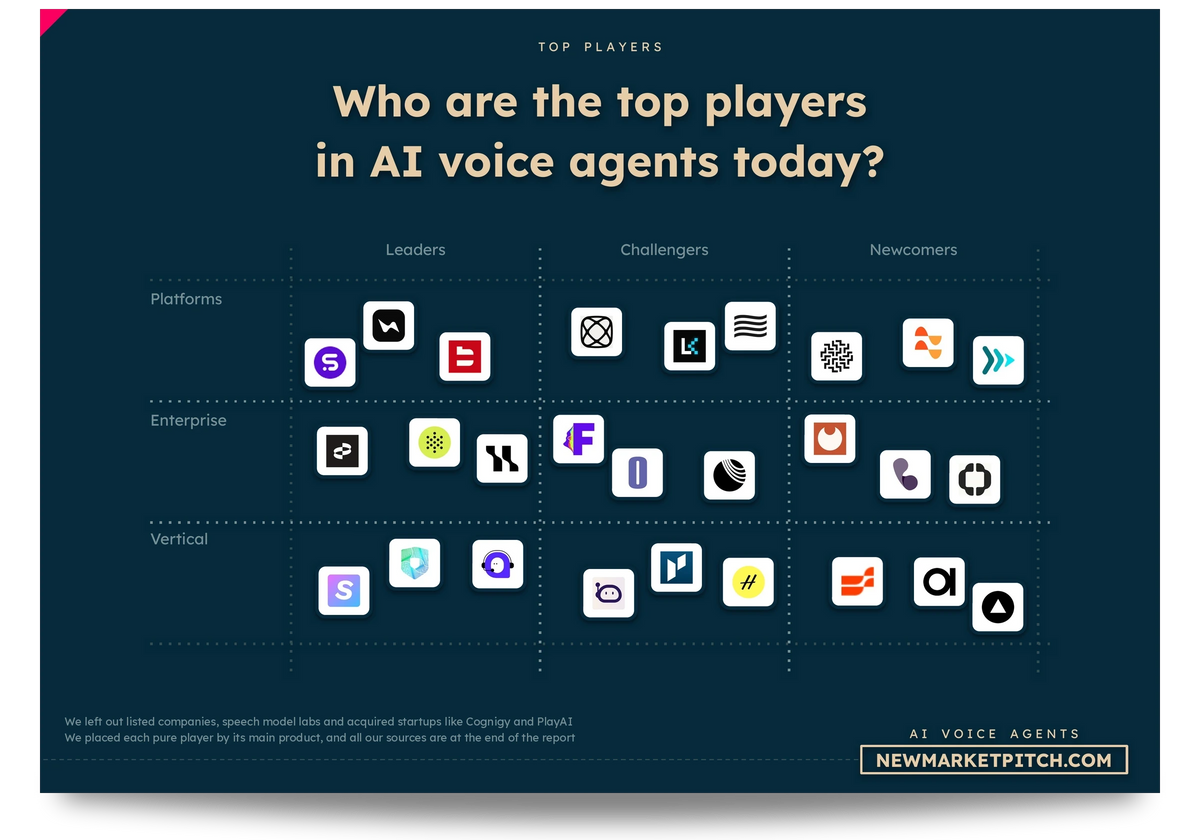
In our report covering the AI voice agent market, we turn what is vague and complex into simple, useful visuals. Market maps like this one show you at a glance where every startup stands.
Have AI voice agents actually moved beyond demos?
AI voice agents are already handling millions of real customer calls, and several startups have turned that usage into businesses generating tens of millions of dollars a year.
Retell AI reported reaching $80 million in annualized revenue in September 2026, compared with $40 million near the end of 2025. Vapi disclosed more than one billion cumulative calls in May 2026, while Bland AI reported handling over 3.5 million long conversations every week in June. Companies are clearly spending real money on automated phone conversations.
Enterprise adoption has also moved well beyond small pilots. Amazon Ring selected Vapi after evaluating more than 40 providers and now routes all its inbound calls through the platform. PolyAI has deployments at companies including PG&E, Marriott, and UniCredit. Decagon has published customer implementations at Chime and Valon.
What remains harder to establish is how much useful work these systems complete. A platform can process millions of calls while still transferring difficult conversations to human agents. Revenue, customer retention, and successful resolutions tell us considerably more about commercial progress than a polished demonstration.
Which AI voice agent startups are actually leading the market?
Retell AI, Vapi, Bland AI, PolyAI, and Parloa are the strongest voice-focused startups in our assessment, while ElevenLabs, Sierra, Decagon, and Regal are serious competitors from adjacent parts of the market.
The ranking changes depending on what we measure. Retell has particularly strong revenue growth. Vapi has impressive developer adoption and large enterprise customers. Bland processes substantial call volume, while PolyAI and Parloa have built businesses around complex enterprise deployments.
ElevenLabs is financially larger than any of these specialists, but its revenue includes speech generation and other products beyond conversational agents. Sierra and Decagon compete more broadly in customer-service automation, where voice is one part of a larger product.
To compare them properly, we have separated disclosed revenue from production usage and customer evidence. The figures below come from company announcements, financial disclosures, and published customer studies. They cover different reporting periods and should not be mistaken for a single audited ranking.
| Startup | Reported commercial scale | Production evidence | Main strength |
|---|---|---|---|
| Retell AI | $80M annualized revenue | Tens of millions of monthly calls | Revenue growth and efficiency |
| Vapi | Eight-figure annual revenue run rate | 1B+ cumulative calls; Amazon Ring | Developer infrastructure |
| Bland AI | Revenue not comparably disclosed | 3.5M+ conversations weekly | Complex phone conversations |
| PolyAI | Revenue not comparably disclosed | 100+ enterprises, 2,000+ deployments | Enterprise rollouts |
| Parloa | $50M+ ARR | 150% net revenue retention | Enterprise account expansion |
| ElevenLabs | $500M+ total ARR | Enterprise voice-agent deployments | Voice models and infrastructure |
| Sierra | $100M ARR | Major customer-service deployments | Enterprise service automation |
| Decagon | Revenue not comparably disclosed | Chime, Valon and other customers | Cross-channel issue resolution |
| Regal | Revenue not comparably disclosed | Production sales and service calls | Revenue-generating conversations |
Voice AI already supports several substantial businesses. We cannot yet identify one undisputed leader because the companies disclose different metrics and sell different combinations of technology and services.

Our research about AI voice agents gets updated several times a month, so you always get the latest view of where things stand.
Is Retell AI the strongest pure-play voice agent startup?
Retell AI has the clearest case for leadership among independent voice-agent platforms when we compare disclosed revenue growth with the amount of funding used to reach it.
Retell's own company timeline shows annualized revenue doubling from $40 million to $80 million in less than a year. An AWS customer study also documented its earlier progression from approximately $4 million at the end of 2024 to $40 million at the end of 2025.
That is roughly twentyfold growth in less than two years. Even allowing for the limitations of annualized revenue, the speed is exceptional for a company selling infrastructure that businesses pay to use.
Retell initially raised just $4.6 million in seed financing. Its company materials also reported reaching $40 million in annualized revenue while profitable, with a team of around 25 people. That gives it an unusually strong early capital-efficiency record compared with enterprise AI startups that have raised hundreds of millions of dollars.
Retell serves customers across industries including automotive, healthcare, finance, and logistics. Its technology handles live calls, integrates with business systems, and lets customers configure their own voice agents.
The remaining question concerns the economics of larger enterprise deployments. Retell has shared unusually detailed revenue milestones, but we still lack standardized figures for gross margins, customer retention, and the percentage of calls resolved successfully.
For now, Retell deserves the top position among voice-native startups. Its disclosed financial progress is stronger than the evidence available for most of its direct competitors.
If you want more recent data on this point, please see our latest AI voice agents market report.
Has Vapi become a serious enterprise voice AI company?
Vapi has become one of the strongest enterprise voice AI platforms, and its deployment at Amazon Ring is among the most convincing examples of commercial adoption in this market.
TechCrunch reported in May 2026 that Ring had considered more than 40 voice AI providers before selecting Vapi. Ring subsequently routed 100% of its inbound phone traffic through the platform.
That decision carries more weight than an ordinary customer announcement. Ring already operates a large consumer-support organization, where failed conversations can damage customer satisfaction and increase costs. According to Vapi, the platform gives Ring's engineers detailed control over how agents behave during live calls.
Vapi's wider business is also growing quickly. The company reported processing between one million and five million calls daily, and more than one million developers have used its self-service platform. It also disclosed 2.7 million unique agents created by users.
Its $50 million Series B in May valued the company at approximately $500 million and brought total funding to $72 million. Vapi said enterprise ARR had increased tenfold since its previous financing, although it did not release the underlying revenue figure. TechCrunch separately reported that its annual revenue run rate was in the eight figures.
The interesting part is how Vapi reached enterprise customers. It began by attracting developers who wanted to build their own voice applications, then used that adoption to win much larger organizations.
Vapi is now a major infrastructure contender. Its biggest test is whether customers continue paying for its orchestration layer as competing platforms offer increasingly similar capabilities.

In our market report about AI voice agents, we look at what the winners do differently, so you can learn from the best instead of guessing.
Is Bland AI more than a company making realistic phone calls?
Bland AI has already reached substantial production scale, particularly for complicated telephone conversations in industries where customers cannot simply follow a fixed script.
In June 2026, Bland disclosed more than 3.5 million long conversations per week. Maintaining that rate for a year would mean approximately 182 million conversations. The company raised a $50 million Series C the same month, taking total funding above $100 million.
Its customers include Samsara, Kin Insurance, and CNO Financial Group. These businesses deal with conversations involving insurance policies, logistics, customer records, and other information that often requires access to internal systems.
Bland has chosen a different technical approach from startups that rely heavily on external speech providers. It develops its own voice models, giving it more direct control over speech generation, latency, and conversational behavior.
That strategy could become valuable when customers need agents to handle interruptions, unexpected questions, and complicated sequences of actions. However, developing proprietary models also creates additional research and infrastructure costs.
Bland's commercial reach is clear from its reported conversation volume and customer base. Its financial position is harder to compare because it has not published recurring revenue figures with the same detail as Retell or Parloa.
Among startups specializing in complex phone interactions, Bland belongs near the top. More transparent data on customer spending and completed tasks would make its position easier to judge.
Why is PolyAI one of the strongest enterprise voice AI startups?
PolyAI has some of the best evidence of repeat enterprise adoption, with more than 2,000 live deployments across over 100 corporate customers.
Those figures came from PolyAI's December 2025 announcement of an $86 million Series D, which brought its total funding above $200 million. Its deployments covered 45 languages and more than 25 countries.
Dividing the disclosed deployment count by the customer count gives roughly 20 deployments per enterprise, although the actual average is approximate because both figures were reported as thresholds. More importantly, it suggests that PolyAI is expanding inside large organizations rather than relying entirely on new customer wins.
Its case studies also cover unusually different environments. SafeRide Health scaled its deployment to approximately one million calls per month. PG&E reported saving 35,000 labor hours. UniCredit reported a 14-point improvement in net promoter score, while Fogo de Chão reported 95% customer satisfaction.
Those results cannot be compared directly. Labor hours saved, customer satisfaction, and call volume measure different things. But the range of industries is good evidence that PolyAI can handle more than a narrow category of phone requests.
A Forrester study commissioned by PolyAI estimated a 391% return on investment for a modeled customer organization. That calculation is less conclusive than audited savings across the entire customer base, but it adds another financial perspective to the deployment data.
PolyAI looks particularly strong for large enterprises that need agents working across locations, languages, and business processes. Its main weakness in a public ranking is the lack of comparable revenue disclosure.

In our document detailing everything you need to know about AI voice agent, you will always find fresh funding data, taken straight from our own verified funding database.
Is Parloa growing fast enough to justify its $3 billion valuation?
Parloa has become a major enterprise voice AI competitor, but its $3 billion valuation assumes considerable growth beyond the revenue it has publicly disclosed.
In December 2025, Parloa announced that it had passed $50 million in annual recurring revenue. It also reported 150% net revenue retention, meaning existing customer relationships were generating 50% more recurring revenue than in the comparable earlier period, after expansions and contractions.
That retention figure is particularly interesting. Winning a major enterprise contract can produce a large initial sale, but sustained expansion within existing accounts is harder to achieve. Parloa's disclosure suggests that customers were finding additional uses for its platform after their first deployments.
The company works with organizations including TP and HealthEquity. Its product focuses on enterprise customer-service agents, with tools for managing conversations, connecting internal systems, and controlling how agents behave.
Parloa raised $350 million in January 2026 at a $3 billion valuation. Using its previously disclosed $50 million ARR as a reference gives a valuation near 60 times recurring revenue. The actual multiple at the financing date could differ because revenue may have increased.
That's a demanding valuation, even in a market where investors are willing to pay heavily for growth. Parloa faces well-funded startups and established contact-center software providers, many of which already have relationships with the same enterprise buyers.
Parloa has shown that large customers are spending and expanding. But the valuation leaves little room for slowing growth or expensive deployments. The next revenue disclosures will need to be impressive.
If you want more recent data on this point, please see our latest AI voice agents market report.
Is ElevenLabs already bigger than the voice agent specialists?
ElevenLabs is much larger in reported revenue than the pure-play voice-agent startups, although its $500 million-plus ARR includes products beyond conversational agents.
The company announced in May 2026 that it had surpassed $500 million in annual recurring revenue, compared with $350 million at the end of 2025. That is an increase of more than 43% in roughly four months.
ElevenLabs originally became known for realistic text-to-speech generation. Its business now includes dubbing, voice creation, and ElevenAgents, an enterprise platform for conversational AI.
Its customers include Deutsche Telekom, Revolut, and Square. The company has also reported growing adoption of voice agents for customer support, sales, recruitment, and internal operations.
ElevenLabs raised $500 million in February at an $11 billion valuation. Its September employee share tender was announced at a $22 billion valuation, reflecting a further increase in the price investors were willing to pay for its shares. A secondary tender, however, does not have the same financial implications as a new primary funding round.
ElevenLabs has an advantage that many voice-agent specialists lack: its technology can generate revenue even when another company builds and sells the finished agent. Developers and enterprises can buy speech capabilities without using ElevenLabs as their complete customer-service platform.
ElevenLabs belongs among the most important voice AI companies, but its total revenue should be kept separate from the smaller, more narrowly defined voice-agent market.

Learning from others' mistakes is the cheapest lesson there is. In our report covering the AI voice agent market, we look at what broke startups before you, so you don't repeat it.
Could Sierra and Decagon beat the voice-first startups?
Sierra and Decagon could become bigger customer-service AI businesses than several voice-first startups because enterprises increasingly want agents that resolve problems across phone, chat, and other channels.
Sierra reported reaching $100 million in ARR in November 2025, just seven quarters after launching. Its customers include SoFi, Rivian, ADT, SiriusXM, and Wayfair.
Those companies have little in common operationally. A financial-services customer may need help with accounts or payments, while a vehicle manufacturer deals with service requests and ownership questions. Sierra's strategy is to build agents around those business processes rather than selling voice technology as a standalone product.
Decagon has taken a similar broad approach. Its customer cases include Chime, which reported 70% resolution across chat and voice, and Valon, which reported more than 50% voice deflection in mortgage servicing.
The two metrics are different. Resolution measures whether an issue was handled, while deflection generally measures whether a human agent was avoided. Still, both demonstrate that large customers are using AI for tasks extending beyond answering basic questions.
The competitive danger for specialized voice vendors is straightforward. Enterprises often care more about resolving customer issues than about which interface the agent uses. A company controlling the broader service workflow may capture a larger share of the customer's software budget.
Sierra and Decagon should be treated as direct competitors for enterprise spending. In fact, they may have the better long-term position if customers consolidate chat, phone, and other service channels onto a single agent platform.
If you want more recent data on this point, please see our latest AI voice agents market report.
Which voice AI startups can prove that their agents save money?
PolyAI, Decagon, Bland, and Regal have published some of the clearest customer results, although the evidence varies considerably in quality.
PG&E's reported 35,000 labor hours saved with PolyAI gives a concrete indication of reduced workload. Decagon's customer studies describe automated resolution and reduced human involvement, while Regal has published results involving call containment and sales conversion.
Bland offers a different example through its work with Superunit. Its case study reported a 27% improvement in first-call verification completion across 19,363 randomized calls. The use of randomized calls makes that example more informative than a simple before-and-after comparison, although it remains a vendor-published result.
Industry-wide comparisons are difficult because companies report whichever metric best suits the deployment. Some count avoided transfers, others count resolved cases, time saved, customer satisfaction, or conversion rates.
| Vendor and customer | Reported result | What it measures |
|---|---|---|
| PolyAI / PG&E | 35,000 labor hours saved | Reduced workload |
| PolyAI / SafeRide Health | 1M calls monthly | Production scale |
| PolyAI / UniCredit | +14 NPS points | Customer satisfaction |
| PolyAI / Carter's | 60% less seasonal hiring | Staffing requirements |
| Bland / Superunit | 27% more first-call verifications | Task completion |
| Decagon / Chime | 70% chat and voice resolution | Automated resolutions |
| Decagon / Valon | 50%+ voice deflection | Reduced human involvement |
| Regal / booking deployment | 97% inbound containment | Avoided human transfers |
These results are promising, but claimed operational improvements should be distinguished from independently verified financial savings.
A system that contains 97% of calls could still produce poor outcomes if callers struggle to complete their requests. Completed bookings, successful verification, or fewer paid labor hours are closer to the results businesses actually want.

Your time is limited. In our research about AI voice agents, we put numbers on each part of the market, so you can see where it makes sense to focus.
Do customers actually like talking to AI voice agents?
Customers are becoming more comfortable with AI customer service, but they still want the option to speak with a human when something goes wrong.
Gartner surveyed 3,566 business and consumer customers in February and March 2026. Half said interactions had become easier when companies used generative AI, while 87% considered access to a human agent essential.
That combination explains why reported automation rates can be misleading. Someone checking an appointment time may appreciate an instant AI response. The same person might insist on speaking with a human when disputing a large charge or dealing with a complicated insurance claim.
Published enterprise results show that good implementations can still achieve high satisfaction. PolyAI's Fogo de Chão case reported 95% customer satisfaction, while Ring reported improved customer satisfaction after deploying Vapi.
Those results show that customers can accept AI voice agents in real service situations. They don't establish a general preference for automated conversations, particularly when a problem becomes stressful or complicated.
The strongest implementations will likely automate routine calls while making human transfers painless. Forcing customers to remain with an AI agent just to improve a containment metric is a bad trade.
Can AI voice agents really replace human call-center workers?
AI voice agents can already take over a large share of repetitive call-center work, but replacing entire human service teams would require capabilities and economics that have not yet been demonstrated consistently.
Scheduling, order-status checks, basic account questions, and simple information collection are relatively suitable tasks. AI systems can work continuously and handle bursts of demand without hiring additional staff.
More complicated calls create different problems. Insurance disputes, financial complaints, identity verification, and unusual customer circumstances often involve exceptions that are difficult to automate reliably.
There is also a financial limit to consider. In January 2026, Gartner predicted that the cost of resolving a customer issue with generative AI could exceed $3 by 2030, making it more expensive than many offshore human service agents.
That prediction challenges the assumption that AI will always provide the cheapest option. Model inference may become cheaper, but complicated cases can require long conversations, multiple system calls, monitoring, and eventual human intervention.
Automating routine calls is already a serious business. Fully autonomous customer-service departments are another matter. The vendors promising near-total replacement will eventually have to show the total cost per successfully resolved issue, including escalations and mistakes.

In our market report about AI voice agents, we always try to gather several sources and make estimates that make sense, so you can work with solid numbers.
What can voice AI startups do that bigger tech companies cannot easily copy?
Voice AI startups can build durable businesses through reliable deployments and deep customer integrations, even as the underlying speech technology becomes easier to access.
Microsoft, Google, Amazon, and OpenAI can supply increasingly capable models for real-time conversations. Twilio and established contact-center vendors also have infrastructure and customer relationships that could support competing products.
The simplest voice agents are therefore vulnerable. A startup offering little beyond a standard language model connected to speech recognition and synthesis may struggle to justify its pricing once similar features become widely available.
The specialists are responding in different ways. Bland develops proprietary models to control more of the experience. Vapi emphasizes developer flexibility and orchestration. PolyAI and Parloa invest in deployment management, enterprise integrations, and governance.
Retell's AWS engineering study provides another example. Its team worked to reduce conversational latency by placing GPU and CPU resources close together, minimizing the delays that can make phone conversations awkward.
These engineering decisions can improve reliability, but competitors can make similar improvements. More durable advantages develop when a platform becomes deeply connected to a customer's databases, telephony systems, business processes, and monitoring tools.
Our bet is that generic voice functionality will become increasingly cheap and interchangeable. The companies with defensible businesses will be those trusted to manage important conversations, complete transactions, and handle failures without creating operational chaos. A natural-sounding voice alone won't get them there.
If you want more recent data on this point, please see our latest AI voice agents market report.
Will the voice AI market end up with one winner?
The voice AI market has room for several leaders because developer infrastructure, enterprise service software, and speech models serve different customers and purchasing decisions.
Retell and Vapi primarily benefit when businesses build and run more agents on their platforms. PolyAI and Parloa focus heavily on enterprises buying deployed solutions. ElevenLabs can supply speech technology to companies building their own applications.
The economics are different, too. Usage-based infrastructure grows when existing customers process more calls, but prices per minute can fall as technology improves. Enterprise software may offer longer contracts and deeper customer relationships, although deployments can involve more integration and support work.
That leaves room for overlapping winners. An enterprise might use one company for speech models, another for orchestration, and another for the customer-facing service application.
The biggest threat to this structure comes from established software providers bundling these capabilities into products that enterprises already use.
Several substantial businesses can coexist, but that does not mean all today's specialists will survive. Call volume is no guarantee of pricing power, and companies whose products become interchangeable could face serious margin pressure.

If you build or invest in the AI voice agent market, you need to know which business models pay off now and which ones are fading. That's why our report covering it has a whole section on it.
Who are the top AI voice agent startups beyond the demos?
Retell AI, Vapi, PolyAI, Bland AI, and Parloa are the five voice-focused startups we would place at the top, with Retell having the strongest publicly documented financial case.
Retell leads our assessment because of its rapid revenue growth, early capital efficiency, and substantial production usage. Vapi stands out for developer reach and its Amazon Ring deployment. PolyAI has demonstrated unusually broad adoption inside large organizations, while Bland has proven it can handle millions of complicated conversations every week. Parloa's recurring revenue and customer expansion put it firmly in the same group.
ElevenLabs belongs in the wider leadership discussion because its speech technology and conversational-agent business are operating at a much larger reported revenue scale. Sierra and Decagon are particularly important competitors because their broader customer-service products could eventually capture more spending than specialized voice platforms. Regal also deserves attention in sales and customer-engagement workflows.
The industry has already produced several meaningful businesses, but financial transparency varies considerably. Some startups report revenue, others emphasize call volume, and others publish impressive customer outcomes. Those figures shouldn't be treated as equivalent.
The next stage of competition will depend increasingly on how much useful work agents complete, how reliably they handle complicated situations, and whether customers continue expanding deployments after the initial rollout.
Retell currently has the clearest claim among pure-play voice platforms. But the larger contest remains open, and the companies that ultimately capture the most value may be those controlling customer-service workflows rather than the voice technology itself.
If you want more recent data on this point, please see our latest AI voice agents market report.
Our methodology
This analysis identifies the leading AI voice agent startups based on their demonstrated commercial and operational progress through October 2026. We assessed six dimensions: commercial traction, production adoption, enterprise penetration, operational effectiveness, customer economics, and competitive durability. The objective was to distinguish companies running substantial businesses from those primarily known for impressive demonstrations.
For each dimension, we collected recent evidence from company financial announcements, funding disclosures, production deployments, named customer implementations, technical documentation, and independent industry research. We then aggregated comparable findings within each dimension, evaluated their strength and consistency, and used the combined results to identify leaders. We gave particular weight to companies showing progress across several dimensions instead of relying on a single high-profile announcement.
Commercial traction was assessed through reported annual recurring revenue, annualized revenue, financing history, and customer expansion. Production adoption was assessed through documented call volume, enterprise deployments, and customer relationships. We kept these measurements separate: cumulative calls do not establish recurring revenue, and annualized usage revenue is not the same as contracted ARR. ElevenLabs and Sierra were also assessed separately from pure-play platforms because their disclosed revenue includes products and channels beyond voice agents.
Operational effectiveness was evaluated through measurable customer outcomes, including completed tasks, resolution rates, avoided transfers, labor hours saved, and customer satisfaction. We considered the difference between vendor-reported results and independently verified savings, and between metrics such as containment and successful resolution. Evidence of randomized testing received additional attention, as did repeated deployments and net revenue retention, which help establish whether enterprises continue finding value after initial adoption.
Competitive durability was assessed through technical control, integration depth, enterprise governance, deployment requirements, and exposure to competition from cloud providers and established contact-center software companies. We did not assign a numerical score to companies reporting fundamentally different metrics. Instead, we compared the evidence within each dimension, then examined which businesses had the strongest overall support for their leadership claims.
Key commercial and financing sources include Retell AI's company timeline, AWS's Retell engineering case study, Vapi's Series B announcement, TechCrunch's reporting on Vapi and Amazon Ring, Bland AI's Series C announcement, PolyAI's Series D announcement, Parloa's ARR disclosure, Parloa's valuation announcement, ElevenLabs' revenue announcement, ElevenLabs' employee tender announcement, and Sierra's ARR disclosure.
For production results, we examined PolyAI's published customer implementations at PG&E, SafeRide Health, UniCredit, Fogo de Chão, and Carter's, alongside Bland AI's Superunit verification study, Decagon's customer case studies, and Regal's published deployment results. These sources provided specific evidence about workload reduction, production scale, verification completion, customer experience, and automated service outcomes.
To assess customer acceptance and longer-term economics, we used Gartner's August 2026 customer-service survey and Gartner's January 2026 analysis of AI resolution costs. These findings were used to test whether reported automation gains translate into an acceptable customer experience and sustainable operating economics.
The final ranking reflects the combined strength of disclosed revenue, real-world adoption, measurable customer results, and the likelihood of maintaining a competitive position. Company-reported figures remain attributable to their original publishers, and the assessment distinguishes completed commercial achievements from forecasts, valuations, and projected usage. This produces a more meaningful comparison than ranking startups solely by funding, call volume, or public visibility.

In our report covering the AI voice agent market, we don't want to repeat what boring consulting reports say. Instead, we show you the real and latest market signals that matter.
Written by the New Market Pitch teamWe track new markets so founders and investors can move faster. About us