Alternative Protein Funding Tracker (100 deals)
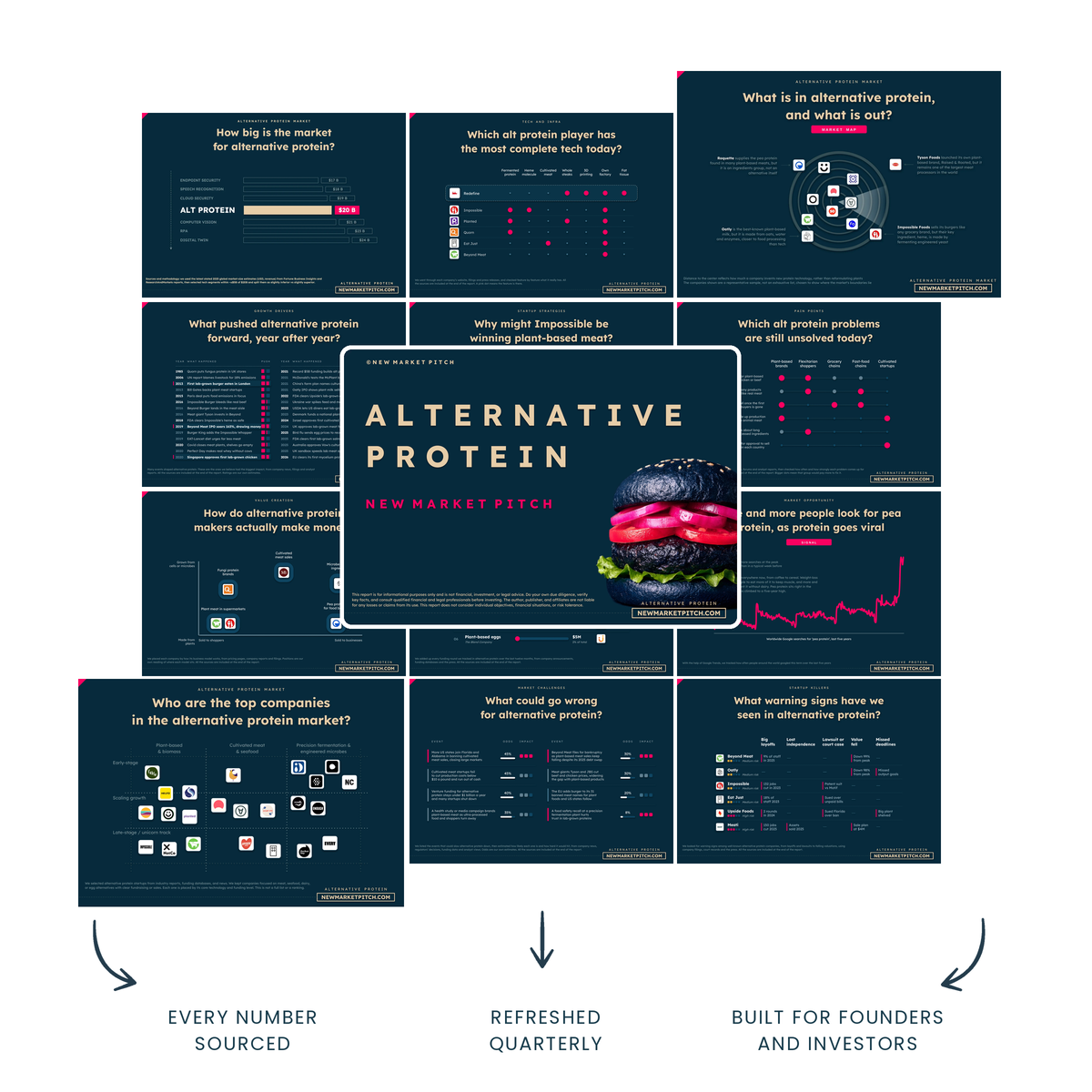
Whether you're building or investing in the alternative protein market, our report covers everything you need to know: the players, the money, and what's coming next.
Summary
Across 100 tracked deals, alternative protein is a real billion-dollar funding market, but one where the typical startup is still raising relatively modest checks and scale capital has become much more selective.
The market is less dependent on mega-rounds than many venture categories. Financings above $50 million account for 23.8% of capital, leaving $876.1 million even after the four largest rounds are removed.
The breadth is also genuine. The 100 financings are spread across 91 companies, and only a small minority appear more than once during the period. At the same time, 94.4% of capital went to follow-on financings, so investors are overwhelmingly funding companies that had already raised before.
Deal count and dollar allocation tell very different stories. Seventy-nine percent of rounds were below $20 million, yet they represented only 30.8% of capital. The real financial center of gravity sits between $20 million and $50 million.
Fermentation has clearly separated itself from the rest of alternative protein. It produced 31% of the financings but 51.2% of all capital, helped by companies moving from technical validation into manufacturing, retail launches and commercial-scale production.
Plant-based food remains active rather than dead. Meat and dairy together generated half of all deals, but the average check is generally smaller than in fermentation, especially in plant-based dairy.
The funding market increasingly rewards proof of execution. Large rounds tend to go to older companies with several years of technical work, regulatory progress, customers or manufacturing development already behind them.
The sharpest financing bottleneck comes after Series B. Seed, Series A and Series B remain reasonably populated, but very few companies progress into clearly labelled Series C or later venture rounds.
Strategic investors become more visible as companies approach commercial scale. Deals involving at least one disclosed corporate or strategic investor had a $9.5 million median, versus $3.28 million for deals without one, and those investors often bring manufacturing, distribution or customer relationships alongside capital.
Geographically, Europe has the deepest market by deal count and total capital, while North America has fewer financings but a somewhat larger median check. Asia-Pacific remains much smaller and is unusually dependent on a handful of larger companies.
The $1.150 billion total should be read as a carefully standardized estimate, not an accounting figure. Currency conversions, lower-bound disclosures, extensions and mixed financing packages introduce some unavoidable uncertainty, but they do not change the main picture: alternative protein still attracts capital, just on much tougher terms once companies need industrial-scale money.

Written by the New Market Pitch teamWe track new markets so founders and investors can move faster. About us

In our report covering the alternative protein market, you will always find fresh funding data, taken straight from our own verified funding database.
Our funding tracker covering the alternative protein market
Below is the table listing all the deals. You may find our methodology at the end of this page.
And, if you want to gain a deeper understanding of the market and its current dynamics, get our report covering the Alternative Protein Market.
| Company | Category | Date | Stage | Deal size | What they do | Region | Lead investors | Country | Rank |
|---|---|---|---|---|---|---|---|---|---|
| Kinish | Plant Based Dairy | October 2026 | Series A | ≈$3.1M | Develops rice-based dairy alternatives including rice-derived casein and The Rice Creamery plant-based ice cream | Asia-Pacific | Not disclosed | Japan | |
| Pythag Tech | Cultivated Meat | October 2026 | Seed | $4.3M | AI-driven platform that cuts cultivated meat production costs and licenses processes to food companies | North America | Azolla Ventures | United States | |
| Paleo | Fermentation Proteins | September 2026 | Unknown | ≈$2.3M | Produces animal-identical myoglobin through precision fermentation to improve meat and seafood alternatives. | Europe | Beyond Impact VC | Belgium | |
| MAASH | Fermentation Proteins | August 2026 | Unknown | $6.8M | Produces LoCylia mycoprotein through submerged fermentation for blended meat and other animal-protein-reducing food formulations. | Europe | Not disclosed | Belgium | |
| Millow AB | Fermentation Proteins | August 2026 | Seed | $2.3M | Produces oat-and-mycelium meat-alternative protein ingredients using solid-state fermentation. | Europe | Magnus Emilson | Sweden | |
| Plantopia | Plant Based Dairy | July 2026 | Unknown | $9M | Produces animal-free casein in sprouted oats via molecular farming for dairy alternatives such as cheese. | Middle East | Schreiber Foods; Siddhi Capital | Israel | |
| The Protein Brewery | Fermentation Proteins | June 2026 | Series B | $20.5M | Produces Fermotein, a whole-food mycelium protein ingredient made through biomass fermentation for food applications. | Europe | ABN AMRO Sustainable Impact Fund | Netherlands | |
| Vivici B.V. | Fermentation Proteins | June 2026 | Unknown | ≈$11.6M | Produces animal-free dairy proteins including beta-lactoglobulin and lactoferrin through precision fermentation. | Europe | Not disclosed | Netherlands | |
| NS/TX Industries Inc. | Plant Based Meat | June 2026 | Series A | $10.5M | Develops and operates a structuring and manufacturing platform for whole-cut plant-based meat and seafood alternatives. | North America | Inter IKEA Development BV; Lever VC | Canada | |
| Pacifico Biolabs | Fermentation Proteins | May 2026 | Series A | $8.2M | Produces mycelium-fermented protein for whole-cut meat and seafood alternatives using conventional brewery infrastructure. | Europe | Stray Dog Capital | Germany | |
| Oshi Inc. | Plant Based Meat | May 2026 | Unknown | $3M | Produces whole-cut plant-based salmon and whitefish fillets using proprietary layering technology. | North America | Not disclosed | United States | |
| SuperMeat The Essence of Meat Ltd. | Cultivated Meat | May 2026 | Series A | $6M | Develops cultivated chicken meat grown directly from animal cells for human food. | Middle East | Agronomics | Israel | |
| Tempty Foods ApS | Fermentation Proteins | May 2026 | Seed | $489K | Makes ready-to-cook mycelium-based protein foods positioned for meat-reduction occasions. | Europe | Not disclosed | Denmark | |
| AuX Labs | Fermentation Proteins | April 2026 | Seed | $4M | Produces precision-fermented casein proteins for animal-free cheese with conventional dairy functionality. | North America | NYA Ventures; Nàdarra Ventures | Canada | |
| Finally Foods Ltd | Plant Based Dairy | April 2026 | Seed | $1.4M | Uses molecular farming in potatoes to produce animal-identical casein for cow-free dairy products. | Middle East | Central Bottling Company (CBC Group) | Israel | |
| Standing Ovation | Fermentation Proteins | March 2026 | Series B | $28.5M | Produces casein dairy proteins from whey side streams via precision fermentation for cheese and other dairy applications. | Europe | Ecotechnologies 2 (Bpifrance); Crédit Mutuel Innovation | France | |
| Aquafab Official Pty Ltd | Plant Based Eggs | March 2026 | Series A | ≈$424K | Makes a shelf-stable faba-bean protein foamer positioned as an egg-white replacement for cocktails. | Asia-Pacific | Not disclosed | Australia | |
| JAY & JOY | Plant Based Dairy | March 2026 | Unknown | ≈$2.3M | Makes fermented and aged plant-based cheese alternatives under the Jay&Joy and Les Nouveaux Affineurs brands. | Europe | Demeter; Beyond Impact; Mindstone; Vivegan | France | |
| Verley | Fermentation Proteins | February 2026 | Series A | $30M | Produces dairy-identical whey proteins, particularly beta-lactoglobulin, through precision fermentation for food and nutrition applications. | Europe | Alven | France | |
| Those Vegan Cowboys | Fermentation Proteins | February 2026 | Unknown | $4.5M | Produces cow-free casein through precision fermentation for animal-free cheese and other dairy applications. | Europe | Not disclosed | Belgium | |
| The Bland Company | Plant Based Eggs | February 2026 | Seed | $2.7M | Turns proteins recovered from agricultural side streams into functional plant ingredients designed to replace eggs in food manufacturing. | Europe | Initialized Capital | United Kingdom | |
| 1.5 Degree | Plant Based Dairy | February 2026 | Seed | $1M | Supplies plant-based milk, dairy alternatives and frozen desserts primarily to institutional foodservice customers. | Asia-Pacific | 35North Ventures' India Discovery Fund II | India | |
| Evergreen Select | Cultivated Meat | February 2026 | Series A | $6M | Develops cultivated beef biomass for incorporation into conventional beef products to improve supply consistency. | North America | Not disclosed | United States | |
| Green Rebel Foods | Plant Based Meat | January 2026 | Series A | $10.5M | Makes Asian-style plant-based beef, chicken and other meat alternatives for retail and foodservice. | Asia-Pacific | Not disclosed | Indonesia | |
| Maia Farms | Fermentation Proteins | January 2026 | Seed | $2.7M | Produces mushroom and mycelium protein ingredients using fermentation and extrusion for food manufacturers. | North America | Active Impact Investments | Canada | |
| Mö Foods | Plant Based Dairy | January 2026 | Seed | $2.8M | Makes oat-based cheese alternatives designed to melt, slice and perform like dairy cheese. | Europe | Nordic Foodtech VC | Finland | |
| Mooji Meats Inc. (Offbeast) | Plant Based Meat | January 2026 | Unknown | $1M | Makes whole-cut plant-based steak products using proprietary fiber-assembly technology to reproduce meat texture. | North America | Not disclosed | United States | |
| BlueNalu, Inc. | Cultivated Seafood | December 2025 | Growth Equity | $6M | Develops cell-cultivated bluefin tuna and other seafood products for commercial food markets. | North America | Not disclosed | United States | |
| Those Vegan Cowboys | Fermentation Proteins | December 2025 | Unknown | ≈$7.3M | Produces cow-free casein via precision fermentation for cheese and other dairy alternatives. | Europe | Pieter Geelen | Belgium | |
| The Green Dairy | Plant Based Dairy | December 2025 | Unknown | ≈$8.6M | Manufactures private-label oat- and fava-bean dairy alternatives for brands, retailers and foodservice. | Europe | Not disclosed | Sweden | |
| Ripple Foods | Plant Based Dairy | December 2025 | Growth Equity | $17M | Makes pea-protein plant milks, protein shakes and other dairy-free products. | North America | Material Impact | United States | |
| Sproud | Plant Based Dairy | December 2025 | Unknown | ≈$2.1M | Makes pea-protein milk and other dairy-alternative beverages. | Europe | Not disclosed | Sweden | |
| Clever Carnivore, Inc. | Cultivated Meat | November 2025 | Seed | $2.3M | Develops cultivated meat, initially pork, using cell-culture and scalable bioprocessing technology. | North America | Not disclosed | United States | |
| The EVERY Company | Fermentation Proteins | November 2025 | Series D+ | $55M | Produces animal-free egg proteins via precision fermentation for food and beverage applications. | North America | McWin Capital Partners via McWin Food Tech Fund | United States | |
| UMAMI UNITED | Plant Based Eggs | October 2025 | Seed | $2M | Develops plant-based egg products and egg-replacement ingredients for foodservice and food manufacturers. | Asia-Pacific | Not disclosed | Japan | |
| MATR Foods | Plant Based Meat | October 2025 | Series A | $23.2M | Makes plant-based meat alternatives by fungi-fermenting Nordic vegetables, legumes and grains. | Europe | Novo Holdings; EIFO | Denmark | |
| Bettani Farms | Plant Based Dairy | October 2025 | Series A | $6.5M | Develops Caseed seed-protein technology and protein-rich dairy-free cheeses designed to replicate casein functionality. | North America | S2G Investments | United States | |
| Revyve | Fermentation Proteins | September 2025 | Series B | $28M | Produces functional yeast proteins that replace eggs and additives in plant-based and other animal-free food formulations. | Europe | ABN AMRO Sustainable Impact Fund; Invest-NL | Netherlands | |
| The Protein Brewery | Fermentation Proteins | September 2025 | Series B | $35.6M | Produces Fermotein, a fungal-fermentation protein ingredient for animal-free food applications. | Europe | Novo Holdings | Netherlands | |
| Nxtfood | Plant Based Meat | September 2025 | Series B | $29M | Develops and manufactures ACCRO-branded plant-based alternatives to minced meat, burgers and other meat products. | Europe | Creadev; Roquette Ventures | France | |
| Arummi Foods | Plant Based Dairy | September 2025 | Seed | $2M | Produces cashew milk as a plant-based dairy alternative for retail and foodservice. | Asia-Pacific | BEENEXT; Korea Investment Partners; Fondation Botnar | Indonesia | |
| SUMM Ingredients | Fermentation Proteins | September 2025 | Seed | $2M | Develops FermiPro, a multifunctional fermented plant-protein ingredient for plant-based meat and dairy formulations. | Europe | Not disclosed | Denmark | |
| Itz Nutz | Plant Based Dairy | September 2025 | Seed | $535K | Produces cashew-based plant dairy alternatives including cheeses, yogurt and butter-style products. | Europe | ŞirketOrtağım Angel Investor Network; Mehmet Betil | Turkey | |
| The Better Meat Co. | Fermentation Proteins | August 2025 | Series A | $31M | Produces Rhiza mycoprotein via fermentation for use as an animal-free meat-replacement and meat-enhancing protein ingredient. | North America | Future Ventures; Resilience Reserve | United States | |
| Better Nature | Plant Based Meat | August 2025 | Unknown | ≈$1.5M | Makes tempeh-based plant protein products positioned as direct substitutes for chicken and other meat. | Europe | Not disclosed | United Kingdom | |
| MUCHgroup B.V. | Plant Based Meat | July 2025 | Unknown | ≈$438.5K | Produces shiitake-based whole-food meat alternatives for foodservice, including pulled-meat, tartare and pork-belly substitutes. | Europe | Not disclosed | Netherlands | |
| Rival Foods | Plant Based Meat | June 2025 | Series B | $11.6M | Produces whole-cut plant-based meat using proprietary shear-cell technology for foodservice, brands and retail. | Europe | APG (on behalf of ABP) | Netherlands | |
| Plan(e)t Foods | Plant Based Dairy | June 2025 | Seed | $1.2M | Makes oat-based plant-based ice cream designed to substitute conventional dairy ice cream. | Europe | SPOROS Platform | Greece | |
| Sproud | Plant Based Dairy | May 2025 | Unknown | $2.2M | Makes pea-protein milk, barista drinks and other plant-based dairy alternatives. | Europe | Not disclosed | Sweden | |
| High Time Foods | Plant Based Meat | May 2025 | Seed | $1.2M | Makes shelf-stable plant-based minced-meat and chicken-style protein alternatives for foodservice. | Asia-Pacific | Avaana Capital | India | |
| catchfree AG | Plant Based Meat | April 2025 | Seed | ≈$1.5M | Develops plant-based shrimp, fish burgers, fish bites and other seafood alternatives. | Europe | FortyOne Group; Stiftung Startfeld | Switzerland | |
| Aleph Farms | Cultivated Meat | March 2025 | Unknown | $29M | Develops cultivated whole-cut beef steaks using cellular agriculture. | Middle East | Not disclosed | Israel | |
| Re:meat® | Cultivated Meat | March 2025 | Seed | ≈$1.1M | Develops cultivated beef and modular production systems for making cultivated meat. | Europe | 8+ Ventures | Sweden | |
| Tiba Tempeh | Plant Based Meat | March 2025 | Growth Equity | >$1.4M | Makes tempeh-based meat-free products including mince, burgers, blocks and marinated pieces. | Europe | Maven Capital Partners | United Kingdom | |
| Vivici B.V. | Fermentation Proteins | February 2025 | Series A | ≈$33.7M | Produces animal-free dairy proteins using precision fermentation. | Europe | APG (on behalf of ABP); Invest-NL | Netherlands | |
| Mosa Meat | Cultivated Meat | February 2025 | Growth Equity | $4M | Develops cultivated beef grown from animal cells, including cultivated beef fat and burgers. | Europe | Not disclosed | Netherlands | |
| Kinish Inc. | Plant Based Dairy | February 2025 | Seed | $800K | Uses plant molecular farming to produce milk proteins in rice for dairy substitutes. | Asia-Pacific | Genesia Ventures | Japan | |
| PlantBaby, Inc. | Plant Based Dairy | February 2025 | Seed | $4M | Develops organic plant-based milk and related nutrition products centered on its Kiki Milk dairy alternative. | North America | B2 Partners | United States | |
| JAY & JOY | Plant Based Dairy | January 2025 | Unknown | $2.1M | Produces fermented and aged plant-based cheese alternatives. | Europe | Not disclosed | France | |
| Project Eaden GmbH | Plant Based Meat | January 2025 | Series A | $15.6M | Creates ultra-realistic plant-based meat using proprietary fiber-spinning and compounding technology. | Europe | Planet A; REWE Group | Germany | |
| Plantible Foods | Plant Based Eggs | November 2024 | Series B | $30M | Produces lemna-derived Rubi Protein and ingredient systems used to replace eggs and improve plant-based meat and dairy formulations. | North America | Piva Capital; Siddhi Capital | United States | |
| The Jackfruit Company | Plant Based Meat | October 2024 | Series B | $5M | Makes jackfruit-based meat alternatives under The Jackfruit Company and Jack & Annie's brands. | North America | InvestEco; Creadev; Grosvenor Food & AgTech | United States | |
| La Vie | Plant Based Meat | October 2024 | Series B | ≈$27.4M | Makes plant-based pork and deli-meat alternatives including bacon, lardons, ham and meatballs. | Europe | Not disclosed | France | |
| UOBO | Plant Based Eggs | October 2024 | Seed | ≈$550K | Makes liquid plant-based egg substitutes for foodservice and food manufacturers. | Europe | Enzo Ventures | Spain | |
| Luya Foods | Plant Based Meat | September 2024 | Series A | ≈$5.9M | Makes fermented plant-based meat alternatives from upcycled okara and chickpeas. | Europe | Not disclosed | Switzerland | |
| Helaina | Fermentation Proteins | September 2024 | Series B | $45M | Precision-fermented human-identical lactoferrin and other milk proteins | North America | Avidity Partners | United States | |
| Fermtech | Fermentation Proteins | September 2024 | Unknown | >$430K | Produces fermented protein ingredients from food-industry side streams for products including plant-based meat and cheese. | Europe | Not disclosed | United Kingdom | |
| Sproud | Plant Based Dairy | September 2024 | Unknown | ≈$1.4M | Makes pea-protein plant milks and cream alternatives to dairy. | Europe | Not disclosed | Sweden | |
| Fabas Foods AG | Plant Based Dairy | September 2024 | Seed | >$1.5M | Produces pulse-protein ingredient systems for plant-based food alternatives, initially targeting dairy applications. | Europe | Not disclosed | Switzerland | |
| Standing Ovation | Fermentation Proteins | September 2024 | Series A | $4.2M | Produces animal-free casein for cheese and other dairy foods using precision fermentation. | Europe | Astanor Ventures | France | |
| Novameat | Plant Based Meat | September 2024 | Series A | ≈$19.2M | Makes whole-cut and shredded plant-based meat using proprietary protein-texturizing technology. | Europe | Sofinnova Partners; Forbion | Spain | |
| Formo | Fermentation Proteins | September 2024 | Series B | $61M | Makes animal-free cheese using koji fermentation while developing precision-fermented casein for dairy foods. | Europe | Not disclosed | Germany | |
| Meat Tomorrow (now Armenta Bioscience) | Cultivated Meat | September 2024 | Seed | ≈$610K | Develops pluripotent pig stem-cell lines for producing cultivated pork muscle and fat. | Europe | Mikkel Skorkjær Kongsfelt; Accelerace | Denmark | |
| New School Foods Inc. | Plant Based Meat | August 2024 | Seed | $6M | Develops whole-cut plant-based seafood, led by a salmon fillet designed to replicate conventional fish texture and cooking behavior. | North America | Good Startup | Canada | |
| De Novo Foodlabs | Fermentation Proteins | August 2024 | Seed | $1.5M | Produces animal-free lactoferrin and other functional proteins through precision fermentation as alternatives to animal-derived proteins. | North America | Joyful Ventures | United States | |
| Adamo Foods | Fermentation Proteins | August 2024 | Seed | $2.5M | Develops whole-cut meat alternatives from fungal mycelium using proprietary fermentation technology. | Europe | UK Innovation Science and Seed Fund (UKI2S); Joyful Ventures | United Kingdom | |
| The VERY Food Co. | Plant Based Eggs | July 2024 | Seed | $461K | Develops plant-based functional ingredients replacing eggs and dairy ingredients in food manufacturing and foodservice. | Europe | Not disclosed | France | |
| OATSIDE | Plant Based Dairy | June 2024 | Series B | $35.3M | Produces oat-based milk and other dairy-alternative beverages. | Asia-Pacific | Not disclosed | Singapore | |
| Ever After Foods Ltd. | Cultivated Meat | June 2024 | Unknown | $10M | Develops scalable bioreactor technology and production processes for cultivated meat, fish and seafood. | Middle East | Not disclosed | Israel | |
| Tender Food Inc. | Plant Based Meat | June 2024 | Series A | >$11M | Makes whole-cut plant-based meat and seafood using fiber-spinning technology. | North America | Rhapsody Venture Partners | United States | |
| THIS™ | Plant Based Meat | June 2024 | Series C | $25.4M | Produces plant-based meat alternatives including chicken, beef and pork-style products. | Europe | Planet First Partners | United Kingdom | |
| NewMoo, Ltd. | Plant Based Dairy | May 2024 | Seed | $7M | Produces animal-free casein in plants for dairy-free cheese and other dairy alternatives. | Middle East | lool Ventures; ZORA Ventures | Israel | |
| Ark Biotech Inc. | Cultivated Meat | May 2024 | Unknown | $8.2M | Develops bioreactors and operating systems for industrial-scale cultivated-meat production. | North America | Not disclosed | United States | |
| Meati Foods | Fermentation Proteins | May 2024 | Series C | $100M | Produces whole-cut meat alternatives from fermented mycelium. | North America | Grosvenor Food & AgTech | United States | |
| Solar Foods Oy | Fermentation Proteins | April 2024 | Series B | $8.6M | Produces Solein, a microbial food protein made by gas fermentation from carbon dioxide, hydrogen and nutrients. | Europe | Not disclosed | Finland | |
| Edonia | Plant Based Meat | April 2024 | Seed | $1.2M | Turns microalgae into textured protein ingredients positioned as substitutes for ground meat in plant-based foods. | Europe | Asterion Ventures | France | |
| Mosa Meat | Cultivated Meat | April 2024 | Unknown | $42.5M | Develops cultivated beef from bovine cells for burgers and other meat products. | Europe | Lowercarbon Capital; M Ventures | Netherlands | |
| Onego Bio | Fermentation Proteins | April 2024 | Series A | $29.1M | Produces bioidentical egg-white protein by precision fermentation for animal-free food applications. | Europe | NordicNinja | Finland | |
| Innocent Meat GmbH | Cultivated Meat | March 2024 | Series A | $3.3M | Builds automated end-to-end systems and bioprocess inputs that enable meat producers to manufacture cultivated meat. | Europe | Not disclosed | Germany | |
| SHICKEN Foods | Plant Based Meat | March 2024 | Seed | $5.1M | Makes plant-based chicken-style curries, kebabs and ready meals. | Europe | Veg Capital | United Kingdom | |
| Mozza Foods, Inc. | Plant Based Dairy | March 2024 | Series A | $5.2M | Produces cow-identical micellar casein in engineered soybeans for animal-free cheese and other dairy products. | North America | Not disclosed | United States | |
| ANDFOODS | Plant Based Dairy | March 2024 | Seed | $1.7M | Develops legume-based dairy-free creams, milks and powders for food manufacturers and foodservice. | Asia-Pacific | Icehouse Ventures | New Zealand | |
| Cultivated Biosciences SA (now Cosaic) | Fermentation Proteins | March 2024 | Seed | $5M | Produces a fermented yeast-derived cream containing proteins, fats and fibers for dairy-free milks, creamers and ice cream. | Europe | Navus Ventures | Switzerland | |
| MALK Organics LLC | Plant Based Dairy | March 2024 | Series B | $7M | Produces organic almond, oat, cashew and other plant-based milk alternatives. | North America | Benvolio Group; Rotor Capital | United States | |
| 70/30 Food Tech | Fermentation Proteins | February 2024 | Seed | $700K | Develops fermented mycelium protein for shredded-meat alternatives and hybrid mushroom-soy foods. | Asia-Pacific | Better Bite Ventures | China | |
| Miruku | Plant Based Dairy | February 2024 | Unknown | $5M | Engineers oilseed crops to produce animal-free dairy proteins and fats directly inside their seeds. | Asia-Pacific | Motion Capital | New Zealand | |
| Pacifico Biolabs | Fermentation Proteins | February 2024 | Seed | $3.3M | Uses biomass fermentation of multiple microorganisms including mycelium to make whole-cut alternative proteins, initially seafood. | Europe | FoodLabs; Simon Capital | Germany | |
| SIMPLE planet | Cultivated Meat | February 2024 | Unknown | $6M | Cultivates animal cells to produce high-protein powders and ingredients for alternative meat and seafood foods. | Asia-Pacific | Not disclosed | South Korea | |
| Heura Foods | Plant Based Meat | February 2024 | Series B | $42.9M | Develops branded plant-based meat and fish alternatives using legume proteins and proprietary food formulations. | Europe | Upfield | Spain | |
| Ingrediome | Fermentation Proteins | February 2024 | Seed | $2.8M | Uses photosynthetic precision fermentation in microalgae to make nature-identical animal muscle proteins for meat and seafood alternatives. | Middle East | Not disclosed | Israel | |
| MyForest Foods Co. | Plant Based Meat | February 2024 | Series A | $3.5M | Grows oyster-mushroom mycelium into whole-cut meat alternatives led by its MyBacon product. | North America | Not disclosed | United States | |
| The Coconut Collaborative | Plant Based Dairy | January 2024 | Series B | $1.9M | Makes coconut-based dairy alternatives including yogurts, creams, puddings and dairy-free drinks. | Europe | Not disclosed | United Kingdom | |
| Chunk Foods | Plant Based Meat | January 2024 | Seed | $7.5M | Produces fermented soy- and wheat-based whole-cut plant-based meats, including steak alternatives. | North America | Cheyenne Ventures | United States | |
| Infinite Roots | Fermentation Proteins | January 2024 | Series B | $58M | Uses biomass fermentation of mushroom mycelium to produce protein-rich foods and meat alternatives. | Europe | Dr. Hans Riegel Holding (HRH) | Germany | |
| Perfect Day | Fermentation Proteins | January 2024 | Series D+ | $90M | Precision-fermented animal-free whey and dairy proteins | North America | Not disclosed | United States |

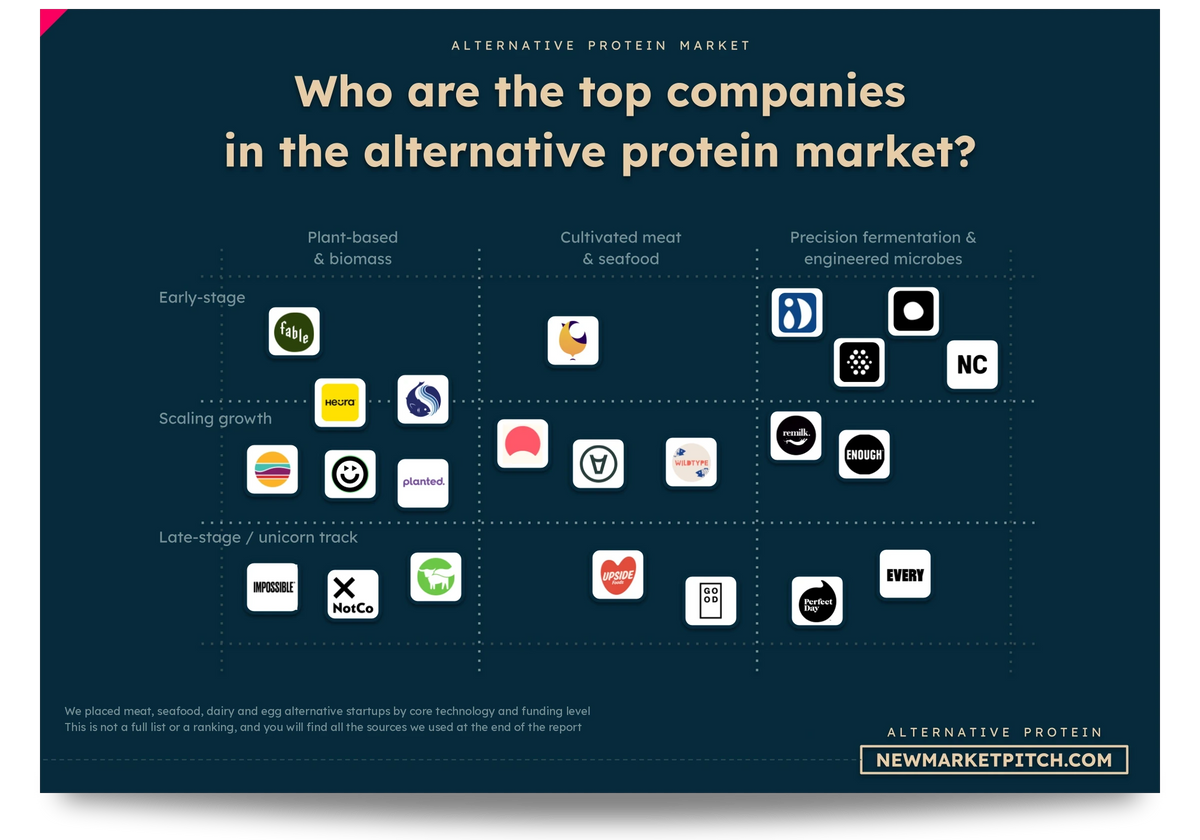
In our research about alternative proteins, we turn what is vague and complex into simple, useful visuals. Market maps like this one show you at a glance where every startup stands.
Is alternative protein funding actually a big market right now?
Alternative protein funding is still a meaningful billion-dollar market, although a normal company raises far less than the headline total suggests.
We tracked 100 qualifying financings across 91 companies, representing approximately $1.150 billion of disclosed or estimated capital. The median financing was $5 million, compared with an $11.5 million average. A few large transactions pull that average up quickly.
Four rounds above $50 million generated 23.8% of all capital. Even after removing them, $876.1 million remains. Alternative protein funding therefore has real depth beyond its biggest deals, while ordinary fundraising still happens on a much smaller scale.
The market also looks selective these days. The Good Food Institute's current investment tracker shows the same broad pattern outside our own dataset: using GFI's separate methodology, fermentation companies raised $132 million in Q2 2026, versus $41 million for plant-based companies and $25 million for cultivated protein companies. The money is still moving, but investors are choosing where to place large checks much more carefully.
How many alternative protein companies are actually getting funded?
The alternative protein funding market currently consists of a surprisingly broad group of companies: our 100 financings are spread across 91 businesses.
Eighty-three companies appear only once during the period. Seven raised twice and just one appears three times. That gives us a repeat-fundraising rate of 8.8%.
Those single-round companies still collected $936.2 million, or 81.4% of all capital. The market therefore cannot be reduced to a small circle of startups coming back every few months for more money.
At the same time, appearing in the market and attracting serious capital are two different things. Nearly half of companies never pass $5 million of cumulative funding during our window, while only 5.5% get beyond $50 million.
Is most alternative protein funding going to a handful of startups?
Alternative protein funding is fairly concentrated today, but no single startup comes close to controlling the market.
Meati Foods is the largest company in our period with $100 million, equal to 8.7% of market capital. The top five companies reach 28.7%, while the top ten reach 46.3%.
That leaves a market where a relatively small upper tier attracts a lot of the money without one company swallowing the whole category. Formo raised $61 million, Infinite Roots $58 million and The EVERY Company $55 million. The Protein Brewery reached $56.1 million across two financings, while Mosa Meat, Vivici and Standing Ovation also accumulated sizeable amounts through more than one transaction.
The gap below that group is large. Almost half of the companies we tracked never raised more than $5 million during the period.
| Company | Qualifying rounds | Capital during the period |
|---|---|---|
| Meati Foods | 1 | $100.0M |
| Formo | 1 | $61.0M |
| Infinite Roots | 1 | $58.0M |
| The Protein Brewery | 2 | $56.1M |
| The EVERY Company | 1 | $55.0M |
| Mosa Meat | 2 | $46.5M |
| Vivici | 2 | $45.3M |
| Heura Foods | 1 | $42.9M |
| OATSIDE | 1 | $35.3M |
| Standing Ovation | 2 | $32.65M |

In our market report about alternative proteins, we always try to gather several sources and make estimates that make sense, so you can work with solid numbers.
How much can an alternative protein startup realistically raise?
A typical alternative protein round is around $5 million, and fundraising becomes much harder once a company needs tens of millions rather than a few million.
Forty-eight of the 100 financings we tracked were below $5 million. Another 31 fell between $5 million and $20 million. In other words, 79% of deals were below $20 million.
The dollars tell a very different story. Those 79 financings together supplied only 30.8% of market capital.
Seventeen rounds between $20 million and $50 million generated $521.1 million, or 45.3% of every dollar raised. This is where the market's financial weight really sits.
For founders, that creates a fairly clear progression. Raising $1 million to $10 million is common enough. Getting into the $20 million-plus range puts a company in a much smaller club, usually because investors are being asked to finance manufacturing, commercial expansion or both.
| Round size | Deals | Share of deals | Capital | Share of capital |
|---|---|---|---|---|
| Below $5M | 48 | 48% | $92.3M | 8.0% |
| $5M to below $20M | 31 | 31% | $262.7M | 22.8% |
| $20M to below $50M | 17 | 17% | $521.1M | 45.3% |
| $50M to below $100M | 3 | 3% | $174.0M | 15.1% |
| $100M+ | 1 | 1% | $100.0M | 8.7% |
| Total | 100 | 100% | $1.150B | 100% |
Which type of alternative protein is getting the most funding now?
Fermentation is currently the clear money magnet in alternative protein, with 31% of deals attracting 51.2% of all capital.
We counted $589.1 million across 31 fermentation-protein financings. Plant-based meat came next with $270.4 million, followed by plant-based dairy at $129.6 million and cultivated meat at $118.9 million.
The difference between plant-based meat and dairy is especially useful. Each category produced 25 deals, yet meat startups raised more than twice as much capital. Plant-based dairy had plenty of fundraising activity, just at much smaller check sizes.
The plant-based eggs category looks even thinner once we inspect the companies behind the total. Six financings generated $36.1 million, but Plantible's $30 million Series B alone contributed 83% of that amount.
Cultivated seafood barely appears at all, with one $6 million deal. There simply is not enough financing activity there yet to talk about a real funding market.
| Category | Deals | Companies | Capital | Share of capital |
|---|---|---|---|---|
| Fermentation Proteins | 31 | 26 | $589.1M | 51.2% |
| Plant Based Meat | 25 | 25 | $270.4M | 23.5% |
| Plant Based Dairy | 25 | 22 | $129.6M | 11.3% |
| Cultivated Meat | 12 | 11 | $118.9M | 10.3% |
| Plant Based Eggs | 6 | 6 | $36.1M | 3.1% |
| Cultivated Seafood | 1 | 1 | $6.0M | 0.5% |
| Total | 100 | 91 unique overall | $1.150B | 100% |
Why is fermentation attracting so much alternative protein funding?
Fermentation is pulling in bigger alternative protein checks because several of its leading companies have reached the expensive part of the journey: manufacturing at industrial scale and selling real volumes.
The largest deals show that clearly. Meati raised $100 million while expanding retail distribution. Formo's $61 million Series B came alongside the rollout of its cheese alternatives through more than 2,000 REWE, BILLA and METRO stores. Infinite Roots raised $58 million to push its mycelium platform toward wider commercial use. The EVERY Company raised $55 million to expand manufacturing capacity and move toward profitability.
Recent developments make that pattern even clearer. In June 2026, EVERY announced that it was quadrupling production capacity with Huvepharma. The company said orders secured during the first four months of 2026 were equivalent to 550% of its entire 2025 order volume. That is exactly the kind of commercial growth that requires substantially more capital than running a pilot plant.
The Protein Brewery provides another current example. After raising €30 million in Series B equity in 2025, it added an €18 million extension in 2026. The company said the new money would help lift production capacity above 2,000 metric tonnes and support its European launch. Shortly afterward, the European Union formally authorized its Rhizomucor pusillus mycelium as a novel food.
GFI's research on commercial manufacturing explains why these checks become so large. Pilot facilities can often be financed with equity and grants, while commercial plants eventually need a much heavier combination of equity, debt, public financing and industrial partnerships.
The result is visible in our numbers. Fermentation has become the part of alternative protein where investors are most often being asked to fund the jump from promising science to actual production infrastructure.

Our document detailing everything you need to know about alternative protein gets updated several times a month, so you always get the latest view of where things stand.
Is plant-based food still getting funded?
Plant-based alternative protein is still getting funded regularly, although the typical checks are much smaller than the largest fermentation rounds.
Plant-based meat and plant-based dairy together account for half of every financing we tracked. Investors have clearly kept writing checks in both categories.
The differences appear when we look at size. Plant-based meat has a $6 million median round and $270.4 million of total capital. Plant-based dairy has a $2.23 million median and $129.6 million of capital despite matching meat's 25 deals.
There are still large exceptions. Heura raised $42.9 million, while OATSIDE raised $35.3 million. Those deals show that investors will finance sizeable plant-based businesses when they see enough commercial potential.
What has changed is where some of the biggest dairy and egg replacement bets now sit. Formo, Vivici, Standing Ovation and EVERY target cheese, whey, casein or egg functionality through fermentation, so their funding appears in the fermentation category rather than conventional plant-based dairy or eggs.
That shift in technology helps explain why plant-based deal counts remain high while so much large-round capital has moved elsewhere.
Is cultivated meat still getting serious funding?
Cultivated meat is still attracting real money, but the funding market remains thin once we look beyond a few sizeable companies.
We found 12 cultivated-meat financings across 11 companies worth $118.9 million. The median deal was $6 million.
Mosa Meat dominates the upper end. Its €40 million financing was announced to scale production, reduce manufacturing costs and prepare for market entry. A later crowdfunding round added roughly another $4 million during our period.
The category's stage data are harder to read than elsewhere because five of the 12 transactions have no reliable stage label. That makes any claim about a precise Series A-to-B-to-C funnel too confident.
Commercialisation is still moving, though. Mosa Meat filed its first EU market-authorization request in 2025 and has continued working on production economics. The money therefore has a concrete destination: getting cultivated products through regulation, lowering costs and preparing for real manufacturing.
For now, cultivated meat has credible funded companies but nowhere near the scale-capital depth we see in fermentation.
Are investors still backing new alternative protein startups?
Alternative protein funding these days goes overwhelmingly to companies that have already raised money before.
We classified 85 financings as follow-ons and only 14 as first financings, with one remaining uncertain. Follow-on rounds captured $1.086 billion, equal to 94.4% of the capital we tracked.
First financings were also much smaller. Their median was $1.58 million, compared with $6 million for follow-ons.
The age of the companies tells the same story. Fifty-four of the 89 businesses with a known founding year were created between 2020 and 2022. Only a handful were founded from 2024 onward.
Capital is therefore circulating mainly through a generation of startups that investors already know. New companies still enter the market, but they account for a small share of the money.

In our report covering the alternative protein market, we look at what the winners do differently, so you can learn from the best instead of guessing.
How old are alternative protein companies when they raise big rounds?
Alternative protein companies usually spend several years proving themselves before investors write genuinely large checks.
The median company in our research was four years old at the time of financing. That rises steadily as rounds get more mature: three years at Seed, four at Series A, six at Series B and seven at Series C.
Companies raising more than $50 million had a median age of seven years, versus four years for companies raising below $5 million.
The major rounds fit that pattern. Meati was founded in 2016 before its $100 million financing. Infinite Roots dates to 2018, Formo to 2019 and The Protein Brewery to 2020. EVERY, which raised $55 million during our period, dates back to 2014.
As a result, the current funding market is largely paying for years of technical work, regulatory progress, manufacturing development and customer acquisition. Very large alternative protein rounds rarely arrive at the beginning of a company's life.
Where does alternative protein funding start to dry up?
Alternative protein funding narrows dramatically after Series B, which is currently the clearest weak point in the financing ladder.
We identified 35 Seed deals, 20 Series A rounds and 16 Series B rounds. After that come only two classified Series C financings and one Series D+ round.
The check sizes rise fast before the funnel tightens. Median funding moves from $2 million at Seed to $9.33 million at Series A and $28.25 million at Series B. Series B alone absorbed $430.2 million, more than any other named stage.
The drop from B to C is far sharper than the earlier transitions. There are 1.75 Seed deals for every A and 1.25 A deals for every B, followed by eight Series B rounds for each Series C.
Twenty-two deals have an unknown stage, so we should leave some room for classification noise. Even with that limitation, the late-stage gap is too large to ignore.
| Stage | Deals | Capital | Median round | Median company age |
|---|---|---|---|---|
| Seed | 35 | $83.2M | $2.0M | 3 years |
| Series A | 20 | $262.9M | $9.33M | 4 years |
| Series B | 16 | $430.2M | $28.25M | 6 years |
| Series C | 2 | $125.4M | $62.7M | 7 years |
| Series D+ | 1 | $55.0M | $55.0M | 11 years |
| Growth Equity | 4 | $28.4M | $5.0M | 9 years |
| Unknown | 22 | $165.0M | $4.75M | 5 years |
Why do so few alternative protein startups reach Series C?
The Series C shortage in alternative protein appears to come from a financing problem that gets much harder once companies need full commercial infrastructure.
By Series B, many companies have already proved enough science to raise tens of millions. The next stage asks a different set of questions. Can production run reliably at industrial volumes? Can unit costs fall far enough? Are customers actually signing contracts? Does regulation allow the product to reach the target market? Can a factory be financed without relying entirely on expensive equity?
Those questions are showing up more clearly in fundraising conversations now. Vivici wrote in late 2025 that fermentation investors had become heavily focused on execution and delivery rather than the strength of the story alone. Its own progress illustrates what investors increasingly want to see: commercial offtake agreements, U.S. product launches and a further €12.5 million EIC financing package in 2026 to expand supply and market access.
The Protein Brewery followed a similar path. Its 2026 financing arrived alongside regulatory progress, contracted demand and plans for higher production capacity. EVERY's latest manufacturing expansion followed a sharp increase in orders.
GFI's work on commercial-scale financing reaches the same underlying problem from another angle: once capex becomes large, venture equity alone becomes an expensive way to fund factories, while conventional lenders may still see the company as too risky.
As we saw above, the B-to-C drop is unusually steep. The companies that cross it increasingly need to look financeable as industrial businesses, not simply exciting food-tech startups.

In our research about alternative proteins, we don't want to repeat what boring consulting reports say. Instead, we show you the real and latest market signals that matter.
Do corporate investors actually matter in alternative protein?
Corporate and strategic investors matter more in alternative protein once companies get close to manufacturing and commercial scale.
Thirty percent of the financings we tracked included at least one disclosed strategic investor. Their median round was $9.5 million, compared with $3.28 million when no strategic investor was identified.
Only three strategic-backed deals were at Seed, while eight were Series B. That timing makes sense when we look at who is investing.
Formo brought REWE Group into its $61 million round while the retailer was helping put its products into stores. Standing Ovation's 2026 Series B included both Bel Group and Danone Ventures as the company pushed animal-free dairy proteins toward commercialization. Vivici was created with backing from dsm-firmenich and Fonterra and later raised €32.5 million in Series A financing after already securing customer offtake agreements.
Plantible's $30 million Series B attracted Betagro Ventures, Chipotle's Cultivate Next, Griffith Foods' Nourish Ventures and ICL. Those companies bring food production, restaurant demand, formulation and ingredient expertise around the same table.
Corporate money therefore becomes especially useful when a startup needs customers, manufacturing know-how, distribution or an industrial partner alongside cash.
Which investors keep coming back to alternative protein?
Alternative protein has plenty of investors, but remarkably few lead investors keep showing up across multiple deals.
Lead information was publicly available for 62 of our 100 financings. Those deals contained 82 different lead or co-lead names, while only seven leads appeared more than once.
Grosvenor Food & AgTech is attached to the largest combined value of recurring-led rounds, helped by Meati's $100 million financing. Invest-NL, Novo Holdings and ABN AMRO Sustainable Impact Fund recur heavily around fermentation. Siddhi Capital, Creadev and Joyful Ventures appear more than once in other parts of the market.
This leaves alternative protein with a wide financing network and a relatively small group of repeat underwriters. A founder can find many investors interested in the sector; finding investors willing to lead successive scale-up rounds is much harder.
The limited lead-investor disclosure means we should be more cautious here than with category or deal-size analysis. Still, 82 lead names across 62 disclosed deals gives a strong sense of how fragmented the investor base currently is.
| Recurring lead | Deals | Combined value of those rounds | Main exposure |
|---|---|---|---|
| Grosvenor Food & AgTech | 2 | $105.0M | Fermentation / Plant Based Meat |
| Invest-NL | 2 | $61.7M | Fermentation |
| Novo Holdings | 2 | $58.8M | Fermentation / Plant Based Meat |
| ABN AMRO Sustainable Impact Fund | 2 | $48.5M | Fermentation |
| Siddhi Capital | 2 | $39.0M | Dairy / Eggs |
| Creadev | 2 | $34.0M | Plant Based Meat |
| Joyful Ventures | 2 | $4.0M | Fermentation / Seed |

Learning from others' mistakes is the cheapest lesson there is. In our market report about alternative proteins, we look at what broke startups before you, so you don't repeat it.
Where is alternative protein funding happening today?
Europe currently has the broadest alternative protein funding market, while North America produces fewer deals with somewhat larger checks.
Europe generated 56 of our 100 financings and $684 million of capital. North America contributed 24 deals and $333.8 million.
The median North American financing was $6 million versus $4.33 million in Europe. Europe still has far more company depth, with major funded businesses spread across Germany, France, the Netherlands, the UK and several Nordic markets.
Asia-Pacific sits much further behind in dollars. The region produced 12 deals but only $66.6 million of funding, and OATSIDE alone accounted for more than half of that capital. The Middle East recorded eight deals worth $65.7 million.
The fresh European activity is particularly interesting. Standing Ovation raised its Series B in 2026, Vivici received additional EIC backing, and The Protein Brewery completed a new extension before receiving EU authorization for Fermotein's underlying mycelium. Europe is therefore producing more than a high deal count; several companies are actively crossing regulatory and manufacturing milestones as well.
Are alternative protein funding totals completely reliable?
Alternative protein funding totals need to be read as carefully researched estimates because venture rounds are often messier than the headline number suggests.
We found no exact duplicate financings and no source-backed error large enough to justify overriding the core dataset. The complications mostly concern how individual deals are structured and reported.
Twenty financing amounts are expressed as estimates rather than perfectly clean figures. Some are approximate currency conversions and four are explicit lower bounds. Tender Food, for example, announced that it had raised more than $11 million, so we preserve the amount as greater than $11 million rather than pretending the exact figure is known.
Extensions also appear regularly. The Protein Brewery's €18 million 2026 financing was an extension of its earlier Series B. Standing Ovation announced a broader $34.2 million package, but only the $28.5 million equity portion enters our funding calculation because the rest was non-dilutive capital. Vivici's EIC package receives the same treatment.
Other deals involve crowdfunding, SAFE conversions, share consideration or primary-secondary complications. Whenever the clean equity component could be isolated, we used it. When a source left genuine uncertainty, we kept that uncertainty visible.
The $1.150 billion market figure should therefore be read as a consistent estimate of qualifying financing activity rather than an artificially precise accounting total.

If you build or invest in the alternative protein market, you need to know which business models pay off now and which ones are fading. That's why our report covering it has a whole section on it.
What should we actually take away from alternative protein funding right now?
Alternative protein funding currently looks like a maturing market where plenty of companies can still raise money, but serious scale capital is becoming much more selective.
The breadth is real. We found 91 funded companies, and most appeared only once during the period. This sector still supports a large population of startups rather than a tiny group trading capital among themselves.
The typical financing remains modest. As seen above, the typical round gives a much better idea of normal fundraising than the much higher average.
The biggest checks increasingly follow commercial evidence. Fermentation has benefited most from that shift, with companies such as EVERY, The Protein Brewery, Formo, Vivici and Standing Ovation combining fundraising with production expansion, distribution, regulatory progress or customer demand.
The startup pipeline itself is older than the hype around the sector might suggest. Follow-on financings receive nearly all of the capital, and companies founded from 2020 to 2022 dominate the funded population.
The hardest part of the market appears after Series B. As pointed out above, the drop into Series C is unusually sharp. The problem these companies face by then is broader than raising another venture round: they need to prove that factories, unit economics, regulation and demand can all work together.
Finally, alternative protein does not lack investors. It lacks a deep bench of investors repeatedly leading companies through industrial-scale growth. That distinction goes a long way toward explaining why the market can support dozens of early and mid-stage financings while still producing so few mature private companies.
Our methodology
This analysis tracks private-company fundraising in alternative protein from 1 January 2024 through 21 September 2026. We identified 100 qualifying financings across 91 companies and used them to measure deal sizes, company concentration, technology categories, financing stages, investor participation, company age and geographic activity.
We applied a strict market-definition test. Alternative protein had to represent an overwhelming part of the company's core business at the time of financing. We focused on private-company equity funding and excluded identifiable debt, grants, loans, public offerings and other non-dilutive capital when those components could be separated reliably.
Each genuine financing event was treated separately, while duplicate reports of the same transaction were consolidated. Extensions, additional closes and tranches were reviewed individually. A separately announced extension could remain a distinct financing when it represented new capital, but repeated reporting of the same money did not create another deal.
We recorded stages, investors, lead investors, strategic participation, founding years, prior fundraising and use-of-funds information only when public evidence supported them. We did not infer a financing stage from check size, assume that a prominent investor was the lead, or invent undisclosed values. Approximate amounts and explicit lower bounds remain approximate in the dataset.
Mixed financing packages received particular attention. For example, only the identifiable equity portion of Standing Ovation's broader 2026 package enters the funding total, and Vivici's EIC financing is treated the same way. Currency conversions, crowdfunding, SAFE conversions, extensions and primary-secondary structures were reviewed case by case rather than forced into a single convention.
We also ran a separate completeness and quality-control pass after building the dataset. That included searches for missed financings, period-boundary checks, market-eligibility reviews, duplicate checks and additional scrutiny of unusually structured transactions.
Key sources included The Good Food Institute's investment tracker and GFI's work on financing commercial-scale manufacturing, alongside company and investor disclosures for the largest and most important transactions. These included Grosvenor Food & AgTech on Meati Foods, M Ventures on Formo, Redalpine on Infinite Roots, and The EVERY Company on its $55 million financing.
For current scale-up and regulatory developments, we also used EVERY's 2026 production update, The Protein Brewery's Series B announcement, its 2026 extension, the European Commission's novel-food authorization, Vivici's Series A disclosure, and Vivici's 2026 EIC financing announcement.
Other important transaction sources included Seventure Partners on Standing Ovation's Series B, Mosa Meat on its €40 million financing, Plantible Foods on its $30 million Series B, and European Circular Bioeconomy Fund on Heura Foods. The objective throughout was to produce a quantitative snapshot of observable fundraising activity rather than reproduce the headline totals of any single database or industry report.

In our report covering the alternative protein market, we like to show you the big picture. We know your time is precious, so we make every page quick to read and packed with as much learning as possible per minute.
Written by the New Market Pitch teamWe track new markets so founders and investors can move faster. About us