Which biotech startup is growing the fastest?
Whether you're building or investing in the biotech market, our report covers everything you need to know: the players, the money, and what's coming next.
Summary
Chai Discovery is currently the fastest-growing independent biotech platform startup among the companies examined, with its valuation rising approximately 25-fold in less than two years and six major pharmaceutical partnerships announced during 2026. Enveda leads on clinical development, while Isomorphic Labs has attracted substantially more capital.
The biggest problem with ranking biotech startups is that the industry has no common growth metric. A drug developer can make enormous scientific progress without generating revenue, while a technology platform can sign commercial customers long before any medicine reaches patients.
Chai Discovery's reported valuation climbed from $150 million in September 2024 to $3.8 billion in July 2026. Even more striking, approximately $2.5 billion of that increase happened during the final seven months, suggesting that investor confidence accelerated rather than simply growing steadily.
Chai's pharmaceutical relationships are arguably more important than the funding itself. Eli Lilly, Pfizer, Novartis, argenx, Bristol Myers Squibb and GSK all announced relationships with the company during 2026, an unusual concentration of established drugmakers for a business founded in 2024.
There is a catch: Chai has not disclosed enough customer revenue, contract values or renewal data to establish how much commercial business those partnerships represent. Its growth is well documented in valuation and customer adoption, but not in actual sales.
Isomorphic Labs is operating on a different financial scale. It raised $2.1 billion in May 2026, bringing disclosed external financing to $2.7 billion. Its Alphabet backing and internal drug pipeline make direct comparisons with independent platform providers difficult.
Enveda has something neither Chai nor Isomorphic has demonstrated at the same level publicly: three internally discovered medicines advanced into human trials. Its $311 million September financing and approximately $2 billion valuation are supported by clinical milestones rather than partnerships alone.
The early clinical evidence is promising but still limited. Enveda reported an 85% average improvement in eczema severity in an early ENV-294 study, while its ENV-308 program demonstrated biological activity in healthy volunteers. Neither result establishes late-stage clinical efficacy.
NewLimit is attracting extraordinary capital for experimental longevity research, with a $435 million financing in June 2026. But Orca Bio illustrates the other end of biotech development: its TREGZI cell therapy received FDA approval, putting it ahead of these companies in regulatory progress.
The broader AI drug-discovery boom is also less dominant than the largest financing announcements suggest. An August 2026 analysis of 50 highly funded private biotechs found that only four centered their investment proposition on AI, representing approximately 13% of the group's capital.
Public companies highlight the missing piece in private biotech comparisons. Tempus AI reported 83.4% revenue growth in 2025, but approximately 30% organic growth after accounting for acquisitions. Comparable revenue figures simply aren't available for most of the private contenders.
Our conclusion is that Chai has the strongest documented combination of financial acceleration and pharmaceutical adoption, while Enveda is the more compelling candidate for clinical momentum. The next real test for Chai is repeatable commercial revenue; for Enveda, it is whether early clinical results survive larger controlled trials.

Written by the New Market Pitch teamWe track new markets so founders and investors can move faster. About us

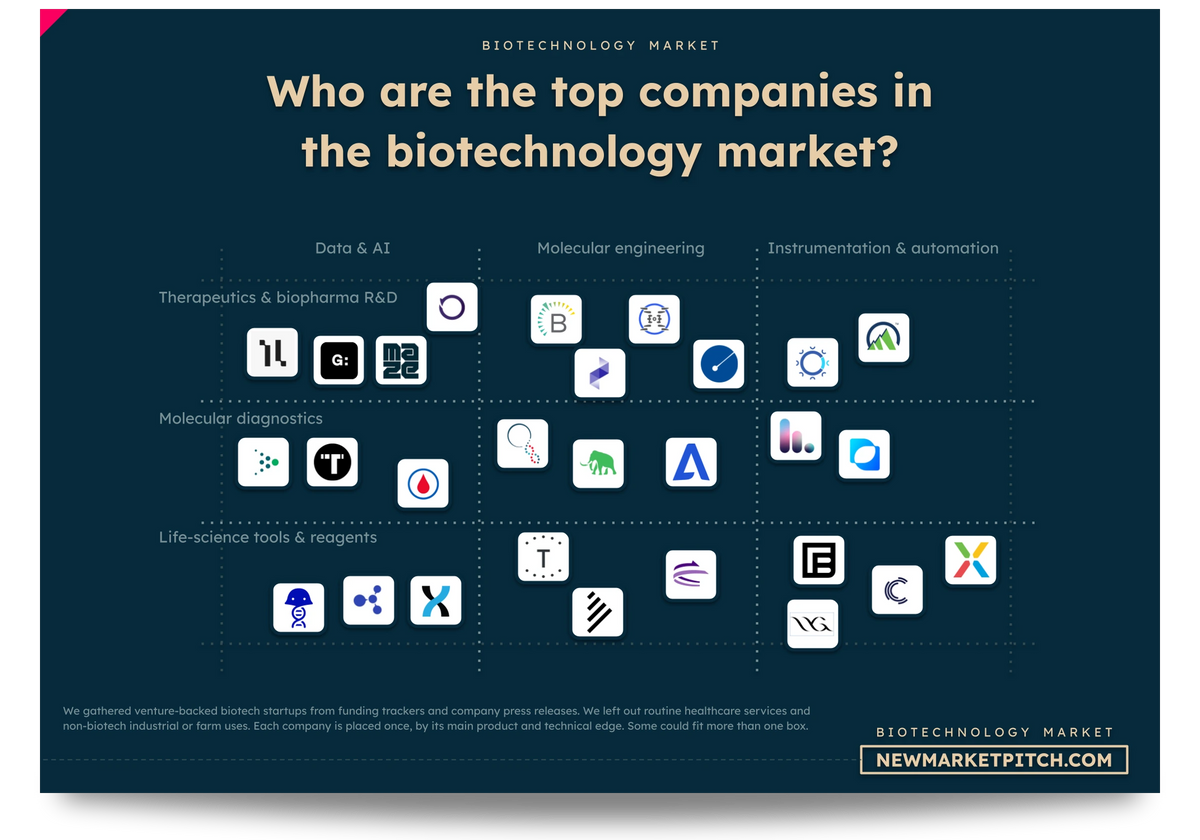
In our report covering the biotech market, we turn what is vague and complex into simple, useful visuals. Market maps like this one show you at a glance where every startup stands.
Why is it so hard to identify the fastest-growing biotech startup?
Chai Discovery currently has one of the strongest growth records among private biotech startups, but Enveda and Isomorphic Labs are moving faster in other areas.
The problem is that biotech companies don't all grow the same way. A company developing its own medicines might spend ten years without product revenue, while a company selling drug-discovery technology can attract pharmaceutical customers almost immediately.
This creates some unusual comparisons. Chai Discovery has gone from a newly founded company to working with six major pharmaceutical businesses in less than two years. Enveda has advanced three medicines into human trials. Isomorphic Labs raised $2.1 billion in a single financing round.
All three are growing quickly, but their achievements measure different things. We can compare financing, valuations, pharmaceutical partnerships and clinical progress. What we cannot do is produce a reliable industry-wide revenue growth ranking, because most private biotech companies don't disclose enough financial information.
Is AI changing which biotech startups grow the fastest?
AI drug discovery has produced some of biotech's most dramatic recent funding rounds, although most of the money is still going to companies developing medicines through more established approaches.
Isomorphic Labs raised $2.1 billion in May 2026, Chai Discovery secured $400 million in July, and Enveda completed a $311 million financing in September. Together, those three rounds brought in more than $2.8 billion.
What's interesting is how differently these companies use AI. Chai sells molecular-design technology to pharmaceutical companies. Isomorphic combines its AI systems with an internal drug-development pipeline. Enveda uses computational techniques to discover compounds from biological sources and then develops them as medicines.
The distinction becomes clearer when we look at the broader market. According to Drug Discovery Trends' August 2026 analysis of 50 highly funded private biotechs, only four companies in that group placed AI at the center of their investment proposition. They accounted for approximately 13% of the group's capital.
So AI is attracting some exceptionally large investments, but it still represents a relatively small part of the wider biotech financing market. Investors are continuing to fund cell therapies, genetic medicines, oncology drugs and other approaches at substantial scale.

Our research about biotech companies gets updated several times a month, so you always get the latest view of where things stand.
Is Chai Discovery the fastest-growing biotech startup right now?
Chai Discovery is currently our leading candidate for the fastest-growing independent biotech platform startup, particularly when we look at its valuation and the speed at which it has attracted pharmaceutical partners.
Founded in 2024, Chai raised $30 million in September of that year, followed by $70 million in August 2025, $130 million in December 2025 and $400 million in July 2026. Its disclosed funding reached approximately $630 million.
The company's reported valuation climbed from roughly $150 million in September 2024 to $3.8 billion in July 2026. That's approximately 25 times its initial valuation in less than two years.
The commercial side is equally interesting. During 2026, Chai announced relationships with Eli Lilly, Pfizer, Novartis, argenx, Bristol Myers Squibb and GSK. These are established pharmaceutical companies with substantial internal drug-discovery capabilities.
That combination of rapid fundraising, rising valuation and external adoption is unusual for such a young business. The main gap is revenue. Chai hasn't published enough information about customer spending or recurring contracts to establish whether its sales are growing faster than those of every competing biotech.
If you want more recent data on this point, please see our latest biotechnology market report.
How fast has Chai Discovery's valuation actually grown?
Chai Discovery's valuation increased approximately 25-fold between September 2024 and July 2026, including a particularly sharp jump during its latest financing rounds.
Its early funding history gives us four valuation reference points. Chai was valued at approximately $150 million in September 2024, $550 million in August 2025, $1.3 billion in December 2025 and $3.8 billion in July 2026, according to financing records compiled by StockAnalysis and Forge.
The acceleration becomes obvious when we compare the intervals. Chai added approximately $400 million in valuation during the first eleven months, another $750 million over the following four months, and $2.5 billion during the next seven months.
Between December 2025 and July 2026 alone, its valuation increased by approximately 192%.
Private valuations reflect what investors agree to pay for a stake in the company, rather than what the business would necessarily sell for in a broader market. Still, four consecutive valuation increases make Chai's financial trajectory difficult to dismiss as a one-off announcement.
| Date | Funding round | Amount raised | Reported valuation |
|---|---|---|---|
| September 2024 | Seed | $30M | $150M |
| August 2025 | Series A | $70M | $550M |
| December 2025 | Series B | $130M | $1.3B |
| July 2026 | Series C | $400M | $3.8B |
| First to latest valuation | - | - | 25.3x |
| December 2025 to July 2026 | - | - | +192% |
| Total disclosed funding | Four rounds | $630M | - |

In our market report about biotech companies, we look at what the winners do differently, so you can learn from the best instead of guessing.
Are pharmaceutical companies really using Chai Discovery?
Chai Discovery has built relationships with six major pharmaceutical companies during 2026, making external adoption one of the strongest parts of its growth story.
Eli Lilly began collaborating with Chai in January and expanded access through its TuneLab initiative in June. Pfizer signed a licensing arrangement in June, followed by Novartis and argenx in July, Bristol Myers Squibb in August, and GSK in October.
The concentration is remarkable for a company founded only two years earlier. More importantly, several of these pharmaceutical businesses already have advanced computational research teams. They're evaluating Chai despite having substantial internal capabilities.
The GSK collaboration gives us a more concrete indication of what customers are testing. According to its October announcement, Chai generated molecular designs against multiple targets without target-specific training. GSK then tested those designs experimentally and reported binding across the targets before expanding the collaboration.
That's useful laboratory evidence, although it doesn't establish that Chai's technology will produce approved drugs.
There's also an important commercial limitation. The companies haven't disclosed the financial value of every agreement. A research evaluation, platform license and large multiyear commercial contract can all appear in partnership announcements, even though they represent very different amounts of revenue.
| Pharmaceutical partner | Announcement | Publicly disclosed development |
|---|---|---|
| Eli Lilly | January 2026 | Initial research collaboration |
| Eli Lilly | June 2026 | Expanded access through TuneLab |
| Pfizer | June 2026 | Molecular-design licensing agreement |
| Novartis | July 2026 | Drug-discovery collaboration |
| argenx | July 2026 | Antibody-discovery partnership |
| Bristol Myers Squibb | August 2026 | AI drug-discovery collaboration |
| GSK | October 2026 | Expanded collaboration following experimental testing |
Is Chai Discovery's AI actually getting better?
Chai Discovery has reported substantial improvements in antibody design, but we still don't know whether those gains will translate into faster clinical drug development.
One of the more interesting results came from Chai's second-generation model, which was associated with a reported 16% experimental hit rate in fully de novo antibody design. In practical terms, a meaningful share of newly generated candidates showed the intended binding activity in laboratory testing.
Chai subsequently reported that its Chai-3 model achieved approximately twice the antibody-design success rate of its predecessor in its evaluations.
For a pharmaceutical researcher, that kind of improvement could reduce the number of candidates that need to be synthesized and tested. The advantage becomes especially valuable when researchers are working with difficult targets or have limited experimental capacity.
But there's a considerable distance between designing an antibody that binds to a target and developing a medicine that works safely in patients. Researchers still need to establish toxicity, stability, manufacturing feasibility and clinical effectiveness.
Chai's reported improvements are promising at the discovery stage. What remains unproven is whether pharmaceutical partners can consistently turn those improvements into shorter development timelines or lower costs per successful drug.

In our document detailing everything you need to know about biotech, you will always find fresh funding data, taken straight from our own verified funding database.
Is Isomorphic Labs growing faster than Chai Discovery?
Isomorphic Labs is growing faster than Chai Discovery in terms of disclosed financing, with $2.7 billion raised externally across two major rounds.
The Alphabet-controlled company raised $600 million in March 2025 and another $2.1 billion in May 2026. Its second financing was 3.5 times larger than its first, with approximately fourteen months between them.
Isomorphic also has substantial pharmaceutical relationships. Its collaborations with Eli Lilly and Novartis began in January 2024. The Novartis relationship expanded in February 2025, and Johnson & Johnson joined as a research partner in January 2026.
The two businesses are difficult to compare directly because Isomorphic has access to Alphabet's broader research ecosystem and is developing its own drug pipeline alongside its pharmaceutical collaborations.
Chai has a clearer record of rapidly adding external pharmaceutical partners as an independent company. Isomorphic has much more money available to build its models, laboratories and therapeutic programs.
We also lack a comparable recent valuation for Isomorphic, because its May financing did not disclose one. That prevents us from measuring whether its equity value has risen faster than Chai's.
| Biotech company | Major 2026 financing | Approx. disclosed cumulative funding | Main activity |
|---|---|---|---|
| Isomorphic Labs | $2.1B | $2.7B external | AI drug design |
| Earendil Labs | $787M financing disclosed | At least $787M | AI-designed biologics |
| NewLimit | $435M | $650M | Epigenetic reprogramming |
| Chai Discovery | $400M | $630M | AI molecular design |
| Enveda | $311M | Over $845M | AI-discovered medicines |
| AdvanCell | $315M | Approx. $439M | Radiopharmaceuticals |
| Orca Bio | $250M | Approx. $550M | Cell therapies |
| LifeMine Therapeutics | $188M | Approx. $558M | Genomics-derived medicines |
If you want more recent data on this point, please see our latest biotechnology market report.
Could Enveda be growing faster than Chai Discovery?
Enveda has a stronger claim to rapid clinical growth than Chai Discovery, having already advanced three internally discovered medicines into human testing.
Founded in 2019, Enveda uses AI and laboratory techniques to identify potential medicines from biological sources, including plants and microorganisms.
By September 2026, Enveda reported discovering 17 development candidates, with three progressing into human trials. Its ENV-294 program for inflammatory disease and ENV-308 program for metabolic health both produced encouraging early clinical findings during 2026.
The financing trajectory also shows substantial growth. Enveda raised $130 million in November 2024, $150 million in September 2025 and $311 million in September 2026. According to TechCrunch, the latest round valued the company at approximately $2 billion, twice its valuation around a year earlier.
A doubling valuation is impressive, although it falls well short of Chai's reported 192% increase between its two latest priced rounds.
Where Enveda stands apart is its clinical pipeline. Its financing growth has occurred alongside progress toward testing medicines in patients. That gives us a different kind of evidence from the partnership and platform-adoption figures supporting Chai.

Learning from others' mistakes is the cheapest lesson there is. In our report covering the biotech market, we look at what broke startups before you, so you don't repeat it.
Are Enveda's drugs actually working in human trials?
Enveda has reported encouraging early human results for two experimental medicines, although neither has yet demonstrated effectiveness in a large, late-stage clinical trial.
Its inflammatory-disease candidate ENV-294 is an oral treatment being developed for conditions including atopic dermatitis. In a Phase 1b study, Enveda reported an average 85% improvement in eczema severity after 42 days, with no serious adverse events.
That's a promising early result, but the size and design of the study limit what we can conclude. Larger controlled trials will need to establish how much of the improvement comes from the drug, how long the benefit lasts and whether the safety profile remains acceptable.
ENV-308 is being developed for metabolic health and weight management. In a study involving 88 healthy volunteers, Enveda reported that the treatment was tolerated and affected circulating leptin levels.
Changes in leptin suggest the drug may influence metabolic pathways. They don't yet demonstrate that patients will lose substantial weight or maintain weight loss over time.
Enveda also advanced ENV-6946 into Phase 1 testing for inflammatory bowel disease.
Having three programs reach human testing is a serious achievement. Many well-funded AI drug-discovery companies are still trying to get their first internally discovered medicine into the clinic.
Is NewLimit the fastest-growing longevity biotech startup?
NewLimit is currently one of the fastest-growing longevity-focused biotech startups by funding and valuation, although its treatments remain earlier in development than Enveda's clinical programs.
NewLimit works on epigenetic reprogramming, an approach intended to restore aspects of youthful cellular function. Its ambition is to develop medicines that can change how cells behave as they age.
The company's financing accelerated quickly. It raised $130 million in May 2025, another $45 million in October, and $435 million in June 2026.
Its latest financing valued the business at approximately $3.1 billion, compared with a reported $1.62 billion valuation cap in October 2025. That's an increase of roughly 91%, although a valuation cap and a priced equity valuation aren't directly equivalent.
The company also reported expanding from two to three therapeutic programs. In its June research update, NewLimit described a 100-fold manufacturing scale-up for its lead candidate and improvements in AI-assisted discovery efficiency.
These are substantial developments for a company still working toward clinical testing. But NewLimit's eventual position will depend on whether its approach can safely produce meaningful benefits in humans.
For investors interested specifically in therapies targeting biological aging, NewLimit has one of the strongest recent funding trajectories. Enveda remains further along in demonstrating results from actual human studies.
If you want more recent data on this point, please see our latest biotechnology market report.

In our research about biotech companies, we always try to gather several sources and make estimates that make sense, so you can work with solid numbers.
Is Orca Bio ahead of faster-growing biotech startups?
Orca Bio has achieved something most heavily funded biotech startups haven't: FDA approval for its first treatment in June 2026.
The company's cell therapy TREGZI, previously known as Orca-T, was approved for adults with certain blood cancers undergoing allogeneic stem-cell transplantation.
Its approval followed the randomized PRECISION-T trial involving 187 adults. According to the American Association of Blood Banks' summary of the FDA decision, approximately 78% of patients receiving Orca-T were alive without chronic graft-versus-host disease after one year, compared with 38.4% receiving conventional transplantation.
That's a substantial difference in a serious complication that can affect patients after stem-cell transplantation.
Orca also raised $250 million in January 2026 and expanded manufacturing operations in preparation for commercialization.
The comparison with Chai and Enveda is revealing. Chai is growing through pharmaceutical adoption, while Enveda is building its clinical pipeline. Orca has already secured regulatory approval, putting it much closer to generating meaningful product sales.
We still need evidence of commercial adoption, including treatment volumes and revenue. But on regulatory progress, Orca is clearly further ahead than the other companies discussed here.
Are publicly traded biotech companies growing faster than private startups?
Some public biotech-related companies are already reporting revenue growth that private drug-discovery startups cannot match with disclosed figures, although acquisitions can make the comparison misleading.
Tempus AI is a useful example. The precision-medicine company reported approximately $1.27 billion in 2025 revenue, an 83.4% increase from 2024.
However, the acquisition of Ambry Genetics contributed substantially to that increase. Tempus's underlying organic growth was approximately 30%, considerably below its headline growth rate.
The company's second-quarter 2026 results offer a more detailed picture. Revenue reached $382.5 million, increasing 22% year over year, while oncology testing volume increased 31% and data-licensing and modeling revenue rose 36%.
Those operating figures help us separate the growth of the underlying business from the effects of acquisitions.
Twist Bioscience provides another example. The synthetic biology company reported approximately 20% revenue growth in fiscal 2025 and subsequently recorded quarterly growth exceeding 23%.
Both companies have established commercial operations and publicly available financial statements. They provide stronger evidence of actual sales growth than most private biotech startups, even though their business models differ from those of companies developing experimental medicines.
If we define growth strictly as reported revenue growth, we cannot confidently put Chai, Enveda or Isomorphic ahead of companies such as Tempus without access to their private financial records.
If you want more recent data on this point, please see our latest biotechnology market report.

If you build or invest in the biotech market, you need to know which business models pay off now and which ones are fading. That's why our report covering it has a whole section on it.
Can biotech startups keep growing without approved medicines?
Chai Discovery can potentially keep expanding its business without bringing its own drug to market, while companies such as Enveda and NewLimit face a much greater dependence on clinical results.
Chai sells access to technology used during drug discovery. That means it can attract paying pharmaceutical customers years before a molecule designed with its system receives approval.
Enveda follows a different path. Its main value depends on developing medicines that perform well in clinical trials and eventually reach patients. Even strong early results may be followed by disappointing larger studies.
NewLimit faces an additional challenge because epigenetic reprogramming is a comparatively young therapeutic approach. Its researchers must demonstrate both meaningful biological effects and an acceptable safety profile.
Isomorphic Labs operates across both approaches, combining pharmaceutical partnerships with an internal drug-development pipeline. Its large financing rounds provide resources for that strategy, but they also create significant expectations.
Chai's immediate challenge is converting its partnerships into repeatable, growing revenue. Enveda needs to reproduce its early clinical findings in larger trials. NewLimit must first demonstrate that its treatments work safely in humans.
These milestones will tell us far more about which company can sustain its growth than another impressive private valuation.
Could Chai Discovery lose its lead to another biotech startup?
Chai Discovery could lose its current growth lead if its pharmaceutical partnerships fail to produce substantial repeat business, particularly as competitors move their own medicines closer to approval.
The biggest unknown remains how much customers are actually spending on Chai's platform. Its publicly announced relationships are impressive, but contract values, revenue recognition and renewal rates remain largely undisclosed.
Isomorphic Labs could become a much stronger competitor as it puts its considerable funding to work. Its ties to Alphabet, large pharmaceutical collaborations and internal drug pipeline give it resources and capabilities that smaller companies may struggle to match.
Generate:Biomedicines is another important competitor in computational protein design. Its lead antibody program, GB-0895, has advanced into Phase 3 development for severe asthma. That puts the company much closer to demonstrating clinical value from computationally designed proteins.
Enveda could also change the ranking if its early trial results hold up in larger studies. A successful later-stage clinical trial would represent a much stronger therapeutic milestone than additional research partnerships.
For Chai, the next convincing evidence would be repeat licensing revenue, larger commercial deployments or specific drug programs advancing with its technology. Until those results become public, the company's leadership remains strongest in valuation growth and pharmaceutical adoption.

Theory only gets you so far. In our document detailing everything you need to know about biotech, we dig up the real signals from the field and show you the ones worth watching.
Which biotech startup is growing the fastest today?
Chai Discovery is currently our strongest choice for the fastest-growing independent biotech platform startup, based on its exceptional valuation growth and rapid expansion of pharmaceutical partnerships.
Chai's reported valuation increased approximately 25-fold between September 2024 and July 2026, and it established six major pharmaceutical relationships during 2026. That's an unusually strong combination for a company founded in 2024.
However, we wouldn't call Chai the undisputed fastest-growing biotech company across every possible measure. The available financial disclosures simply don't support that claim.
Isomorphic Labs leads in recent external financing, with $2.7 billion raised across two rounds. Enveda has stronger evidence of rapid progress through human clinical testing. NewLimit stands out for its funding growth in longevity research, while Orca Bio has already reached FDA approval.
The most interesting distinction is between Chai and Enveda. Chai is moving faster in building an externally adopted drug-discovery platform. Enveda is further along in turning computational discoveries into experimental medicines tested in humans.
Our judgment is that Chai Discovery currently has the most compelling publicly documented financial and partnership growth trajectory among the independent biotech platforms examined. Enveda is the stronger candidate if we prioritize clinical progress. Neither can be declared the industry's definitive revenue-growth leader without more comparable financial data.
If you want more recent data on this point, please see our latest biotechnology market report.
Sources and methodology
This analysis examines which biotech startup is growing the fastest using publicly documented developments available through October 2026. We compare Chai Discovery, Isomorphic Labs, Enveda, NewLimit, Orca Bio and other relevant companies across five dimensions: financial acceleration, commercial traction, technological progress, clinical development and regulatory advancement.
We did not use a single funding round or valuation increase to determine the overall leader. Instead, we examined changes over time and whether different indicators supported the same growth trajectory. Financial momentum was compared with pharmaceutical adoption, reported experimental results, clinical milestones and regulatory decisions. Each company was assessed according to the evidence available for its business model.
For financial comparisons, we used disclosed financing amounts, reported private valuations and cumulative funding histories. Private valuations are treated as investor transaction prices rather than independently established business values. We also distinguish priced equity valuations from valuation caps and financing amounts. Chai Discovery's financing history is supported by its Series A announcement, Series B announcement and Series C announcement. Isomorphic Labs' financing is documented in its March 2025 investment announcement and May 2026 funding announcement.
Commercial traction was assessed through disclosed pharmaceutical agreements and evidence of external adoption, without assuming that every partnership represents an equivalent commercial contract. Chai's relationships were examined using original announcements covering Eli Lilly, Pfizer, Novartis, argenx, Bristol Myers Squibb and GSK. Reported antibody-design improvements were considered separately, using Chai's experimental research update.
For clinical development, we prioritized medicines that had entered human testing and examined the phase, population and reported outcomes of each study. Enveda's clinical progress was assessed using its September 2026 financing announcement, ENV-294 Phase 1b results, ENV-308 Phase 1 results and ENV-6946 clinical development announcement. Early clinical findings were not treated as equivalent to results from large controlled trials.
For longevity and regulatory comparisons, we used NewLimit's June 2026 financing and research update and the FDA's announcement of TREGZI approval. Regulatory approval was given greater evidentiary weight than preclinical progress, while remaining separate from evidence of commercial revenue growth.
Public-company financial results provided a benchmark for measurable operating growth. We used Tempus AI's 2025 financial disclosure, Tempus AI's second-quarter 2026 results and Twist Bioscience's fiscal 2025 results. We distinguished organic revenue growth from acquisition-driven growth and avoided treating public-company financial performance as directly comparable with undisclosed private startup revenues.
The final ranking reflects the combination of documented developments rather than a mathematical industry-wide revenue leaderboard. Chai Discovery leads our comparison on valuation acceleration and pharmaceutical adoption; Isomorphic Labs on disclosed financing; Enveda on advancement of internally discovered medicines into human trials; and Orca Bio on regulatory maturity. These conclusions describe the strengths demonstrated by the available evidence, with company announcements used to establish reported facts and the broader comparative judgment made across those findings.

In our report covering the biotech market, we don't want to repeat what boring consulting reports say. Instead, we show you the real and latest market signals that matter.
Written by the New Market Pitch teamWe track new markets so founders and investors can move faster. About us