
What’s getting funded in biotech right now?
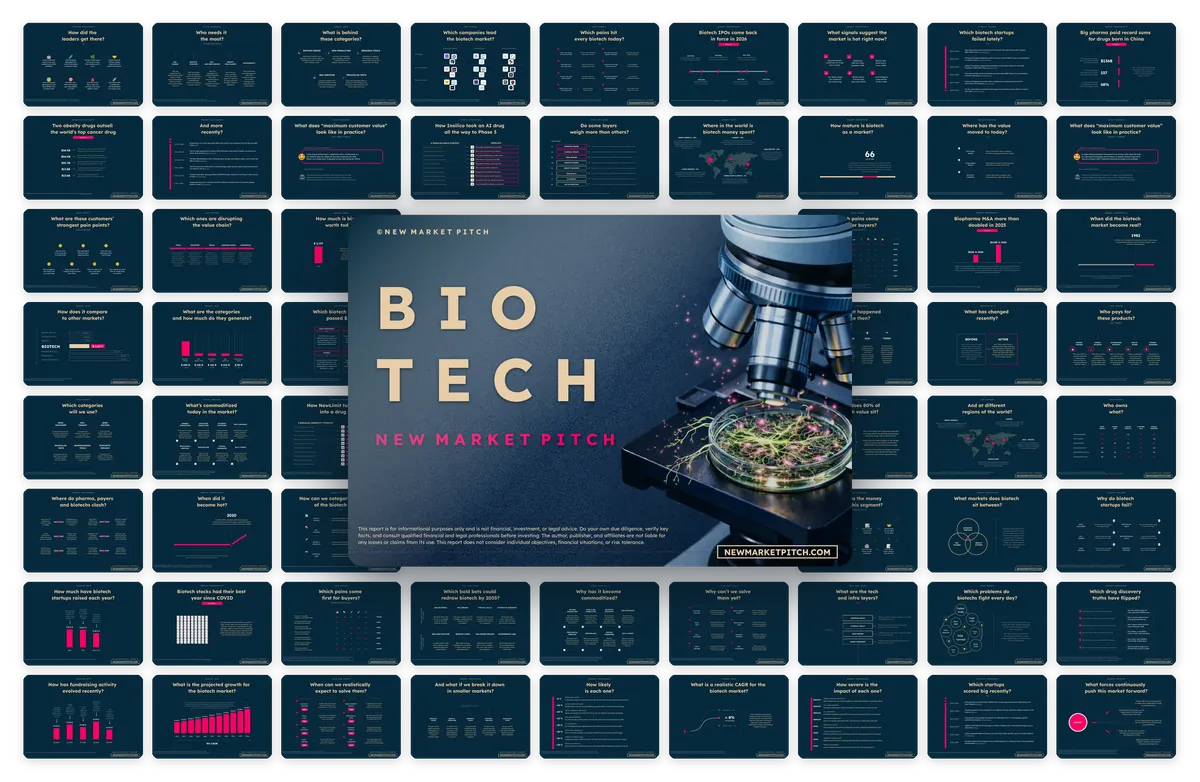
Whether you're building or investing in the biotechnology market, our report covers everything you need to know: the players, the money, and what's coming next.
Summary
Biotech funding is flowing most aggressively to clinical-stage drugs, immunology, selective oncology programs, differentiated obesity medicines, radiopharma, leading AI drug-discovery platforms, and a narrow group of preclinical technologies that can reach human testing quickly.
The funding recovery is real, but it is concentrated. Overall venture totals, M&A activity and IPO proceeds have all improved, while the number of young companies completing seed and Series A rounds has fallen to a decade-low first-half level.
That apparent contradiction is the defining feature of the market. Investors have capital, yet they are directing more of it toward fewer companies that already have human data, a near-term clinical readout or an obvious strategic buyer.
Mega-rounds are becoming normal because investors increasingly want one financing to carry a program through a decisive milestone. A $100 million-plus check can remove the risk of returning to market halfway through a Phase 2 study or during a difficult financing window.
Clinical maturity now changes the funding odds more than almost anything else. Roughly two-thirds of the companies in BioPharma Dive’s first-half sample already had a drug in human testing, and the IPO market has been even less forgiving toward preclinical companies.
Immunology looks like the broadest therapeutic winner, while oncology remains deep but much more selective. Investors will still finance cancer companies heavily, but they expect a concrete advantage in targeting, delivery, payload, therapeutic window or access to previously difficult biology.
Obesity and radiopharma are attracting large checks for different reasons. Obesity investors are paying for better dosing, tolerability and mechanisms; radiopharma investors are funding both the medicine and the manufacturing, isotope and logistics infrastructure needed to make it commercially usable.
AI drug discovery is exceptional at the top of the market, especially where pharmaceutical companies are already using the platform. Ordinary preclinical platforms remain difficult unless the technology is hard to copy, backed by unusually strong builders and close to a first human experiment.
Chinese drug assets have become a major shortcut for Western company creation. Licensing an existing clinical or near-clinical molecule can remove years of discovery work and let a new biotech spend its first round on development rather than on finding a candidate.
The practical rule is simple: capital is rewarding programs that can create clinical or strategic value quickly. Novel science still gets funded, sometimes spectacularly, but evidence, differentiation and a believable route to partnership, acquisition or approval now carry far more weight than novelty by itself.

Written by the New Market Pitch teamWe track new markets so founders and investors can move faster. About us

In our report covering the biotech market, you will always find fresh funding data, taken straight from our own verified funding database.
Is biotech funding actually back right now?
Yes. Biotech funding is stronger today, although the money is piling into fewer companies than during the last boom.
J.P. Morgan’s DealForma data put first-half biopharma venture funding at $16.3 billion across 235 rounds. BioPharma Dive, using a narrower universe of companies backed by 26 highly active biotech investors, counted more than $9.1 billion across 68 companies, its strongest first-half total since 2022. Different datasets give different totals, but the direction is hard to dispute.
The exit market has improved at the same time. J.P. Morgan counted $96 billion of biopharma M&A across 80 deals in the first half, alongside 13 IPOs raising $5 billion. Those IPO proceeds already exceeded every full-year total from 2022 through 2025. BioPharma Dive separately counted 38 acquisitions during the first half, the fastest pace in at least seven years in its dataset.
This is a real funding recovery, but the word “recovery” needs qualification. Investors have more confidence that a good private biotech can eventually be sold or taken public. They still have very little appetite for spreading money evenly across the startup population.
| Measure | Current reading | What we learn from it |
|---|---|---|
| Biopharma VC, J.P. Morgan / DealForma | $16.3B across 235 first-half rounds | Private capital has clearly returned |
| Tracked biotech VC, BioPharma Dive | $9.1B+ across 68 companies | Specialist investors are writing large checks again |
| Biopharma M&A, J.P. Morgan | $96B across 80 deals | Buyers are giving VCs a credible exit route |
| Biopharma IPOs, J.P. Morgan | 13 IPOs raising $5B | Public markets have reopened for stronger companies |
Why does biotech funding still feel brutal for new startups?
Biotech funding feels much worse at the startup level because the current recovery has barely reached seed and Series A companies.
BioCentury counted $4.4 billion raised through biotech seed and Series A rounds in the first half of 2026. That was 15% below the previous year and 47% below the 2021 peak. More strikingly, the number of disclosed seed and Series A rounds fell to the lowest first-half level in a decade.
This started before 2026. BioCentury counted 115 early-stage companies raising in the first half of 2025, down from 157 a year earlier, even though the amount of money per successful company was increasing. The concentration has been building for a while.
The practical result is strange: plenty of capital exists, yet many founders cannot access it. Investors these days appear much happier putting $100 million behind one company they strongly believe in than putting $10 million into ten companies and discovering which one deserves the next round. That is the odd part, and it makes new company formation much harsher than the headline totals suggest.
If you want more recent data on this point, please see our latest biotechnology market report.

In our research about biotech companies, we turn what is vague and complex into simple, useful visuals. Market maps like this one show you at a glance where every startup stands.
Why are $100M biotech rounds becoming so common?
Large biotech rounds are becoming common because investors increasingly want to finance a company all the way to its next decisive clinical result instead of sending it back to market every 18 months.
BioPharma Dive found that 76% of the money in its first-half funding sample came through rounds worth at least $100 million. Isomorphic Labs’ extraordinary $2.1 billion financing inflates that number, but it does not explain the trend by itself. Using BioPharma Dive’s totals, roughly 69% of the remaining capital still came through mega-rounds even after removing Isomorphic.
Recent deals show how broad this has become. Serapha Bio secured a $230 million concurrent private placement tied to its merger with Boundless Bio as its first human studies got underway. Osanni Bio raised $190 million to push its eye-disease program through clinical development while moving additional assets toward the clinic. LifeMine Therapeutics raised $263 million for an immunosuppressant moving into kidney-transplant and islet-cell studies. Coultreon raised $125 million around a Phase 1 immunology drug with Phase 2 studies planned.
The money is sized to reach a result that could dramatically change the company’s value. A $150 million round can finance a Phase 2 study, expand manufacturing, build a second program and leave some room if the capital markets close again. Investors are paying more upfront to avoid financing risk later.
| Company | Recent financing | What the money is meant to reach |
|---|---|---|
| Serapha Bio | $230M private placement | Human proof-of-concept in atopic dermatitis |
| Osanni Bio | $190M Series B | Clinical development plus six earlier programs |
| LifeMine Therapeutics | $263M financing | Phase 2 and Phase 1b transplant studies |
| Vaderis Therapeutics | $152M Series B | Phase 3 development |
| Coultreon Biopharma | $125M Series A | Phase 2 immunology studies |
Are biotech investors mostly funding drugs that are already in human trials?
Yes. Clinical-stage biotech is currently where the funding market becomes dramatically easier.
BioPharma Dive found that 42 of the 68 first-half venture rounds it tracked went to companies that already had a drug in human testing. That is roughly two-thirds of the sample. The recent fundraising tape has kept reinforcing the same preference.
Vaderis Therapeutics raised $152 million just as it launched a Phase 3 study of engasertib in hereditary hemorrhagic telangiectasia. Expedition Therapeutics raised $115 million to carry a COPD drug through Phase 2. InduPro raised $77 million after dosing the first patient with its bispecific antibody-drug conjugate. Epicrispr raised $90 million with an epigenetic medicine already in Phase 1/2.
The public market shows an even stronger version of this preference. BioPharma Dive found that all but one of the biotech IPOs completed during the first quarter of 2026 involved companies with drugs in mid- or late-stage testing, and no preclinical biotech had gone public since 2024.
For a VC, human data can remove several uncertainties at once. We learn whether the drug reaches the patient, whether the pharmacology behaves as expected, whether obvious safety problems appear and sometimes whether there is already a hint of efficacy. A company that has crossed that line can still fail, of course, but investors have fewer things left to guess.

In our market report about biotech companies, we always try to gather several sources and make estimates that make sense, so you can work with solid numbers.
Is immunology the hottest area in biotech funding today?
Immunology currently looks like the clearest therapeutic winner in biotech venture funding.
BioPharma Dive counted about $2.1 billion going into immune-disease companies during the first half alone. Together, immune and cancer companies represented more than 40% of both the dollars raised and the companies funded in its sample.
The range of immunology strategies attracting money is more interesting than the headline total. Coultreon raised $125 million around an oral SIK3 inhibitor for psoriasis and ulcerative colitis. Infinimmune raised $75 million to move two eczema antibodies toward the clinic, including one against IL-22, a target that has never produced an approved drug. LifeMine’s $263 million financing is backing a fungal-derived immunosuppressant for organ transplantation.
Even Abcuro managed to raise another $66 million after its Phase 2/3 trial of ulviprubart missed statistical significance in the overall inclusion-body-myositis population. The company saw enough activity in a predefined subgroup of less severely affected patients to fund another study. That says quite a lot about investor willingness to stay with immunology when a plausible clinical path remains.
The interest also extends well beyond conventional immunosuppression. T-cell engagers, CAR-T, regulatory T-cell biology and other technologies first pushed forward in cancer are now being adapted to autoimmune disease. Pharma buyers have already spent billions buying companies in these areas, giving venture investors a very visible route to an exit.
If you want more recent data on this point, please see our latest biotechnology market report.
Is oncology still one of the easiest biotech sectors to fund?
Oncology is still one of biotech’s deepest funding pools, but investors are now much tougher about what counts as a differentiated cancer drug.
The latest rounds make that clear. InduPro raised $77 million for a bispecific ADC designed to recognize EGFR together with a second tumor-associated antigen. Sidewinder raised $137 million for its own bispecific ADC pipeline. Cytospire raised $83 million around a gamma-delta T-cell engager. Parabilis raised $305 million privately earlier this year and later pulled off a $670 million IPO, the largest new stock sale ever completed by a venture-backed biotech at the time.
The money is clustering around ways to attack an old cancer problem better: more selective delivery, multiple targets, better payloads, wider therapeutic windows or access to proteins that conventional drugs struggle to reach.
Pharma spending helps explain why investors keep showing up. Pfizer’s alliance with Innovent covers as many as 12 cancer programs, including ADCs and multispecific antibodies, with $650 million upfront and potential payments above $10 billion. Bristol Myers Squibb’s broad Hengrui partnership reaches as many as 13 drug programs and carries more than $15 billion of potential economics.
For oncology startups, the bar has moved. “Another ADC” or “another checkpoint drug” is a weak pitch these days. Investors want to know exactly what the new architecture lets the drug do that existing molecules cannot.

Our document detailing everything you need to know about biotech gets updated several times a month, so you always get the latest view of where things stand.
Are obesity biotech startups still getting huge checks?
Yes. Obesity biotech can still attract enormous funding, but investors are increasingly paying for specific improvements over today’s GLP-1 drugs.
Corxel Pharmaceuticals raised up to $287 million around CX11, an oral small-molecule GLP-1 drug already in Phase 2 in the U.S. and Phase 3 through its Chinese originator. The bet has since become more concrete: Corxel reported positive top-line Phase 2 obesity results earlier in 2026.
QL Biopharm raised more than $72 million around a pipeline led by zovaglutide, a once-monthly GLP-1 peptide already in Phase 3 in China. AstraZeneca went much further on the strategic side, paying CSPC $1.2 billion upfront for access to eight obesity and diabetes programs plus its monthly-dosing and AI peptide-discovery technologies. Total potential payments can reach roughly $18.5 billion.
Those examples show what the obesity market is rewarding now. Oral dosing, monthly dosing, better tolerability, muscle preservation, new combinations and mechanisms beyond standard GLP-1 biology are all easier to finance than a lightly differentiated weekly injectable.
The category is still hot because the commercial prize is enormous. Lilly, Novo Nordisk and other large players keep raising the standard, though. An obesity startup needs a reason patients or doctors would switch, not merely a reason the molecule should cause weight loss.
If you want more recent data on this point, please see our latest biotechnology market report.
Is radiopharma turning into a major biotech funding category?
Yes. Radiopharma has moved beyond niche status and is now attracting the kind of venture rounds usually associated with major drug categories.
AdvanCell closed an oversubscribed $315 million Series D to push its lead-212 prostate-cancer therapy toward Phase 3 while expanding manufacturing. Nuclidium brought its Series B to roughly €115 million for copper-based radiotheranostics. Ratio Therapeutics added $70 million for an actinium-based program in sarcoma and for additional manufacturing capacity.
The manufacturing part is unusually important here. A radiopharmaceutical company needs access to scarce isotopes, specialized production, tight logistics and reliable delivery of a product that may decay rapidly. Those constraints make the business harder to build and, in a successful company, harder to copy.
Investors can already see the commercial endpoint. Novartis proved that radioligand drugs can become large products, and major pharma companies have spent billions buying their way into the category. Large strategic transactions around radiopharma assets have kept coming.
Capital is funding two things at once: the molecule and the infrastructure required to make the molecule commercially useful. Few biotech categories give manufacturing such a central role in the investment thesis.

In our report covering the biotech market, we look at what the winners do differently, so you can learn from the best instead of guessing.
Is neuroscience finally fundable again?
Neuroscience is fundable again, especially when a company brings investors a clinical-stage drug with a clear mechanism instead of asking them to finance years of basic discovery.
Tortugas Neuroscience launched with $106 million and four Phase 2-stage neurology and neuropsychiatry drugs licensed from Hansoh and Eisai. Its pipeline includes programs for schizophrenia, tinnitus, focal epilepsy and reversible encephalopathies. Investors were buying a ready-made clinical portfolio rather than waiting for a new platform to discover its first candidate.
Draig Therapeutics then raised another $65 million to accelerate DT-101, an AMPA-receptor potentiator heading into Phase 2 for major depressive disorder. Slate Medicines raised $130 million around a migraine antibody licensed from China’s DartsBio, while Vedana raised $46 million around antibodies targeting PACAP, including a bispecific designed to hit both PACAP and the already validated CGRP pathway.
These financings make neuroscience look healthier, but it is not another immunology yet. CNS trials remain difficult, placebo effects can be brutal and older neuroscience companies have produced plenty of expensive failures.
The risk investors will take has narrowed. A well-characterized molecule, human pharmacology, a validated or increasingly credible pathway and a clearly measurable patient population can get funded now. A broad promise to “solve the brain” still faces a much harder audience.
Is cell and gene therapy still stuck in a funding slump?
Yes. Cell and gene therapy remains one of the clearest weak spots in biotech funding, although investors are still backing technologies that directly fix the problems of the first generation.
BioPharma Dive says cellular and genetic medicine companies are again on pace for roughly $2 billion of annual venture funding, close to the subdued levels seen through much of the period since 2022. That is a very different market from the enthusiasm these technologies enjoyed around 2020 and 2021.
There are good reasons for the caution. Investors have watched commercial launches such as Casgevy develop more slowly than hoped, while several programs across the field have run into safety concerns, manufacturing complexity and tighter regulatory scrutiny.
Yet the recent rounds show that investors have not abandoned genetic medicine itself. Epicrispr raised $90 million for epigenetic medicines that modify gene expression without cutting DNA. Create Medicines raised $122 million around in vivo CAR-T, a strategy that could eventually generate therapeutic CAR-T cells directly inside a patient. SonoThera raised $125 million for ultrasound-guided nonviral gene delivery. Oricell raised more than $110 million for CAR-T programs already being tested against solid tumors.
The money is going toward removing a practical bottleneck: manufacturing, delivery, toxicity, redosing or the need to take a patient’s cells out of the body. Recreating the original gene-therapy model has a weak audience; making genetic medicines easier to deliver and sell has a much better one.
If you want more recent data on this point, please see our latest biotechnology market report.

Theory only gets you so far. In our research about biotech companies, we dig up the real signals from the field and show you the ones worth watching.
What kind of preclinical biotech can still raise serious money?
Preclinical biotech can still raise huge rounds when investors believe the underlying technology is unusually hard to copy and can reach humans faster than a normal discovery platform.
NewLimit is the most extreme example. The longevity biotech raised $435 million at a reported $3.1 billion valuation for epigenetic reprogramming therapies that have yet to enter human testing. The company says progress with a liver-cell reprogramming program brought its expected clinical timeline forward by years, with a first human trial now planned for 2027. Founders Fund led the round, with Thrive, Greenoaks, Kleiner Perkins and Lilly Ventures among the investors.
Targeted protein degradation is producing smaller but still meaningful early rounds. TRIMTECH Therapeutics brought its seed financing to $47 million for degraders designed to remove toxic protein aggregates while leaving normal versions of the protein intact. Its investor base includes venture arms connected to Johnson & Johnson, Pfizer and Lilly. Enodia raised about $25 million at seed for a different degradation strategy aimed at destroying secreted proteins as they are being synthesized.
RQ Bio also raised $115 million at Series A for long-acting antiviral antibodies that have not yet entered human testing. The company expects its lead flu-prevention program to move into the clinic in 2027.
These examples are exceptions to the wider early-stage drought. They usually combine unusually strong investors, experienced company builders, a technology with a very clear technical advantage and a short route to the first human experiment. A generic platform with five years of research ahead of it faces a very different funding market.
Is AI drug discovery really taking over biotech funding?
AI drug discovery is now one of biotech’s biggest funding categories, and the latest deals suggest the serious money is moving toward AI platforms that pharmaceutical companies are already using.
Nature Biotechnology, using DealForma data, put AI and machine-learning drug-discovery venture funding at about $5.7 billion from the start of 2025 through the early part of 2026. At that point, AI was already second only to small molecules among the technologies in the dataset.
Then came the rounds that make the published aggregate look almost outdated. Isomorphic Labs raised $2.1 billion to scale its AI drug-design engine and advance its own pipeline. Chai Discovery later raised $400 million at a $3.8 billion valuation. Adding those two subsequent rounds alone to the earlier DealForma figure pushes observed AI-biotech funding since 2025 above $8 billion, even before counting other financings completed later.
Chai is especially useful because we can see whether pharmaceutical companies actually want the product. Lilly, Pfizer and Novartis were already working with the company. Bristol Myers Squibb later added another collaboration to use Chai’s models for therapeutic antibody discovery. The $400 million round is easier to understand when customers are using the platform on real drug programs rather than only watching benchmark performance.
We still do not have proof that AI can reliably improve the terrible overall success rate of drug development. No AI-designed drug has demonstrated that at commercial scale. What has changed is the evidence one step earlier: these models are increasingly being used to design real molecules for large pharmaceutical companies, and investors are financing that transition very aggressively.

In our market report about biotech companies, we don't want to repeat what boring consulting reports say. Instead, we show you the real and latest market signals that matter.
Why are Chinese drug assets pulling in so much Western biotech money?
Chinese drug assets are pulling in Western biotech money because they can let a new startup skip several expensive years of discovery and start much closer to human proof-of-concept.
BioPharma Dive has tracked more than 100 licensing agreements between Chinese drug developers and U.S. or European counterparts since the beginning of 2025. The volume is now large enough to change how Western startups are built.
AirNexis is a clean example. The company launched with a $200 million Series A and licensed ex-China rights to a COPD drug from Haisco that was already being studied in Phase 2. AirNexis could spend its first venture round developing an existing clinical asset rather than discovering one.
Expedition Therapeutics follows the same logic. The company licensed a DPP1 inhibitor from Fosun, raised $165 million in its Series A and added another $115 million to carry the drug through a global Phase 2 COPD study. Slate Medicines raised $130 million around a migraine antibody from DartsBio. Corxel built its lead obesity program around a drug licensed from Vincentage.
There is already proof that this company-building model can produce very large outcomes. Atlas Venture and Bain Capital created Aiolos Bio around a Hengrui drug and sold the company to GSK for $1 billion. Investors later used Hengrui assets to build Kailera Therapeutics, which went on to complete one of the largest biotech IPOs in years.
Pharma companies are doing the same thing at a much larger scale. Pfizer’s Innovent alliance can exceed $10 billion, Bristol Myers Squibb’s Hengrui collaboration can exceed $15 billion, and AstraZeneca’s CSPC obesity agreement can reach about $18.5 billion.
Political scrutiny may eventually slow the flow. For now, the economic advantage is simply too large to ignore. Western investors can finance a company whose drug already exists, whose manufacturing has begun and sometimes whose first human data have already been generated. That can remove years of work from the riskiest part of building a biotech.
So what’s actually getting funded in biotech right now?
The strongest biotech funding today is going to clinical-stage drugs, immunology and oncology programs, differentiated obesity medicines, radiopharma, AI drug discovery and a much narrower group of frontier platforms that can show a believable path into human testing.
The broader pattern is more useful than the list of hot sectors. Investors currently pay up for three things: evidence in humans, a clear advantage over existing drugs and a believable buyer at the other end. A startup that checks two or three of those boxes can raise $100 million or more surprisingly quickly. One that offers interesting biology but needs years before producing meaningful data faces a much tougher market.
That explains several things that otherwise look contradictory. Biotech venture totals are rising while seed activity remains depressed. Mega-rounds are everywhere while many startups struggle to raise anything. Cell and gene therapy can be weak overall while in vivo CAR-T raises nine figures. Obesity is crowded, yet differentiated oral and monthly programs still pull in enormous capital. AI gets huge technology-style rounds, while ordinary preclinical discovery platforms remain difficult to finance.
The modality data make the same point from another angle. In DealForma data published by Nature Biotechnology for 2025 and early 2026, ordinary small molecules still received more venture money than any other technology. Antibodies also remained one of the largest pools. AI had already moved into second place before some of the largest recent AI rounds were counted. Gene and cell therapy were much smaller.
Our answer is sharp: biotech investors these days are funding programs that can create clinical or strategic value quickly. Novel science still gets money, sometimes extraordinary amounts, but novelty alone has lost much of its financing power. The best-funded biotech usually gives investors a credible route from this round to human data, a pivotal trial, a major pharma partnership or an acquisition.
| What is getting funded now? | Current funding position | What investors appear to want |
|---|---|---|
| Clinical-stage therapeutics | Very strong | Human data and a nearby value-changing readout |
| Immunology | Very strong | Large diseases plus newer immune mechanisms |
| Oncology | Very strong but selective | Clearly differentiated ADCs, multispecifics, engagers and precision drugs |
| Obesity / metabolic | Strong | Oral, monthly, combination or otherwise differentiated drugs |
| Radiopharma | Strong and rising | Clinical assets plus scalable isotope and manufacturing infrastructure |
| AI drug discovery | Exceptional for the leaders | Real pharma adoption, proprietary models and data, and drug pipelines |
| Neuroscience | Recovering | Clinical assets with understandable mechanisms |
| In vivo genetic medicine | Selectively strong | Better delivery, manufacturing and scalability |
| Conventional cell and gene therapy | Weak | A major technical or commercial improvement |
| Generic preclinical platforms | Difficult | A much faster route to proof than a traditional platform story |
If you want more recent data on this point, please see our latest biotechnology market report.
Our methodology
This analysis asks what is actually getting funded in biotech in 2026 and whether the apparent recovery is broad or concentrated. We separated the market into overall venture activity, seed and Series A financing, round size, clinical stage, therapeutic area, technology platform, IPOs, M&A, licensing and strategic demand.
We prioritized the most recent available evidence. First-half 2026 aggregate data provide the market baseline, while later financings and company announcements are used where they reveal how investor behavior continued to develop after those datasets closed.
The main datasets cover different universes, so their absolute totals are not treated as directly interchangeable. J.P. Morgan and DealForma provide a broad biopharma market view; BioPharma Dive follows a narrower group of companies backed by highly active biotech investors; BioCentury is used for the early-stage market. We compare direction, concentration and stage preference rather than forcing those totals into one synthetic number.
Individual financings are used to test and illustrate broader patterns, not to establish a trend on their own. When one exceptional transaction could distort an aggregate result, we checked whether the pattern survived without it; the mega-round calculation excluding Isomorphic Labs is one example.
Terms such as “very strong,” “recovering,” “selectively strong” and “weak” are our editorial synthesis, not labels copied from a single database. They reflect the amount of capital deployed, the number and consistency of financings, clinical maturity, strategic buyer interest, licensing activity and the kind of development risk investors are currently willing to finance.
Company and investor announcements were used to verify round sizes, development stages and stated uses of capital. That source check is why LifeMine is shown at $263 million and Serapha Bio’s $230 million transaction is described as a concurrent private placement tied to its merger with Boundless Bio rather than as a Series A.
Key sources include J.P. Morgan’s biopharma and medtech deal reports, DealForma’s 2026 venture review, BioPharma Dive’s first-half funding analysis, BioCentury’s seed and Series A analysis, BioPharma Dive’s immunology and oncology review, Nature Biotechnology’s capital-markets analysis, and Nature Biotechnology’s AI drug-discovery analysis.
We also relied on first-hand releases and filings from Isomorphic Labs, Chai Discovery, NewLimit, AdvanCell, LifeMine Therapeutics, AstraZeneca, Pfizer, and Hengrui’s HKEX filing, together with BioPharma Dive’s China-origin licensing tracker.

Learning from others' mistakes is the cheapest lesson there is. In our document detailing everything you need to know about biotech, we look at what broke startups before you, so you don't repeat it.
Written by the New Market Pitch teamWe track new markets so founders and investors can move faster. About us