Can clinical decision support make money if it's free?
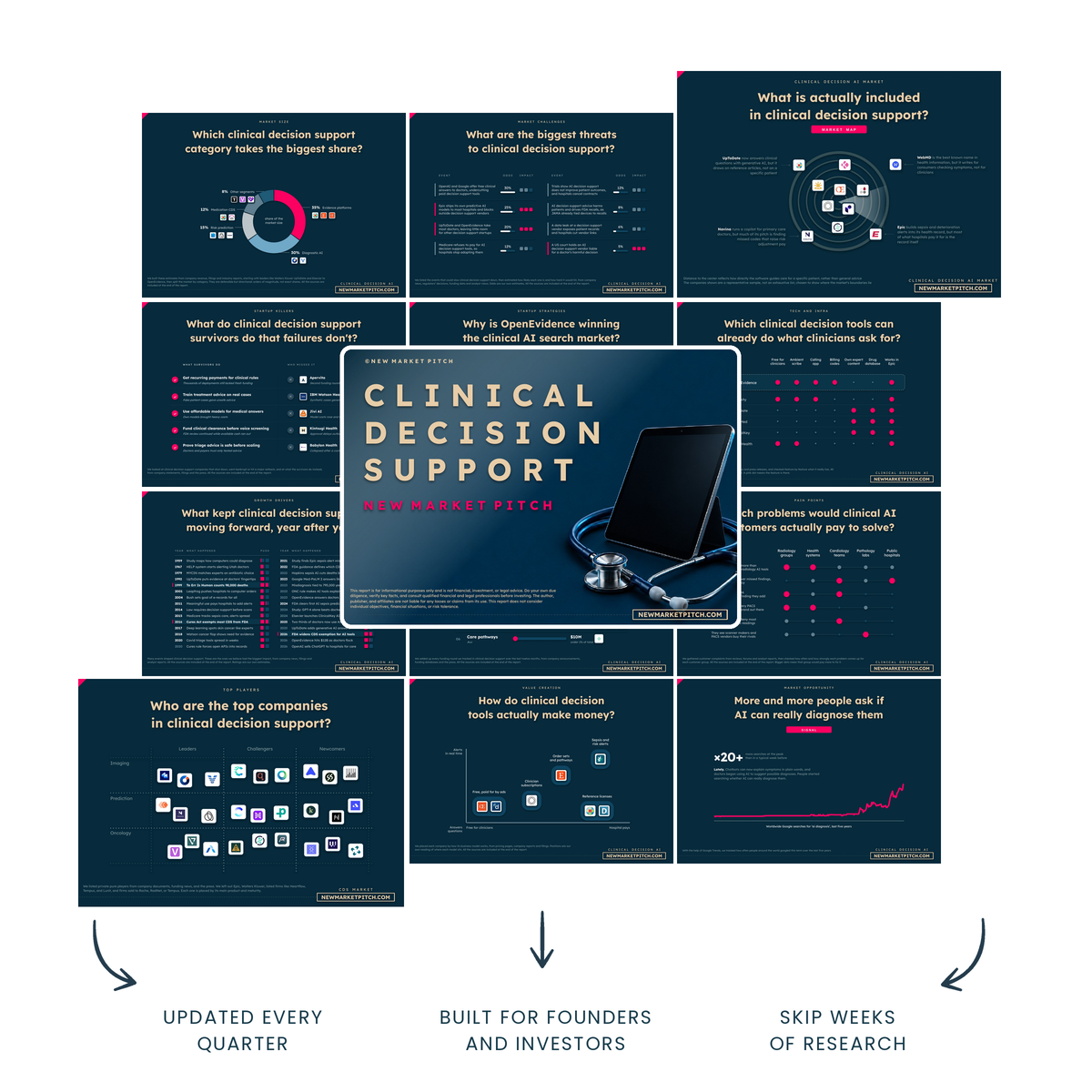
Whether you're building or investing in the clinical decision support market, our report covers everything you need to know: the players, the money, and what's coming next.
Summary
Yes, free clinical decision support can make serious money. OpenEvidence has demonstrated that pharmaceutical advertising can support a rapidly growing clinical AI business, while Doximity proves that giving doctors free tools can generate substantial operating profits. The distinction is that OpenEvidence's net profitability remains unverified.
Physician demand is no longer the main uncertainty. The American Medical Association found that 81% of surveyed physicians used AI professionally in 2026, up from 38% in 2023. OpenEvidence had reached approximately 20 million monthly consultations by January 2026, showing how quickly a free clinical research product can become part of doctors' routines.
The advertising economics are already meaningful. OpenEvidence's estimated revenue reached a $300 million annualized run rate by July 2026, equivalent to roughly $1.25 per consultation using its earlier reported usage volume. That is an aggregate monetization ratio, not an advertising price, but it shows how frequent clinical questions can support a sizeable business.
OpenEvidence may have considerable room to monetize its existing audience. The Information reported that less than 5% of available advertising inventory was being sold in July 2026. Selling more inventory could increase revenue without requiring proportional growth in consultations, although pharmaceutical budgets and repeated exposure to the same physicians impose real limits.
Doximity offers stronger evidence of profitability. Its fiscal 2026 revenue reached $644.9 million, with a 33.3% operating margin and free cash flow equivalent to approximately 49% of revenue. Those results cover a broader physician platform, but they establish that free professional tools can underpin a highly profitable healthcare business.
Free access does not eliminate the market for paid clinical information. UpToDate serves more than 3 million users through a largely subscription-supported model, with institutional renewal rates above 90%. Hospitals are purchasing trusted content, consistent access and integration across their organizations, not simply answers to individual medical questions.
That creates two different routes to revenue. Advertising-funded platforms need verified physician audiences, frequent engagement and valuable specialty targeting. Enterprise clinical AI vendors need workflow integration, security, administration and measurable improvements that justify hospital purchasing decisions.
The most uncomfortable trade-off is trust. Pharmaceutical companies are willing to pay because doctors research treatments close to prescribing decisions. That same proximity makes advertising commercially valuable and potentially damaging if sponsors appear to influence the medical answers themselves.
Free clinical AI also faces a growing commoditization problem. Medical research assistants are becoming easier to build, and physicians can switch between tools with little friction. Distribution, publisher relationships, clinical reliability and integration into hospital software may matter more over time than the ability to generate a well-written medical answer.
The strongest businesses will probably be those that turn repeated free usage into something competitors cannot easily reproduce: a trusted physician audience, established advertising relationships or clinical workflows deeply embedded in healthcare organizations. Free access can build the audience. Making money depends on what the platform can uniquely sell around it.

Written by the New Market Pitch teamWe track new markets so founders and investors can move faster. About us
Why are clinical decision support tools becoming free?
Free clinical decision support is becoming a serious business because AI has made medical knowledge easier to access, while pharmaceutical companies and healthcare organizations are still willing to pay to reach doctors.
OpenEvidence is the clearest example. The company gives verified clinicians free access to an AI-powered medical research assistant and makes money primarily through pharmaceutical advertising. Its monthly clinical consultations increased from approximately 3 million in late 2024 to 18 million by December 2025 and around 20 million in January 2026.
Investors have taken notice. OpenEvidence's valuation rose from $1 billion in February 2025 to $12 billion in January 2026, followed by a reported $15 billion valuation in September 2026.
There is also a much older precedent. Doximity generated $644.9 million in fiscal 2026 revenue from a professional healthcare platform built around free physician tools, pharmaceutical marketing, recruiting and other services.
What has changed is the product doctors can access without paying. Free clinical platforms previously focused heavily on professional networks, drug references and medical news. They can now answer complex medical questions, retrieve clinical studies and summarize evidence within seconds.
Are doctors actually using free clinical AI enough to support a business?
Doctors are already using clinical AI at a scale that makes free distribution commercially attractive, and adoption has accelerated sharply over the past three years.
The American Medical Association's 2026 survey of 1,692 physicians found that 81% used AI professionally, compared with 66% in 2024 and 38% in 2023. That represents a 43-percentage-point increase in three years.
Medical information retrieval is one of the clearest areas of demand. Some 39% of surveyed physicians used AI to summarize medical research and standards of care, while 17% used it for assistive diagnosis. These categories are more relevant to clinical decision support than the broader use of AI for administrative work.
OpenEvidence offers a closer look at actual product usage. The company reported 760,000 registered U.S. physicians by the end of 2025 and 18 million monthly consultations. Dividing those figures gives approximately 24 consultations per registered physician per month. This is an average across the registered base, including potentially inactive users, rather than a measure of what a typical active doctor does.
Doximity provides another example. In its May 2026 earnings announcement, the company reported more than 800,000 active prescribers using its workflow tools during the fourth quarter, with nearly half using its clinical AI.
Dedicated clinical AI products have attracted large professional audiences and substantial repeat activity. We have much less independent evidence about how consistently individual doctors rely on them over time.

A good product starts with a real problem. In our report covering the clinical decision support market, we show you the ones customers still live with.
What does free clinical decision support actually sell?
Free clinical decision support usually makes money by selling advertising, professional access or enterprise services to organizations that want to reach doctors or improve their workflows.
OpenEvidence uses the pharmaceutical advertising model. Manufacturers pay to reach verified clinicians while they research medical questions. Doximity follows a broader version, combining pharmaceutical marketing, physician recruiting and workflow services.
Medscape has operated a related model for years. Its medical news, references and educational content attract healthcare professionals, while advertising and sponsored educational services support the business. Epocrates also offers free drug-reference tools alongside commercial products.
There is a different approach in hospitals. Doctors may use clinical software without paying personally because their employer purchased an institutional license. Wolters Kluwer's UpToDate is an established example, although the underlying product remains paid.
A newer company can also combine free individual use with paid enterprise features, such as integration with electronic health records, centralized administration or advanced clinical workflows.
| Platform or model | Free access | Who pays | Main revenue source |
|---|---|---|---|
| OpenEvidence | Verified clinicians | Pharmaceutical advertisers | Advertising |
| Doximity | Physicians using platform tools | Pharma companies, health systems, recruiters | Marketing and commercial services |
| Medscape | Medical content and references | Advertisers and education sponsors | Advertising and sponsorships |
| Epocrates | Basic drug-reference tools | Advertisers and commercial customers | Advertising and paid services |
| UpToDate | Often included for hospital employees | Hospitals and individual subscribers | Subscriptions |
| Hospital EHR decision support | Included in workplace systems | Healthcare organizations | Enterprise software contracts |
| Freemium clinical AI | Basic individual capabilities | Practices and enterprise customers | Premium software and integrations |
Can pharmaceutical advertising really finance free clinical AI?
Pharmaceutical advertising can already finance clinical AI at hundreds-of-millions-of-dollars scale, and OpenEvidence is the strongest example.
According to Sacra, OpenEvidence's estimated annualized revenue increased from approximately $7.9 million at the end of 2024 to $150 million at the end of 2025, reaching $300 million by July 2026. The Information separately reported in July 2026 that annualized revenue was approaching $300 million.
These are estimates of annualized revenue, rather than audited full-year sales. Still, estimated revenue grew nearly nineteenfold during 2025.
The business works because reaching verified prescribing professionals is commercially valuable. A pharmaceutical manufacturer advertising to a cardiologist reviewing heart-failure treatments may reach a more relevant audience than it would through ordinary consumer advertising. There is no reliable public average advertising rate for clinical AI, however, so we cannot assume every medical query is worth the same amount.
GoodRx provides another useful comparison. Its pharmaceutical direct revenue grew 41% in 2025, reaching $151.4 million from $107.2 million a year earlier, even though total company revenue was nearly flat at $796.9 million.
Doximity's profitable advertising and professional-services business adds a third example. Targeted digital healthcare marketing is already a substantial market. Clinical AI is finding a way to capture more of that spending, particularly when doctors are actively researching treatments.
If you want more recent data on this point, please see our latest clinical decision support market report.

If you build or invest in the clinical decision support market, you need to know which business models pay off now and which ones are fading. That's why our report covering it has a whole section on it.
How much money can OpenEvidence make from each free doctor?
OpenEvidence's estimated revenue suggests that one registered physician can support hundreds of dollars in annual advertising revenue, although the precise revenue generated by active users is not publicly disclosed.
Using the company's 760,000 registered U.S. physicians at the end of 2025 and Sacra's estimated $150 million annualized revenue gives approximately $197 per registered physician per year.
Applying the same physician base to the estimated July 2026 revenue run rate produces roughly $395. That second figure is only illustrative because the number of registered physicians may have increased in the intervening months.
We can also compare revenue with consultations. At 20 million monthly consultations, annual volume would reach 240 million if usage stayed constant. A $300 million annualized revenue rate divided by that volume implies approximately $1.25 in revenue per consultation.
That figure helps explain the economics, but it does not represent the price of an individual advertisement. Some consultations may generate no advertising revenue, while others may be associated with more valuable campaigns.
The Information reported in July 2026 that OpenEvidence was selling less than 5% of its available advertising inventory. If accurate, the company had considerable unused inventory, although that does not mean it could multiply revenue twentyfold. Advertiser budgets, campaign relevance and repeated exposure to the same doctors all limit how much inventory can be sold.
| OpenEvidence metric | Calculation or reported figure | Result |
|---|---|---|
| Registered U.S. physicians | End of 2025 | 760,000 |
| Monthly consultations | January 2026 | ~20 million |
| Annualized consultation volume | 20M × 12 | ~240 million |
| Estimated year-end 2025 revenue run rate | Sacra | $150 million |
| Estimated July 2026 revenue run rate | Sacra | $300 million |
| Earlier revenue per registered physician | $150M / 760,000 | ~$197/year |
| Later revenue per earlier registered base | $300M / 760,000 | ~$395/year |
| Revenue per consultation at later run rate | $300M / 240M | ~$1.25 |
Is OpenEvidence actually profitable yet?
OpenEvidence has built a fast-growing revenue business around free clinical AI, but its net profitability has not been established through publicly available audited financial statements.
Sacra estimates that OpenEvidence operates with gross margins of approximately 90%. The Information also reported gross profit margins around that level in July 2026.
At that margin, every $100 in revenue would leave around $90 after the costs included in gross profit. That provides considerable room to pay for engineering, research, marketing and administration.
However, a high gross margin can coexist with substantial operating losses. Developing medical AI products requires engineers, clinical experts, evidence evaluation and ongoing model improvements. Those expenses may sit outside cost of revenue.
The company's reported $15 billion valuation offers another perspective. Against the estimated July revenue run rate, that would represent approximately 50 times annualized revenue.
Investors are clearly expecting much more growth. Whether OpenEvidence is already producing net profits is a separate question, and one the available financial disclosures do not settle.

Learning from others' mistakes is the cheapest lesson there is. In our market report about clinical decision support tools, we look at what broke startups before you, so you don't repeat it.
Does Doximity prove that giving doctors free tools can be profitable?
Doximity has already proved that free physician tools can support a highly profitable business, with financial results that are much easier to verify than those of private clinical AI startups.
For its fiscal year ended March 2026, Doximity reported $644.9 million in revenue, $574.5 million in gross profit and $214.9 million in operating income.
That represents an 89.1% gross margin and a 33.3% operating margin. Free cash flow reached $317.5 million, equivalent to approximately 49% of revenue.
Doximity benefits from years of building a verified professional network, pharmaceutical advertising relationships and physician workflow products. It also offers recruiting and other commercial services, so its profitability cannot be attributed solely to clinical AI.
But its results settle an important part of the business-model debate. Doctors can receive valuable software for free while the platform earns substantial profits from organizations that want to reach or serve them. That is a demonstrated business, not a theoretical AI monetization strategy.
If you want more recent data on this point, please see our latest clinical decision support market report.
Can free medical AI survive the cost of millions of clinical questions?
Free medical AI can support strong margins at very high usage levels, although the economics depend heavily on the cost of each answer and the revenue generated around it.
An ordinary medical research question may require retrieving journal articles, interpreting evidence and generating a concise response. More complex questions can involve several searches, longer context windows, multiple model calls and additional verification.
Clinical AI companies also face expenses beyond inference. They may need to license research content, maintain medical databases, evaluate accuracy and manage professional authentication.
OpenEvidence's reported gross margins suggest that its current combination of advertising revenue and direct costs is favorable. But publicly available figures do not show how expenses are allocated between direct service delivery and research or product development.
The risk becomes clearer when we compare different types of clinical AI. Summarizing a published study is generally a less demanding service than processing a large patient history, reviewing several imaging studies or running multiple rounds of specialist reasoning.
As clinical assistants become more capable, their computing requirements may increase. Cheaper inference technology can offset some of that growth, but we cannot assume every advanced clinical workflow will have the same economics as medical search.

When you build or invest in the clinical decision support market, you need clarity, not confusion. In our document detailing everything you need to know about clinical decision support, we always try to put numbers on and quantify whatever is usually vague and confusing.
Could free clinical AI replace UpToDate?
Free clinical AI is becoming a credible alternative for medical research, but UpToDate remains strongly protected by hospital subscriptions, editorial content and established clinical workflows.
Wolters Kluwer's September 2025 investor presentation reported more than 3 million UpToDate users worldwide, over 50,000 institutional sites and approximately 50 million to 60 million monthly queries.
OpenEvidence's January 2026 consultation volume was already equivalent to roughly one-third to two-fifths of UpToDate's reported monthly query volume. The two measures are not identical, and the geographic coverage differs, but the comparison shows how quickly a newer product has become relevant.
Yet UpToDate has not lost its institutional position. Wolters Kluwer reported renewal rates above 90%, while approximately 80% of clinical decision-support revenue came from institutional and enterprise customers.
Individual UpToDate subscriptions also remain expensive, with published annual plans beginning around $579 and Pro Plus starting around $699.
The company has responded to AI competition by adding generative AI features to its own offering.
For physicians who primarily want quick answers and medical references, the free alternative is increasingly attractive. Hospitals make a different purchasing decision because they pay for standardized knowledge, editorial oversight, integration and reliable access across their organizations. That makes UpToDate much harder to displace than its subscription price alone would suggest.
If you want more recent data on this point, please see our latest clinical decision support market report.
Will hospitals pay for clinical AI when doctors can use it for free?
Hospitals will pay for clinical AI when the enterprise version offers something meaningfully better than a free research assistant, especially integration with patient records and clinical workflows.
A doctor using a free assistant can independently search medical literature. A hospital deploying AI across thousands of clinicians needs centralized user management, reliable service, data-security controls, audit trails and support for its existing software.
These requirements become more demanding when an AI product connects directly to electronic health records or processes identifiable patient information.
Hospitals also need a financial justification. Clinical decision support that reduces avoidable work, supports safer prescribing or improves established clinical processes has a stronger purchasing case than another standalone medical chatbot.
However, a startup selling enterprise AI must compete with existing software vendors. Epic, Oracle Health, Wolters Kluwer and other established providers have direct relationships with hospital buyers and can add AI functions to software already deployed.
A free clinical AI startup may win doctors' attention before it wins the hospital's budget. Converting that enthusiasm into enterprise sales will depend on capabilities that existing contracts do not already provide.

In our report covering the clinical decision support market, we look at what the winners do differently, so you can learn from the best instead of guessing.
Can clinical AI make money without pharmaceutical advertising?
Clinical AI can earn revenue without pharmaceutical advertising through institutional subscriptions, software integrations and paid clinical workflows, but those models require a different type of product.
Consider a hospital purchasing software to improve medication safety. It may pay for integration, evidence maintenance, administration and ongoing support, even though physicians receive access without being billed individually.
A medical practice could similarly purchase an AI tool that combines clinical evidence with its patient-management software. The commercial value comes from saving staff time or helping clinicians complete a specific task.
Freemium is another possibility. Individual physicians receive free medical search, while practices or healthcare organizations pay for more advanced features.
The difficulty is demonstrating enough value for an organization to approve another software expense. Hospitals already pay for electronic health records, clinical reference databases and safety applications. A new product that mostly duplicates those capabilities has a weak sales argument.
Could pharmaceutical advertising make doctors distrust clinical AI?
Pharmaceutical advertising creates a genuine trust problem for clinical AI because the same companies paying for promotion may have a commercial interest in the treatments doctors are researching.
Imagine a physician asking an AI assistant to compare two cancer therapies. A manufacturer may want to advertise one of them alongside the answer. That commercial opportunity is valuable precisely because the question is closely connected to a treatment decision.
The problem arises if advertising influences the medical recommendation itself.
OpenEvidence's advertising model depends on doctors believing that clinical answers are generated independently from sponsored content. Medscape, Doximity and other physician platforms face related questions about separating advertising from editorial or educational material.
Clear labels, independently sourced clinical answers and meaningful separation between sponsors and recommendations help protect that distinction.
There is also a commercial trade-off. More advertisements may increase short-term revenue, but intrusive promotion or doubts about independence could push physicians toward competing tools. For a business selling access to doctors' attention, losing doctors' trust would be an expensive mistake.

Your time is limited. In our research about clinical decision support tools, we put numbers on each part of the market, so you can see where it makes sense to focus.
Can clinical AI companies make money by selling patient data?
Selling identifiable patient data is a legally restricted and commercially risky way to monetize clinical AI, especially when the information originates from hospitals or other HIPAA-covered organizations.
The U.S. Department of Health and Human Services explains that HIPAA generally requires authorization for the use or disclosure of protected health information for marketing, subject to specific exceptions.
That does not prohibit all health-data analytics, nor does HIPAA cover every health application in the same way. The applicable rules depend on the company's role, the information involved and how that information is collected or disclosed.
The Federal Trade Commission also oversees certain privacy practices involving health applications that fall outside HIPAA.
For clinical AI, the distinction between professional information and patient information is fundamental. Reaching a verified cardiologist through professional advertising is very different from disclosing an identifiable patient's medical history to a pharmaceutical advertiser.
De-identified datasets may support legitimate research and commercial services under applicable rules, but such arrangements require their own technical, contractual and privacy protections.
Can the market support several big free clinical AI companies?
The market can support several large physician platforms, but it is unlikely to support unlimited advertising-funded clinical AI competitors with similar products and audiences.
We can already identify meaningful revenue across businesses serving healthcare professionals and pharmaceutical advertisers.
Doximity reported $644.9 million in fiscal 2026 revenue. GoodRx generated $151.4 million in pharmaceutical direct revenue during 2025. OpenEvidence's annualized revenue was estimated at approximately $300 million by July 2026.
Together, those figures represent roughly $1.1 billion in commercial activity, although they cover different reporting periods and business categories. Doximity includes non-advertising services, GoodRx has substantial consumer-facing activities, and OpenEvidence's figures are estimates. We should not interpret the sum as the size of the clinical AI advertising market.
What the numbers do show is that pharmaceutical and healthcare commercial spending can sustain multiple sizable digital platforms.
The harder question is how many new companies can win a meaningful share of those budgets. Manufacturers may already advertise through professional networks, medical publishers, conferences and established healthcare marketing providers.
A clinical AI startup must offer something better, such as stronger physician engagement, more relevant specialty audiences or more effective advertising measurement. Simply building another free medical chatbot won't give advertisers much reason to move their budgets.
If you want more recent data on this point, please see our latest clinical decision support market report.

In our market report about clinical decision support tools, we always try to gather several sources and make estimates that make sense, so you can work with solid numbers.
Could free clinical AI become too easy to copy?
Basic clinical AI search is becoming easier to reproduce, so startups that rely mainly on generating sourced medical answers face growing competition.
OpenEvidence was an early beneficiary of specialized clinical AI adoption, but alternatives are expanding. Doximity has added clinical AI to its physician platform, Wolters Kluwer has introduced AI capabilities within UpToDate, and general-purpose AI assistants continue improving at medical information retrieval.
Physicians can compare these tools without major switching costs. That makes long-term differentiation difficult for products offering essentially the same answers and citations.
Access to trusted content is one potential advantage. OpenEvidence has developed relationships with medical publishers, including content associated with the New England Journal of Medicine and JAMA. Wolters Kluwer reported more than 7,600 expert contributors and reviewers supporting UpToDate's editorial infrastructure.
Those resources are valuable, but content access alone does not guarantee a lasting lead. Competitors may license alternative sources, develop proprietary evaluation systems or integrate more deeply into clinical workflows.
Distribution could become even more important. Doximity can introduce AI to an existing physician network, while hospital software providers can place AI inside systems clinicians already use.
Could clinical AI errors destroy the free business model?
Clinical AI errors could seriously damage a free decision-support business because physicians need reliable information, and trust can disappear quickly when clinical recommendations are wrong.
The problem extends beyond generative AI. A 2024 meta-analysis of 16 studies on drug-drug interaction alerts reported a pooled physician override rate of approximately 90%, although the studies varied substantially.
That does not mean 90% of alerts were incorrect. It shows how frequently clinicians dismiss conventional decision-support warnings, whether because they are irrelevant, repetitive, poorly timed or overridden for legitimate clinical reasons.
A 2026 systematic review in the Journal of the American Medical Informatics Association examined 22 reviews of alert fatigue and found substantial inconsistency in how the problem was defined and measured.
Generative clinical AI introduces additional risks, including fabricated citations, outdated recommendations, missing patient context and answers expressed with too much confidence.
Errors may also increase costs. Hospitals can demand additional validation and monitoring, clinicians may spend more time checking answers, and companies may face litigation or regulatory scrutiny.

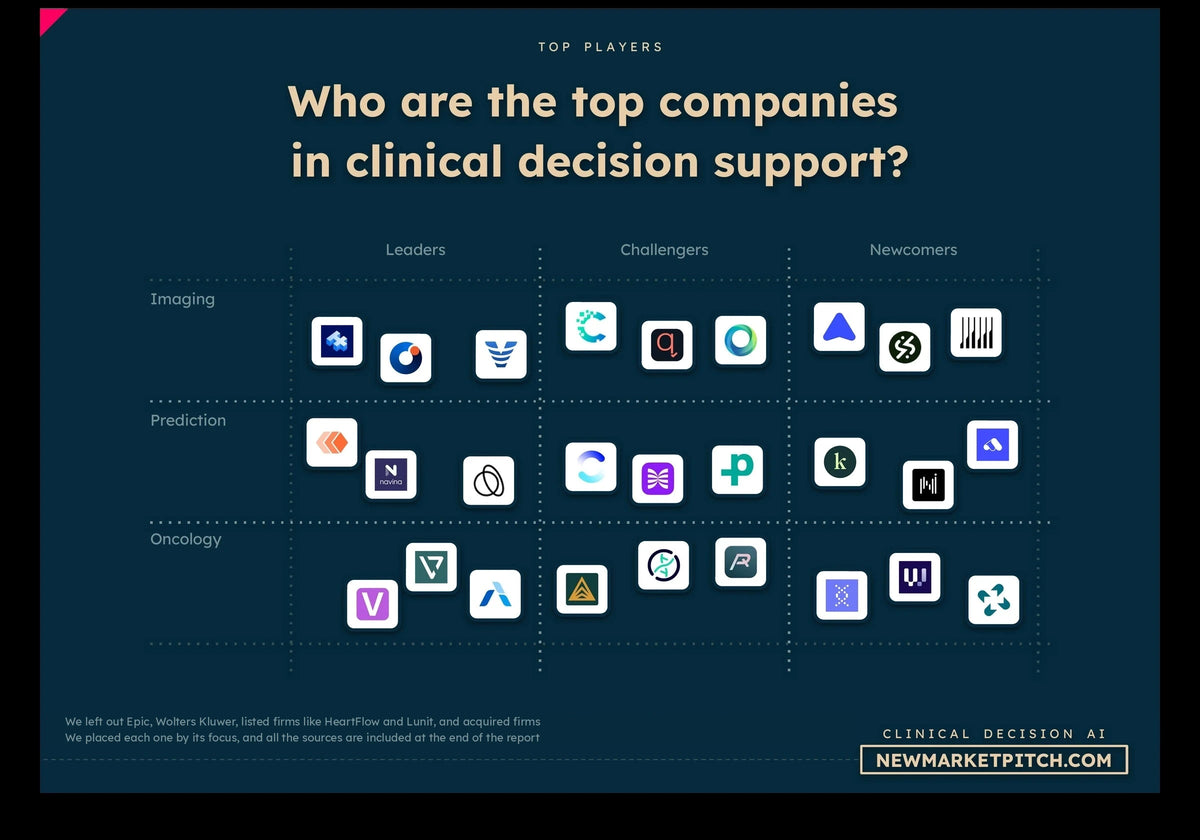
In our document detailing everything you need to know about clinical decision support, we turn what is vague and complex into simple, useful visuals. Market maps like this one show you at a glance where every startup stands.
Does FDA regulation make free clinical AI harder to monetize?
FDA regulation makes some clinical AI products considerably more expensive to build and sell, particularly when software moves beyond information retrieval into medical-device functions.
The FDA's January 2026 final guidance clarified how certain clinical decision-support functions can fall outside medical-device regulation. The criteria consider factors including the intended user, the software's purpose and whether healthcare professionals can independently review the basis of its recommendations.
A clinical assistant that retrieves published studies and explains their findings may face a different regulatory classification from software that independently analyzes medical images or produces diagnostic outputs.
That distinction affects development costs. Regulated software may require clinical evidence, quality-management processes, regulatory submissions and ongoing monitoring.
For startups, these obligations can slow deployment and make a completely free product harder to finance. They can also create advantages for companies that successfully establish clinical reliability and regulatory compliance.
| Clinical AI use case | Main regulatory issue | Business implication |
|---|---|---|
| Medical literature search | Whether functions meet non-device CDS criteria | Easier broad distribution |
| Research summarization | Transparent, reviewable evidence | Free or advertising-supported access |
| Basic medical calculators | Classification and applicable FDA policies | Often bundled into larger products |
| Patient-specific treatment suggestions | Independent clinician review of recommendations | Greater validation requirements |
| Automated diagnostic analysis | Potential medical-device regulation | Higher development and compliance costs |
| Medical image interpretation | Medical-device requirements may apply | Often enterprise or procedure-based revenue |
| EHR-integrated treatment alerts | Function-specific safety and regulatory assessment | Institutional purchasing |
| Autonomous clinical decisions | Higher regulatory and clinical risk | More demanding commercial deployment |
What could stop free clinical decision support from making money?
Free clinical decision support is most vulnerable when a company attracts doctors but cannot earn enough from their activity to cover costs or convince healthcare organizations to pay.
OpenEvidence demonstrates that advertising-supported clinical AI can grow revenue quickly. Doximity has shown that a free physician platform can produce substantial operating profits. Those examples are encouraging, but the advantages are difficult for new competitors to reproduce.
An advertising-funded startup needs a sizeable verified audience, repeated engagement and advertisers willing to spend consistently. A hospital-focused product needs integrations, clinical validation, reliable support and enough measurable value to justify procurement.
Competition makes both approaches harder. General-purpose AI can handle many research questions, established medical publishers already have content relationships, and EHR vendors control much of the workflow inside hospitals.
The greatest commercial risk is probably commoditization. If physicians can get equally good answers from five different free tools, the startup has little pricing power and fewer reasons for advertisers or hospitals to choose it. A large audience can become less valuable surprisingly quickly.
If you want more recent data on this point, please see our latest clinical decision support market report.

Our report covering the clinical decision support market gets updated several times a month, so you always get the latest view of where things stand.
Can clinical decision support make money if it's free?
Yes. Free clinical decision support can already support substantial revenue, and established physician platforms show that giving doctors free software can be highly profitable.
The evidence is strongest across three different business models. OpenEvidence has demonstrated rapid advertising revenue growth from free medical AI. Doximity has built a highly profitable business around free physician engagement and commercial services. UpToDate shows that hospitals continue paying for trusted clinical decision-support systems even when individual physicians have access to alternatives.
The opportunity is real, but we would not expect every free clinical AI startup to succeed. Advertising budgets are limited, competing products are getting better, and medical trust is difficult to build. Hospitals also have little reason to buy another tool unless it offers capabilities their existing software cannot provide.
We expect the biggest winners to be platforms that doctors use frequently, trust with important questions and find difficult to replace. Some will make money from pharmaceutical advertising; others will charge healthcare organizations for integrated clinical workflows.
Free access can be a powerful way to build a clinical software business. But the companies that make serious money will be those that turn that free usage into lasting commercial value without compromising the medical information physicians depend on.
Our methodology
This analysis examines whether free clinical decision support can support a profitable and durable business. We evaluated six dimensions: physician demand, monetization mechanisms, unit economics, demonstrated profitability, institutional purchasing behavior, and competitive defensibility. The objective was to identify which business models already have commercial evidence behind them and which still depend on assumptions about future adoption or monetization.
For each dimension, we gathered recent evidence, aggregated comparable observations, and assessed what they collectively established. We prioritized 2025–2026 physician surveys, company financial disclosures, reported product usage, private-market revenue research, and regulatory publications. Established healthcare software companies provided longer operating histories against which to assess newer clinical AI businesses.
Physician demand was assessed using professional AI adoption, reported clinical research activity, registered physician audiences, and consultation volumes. We distinguished broad professional AI adoption from clinical decision-support usage, and registered users from active users. The main adoption reference was the American Medical Association's 2026 physician survey, complemented by OpenEvidence's reported engagement and Doximity's fiscal 2026 operating disclosures.
For monetization, we compared advertising-supported physician platforms with institutionally funded clinical reference systems and enterprise software. OpenEvidence, Doximity, Medscape, Epocrates, GoodRx and UpToDate were included because they illustrate different ways that clinical information, physician attention, and healthcare workflows generate revenue. The comparison focused on who pays, what they purchase, and whether the resulting revenue model has been demonstrated at meaningful scale.
Financial figures were evaluated according to the type of evidence available. Doximity's reported revenue, profitability and cash generation were taken from its SEC financial exhibit. GoodRx's pharmaceutical direct revenue was checked against its 2025 financial results and Form 10-K. OpenEvidence's revenue progression and estimated gross margins were drawn from Sacra's company research and its September 2026 analysis. We treated private-company revenue run rates as estimates rather than audited annual sales, and gross margins separately from operating and net profitability.
The OpenEvidence monetization ratios were calculated using its reported physician registrations, monthly consultations and estimated annualized revenue. Revenue per registered physician and revenue per consultation are aggregate analytical ratios, not observed customer spending or actual advertisement prices. The calculations also combine observations from different reporting dates, so they are useful for evaluating the scale of monetization rather than measuring precise unit economics.
Institutional purchasing and competitive durability were assessed using renewal rates, customer reach, editorial resources, pricing and enterprise revenue mix. The principal source was Wolters Kluwer's September 2025 UpToDate investor presentation, complemented by UpToDate's subscription information, Medscape's professional advertising documentation, Epocrates' product information, and the JAMA Network's OpenEvidence content partnership announcement. These sources helped distinguish advantages based on audience scale from those based on content, integration and institutional relationships.
Clinical reliability, data protection and regulation were incorporated into the economic assessment because they influence development expenses, legal exposure, product distribution and enterprise purchasing. We used the FDA's January 2026 clinical decision-support guidance, HHS guidance on HIPAA and marketing, and the FTC Health Breach Notification Rule. For decision-support reliability, we reviewed the 2024 meta-analysis of drug-interaction alert overrides and the 2026 systematic review of alert fatigue.
The final assessment aggregates evidence across these dimensions, giving greater weight to conclusions supported by independent observations and demonstrated financial outcomes. It distinguishes the proven profitability of established free physician platforms from the still-estimated economics of private clinical AI companies, while assessing whether advertising relationships, trusted medical content, clinical reliability and enterprise integration can protect those businesses as basic AI research capabilities become more widely available.

In our research about clinical decision support tools, we don't want to repeat what boring consulting reports say. Instead, we show you the real and latest market signals that matter.
Written by the New Market Pitch teamWe track new markets so founders and investors can move faster. About us