How big is the clinical decision support market with LLMs?
Whether you're building or investing in the clinical decision support market, our report covers everything you need to know: the players, the money, and what's coming next.
Summary
The global LLM clinical decision support market is worth approximately $300–500 million annually, with a central estimate near $400 million in 2026. Doctors are adopting these tools rapidly, but the revenue remains a small fraction of the broader clinical decision support industry.
LLMs account for approximately 27% of the estimated $1.5 billion AI clinical decision support market in 2026, and less than 6% of the $7 billion market for all clinical decision support systems. Most existing spending still goes toward traditional software and non-LLM applications.
The $400 million estimate comes from published market research rather than an audited aggregation of vendor revenues. Existing medical subscriptions, enterprise software bundles and advertising-funded platforms make it difficult to isolate what customers actually spend on LLM-based clinical recommendations.
Physician adoption is moving considerably faster than hospital purchasing. The American Medical Association found that 81% of physicians used AI professionally in 2026, while OpenEvidence reported 18 million clinical consultations in December 2025 alone. Neither figure tells us how much physicians or hospitals are paying for decision support.
OpenEvidence illustrates the gap between usage and monetization. It reported more than $100 million in annual revenue and secured a $12 billion valuation in January 2026, despite giving verified physicians free access and relying primarily on advertising.
Established clinical information companies have a different advantage. Wolters Kluwer's Clinical Solutions business generated approximately €910 million in 2025, and around 80 enterprise customers had signed up for UpToDate Expert AI by December. The AI-specific revenue remains undisclosed, but the institutional distribution is already there.
Free AI is changing the competitive economics. Doximity acquired Pathway in 2025 and moved its previously paid clinical reference technology toward free access. That puts pressure on standalone subscriptions while making clinical information more valuable as a feature inside a larger professional platform.
Epic, Oracle Health and other EHR vendors could capture a substantial share of patient-specific decision support. Their access to medications, laboratory results and clinical histories gives integrated assistants an advantage that general medical search tools cannot easily replicate.
Clinical evidence remains uneven. Randomized studies suggest LLMs can help with some complex management tasks, but access to GPT-4 has not consistently improved physicians' diagnostic performance. Regulatory requirements and the need for independently reviewable recommendations will shape which products hospitals deploy.
A $3 billion annual market by 2033 is plausible, but it requires growth of roughly 33% per year. The larger opportunity lies in validated enterprise assistants, EHR-integrated decision support and monetized medical information platforms. General medical question-answering alone is unlikely to carry the market that far.

Written by the New Market Pitch teamWe track new markets so founders and investors can move faster. About us
Is clinical decision support already a big market for LLMs?
Clinical decision support powered by LLMs is now a market worth hundreds of millions of dollars, and doctors are adopting these tools much faster than hospitals are increasing their spending on them.
Grand View Research estimates that LLM-based clinical decision support generated $308.4 million globally in 2025, compared with $1.3 billion for the broader AI clinical decision support market and $6.4 billion for all clinical decision support systems. Its forecast puts the LLM segment at $3.08 billion by 2033, implying roughly tenfold growth.
Physician adoption helps explain that projection. OpenEvidence reported 18 million clinical consultations in December 2025, up from approximately 3 million monthly searches a year earlier. Wolters Kluwer launched UpToDate Expert AI commercially in October 2025, bringing generative AI into one of medicine's most established clinical reference products. Doximity also acquired AI clinical reference provider Pathway in July 2025.
The three companies reveal different ways this market is taking shape. OpenEvidence offers a free, advertising-funded platform. Wolters Kluwer sells clinical knowledge through established subscriptions and enterprise contracts. Doximity is adding medical AI to a professional network that already reaches more than 80% of U.S. physicians.
Physicians can now access similar technology through very different business models. Usage is relatively easy to observe. Revenue generated specifically by LLM decision support is much harder to measure.
What should count as LLM clinical decision support?
The LLM clinical decision support market should cover software that helps healthcare professionals make clinical decisions, including finding medical evidence, comparing diagnoses, checking treatments and interpreting patient information.
OpenEvidence, UpToDate Expert AI and Doximity Ask fit that definition because clinicians use them to answer medical questions. A system that reviews a patient's medications, checks relevant guidelines and proposes changes for physician review would also qualify.
AI scribes deserve more careful treatment. Products from Abridge, Ambience Healthcare and Microsoft's healthcare AI portfolio can summarize medical encounters or patient records, but documentation alone does not constitute clinical decision support. The relevant revenue would come from features that actually assist clinical reasoning or treatment decisions.
The distinction also applies to medical imaging AI. An algorithm detecting lung nodules on a CT scan belongs to the broader AI decision support market, but it should not count toward the LLM segment unless a language model plays a meaningful role in the clinical decision.
We use the narrower definition throughout this analysis because counting every generative AI product sold to a hospital would make the market look much larger than the spending directly tied to clinical decisions.

Your time is limited. In our report covering the clinical decision support market, we put numbers on each part of the market, so you can see where it makes sense to focus.
How much revenue does LLM clinical decision support generate today?
The global LLM clinical decision support market is currently worth approximately $300–500 million a year, with roughly $400 million as our central estimate for 2026.
Grand View Research's dedicated LLM clinical decision support dataset puts 2025 revenue at $308.4 million. Applying its projected 33.4% annual growth rate produces approximately $411 million for 2026.
That estimate sits inside a much larger industry. The same research organization values AI clinical decision support at $1.5 billion in 2026 and the overall clinical decision support systems market at $7 billion.
Using these figures, LLMs accounted for approximately 24% of AI clinical decision support spending and 5% of total clinical decision support revenue in 2025. Those shares are indicative because the market reports have different segmentation rules and some embedded software revenue may overlap.
Market research estimates should also be distinguished from audited sales figures. Vendors rarely disclose how much revenue comes specifically from LLM clinical recommendations, particularly when those features are bundled with existing medical information subscriptions.
Our $300–500 million range therefore remains an estimate of the current commercial market rather than a bottom-up sum of verified company revenue.
| Market definition | 2025 revenue | 2026 estimate | What's included |
|---|---|---|---|
| All clinical decision support systems | $6.4B | $7.0B | Traditional and AI tools |
| AI clinical decision support | $1.3B | $1.5B | AI-based clinical support |
| LLM clinical decision support | $308M | ~$411M | Language-model applications |
| AI CDS excluding LLMs | ~$992M | ~$1.09B | Implied difference |
| LLM share of AI CDS | ~23.7% | ~27.4% | Calculated share |
| LLM share of all CDS | ~4.8% | ~5.9% | Calculated share |
| LLM clinical decision support in 2033 | - | $3.08B forecast | Projected market for 2033 |
If you want more recent data on this point, please see our latest clinical decision support market report.
Are doctors really using LLMs to make medical decisions?
Doctors are using AI routinely now, but clinical research and information retrieval are more established uses than AI-assisted diagnosis.
The American Medical Association's 2026 physician survey found that 81% of physicians used AI professionally, compared with 38% in 2023. That is a 43-percentage-point increase over three years, although the survey covers administrative and documentation tools alongside clinical applications.
The more relevant evidence comes from how physicians use the technology. Doximity's 2026 State of AI in Medicine report surveyed 3,151 U.S. physicians and found that AI use for literature searches increased from 22% in April 2025 to 35% in January 2026. Documentation use rose from 20% to 29% over the same comparison.
Those are meaningful changes in less than a year. The AMA's research also identifies medical research summarization and diagnostic assistance as distinct professional uses, reinforcing the difference between retrieving evidence and relying on AI to make a diagnosis.
Medical evidence search looks like the clearest entry point for LLM clinical decision support. Physicians can use it frequently without handing over final responsibility for a diagnosis or treatment decision.

In our research about clinical decision support tools, we always try to gather several sources and make estimates that make sense, so you can work with solid numbers.
Does OpenEvidence's $12 billion valuation reflect a huge medical AI business?
OpenEvidence has become one of the clearest examples of a medical AI platform growing extremely quickly, although its $12 billion valuation is far ahead of its reported revenue.
In January 2026, the company raised $250 million at a $12 billion valuation. That was double its $6 billion valuation from October 2025 and more than three times the $3.5 billion reported in July 2025.
Its commercial and usage figures are impressive. OpenEvidence reported more than $100 million in annual revenue and 18 million clinical consultations during December 2025. The latter represented a sixfold increase from approximately 3 million monthly searches a year earlier.
If December's consultation volume remained constant for twelve months, the platform would process 216 million annual consultations. Dividing the reported $100 million revenue figure by that hypothetical volume gives approximately $0.46 per consultation. This is only an illustrative calculation because the revenue and consultation figures cover different measurement periods.
OpenEvidence's business model also differs from traditional medical software. The service is free for verified physicians and primarily earns money through advertising aimed at healthcare professionals.
That helps explain how usage can grow so quickly without requiring each doctor or hospital to purchase another subscription. It also creates a commercial risk: OpenEvidence needs advertising demand and other revenue sources to keep pace with clinical usage.
Using $100 million as the revenue denominator gives a valuation multiple of approximately 120 times annual revenue. The actual multiple depends on the company's revenue at the time, which has not been specified precisely in the available disclosures. Investors are assigning considerable value to future growth, physician distribution and opportunities beyond today's advertising business.
Can OpenEvidence and Doximity make paid medical reference tools obsolete?
Free medical AI tools are putting pressure on standalone clinical reference subscriptions, particularly when doctors mainly need quick answers to everyday medical questions.
Doximity's acquisition of Pathway shows how that pressure works. Before the transaction, Pathway had hundreds of thousands of registered users and thousands of customers paying approximately $300 annually for premium access.
Doximity purchased the company in July 2025 for $26 million in cash and up to $37 million in additional equity grants. Rather than preserve its paid subscription model, Doximity announced that it would bring the clinical reference technology to its own physician network for free.
Doximity also told investors that it expected no revenue contribution from Pathway during the fiscal year because it planned to offer the tools without charge. It was buying clinical data, engineering expertise and a feature that could make its existing platform more useful.
OpenEvidence follows a similar free-access strategy, while Wolters Kluwer continues to charge for curated medical knowledge and institutional subscriptions.
Basic medical questions are increasingly answered through free AI products. Hospitals, meanwhile, have reasons to keep paying for validated content, governance, integration and specialty-specific support.
The uncomfortable question for paid vendors is how much extra value those capabilities provide when a doctor can get a useful answer elsewhere in seconds.
If you want more recent data on this point, please see our latest clinical decision support market report.

In our market report about clinical decision support tools, we don't want to repeat what boring consulting reports say. Instead, we show you the real and latest market signals that matter.
Is UpToDate still bigger than the new medical AI startups?
UpToDate's parent company, Wolters Kluwer, has a far larger established clinical information business than most dedicated medical LLM startups, and its newest AI products are being sold through those existing relationships.
Wolters Kluwer reported €1.596 billion in Health division revenue for 2025. Clinical Solutions represented 57% of that total, implying approximately €910 million in revenue across UpToDate, drug information, clinical surveillance and other related products.
That amount cannot be attributed entirely to UpToDate, much less to UpToDate Expert AI. It does, however, show the scale of the customer base and clinical content business supporting the company's AI expansion.
Clinical Solutions recorded 7% organic growth in both 2024 and 2025. The established business was therefore still expanding as newer medical AI companies attracted growing physician audiences.
Wolters Kluwer's December 2025 AI investor presentation also gave unusually concrete adoption figures for Expert AI. Approximately 80 enterprise customers had signed up, including 30 of its 100 largest enterprise customers. Around one-third of renewing individual customers were upgrading to the Pro Plus package that included Expert AI.
The product had followed a gradual rollout: generative AI laboratories launched in October 2023, expanded to 100 hospitals in March 2024, and eventually led to the commercial Expert AI release in October 2025.
Wolters Kluwer spent two years adding LLM functionality to a clinical information business that healthcare institutions already trust. It did not have to replace its content library or start its commercial relationships from scratch.
That advantage becomes especially important when AI buying decisions are made by hospitals instead of individual physicians.
Which companies are actually making money from LLM clinical decision support?
Revenue from LLM clinical decision support is concentrated in a small group of visible commercial platforms, but public disclosure is too limited to produce a reliable company-by-company market ranking.
OpenEvidence has reported more than $100 million in annual revenue, making it one of the clearest standalone examples. Wolters Kluwer has a much larger established clinical information business, but does not break out revenue attributable specifically to Expert AI.
Pathway's thousands of former premium subscribers provide another useful reference. At $300 annually, every 10,000 paid subscribers would have represented approximately $3 million in recurring revenue. Its acquisition by Doximity ended the usefulness of that standalone subscription model as a measure of future revenue.
Elsevier, EBSCO, VisualDx and Isabel Healthcare also operate in clinical information or diagnostic support, but their total corporate sales cannot be counted as LLM decision support revenue. Similarly, revenue from Epic or Oracle Health's broader EHR products should be excluded unless the clinical AI component can be identified.
| Company or product | Commercial evidence | LLM revenue visibility |
|---|---|---|
| OpenEvidence | More than $100M reported annual revenue | Reported overall platform revenue |
| Wolters Kluwer / UpToDate Expert AI | ~80 signed enterprise AI customers in December 2025 | Not disclosed separately |
| Doximity Ask / Pathway | Thousands of former $300/year premium subscribers | New product offered free |
| Elsevier / ClinicalKey AI | Commercial AI-assisted medical information | Not disclosed separately |
| EBSCO / DynaMed | Established subscription clinical reference business | Not disclosed separately |
| VisualDx | Paid diagnostic decision support products | LLM-specific figure unavailable |
| Isabel Healthcare | Commercial diagnostic decision support technology | LLM-specific figure unavailable |
| Epic's AI-enabled clinical tools | Distributed through existing EHR relationships | Not disclosed separately |
The gap between commercial activity and revenue disclosure is substantial. There are enough products and paying customers to establish a real market, but we cannot yet verify a comprehensive LLM-only revenue total from company financial statements.

In our document detailing everything you need to know about clinical decision support, we like to show you the big picture. We know your time is precious, so we make every page quick to read and packed with as much learning as possible per minute.
Are hospitals paying for LLM decision support yet?
Hospitals are now signing commercial agreements for LLM clinical decision support, although vendors disclose much more about adoption than about the additional revenue generated by those contracts.
Wolters Kluwer offers the clearest evidence. Its 80 signed Expert AI enterprise customers, including 30 of its largest 100 accounts, show that clinical AI has moved beyond laboratory testing and into institutional purchasing.
The concentration among major customers is especially interesting. Those 30 accounts represent nearly two-fifths of the 80 early enterprise signings, even though they are only a fraction of the company's much larger global hospital customer base.
What remains unclear is the average contract expansion. An existing hospital could pay an additional fee for Expert AI, upgrade to a broader enterprise package or receive AI functionality as part of a negotiated renewal. All three arrangements count differently when measuring incremental LLM spending.
Doximity took a different approach with Pathway, explicitly expecting no near-term product revenue because free access supported its broader platform strategy.
Hospitals are buying, then, but the available evidence still leaves us unable to say how much new annual revenue an average hospital spends specifically on LLM decision support.
Will Epic and other EHR vendors take over LLM clinical decision support?
Electronic health record vendors have a strong chance of controlling patient-specific LLM decision support because they already sit inside the workflow where clinical decisions happen.
Epic and Oracle Health provide access to information that a standalone medical chatbot usually cannot see automatically: patient histories, medications, laboratory results, diagnoses, allergies and previous encounters.
An assistant connected to that information can potentially answer more useful questions than a general medical reference tool. For example, a physician could ask whether a proposed medication is appropriate for a patient with impaired kidney function and an existing treatment regimen.
The existing clinical decision support industry already includes substantial EHR-integrated software, giving this model an established purchasing and deployment route.
Epic's competitive advantage is its position inside clinical workflows. Wolters Kluwer has a different advantage: curated medical knowledge, specialist-reviewed content and drug information that can be distributed through EHR systems as well as its own products.
Both approaches can coexist. Hospitals may buy integrated EHR capabilities while continuing to license specialist clinical information. For independent LLM startups, the challenge will be convincing hospitals that their products offer enough additional clinical value to justify another contract.
If you want more recent data on this point, please see our latest clinical decision support market report.

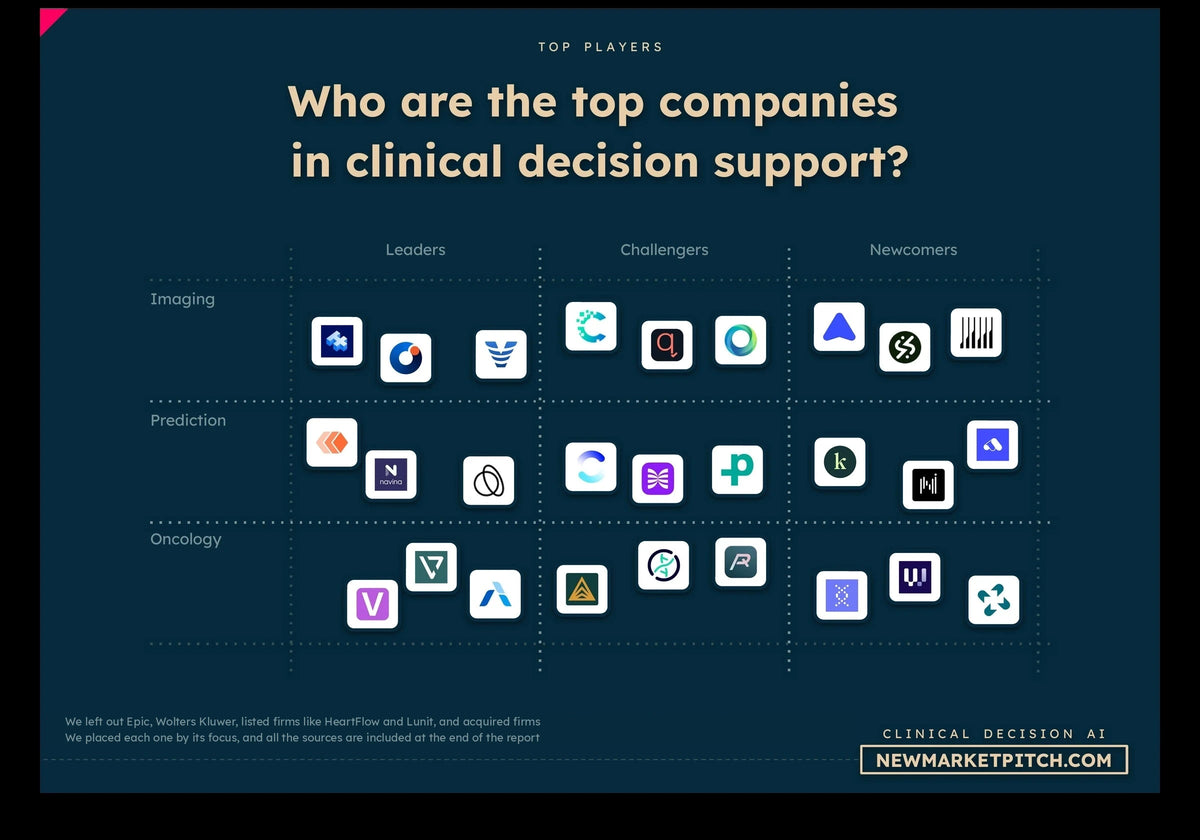
In our report covering the clinical decision support market, we turn what is vague and complex into simple, useful visuals. Market maps like this one show you at a glance where every startup stands.
Can LLMs actually help doctors make better diagnoses?
LLMs can help with clinical reasoning, but the evidence that they consistently improve physicians' real-world diagnostic decisions is still mixed.
A randomized study published in JAMA Network Open in 2024 involved 50 physicians completing diagnostic reasoning tasks. Access to GPT-4 did not significantly improve physicians' diagnostic performance compared with conventional resources, even though the model performed strongly when evaluated separately.
Another randomized study involving 92 physicians found that access to GPT-4 improved performance on complex clinical management scenarios compared with conventional resources alone.
A model answering a medical question correctly and a physician making a better decision because of that model are two different outcomes.
Clinical performance can depend on whether the doctor trusts the answer, notices an error, uses the supporting evidence and integrates the recommendation into an actual patient consultation.
Medical benchmark scores alone cannot establish fewer treatment mistakes or better patient outcomes. Prospective studies that measure clinical errors, treatment changes, patient safety and healthcare costs would provide much stronger evidence.
The case for LLM-assisted medical research and evidence retrieval is convincing. The case for routinely delegating complex diagnostic decisions remains much less settled.
Will FDA regulation slow down LLM clinical decision support?
FDA regulation will slow some patient-specific LLM applications, especially those making recommendations that clinicians cannot independently assess, while leaving room for medical reference and evidence-support products.
The FDA issued updated final guidance on clinical decision support software in January 2026. It clarified how the 21st Century Cures Act separates certain non-device clinical decision support functions from software regulated as medical devices.
An important factor is whether healthcare professionals can independently review the basis of a recommendation. The software's intended use, the information it analyzes and the way clinicians are expected to rely on its output also matter.
A tool summarizing published treatment guidelines with references may qualify for a different regulatory approach from software intended to make a diagnosis from patient data.
The FDA also clarified that some software producing a single clinical recommendation can fall outside device regulation when all applicable statutory criteria are met. Conversely, image-analysis software making diagnostic recommendations generally remains subject to device oversight.
These distinctions favor products that provide traceable sources, clinician review and clearly defined functions.
Companies selling hospital-grade LLM systems will also need to deal with patient privacy, security, clinical validation and liability, even when FDA device authorization is not required.
If you want more recent data on this point, please see our latest clinical decision support market report.

Our research about clinical decision support tools gets updated several times a month, so you always get the latest view of where things stand.
How much could hospitals and doctors realistically spend on LLM decision support?
LLM clinical decision support could become a multibillion-dollar subscription market, but reaching that size would require millions of paying clinicians or significant enterprise spending.
Pathway's former $300 annual premium subscription provides a useful starting point. At that price, one million paying clinicians would generate $300 million annually. Three million would generate $900 million.
At $1,000 annually, one million clinicians would generate $1 billion. That higher price could be reasonable for a sophisticated enterprise product with patient-specific integrations, but would be harder to sustain for a standalone medical search tool competing with free services.
Hospitals also purchase software differently from individual clinicians. An enterprise agreement may cover thousands of users, bundle several AI features and replace part of an existing subscription. The commercial value attributed specifically to decision support could be considerably smaller than the total contract.
The following calculations show how the market changes with the number of paying clinicians and annual revenue per clinician. They are scenarios, not adoption forecasts.
| Paying clinicians | $100/year | $300/year | $1,000/year |
|---|---|---|---|
| 50,000 | $5M | $15M | $50M |
| 100,000 | $10M | $30M | $100M |
| 250,000 | $25M | $75M | $250M |
| 500,000 | $50M | $150M | $500M |
| 1 million | $100M | $300M | $1.0B |
| 2 million | $200M | $600M | $2.0B |
| 3 million | $300M | $900M | $3.0B |
| 5 million | $500M | $1.5B | $5.0B |
Can medical LLM startups compete with OpenAI, Google and Anthropic?
Specialist medical LLM startups can compete with the major AI laboratories when they control trusted clinical information, physician distribution or access to hospital workflows.
OpenAI, Google and Anthropic have the resources to improve general medical reasoning capabilities across successive model generations. A startup whose product consists mainly of a medical chatbot running on a general-purpose model could lose its technical advantage quickly.
The stronger specialist businesses have additional assets. Wolters Kluwer's UpToDate content is maintained by more than 7,600 expert clinicians, editors and reviewers. Pathway developed structured medical information spanning guidelines, drugs and major clinical trials. OpenEvidence has built a large audience of verified physicians and partnerships around professional medical content.
Those advantages require more than model inference. Clinical information has to remain current, supporting evidence needs to be credible, and medical recommendations must fit professional standards.
Distribution is just as important. A hospital already using UpToDate through its EHR may have little reason to purchase a separate chatbot with similar capabilities. A physician already using OpenEvidence for free may resist paying for another medical search service.
The strongest specialist products will probably compete through evidence quality, clinical workflow and customer relationships. As general-purpose models improve, those advantages become harder to ignore.

In our market report about clinical decision support tools, you will always find fresh funding data, taken straight from our own verified funding database.
Could LLM clinical decision support really become a $3 billion market?
A $3 billion annual market for LLM clinical decision support is credible by 2033, but reaching it would require revenue to grow by roughly one-third every year.
Grand View Research projects an increase from $308.4 million in 2025 to $3.08 billion in 2033, equivalent to 33.4% compound annual growth.
That is much faster than the 11.8% growth projected for the overall clinical decision support market between 2026 and 2033. The LLM segment would therefore need to take an increasing share of spending rather than simply grow alongside established products.
There is some precedent for that acceleration. According to the AMA, professional AI usage among physicians rose from 38% in 2023 to 81% in 2026. Medical AI companies have also demonstrated rapid user growth and started converting hospital relationships into commercial AI agreements.
Yet physician adoption cannot grow at the same pace indefinitely. Once most clinicians use some form of AI, additional revenue must come from greater spending per user, broader institutional contracts, more valuable clinical functions or entirely new customer groups.
The LLM segment also faces pressure from free services and software bundles. Both can increase usage without generating much new standalone revenue.
Three sources of future spending look especially plausible: enterprise subscriptions for validated clinical assistants, patient-specific decision support integrated into hospital systems, and advertising-supported medical information platforms.
The forecast is achievable if several of those revenue models grow together. Relying mainly on paid subscriptions for general medical question-answering would make a $3 billion outcome considerably harder.
If you want more recent data on this point, please see our latest clinical decision support market report.
How big is the clinical decision support market with LLMs, ultimately?
The LLM clinical decision support market is already worth approximately $300–500 million annually worldwide, with a central estimate close to $400 million in 2026. We consider a $3 billion market by 2033 plausible, although current revenue remains far below that level.
Our assessment rests on three findings. Clinical AI has moved into routine physician use, particularly for medical research and evidence retrieval. Established clinical information vendors and newer AI companies are beginning to earn meaningful revenue through enterprise contracts, subscriptions and advertising. And the strongest commercial adoption is still concentrated in assisting clinicians rather than replacing their judgment.
The broader market is much larger than the LLM segment. AI clinical decision support represents approximately $1.5 billion in annual spending, while the entire clinical decision support industry is approaching $7 billion.
Those figures explain why multibillion-dollar claims need scrutiny. Much of that spending existed before generative AI, and revenue from EHR systems, conventional drug interaction tools and non-LLM diagnostic algorithms cannot automatically be attributed to language models.
The commercial opportunity is nevertheless substantial. Doctors increasingly want fast access to reliable medical information, and hospitals already pay for software that helps them make clinical decisions. LLMs can make those products more useful, easier to access and, eventually, more personalized.
The next stage of growth will depend less on attracting physicians to AI chat interfaces and more on how much hospitals are willing to pay for tools that measurably improve clinical work.
LLM clinical decision support has become a genuine commercial category with rapid adoption and room for multibillion-dollar growth. Its current revenue is still measured in hundreds of millions, and the companies that capture the largest share may be the ones already controlling clinical knowledge and hospital workflows.

In our document detailing everything you need to know about clinical decision support, we look at what the winners do differently, so you can learn from the best instead of guessing.
Sources and methodology
This analysis estimates the commercial size of the LLM-powered clinical decision support market and examines whether rapid physician adoption can support a multibillion-dollar industry. We evaluate the market through seven dimensions: market boundaries, physician usage, monetization, competition, clinical validation, regulatory requirements, and future spending potential. For each dimension, we collect recent evidence, aggregate comparable observations, assess what they establish, and combine the findings into a market-level conclusion.
We define LLM clinical decision support as software using language models to assist healthcare professionals with medical evidence retrieval, diagnostic reasoning, treatment assessment or patient-specific clinical decisions. General medical documentation, administrative automation and non-LLM imaging algorithms are excluded unless a distinct clinical decision support function can be identified. This boundary prevents revenue from adjacent healthcare AI products from being counted as LLM clinical decision support.
Our market-size calculation starts with Grand View Research's dedicated LLM clinical decision support estimates and compares them with its research on the AI clinical decision support market and the overall clinical decision support systems market. The central 2026 estimate of approximately $411 million is calculated by applying the published 33.4% growth rate to the $308.4 million 2025 estimate. The $300–500 million range accommodates uncertainty around product boundaries, bundled revenue and market-report classifications. The resulting figures are market estimates, not audited totals of LLM-specific company revenue.
To assess demand, we compare reported professional AI adoption with clinical use cases that directly support medical decisions. The American Medical Association's physician research provides a longitudinal view of professional AI usage, while Doximity's 2026 State of AI in Medicine report provides physician-level data on literature searches, documentation and other applications. OpenEvidence's reported consultations add a measure of actual platform activity. We treat broad AI adoption, active product usage and paying customers as separate indicators because they measure different stages of commercialization.
Commercial traction is assessed using disclosed revenue, customer signings, product launches, subscription pricing, acquisitions and enterprise adoption. We use Wolters Kluwer's financial results and its December 2025 AI investor presentation to examine the scale of established clinical information revenue and early UpToDate Expert AI adoption. We also review the Expert AI commercial launch, Doximity's Pathway acquisition announcement, and the related SEC filing. STAT's reporting on OpenEvidence's January 2026 financing supplies an additional reference for valuation, revenue disclosure and its advertising-supported model.
We distinguish total company revenue from revenue attributable to clinical LLM functionality. Wolters Kluwer's Health and Clinical Solutions revenue establishes the commercial scale of its existing business but is not treated as Expert AI revenue. OpenEvidence's reported annual revenue is treated as platform revenue, not a verified measure of paid clinical decision support subscriptions. Doximity's acquisition consideration and OpenEvidence's valuation are used to understand competitive positioning and investor expectations, rather than being added to annual market spending.
Clinical utility is evaluated separately from commercial adoption. We examine the JAMA Network Open randomized study of GPT-4-assisted diagnostic reasoning and the Nature Medicine randomized study of physician performance on complex patient care tasks. These studies help distinguish standalone model performance from improvements achieved when physicians actually use the technology. Regulatory assessment follows the FDA's January 2026 clinical decision support software guidance, with particular attention to intended use, independent clinician review and the boundary between non-device software and regulated medical devices.
Competitive analysis focuses on distribution, medical knowledge and clinical workflow access. We compare emerging medical AI platforms with established providers such as Wolters Kluwer and EHR vendors such as Epic and Oracle Health. The clinical expertise behind UpToDate Expert AI provides evidence of how reviewed medical content can support differentiated products. We assess competitive advantages through disclosed customer relationships, content infrastructure, integrations and business models rather than assuming that general-purpose model performance alone determines market share.
Finally, we test the $3.08 billion 2033 forecast against explicit spending scenarios. The model varies the number of paying clinicians and annual revenue per clinician, using $100, $300 and $1,000 as illustrative pricing points. These scenarios are arithmetic checks, not forecasts of subscriber penetration. We also account for enterprise contracts, advertising revenue, software bundling and possible displacement of existing clinical information spending. Our conclusion gives the greatest weight to the convergence of market estimates, observed physician behavior, actual commercial disclosures, clinical evidence and purchasing economics, rather than to any single valuation or growth projection.

If you build or invest in the clinical decision support market, you need to know which business models pay off now and which ones are fading. That's why our report covering it has a whole section on it.
Written by the New Market Pitch teamWe track new markets so founders and investors can move faster. About us