Which top clinical decision support startups win doctors?
Whether you're building or investing in the clinical decision support market, our report covers everything you need to know: the players, the money, and what's coming next.
Summary
OpenEvidence is winning the race for doctors who voluntarily use AI clinical decision support, while Abridge, Regard, and Aidoc are building strong positions inside hospital workflows. They lead on different measures, and none has established comprehensive dominance across clinical decision-making.
Physician adoption is already substantial. Doximity's 2026 survey found that 54% of 3,151 U.S. physicians used AI in clinical practice, with medical literature searches emerging as a particularly popular application. Doctors are increasingly using AI to look up medical information, not just produce clinical notes.
OpenEvidence has the strongest disclosed evidence of repeated physician engagement. It recorded approximately 20 million clinical consultations in January 2026 and reached one million in a single day in March. The company also claims monthly usage by more than 65% of U.S. physicians, although that reach figure has not been independently verified.
Its free-to-physicians, advertising-funded model is a major competitive advantage. Doctors can start using OpenEvidence without hospital approval, while Sacra estimated its annualized revenue at approximately $300 million by July 2026. That combination of voluntary usage and monetization makes it unusually difficult for smaller standalone competitors to catch.
Hospital-based clinical AI is developing differently. Abridge reported adoption of its contextual clinical intelligence capabilities across more than 300 enterprise health systems, while Regard disclosed more than 12 million clinician-accepted diagnoses across over 150 hospitals. The former has formidable distribution; the latter has unusually concrete evidence of physician interaction with AI-generated diagnostic documentation.
Aidoc has achieved even wider institutional reach, reporting use in more than 1,600 hospitals. Its advantage is that imaging findings and alerts can appear automatically inside clinical workflows, without requiring physicians to open a separate AI application. Hospital coverage, however, cannot be translated directly into active physician preference.
Ambience Healthcare has some of the strongest evidence of clinician preference in competitive evaluations. MultiCare reported 92% adoption across a comparison involving more than 550 clinicians, with a net promoter score 63 points above the next-best product. Most of that evidence concerns documentation rather than independent diagnostic reasoning.
Doximity is a particularly credible threat to OpenEvidence after acquiring Pathway. It reported more than 300,000 quarterly users of its broader AI tools, giving it an established physician audience that younger startups must build from scratch. Glass Health offers a promising clinical reasoning product but has not disclosed comparable active-use figures.
The market is unlikely to produce a single winner across every clinical question. OpenEvidence is strong in evidence retrieval, Glass in clinical reasoning, Atropos Health in generating studies from patient data, Regard in diagnosis documentation, and Aidoc in imaging-related clinical workflows. Established references such as UpToDate and VisualDx also retain considerable institutional reach.
The largest remaining weakness is proof of improved patient outcomes. Millions of consultations, accepted diagnoses, and hospital deployments demonstrate adoption, but they do not establish fewer medical errors or better treatment results. Companies that can connect sustained physician usage with independently verified clinical improvements will have the strongest claim to lasting leadership.

Written by the New Market Pitch teamWe track new markets so founders and investors can move faster. About us

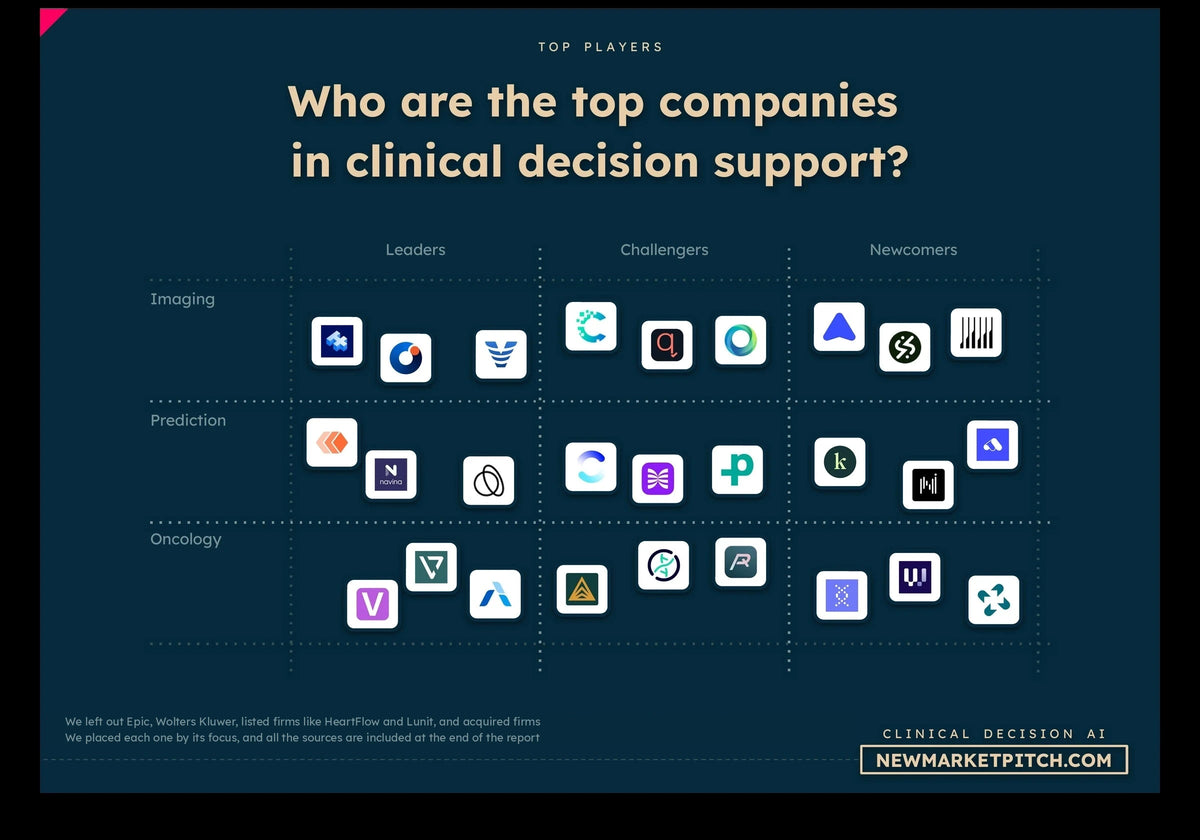
In our report covering the clinical decision support market, we turn what is vague and complex into simple, useful visuals. Market maps like this one show you at a glance where every startup stands.
Are doctors actually using AI clinical decision support every day?
AI clinical decision support is already part of everyday medicine for a growing number of doctors, particularly when they need to check medical evidence, make sense of patient information, or document a consultation.
Doximity's 2026 State of AI in Medicine survey, covering 3,151 U.S. physicians, found that 54% were using AI in clinical practice. Across its spring 2025 and winter 2025–2026 survey waves, reported adoption increased from 47% to 63%. These were different survey samples, so the increase measures a broader trend rather than changes in the behavior of exactly the same doctors.
The details are more revealing. AI-assisted medical literature searches rose from 22% to 35% of surveyed physicians, while ambient documentation increased from 20% to 29%. Doctors were using AI to find medical information more frequently than to write clinical notes, despite the enormous attention given to AI scribes.
OpenEvidence offers a more direct measure. The company reported approximately 20 million clinical consultations with its AI in January 2026 and announced one million consultations in a single day that March. Those figures suggest substantial repeat usage, although the one-day record doesn't tell us the platform's normal daily average.
What doctors are adopting also varies considerably. Some deliberately open an AI tool to investigate a diagnosis. Others encounter AI suggestions inside their hospital's electronic health records. That distinction becomes important when comparing which startups doctors actually prefer.
What does it mean for a clinical decision support startup to win doctors?
Winning doctors means getting them to use a clinical AI product repeatedly and trust its answers, although hospital-wide deployments can produce substantial usage without doctors choosing the software themselves.
OpenEvidence and Glass Health compete directly for physicians looking for clinical answers. Regard and Abridge work inside hospital systems, where administrators often choose the software before individual doctors encounter it. Aidoc analyzes imaging workflows and alerts medical teams, sometimes without requiring a physician to open a separate AI application.
A doctor voluntarily returning to OpenEvidence several times a week tells us something different from 5,000 hospital employees having access to Abridge. Both are commercially valuable, but only the first directly demonstrates individual product preference.
We therefore give the greatest weight to recurring physician activity, actual acceptance of clinical suggestions, and evidence that usage continues after initial deployment. Hospital customer counts and contract announcements help establish reach, but they cannot tell us how much doctors like the product.

Our research about clinical decision support tools gets updated several times a month, so you always get the latest view of where things stand.
Has OpenEvidence already won the race for individual doctors?
OpenEvidence is currently the clearest leader among independent clinical AI startups when it comes to physicians actively choosing and repeatedly using a decision-support tool.
Its growth has been extraordinary. According to data compiled by Sacra, monthly clinical consultations increased from approximately 3 million in early 2025 to 20 million in January 2026, a roughly 6.7-fold increase. Its subsequent record of one million consultations in a single day suggests that usage continued to climb.
OpenEvidence also reports that more than 65% of U.S. physicians use its platform monthly and over half use it daily. Those numbers come from the company itself rather than an independent measurement of the entire physician population. Still, the disclosed consultation volumes support the picture of a product with unusually strong repeat engagement.
Its commercial growth is nearly as striking. Sacra estimated approximately $300 million in annualized revenue by July 2026, compared with $150 million at the end of 2025. A September financing reportedly valued OpenEvidence at $15 billion.
The business model helps explain the adoption. Verified physicians can use the product for free, while OpenEvidence makes money primarily from pharmaceutical and medical-device advertising. Doctors don't need to persuade a hospital procurement department before trying it.
For individual physician adoption, OpenEvidence has the strongest publicly available case. Its biggest unanswered question concerns clinical outcomes: widespread usage and trust are impressive, but neither establishes that its recommendations consistently lead to better treatment decisions.
If you want more recent data on this point, please see our latest clinical decision support market report.
Can Glass Health seriously challenge OpenEvidence?
Glass Health has a compelling AI product for clinical reasoning, but OpenEvidence remains far ahead on publicly disclosed physician usage.
Glass helps doctors work through symptoms, possible diagnoses, guidelines, and treatment plans. A physician can describe a complicated patient case and ask the software to explore what conditions deserve attention. OpenEvidence, meanwhile, has built much of its popularity around quickly retrieving and explaining relevant medical evidence.
There is considerable overlap, particularly as medical AI tools become better at both literature retrieval and clinical reasoning.
Glass has published results from clinical evaluations, including the Harvard-Stanford ARISE NOHARM benchmark, which examines the safety of recommendations in medical scenarios. Such tests help establish what a model can do under controlled conditions. They say much less about how often doctors return to the product after trying it.
OpenEvidence discloses millions of monthly consultations, while Glass hasn't published a similarly detailed series covering active physicians, consultation frequency, and repeat usage.
Glass could still appeal to doctors who want more help developing a differential diagnosis rather than finding an answer to a specific clinical question. For now, however, there is no convincing public evidence that it comes close to OpenEvidence in physician adoption.

In our market report about clinical decision support tools, we look at what the winners do differently, so you can learn from the best instead of guessing.
Is Abridge becoming more than an AI note-taking tool for doctors?
Abridge is turning its huge hospital distribution network into a serious advantage in clinical decision support, although its newer AI capabilities still have less proven engagement than its documentation product.
By October 2025, Abridge reported adoption by more than 200 health systems. In August 2026, the company said more than 300 enterprise health systems had adopted its context-aware clinical decision-support capabilities following their April introduction. The announcements have slightly different scopes, so they shouldn't be treated as an exact like-for-like growth calculation.
Individual hospital networks show what that reach means. UPMC announced plans to expand Abridge to more than 12,000 clinicians by 2026. WVU Medicine separately planned deployment to more than 2,800 clinicians across 25 hospitals and associated care locations.
These are rollout targets and institutional adoption figures, not verified daily active user counts. Even so, Abridge has secured something many medical AI startups struggle to obtain: direct access to thousands of doctors inside major healthcare systems.
Abridge's newer clinical intelligence features connect patient conversations, medical records, and relevant evidence. Instead of typing a separate question into an AI search engine, clinicians can receive information related to the patient they are already treating.
That makes Abridge particularly dangerous to standalone clinical AI products. Doctors may prefer receiving the right information inside their existing workflow, provided the recommendations are accurate and useful.
If you want more recent data on this point, please see our latest clinical decision support market report.
Is Regard actually helping doctors catch more diagnoses?
Regard has some of the strongest evidence that physicians are accepting AI-generated diagnostic suggestions inside hospitals, although its clearest measurable benefits concern documentation and revenue capture.
Regard examines electronic health records, identifies potentially relevant conditions, and prepares diagnoses and documentation for physician review.
By March 2026, the company reported deployments across more than 150 hospitals and over 12 million clinician-accepted diagnoses. It also claimed to have helped customer health systems unlock more than $200 million in earned revenue through improved diagnosis documentation.
These are cumulative company-reported figures. An accepted diagnosis may reflect better documentation of a condition the physician already recognized, so 12 million accepted diagnoses shouldn't be interpreted as 12 million previously missed diseases discovered by AI.
The physician adoption numbers at Monument Health are particularly interesting. According to a presentation involving the health system at the 2026 American Hospital Association Leadership Summit, adoption increased from the high 60% range to 90% after Regard introduced its Max agent.
Monument also reported a 52% improvement in hierarchical condition category capture and a 44% improvement in complication and comorbidity capture. Those measures are important for documenting patient complexity and supporting reimbursement, though they do not directly establish better patient outcomes.
Regard has since expanded beyond hospital medicine into cardiology and surgery. Its software clearly fits physician workflows and improves clinical documentation. Whether it also produces major reductions in missed diagnoses or treatment errors remains a separate question.

In our document detailing everything you need to know about clinical decision support, you will always find fresh funding data, taken straight from our own verified funding database.
Is Aidoc winning hospitals without asking doctors to change their habits?
Aidoc has built one of the largest clinical AI footprints by analyzing medical imaging and bringing findings directly into hospital workflows, often without requiring doctors to open a separate application.
The company reports use of its AI technology at more than 1,600 hospitals worldwide. Its platform helps identify relevant imaging findings, prioritize cases, alert clinicians, and coordinate follow-up care.
A radiologist reviewing scans may encounter Aidoc-generated information automatically, rather than deciding whether to consult an AI assistant. That gives Aidoc an advantage over products that must persuade busy physicians to initiate a separate interaction.
In August 2026, Aidoc announced a diagnostic AI consortium involving 12 U.S. health systems, including Cedars-Sinai, Houston Methodist, Northwell Health, and Sutter Health. Together, the participating organizations serve nearly 20 million patients annually. That is the combined reach of the health systems, not the number of patients whose examinations Aidoc actually analyzed.
Aidoc's distribution is impressive, but we cannot compare 1,600 hospitals directly with OpenEvidence's millions of consultations. One measures institutional reach; the other measures individual interactions.
Aidoc already has a strong position in automated clinical support. Its challenge is demonstrating how consistently its alerts change physician decisions and improve care, particularly when measured across different hospitals and specialties.
Which clinical decision support startups have the most doctors using them?
OpenEvidence has the strongest disclosed evidence of active physician-led consultations, while Abridge, Regard, and Aidoc lead on different measures of hospital adoption and clinical workflow activity.
We've compared the operating figures companies make public, while keeping their limitations visible. Some report actual interactions, others count hospitals, and several rely on deployment targets or selected customer studies. There is no credible way to turn these different measurements into one universal number of active doctors.
| Company | Published adoption evidence | What the figures actually show |
|---|---|---|
| OpenEvidence | About 20M monthly consultations in January 2026; 1M on a peak day in March | Very large volume of physician-initiated clinical questions |
| Abridge | More than 300 health systems adopting contextual clinical decision support | Extensive enterprise distribution, with active usage of newer features less clear |
| Aidoc | More than 1,600 hospitals using its technology | Broad deployment of automated clinical AI |
| Regard | More than 150 hospitals; 12M+ accepted diagnoses | Repeated physician interaction with AI-generated diagnostic documentation |
| Ambience Healthcare | 92% clinician adoption in MultiCare's evaluation; 80% utilization at Houston Methodist | Strong adoption across selected enterprise deployments |
| Pathway / Doximity | 300,000+ quarterly AI-tool users reported by Doximity | Large existing physician audience, now inside a public company |
| VisualDx | More than 2,300 hospitals and institutions reported | Broad reach for established visual diagnostic support |
| Atropos Health | More than 10,000 clinical questions converted into studies | Meaningful usage for specialized evidence generation |
| Glass Health | Clinical evaluation results, but no comparable active-user series disclosed | Product capability with less transparent adoption scale |

Learning from others' mistakes is the cheapest lesson there is. In our report covering the clinical decision support market, we look at what broke startups before you, so you don't repeat it.
Do doctors actually prefer Ambience Healthcare over competing AI tools?
Ambience Healthcare has produced unusually convincing evidence of clinician preference in head-to-head hospital evaluations, particularly for documentation and related clinical workflows.
MultiCare Health System compared three ambient AI products during 2025, involving more than 550 clinicians across over 20 specialties. When the health system announced its decision in February 2026, it reported that Ambience achieved 92% clinician adoption and a net promoter score 63 points higher than the next-best product.
This is more informative than a company announcing that another hospital purchased its software. Clinicians used competing products during the same purchasing process, giving the hospital a basis for comparing acceptance.
Other deployments tell a similar story. Ardent Health reported 90% clinician utilization during a pilot covering 17 specialties and seven languages. Houston Methodist reported 80% utilization across specialties and a 40% reduction in documentation time.
We can't average those percentages into an industry-wide adoption rate because the organizations used different evaluation methods and clinician populations. But the consistency across several substantial hospital deployments makes the results harder to dismiss as an isolated success.
Ambience also introduced commercial arrangements linked to measurable outcomes, tying its value more closely to clinical and financial improvements.
The limitation is the product category. Most published evidence concerns documentation, coding, and integrated workflows. Ambience has clearly persuaded doctors to use its software, but its position in clinical decision-making specifically is less established than its position in ambient documentation.
If you want more recent data on this point, please see our latest clinical decision support market report.
Could Doximity and Pathway take doctors away from OpenEvidence?
Doximity could become OpenEvidence's most serious competitor for physician attention because it already reaches a huge professional audience and acquired the clinical reference startup Pathway.
Doximity purchased Pathway in 2025 for a reported $63 million. Pathway had developed structured clinical information covering guidelines, medications, and important medical studies, and previously reported hundreds of thousands of healthcare professionals using its tools.
The acquisition placed those capabilities inside Doximity's broader physician platform. During the October–December 2025 quarter, Doximity reported more than 300,000 unique clinicians using its AI tools, which it described as approximately 20% of U.S. doctors. That number includes its wider AI offering, not exclusively clinical question-answering.
Doximity also published a 2026 comparison based on 1,315 side-by-side physician evaluations. It reported that DoxGPT won 61% of preferences when physicians selected a better answer, compared with 26% for the closest competitor. Because Doximity ran and published the analysis, we should treat it as company-sponsored evidence rather than an independent ranking of medical AI systems.
OpenEvidence currently has the more impressive disclosed volume of clinical consultations. But Doximity has years of physician relationships and can distribute AI tools alongside services doctors already use.
Pathway's acquisition also raises an interesting question for smaller startups: joining an established physician network could be a faster way to reach doctors than trying to build a comparable audience independently.

Your time is limited. In our research about clinical decision support tools, we put numbers on each part of the market, so you can see where it makes sense to focus.
Are OpenEvidence and Glass Health replacing UpToDate and VisualDx?
OpenEvidence and other AI-native clinical tools are winning physician attention, but there is not yet enough evidence that doctors or hospitals are abandoning established references such as UpToDate and VisualDx.
VisualDx reports deployment across more than 2,300 hospitals and institutions worldwide, including over half of U.S. academic medical centers. Its diagnostic tools combine medical knowledge with a substantial visual reference library, particularly useful for dermatology, infectious diseases, and other conditions where appearances help distinguish diagnoses.
UpToDate has even stronger institutional economics. Sacra estimated approximately $690 million in 2025 revenue, with around 80% coming from institutional customers. Hospitals have spent years integrating established references into their procurement processes and clinical workflows.
OpenEvidence's rise creates a different kind of competition. Doctors can ask a question, receive a synthesized answer, and inspect linked medical evidence without paying a personal subscription. That convenience can gradually reduce the number of questions directed to traditional references.
But a doctor could still use VisualDx to examine a difficult rash, UpToDate for a comprehensive clinical review, and OpenEvidence for a quick question about recent treatment guidance.
The battle will become clearer when we can measure changes in paid subscriptions, renewals, and usage across competing tools. For now, AI-native startups have clearly captured physician activity, while the established providers retain major institutional relationships.
If you want more recent data on this point, please see our latest clinical decision support market report.
Can Atropos Health answer medical questions that ChatGPT and OpenEvidence cannot?
Atropos Health stands out because it can produce new clinical evidence from real patient data when existing medical literature doesn't answer a doctor's specific question.
Its Green Button service takes clinical questions and runs retrospective studies using real-world healthcare datasets. Doctors can investigate outcomes in patient populations with particular diseases, treatments, or combinations of medical conditions.
Atropos reports more than 10,000 clinical questions converted into studies and over 50 peer-reviewed publications connected to its work. Its traditional Green Button service targets results within 48 hours, which makes it better suited to complex evidence requests than quick questions during a consultation.
Consider a physician treating a patient with several chronic conditions who doesn't closely resemble the participants in a major clinical trial. OpenEvidence may help retrieve and interpret published studies, while Atropos can potentially investigate outcomes among more comparable patients in available datasets.
That capability has clear value, though the scale is quite different. Ten thousand completed studies cannot be compared directly with OpenEvidence's millions of monthly consultations, and the companies serve different kinds of questions.
Atropos looks particularly well placed for specialized clinical research and difficult treatment decisions. It has less evidence of becoming an everyday tool for large numbers of individual physicians.

In our market report about clinical decision support tools, we always try to gather several sources and make estimates that make sense, so you can work with solid numbers.
Are clinical AI startups giving doctors accurate answers or just convenient ones?
The best clinical AI tools have demonstrated strong performance in physician evaluations, but accuracy, source quality, and safety still vary enough that convenience alone cannot explain which products doctors should trust.
A June 2026 research preprint examined 620 real point-of-care questions submitted to OpenEvidence across 30 specialties, alongside 187 additional benchmark questions. Researchers recruited 149 practicing physicians from 36 U.S. states to compare responses from OpenEvidence and several general-purpose AI systems.
OpenEvidence performed best across five evaluation dimensions: accuracy, usefulness, source quality, verifiability, and completeness. In the primary analysis, the difference between its win and loss rates ranged from 25 to 39 percentage points.
That's meaningful comparative evidence, especially because practicing physicians judged questions resembling their normal clinical work. However, the original question sample came from OpenEvidence, and the study doesn't establish how every competing specialist medical AI product would perform.
Other evaluations focus on dangerous mistakes rather than the overall usefulness of answers. The Stanford-Harvard ARISE NOHARM benchmark tests how clinical AI responds to cases where inappropriate advice could harm patients. Glass and Doximity have both highlighted results from versions of their systems, though comparisons depend heavily on the model versions and evaluation methods.
Clinical reliability remains a major unresolved competitive advantage. Doctors may initially adopt a tool because it responds quickly, but sustained reliance will depend on whether it provides dependable evidence, handles uncertainty appropriately, and avoids dangerous recommendations.
Have clinical decision support startups actually improved patient outcomes?
Clinical AI startups have strong evidence of saving doctors time and improving documentation, but considerably less evidence that their products consistently reduce medical errors or improve patient health.
Regard reports millions of clinician-accepted diagnoses and stronger documentation of patient conditions. Ambience has demonstrated shorter documentation times and substantial clinician adoption. Abridge has secured broad institutional rollout. These are important achievements, although they don't directly measure whether patients recover faster or experience fewer complications.
A September 2026 research preprint provides a useful illustration of what stronger clinical evidence could look like. Researchers studied an intervention providing drug-interaction information across approximately 2.81 million prescriptions and 1,700 physicians in India. The intervention was associated with an 8.6% reduction in drug-drug interaction errors.
The research wasn't a test of OpenEvidence, Regard, or Abridge. It did, however, show that giving physicians relevant information at the right moment can change prescribing behavior, even when the alerts are optional.
For the major startups, the most convincing future evidence would come from prospective comparisons showing fewer missed diagnoses, medication errors, avoidable hospitalizations, or other measurable patient harms.
Several clinical AI startups have clearly changed doctors' workflows. Claims about better patient outcomes still need more direct evidence.

If you build or invest in the clinical decision support market, you need to know which business models pay off now and which ones are fading. That's why our report covering it has a whole section on it.
Can OpenEvidence, Regard, and Abridge make serious money from clinical AI?
Clinical decision support is already supporting substantial businesses, but OpenEvidence, Regard, and Abridge make money in very different ways.
OpenEvidence primarily sells advertising tied to physician engagement. Sacra estimated that its annualized revenue reached approximately $300 million in July 2026, about twice its estimated level at the end of 2025. These are third-party estimates rather than audited financial statements.
Regard makes its case to hospitals through better clinical documentation and financial returns. The company's reported $200 million in additional earned revenue for customers indicates the size of the economic benefits it claims to deliver. That figure is customer revenue unlocked, not Regard's own sales.
Abridge and Ambience sell into health systems that want to reduce administrative work and improve clinical workflows. Aidoc earns money through enterprise deployment of imaging AI and care-coordination software. Atropos charges for specialized evidence services, while Glass Health offers free and paid clinical reasoning capabilities.
Looking across these companies, physician usage and customer spending often happen in different places. A doctor may freely choose OpenEvidence, while a hospital independently pays for Regard or Abridge because the financial and operational benefits justify the contract.
| Company | Main business model | What customers pay for |
|---|---|---|
| OpenEvidence | Advertising and commercial partnerships | Access to physicians during clinical information searches |
| Regard | Enterprise hospital contracts | Diagnosis documentation, workflow improvement, revenue capture |
| Abridge | Enterprise health-system contracts | Documentation and contextual clinical intelligence |
| Ambience Healthcare | Enterprise contracts, including outcome-linked arrangements | Time savings, clinical documentation, coding improvements |
| Aidoc | Enterprise clinical AI deployments | Imaging analysis, triage, care coordination |
| Atropos Health | Enterprise evidence services and data products | Clinical research using real-world patient data |
| Glass Health | Free and paid offerings | AI-assisted diagnosis and clinical reasoning |
| VisualDx | Individual and institutional subscriptions | Diagnostic reference and visual medical knowledge |
Could Epic and Microsoft take over clinical decision support from startups?
Epic, Microsoft, and other major healthcare software providers could take a large share of clinical AI usage because their products already sit inside the systems doctors use every day.
Electronic health records are particularly important. If useful clinical guidance appears directly in Epic or Oracle Health, physicians have less reason to open a separate application or manually transfer patient details.
Abridge has already moved in this direction by bringing patient-specific intelligence into existing EHR workflows. Regard has also pursued integration with Microsoft's Dragon Copilot environment, connecting patient-record analysis with clinical documentation.
OpenEvidence is approaching the same market from the opposite direction. It has built a large direct physician audience and can develop integrations from that position, rather than depending entirely on hospital procurement to gain access to users.
The risk is greatest for smaller companies offering capabilities that larger platforms can reproduce easily. A generic medical chatbot may struggle if an EHR vendor includes similar functionality in an existing subscription. Specialized tools with proven clinical performance, trusted evidence, or deeply integrated workflows should be harder to replace.
Clinical decision support will probably remain spread across several products, especially because imaging triage, diagnostic reasoning, documentation, and medical literature searches solve different problems. But controlling the physician's main workflow could become an enormous distribution advantage.

In our report covering the clinical decision support market, we don't want to repeat what boring consulting reports say. Instead, we show you the real and latest market signals that matter.
Which clinical decision support startups are actually winning doctors today?
OpenEvidence is the strongest winner in direct physician adoption, while Abridge, Regard, and Aidoc lead in different parts of hospital-based clinical decision support.
OpenEvidence has the clearest evidence of doctors independently choosing an AI clinical reference tool and returning frequently. Its consultation volume, reported physician reach, and rapid estimated revenue growth put it well ahead of smaller standalone challengers such as Glass Health.
Among enterprise startups, Abridge has extensive health-system distribution and is moving deeper into patient-specific clinical intelligence. Regard has demonstrated large-scale physician acceptance of diagnostic suggestions, with particularly strong evidence around documentation and coding. Aidoc has reached more than 1,600 hospitals through imaging analysis and automated clinical workflows.
Ambience Healthcare deserves recognition for high clinician adoption in competitive hospital evaluations, although its best-documented results concern documentation. Atropos serves a smaller but potentially valuable market for generating clinical evidence from patient data. Doximity, now incorporating Pathway, is a major competitive threat to OpenEvidence, even though it is no longer a startup.
Our comparison points to two distinct kinds of winners. OpenEvidence is becoming a default destination for doctors who want fast clinical answers. Abridge, Regard, and Aidoc are building clinical intelligence into the systems where doctors already work.
The most important unanswered question concerns patient outcomes. Physician adoption has moved much faster than independently verified evidence of fewer diagnostic mistakes, safer prescribing, or better treatment results. The startups that can demonstrate those improvements at scale will have a much stronger claim to lasting clinical leadership.
If you want more recent data on this point, please see our latest clinical decision support market report.
Our methodology
This analysis examines which clinical decision support startups are winning physicians based on evidence available through October 12, 2026. We compare voluntary physician adoption, consultation frequency, hospital distribution, acceptance of AI-generated suggestions, clinical performance, customer economics, and evidence of improved medical care. The scope includes AI-native clinical reference tools, diagnostic reasoning systems, embedded clinical intelligence, imaging-based decision support, and adjacent documentation platforms expanding into clinical assistance.
Our research follows a structured aggregation of recent evidence across these dimensions. For each, we identify fresh operating and research findings, assess their relevance and reliability, compare the companies they concern, and aggregate the evidence into stronger conclusions. Recurring consultations receive more weight when assessing voluntary physician preference, while documented deployments and accepted clinical suggestions carry more weight when assessing enterprise adoption. We keep those measures separate rather than constructing a universal ranking from incompatible metrics.
Physician adoption figures are interpreted according to their underlying populations and measurement periods. A monthly consultation count measures interactions, not necessarily unique doctors; an enterprise contract establishes distribution, not daily activity; and a clinician adoption percentage from one hospital cannot be generalized to the entire market. Similarly, announced rollout targets are distinguished from completed deployments, and company-reported physician reach is identified separately from independently measured usage. Our physician-adoption context draws on Doximity's 2026 State of AI in Medicine survey, OpenEvidence's consultation milestone, and Sacra's OpenEvidence operating and financial analysis.
For enterprise clinical AI, we examine implementation-level disclosures and physician interaction separately from contract counts. Key evidence includes Abridge's contextual clinical intelligence announcement, Regard's hospital deployment and accepted-diagnosis disclosures, Aidoc's diagnostic AI consortium announcement, and Ambience Healthcare's competitive evaluation at MultiCare. We treat documented clinician acceptance, utilization, and repeat workflow activity as stronger evidence than product availability alone.
We assess clinical accuracy and patient outcomes separately from usage. Physician-rated answer quality, benchmark performance, diagnosis documentation, reimbursement improvements, and patient health are different outcomes. Our assessment draws on Feng et al.'s 2026 physician evaluation of clinical AI on real point-of-care questions and Shao et al.'s research on prescribing-information interventions. Both are research preprints. Where documentation or financial results are reported, we do not treat them as proof of reduced diagnostic errors or improved patient outcomes.
Competitive positioning is assessed using product distribution, differentiation, integration with electronic health records, and the strength of existing physician relationships. We also considered Doximity's fiscal third-quarter results, Glass Health's clinical evaluation disclosures, Atropos Health's Green Button evidence-generation service, and Sacra's competitive analysis of clinical AI references. Publicly traded and established providers are included as competitive benchmarks where relevant, rather than classified as independent startups.
Commercial traction is evaluated using disclosed revenue, specialist financial estimates, contract relationships, and customer economics. We distinguish annualized revenue estimates from audited revenue, and financial gains generated for hospital customers from revenue earned by the AI vendor itself. The resulting conclusions reflect where several measures of physician activity, clinical credibility, distribution, and commercial progress reinforce one another, while preserving the important differences between tools that doctors choose directly and products deployed through healthcare institutions.

In our research about clinical decision support tools, we like to show you the big picture. We know your time is precious, so we make every page quick to read and packed with as much learning as possible per minute.
Written by the New Market Pitch teamWe track new markets so founders and investors can move faster. About us