What are the most valuable clinical decision support startups?
Whether you're building or investing in the clinical decision support market, our report covers everything you need to know: the players, the money, and what's coming next.
Summary
OpenEvidence is the most valuable clinical decision support startup today, at $15.0B, followed by Aidoc at $1.0B–$1.9B and AMBOSS at $800M–$1.9B. Viz.ai, Cleerly, DentalMonitoring, Glooko and Anumana complete the group of eight companies whose valuation ranges reach at least $1 billion.
OpenEvidence has pulled unusually far ahead. Its September 2026 financing valued the company at a reported $15 billion, while estimated annualized revenue had reached approximately $300 million by July. That puts its valuation around 50 times annualized revenue, a demanding multiple even for a fast-growing healthcare technology business.
The leading companies are making money in very different ways. OpenEvidence offers free AI-powered medical research supported by advertising, AMBOSS sells medical knowledge and subscriptions, while Aidoc sells enterprise diagnostic AI and workflow software to hospitals. These business models have very different economics and shouldn't be judged by the same yardstick.
Medical imaging is one of the strongest areas for billion-dollar valuations. Aidoc and Cleerly, with Deepwise not far behind, demonstrate the commercial appeal of software that helps hospitals interpret scans, identify urgent findings and improve diagnostic workflows.
Only eight of the 82 startups in our ranking have valuation ranges reaching $1 billion. Three have valuations starting at that level, while the other five cross the threshold only at the upper end of their ranges. Clinical decision support has produced some valuable businesses, but billion-dollar companies are still relatively rare.
Doctors are adopting AI quickly, although the most common applications remain research, guideline summaries and administrative assistance. The American Medical Association found that 81% of physicians used AI professionally in 2026, compared with 38% in 2023, while only 17% reported using it for assistive diagnosis.
Cardiovascular AI and digital pathology are attracting particular interest from established healthcare companies. Medtronic completed its $585 million CathWorks acquisition, RadNet paid approximately $264 million for Gleamer, and Roche and Agilent announced major pathology AI acquisitions involving PathAI and Proscia.
The United States dominates the highest valuations, but the competitive landscape is international. China has developed a strong medical imaging cluster, while Germany and France have produced valuable clinical knowledge and diagnostic software businesses.
Regulatory clearance, reimbursement and hospital integration can create meaningful commercial advantages. A diagnostic product that is already used in clinical workflows and covered by insurers has a much stronger position than a promising AI application still waiting for hospitals to adopt it.
General-purpose AI is becoming a real competitive threat to medical research platforms. OpenEvidence and AMBOSS will have to defend their specialist content, physician trust and distribution, while diagnostic companies such as Aidoc and Cleerly benefit from the additional regulatory and technical requirements involved in replacing their products.
Our conclusion is that clinical decision support has become a commercially important healthcare technology market, with OpenEvidence clearly ahead financially. The most defensible valuations belong to companies combining revenue growth with repeat clinical usage, reimbursement, strong hospital relationships and products that are difficult to replace.

Written by the New Market Pitch teamWe track new markets so founders and investors can move faster. About us

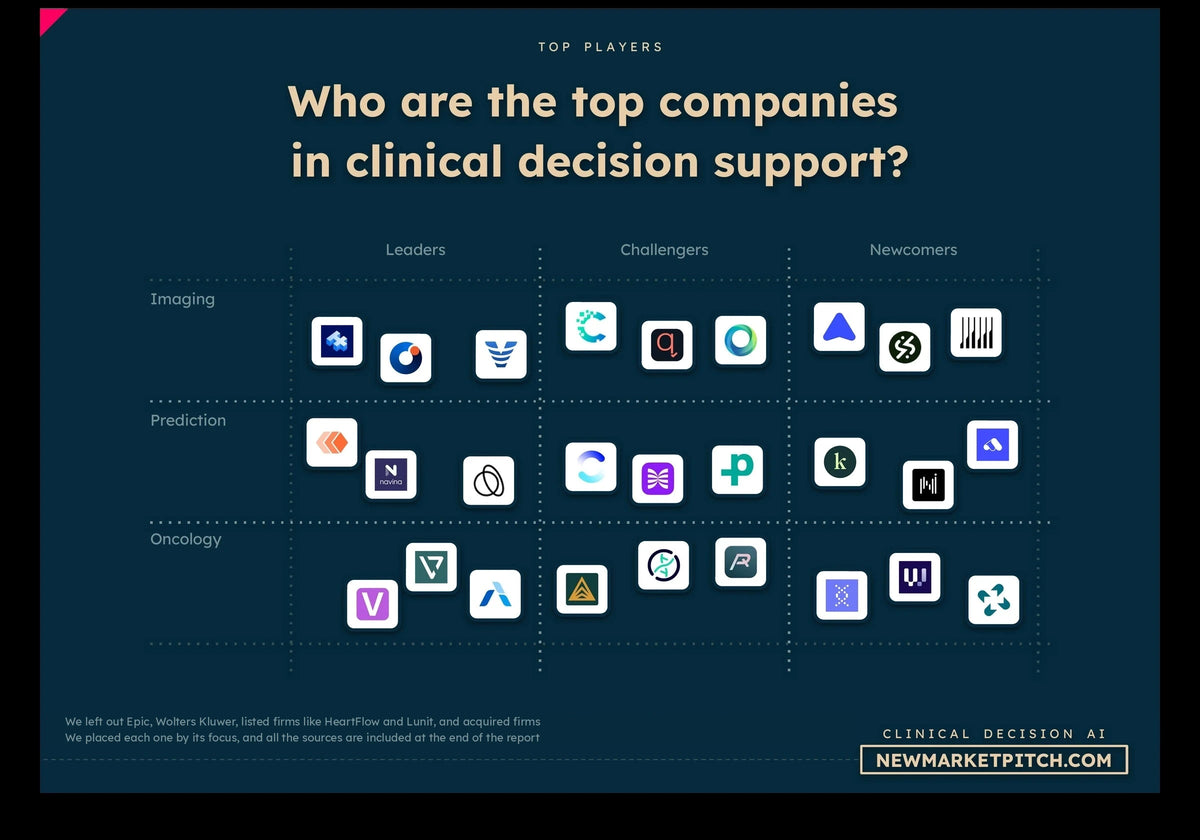
In our report covering the clinical decision support market, we turn what is vague and complex into simple, useful visuals. Market maps like this one show you at a glance where every startup stands.
Top startups in the clinical decision support market ranked by valuation
Here is an updated table that ranks the top startups in the clinical decision support market based on their latest reported or estimated valuations.
If you need to dig deeper and get more detailed data, please check our report covering the clinical decision support market.
| # | Startup | Valuation | Confidence | Valuation basis | Last round | Total funding |
|---|---|---|---|---|---|---|
| Private startups | ||||||
| 1 | OpenEvidenceAI clinical evidence search assistant | $15.0Bas of Sep 2026 | Full | Announced private round valuation | $250MSeries E / growth · Sep 2026 | $1.0Bvalued at 14.8× this |
| 2 | AidocEnterprise clinical imaging AI platform | $1.0B–$1.9Bas of Apr 2026 | Low | Estimated from last round | $150MSeries E · Apr 2026 | $436Mvalued at 3.1× this |
| 3 | AMBOSSMedical knowledge and clinical decision support | $800M–$1.9Bas of Oct 2026 | Partial | Comparables-based estimate | $260MUndisclosed stage · Mar 2025 | $260Mvalued at 4.7× this |
| 4 | Viz.aiAI-powered disease detection and care coordination | $1.2Bas of Apr 2022 | Full | Announced private round valuation | $100MSeries D · Apr 2022 | $171M+valued at 7.0× this |
| 5 | CleerlyAI-powered coronary artery disease diagnostics | $700M–$1.3Bas of Oct 2026 | Partial | Comparables-based estimate | $106MSeries C extension · Dec 2024 | $372Mvalued at 2.6× this |
| 6 | AliveCorAI-powered ECG diagnostics and monitoring | $944Mas of Aug 2022 | Full | Announced private round valuation | $65MSeries E · Nov 2020 | $114Mvalued at 8.3× this |
| 7 | DentalMonitoringAI-powered remote orthodontic monitoring | $667M–$1.2Bas of Feb 2026 | Low | Estimated from last round | $100MGrowth equity · Feb 2026 | $300Mvalued at 3.0× this |
| 8 | GlookoDiabetes management and analytics platform | $667M–$1.2Bas of Oct 2024 | Low | Estimated from last round | $100MSeries D+ · Oct 2024 | $201Mvalued at 4.5× this |
| 9 | AnumanaAI-powered ECG cardiac diagnostics | $636M–$1.2Bas of Apr 2025 | Low | Estimated from last round | $95MSeries C · Apr 2025 | $95Mvalued at 9.1× this |
| 10 | PathAIAI-powered digital pathology and diagnostics | $750Mas of May 2026 | Full | Acquisition value | $165MSeries C · May 2021 | $236M+valued at 3.2× this |
| 11 | DeepwiseAI-powered medical imaging diagnostics | $463M–$869Mas of Jan 2025 | Low | Estimated from last round | $70MSeries D · Jan 2025 | $70M+valued at 9.1× this |
| 12 | ArteraAIAI-powered precision oncology platform | $360M–$900Mas of Mar 2023 | Low | Estimated from last round | $20MOther · Feb 2024 | $110Mvalued at 5.2× this |
| 13 | OverjetAI dental diagnostics and analytics | $550Mas of Mar 2024 | Strong | Reported private round valuation | $25MSeries C-1 · Dec 2025 | $156Mvalued at 3.5× this |
| 14 | CortiClinical conversational AI and documentation | $400M–$750Mas of Sep 2023 | Low | Estimated from last round | $60MSeries B · Sep 2023 | $87M+valued at 6.3× this |
| 15 | Huimei TechnologyAI hospital clinical decision support | $440M–$660M | Partial | Comparables-based estimate | ~$28MLater-stage equity · Aug 2025 | $109Mvalued at 5.0× this |
| 16 | Harrison.aiAI radiology and pathology diagnostics | ~$521Mas of Feb 2025 | Strong | Reported private round valuation | $112MSeries C · Feb 2025 | $131M+valued at 4.0× this |
| 17 | NavinaAI-powered clinical intelligence for physicians | $367M–$688Mas of Mar 2025 | Low | Estimated from last round | $55MSeries C · Mar 2025 | $92Mvalued at 5.5× this |
| 18 | ElucidAI-based cardiovascular plaque analysis | $367M–$688Mas of Sep 2026 | Low | Estimated from last round | $55MSeries D · Sep 2026 | $65Mvalued at 7.7× this |
| 19 | UltromicsAI cardiac ultrasound diagnostic software | $367M–$688Mas of Jul 2025 | Low | Estimated from last round | $55MSeries C · Jul 2025 | $101M+valued at 5.0× this |
| 20 | CaresyntaxSurgical intelligence and workflow software | $380M–$650Mas of Oct 2026 | Partial | Comparables-based estimate | $80MSeries C · Aug 2024 | $302Mvalued at 1.6× this |
| 21 | Qure.ai1AI radiology and disease detection | $350M–$700Mas of Oct 2026 | Partial | Comparables-based estimate | $65MSeries D · Sep 2024 | $121Mvalued at 4.1× this |
| 22 | VieCureAI-powered oncology clinical decision support | $287M–$538Mas of Jan 2026 | Low | Estimated from last round | $43MGrowth equity · Jan 2026 | $113Mvalued at 3.5× this |
| 23 | ImplicityAI-powered remote cardiac monitoring | $267M–$500Mas of Sep 2026 | Low | Estimated from last round | $40MGrowth equity · Sep 2026 | $67Mvalued at 5.4× this |
| 24 | Volta MedicalAI-guided cardiac ablation decision support | $264M–$495Mas of Jan 2023 | Low | Estimated from last round | $40MSeries B · Jan 2023 | $68Mvalued at 5.3× this |
| 25 | RegardAI clinical insights and documentation | ~$350Mas of Jul 2024 | Strong | Reported private round valuation | $61MSeries B · Jul 2024 | $81M+valued at 4.3× this |
| 26 | Scopio LabsAI-powered digital blood cell analysis | $270M–$420Mas of Oct 2026 | Partial | Comparables-based estimate | $10MSeries D extension · Jul 2025 | $125Mvalued at 2.7× this |
| 27 | Eko HealthAI-powered cardiac and pulmonary screening | $250M–$450Mas of Oct 2026 | Partial | Comparables-based estimate | $41MSeries D · Jun 2024 | $161M+valued at 2.1× this |
| 28 | QuibimAI imaging biomarkers for precision medicine | $250M–$417Mas of Jan 2025 | Low | Estimated from last round | $50MSeries A · Jan 2025 | $65Mvalued at 5.0× this |
| 29 | RapidAIAI-powered stroke and vascular diagnostics | $200M–$520Mas of Oct 2026 | Partial | Comparables-based estimate | $25MSeries B · Sep 2020 | $25Mvalued at 12.9× this |
| 30 | Imagen TechnologiesAI-enabled radiology diagnostic services | $210M–$480Mas of Oct 2026 | Partial | Comparables-based estimate | Undisclosed | |
| 31 | Atropos Health1Real-world evidence clinical decision support | $220M–$412Mas of May 2024 | Low | Estimated from last round | $33MSeries B · May 2024 | $47M+valued at 6.4× this |
| 32 | InfervisionAI-assisted medical image interpretation | $160M–$500Mas of Oct 2026 | Partial | Comparables-based estimate | Undisclosed | |
| 33 | Ibex Medical AnalyticsAI-powered cancer pathology diagnostics | $180M–$380Mas of Oct 2026 | Partial | Comparables-based estimate | $55MSeries C · Sep 2023 | $104Mvalued at 2.5× this |
| 34 | Digital DiagnosticsAutonomous AI disease diagnosis | $170M–$400Mas of Oct 2026 | Partial | Comparables-based estimate | $75MSeries B · Aug 2022 | $75Mvalued at 3.5× this |
| 35 | ClinomicAI-powered intensive care assistance | $169M–$316Mas of Apr 2025 | Low | Estimated from last round | $25MSeries B · Apr 2025 | $33Mvalued at 7.0× this |
| 36 | AITRICSAI-powered clinical deterioration prediction | $159M–$299Mas of Dec 2025 | Low | Estimated from last round | ~$24MSeries C · Dec 2025 | $53M+valued at 4.1× this |
| 37 | Keya MedicalAI-powered coronary imaging diagnostics | $130M–$360Mas of Oct 2026 | Partial | Comparables-based estimate | $46MSeries D · Jan 2021 | $96M+valued at 2.3× this |
| 38 | Diagnostic RoboticsAI-driven predictive patient care | $170M–$270M | Partial | Comparables-based estimate | $45MSeries B · Jul 2022 | $84M+valued at 2.6× this |
| 39 | AI Medical ServiceAI-powered endoscopic diagnostic support | $140M–$310Mas of Oct 2026 | Partial | Comparables-based estimate | $54MSeries C · Apr 2022 | $108Mvalued at 1.9× this |
| 40 | SeqOneAI genomic analysis and interpretation | $147M–$275Mas of May 2025 | Low | Estimated from last round | $22MGrowth equity · May 2025 | $47Mvalued at 4.2× this |
| 41 | DeciphexAI-powered digital pathology diagnostics | $150M–$260Mas of Oct 2026 | Partial | Comparables-based estimate | $32MSeries C · Jan 2025 | $57Mvalued at 3.5× this |
| 42 | HutomAI-assisted surgical planning technology | $156M–$234Mas of Oct 2026 | Partial | Comparables-based estimate | $15MSeries C · Mar 2024 | $34Mvalued at 5.6× this |
| 43 | AignosticsAI-powered precision pathology diagnostics | $145M–$250Mas of Oct 2026 | Partial | Comparables-based estimate | $34MSeries B · Oct 2024 | $76Mvalued at 2.5× this |
| 44 | PerspectumAI-powered quantitative medical imaging | $130M–$270Mas of Oct 2026 | Partial | Comparables-based estimate | Undisclosed | |
| 45 | Vera HealthEvidence-based AI clinical search engine | $142M–$238Mas of Oct 2026 | Low | Estimated from last round | $28MSeries A · Oct 2026 | $28Mvalued at 6.5× this |
| 46 | Skin AnalyticsAI autonomous skin cancer screening | $128M–$240Mas of Apr 2025 | Low | Estimated from last round | $19MSeries B · Apr 2025 | $26M+valued at 6.6× this |
| 47 | ScreenPoint MedicalAI breast cancer screening software | $120M–$220Mas of Oct 2026 | Partial | Comparables-based estimate | $14MSeries C extension · Apr 2026 | $47Mvalued at 3.5× this |
| 48 | Hypervision SurgicalAI hyperspectral surgical imaging | $115M–$191Mas of Apr 2026 | Low | Estimated from last round | ~$23MSeries A · Apr 2026 | $31M+valued at 4.7× this |
| 49 | Ada Health1Medical knowledge and clinical decision support | $120M–$180Mas of Oct 2026 | Partial | Comparables-based estimate | $30MSeries B extension · Feb 2022 | $120M+valued at 1.2× this |
| 50 | Incepto MedicalAI radiology applications marketplace | $107M–$200Mas of Oct 2026 | Partial | Comparables-based estimate | $16MGrowth equity · Sep 2026 | $52Mvalued at 2.8× this |
| 51 | ClosedLoop.aiAI-driven patient risk prediction | $110M–$190M | Partial | Revenue or ARR multiple estimate | $25KAngel · Aug 2022 | $48M+valued at 3.0× this |
| 52 | ClairityAI-powered imaging-based cancer risk prediction | $137Mas of Nov 2025 | Strong | Reported private round valuation | $43MSeries B · Nov 2025 | $43M+valued at 3.2× this |
| 53 | Synapse MedicineAI medication safety and prescribing | $105M–$165M | Partial | Comparables-based estimate | $28MSeries B · Feb 2023 | $39Mvalued at 3.4× this |
| 54 | PrenosisAI-powered sepsis diagnosis and prediction | $100M–$167Mas of Jan 2026 | Low | Estimated from last round | $20MSeries A · Jan 2026 | $20Mvalued at 6.5× this |
| 55 | CorVista HealthAI-powered noninvasive cardiovascular diagnostics | $95M–$175M | Partial | Comparables-based estimate | $1MUndisclosed equity · Oct 2025 | $142Mvalued at 0.9× this |
| 56 | PodimetricsRemote diabetic foot complication prevention | $100M–$160M | Partial | Comparables-based estimate | $45MSeries C · Mar 2022 | $78Mvalued at 1.6× this |
| 57 | AZmedAI-powered radiology imaging software | $75M–$155Mas of Oct 2026 | Partial | Comparables-based estimate | ~$16MSeries A · Feb 2024 | $21Mvalued at 5.0× this |
| 58 | EyenukAutonomous AI retinal disease screening | $70M–$155Mas of Oct 2026 | Partial | Comparables-based estimate | $5.6MSeries A-II · Jun 2026 | $33Mvalued at 3.1× this |
| 59 | InfermedicaAI symptom assessment and triage | $70M–$140M | Partial | Comparables-based estimate | $30MSeries B · Jan 2022 | $46M+valued at 2.2× this |
| 60 | VIDA DiagnosticsAI-powered pulmonary imaging intelligence | $55M–$150Mas of Oct 2026 | Partial | Comparables-based estimate | $11MUndisclosed equity · Sep 2023 | $29Mvalued at 3.1× this |
| 61 | Koios MedicalAI breast and thyroid ultrasound | $90Mas of Sep 2026 | Full | Announced private round valuation | $9.3MPreferred-equity crowdfunding · Nov 2024 | $22M+valued at 4.0× this |
| 62 | OptellumAI lung cancer risk prediction | $60M–$130Mas of Oct 2026 | Partial | Comparables-based estimate | UndisclosedSeries B · Jan 2026 | $19M+valued at 4.6× this |
| 63 | DeepcRadiology AI integration platform | $60M–$130Mas of Oct 2026 | Partial | Comparables-based estimate | $13MSeries A extension · Jul 2024 | $26M+valued at 3.4× this |
| 64 | MDI HealthAI medication optimization platform | $55M–$115M | Partial | Comparables-based estimate | $20MSeries A · Feb 2023 | $26M+valued at 3.0× this |
| 65 | Cydar MedicalAI-guided vascular surgery planning | $55M–$115Mas of Oct 2026 | Partial | Comparables-based estimate | $12MSeries A · Feb 2023 | $21Mvalued at 3.9× this |
| 66 | Tricog HealthAI-enabled remote cardiac diagnostics | $60M–$105M | Partial | Revenue or ARR multiple estimate | UndisclosedStrategic · Nov 2025 | $24M+valued at 3.4× this |
| 67 | Eolas MedicalClinical knowledge management platform | $60M–$100Mas of Jan 2026 | Low | Estimated from last round | $12MSeries A · Jan 2026 | $15Mvalued at 5.3× this |
| 68 | AvoMDEHR-integrated point-of-care clinical AI | $50M–$83Mas of Mar 2026 | Low | Estimated from last round | $10MSeries A · Mar 2026 | $13Mvalued at 5.0× this |
| 69 | EonAI-powered incidental findings management | $40M–$90M | Partial | Comparables-based estimate | $16MGrowth equity · Apr 2022 | $17Mvalued at 3.6× this |
| 70 | Avenda HealthAI-guided prostate cancer treatment | $45M–$80M | Partial | Comparables-based estimate | $10MSeries B · Aug 2022 | $13Mvalued at 4.5× this |
| 71 | BrainomixAI-powered stroke and lung imaging | $43M–$81Mas of Feb 2026 | Low | Estimated from last round | ~$6.5MSeries C extension · Feb 2026 | $59M+valued at 1.0× this |
| 72 | EtiometryAI-powered critical care analytics | $40M–$75M | Partial | Comparables-based estimate | $9MSeries A-3 · Jun 2021 | $15Mvalued at 3.7× this |
| 73 | CancerIQPrecision cancer risk and care | $40M–$75M | Partial | Comparables-based estimate | $14MSeries B · Mar 2022 | $19M+valued at 2.9× this |
| 74 | InsightRXPrecision dosing clinical decision software | $35M–$75M | Partial | Proxy-based estimate | $10MSeries A · Sep 2019 | $13M+valued at 4.0× this |
| 75 | EvidenceCareEvidence-based clinical decision support software | $35M–$65M | Partial | Comparables-based estimate | $15MEquity financing · Mar 2025 | $31Mvalued at 1.5× this |
| 76 | HealthleapAI inpatient disease risk detection | $32M–$53Mas of Oct 2026 | Low | Estimated from last round | $8MSeed · Oct 2026 | $38Mvalued at 1.1× this |
| 77 | EgniteAI-powered cardiovascular care analytics | $20M–$60M | Partial | Proxy-based estimate | UndisclosedSeed VC · Feb 2021 | Undisclosed |
| 78 | OptainAI retinal disease screening | $18M–$55Mas of Oct 2026 | Partial | Comparables-based estimate | $7.5MSeries A extension · Sep 2026 | $45Mvalued at 0.7× this |
| 79 | CathVisionElectrophysiology recording and AI analytics | $20M–$40M | Partial | Proxy-based estimate | $9MSeries B extension · Jul 2023 | $35M+valued at 0.8× this |
| 80 | See All AIAI surgical 3D imaging navigation | $8M–$32Mas of Oct 2026 | Partial | Comparables-based estimate | $33MSeries A · May 2025 | $33Mvalued at 0.5× this |
| 81 | VoxelCloudAI-powered medical imaging diagnostics | Undisclosed | Low | Comparables-based estimate | Undisclosed | |
| 82 | Bayesian HealthReal-time AI clinical intelligence | Undisclosed | Low | Comparables-based estimate | $15MSeries A · Jul 2021 | $15M |
| NR | Shukun TechnologyAI-powered cardiovascular imaging diagnostics | Undisclosed | Last published price over 5 years old (2021) | UndisclosedStrategic · Feb 2022 | $181M | |
| Listed in the last 5 years or acquired in the last 3 years · not ranked | ||||||
| CathWorksAI-powered coronary physiology assessment | $585M2 | Full | Acquisition value | $30MSeries C · Feb 2019 | $46M+valued at 12.8× this | |
| GleamerAI radiology image interpretation | $264M2 | Full | Acquisition value | $30MSeries B · Jun 2023 | $40Mvalued at 6.6× this | |
| ProsciaAI-enabled digital pathology software | $240Mas of Oct 2026 | Full | Acquisition value | $50MGrowth / Series D · Mar 2025 | $129Mvalued at 1.9× this | |
No startups match this search.
- Total funding is a minimum: some rounds have no public amount.
- Acquisition values: CathWorks excludes earn-outs; Gleamer includes contingent payments.

Our research about clinical decision support tools gets updated several times a month, so you always get the latest view of where things stand.
Which clinical decision support startups are worth the most today?
OpenEvidence is currently the most valuable clinical decision support startup, valued at $15.0B, well ahead of Aidoc at $1.0B–$1.9B and AMBOSS at $800M–$1.9B.
The gap is enormous. OpenEvidence's $15.0B valuation is more than seven times AMBOSS's highest estimate. The distance has grown quickly, too. OpenEvidence completed a $250 million funding round at a reported $15 billion valuation in September 2026, just eight months after reaching $12 billion.
These companies have very different business models. OpenEvidence gives doctors free access to AI-powered medical research and earns revenue from advertising. AMBOSS has built a medical knowledge business around education, clinical reference materials and professional subscriptions. Aidoc sells diagnostic AI and workflow software directly to hospitals.
Below OpenEvidence, Aidoc and AMBOSS, Viz.ai ($1.2B), Cleerly ($700M–$1.3B), AliveCor ($944M), DentalMonitoring ($667M–$1.2B), Glooko ($667M–$1.2B) and Anumana ($636M–$1.2B) form the next group. Their products cover medical imaging, cardiovascular diagnostics, diabetes management and specialized clinical workflows. DentalMonitoring and Glooko share the same range because both are estimated from recent funding rounds of similar size.
There is a striking difference between the general medical knowledge platforms at the top and the more specialized diagnostic businesses below them. OpenEvidence has managed to build a very large physician audience, while most of its competitors are still focused on particular clinical specialties or hospital applications.
How many clinical decision support startups are worth over $1 billion?
In our ranking, 3 clinical decision support startups have valuation ranges starting at $1 billion or more, while another five have ranges extending beyond that threshold.
OpenEvidence, Aidoc and Viz.ai make up the first group. AMBOSS, Cleerly, DentalMonitoring, Glooko and Anumana have ranges that cross the billion-dollar threshold, although their lower estimates fall below it.
DentalMonitoring stays in this group with a range estimated from its February 2026 round, since its reported $1 billion price from 2021 is now more than five years old. Shukun Technology has left it: its last published price, about $1.5 billion in 2021, is also more than five years old and no round with a price has followed, so it is listed without a rank at the end of the table.
That gives us eight companies with valuations reaching at least $1 billion, out of 82 in the ranking. In percentage terms, that's approximately 10% of the companies ranked.
There is an important difference between a company with a valuation range of $900M–$1.5B and one that has recently completed financing at a disclosed billion-dollar valuation. Both may reach the same headline number, but the underlying financial circumstances are quite different.
The rest of the market is much more concentrated in smaller valuation ranges. Companies such as Deepwise ($463M–$869M), ArteraAI ($360M–$900M) and RapidAI ($200M–$520M) have attracted serious investment without reaching the financial scale of the leading group.
Clinical decision support has produced several unicorns, but billion-dollar valuations remain relatively uncommon across the sector.

In our market report about clinical decision support tools, we look at what the winners do differently, so you can learn from the best instead of guessing.
Why is OpenEvidence worth so much more than other clinical AI startups?
OpenEvidence is valued far above other clinical AI startups because physician adoption and revenue have grown at a pace rarely seen in healthcare software.
Sacra estimates that OpenEvidence increased annualized revenue from $7.9 million at the end of 2024 to $150 million at the end of 2025, then reached approximately $300 million by July 2026. That's roughly 38 times its late-2024 revenue run rate in around nineteen months.
The audience has grown just as quickly. Financial Times reporting in October 2026 indicated that nearly two-thirds of U.S. doctors were using OpenEvidence, with more than 42 million prompts submitted in a recent month. Those are extraordinary usage figures for a professional medical application.
The business model helps explain the growth. Physicians get free access to research assistance, while pharmaceutical and medical-device companies pay to reach a verified medical audience. OpenEvidence can expand without waiting for every hospital or physician to sign a subscription contract.
The September 2026 funding round valued OpenEvidence at $15 billion, equivalent to approximately 50 times its estimated $300 million annualized revenue. That's an exceptionally demanding multiple, although the company also benefits from rapid growth and reported gross margins around 90%.
There is a clear risk. OpenEvidence relies heavily on advertising economics, and competitors are increasingly offering medical AI tools directly to physicians. Its valuation assumes that the company can keep expanding its audience and advertising revenue without losing doctors' trust.
Can AMBOSS catch up with OpenEvidence?
AMBOSS can compete seriously with OpenEvidence in clinical knowledge searches, but catching up financially looks difficult given their current valuation gap.
AMBOSS is valued at $800M–$1.9B, compared with OpenEvidence's $15.0B. The German company has a different background: it built its reputation through medical education, examination preparation and structured clinical reference content before expanding further into AI assistance.
In March 2025, AMBOSS announced a €240 million financing round backed by investors including KIRKBI, M&G Investments and Lightrock. It subsequently introduced AI Mode for clinical search in November 2025 and expanded its medical AI products during 2026.
AMBOSS has also reported strong results in clinical AI evaluations, including a July 2026 comparison in which it ranked ahead of several competing medical AI products. Those results are worth considering, although company-reported benchmark rankings don't establish overall product superiority.
OpenEvidence has the stronger recent commercial growth figures. AMBOSS, meanwhile, has established educational relationships with physicians and medical students, alongside subscription-based products.
The biggest question is whether doctors ultimately prefer a free AI search tool or a more structured medical knowledge platform. Both can have a place in clinical practice, but OpenEvidence has already demonstrated considerably greater financial scale.

In our document detailing everything you need to know about clinical decision support, you will always find fresh funding data, taken straight from our own verified funding database.
Why are medical imaging AI startups getting such high valuations?
Medical imaging AI startups attract some of the largest clinical decision support valuations because their products can be used directly in diagnostic workflows that hospitals already pay for.
Aidoc ($1.0B–$1.9B), Cleerly ($700M–$1.3B), Deepwise ($463M–$869M) and Qure.ai ($350M–$700M) illustrate how much investors value AI tools that interpret scans or help clinicians identify diseases.
A hospital performing thousands of CT scans or X-rays has a practical reason to buy software that can prioritize urgent cases, assist interpretation or reduce radiologists' workloads. These are established clinical activities with measurable costs and operational requirements.
Aidoc provides a good example of how this business can expand. Its April 2026 $150 million Series E financing, led by Goldman Sachs Alternatives, followed another major financing announcement in July 2025. The company is developing its aiOS enterprise platform alongside clinical foundation models intended to support more medical applications.
Cleerly is following a more specialized route. Its coronary plaque analysis software received broader reimbursement coverage when Aetna joined other insurers in January 2026, bringing the potential covered population for the relevant technology to more than 86 million people.
Commercialization can still be slow. Hospitals must assess clinical performance, integrate software with existing systems and often obtain reimbursement or budget approval. Established hospital relationships are therefore particularly valuable in this market.
Is Aidoc becoming the biggest clinical AI platform for hospitals?
Aidoc is one of the leading enterprise clinical AI contenders, although its $1.0B–$1.9B valuation alone cannot establish that it has the largest hospital customer base.
The company has moved well beyond its initial focus on detecting urgent findings in medical images. Its aiOS platform is designed to integrate multiple AI applications into hospital workflows, while its CARE foundation-model project aims to support a wider range of clinical imaging tasks.
Its financing history is revealing. Aidoc announced $150 million in financing in July 2025, including a $40 million revolving credit facility, followed by another $150 million Series E in April 2026. The company said the latter round brought cumulative financing above $500 million.
That level of investment suggests Aidoc is pursuing a broad enterprise platform rather than relying on one diagnostic application.
Other hospital-focused companies have their own strengths. Viz.ai ($1.2B, set in its last announced round) concentrates on disease detection and care coordination, while RapidAI ($200M–$520M) focuses on stroke and vascular diagnostics. Harrison.ai (~$521M) has expanded its radiology and pathology software internationally, supported by a $112 million financing round announced in February 2025.
Aidoc's range of applications makes it a strong candidate for a central role in hospital AI. But comparable figures on active hospital deployments, recurring revenue and customer retention would be needed to establish overall market leadership.

Learning from others' mistakes is the cheapest lesson there is. In our report covering the clinical decision support market, we look at what broke startups before you, so you don't repeat it.
Are cardiovascular AI startups becoming the next big winners?
Cardiovascular AI is already one of the most valuable specialized areas of clinical decision support, with several companies attracting hundreds of millions of dollars in funding and valuation.
Cleerly ($700M–$1.3B) and Keya Medical ($130M–$360M) focus on coronary imaging, while Anumana ($636M–$1.2B) develops AI-enabled ECG diagnostics. Elucid ($367M–$688M) analyzes cardiovascular plaque, and AliveCor ($944M, its last announced round valuation) combines ECG technology with AI-powered cardiac monitoring.
These companies address different parts of cardiovascular care. Some help detect abnormalities before invasive procedures; others support interpretation, risk assessment or ongoing monitoring.
Cleerly's reimbursement progress is particularly important. Its January 2026 announcement reported commercial insurance coverage arrangements reaching more than 86 million lives, alongside the introduction of a Category I CPT code for the relevant coronary plaque analysis technology.
There is also evidence of acquisition demand. Medtronic completed its $585 million acquisition of CathWorks in April 2026, four years after entering a commercial partnership with the company.
The variety of approaches gives cardiovascular AI several possible routes to growth. Coronary imaging, ECG analysis and procedure guidance each have different customers and payment models, so no single company is likely to capture the entire opportunity.
Does FDA clearance make a clinical AI startup more valuable?
FDA clearance can make clinical AI software much easier to sell, especially when it supports diagnosis, but clearance alone doesn't guarantee a high valuation.
Aidoc has built a large portfolio of FDA-cleared imaging applications, helping it develop relationships with hospitals and healthcare systems. Smaller companies such as Eyenuk ($70M–$155M), Digital Diagnostics ($170M–$400M) and ScreenPoint Medical ($120M–$220M) have pursued more specialized diagnostic applications.
Regulatory authorization creates a route to clinical use, but customers still need evidence that the software performs reliably and fits their workflows.
The FDA's January 2026 guidance also highlights an important distinction. Certain clinical decision support software functions may be excluded from medical-device regulation when they meet specific conditions. Other applications, particularly those performing regulated diagnostic functions, remain subject to device requirements.
A clinical research assistant and autonomous diagnostic software therefore cannot be compared simply by counting regulatory authorizations.
What makes authorization financially valuable is the business it enables. A cleared diagnostic product with reimbursement, repeat usage and hospital integration has a stronger commercial position than a cleared application with little real-world adoption.

Your time is limited. In our research about clinical decision support tools, we put numbers on each part of the market, so you can see where it makes sense to focus.
Are doctors actually using clinical decision support AI?
Clinical decision support AI is becoming part of everyday medical practice, although doctors use it much more frequently for research and documentation than for direct diagnosis.
The American Medical Association's March 2026 survey found that 81% of physicians used AI professionally, up from 38% in 2023. That's a 43-percentage-point increase in three years.
The types of use are revealing. Research and clinical guideline summaries were used by 39% of respondents, documentation-related tasks were common, and 17% reported using AI for assistive diagnosis.
| Physician AI usage | Share of respondents |
|---|---|
| Any professional AI use | 81% |
| Medical research and guideline summaries | 39% |
| Discharge instructions, care plans or progress notes | 30% |
| Billing codes, medical charts or visit notes | 28% |
| Chart summaries | 28% |
| Draft patient portal responses | 19% |
| Translation services | 18% |
| Assistive diagnosis | 17% |
This helps explain why companies such as OpenEvidence and AMBOSS can build large physician audiences without replacing clinical judgment. Research assistance is already familiar to doctors, whereas diagnostic AI requires more careful evaluation.
The survey also found that 88% of physicians considered robust safety and efficacy validation important for broader adoption.
Patient outcomes remain a more difficult question. A Nature Medicine randomized trial published in June 2026 studied 9,691 patients across 16 Kenyan primary care facilities. AI assistance improved documentation and aspects of clinical reasoning, but treatment failure rates were 2.2% with AI assistance and 2.0% without it, a difference that was not statistically significant.
The evidence supports widespread adoption of clinical AI tools. There is considerably less proof so far that their use consistently improves patient outcomes. That's a distinction investors should keep in mind.
Which clinical decision support startups have raised the most funding?
OpenEvidence has attracted the most funding in our clinical decision support ranking, at $1 billion, followed by several imaging and diagnostics companies that have raised hundreds of millions.
Aidoc has raised $436 million, Cleerly $372 million, Caresyntax $302 million, DentalMonitoring $300 million and AMBOSS $260 million.
The financial differences are striking. OpenEvidence has raised more than twice as much as Aidoc, yet its valuation range is several times higher. Cleerly has also attracted substantial capital while focusing on a more specialized cardiovascular application.
Funding alone says surprisingly little about commercial success. Developing regulated diagnostic software can require years of research, clinical validation, regulatory work and hospital sales before revenue reaches a meaningful scale.
Ada Health provides an interesting example. It has raised at least $120 million against a current estimated valuation of $120M–$180M. The lower end of its valuation range is no higher than the capital it has raised, although funding totals and equity valuations measure different things. It doesn't automatically mean investors have lost money.
OpenEvidence's faster revenue growth shows why investors may reward a physician-facing software business differently from a company selling complex diagnostic infrastructure.

In our market report about clinical decision support tools, we always try to gather several sources and make estimates that make sense, so you can work with solid numbers.
Are American startups dominating clinical decision support AI?
American startups dominate the highest clinical decision support valuations, but Europe and China have developed serious competitors, especially in imaging and specialized diagnostics.
OpenEvidence ($15.0B) and Viz.ai ($1.2B) are U.S.-based companies, while Aidoc ($1.0B–$1.9B) comes from Israel. Cleerly ($700M–$1.3B), Overjet ($550M) and Anumana ($636M–$1.2B) add further depth in cardiovascular and dental AI.
Germany has AMBOSS ($800M–$1.9B), France has DentalMonitoring ($667M–$1.2B), and China has Deepwise ($463M–$869M), Keya Medical ($130M–$360M) and Infervision ($160M–$500M).
China's presence is particularly strong in medical imaging. Beyond those three companies, Huimei Technology ($440M–$660M) covers hospital decision support. Shukun Technology, also Chinese, now sits without a rank at the end of the table because its last published price dates from 2021. VoxelCloud, with no current valuation in our data, has Chinese operations but is headquartered in Los Angeles.
European companies are more spread across clinical knowledge, imaging, diagnostics and monitoring. Denmark's Corti ($400M–$750M), Spain's Quibim ($250M–$417M) and the United Kingdom's Ultromics ($367M–$688M) demonstrate the range.
The United States has the largest concentration of high-value companies, helped by its healthcare spending, venture funding and hospital technology market. China has built a strong imaging cluster, while European companies compete across several niches.
Is AI pathology becoming a major acquisition target?
AI pathology has become an important acquisition target, with Roche and Agilent announcing deals worth hundreds of millions of dollars in 2026.
Roche announced its agreement to acquire PathAI in May 2026 for $750 million upfront, plus up to $300 million in milestones. PathAI's transaction-based valuation is $750M, with closing pending.
Agilent followed in October 2026 with an agreement to acquire Proscia for $240 million at closing, plus up to $30 million in additional performance payments. Proscia's valuation is $240M, also reflecting a transaction awaiting closing.
The buyers have related but distinct goals. Roche wants to strengthen pathology image analysis and companion diagnostics, building on an existing PathAI partnership dating back to 2021. Agilent wants to add digital pathology software to its established instruments, reagents and diagnostics business.
The wider sector includes Ibex Medical Analytics ($180M–$380M), Aignostics ($145M–$250M) and Deciphex ($150M–$260M), each working on AI-powered pathology analysis.
Two major acquisition agreements in roughly five months are a notable development for a specialized healthcare software category. Established diagnostics companies are willing to buy digital pathology capabilities rather than build everything internally.

If you build or invest in the clinical decision support market, you need to know which business models pay off now and which ones are fading. That's why our report covering it has a whole section on it.
What are the biggest clinical decision support startup acquisitions?
CathWorks and Gleamer are among the largest completed clinical decision support acquisitions in our ranking, at $585 million and $264 million respectively, while PathAI and Proscia have announced additional transactions that remain pending.
Medtronic completed its acquisition of CathWorks in April 2026. The deal followed a commercial partnership established in 2022 and focused on CathWorks' FFRangio technology for coronary physiology assessment.
RadNet completed its Gleamer acquisition in March 2026. According to its SEC filing, total purchase consideration was approximately $264.1 million, including contingent consideration.
Gleamer is particularly interesting because RadNet disclosed meaningful commercial figures. The company had more than 700 customer contracts across 44 countries, and its annual recurring revenue grew at a compound annual rate above 90% between 2022 and 2025. RadNet expected approximately $30 million in ARR during 2026.
At $264 million, that puts Gleamer's acquisition value at roughly nine times expected 2026 ARR. It's one of the more useful observable transaction benchmarks for clinical imaging AI businesses.
PathAI and Proscia show that pathology software can also attract strategic buyers, although their acquisition agreements should not be treated as completed transactions.
| Company | Buyer | Transaction status | Strategic reason |
|---|---|---|---|
| CathWorks | Medtronic | Completed April 2026 | Coronary physiology assessment |
| Gleamer | RadNet | Completed March 2026 | Radiology interpretation software |
| Visiopharm | - | Acquired | Digital pathology analysis |
| PathAI | Roche | Announced, closing pending | Pathology AI and companion diagnostics |
| Proscia | Agilent | Announced, closing pending | Enterprise pathology software |
Are clinical AI companies being acquired for less than investors expected?
Some clinical AI acquisition prices look relatively modest compared with the capital these businesses have raised, but completed deals show that buyers are still paying meaningful premiums for commercial technology.
CathWorks raised $150.8 million and was acquired for $585 million. Gleamer's $264 million acquisition value compares with approximately $40 million in funding.
The announced transactions offer two more examples. PathAI raised at least $236 million and agreed to a $750M transaction. Proscia raised approximately $129 million and agreed to a $240M transaction.
These comparisons show acquisition values above cumulative funding, but they don't tell us how much individual investors earned. Investors entered at different prices, ownership was diluted over successive rounds, and some transaction payments depend on future performance.
One notable pattern is that acquirers already had a clear reason to own these technologies. Medtronic had worked with CathWorks since 2022, Roche had collaborated with PathAI since 2021, and Agilent wanted software that could complement its pathology hardware and reagents.
The acquisition market looks active for companies that fit established healthcare businesses. That's a more useful conclusion than assuming every well-funded clinical AI startup will eventually receive a premium buyout.

In our report covering the clinical decision support market, we don't want to repeat what boring consulting reports say. Instead, we show you the real and latest market signals that matter.
Can smaller clinical decision support startups reach $1 billion?
Several clinical decision support startups could reach billion-dollar valuations, with Overjet, Harrison.ai and ArteraAI offering different routes towards that level.
Overjet is valued at $550M and sells AI-powered dental diagnostics and analytics. In March 2024, it announced a $53.2 million Series C at a disclosed $550 million valuation. Its current valuation reflects a business positioned across dental practices, insurers and clinical decision support.
Harrison.ai (~$521M) raised $112 million in February 2025 to support international expansion of its radiology and pathology technology. Its opportunity depends partly on selling diagnostic software across multiple countries and clinical specialties.
ArteraAI ($360M–$900M) approaches clinical AI through precision oncology, where broader clinical adoption and reimbursement could support further growth.
Other companies, including Navina ($367M–$688M), AI Medical Service ($140M–$310M) and Elucid ($367M–$688M), have already reached substantial estimated valuations.
The path to $1 billion differs between them. Overjet can expand across dental providers and payers, Harrison.ai can increase international diagnostic deployments, and ArteraAI can broaden its role in cancer treatment decisions.
None is a guaranteed future unicorn. The strongest signs of progress will be sustained revenue growth, expanding customer usage and clinical applications that generate repeat payments.
Could ChatGPT and other general-purpose AI tools hurt clinical decision support startups?
General-purpose AI is becoming a serious competitive threat to clinical knowledge startups such as OpenEvidence and AMBOSS, particularly as medical research search becomes easier and cheaper.
OpenEvidence's rapid growth has attracted direct competition. OpenAI expanded its healthcare offering in 2026, including tools for healthcare organizations and clinicians. Other established medical information providers have also introduced AI-powered search products.
Clinical research assistance is particularly exposed because much of the underlying work involves retrieving, summarizing and explaining published medical knowledge. A capable general-purpose model can already perform portions of that work, especially when it has access to reliable sources.
That puts pressure on specialist companies to offer something doctors cannot easily get elsewhere: trusted medical content, dependable citations, validated clinical answers and convenient integration with daily workflows.
Specialized imaging and diagnostic companies face a different competitive environment. Replacing Cleerly's coronary plaque analysis, Aidoc's regulated imaging products or ScreenPoint Medical's breast screening software involves much more than producing good medical text. Clinical validation, regulatory authorization and integration with existing equipment create additional barriers.
OpenEvidence may face the greatest competitive pressure because its market is large and attractive to general-purpose AI providers. Its strong distribution gives it an advantage today, but maintaining that lead will require continued product improvement.

In our research about clinical decision support tools, we like to show you the big picture. We know your time is precious, so we make every page quick to read and packed with as much learning as possible per minute.
Are clinical decision support startup valuations actually justified today?
Clinical decision support startup valuations are partly justified by real adoption, fast-growing revenue and acquisition demand, but the highest valuations still assume substantial future growth.
OpenEvidence makes the tension obvious. At $15.0B, the company is valued far above its competitors. Its estimated $300 million annualized revenue and enormous physician audience support a strong business case, yet the reported $15 billion financing valuation represents around 50 times annualized revenue.
AMBOSS ($800M–$1.9B) has an established medical knowledge business, while Aidoc ($1.0B–$1.9B) has attracted substantial funding for its enterprise clinical AI platform. Their business models differ enough that a single valuation multiple would be misleading.
Medical imaging companies have another advantage: many of their products address existing diagnostic procedures, sometimes with established reimbursement pathways. Cleerly's expanded insurance coverage and the completed CathWorks acquisition illustrate that opportunity.
Acquisitions offer further evidence. RadNet paid $264 million for Gleamer, while Medtronic paid $585 million for CathWorks. Roche and Agilent have also agreed to substantial pathology AI transactions. These are concrete indications of strategic demand from established healthcare companies.
Still, clinical AI adoption has moved faster than proof of improved patient outcomes in many settings. The AMA's physician survey shows widespread professional use, while the large randomized trial published in Nature Medicine found no statistically significant improvement in its primary patient outcome.
Our conclusion is that clinical decision support has become a valuable and commercially relevant healthcare technology market. OpenEvidence is the standout financial winner today, while diagnostic imaging and specialized medical software offer several credible routes to billion-dollar scale.
The valuations most likely to hold up are those supported by growing revenue, repeated clinical use, reimbursement and lasting customer relationships. Companies relying mainly on the expectation that hospitals will eventually adopt their technology face a much harder test.
Our methodology
This analysis examines the most valuable independent companies in the clinical decision support market. We assess their valuations using financing rounds, acquisition transactions, revenue and ARR figures, clinical adoption, regulatory developments, reimbursement progress and commercial partnerships.
Completed financing rounds and acquisition prices are treated as transaction anchors when their financial terms are disclosed. For companies without a recent disclosed valuation, we estimate a range using available funding history, revenue, comparable companies and transactions, customer adoption, clinical deployments and the characteristics of their business models. Announced acquisitions awaiting completion are identified separately from completed deals. A published price more than five years old, with no priced round since, is no longer shown: the company is listed without a rank at the end of the table.
We also distinguish between cumulative funding and company valuation, since they measure different things. Valuation ranges reflect differences in growth, commercial maturity, geography, recurring revenue, regulatory status and the strength of a company's position in its particular clinical market.
A company can appear in this ranking even when its total funding is undisclosed: its position depends on its valuation, not on the capital it has raised.
Key sources used for this analysis include: Becker's Hospital Review on OpenEvidence's September 2026 financing, Sacra on OpenEvidence's revenue and valuation history, Financial Times on physician adoption and advertising revenue, AMBOSS's €240 million financing announcement, Aidoc's Series E financing announcement, Cleerly's announcement on Aetna reimbursement coverage, Harrison.ai's Series C announcement, and Overjet's Series C financing announcement.
For acquisitions, we consulted Roche's PathAI acquisition announcement, Agilent's Proscia acquisition announcement, Medtronic's completed CathWorks acquisition announcement, RadNet's Gleamer acquisition announcement, RadNet's SEC filing on Gleamer's purchase consideration and Medtronic's SEC filing on CathWorks.
Clinical adoption and regulatory developments were assessed using the American Medical Association's 2026 physician AI survey, its full physician AI sentiment report, the U.S. Food and Drug Administration's clinical decision support software guidance and the Nature Medicine randomized clinical trial on generative AI decision support.

When you build or invest in the clinical decision support market, you need clarity, not confusion. In our market report about clinical decision support tools, we always try to put numbers on and quantify whatever is usually vague and confusing.
Written by the New Market Pitch teamWe track new markets so founders and investors can move faster. About us