Clinical decision support funding tracker (135 deals)
Whether you're building or investing in the clinical decision support market, our report covers everything you need to know: the players, the money, and what's coming next.
Summary
Clinical decision support funding tracker (135 deals) shows a market attracting nearly $3 billion in funding, but access to that capital is highly concentrated. Just 15 rounds above $50 million captured 60.5% of all recorded funding between January 2024 and September 24, 2026.
The typical financing is much smaller than the headlines suggest. The median disclosed round was $7.46 million, compared with an average of $22.36 million. For most founders, the median is a far more realistic fundraising benchmark.
Of the 118 funded companies, 104 appeared in just one qualifying transaction. Yet the 14 companies that raised money multiple times attracted $1.531 billion, slightly more than all the single-transaction businesses combined.
OpenEvidence is the biggest reason the market looks so well funded. Its five transactions totaling $985 million represent almost one-third of all recorded capital and 92.7% of funding in the evidence and guideline support category.
Diagnostic decision support has much broader investor backing. It attracted $1.246 billion across 70 transactions involving 64 companies, making it the most active category by both deal count and recorded capital.
The financing ladder gets much narrower after the early stages. Seed and Series A accounted for 69 of the 107 classified transactions but attracted only $549.8 million, compared with $2.224 billion for Series B and later-stage rounds, including growth equity.
Large clinical AI financings usually follow years of development. Companies raising more than $50 million had a median age of seven years, reflecting the time often needed for clinical validation, regulatory work and deployment across healthcare organizations.
Europe has more funded clinical decision support businesses than North America, with 60 against 41. But North America received $2.129 billion, nearly four times Europe's $538.6 million, and its median financing was roughly three times larger.
Healthcare companies and other strategic investors are already participating in the market. They appeared in 30 transactions, and those rounds had a median size of $16.1 million, compared with $5 million when no strategic investor was named.
The underlying market is active, but the billion-dollar headline is shaped by occasional enormous rounds rather than steadily rising financing volumes. Across 135 deals, recorded capital totaled approximately $2.996 billion, with one transaction still undisclosed. The central fundraising challenge is moving from an initially financed clinical product to a business investors will repeatedly back at commercial scale.

Written by the New Market Pitch teamWe track new markets so founders and investors can move faster. About us

In our report covering the clinical decision support market, you will always find fresh funding data, taken straight from our own verified funding database.
Our funding tracker covering the clinical decision support market
Below is the table listing all the deals. You may find our methodology at the end of this page.
And, if you want to gain a deeper understanding of the market and its current dynamics, get our report covering the clinical decision support market.
| Company | Category | Date | Stage | Deal size | What they do | Region | Lead investors | Country | Rank |
|---|---|---|---|---|---|---|---|---|---|
| OpenEvidence | Evidence & Guideline Support | September 2026 | Growth Equity | $250M | Operates an AI clinical evidence platform that answers physicians' patient-specific questions using medical literature and treatment guidelines. | North America | Andreessen Horowitz; Byers Capital | United States | |
| PGxAI | Medication Decision Support | September 2026 | Seed | $3M | Develops AI pharmacogenomic decision-support software that recommends individualized medications and dosages using genetic, clinical and interaction data. | North America | Not disclosed | United States | |
| Implicity | Risk Prediction & Alerts | September 2026 | Growth Equity | $40M | Provides AI-powered cardiac remote-monitoring software that analyzes implanted-device data, prioritizes clinical alerts and identifies patients requiring intervention. | Europe | IRIS | France | |
| Elucid | Diagnostic Decision Support | September 2026 | Series D+ | $55M | Provides AI-powered coronary CT analysis that characterizes arterial plaque to inform cardiovascular diagnosis and individualized treatment decisions. | North America | Not disclosed | United States | |
| Eyedentity | Diagnostic Decision Support | August 2026 | Seed | $1.6M | Develops AI software that analyzes retinal photographs to identify suspected eye cancer and support clinical referral decisions. | Europe | Norrsken Launcher | Sweden | |
| RevealDx | Diagnostic Decision Support | August 2026 | Series A | $3.4M | Develops AI software that assesses the malignancy risk of lung nodules on CT scans to support radiologists' diagnostic and follow-up decisions. | North America | 4DMedical | United States | |
| Neuronostics | Diagnostic Decision Support | June 2026 | Unknown | ≈$4M | Develops BioEP, digital EEG-biomarker software that helps clinicians diagnose epilepsy when conventional EEG findings are inconclusive. | Europe | Empirical Ventures; The FSE Group | United Kingdom | |
| NEX Health Intelligence | Risk Prediction & Alerts | May 2026 | Seed | ≈$1.2M | Develops AI software that predicts hospital-acquired infection risks and identifies emerging transmission patterns to guide clinical infection-prevention decisions. | Europe | Brighteye Ventures | United Kingdom | |
| Aidoc | Diagnostic Decision Support | April 2026 | Series D+ | $150M | Develops clinical AI software that detects abnormalities in medical images, prioritizes findings, and alerts care teams to support diagnosis and timely intervention. | North America | Growth Equity at Goldman Sachs Alternatives | United States | |
| Almanac Health | Evidence & Guideline Support | April 2026 | Seed | $10M | Provides an evidence-grounded clinical AI assistant that synthesizes medical research and guidelines to support clinicians' decisions at the point of care. | North America | F-Prime | United States | |
| Future Fertility Inc. | Diagnostic Decision Support | April 2026 | Series A | $4.1M | Provides AI software that evaluates human egg quality to support individualized IVF counseling and treatment planning. | North America | M Ventures; Whitecap Venture Partners | Canada | |
| Predictheon Medical, S.L. | Risk Prediction & Alerts | April 2026 | Seed | ≈$2.1M | Develops predictive software that analyzes patient data to warn anesthesiologists of impending complications during surgical procedures. | Europe | Grow Venture Partners | Spain | |
| Acurion | Precision Medicine Decision Support | April 2026 | Seed | $4.3M | Develops OncoGaze, AI software that predicts actionable cancer biomarkers from pathology images to inform personalized oncology treatment decisions. | North America | TK & Partners | United States | |
| Ambient Clinical Analytics | Risk Prediction & Alerts | March 2026 | Unknown | $5M | Provides real-time clinical analytics and decision-support software that helps hospital teams identify deterioration and manage acute-care risks. | North America | Not disclosed | United States | |
| Avo | Care Pathway Support | March 2026 | Series A | $10M | Provides an EHR-integrated clinical AI platform that combines patient information and medical guidelines to recommend diagnoses and care plans. | North America | Noro-Moseley Partners | United States | |
| Mediwhale | Risk Prediction & Alerts | March 2026 | Series C | $13.1M | Develops retinal-image AI software that predicts patients’ cardiovascular and cardiometabolic disease risks to support clinical decisions. | Asia-Pacific | Premier Partners | South Korea | |
| Lucida Medical | Diagnostic Decision Support | March 2026 | Growth Equity | $11.6M | Develops AI software that analyzes prostate MRI scans to help clinicians detect cancer and make diagnostic decisions. | Europe | IW Capital | United Kingdom | |
| Waiv | Precision Medicine Decision Support | March 2026 | Series A | $33M | Develops AI-powered oncology precision tests that analyze pathology and multimodal clinical data to guide biomarker-based treatment selection. | Europe | OTB Ventures; Alpha Intelligence Capital | France | |
| Spotlight Pathology | Diagnostic Decision Support | March 2026 | Seed | $1.9M | Develops AI pathology software that assists specialists in diagnosing blood cancers from digital tissue images. | Europe | UK Innovation and Science Seed Fund; Liverpool City Region Seed Fund | United Kingdom | |
| Brainomix | Diagnostic Decision Support | February 2026 | Series C | $6.5M | Develops AI imaging software that interprets brain and lung scans to support clinical diagnosis and treatment decisions. | Europe | Parkwalk Advisors; Hostplus | United Kingdom | |
| PH Predicting Health GmbH | Risk Prediction & Alerts | February 2026 | Seed | Not Disclosed | Develops AI software that analyzes hospital records to predict individual patients’ risks of delirium, falls and malnutrition. | Europe | Not disclosed | Austria | |
| Prenosis | Diagnostic Decision Support | January 2026 | Series A | $20M | Develops AI-based clinical diagnostic software that analyzes patient biological and clinical data to support sepsis and critical-care decisions. | North America | PACE Healthcare Capital | United States | |
| OpenEvidence | Evidence & Guideline Support | January 2026 | Series D+ | $250M | Provides an AI medical evidence-search platform that synthesizes clinical research to support physicians’ diagnostic and treatment decisions. | North America | Thrive Capital; DST Global | United States | |
| Eolas Medical | Evidence & Guideline Support | January 2026 | Series A | $12M | Provides an AI-powered clinical knowledge platform that gives healthcare professionals access to institutional guidelines and evidence at the point of care. | Europe | Acton Capital | United Kingdom | |
| neuropacs Corp. | Diagnostic Decision Support | January 2026 | Seed | >$1M | Develops AI-assisted neurological diagnostic software that analyzes MRI data to differentiate Parkinson’s disease and related conditions. | North America | Not disclosed | United States | |
| Omniscient Neurotechnology | Treatment Recommendation | January 2026 | Series D+ | $13.4M | Develops AI brain-mapping software that supports personalized neurosurgical planning and neurological treatment decisions. | Asia-Pacific | National Reconstruction Fund Corporation; OIF Ventures | Australia | |
| VieCure | Precision Medicine Decision Support | January 2026 | Unknown | $43M | Provides an oncology clinical decision-support platform that combines patient data and medical evidence to guide personalized cancer treatment. | North America | Mitch Rales; Northpond Ventures | United States | |
| BrightHeart | Diagnostic Decision Support | January 2026 | Series A | $12.8M | Develops AI software that supports prenatal ultrasound interpretation and detection of congenital abnormalities. | Europe | Odyssée Venture; GO Capital | France | |
| Pragmatech AI Solutions | Medication Decision Support | December 2025 | Unknown | ≈$560K | Develops iAST, clinical decision-support software providing patient-specific antibiotic prescribing recommendations. | Europe | First Drop | Spain | |
| a2z Radiology AI | Diagnostic Decision Support | December 2025 | Seed | $4.5M | Develops AI software that identifies urgent findings in abdominal and pelvic CT scans and assists radiologists with interpretation. | North America | Khosla Ventures; SeaX Ventures | United States | |
| Revela | Diagnostic Decision Support | December 2025 | Seed | ≈$550K | Develops AI software that analyzes ultrasound images to identify signs of endometriosis for clinician review. | Europe | Not disclosed | United Kingdom | |
| MultivisionDx | Precision Medicine Decision Support | December 2025 | Seed | ≈$1.2M | Uses AI and spatial pathology analysis to identify cancer characteristics and support personalized treatment selection. | Europe | Antler | Finland | |
| AITRICS | Risk Prediction & Alerts | December 2025 | Series C | ≈$23.9M | Develops hospital AI software that predicts patient deterioration and provides clinical risk alerts. | Asia-Pacific | Premier Partners; Hanriver Partners; Mirae Asset Venture Investment; ShinYoung Securities–BSK Investment | South Korea | |
| Healthplus.ai | Risk Prediction & Alerts | November 2025 | Seed | ≈$2.7M | Predicts individual patients' postoperative infection risks and recommends preventive measures to surgical teams. | Europe | Elevating Capital; LUMO Labs | Netherlands | |
| Innocens | Risk Prediction & Alerts | November 2025 | Seed | ≈$1.7M | Analyzes neonatal intensive-care monitoring data to warn clinicians of early signs of sepsis in premature infants. | Europe | Not disclosed | Belgium | |
| Voio, Inc. | Diagnostic Decision Support | November 2025 | Seed | $8.6M | Develops AI models that interpret radiology images, identify clinical findings and assist radiologists in drafting diagnostic reports. | North America | Laude Ventures | United States | |
| AI-Stroke | Diagnostic Decision Support | November 2025 | Seed | $4.6M | Uses smartphone video analysis to identify suspected strokes and support urgent clinical triage before CT imaging. | Europe | Heka | France | |
| Clairity, Inc. | Risk Prediction & Alerts | November 2025 | Series B | $43M | Uses AI to estimate a patient's five-year breast-cancer risk from screening mammograms to guide personalized prevention. | North America | ACE Global Equity; Santé Ventures | United States | |
| Traick AI | Diagnostic Decision Support | November 2025 | Seed | $1.5M | Develops AI ultrasound analysis that assigns malignancy-risk scores to thyroid and breast nodules for clinician diagnosis. | Europe | Not disclosed | United Kingdom | |
| Lumonus | Treatment Recommendation | November 2025 | Series B | ≈$16.2M | Provides AI software that supports individualized radiation-oncology prescriptions, dosimetry and cancer treatment planning. | Asia-Pacific | Aviron Investment Management | Australia | |
| HoloMD | Treatment Recommendation | November 2025 | Seed | $1.6M | Provides AI-assisted psychiatric monitoring that alerts clinicians to patient deterioration and supports individualized treatment adjustments. | North America | Not disclosed | United States | |
| Mecha Health | Diagnostic Decision Support | November 2025 | Seed | $4.1M | Builds radiology foundation models that interpret medical images and generate structured findings for clinicians. | North America | Valia Ventures | United States | |
| Primaa | Diagnostic Decision Support | October 2025 | Series A | $2.8M | Develops AI pathology software that detects and quantifies cancer biomarkers to support diagnostic interpretation. | Europe | Not disclosed | France | |
| Virtest Technologies | Treatment Recommendation | October 2025 | Seed | ≈$930K | Develops patient-specific cardiac digital-twin software to support surgical planning, device selection and complication assessment. | Europe | Grow Venture Partners | Spain | |
| OpenEvidence | Evidence & Guideline Support | October 2025 | Series C | $200M | Provides physicians with AI-powered medical evidence search and research synthesis to support patient-specific clinical decisions. | North America | GV | United States | |
| Kneu Health | Risk Prediction & Alerts | October 2025 | Seed | $5.6M | Analyzes smartphone-based motor, speech and cognitive measurements to detect neurological deterioration and inform personalized care. | Europe | Oxford Science Enterprises; Cedars-Sinai | United Kingdom | |
| Aisthesis Medical | Risk Prediction & Alerts | October 2025 | Seed | ≈$1.2M | Develops explainable AI software that predicts hospital patients' sepsis risk and provides clinicians with early-warning insights. | Europe | Twin Path Ventures | United Kingdom | |
| StratifAI | Precision Medicine Decision Support | September 2025 | Unknown | $14.7M | Develops multimodal AI biomarkers from pathology and molecular data to estimate cancer prognosis and inform individualized treatment selection. | Europe | Picus Capital; Alven | Germany | |
| Aiosyn | Diagnostic Decision Support | September 2025 | Unknown | $2.8M | Develops AI pathology software that evaluates tissue images and biomarkers to assist pathologists with cancer diagnosis. | Europe | Not disclosed | Netherlands | |
| Joint Ai | Diagnostic Decision Support | September 2025 | Unknown | $315K | Develops an AI clinical decision aid combining X-rays and patient-reported outcomes to assess hip and knee arthritis and guide orthopedic triage. | North America | Richard King Mellon Foundation | United States | |
| Seluna | Diagnostic Decision Support | August 2025 | Seed | $850K | Develops AI software that interprets pediatric sleep studies to help clinicians diagnose sleep apnea and prioritize treatment. | Europe | Gabriel Investment Syndicate | United Kingdom | |
| Better Medicine | Diagnostic Decision Support | August 2025 | Seed | $1.2M | Develops AI radiology software that detects and characterizes suspicious kidney lesions on CT scans to support cancer diagnosis. | Europe | Soulmates Ventures | Estonia | |
| Ultromics | Diagnostic Decision Support | July 2025 | Series C | $55M | Develops AI software that analyzes echocardiograms to help clinicians identify heart failure and cardiac amyloidosis. | Europe | L&G; Allegis Capital; Lightrock | United Kingdom | |
| C8 Health | Evidence & Guideline Support | July 2025 | Series A | $12M | Delivers AI-powered, context-aware access to clinical protocols and evidence-based guidance within hospital workflows. | North America | Team8 | United States | |
| BloodFlow | Diagnostic Decision Support | July 2025 | Seed | $1.4M | Provides AI software integrated with clinical systems to interpret blood-test results and deliver actionable diagnostic insights to physicians. | Europe | 3xP Global | Portugal | |
| Aidoc | Diagnostic Decision Support | July 2025 | Series D+ | $110M | Develops clinical AI software that analyzes medical imaging, detects urgent findings, and alerts clinicians to support diagnosis and treatment decisions. | North America | General Catalyst; Square Peg | United States | |
| OpenEvidence | Evidence & Guideline Support | July 2025 | Series B | $210M | Provides an AI-powered medical evidence assistant that answers clinicians' questions and synthesizes research to support patient-care decisions. | North America | GV; Kleiner Perkins | United States | |
| EnsoData | Diagnostic Decision Support | June 2025 | Series B | $20M | Develops EnsoSleep, AI software that analyzes sleep studies to support clinical diagnosis of sleep disorders. | North America | Questa Capital | United States | |
| Arine | Medication Decision Support | June 2025 | Series C | $30M | Develops AI-driven medication intelligence software that identifies and recommends patient-specific medication interventions. | North America | Town Hall Ventures | United States | |
| PointCaré | Treatment Recommendation | June 2025 | Seed | $1.7M | Develops OnTarget, AI software that interprets operating-room and intensive-care data to recommend patient-specific clinical interventions. | Europe | Not disclosed | Belgium | |
| PreciseDx | Precision Medicine Decision Support | June 2025 | Series B | $11M | Develops AI pathology software that predicts individual breast-cancer recurrence risk to inform treatment planning. | North America | Eventide Asset Management; Merck Global Health Innovation Fund; Philips Ventures | United States | |
| Brainreader A/S | Diagnostic Decision Support | May 2025 | Unknown | $7.3M | Develops Neuroreader, AI software that analyzes brain MRI scans to quantify structural changes supporting neurological diagnosis. | Europe | Dahlgren Capital | Denmark | |
| SeqOne Genomics | Precision Medicine Decision Support | May 2025 | Growth Equity | $22.7M | Develops AI-powered genomic analysis and variant-interpretation software supporting oncology and rare-disease clinical decisions. | Europe | Supernova Invest | France | |
| Mentaily | Diagnostic Decision Support | May 2025 | Seed | $3M | Develops conversational AI that conducts psychiatric assessments and produces diagnostic insights for mental-health clinicians. | Middle East | Not disclosed | Israel | |
| Medmain Inc. | Diagnostic Decision Support | May 2025 | Unknown | $3.3M | Develops PidPort, an AI-powered digital pathology platform supporting cancer diagnosis from patient tissue images. | Asia-Pacific | One Capital | Japan | |
| Spotlight Pathology | Diagnostic Decision Support | April 2025 | Unknown | $567K | Develops AI tools to help pathologists identify blood cancers from lymph-node and bone-marrow biopsy images. | Europe | EHE Ventures | United Kingdom | |
| Skin Analytics | Diagnostic Decision Support | April 2025 | Series B | $19.9M | Develops DERM, autonomous AI software that evaluates skin lesions and identifies potential skin cancers. | Europe | Intrepid Growth Partners | United Kingdom | |
| CGC Genomics | Precision Medicine Decision Support | April 2025 | Seed | $1.9M | Develops Qnomx, generative AI software that interprets cancer genomic profiles to inform oncology diagnosis and treatment decisions. | Europe | Not disclosed | Switzerland | |
| Okeiro | Risk Prediction & Alerts | April 2025 | Series A | $11.1M | Develops AI-powered prognostic software that predicts transplant complications and supports patient-specific clinical management. | Europe | Alven; Forepont Capital Partners; Red River West | France | |
| Diagnoly | Diagnostic Decision Support | April 2025 | Seed | $6.1M | Develops Fetoly, AI software that analyzes fetal ultrasound examinations to help clinicians detect prenatal abnormalities. | Europe | Mutuelles Impact; Newfund | France | |
| GenomeUp | Precision Medicine Decision Support | April 2025 | Unknown | $4.9M | Develops AI software for genetic variant interpretation and patient-specific diagnostic decision support in rare diseases. | Europe | The Techshop | Italy | |
| Navina | Risk Prediction & Alerts | March 2025 | Series C | $55M | Develops an AI clinical copilot that synthesizes patient records to surface clinical risks, care gaps and actionable insights for physicians. | North America | Growth Equity at Goldman Sachs Alternatives | United States | |
| Brainomix | Diagnostic Decision Support | March 2025 | Series C | $18M | Develops AI imaging software that supports patient-specific stroke treatment decisions and assessment of lung fibrosis. | Europe | Parkwalk Advisors; Boehringer Ingelheim Venture Fund | United Kingdom | |
| Deontics Limited | Treatment Recommendation | March 2025 | Unknown | $1.6M | Develops clinical decision-support software that converts medical guidelines into personalized treatment recommendations using patient data. | Europe | Not disclosed | United Kingdom | |
| EvidenceCare | Evidence & Guideline Support | March 2025 | Series B | $10M | Provides EHR-integrated clinical decision-support software that delivers patient-specific evidence and care recommendations to physicians. | North America | Orlando Health Ventures; Rockmont Partners | United States | |
| Ataraxis AI | Precision Medicine Decision Support | March 2025 | Series A | $20.4M | Develops AI cancer-prognosis software that predicts patient outcomes and helps oncologists select appropriate treatments. | North America | AIX Ventures | United States | |
| OpenEvidence | Evidence & Guideline Support | February 2025 | Series A | $75M | Provides an AI medical-evidence assistant that helps physicians apply scientific literature to point-of-care clinical decisions. | North America | Sequoia Capital | United States | |
| Cercare Medical | Diagnostic Decision Support | February 2025 | Unknown | $7.8M | Develops CT and MRI perfusion-analysis software that helps clinicians assess stroke, brain tumors and other neurological conditions. | Europe | West Hill Capital | Denmark | |
| hema.to GmbH | Diagnostic Decision Support | February 2025 | Unknown | $3.8M | Develops AI-powered flow-cytometry analysis software to support blood-cancer diagnosis and clinical treatment decisions. | Europe | LUMO Labs | Germany | |
| Harrison.ai | Diagnostic Decision Support | February 2025 | Series C | $112M | Develops AI diagnostic-support software that analyzes radiology and pathology images to help clinicians identify disease. | Asia-Pacific | Aware Super; ECP; Horizons Ventures | Australia | |
| Floy | Diagnostic Decision Support | February 2025 | Seed | $3.7M | Develops AI software that helps radiologists identify subtle abnormalities in medical images. | Europe | Acurio Ventures; HV Capital | Germany | |
| C the Signs | Risk Prediction & Alerts | January 2025 | Unknown | $8M | Develops AI software that analyzes patient risk factors and medical records to flag suspected cancers and recommend diagnostic investigations. | Europe | Khosla Ventures | United Kingdom | |
| Quibim | Diagnostic Decision Support | January 2025 | Series A | $50M | Develops AI imaging biomarkers that help clinicians detect disease, characterize lesions and assess patient-specific outcomes. | Europe | Asabys Partners; Buenavista Equity Partners | Spain | |
| Videa | Diagnostic Decision Support | January 2025 | Series B | $40M | Provides dental AI software that analyzes radiographs to identify clinical findings and support dentists' diagnostic decisions. | North America | Threshold Ventures | United States | |
| Sycai Medical | Diagnostic Decision Support | January 2025 | Unknown | $3.1M | Develops AI software that identifies and characterizes abdominal cancer lesions in medical images to support earlier diagnosis. | Europe | LUMO Labs; Ship2B Ventures | Spain | |
| BrainSightAI | Diagnostic Decision Support | January 2025 | Unknown | $5M | Develops AI-based brain-connectivity mapping software that helps clinicians diagnose neurological disorders and plan interventions. | Asia-Pacific | IAN Alpha Fund | India | |
| Nucs AI | Precision Medicine Decision Support | December 2024 | Seed | $3.5M | Develops AI tools for prostate cancer imaging analysis and personalized treatment assessment. | North America | Not disclosed | United States | |
| dEEGtal Insights SA | Diagnostic Decision Support | December 2024 | Seed | $1.1M | Develops AI software that analyzes EEG recordings to assist neurologists in diagnosing epilepsy. | Europe | Not disclosed | Switzerland | |
| Saventic Health | Diagnostic Decision Support | December 2024 | Unknown | $2.1M | Uses AI to identify patients potentially affected by rare diseases and recommend further diagnostic investigation. | Europe | Not disclosed | Poland | |
| Cleerly | Diagnostic Decision Support | December 2024 | Series C | $106M | Provides AI analysis of coronary CT angiography to characterize plaque and support coronary artery disease diagnosis. | North America | Insight Partners | United States | |
| Raidium | Diagnostic Decision Support | November 2024 | Seed | $16.9M | Develops AI-native medical imaging software for clinical image interpretation, segmentation and quantitative diagnosis. | Europe | Newfund; Kurma Partners | France | |
| FertilAI | Treatment Recommendation | November 2024 | Seed | $4.5M | Provides AI-assisted fertility treatment planning and personalized IVF clinical recommendations. | Middle East | Longevity Venture Partners; Redseed | Israel | |
| Augere Medical AS | Diagnostic Decision Support | November 2024 | Unknown | $2.1M | Develops real-time AI assistance for identifying and characterizing colorectal polyps during colonoscopy. | Europe | Not disclosed | Norway | |
| Primaa | Diagnostic Decision Support | November 2024 | Unknown | $5.3M | Develops AI pathology software that detects cancer biomarkers and assists pathologists with diagnostic interpretation. | Europe | Not disclosed | France | |
| mediaire | Diagnostic Decision Support | November 2024 | Series A | $12.7M | Provides AI-based MRI analysis software that quantifies neurological abnormalities for radiologists. | Europe | LBO France | Germany | |
| Soombit.ai | Diagnostic Decision Support | November 2024 | Seed | $3.6M | Develops AI software to help clinicians interpret chest X-rays and identify potential abnormalities. | Asia-Pacific | Altos Ventures | South Korea | |
| Ataraxis AI | Precision Medicine Decision Support | October 2024 | Seed | $4M | Develops AI pathology tests that predict cancer recurrence and support personalized oncology treatment decisions. | North America | Giant Ventures; Obvious Ventures | United States | |
| Vara | Diagnostic Decision Support | October 2024 | Series B | $8.9M | Provides AI-assisted mammography interpretation to help clinicians detect breast cancer. | Europe | Smart Family Office; FJH; IBB Ventures | Germany | |
| Ikerian (formerly RetinAI) | Diagnostic Decision Support | October 2024 | Series B | $8M | Develops AI software for interpreting retinal images and extracting diagnostic biomarkers for ophthalmic care. | Europe | Sanoptis | Switzerland | |
| LEVY Health | Diagnostic Decision Support | October 2024 | Seed | $4.5M | Develops clinical decision-support software to identify reproductive and hormonal disorders and guide fertility-related diagnostic testing. | North America | XYZ Venture Capital | United States | |
| Mindpeak | Diagnostic Decision Support | September 2024 | Series A | $15.3M | Develops AI digital-pathology software that analyzes tissue images to assist cancer diagnosis and biomarker assessment. | Europe | ZEISS Ventures; InnoVentureFund | Germany | |
| VieCure | Precision Medicine Decision Support | September 2024 | Unknown | $45M | Provides AI-powered precision-oncology decision support that helps clinicians select and manage personalized cancer treatments. | North America | Northpond Ventures | United States | |
| Mediwhale | Risk Prediction & Alerts | September 2024 | Series A | $12M | Develops AI software that analyzes retinal scans to predict cardiovascular and metabolic disease risks for clinical assessment. | Asia-Pacific | Korea Development Bank | South Korea | |
| Qure.ai | Diagnostic Decision Support | September 2024 | Series D+ | $65M | Develops AI software that interprets medical images to identify, prioritize and monitor conditions including tuberculosis, lung cancer and stroke. | Asia-Pacific | Lightspeed; 360 ONE Asset | India | |
| StratifAI | Precision Medicine Decision Support | September 2024 | Seed | ≈$1.7M | Develops AI software for cancer prognosis and risk stratification to support personalized oncology treatment decisions. | Europe | Neulogy Ventures; MultiplexDX | Germany | |
| PreciseDx | Precision Medicine Decision Support | August 2024 | Series B | $20.7M | Develops AI pathology software that assesses breast-cancer recurrence risk to inform treatment decisions. | North America | Eventide Asset Management | United States | |
| DreaMed Diabetes | Medication Decision Support | August 2024 | Unknown | $3M | Provides AI-based clinical decision support that generates personalized insulin-treatment recommendations for diabetes care. | Middle East | eHealth Ventures | Israel | |
| RetiSpec | Diagnostic Decision Support | July 2024 | Series A | $10M | Develops AI software that analyzes retinal images to assess Alzheimer's-related biomarkers and assist clinical evaluation. | North America | iGan Partners | Canada | |
| Pearl | Diagnostic Decision Support | July 2024 | Series B | $58M | Provides AI software that interprets dental radiographs to identify potential pathology and support dentists' diagnoses. | North America | Left Lane Capital | United States | |
| RevealDx | Diagnostic Decision Support | July 2024 | Unknown | $4.3M | Develops AI software that analyzes lung CT scans to assess pulmonary-nodule malignancy risk and assist diagnostic decisions. | North America | Not disclosed | United States | |
| Spotlight Medical | Precision Medicine Decision Support | July 2024 | Seed | ≈$6.8M | Develops AI-powered cancer prognosis tests that help physicians select appropriate patient-specific treatments. | Europe | Kurma Partners; Heal Capital | France | |
| Regard | Diagnostic Decision Support | July 2024 | Series B | $61M | Develops AI software that analyzes patient records to identify relevant diagnoses and surface clinical insights for physicians. | North America | Oak HC/FT | United States | |
| Octagos Health | Risk Prediction & Alerts | July 2024 | Series B | >$43M | Provides AI software that analyzes cardiac-device monitoring data and alerts clinicians to potentially significant cardiac events. | North America | Morgan Stanley Expansion Capital | United States | |
| Canary Speech, Inc. | Diagnostic Decision Support | June 2024 | Series A | $13M | Develops AI vocal-biomarker software to support clinical screening for mental health and cognitive disorders. | North America | Cortes Capital, LLC | United States | |
| Psyomics Ltd. | Care Pathway Support | June 2024 | Unknown | $5.1M | Develops Censeo, an AI-informed mental health assessment system that helps clinicians evaluate patients and direct them to appropriate care pathways. | Europe | Parkwalk Advisors | United Kingdom | |
| Valar Labs | Precision Medicine Decision Support | May 2024 | Series A | $22M | Develops computational histology AI tests that predict cancer treatment response to help oncologists select patient-specific therapies. | North America | DCVC; Andreessen Horowitz | United States | |
| Atropos Health | Evidence & Guideline Support | May 2024 | Series B | $33M | Provides software that generates personalized real-world clinical evidence to inform patient-care decisions when published guidance is insufficient. | North America | Valtruis | United States | |
| Videra Health | Diagnostic Decision Support | May 2024 | Seed | $5.6M | Develops AI-powered video assessments that help clinicians screen for mental health conditions and monitor symptom changes. | North America | Peterson Ventures | United States | |
| HoneyNaps Co., Ltd. | Diagnostic Decision Support | May 2024 | Series B | $11.6M | Develops AI software that analyzes polysomnography and other sleep biosignals to support clinical diagnosis of sleep disorders. | Asia-Pacific | Not disclosed | South Korea | |
| inHEART | Treatment Recommendation | May 2024 | Unknown | $11M | Develops AI-driven patient-specific cardiac digital twins to guide catheter-ablation planning and other clinical decisions. | Europe | Vesalius Biocapital IV; Elaia Partners | France | |
| AISAP Ltd. | Diagnostic Decision Support | May 2024 | Seed | $13M | Develops AI software that interprets point-of-care cardiac ultrasound scans and provides diagnostic findings and urgency scores to clinicians. | Middle East | Harel Insurance Investments & Financial Services Ltd.; Shoni Top Ventures, L.P. | Israel | |
| AI Medical Technology AIM AB | Diagnostic Decision Support | April 2024 | Unknown | $1.1M | Develops Dermalyser, an AI diagnostic decision-support application that evaluates skin lesions for malignant melanoma. | Europe | Not disclosed | Sweden | |
| Prescriby | Medication Decision Support | April 2024 | Seed | $2.1M | Provides clinician-directed medication tapering plans and monitoring software to support decisions about reducing addictive prescriptions. | Europe | Crowberry Capital | Iceland | |
| Endimension Technology Private Limited | Diagnostic Decision Support | April 2024 | Seed | $720K | Develops AI software that helps radiologists identify abnormalities in medical images and generate diagnostic findings. | Asia-Pacific | Inflection Point Ventures | India | |
| Clarified Precision Medicine | Precision Medicine Decision Support | April 2024 | Seed | $1.2M | Provides molecular tumor-board decision support that interprets genomic test results and identifies personalized oncology treatment options. | North America | Avestria Ventures | United States | |
| Neuronostics | Diagnostic Decision Support | April 2024 | Seed | $2.7M | Develops BioEP, software that analyzes EEG recordings to help clinicians diagnose epilepsy. | Europe | Ascension Life Fund | United Kingdom | |
| Ambient Clinical Analytics | Risk Prediction & Alerts | April 2024 | Series B | $1.7M | Develops real-time clinical decision-support software that analyzes patient data to detect sepsis and other acute-care deterioration risks. | North America | Not disclosed | United States | |
| AITRICS | Risk Prediction & Alerts | March 2024 | Series B | $20.4M | Develops AI software that analyzes hospitalized patients' clinical data to predict sepsis, cardiac arrest and other deterioration risks. | Asia-Pacific | Not disclosed | South Korea | |
| UpHill | Care Pathway Support | March 2024 | Series A | $7.6M | Provides clinical pathway and decision-support software that guides patient-specific care processes using standardized medical evidence. | Europe | Explorer Investments; Redstone; Brighteye Ventures; Maze | Portugal | |
| Limbic | Diagnostic Decision Support | March 2024 | Series A | $14M | Provides clinical AI that assesses mental-health symptoms, predicts potential diagnoses and helps triage patients to appropriate care. | Europe | Khosla Ventures | United Kingdom | |
| AZmed | Diagnostic Decision Support | February 2024 | Series A | $16.2M | Develops AI software that detects fractures and other radiographic abnormalities to assist clinicians with diagnostic interpretation. | Europe | Not disclosed | France | |
| ArteraAI | Precision Medicine Decision Support | February 2024 | Unknown | $20M | Develops multimodal AI tests that predict cancer prognosis and individual patients' likely benefit from specific treatments. | North America | Prosperity7 Ventures | United States | |
| Mesh Bio | Risk Prediction & Alerts | January 2024 | Series A | $3.5M | Develops predictive clinical intelligence and digital-twin software to assess chronic-disease progression and inform patient management. | Asia-Pacific | East Ventures | Singapore | |
| Swift Medical | Diagnostic Decision Support | January 2024 | Unknown | $8M | Provides AI-based wound imaging, measurement and clinical assessment software to support wound-care treatment decisions. | North America | BDC Capital Women in Technology Venture Fund; Virgo Investment Group | Canada | |
| Eyecuracy | Diagnostic Decision Support | January 2024 | Seed | $1.3M | Develops AI-powered eye-tracking software to support diagnosis and monitoring of neurological and neuro-ophthalmological disorders. | Middle East | Random Forest VC | Israel |

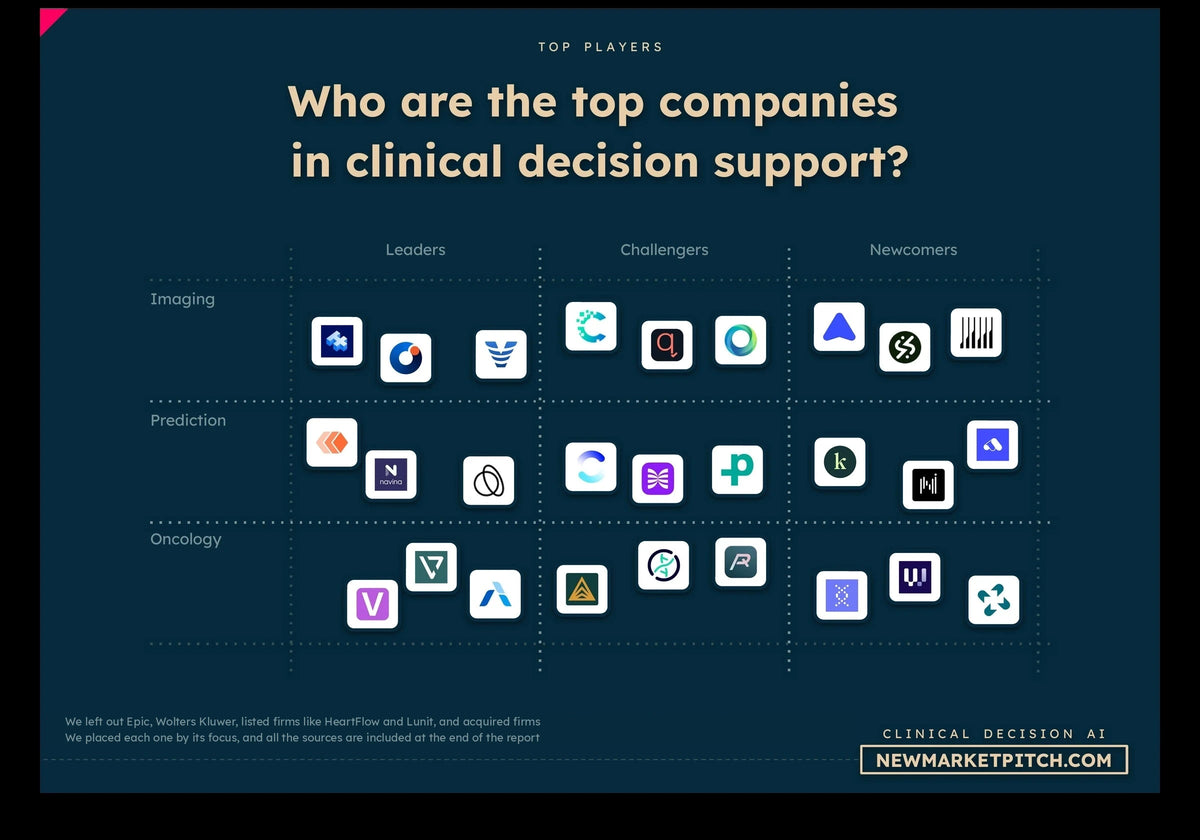
In our research about clinical decision support tools, we turn what is vague and complex into simple, useful visuals. Market maps like this one show you at a glance where every startup stands.
Is clinical decision support really a $3 billion funding market?
Clinical decision support companies attracted approximately $2.996 billion in recorded funding across 135 deals between January 1, 2024, and September 24, 2026. But most of that money went to a surprisingly small number of businesses.
We identified 118 funded companies, covering everything from medical imaging AI and clinical risk prediction to precision medicine and tools that help doctors find reliable medical evidence.
Just 15 rounds worth more than $50 million accounted for approximately $1.812 billion, or 60.5% of all recorded funding. Without those rounds, the market would have raised approximately $1.184 billion.
There is a broad market for financing the development and validation of clinical AI products, alongside a much smaller group of companies raising the kind of money needed to expand across major healthcare systems.
How much can a typical clinical decision support startup raise?
The typical clinical decision support financing is around $7.46 million, considerably less than the $22.36 million average reported across the market.
We calculated both figures from the 134 financing transactions with quantifiable amounts. The average is three times the median because a relatively small number of exceptionally large rounds pull it upward.
Looking at companies rather than transactions gives us a similar result. The median company raised $7.64 million during the period, compared with an average of $25.39 million.
There is also a clear difference between first financings and later rounds. Transactions classified as first financings had a median of $1.91 million, while follow-on transactions reached $11 million.
Consider three recent examples. Acurion raised $4.3 million in April 2026 to advance its OncoGaze precision oncology platform. In December 2025, a2z Radiology AI secured $4.5 million to expand its CT interpretation technology. French startup AI-Stroke raised $4.6 million in November 2025 to support clinical studies and its regulatory pathway.
These financings are much closer to the normal fundraising experience than the nine-figure rounds that dominate industry headlines.

Your time is limited. In our market report about clinical decision support tools, we put numbers on each part of the market, so you can see where it makes sense to focus.
How many clinical decision support startups are getting funded more than once?
Only 14 of the 118 clinical decision support companies we identified raised money more than once during the observation window.
The other 104 companies, representing 88.1% of the market, appeared in just one qualifying transaction.
That might sound like a weak repeat-fundraising rate, but the money tells a more interesting story. The 14 companies with multiple recorded rounds attracted approximately $1.531 billion, slightly more than the $1.465 billion received by businesses appearing once.
Much of that concentration comes from OpenEvidence and Aidoc, which completed five and two recorded financings respectively. Other companies, including Harrison.ai and Cleerly, attracted substantial capital through a single large transaction during the period.
We should also distinguish between a company receiving follow-on funding and one raising repeatedly within this specific window. Many businesses had already secured financing before January 2024, so a single recorded deal can still represent a mature company raising its Series C or Series D.
Which clinical decision support companies have raised the most money?
OpenEvidence is by far the largest recipient of clinical decision support funding, followed by Aidoc, with a considerable gap separating both companies from the rest of the market.
OpenEvidence raised $985 million across five transactions during the period. Aidoc followed with $260 million in recorded equity financing, while Harrison.ai and Cleerly raised $112 million and $106 million respectively.
There is considerable variety among these leaders. OpenEvidence provides AI-powered access to clinical research and medical evidence. Aidoc develops enterprise clinical AI applications across multiple medical specialties. Harrison.ai concentrates on diagnostic imaging and pathology, while Cleerly uses AI-powered coronary imaging to support cardiovascular assessment.
Further down the ranking, Qure.ai raised $65 million, Regard secured $61 million, Pearl raised $58 million for dental AI, and Navina attracted $55 million for its clinical intelligence platform.
These companies have different products and customers, but their large financings have something in common: the capital is generally being directed toward products with wider clinical deployment ambitions, rather than a single early-stage experiment.
| Company | Rounds | Capital raised |
|---|---|---|
| OpenEvidence | 5 | $985M |
| Aidoc | 2 | $260M |
| Harrison.ai | 1 | $112M |
| Cleerly | 1 | $106M |
| VieCure | 2 | $88M |
| Qure.ai | 1 | $65M |
| Regard | 1 | $61M |
| Pearl | 1 | $58M |
| Elucid | 1 | $55M |
| Navina | 1 | $55M |

In our document detailing everything you need to know about clinical decision support, we always try to gather several sources and make estimates that make sense, so you can work with solid numbers.
Is OpenEvidence taking over clinical decision support funding?
OpenEvidence has become the dominant fundraising story in clinical decision support, accounting for nearly one-third of all capital raised during our observation window.
Its financing history is particularly unusual. The company raised $75 million in February 2025, followed by $210 million in July and $200 million in October. Another $250 million arrived in January 2026, followed by a further $250 million financing reported in September.
The last transaction reportedly valued OpenEvidence at $15 billion. Reporting by Becker's Hospital Review in September 2026 confirmed that the company's CEO had acknowledged the raise and identified Andreessen Horowitz and Byers Capital as lead investors.
Why has OpenEvidence attracted so much money?
Its product addresses a much broader audience than many specialized clinical AI applications. Rather than focusing on one disease or medical imaging procedure, OpenEvidence allows physicians to search and interpret medical research, clinical guidelines and published evidence.
That gives investors a potential distribution opportunity across multiple specialties and healthcare settings. The company has also built relationships with major medical publishers, including the New England Journal of Medicine, and has reported strong physician adoption.
OpenEvidence represents approximately 92.7% of all funding in the evidence and guideline support category. Removing the company from the market would bring aggregate recorded funding down to approximately $2.011 billion.
Which clinical decision support categories are attracting the most investment today?
Diagnostic decision support is the biggest category by deal count and capital raised, while evidence and guideline support stands out for its unusually large financing amounts.
We counted 70 diagnostic decision support transactions involving 64 companies, for a total of approximately $1.246 billion. That includes businesses developing tools for radiology, cardiovascular diagnosis, pathology and other medical specialties.
Evidence and guideline support attracted $1.062 billion through just ten transactions involving six companies. Its median financing reached $54 million, almost ten times the $5.45 million median for diagnostic decision support.
As we saw with OpenEvidence, most of that difference comes from one company. It would be misleading to assume that clinical evidence startups generally raise much more than diagnostic AI businesses.
Risk prediction and alerts attracted $294.2 million, while precision medicine decision support received $281.9 million. Both categories have a meaningful number of funded companies, although their aggregate financing is much smaller.
At the other end, treatment recommendation, medication decision support and care pathway support received relatively little capital. Their smaller company populations also make it harder to draw conclusions about how these markets will develop.
| Category | Deals | Companies | Capital | Median round |
|---|---|---|---|---|
| Diagnostic Decision Support | 70 | 64 | $1,245.6M | $5.45M |
| Evidence & Guideline Support | 10 | 6 | $1,062.0M | $54.00M |
| Risk Prediction & Alerts | 20 | 17 | $294.2M | $8.00M |
| Precision Medicine Decision Support | 19 | 15 | $281.9M | $11.00M |
| Treatment Recommendation | 8 | 8 | $50.9M | $3.09M |
| Medication Decision Support | 5 | 5 | $38.7M | $3.00M |
| Care Pathway Support | 3 | 3 | $22.7M | $7.62M |

Our report covering the clinical decision support market gets updated several times a month, so you always get the latest view of where things stand.
Why are investors putting so much money into diagnostic AI?
Diagnostic AI attracts large funding rounds because established companies increasingly need to support entire clinical workflows, making development, validation and hospital deployment expensive.
Aidoc gives us a good example. In July 2025, the company announced a $150 million financing package, including $110 million of equity and a $40 million credit facility. Less than a year later, in April 2026, it announced another $150 million Series E led by Goldman Sachs Alternatives.
According to Goldman Sachs' announcement, the later financing was intended to expand Aidoc's clinical foundation model and enterprise AI platform.
Other companies reveal different parts of the same problem. Harrison.ai raised $112 million in February 2025 to expand its medical imaging and pathology solutions internationally, particularly in the United States. Cleerly's $106 million Series C extension in December 2024 was directed toward commercial growth and further clinical evidence generation for its cardiovascular imaging technology.
Qure.ai provides another useful comparison. Its $65 million Series D in September 2024 was intended to support international expansion, foundational AI development and potential acquisitions of complementary medical technology businesses.
A clinical AI business may need to validate performance across hospitals, obtain medical-device clearances, integrate with existing systems and support customers using its software in real clinical settings. These requirements help explain why advanced diagnostic companies can need substantially more capital than those still testing an initial product.
Are precision medicine startups getting funded earlier than other clinical AI companies?
Precision medicine decision support companies are attracting investment at a noticeably younger age than most other clinical AI businesses.
Their median age at financing is just 2.5 years, compared with six years for diagnostic decision support and seven years for risk prediction and alerts.
Despite being younger, precision medicine businesses recorded a median financing of $11 million, exceeding the median round in both of those categories.
Acurion illustrates the kind of product attracting early funding. Founded in 2021, the company raised $4.3 million in April 2026 to advance OncoGaze, which uses pathology images to predict actionable cancer biomarkers.
Its announcement specifically identified further clinical validation, regulatory preparation and commercialization among the uses of the funding.
Meanwhile, older risk prediction companies tend to operate in more established clinical environments, where the work involves identifying patient risks, triggering alerts or supporting clinical monitoring.
We cannot conclude from these figures that precision medicine businesses develop products faster. Founding dates, academic spin-offs and company classifications can all influence apparent age. But investors have been willing to back relatively young precision medicine businesses with meaningful financing amounts.

In our research about clinical decision support tools, we look at what the winners do differently, so you can learn from the best instead of guessing.
Why are treatment recommendation and medication AI startups raising so little?
Treatment recommendation and medication decision support have attracted surprisingly little dedicated venture funding compared with diagnostic applications.
Together with care pathway support, these categories account for just 16 of the 135 transactions and $112.3 million of recorded capital.
Treatment recommendation generated eight deals totaling $50.9 million, with a median round of approximately $3.09 million. Medication decision support had five transactions worth $38.7 million, while care pathway support recorded three financings totaling $22.7 million.
The medication category is particularly dependent on one company: its largest $30 million transaction accounts for more than three-quarters of the category's capital.
There is a plausible commercial explanation for the relatively limited number of standalone financings. Treatment recommendations, medication optimization and care pathway management can be embedded within larger healthcare software platforms, electronic health records or specialized disease-management systems. As a result, venture funding for these functions may appear under other company categories.
We haven't found enough independent financing activity to call these categories established standalone funding markets.
Are clinical decision support startups mostly stuck between Seed and Series C?
Clinical decision support has plenty of Seed funding, but the financing ladder narrows sharply before Series C, where only ten transactions were recorded.
Among 107 transactions with a classified stage, 46 were Seed rounds and 23 were Series A. These 69 early-stage financings represented 64.5% of classified deals.
Their combined capital, however, was approximately $549.8 million. The 38 classified Series B and later-stage transactions, including growth equity, attracted approximately $2.224 billion.
Round sizes rise sharply as companies mature. The median Seed financing was $2.14 million, increasing to $12.7 million at Series A and $20.2 million at Series B.
By Series C, the median reached $42.5 million. At Series D+, it was $87.5 million.
The first big contraction appears between Seed and Series A, where deal count halves. There is another noticeable decline between Series B, with 18 transactions, and Series C, with ten.
One reason the transition can be difficult is that clinical AI products often face a longer path from technical development to routine medical use than ordinary enterprise software.
A model can perform well in controlled testing without immediately becoming something hospitals are ready to purchase and deploy. Companies may need additional clinical evidence, regulatory clearance, compatibility with hospital systems and proof that doctors will actually use the product.
The FDA's updated clinical decision support guidance, reissued in January 2026, illustrates one of these challenges. Certain software functions can fall outside medical-device regulation, but others remain regulated, including functions that analyze medical images or particular medical signals.
We can see similar practical priorities in funding announcements. Cleerly raised money for clinical evidence generation and commercial expansion, while Acurion identified validation and regulatory preparation as important next steps.
These examples help explain why moving up the financing ladder can be difficult, although they don't prove why any particular company failed to raise a Series C. The Seed and Series C transactions also involve different company populations, so comparing their counts does not establish startup survival rates.
Twenty-eight transactions could not be assigned a reliable stage. We have kept them separate rather than forcing them into the financing ladder based on their size.
| Stage | Deals | Capital | Median round |
|---|---|---|---|
| Seed | 46 | $156.8M | $2.14M |
| Series A | 23 | $393.0M | $12.70M |
| Series B | 18 | $636.4M | $20.20M |
| Series C | 10 | $619.5M | $42.50M |
| Series D+ | 6 | $643.4M | $87.50M |
| Growth Equity | 4 | $324.3M | $31.35M |
| Unknown | 28 | $222.6M | $4.58M |

In our market report about clinical decision support tools, we don't want to repeat what boring consulting reports say. Instead, we show you the real and latest market signals that matter.
How old are clinical decision support startups when they raise big rounds?
Clinical decision support companies raising more than $50 million are typically around seven years old, suggesting that serious expansion financing often comes after several years of development.
Across the full dataset, the median age at financing is five years. Companies receiving rounds below $5 million have a median age of four years, while those raising above $50 million have a median age of seven.
The age difference becomes clearer at successive funding stages. Seed-funded companies have a median age of three years, compared with six years at Series A, seven at Series B and eight at Series C.
Even the market's founding-year distribution reflects this pattern. The largest funded founding cohort dates back to 2018, several years before the financing window began.
For example, Qure.ai was founded in 2016 and completed its $65 million Series D in 2024. Aidoc was also founded in 2016 and raised its two large recorded financings in 2025 and 2026.
Their histories help explain why large clinical AI rounds often go to businesses that have already spent years building products, securing clearances and expanding into healthcare organizations.
This doesn't mean every clinical AI company needs seven years to attract serious funding. OpenEvidence demonstrates that some platforms can raise extremely large amounts much sooner.
But for investors and founders assessing the broader market, a multi-year development cycle is a more realistic benchmark than the exceptionally rapid financing history of its most prominent company.
Is clinical decision support funding growing steadily, or coming in occasional huge rounds?
Clinical decision support funding has been uneven, with occasional enormous transactions creating spikes in capital even when the number of deals remains fairly ordinary.
Across the 32 completed calendar months from January 2024 through August 2026, we counted an average of 4.09 deals per month.
The median completed month recorded approximately $43.24 million of funding. The largest month, July 2025, reached $388.4 million, almost nine times that amount.
That month included a $210 million financing, representing more than half of the capital raised.
October 2025 provides an even more striking case. A single $200 million transaction accounted for almost all the $210.6 million raised during the month.
January 2026 also recorded a major concentration, with one $250 million round inside a total of $352.2 million.
Interestingly, the busiest month by number of transactions was November 2025, with nine deals, rather than one of those exceptionally large funding months.
The monthly figures show fairly regular smaller-round activity, interrupted by huge financings to a few companies. Those capital spikes tell us little about whether fundraising became easier for the typical startup.

Learning from others' mistakes is the cheapest lesson there is. In our document detailing everything you need to know about clinical decision support, we look at what broke startups before you, so you don't repeat it.
Is Europe actually ahead of the US in clinical decision support startups?
Europe has more funded clinical decision support companies than North America, but North America receives almost four times as much capital.
We identified 60 funded European companies across 65 transactions. North America had 41 companies and 51 deals.
Despite that smaller number, North American companies attracted $2.129 billion, or 71.1% of the market's recorded funding. Europe received $538.6 million.
The difference also appears in typical financing amounts. The median North American round was $13 million, compared with $4.29 million in Europe.
The United States accounted for 48 deals and approximately $2.107 billion. Within Europe, the United Kingdom recorded 20 deals worth $171.6 million, while France attracted $189.3 million across 13 deals.
OpenEvidence contributes substantially to this gap. Removing its $985 million would reduce North American funding by almost half, although North America would remain the largest region by capital.
Asia-Pacific has a similar concentration issue on a smaller scale. Its $303.7 million of funding includes Harrison.ai's $112 million financing, which accounts for 36.9% of the regional total.
| Region | Deals | Companies | Capital raised | Median round |
|---|---|---|---|---|
| North America | 51 | 41 | $2,128.7M | $13.00M |
| Europe | 65 | 60 | $538.6M | $4.29M |
| Asia-Pacific | 14 | 12 | $303.7M | $12.55M |
| Middle East | 5 | 5 | $24.8M | $3.00M |
Which investors are backing clinical decision support startups again and again?
Clinical decision support has a fairly fragmented investor base, with only fourteen named lead investors appearing in more than one financing transaction.
We identified 141 distinct named lead or co-lead investors. Khosla Ventures, Parkwalk Advisors and LUMO Labs were the most frequent, each appearing in three transactions.
Their financing activity is quite different. Khosla Ventures has backed diagnostic and risk prediction businesses, while Parkwalk has participated in diagnostic and care pathway companies. LUMO Labs appears repeatedly in smaller financings.
By contrast, some of the largest investors show up less frequently but are associated with much bigger rounds.
GV appears in two transactions with combined round sizes of $410 million. Andreessen Horowitz is associated with two rounds totaling $272 million, while Goldman Sachs Alternatives' growth equity business appears in two worth $205 million.
These totals describe the entire rounds led or co-led by the investors, rather than the amounts they personally contributed.
Some firms repeatedly finance emerging clinical technologies with modest checks. Others appear mainly when an established company is raising tens or hundreds of millions of dollars.

If you build or invest in the clinical decision support market, you need to know which business models pay off now and which ones are fading. That's why our report covering it has a whole section on it.
Are hospitals and big healthcare companies investing in clinical AI themselves?
Hospitals, healthcare companies and other strategic investors already participate in clinical AI financing, especially when a company is raising larger amounts.
We identified named strategic participation in 30 deals, representing 22.2% of all recorded transactions.
Those financings had a median size of $16.1 million, compared with $5 million for rounds without named strategic investors.
Aidoc's July 2025 financing is a particularly clear example. Alongside General Catalyst and Square Peg, investors included NVentures and four US healthcare systems: Hartford HealthCare, Mercy, Sutter Health and WellSpan Health.
The involvement of hospital operators is commercially relevant. Healthcare systems can potentially support deployment, provide clinical feedback and help companies understand the practical requirements of integrating software into care delivery.
Other strategic investors bring different advantages. Qure.ai's September 2024 Series D included Merck Global Health Innovation Fund, while Elucid's September 2026 $55 million Series D announcement highlighted participation from a major medical technology company, described as its fourth publicly traded strategic investor.
According to Elucid, that capital will support commercial expansion, product development and further clinical studies.
Strategic participation appears most often in diagnostic decision support, where we recorded 17 deals involving named strategic investors.
There is a limitation worth keeping in mind: the database tracks disclosed equity participation, so commercial partnerships without investment are not necessarily captured.
And although strategic-backed rounds are typically larger, we cannot conclude that strategic investors cause companies to raise more. Established businesses may simply be more attractive to both strategic and financial backers.
Still, the role of healthcare organizations in funding is already meaningful, particularly for businesses developing products that need to be deployed within complex clinical environments.
What's the biggest problem with clinical decision support funding right now?
The biggest weakness in clinical decision support funding is the small number of companies reaching substantial, repeated expansion financing.
The sector has no apparent shortage of initial investment activity. We identified 31 financings labelled as first rounds, 46 classified Seed transactions and a wide range of funded businesses across diagnostics, risk prediction and precision medicine.
The difficulty becomes more visible higher up the financing ladder.
Only eleven companies raised more than $50 million cumulatively during the period. Very few completed multiple qualifying transactions, and late-stage financings were considerably less common than Seed rounds.
Several categories also have limited independent financing activity. Medication decision support and care pathway support, for example, have only five and three recorded transactions respectively.
In practical terms, we have evidence that investors are willing to finance many new clinical AI products. There is much less evidence of a broad population of businesses repeatedly raising the large amounts associated with national or international commercial expansion.
That doesn't establish how many companies are profitable, have been acquired or can operate successfully without further fundraising.
What the data does show is a funding market where major financial resources are concentrated among a small group of companies that investors are willing to support at scale.

In our research about clinical decision support tools, we like to show you the big picture. We know your time is precious, so we make every page quick to read and packed with as much learning as possible per minute.
What should we actually take away from the funding data?
Clinical decision support is a sizeable funding market, but access to large amounts of capital remains limited to a relatively small group of companies. After reviewing the financings, several conclusions stand out.
The typical company raises much less than the headline figures suggest. Smaller rounds dominate transaction volume, while a few nine-figure financings account for a substantial part of total funding. For most founders, single-digit-million-dollar rounds are a more useful reference point than the market average.
Diagnostic decision support has the broadest investor backing. Its funding covers dozens of independent businesses developing medical imaging and diagnostic applications. Evidence and guideline support has attracted extraordinary capital, but that category's funding depends overwhelmingly on OpenEvidence.
Large investments usually go to companies with established financing histories. The median age of businesses raising more than $50 million is seven years, and follow-on rounds absorb the overwhelming majority of capital. Clinical AI investors appear comfortable financing long development cycles when companies demonstrate enough progress to justify further investment.
Europe supports more funded companies, while North America attracts much bigger checks. The difference is reinforced by the presence of several exceptionally well-funded American businesses.
Strategic investors are already part of the market. Hospitals, healthcare groups, technology suppliers and medical technology companies participate in a meaningful share of financings, particularly at more advanced stages.
The upper financing ladder remains narrow. Early-stage capital reaches a substantial number of companies, but relatively few recorded transactions involve the large amounts associated with commercial-scale expansion.
Overall, clinical decision support has a wide range of emerging businesses developing specialized tools, and a much smaller group of companies building platforms intended for broad clinical deployment.
For now, that smaller group commands most of the money.
Sources and methodology
This analysis examines private-company fundraising in the clinical decision support market between January 1, 2024, and September 24, 2026, inclusive. We reviewed 135 qualifying financing transactions involving 118 distinct companies, representing approximately $2.996 billion in recorded capital. All figures refer to this single observation window, not lifetime funding or separate annual cohorts.
Our market definition covers businesses whose core products directly support clinical decisions, including diagnostic assessment, medical imaging, clinical evidence retrieval, risk prediction, precision medicine, treatment recommendations, medication decisions and care pathways. We reviewed companies individually to distinguish clinical decision support products from broader healthcare AI and administrative software.
We counted distinct financing transactions and examined extensions, additional closes and cumulative disclosures to avoid double counting. Where identifiable, debt and credit facilities were excluded from the recorded equity amount. For example, Aidoc's July 2025 $150 million financing package included a $40 million credit facility, leaving $110 million of recorded equity. Some transactions, including Mediwhale's Series A2, contained components that could not be separated precisely.
Of the 135 transactions, 134 had quantifiable amounts and one was undisclosed. Some figures involve approximate currency conversions or reported minimum amounts, so the $2.996 billion total represents recorded financing capital rather than an audited measure of newly issued equity. The category and financing-stage totals each sum to approximately $2.996 billion, while regional totals sum to $2.9958 billion because of rounding.
Category and region were available for all transactions. We identified financing stages for 107 deals, named lead investors for 108, and usable founding years for 133. Unclassified stages were kept separate. We also distinguished first financings from follow-on transactions and companies raising more than once during the study period. The stage counts describe observed financing activity and should not be interpreted as startup survival or progression rates.
Our research prioritized original company and investor announcements, regulatory publications and established industry reporting. We reviewed disclosed financing amounts, dates, stages, investors, business activities and intended uses of funds, and checked the largest transactions for duplicate disclosures, unusual financing structures and concentration effects.
Key sources for the largest financings include OpenEvidence's February 2025 announcement, Becker's Hospital Review on its September 2026 financing, Aidoc's July 2025 financing disclosure, Goldman Sachs on Aidoc's April 2026 Series E, Harrison.ai's Series C announcement, and Cleerly's $106 million financing announcement.
Other company-specific sources include Qure.ai's Series D disclosure, Regard's $61 million announcement, Pearl's Series B announcement, Elucid's Series D disclosure, Navina's Series C announcement, Acurion's Seed financing, a2z Radiology AI's Seed announcement, and AI-Stroke's company press disclosures.
For the regulatory context, we consulted the US Food and Drug Administration's Clinical Decision Support Software guidance, its clinical decision support FAQs, the Digital Health Policy Navigator, and the March 2026 regulatory town hall. Aggregate funding figures, medians, category allocations, regional comparisons and investor-frequency statistics come from our deal-level analysis.

When you build or invest in the clinical decision support market, you need clarity, not confusion. In our market report about clinical decision support tools, we always try to put numbers on and quantify whatever is usually vague and confusing.
Written by the New Market Pitch teamWe track new markets so founders and investors can move faster. About us